Theoretical Approaches to First Language Acquisition
Investigatingthe processesthroughwhichindividualsacquire language isLanguage acquisition.Ingeneral,acquisitionof
language pointstonative languageacquisition,whichexamineschildren’sacquisitionof theirfirstlanguage,whilesecond
language acquisitionconcernsacquisitionof extralanguagesinchildrenandadultsaswell.Thehistoryof languagelearning
theoriescanbe consideredasa greatpendulumcycledfromSkinnerianenvironmentalismtoPiagetianconstructivismto
Chomskianinnatism.Consequently,muchof research inthis fieldhasbeenrevolvedaroundthe debatesaboutwhether
cognitive processandstructure are constrainedbyinnatelypredeterminedmechanismorshapedbyenvironmentalinput.
LinguistsNoamChomskyandEricLenneberg,forhalf acenturyhave arguedforthe hypothesisthatchildrenhave inborn,
language-specific capabilities that make possible and restrict language learning. Others, like Catherine Snow, Elizabeth
Batesand BrianMacWhinneyhave hypothesizedthatlanguage acquisitionisthe productof commoncognitivecapacities
and the interface between children and their surrounding communities.
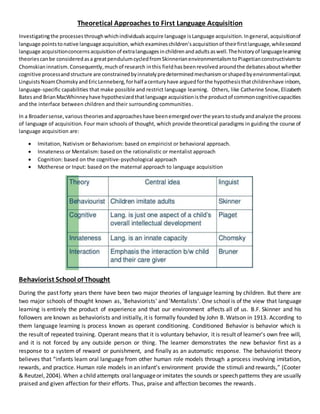
In a Broadersense,various theoriesandapproacheshave beenemergedoverthe yearstostudyandanalyze the process
of language of acquisition. Four main schools of thought, which provide theoretical paradigms in guiding the course of
language acquisition are:
 Imitation, Nativism or Behaviorism: based on empiricist or behavioral approach.
 Innateness or Mentalism: based on the rationalistic or mentalist approach
 Cognition: based on the cognitive-psychological approach
 Motherese or Input: based on the maternal approach to language acquisition
Behaviorist School of Thought
During the past forty years there have been two major theories of language learning by children. But there are
two major schools of thought known as, 'Behaviorists' and 'Mentalists'. One school is of the view that language
learning is entirely the product of experience and that our environment affects all of us. B.F. Skinner and his
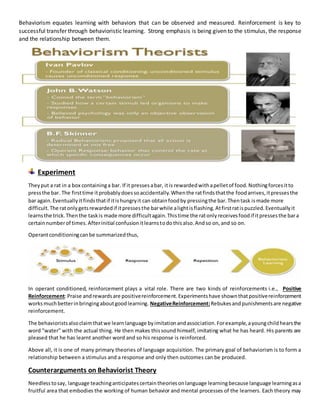
followers are known as behaviorists and initially, it is formally founded by John B. Watson in 1913. According to
them language learning is process known as operant conditioning. Conditioned Behavior is behavior which is
the result of repeated training. Operant means that it is voluntary behavior, it is result of learner's own free will,
and it is not forced by any outside person or thing. The learner demonstrates the new behavior first as a
response to a system of reward or punishment, and finally as an automatic response. The behaviorist theory
believes that “infants learn oral language from other human role models through a process involving imitation,
rewards, and practice. Human role models in an infant’s environment provide the stimuli and rewards,” (Cooter
& Reutzel, 2004). When achild attempts oral languageor imitates the sounds or speech patterns they are usually
praised and given affection for their efforts. Thus, praise and affection becomes the rewards.
Behaviorism equates learning with behaviors that can be observed and measured. Reinforcement is key to
successful transfer through behavioristic learning. Strong emphasis is being given to the stimulus, the response
and the relationship between them.
Experiment
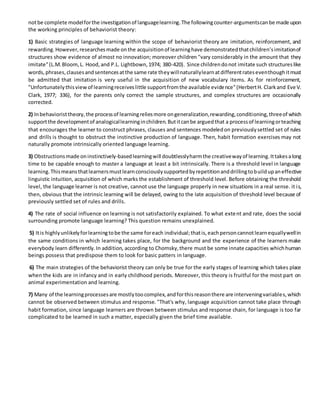
Theyput a rat in a box containinga bar. If it pressesabar, itis rewardedwithapelletof food.Nothingforcesitto
pressthe bar. The firsttime it probablydoessoaccidentally.Whenthe ratfindsthatthe foodarrives,itpressesthe
bar again.Eventuallyitfindsthatif itishungryit can obtainfoodby pressingthe bar.Thentask ismade more
difficult.The ratonlygetsrewardedif itpressesthe barwhile alightisflashing.Atfirstratispuzzled.Eventuallyit
learnsthe trick.Thenthe taskis made more difficultagain.Thistime the ratonlyreceivesfoodif itpressesthe bara
certainnumberof times.Afterinitial confusionitlearnstodothisalso.Andso on,and so on.
Operantconditioningcanbe summarizedthus,
In operant conditioned, reinforcement plays a vital role. There are two kinds of reinforcements i.e., Positive
Reinforcement:Praise andrewardsare positivereinforcement.Experimentshave shownthatpositivereinforcement
worksmuchbetterinbringingaboutgoodlearning. NegativeReinforcement:Rebukesandpunishmentsare negative
reinforcement.
The behavioristsalsoclaimthatwe learnlanguage byimitationandassociation.Forexample,ayoungchildhearsthe
word "water" with the actual thing. He then makes thissound himself, imitating what he has heard. His parents are
pleased that he has learnt another word and so his response is reinforced.
Above all, it is one of many primary theories of language acquisition. The primary goal of behaviorism is to form a
relationship between a stimulus and a response and only then outcomes can be produced.
Counterarguments on Behaviorist Theory
Needlesstosay, language teachinganticipatescertaintheoriesonlanguage learningbecause language learningasa
fruitful area that embodies the working of human behavior and mental processes of the learners. Each theory may
notbe complete modelforthe investigationof languagelearning.The followingcounter-argumentscanbe made upon
the working principles of behaviorist theory:
1) Basic strategies of language learning within the scope of behaviorist theory are imitation, reinforcement, and
rewarding.However,researchesmade onthe acquisitionof learninghave demonstratedthatchildren’simitationof
structures show evidence of almost no innovation; moreover children "vary considerably in the amount that they
imitate"(L.M.Bloom,L. Hood,and P.L. Lightbown,1974; 380-420). Since childrendonot imitate such structureslike
words,phrases,clausesandsentencesatthe same rate theywillnaturallylearnatdifferentrateseventhoughitmust
be admitted that imitation is very useful in the acquisition of new vocabulary items. As for reinforcement,
"Unfortunatelythisviewof learningreceiveslittle supportfromthe available evidence"(HerbertH. Clarkand Eve V.
Clark, 1977; 336), for the parents only correct the sample structures, and complex structures are occasionally
corrected.
2) Inbehavioristtheory,the processof learningreliesmore ongeneralization,rewarding,conditioning,threeof which
supportthe developmentof analogicallearninginchildren.Butitcanbe arguedthat a processof learningorteaching
that encourages the learner to construct phrases, clauses and sentences modeledon previouslysettled set of rules
and drills is thought to obstruct the instinctive production of language. Then, habit formation exercises may not
naturally promote intrinsically oriented language learning.
3) Obstructionsmade oninstinctively-basedlearningwill doubtlesslyharmthe creativewayof learning.Ittakesalong
time to be capable enough to master a language at least a bit intrinsically. There is a threshold level in language
learning.Thismeansthatlearnersmustlearnconsciouslysupportedbyrepetitionanddrillingtobuildupaneffective
linguistic intuition, acquisition of which marks the establishment of threshold level. Before obtaining the threshold
level, the language learner is not creative, cannot use the language properly in new situations in a real sense. it is,
then, obvious that the intrinsic learning will be delayed, owing to the Iate acquisition of threshold level because of
previously settled set of rules and drills.
4) The rate of social influence on learning is not satisfactorily explained. To what extent and rate, does the social
surrounding promote language learning? This question remains unexplained.
5) Itis highlyunlikelyforlearningtobe the same foreach individual;thatis,eachpersoncannotlearnequallywellin
the same conditions in which learning takes place, for the background and the experience of the learners make
everybody learn differently.In addition, according to Chomsky,there must be some innate capacities whichhuman
beings possess that predispose them to look for basic patters in language.
6) The main strategies of the behaviorist theory can only be true for the early stages of learning which takes place
when the kids are in infancy and in early childhood periods. Moreover, this theory is fruitful for the most part on
animal experimentation and learning.
7) Many of the learningprocessesare mostlytoocomplex,andforthisreasonthere are interveningvariables,which
cannot be observed between stimulus and response. "That's why, language acquisition cannot take place through
habit formation, since language learners are thrown between stimulus and response chain, for language is too far
complicated to be learned in such a matter, especially given the brief time available.
The Mentalist School of Thought
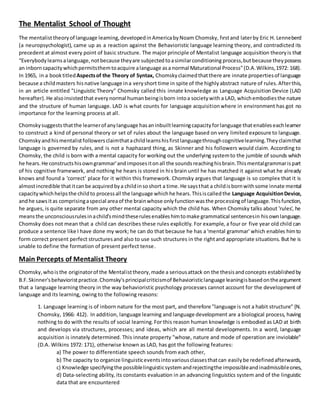
The mentalisttheoryof language leaming,deveIopedinAmericabyNoam Chomsky, fırstand laterby Eric H. Lenneberd
(a neuropsychologist), came up as a reaction against the Behavioristic language learning theory, and contradicted its
precedent at almost every point of basic structure. The major principle of Mentalist language acquisition theoryis that
“Everybodylearnsalanguage,notbecause theyare subjected toasimilarconditioning process,butbecause theypossess
an inborn capacitywhichpermitsthemtoacquire alanguage asa normal Maturational Process"(D.A.Wilkins,1972: 168).
In 1965, in a book titledAspectsof the Theory of Syntax, Chomskyclaimedthatthere are innate propertiesof language
because a childmasters hisnative language ina veryshort time in spite of the highlyabstract nature of rules.Afterthis,
in an article entitled "Linguistic Theory" Chomsky called this innate knowledge as Language Acquisition Device (LAD
hereafter).He alsoinsistedthat everynormal humanbeingisborn intoa societywith a LAD, whichembodiesthe nature
and the structure of human language. LAD is what counts for language acquisitionwhere in environment has got no
importance for the learning process at all.
Chomskysuggests thatthe learnerof anylanguage hasaninbuiltlearningcapacityforlanguage thatenableseachlearner
to construct a kind of personal theory or set of rules about the language based on very limited exposure to language.
Chomskyandhismentalistfollowersclaimthatachildlearnshisfirstlanguagethroughcognitivelearning.Theyclaimthat
language is governed by rules, and is not a haphazard thing, as Skinner and his followers would claim. According to
Chomsky, the child is born with a mental capacity for working out the underlying systemto the jumble of sounds which
he hears.He constructshisowngrammar'andimposesitonall the soundsreachinghisbrain.Thismentalgrammarispart
of his cognitive framework, and nothing he hears is stored in his brain until he has matched it against what he already
knows and found a 'correct' place for it within this framework. Chomsky argues that language is so complex that it is
almostincredible thatitcanbe acquiredbya childinsoshort a time.He saysthat a childisbornwithsome innate mental
capacitywhichhelpsthe childto processall the language whichhe hears.Thisiscalledthe Language AcquisitionDevice,
andhe sawsitas comprisingaspecial areaof the brainwhose onlyfunctionwasthe processingof language.Thisfunction,
he argues, is quite separate from any other mental capacity which the child has. When Chomsky talks about 'rules', he
meansthe unconsciousrulesinachild'smindtheserulesenableshimtomake grammatical sentencesin hisownlanguage.
Chomsky does not mean that a child can describes these rules explicitly. For example, a four or five year old child can
produce a sentence like I have done my work; he can do that because he has a 'mental grammar' which enables himto
form correct present perfect structuresand also to use such structures in the rightand appropriate situations. But he is
unable to define the formation of present perfect tense.
Main Percepts of Mentalist Theory
Chomsky,whoisthe originatorof the Mentalisttheory,made a seriousattack on the thesisandconcepts establishedby
B.F.Skinner'sbehavioristpractice.Chomsky'sprincipalcriticismof Behavioristiclanguage leaningisbasedontheargument
that a language learning theory in the way behavioristic psychology processes cannot account for the development of
language and its learning, owing to the following reasons:
1. Language learning is of inborn nature for the most part, and therefore "language is not a habit structure" (N.
Chomsky, 1966: 412). In addition, language learning and language development are a biological process, having
nothing to do with the results of social learning.For this reason human knowledge is embodied as LAD at birth
and develops via structures, processes; and ideas, which are all mental developments. In a word, language
acquisition is innately determined. This innate property "whose, nature and mode of operation are inviolable"
(D.A. Wilkins 1972: 171), otherwise known as LAD, has got the following features:
a) The power to differentiate speech sounds from each other,
b) The capacity to organize linguisticeventsintovariousclassesthatcan easilybe redefinedafterwards,
c) Knowledge specifyingthe possiblelinguisticsystemandrejectingthe impossibleandinadmissibleones,
d) Data-selecting ability, its constants evaluation in an advancing linguistics system and of the linguistic
data that are encountered
2. The Linguisticsbehaviorisnot composedof responsestostimuli that is,of S ---> R relationship;anditis not a
matter of habit-formation and generalization. "S --->R theory is so limited, the problem of language acquisition
simplyfallsbeyonditsdomain"(D.McNeil,1966: 412). The stimuli-responseistherefore nonsense,forakid uses
hid cognitive capacity to discover the structure of the language spoken around himself. Moreover, Behaviourist
theorymostlyanalyzedanimal behaviorinlabs,buthumanbehaviorismuchmore complexthananimalbehavior.
Language behavior is so unique to humans that it can never be explained by means of animal behavior.
3. AccordingtoChomsky,LADispeculiaronlytohumanbeingswhouse language,where asotheranimalsdonot.
Since all humanbeingslearntheirlanguagesuccessfullytheyhave topossesssame internal capacityforlanguage
learningthatotheranimalsdonotown;then,thiscapacitycannothave beenacquiredsocially,therefore,itmust
be innate.Thus,social factorshave virtuallynofunctionatall inlearninglanguages.Itisthe inborncapacitywhich
is responsible for the language acquisition process.
4. Analogizingand generalizations made by children are, in fact, production and application of rules, because
"ordinarylinguisticbehaviorcharacteristicallyinvolvesinnovation.Formationof new sentencesandnewpatterns
in accordance with rules of great abstractness and intricacy... therefore there are no known principles of
association or reinforcement, and no known sense of generalization that can begin to account for this
characteristic "creatıve" aspect of normal behavior" (N. Chomsky, 1966: 48).
5. Children quite often parrot the words and structures of their parents, but in many cases children's language
indicate systematicdepartures fromthe language usedbytheiradults:then,such systematicdeviationsrefuteto
deductionsof a theorywhich relegatesthe learningof a language to imitative behavior.The fact here isthat the
kidsdonot alwaysimitate whattheyhear.Forexample,intermsof overgeneralization,irregularpasttense verbs
are infrequent in parents" speech, and kids do not often imitate such verbs but produce systematic forms like
*comed,"'goed,"'doed,"'speaked,and"'becomed.Andthisveryfactindicatesthatthe kidsinamajorityof cases
go on their own ways in speaking. Parental frequency, approval or disapproval are very limited in terms of
grammaticality because parents mostlyinsist on truth values of the utterances. Then,parental approval cannot
be considered as reinforcement for ungrammaticality.
6. In brief, the gist and the summary list of the mentalist theory can be stated as follows: "Hypothesis testing
insteadof discriminationlearning,evaluationof hypothesisinsteadof reinforcementof responses,rulesinstead
of habits, productivityinsteadof generalization,innateanduniversalhumancapacitiesinsteadof special methods
of vocal responses" (Esper Erwin, 1968: 227).
Thus,in accordance withthistypeof reasoningof Mentalism, itisclearthatthe majorperceptsof behaviorismtolanguage
are entirely inefficient for a satisfactory description of language as verbal behavior.
Counterarguments of Mentalist Theory
To some extent, the mentalist theory seems complementary to behaviorist theory, whose major principles are further
clarifiedandthendevelopedbymentalisttheorists.The followingreasonsrepresentthe factthatsome of the preceptsof
Mentalist theory should be refined.
1. Language acquisitionisnottotallyof inbornnature norisitjustamatterof biological make-up.Thereisalsoan
undeniableeffectinlanguage learningcomingfromthe social environmentsince infantsgrow upbiologicallyina
social environmentfromwhichtheycannot be divorced.The presence of a motherand father in frontof a child
establishesanatural social environment.Noonecanlearntospeakif thereisnoone around:then,inthisrespect,
innate language learningwill benothingbutafiasco.Itislogical tothinkthateveryhumanbeinghasgotabiosocial
nature.Though"balance betweenenvironmental influencesandbiological growthwasstillnotclear"(H.H.Stern,
1983: 302)
2. At eachlearninglevel,‘the kid'sformingupan hypothesisandtryingitin hislinguisticformations,recognizing
that his hypothesisfallsshort,thenhe makesnecessarymodifications,all of these indicate thathe still learns by
doing: a method like trial and error; thus, acquisition is also a learn-by-doing activity to an extent. Therefore,
language learning is basically a mentally-oriented-verbal behavior.
3. AccordingtoWhorfianhypothesis,andlatedSapir-Whorfhypothesis,languageexertsanundeniablyformative,
limited effect on perception and cognition of language,especially in learning one's mother tongue. In addition,
the individual's'worldviewandhiscognitive systemare naturallycontrolledandshapedbythe verbal systemsof
all kinds given restrictively to him by society into which he is born into in the process of acquisition of native
language. Then it is very difficult to buy the idea that "the social factors have virtuallyno role at all" in learning
languages (D.A. Wilkins, 1972: 171-172).
4. The use and influence of imitationsandreinforcementscannottotallybe deniedordisregarded bysayingthat
they destroy or relegate the possible creativity in language learning. But before making a creative performance,
that performance hasto be establishedasanacquiredskill whose formationcanonlybe managedby imitations,
repetitions, and reinforcements of certain doses, after a reasonable amount of which the "threshold level"
(Mehmet Demirezen, 1988: 138-139) of learning will naturally be established in the language learning process.
How will youmake the unknownornewlylearned,say,vocabularyitemsmastered completely?Asitisclear,the
role of imitations and repetitions cannot be wholly denied in such areas like learning vocabulary items and
structural patterns. Then, to favor a considerable dose of imitations, repetitions, and reinforcement will be
reasonable,providedthat they shouldbe stopped atthe junctionwhere theyharm the creative use of language.
5. Analogizing and generalizations are not entirely the application of rules and transformations, but are
productions andreinforcements andcan onlybe sophisticatedbyrepetitions.Itistrue to say that inanalogizing
or makinggeneralizationschildrencommitmistakes,i.e.,theyutterthe pasttense of suchirregularverbslike go,
do, and make as goed, doed and maked, which by themselves are applications. As it is apparent, not each
application of rules create correct grammatical forms. It is reasonable to think that application of rules, for the
most part, generates correct verbal items not the incorrect ones, though it does both.
6. It is not true to say that behaviorism is "at least quite incapable of explaining our ability to learn and use our
mothertongue"(NoamChomsky,1959: 26-58). On the contrary, Behaviorismisa clearcut explanationof Sapir-
Whorf hypothesis,whichinsiststhatone'snativetonguelimitsandrestrictshisviewof the world.Moreover,there
have always been negative interferences and transfers from the mother tongue in foreign language teaching
process, both in competence and performance levels. The motto of behaviorism is that language is a verbal
behavior,learn-by-doingactivityinlearningalanguage.Kidswill naturallycommitmistakeswhilenotonlylearning
their mother tongue but also a foreign language. Thus, this claim of Chomsky is really questionable.
İt is an obvious fact that behaviorism has influencedand dominated foreignlanguage teaching for several decades. Yet,
Behavioristattitude towardsthe meaninginlanguage,uncreativity,andmuchindulgence onstimuli-responseweretaken
up as seriouscausesof attack. As for. Mentalism, itseemstoo much theoretical.Inmentalisttype of learning,all that is
neededisthe adequate exposure tothe target language whichwill give ideasto the kid to form hypothesisonlinguistic
utterances. Both the schools have said significant things, yet neither is perfect. The mentalists' emphasis on the rule-
learningisoverenthusiastic,andthe behaviorists'rejectionof meaningisentirelyunjust.Language acquisitionseemsto
be a process both of analogy and application, both nature and nurture.
Homework: Prepare notes of both theories

Theoretical Approaches to First Language Acquisition

  • 1.
    Theoretical Approaches toFirst Language Acquisition Investigatingthe processesthroughwhichindividualsacquire language isLanguage acquisition.Ingeneral,acquisitionof language pointstonative languageacquisition,whichexamineschildren’sacquisitionof theirfirstlanguage,whilesecond language acquisitionconcernsacquisitionof extralanguagesinchildrenandadultsaswell.Thehistoryof languagelearning theoriescanbe consideredasa greatpendulumcycledfromSkinnerianenvironmentalismtoPiagetianconstructivismto Chomskianinnatism.Consequently,muchof research inthis fieldhasbeenrevolvedaroundthe debatesaboutwhether cognitive processandstructure are constrainedbyinnatelypredeterminedmechanismorshapedbyenvironmentalinput. LinguistsNoamChomskyandEricLenneberg,forhalf acenturyhave arguedforthe hypothesisthatchildrenhave inborn, language-specific capabilities that make possible and restrict language learning. Others, like Catherine Snow, Elizabeth Batesand BrianMacWhinneyhave hypothesizedthatlanguage acquisitionisthe productof commoncognitivecapacities and the interface between children and their surrounding communities. In a Broadersense,various theoriesandapproacheshave beenemergedoverthe yearstostudyandanalyze the process of language of acquisition. Four main schools of thought, which provide theoretical paradigms in guiding the course of language acquisition are:  Imitation, Nativism or Behaviorism: based on empiricist or behavioral approach.  Innateness or Mentalism: based on the rationalistic or mentalist approach  Cognition: based on the cognitive-psychological approach  Motherese or Input: based on the maternal approach to language acquisition Behaviorist School of Thought During the past forty years there have been two major theories of language learning by children. But there are two major schools of thought known as, 'Behaviorists' and 'Mentalists'. One school is of the view that language learning is entirely the product of experience and that our environment affects all of us. B.F. Skinner and his followers are known as behaviorists and initially, it is formally founded by John B. Watson in 1913. According to them language learning is process known as operant conditioning. Conditioned Behavior is behavior which is the result of repeated training. Operant means that it is voluntary behavior, it is result of learner's own free will, and it is not forced by any outside person or thing. The learner demonstrates the new behavior first as a response to a system of reward or punishment, and finally as an automatic response. The behaviorist theory believes that “infants learn oral language from other human role models through a process involving imitation, rewards, and practice. Human role models in an infant’s environment provide the stimuli and rewards,” (Cooter & Reutzel, 2004). When achild attempts oral languageor imitates the sounds or speech patterns they are usually praised and given affection for their efforts. Thus, praise and affection becomes the rewards.
  • 2.
    Behaviorism equates learningwith behaviors that can be observed and measured. Reinforcement is key to successful transfer through behavioristic learning. Strong emphasis is being given to the stimulus, the response and the relationship between them. Experiment Theyput a rat in a box containinga bar. If it pressesabar, itis rewardedwithapelletof food.Nothingforcesitto pressthe bar. The firsttime it probablydoessoaccidentally.Whenthe ratfindsthatthe foodarrives,itpressesthe bar again.Eventuallyitfindsthatif itishungryit can obtainfoodby pressingthe bar.Thentask ismade more difficult.The ratonlygetsrewardedif itpressesthe barwhile alightisflashing.Atfirstratispuzzled.Eventuallyit learnsthe trick.Thenthe taskis made more difficultagain.Thistime the ratonlyreceivesfoodif itpressesthe bara certainnumberof times.Afterinitial confusionitlearnstodothisalso.Andso on,and so on. Operantconditioningcanbe summarizedthus, In operant conditioned, reinforcement plays a vital role. There are two kinds of reinforcements i.e., Positive Reinforcement:Praise andrewardsare positivereinforcement.Experimentshave shownthatpositivereinforcement worksmuchbetterinbringingaboutgoodlearning. NegativeReinforcement:Rebukesandpunishmentsare negative reinforcement. The behavioristsalsoclaimthatwe learnlanguage byimitationandassociation.Forexample,ayoungchildhearsthe word "water" with the actual thing. He then makes thissound himself, imitating what he has heard. His parents are pleased that he has learnt another word and so his response is reinforced. Above all, it is one of many primary theories of language acquisition. The primary goal of behaviorism is to form a relationship between a stimulus and a response and only then outcomes can be produced. Counterarguments on Behaviorist Theory Needlesstosay, language teachinganticipatescertaintheoriesonlanguage learningbecause language learningasa fruitful area that embodies the working of human behavior and mental processes of the learners. Each theory may
  • 3.
    notbe complete modelfortheinvestigationof languagelearning.The followingcounter-argumentscanbe made upon the working principles of behaviorist theory: 1) Basic strategies of language learning within the scope of behaviorist theory are imitation, reinforcement, and rewarding.However,researchesmade onthe acquisitionof learninghave demonstratedthatchildren’simitationof structures show evidence of almost no innovation; moreover children "vary considerably in the amount that they imitate"(L.M.Bloom,L. Hood,and P.L. Lightbown,1974; 380-420). Since childrendonot imitate such structureslike words,phrases,clausesandsentencesatthe same rate theywillnaturallylearnatdifferentrateseventhoughitmust be admitted that imitation is very useful in the acquisition of new vocabulary items. As for reinforcement, "Unfortunatelythisviewof learningreceiveslittle supportfromthe available evidence"(HerbertH. Clarkand Eve V. Clark, 1977; 336), for the parents only correct the sample structures, and complex structures are occasionally corrected. 2) Inbehavioristtheory,the processof learningreliesmore ongeneralization,rewarding,conditioning,threeof which supportthe developmentof analogicallearninginchildren.Butitcanbe arguedthat a processof learningorteaching that encourages the learner to construct phrases, clauses and sentences modeledon previouslysettled set of rules and drills is thought to obstruct the instinctive production of language. Then, habit formation exercises may not naturally promote intrinsically oriented language learning. 3) Obstructionsmade oninstinctively-basedlearningwill doubtlesslyharmthe creativewayof learning.Ittakesalong time to be capable enough to master a language at least a bit intrinsically. There is a threshold level in language learning.Thismeansthatlearnersmustlearnconsciouslysupportedbyrepetitionanddrillingtobuildupaneffective linguistic intuition, acquisition of which marks the establishment of threshold level. Before obtaining the threshold level, the language learner is not creative, cannot use the language properly in new situations in a real sense. it is, then, obvious that the intrinsic learning will be delayed, owing to the Iate acquisition of threshold level because of previously settled set of rules and drills. 4) The rate of social influence on learning is not satisfactorily explained. To what extent and rate, does the social surrounding promote language learning? This question remains unexplained. 5) Itis highlyunlikelyforlearningtobe the same foreach individual;thatis,eachpersoncannotlearnequallywellin the same conditions in which learning takes place, for the background and the experience of the learners make everybody learn differently.In addition, according to Chomsky,there must be some innate capacities whichhuman beings possess that predispose them to look for basic patters in language. 6) The main strategies of the behaviorist theory can only be true for the early stages of learning which takes place when the kids are in infancy and in early childhood periods. Moreover, this theory is fruitful for the most part on animal experimentation and learning. 7) Many of the learningprocessesare mostlytoocomplex,andforthisreasonthere are interveningvariables,which cannot be observed between stimulus and response. "That's why, language acquisition cannot take place through habit formation, since language learners are thrown between stimulus and response chain, for language is too far complicated to be learned in such a matter, especially given the brief time available.
  • 4.
    The Mentalist Schoolof Thought The mentalisttheoryof language leaming,deveIopedinAmericabyNoam Chomsky, fırstand laterby Eric H. Lenneberd (a neuropsychologist), came up as a reaction against the Behavioristic language learning theory, and contradicted its precedent at almost every point of basic structure. The major principle of Mentalist language acquisition theoryis that “Everybodylearnsalanguage,notbecause theyare subjected toasimilarconditioning process,butbecause theypossess an inborn capacitywhichpermitsthemtoacquire alanguage asa normal Maturational Process"(D.A.Wilkins,1972: 168). In 1965, in a book titledAspectsof the Theory of Syntax, Chomskyclaimedthatthere are innate propertiesof language because a childmasters hisnative language ina veryshort time in spite of the highlyabstract nature of rules.Afterthis, in an article entitled "Linguistic Theory" Chomsky called this innate knowledge as Language Acquisition Device (LAD hereafter).He alsoinsistedthat everynormal humanbeingisborn intoa societywith a LAD, whichembodiesthe nature and the structure of human language. LAD is what counts for language acquisitionwhere in environment has got no importance for the learning process at all. Chomskysuggests thatthe learnerof anylanguage hasaninbuiltlearningcapacityforlanguage thatenableseachlearner to construct a kind of personal theory or set of rules about the language based on very limited exposure to language. Chomskyandhismentalistfollowersclaimthatachildlearnshisfirstlanguagethroughcognitivelearning.Theyclaimthat language is governed by rules, and is not a haphazard thing, as Skinner and his followers would claim. According to Chomsky, the child is born with a mental capacity for working out the underlying systemto the jumble of sounds which he hears.He constructshisowngrammar'andimposesitonall the soundsreachinghisbrain.Thismentalgrammarispart of his cognitive framework, and nothing he hears is stored in his brain until he has matched it against what he already knows and found a 'correct' place for it within this framework. Chomsky argues that language is so complex that it is almostincredible thatitcanbe acquiredbya childinsoshort a time.He saysthat a childisbornwithsome innate mental capacitywhichhelpsthe childto processall the language whichhe hears.Thisiscalledthe Language AcquisitionDevice, andhe sawsitas comprisingaspecial areaof the brainwhose onlyfunctionwasthe processingof language.Thisfunction, he argues, is quite separate from any other mental capacity which the child has. When Chomsky talks about 'rules', he meansthe unconsciousrulesinachild'smindtheserulesenableshimtomake grammatical sentencesin hisownlanguage. Chomsky does not mean that a child can describes these rules explicitly. For example, a four or five year old child can produce a sentence like I have done my work; he can do that because he has a 'mental grammar' which enables himto form correct present perfect structuresand also to use such structures in the rightand appropriate situations. But he is unable to define the formation of present perfect tense. Main Percepts of Mentalist Theory Chomsky,whoisthe originatorof the Mentalisttheory,made a seriousattack on the thesisandconcepts establishedby B.F.Skinner'sbehavioristpractice.Chomsky'sprincipalcriticismof Behavioristiclanguage leaningisbasedontheargument that a language learning theory in the way behavioristic psychology processes cannot account for the development of language and its learning, owing to the following reasons: 1. Language learning is of inborn nature for the most part, and therefore "language is not a habit structure" (N. Chomsky, 1966: 412). In addition, language learning and language development are a biological process, having nothing to do with the results of social learning.For this reason human knowledge is embodied as LAD at birth and develops via structures, processes; and ideas, which are all mental developments. In a word, language acquisition is innately determined. This innate property "whose, nature and mode of operation are inviolable" (D.A. Wilkins 1972: 171), otherwise known as LAD, has got the following features: a) The power to differentiate speech sounds from each other, b) The capacity to organize linguisticeventsintovariousclassesthatcan easilybe redefinedafterwards, c) Knowledge specifyingthe possiblelinguisticsystemandrejectingthe impossibleandinadmissibleones, d) Data-selecting ability, its constants evaluation in an advancing linguistics system and of the linguistic data that are encountered
  • 5.
    2. The Linguisticsbehaviorisnotcomposedof responsestostimuli that is,of S ---> R relationship;anditis not a matter of habit-formation and generalization. "S --->R theory is so limited, the problem of language acquisition simplyfallsbeyonditsdomain"(D.McNeil,1966: 412). The stimuli-responseistherefore nonsense,forakid uses hid cognitive capacity to discover the structure of the language spoken around himself. Moreover, Behaviourist theorymostlyanalyzedanimal behaviorinlabs,buthumanbehaviorismuchmore complexthananimalbehavior. Language behavior is so unique to humans that it can never be explained by means of animal behavior. 3. AccordingtoChomsky,LADispeculiaronlytohumanbeingswhouse language,where asotheranimalsdonot. Since all humanbeingslearntheirlanguagesuccessfullytheyhave topossesssame internal capacityforlanguage learningthatotheranimalsdonotown;then,thiscapacitycannothave beenacquiredsocially,therefore,itmust be innate.Thus,social factorshave virtuallynofunctionatall inlearninglanguages.Itisthe inborncapacitywhich is responsible for the language acquisition process. 4. Analogizingand generalizations made by children are, in fact, production and application of rules, because "ordinarylinguisticbehaviorcharacteristicallyinvolvesinnovation.Formationof new sentencesandnewpatterns in accordance with rules of great abstractness and intricacy... therefore there are no known principles of association or reinforcement, and no known sense of generalization that can begin to account for this characteristic "creatıve" aspect of normal behavior" (N. Chomsky, 1966: 48). 5. Children quite often parrot the words and structures of their parents, but in many cases children's language indicate systematicdepartures fromthe language usedbytheiradults:then,such systematicdeviationsrefuteto deductionsof a theorywhich relegatesthe learningof a language to imitative behavior.The fact here isthat the kidsdonot alwaysimitate whattheyhear.Forexample,intermsof overgeneralization,irregularpasttense verbs are infrequent in parents" speech, and kids do not often imitate such verbs but produce systematic forms like *comed,"'goed,"'doed,"'speaked,and"'becomed.Andthisveryfactindicatesthatthe kidsinamajorityof cases go on their own ways in speaking. Parental frequency, approval or disapproval are very limited in terms of grammaticality because parents mostlyinsist on truth values of the utterances. Then,parental approval cannot be considered as reinforcement for ungrammaticality. 6. In brief, the gist and the summary list of the mentalist theory can be stated as follows: "Hypothesis testing insteadof discriminationlearning,evaluationof hypothesisinsteadof reinforcementof responses,rulesinstead of habits, productivityinsteadof generalization,innateanduniversalhumancapacitiesinsteadof special methods of vocal responses" (Esper Erwin, 1968: 227). Thus,in accordance withthistypeof reasoningof Mentalism, itisclearthatthe majorperceptsof behaviorismtolanguage are entirely inefficient for a satisfactory description of language as verbal behavior. Counterarguments of Mentalist Theory To some extent, the mentalist theory seems complementary to behaviorist theory, whose major principles are further clarifiedandthendevelopedbymentalisttheorists.The followingreasonsrepresentthe factthatsome of the preceptsof Mentalist theory should be refined. 1. Language acquisitionisnottotallyof inbornnature norisitjustamatterof biological make-up.Thereisalsoan undeniableeffectinlanguage learningcomingfromthe social environmentsince infantsgrow upbiologicallyina social environmentfromwhichtheycannot be divorced.The presence of a motherand father in frontof a child establishesanatural social environment.Noonecanlearntospeakif thereisnoone around:then,inthisrespect, innate language learningwill benothingbutafiasco.Itislogical tothinkthateveryhumanbeinghasgotabiosocial
  • 6.
    nature.Though"balance betweenenvironmental influencesandbiologicalgrowthwasstillnotclear"(H.H.Stern, 1983: 302) 2. At eachlearninglevel,‘the kid'sformingupan hypothesisandtryingitin hislinguisticformations,recognizing that his hypothesisfallsshort,thenhe makesnecessarymodifications,all of these indicate thathe still learns by doing: a method like trial and error; thus, acquisition is also a learn-by-doing activity to an extent. Therefore, language learning is basically a mentally-oriented-verbal behavior. 3. AccordingtoWhorfianhypothesis,andlatedSapir-Whorfhypothesis,languageexertsanundeniablyformative, limited effect on perception and cognition of language,especially in learning one's mother tongue. In addition, the individual's'worldviewandhiscognitive systemare naturallycontrolledandshapedbythe verbal systemsof all kinds given restrictively to him by society into which he is born into in the process of acquisition of native language. Then it is very difficult to buy the idea that "the social factors have virtuallyno role at all" in learning languages (D.A. Wilkins, 1972: 171-172). 4. The use and influence of imitationsandreinforcementscannottotallybe deniedordisregarded bysayingthat they destroy or relegate the possible creativity in language learning. But before making a creative performance, that performance hasto be establishedasanacquiredskill whose formationcanonlybe managedby imitations, repetitions, and reinforcements of certain doses, after a reasonable amount of which the "threshold level" (Mehmet Demirezen, 1988: 138-139) of learning will naturally be established in the language learning process. How will youmake the unknownornewlylearned,say,vocabularyitemsmastered completely?Asitisclear,the role of imitations and repetitions cannot be wholly denied in such areas like learning vocabulary items and structural patterns. Then, to favor a considerable dose of imitations, repetitions, and reinforcement will be reasonable,providedthat they shouldbe stopped atthe junctionwhere theyharm the creative use of language. 5. Analogizing and generalizations are not entirely the application of rules and transformations, but are productions andreinforcements andcan onlybe sophisticatedbyrepetitions.Itistrue to say that inanalogizing or makinggeneralizationschildrencommitmistakes,i.e.,theyutterthe pasttense of suchirregularverbslike go, do, and make as goed, doed and maked, which by themselves are applications. As it is apparent, not each application of rules create correct grammatical forms. It is reasonable to think that application of rules, for the most part, generates correct verbal items not the incorrect ones, though it does both. 6. It is not true to say that behaviorism is "at least quite incapable of explaining our ability to learn and use our mothertongue"(NoamChomsky,1959: 26-58). On the contrary, Behaviorismisa clearcut explanationof Sapir- Whorf hypothesis,whichinsiststhatone'snativetonguelimitsandrestrictshisviewof the world.Moreover,there have always been negative interferences and transfers from the mother tongue in foreign language teaching process, both in competence and performance levels. The motto of behaviorism is that language is a verbal behavior,learn-by-doingactivityinlearningalanguage.Kidswill naturallycommitmistakeswhilenotonlylearning their mother tongue but also a foreign language. Thus, this claim of Chomsky is really questionable. İt is an obvious fact that behaviorism has influencedand dominated foreignlanguage teaching for several decades. Yet, Behavioristattitude towardsthe meaninginlanguage,uncreativity,andmuchindulgence onstimuli-responseweretaken up as seriouscausesof attack. As for. Mentalism, itseemstoo much theoretical.Inmentalisttype of learning,all that is neededisthe adequate exposure tothe target language whichwill give ideasto the kid to form hypothesisonlinguistic utterances. Both the schools have said significant things, yet neither is perfect. The mentalists' emphasis on the rule- learningisoverenthusiastic,andthe behaviorists'rejectionof meaningisentirelyunjust.Language acquisitionseemsto be a process both of analogy and application, both nature and nurture. Homework: Prepare notes of both theories