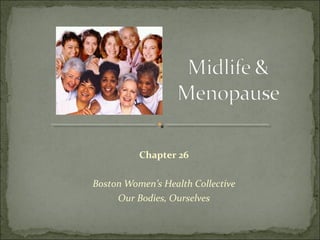
Chapter 26

Boston Women’s Health Collective
     Our Bodies, Ourselves
“With the advent of menopause, children leaving home,
 or the decline of a parent, we come to the end of
 familiar roles and ways of being and begin a different
 way of life”
                                           -page 528
Midlife is defined as ages 45 – 65
Midlife is a time of emotional, social & physical
 changes which for women includes menopause
Menopause defined as end of monthly bleeding
1 – 10 years prior to menopause a woman may
 experience symptoms of “peri” (around) menopause
 which include hot flashes, irregular periods, more
 pronounced PMS
Menopause occurs at different times for women, the
 average age is 51
Menopause can be brought on earlier by smoking, or
 be surgically or chemically induced
Midlife is often a time of social changes including
 children leaving home, health decline of parents, and
 assumption of new roles including mother-in-law or
 grandmother

It can be a time of redefining oneself as nurturing roles
 shift providing more time and energy for achieving
 goals put on hold years earlier

Often comes with increased perspective on life and/or
 accomplishment, along with a new sense of self-pride
 and awareness
Many women in midlife enter the “sandwich
 generation” where they are caring for children and
 ailing parents

Divorce/separation after children leave home may
 occur creating further stress (or relief )

Transition can trigger emotional problems – or
 feelings restlessness associated with changes
 occurring emotionally, physically and socially
Physical changes including weight gain, loss of
 reproductive capabilities, wrinkles, thinning hair can
 create emotional stress in a society focused on youth
 and beauty

May be associated with “ageism” & discrimination due
 to age

Health changes related to decreased estrogen
 production increase a woman’s risk for osteoporosis,
 cardiac disease, urinary incontinence, weight gain
With decreased production of estrogen/progestin
 women experience symptoms of “the change of life”
 while their body adjusts to hormonal changes
During perimenopause & menopause a woman may
 experience:
     More severe PMS symptoms
     Irregular periods varying in occurrence, flow, duration
     Hot flashes and night sweats
     Insomnia and sleep disturbances
     Vaginal dryness and/or pain with intercourse
     Urinary changes such as stress or urge incontinence
      and increased urinary tract infections
     Increase or decrease in sexual libido
     Mood changes
Health related risks associated with decreased
 estrogen production include:
Increased risk of heart disease
Increased risk of fracture secondary to decreased
 bone density and/or osteoporosis (only 15% of women
 are diagnosed w/osteo)
Decrease in lean muscle mass and increase in adipose
 tissue
What to do….
 Aerobic exercise and weight bearing exercise help to
 greatly diminish these risks and symptoms related to
 menopause
Sexuality (unlike fertility) continues throughout our
 lives
Post menopause women no longer need to worry about
 pregnancy or birth control providing more spontaneity
Vaginal changes in women post menopause put them
 at higher risk for contracting STI’s and HIV, (if not in a
 mutually monogamous relationship) hence “safe sex”
 practice is encouraged
Vaginal dryness and/or discomfort can often be
 remedied with OTC moisturizers or lubricants
For sexual dysfunction and or pain with intercourse
 medical intervention may assist
Hormone Replacement Therapy (HRT) available since
 1960’s, generally uses estrogen in pill, patch, ring or
 cream form. Many also include progestin additive.
Widely prescribed when first available, but often
 associated with negative side effects – including
 increased risk of breast cancer and blood clots
Women's Health Initiative (WHI) 2002 published
 study confirming risks of HRT for breast cancer and
 blood clots. They also concluded women were more at
 risk for cardiovascular disease & stroke with HRT
 Study tested only one regimen of HRT – leaving some
 questions remaining regarding efficacy and safety of
 HRT
HRT concerns have generated new drugs for providing
 benefits of hormone replacement without negative side
 effects
Selective Estrogen Receptor Modulators – SERM’s
 (Raloxifene/Evista®), Tamoxifen, help prevent bone
 loss and reduce risk of fx without stimulating breast or
 uterine tissue to become cancerous
Biphosphonates (Fosamax®, Boniva®) are another class
 of drug which help to prevent bone density loss
Herbal treatments such as black cohosh, red clover and
 soy are felt safe for short term (<6 mos) use
Exercise, well-balanced nutrition, and cessation of
 smoking, drinking or substance abuse can have
 dramatic results on the effects of aging and menopause
Aerobic exercise – walking, running, jogging, dancing,
 greatly improves stamina, cardiovascular status, and
 releases “feel good” endorphins
Weight resistance exercise – push ups, pull ups, squats,
 lunges, weight lifting, or water exercise help to increase
 load bearing on muscles & tendons thereby increasing
 muscle mass, and decreasing bone density loss
Many women in midlife are without health insurance
 and/or do not receive this through a spouse or
 employer
Midlife women without health insurance (if not
 disabled) must pay privately for coverage or seek
 employment that provides it
For older women needing insurance (<65), full-time
 work may not be an option and they may not meet
 poverty level for state Medicaid assistance
Affordable Care Act designed to provide more
 affordable insurance options for under privileged
 Americans through state wide insurance exchanges
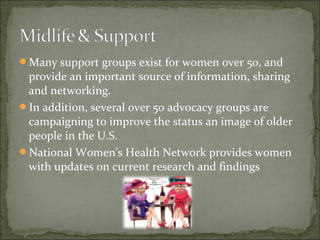
Many support groups exist for women over 50, and
 provide an important source of information, sharing
 and networking.
In addition, several over 50 advocacy groups are
 campaigning to improve the status an image of older
 people in the U.S.
National Women’s Health Network provides women
 with updates on current research and findings
So when did I get here? As a woman who is officially in
 “midlife” I can tell you it has to be one of the best times
 of my life. I am more confident, self-aware, and love
 my new titles including “Mom-in-Law” and “Grandma”.
  I feel I’m at the top of my game mentally, and
 professionally, and no longer feel the need to put my
 needs on the back burner.

I found this chapter to be very informative and helpful
 in realizing some of the “restlessness” that comes with
 this age is normal.
A thought for discussion:

What are you experiencing if you are indeed in
 “midlife”. If you are not even close, where do you
 think you will be when you get there?

I wince at saying this for fear of sounding “old”, but
 time does go so fast. You really need to enjoy every
 minute of your life, and make the most of what God
 has given you.

Midlife presentation chapter 26

  • 1.
    Chapter 26 Boston Women’sHealth Collective Our Bodies, Ourselves
  • 2.
    “With the adventof menopause, children leaving home, or the decline of a parent, we come to the end of familiar roles and ways of being and begin a different way of life” -page 528
  • 3.
    Midlife is definedas ages 45 – 65 Midlife is a time of emotional, social & physical changes which for women includes menopause Menopause defined as end of monthly bleeding 1 – 10 years prior to menopause a woman may experience symptoms of “peri” (around) menopause which include hot flashes, irregular periods, more pronounced PMS Menopause occurs at different times for women, the average age is 51 Menopause can be brought on earlier by smoking, or be surgically or chemically induced
  • 4.
    Midlife is oftena time of social changes including children leaving home, health decline of parents, and assumption of new roles including mother-in-law or grandmother It can be a time of redefining oneself as nurturing roles shift providing more time and energy for achieving goals put on hold years earlier Often comes with increased perspective on life and/or accomplishment, along with a new sense of self-pride and awareness
  • 5.
    Many women inmidlife enter the “sandwich generation” where they are caring for children and ailing parents Divorce/separation after children leave home may occur creating further stress (or relief ) Transition can trigger emotional problems – or feelings restlessness associated with changes occurring emotionally, physically and socially
  • 6.
    Physical changes includingweight gain, loss of reproductive capabilities, wrinkles, thinning hair can create emotional stress in a society focused on youth and beauty May be associated with “ageism” & discrimination due to age Health changes related to decreased estrogen production increase a woman’s risk for osteoporosis, cardiac disease, urinary incontinence, weight gain
  • 7.
    With decreased productionof estrogen/progestin women experience symptoms of “the change of life” while their body adjusts to hormonal changes During perimenopause & menopause a woman may experience: More severe PMS symptoms Irregular periods varying in occurrence, flow, duration Hot flashes and night sweats Insomnia and sleep disturbances Vaginal dryness and/or pain with intercourse Urinary changes such as stress or urge incontinence and increased urinary tract infections Increase or decrease in sexual libido Mood changes
  • 8.
    Health related risksassociated with decreased estrogen production include: Increased risk of heart disease Increased risk of fracture secondary to decreased bone density and/or osteoporosis (only 15% of women are diagnosed w/osteo) Decrease in lean muscle mass and increase in adipose tissue What to do…. Aerobic exercise and weight bearing exercise help to greatly diminish these risks and symptoms related to menopause
  • 9.
    Sexuality (unlike fertility)continues throughout our lives Post menopause women no longer need to worry about pregnancy or birth control providing more spontaneity Vaginal changes in women post menopause put them at higher risk for contracting STI’s and HIV, (if not in a mutually monogamous relationship) hence “safe sex” practice is encouraged Vaginal dryness and/or discomfort can often be remedied with OTC moisturizers or lubricants For sexual dysfunction and or pain with intercourse medical intervention may assist
  • 10.
    Hormone Replacement Therapy(HRT) available since 1960’s, generally uses estrogen in pill, patch, ring or cream form. Many also include progestin additive. Widely prescribed when first available, but often associated with negative side effects – including increased risk of breast cancer and blood clots Women's Health Initiative (WHI) 2002 published study confirming risks of HRT for breast cancer and blood clots. They also concluded women were more at risk for cardiovascular disease & stroke with HRT  Study tested only one regimen of HRT – leaving some questions remaining regarding efficacy and safety of HRT
  • 11.
    HRT concerns havegenerated new drugs for providing benefits of hormone replacement without negative side effects Selective Estrogen Receptor Modulators – SERM’s (Raloxifene/Evista®), Tamoxifen, help prevent bone loss and reduce risk of fx without stimulating breast or uterine tissue to become cancerous Biphosphonates (Fosamax®, Boniva®) are another class of drug which help to prevent bone density loss Herbal treatments such as black cohosh, red clover and soy are felt safe for short term (<6 mos) use
  • 12.
    Exercise, well-balanced nutrition,and cessation of smoking, drinking or substance abuse can have dramatic results on the effects of aging and menopause Aerobic exercise – walking, running, jogging, dancing, greatly improves stamina, cardiovascular status, and releases “feel good” endorphins Weight resistance exercise – push ups, pull ups, squats, lunges, weight lifting, or water exercise help to increase load bearing on muscles & tendons thereby increasing muscle mass, and decreasing bone density loss
  • 13.
    Many women inmidlife are without health insurance and/or do not receive this through a spouse or employer Midlife women without health insurance (if not disabled) must pay privately for coverage or seek employment that provides it For older women needing insurance (<65), full-time work may not be an option and they may not meet poverty level for state Medicaid assistance Affordable Care Act designed to provide more affordable insurance options for under privileged Americans through state wide insurance exchanges
  • 14.
    Many support groupsexist for women over 50, and provide an important source of information, sharing and networking. In addition, several over 50 advocacy groups are campaigning to improve the status an image of older people in the U.S. National Women’s Health Network provides women with updates on current research and findings
  • 15.
    So when didI get here? As a woman who is officially in “midlife” I can tell you it has to be one of the best times of my life. I am more confident, self-aware, and love my new titles including “Mom-in-Law” and “Grandma”. I feel I’m at the top of my game mentally, and professionally, and no longer feel the need to put my needs on the back burner. I found this chapter to be very informative and helpful in realizing some of the “restlessness” that comes with this age is normal.
  • 16.
    A thought fordiscussion: What are you experiencing if you are indeed in “midlife”. If you are not even close, where do you think you will be when you get there? I wince at saying this for fear of sounding “old”, but time does go so fast. You really need to enjoy every minute of your life, and make the most of what God has given you.