Meniscal Pathology 
Mr. Abdul Wahab
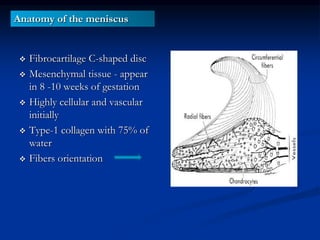
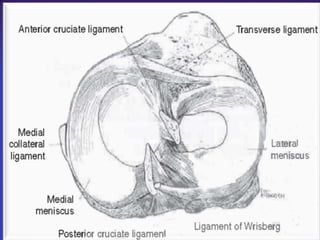
Anatomy of the meniscus 
 Fibrocartilage C-shaped disc 
 Mesenchymal tissue - appear 
in 8 -10 weeks of gestation 
 Highly cellular and vascular 
initially 
 Type-1 collagen with 75% of 
water 
 Fibers orientation
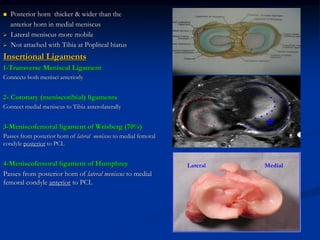
 Posterior horn thicker & wider than the 
anterior horn in medial meniscus 
 Lateral meniscus more mobile 
 Not attached with Tibia at Popliteal hiatus 
Insertional Ligaments 
1-Transverse Meniscal Ligament 
Connects both menisci anteriorly 
2- Coronary (meniscotibial) ligaments 
Connect medial meniscus to Tibia anterolaterally 
3-Meniscofemoral ligament of Wrisberg (70%) 
Passes from posterior horn of lateral meniscus to medial femoral 
condyle posterior to PCL 
4-Meniscofemoral ligament of Humphrey 
Passes from posterior horn of lateral meniscus to medial 
femoral condyle anterior to PCL 
Lateral Medial
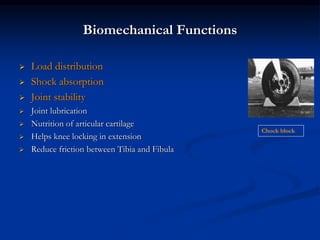
Biomechanical Functions 
 Load distribution 
 Shock absorption 
 Joint stability 
 Joint lubrication 
 Nutrition of articular cartilage 
 Helps knee locking in extension 
 Reduce friction between Tibia and Fibula 
Chock block
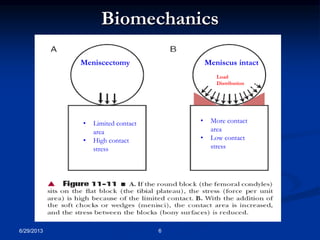
Biomechanics 
Meniscectomy Meniscus intact 
• Limited contact 
area 
• High contact 
stress 
6/29/2013 6 
Load 
Distribution 
• More contact 
area 
• Low contact 
stress
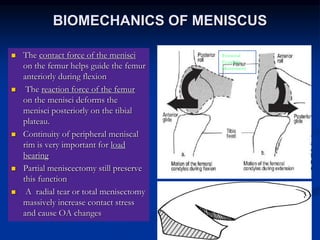
BIOMECHANICS OF MENISCUS 
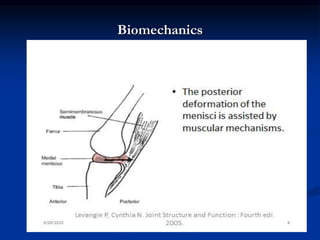
 The contact force of the menisci 
on the femur helps guide the femur 
anteriorly during flexion 
 The reaction force of the femur 
on the menisci deforms the 
menisci posteriorly on the tibial 
plateau. 
 Continuity of peripheral meniscal 
rim is very important for load 
bearing 
 Partial meniscectomy still preserve 
this function 
 A radial tear or total menisectomy 
massively increase contact stress 
and cause OA changes 
Femoral 
Condyle 
Movement
Biomechanics
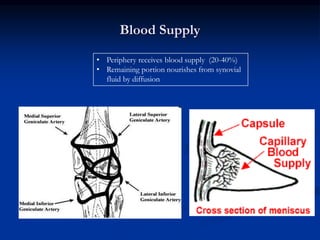
Blood Supply 
• Periphery receives blood supply (20-40%) 
• Remaining portion nourishes from synovial 
fluid by diffusion
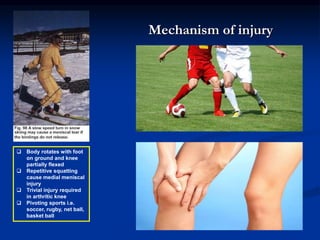
Mechanism of injury 
 Body rotates with foot 
on ground and knee 
partially flexed 
 Repetitive squatting 
cause medial meniscal 
injury 
 Trivial injury required 
in arthritic knee 
 Pivoting sports i.e. 
soccer, rugby, net ball, 
basket ball
Normal meniscus 
Small meniscus 
Truncated free edge 
Displaced meniscal fragment
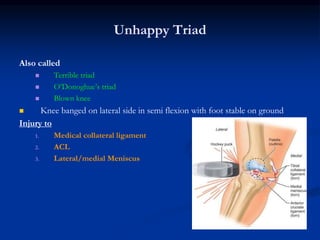
Unhappy Triad 
Also called 
 Terrible triad 
 O’Donoghue’s triad 
 Blown knee 
 Knee banged on lateral side in semi flexion with foot stable on ground 
Injury to 
1. Medical collateral ligament 
2. ACL 
3. Lateral/medial Meniscus
Signs & symptoms 
Not all meniscal tears are symptomatic 
 Swelling 
 Pain and tenderness along joint line - medial or lateral 
 Pain worse on squatting, kneeling or pivoting 
 Locking of the knee 
 Giving way, snaps, clicks, clunks, catches in knee. 
 Atrophy of quadriceps 
 Instability of joint 
 Elastic block at terminal extension 
 Springy end feel
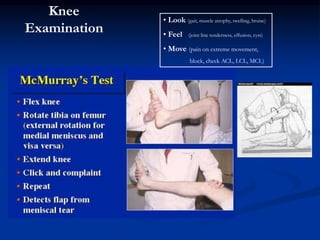
Knee 
Examination 
• Look (gait, muscle atrophy, swelling, bruise) 
• Feel (joint line tenderness, effusion, cyst) 
• Move (pain on extreme movement, 
block, check ACL, LCL, MCL)
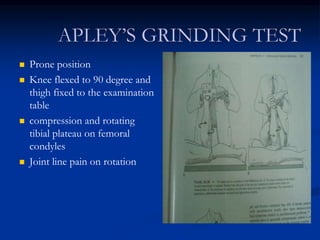
 Prone position 
 Knee flexed to 90 degree and 
thigh fixed to the examination 
table 
 compression and rotating 
tibial plateau on femoral 
condyles 
 Joint line pain on rotation
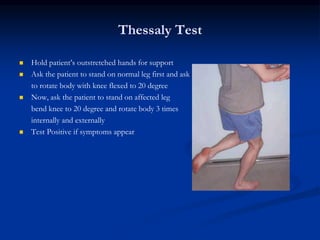
Thessaly Test 
 Hold patient’s outstretched hands for support 
 Ask the patient to stand on normal leg first and ask 
to rotate body with knee flexed to 20 degree 
 Now, ask the patient to stand on affected leg 
bend knee to 20 degree and rotate body 3 times 
internally and externally 
 Test Positive if symptoms appear
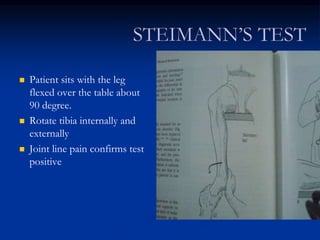
 Patient sits with the leg 
flexed over the table about 
90 degree. 
 Rotate tibia internally and 
externally 
 Joint line pain confirms test 
positive
Imaging 
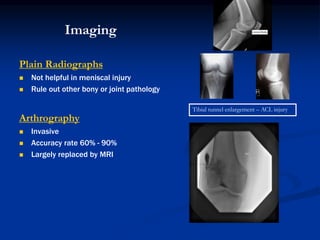
Plain Radiographs 
 Not helpful in meniscal injury 
 Rule out other bony or joint pathology 
Arthrography 
 Invasive 
 Accuracy rate 60% - 90% 
 Largely replaced by MRI 
Tibial tunnel enlargement – ACL injury
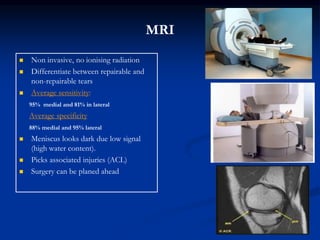
MRI 
 Non invasive, no ionising radiation 
 Differentiate between repairable and 
non-repairable tears 
 Average sensitivity: 
95% medial and 81% in lateral 
Average specificity 
88% medial and 95% lateral 
 Meniscus looks dark due low signal 
(high water content). 
 Picks associated injuries (ACL) 
 Surgery can be planed ahead
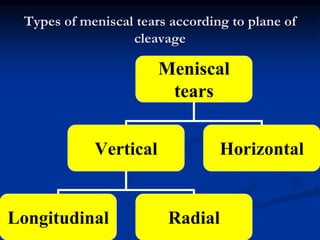
Types of meniscal tears according to plane of 
cleavage 
Meniscal 
tears 
Vertical Horizontal 
Longitudinal Radial
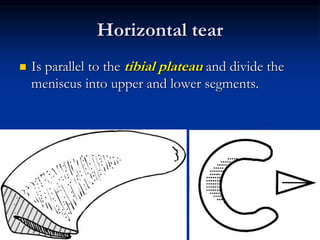
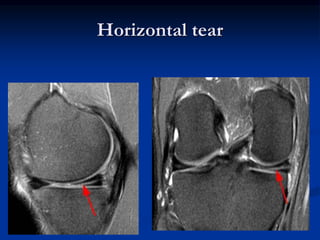
Horizontal tear 
 Is parallel to the tibial plateau and divide the 
meniscus into upper and lower segments.
Horizontal tear
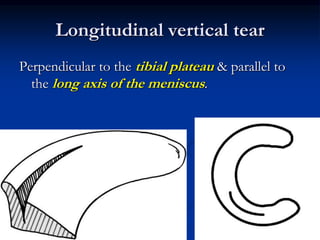
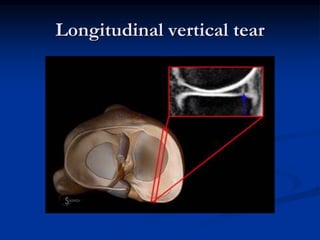
Longitudinal vertical tear 
Perpendicular to the tibial plateau & parallel to 
the long axis of the meniscus.
Longitudinal vertical tear
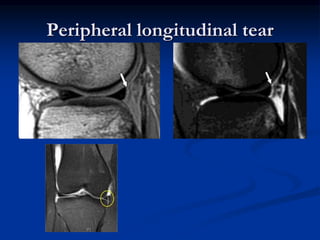
Peripheral longitudinal tear
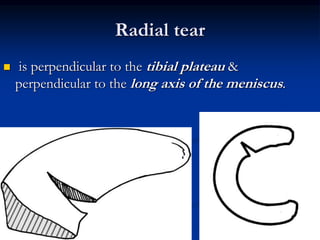
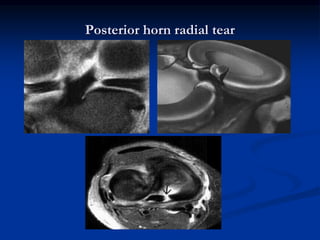
Radial tear 
 is perpendicular to the tibial plateau & 
perpendicular to the long axis of the meniscus.
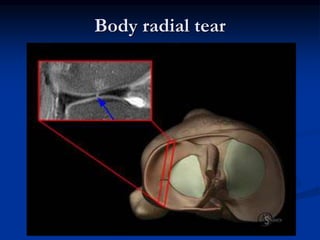
Body radial tear
Full thickness body radial tear
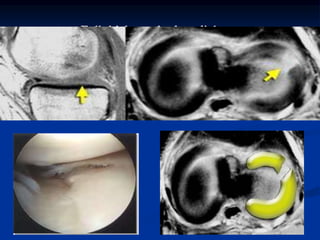
Posterior horn radial tear
Displaced meniscal tears
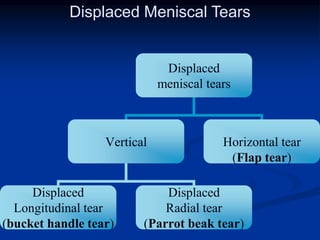
Displaced Meniscal Tears 
Displaced 
meniscal tears 
Vertical Horizontal tear 
(Flap tear) 
Displaced 
Longitudinal tear 
(bucket handle tear) 
Displaced 
Radial tear 
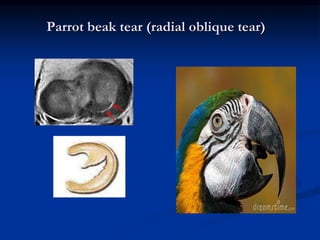
(Parrot beak tear)
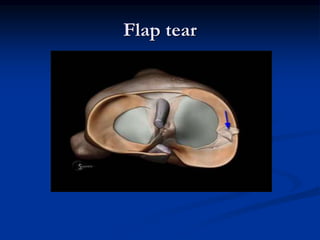
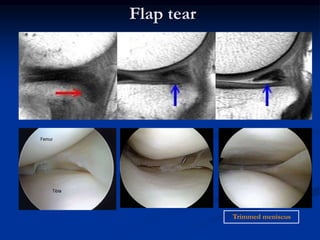
Flap tear
Flap tear 
Trimmed meniscus
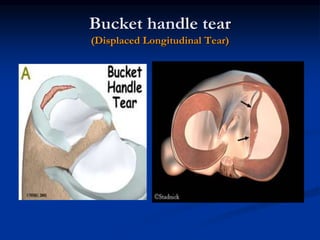
Bucket handle tear 
(Displaced Longitudinal Tear)
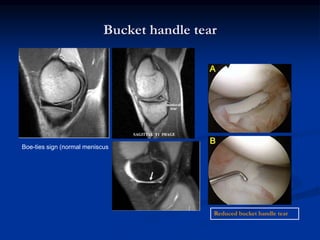
Bucket handle tear 
Reduced bucket handle tear 
Boe-ties sign (normal meniscus
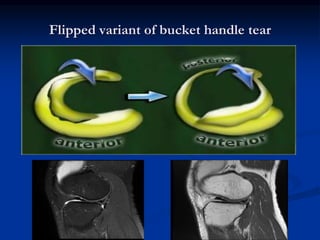
Flipped variant of bucket handle tear
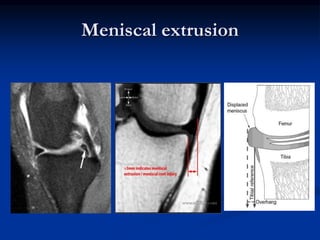
Meniscal extrusion
Parrot beak tear (radial oblique tear)
Management 
 Non Surgical 
 Surgical
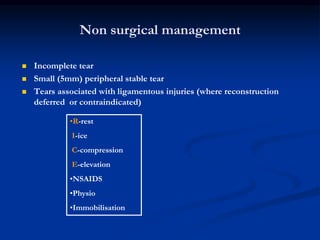
Non surgical management 
 Incomplete tear 
 Small (5mm) peripheral stable tear 
 Tears associated with ligamentous injuries (where reconstruction 
deferred or contraindicated) 
•R-rest 
I-ice 
C-compression 
E-elevation 
•NSAIDS 
•Physio 
•Immobilisation
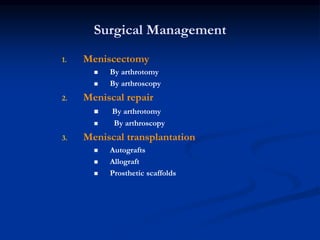
Surgical Management 
1. Meniscectomy 
 By arthrotomy 
 By arthroscopy 
2. Meniscal repair 
 By arthrotomy 
 By arthroscopy 
3. Meniscal transplantation 
 Autografts 
 Allograft 
 Prosthetic scaffolds
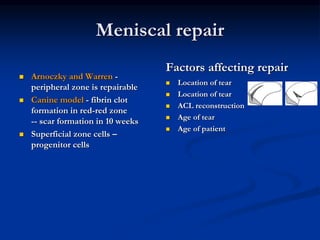
Meniscal repair 
 Arnoczky and Warren - 
peripheral zone is repairable 
 Canine model - fibrin clot 
formation in red-red zone 
-- scar formation in 10 weeks 
 Superficial zone cells – 
progenitor cells 
Factors affecting repair 
 Location of tear 
 Location of tear 
 ACL reconstruction 
 Age of tear 
 Age of patient
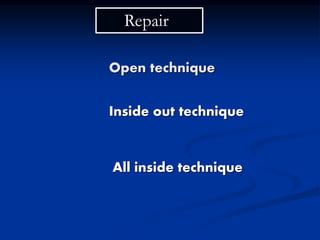
Repair 
Open technique 
Inside out technique 
All inside technique
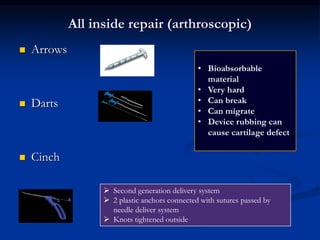
All inside repair (arthroscopic) 
 Arrows 
 Darts 
 Cinch 
• Bioabsorbable 
material 
• Very hard 
• Can break 
• Can migrate 
• Device rubbing can 
cause cartilage defect 
 Second generation delivery system 
 2 plastic anchors connected with sutures passed by 
needle deliver system 
 Knots tightened outside

Meniscal pathology

  • 1.
  • 2.
    Anatomy of themeniscus  Fibrocartilage C-shaped disc  Mesenchymal tissue - appear in 8 -10 weeks of gestation  Highly cellular and vascular initially  Type-1 collagen with 75% of water  Fibers orientation
  • 3.
     Posterior hornthicker & wider than the anterior horn in medial meniscus  Lateral meniscus more mobile  Not attached with Tibia at Popliteal hiatus Insertional Ligaments 1-Transverse Meniscal Ligament Connects both menisci anteriorly 2- Coronary (meniscotibial) ligaments Connect medial meniscus to Tibia anterolaterally 3-Meniscofemoral ligament of Wrisberg (70%) Passes from posterior horn of lateral meniscus to medial femoral condyle posterior to PCL 4-Meniscofemoral ligament of Humphrey Passes from posterior horn of lateral meniscus to medial femoral condyle anterior to PCL Lateral Medial
  • 5.
    Biomechanical Functions Load distribution  Shock absorption  Joint stability  Joint lubrication  Nutrition of articular cartilage  Helps knee locking in extension  Reduce friction between Tibia and Fibula Chock block
  • 6.
    Biomechanics Meniscectomy Meniscusintact • Limited contact area • High contact stress 6/29/2013 6 Load Distribution • More contact area • Low contact stress
  • 7.
    BIOMECHANICS OF MENISCUS  The contact force of the menisci on the femur helps guide the femur anteriorly during flexion  The reaction force of the femur on the menisci deforms the menisci posteriorly on the tibial plateau.  Continuity of peripheral meniscal rim is very important for load bearing  Partial meniscectomy still preserve this function  A radial tear or total menisectomy massively increase contact stress and cause OA changes Femoral Condyle Movement
  • 8.
  • 9.
    Blood Supply •Periphery receives blood supply (20-40%) • Remaining portion nourishes from synovial fluid by diffusion
  • 10.
    Mechanism of injury  Body rotates with foot on ground and knee partially flexed  Repetitive squatting cause medial meniscal injury  Trivial injury required in arthritic knee  Pivoting sports i.e. soccer, rugby, net ball, basket ball
  • 11.
    Normal meniscus Smallmeniscus Truncated free edge Displaced meniscal fragment
  • 12.
    Unhappy Triad Alsocalled  Terrible triad  O’Donoghue’s triad  Blown knee  Knee banged on lateral side in semi flexion with foot stable on ground Injury to 1. Medical collateral ligament 2. ACL 3. Lateral/medial Meniscus
  • 13.
    Signs & symptoms Not all meniscal tears are symptomatic  Swelling  Pain and tenderness along joint line - medial or lateral  Pain worse on squatting, kneeling or pivoting  Locking of the knee  Giving way, snaps, clicks, clunks, catches in knee.  Atrophy of quadriceps  Instability of joint  Elastic block at terminal extension  Springy end feel
  • 14.
    Knee Examination •Look (gait, muscle atrophy, swelling, bruise) • Feel (joint line tenderness, effusion, cyst) • Move (pain on extreme movement, block, check ACL, LCL, MCL)
  • 15.
     Prone position  Knee flexed to 90 degree and thigh fixed to the examination table  compression and rotating tibial plateau on femoral condyles  Joint line pain on rotation
  • 16.
    Thessaly Test Hold patient’s outstretched hands for support  Ask the patient to stand on normal leg first and ask to rotate body with knee flexed to 20 degree  Now, ask the patient to stand on affected leg bend knee to 20 degree and rotate body 3 times internally and externally  Test Positive if symptoms appear
  • 17.
     Patient sitswith the leg flexed over the table about 90 degree.  Rotate tibia internally and externally  Joint line pain confirms test positive
  • 18.
    Imaging Plain Radiographs  Not helpful in meniscal injury  Rule out other bony or joint pathology Arthrography  Invasive  Accuracy rate 60% - 90%  Largely replaced by MRI Tibial tunnel enlargement – ACL injury
  • 19.
    MRI  Noninvasive, no ionising radiation  Differentiate between repairable and non-repairable tears  Average sensitivity: 95% medial and 81% in lateral Average specificity 88% medial and 95% lateral  Meniscus looks dark due low signal (high water content).  Picks associated injuries (ACL)  Surgery can be planed ahead
  • 20.
    Types of meniscaltears according to plane of cleavage Meniscal tears Vertical Horizontal Longitudinal Radial
  • 21.
    Horizontal tear Is parallel to the tibial plateau and divide the meniscus into upper and lower segments.
  • 22.
  • 23.
    Longitudinal vertical tear Perpendicular to the tibial plateau & parallel to the long axis of the meniscus.
  • 24.
  • 25.
  • 26.
    Radial tear is perpendicular to the tibial plateau & perpendicular to the long axis of the meniscus.
  • 27.
  • 28.
  • 29.
  • 30.
  • 31.
    Displaced Meniscal Tears Displaced meniscal tears Vertical Horizontal tear (Flap tear) Displaced Longitudinal tear (bucket handle tear) Displaced Radial tear (Parrot beak tear)
  • 32.
  • 33.
  • 34.
    Bucket handle tear (Displaced Longitudinal Tear)
  • 35.
    Bucket handle tear Reduced bucket handle tear Boe-ties sign (normal meniscus
  • 36.
    Flipped variant ofbucket handle tear
  • 37.
  • 38.
    Parrot beak tear(radial oblique tear)
  • 39.
    Management  NonSurgical  Surgical
  • 40.
    Non surgical management  Incomplete tear  Small (5mm) peripheral stable tear  Tears associated with ligamentous injuries (where reconstruction deferred or contraindicated) •R-rest I-ice C-compression E-elevation •NSAIDS •Physio •Immobilisation
  • 41.
    Surgical Management 1.Meniscectomy  By arthrotomy  By arthroscopy 2. Meniscal repair  By arthrotomy  By arthroscopy 3. Meniscal transplantation  Autografts  Allograft  Prosthetic scaffolds
  • 42.
    Meniscal repair Arnoczky and Warren - peripheral zone is repairable  Canine model - fibrin clot formation in red-red zone -- scar formation in 10 weeks  Superficial zone cells – progenitor cells Factors affecting repair  Location of tear  Location of tear  ACL reconstruction  Age of tear  Age of patient
  • 43.
    Repair Open technique Inside out technique All inside technique
  • 44.
    All inside repair(arthroscopic)  Arrows  Darts  Cinch • Bioabsorbable material • Very hard • Can break • Can migrate • Device rubbing can cause cartilage defect  Second generation delivery system  2 plastic anchors connected with sutures passed by needle deliver system  Knots tightened outside

Editor's Notes

  • #6 LOAD DISTRIBUTION 40% load distribution in extension and 80% in knee flexion Contact area reduced by 75% after menisectomy resulting in increase in peak contact pressure up to 250% Medial compartment more congruent and less contact stress after menisectomy SHOCK ABSORPTION Axial loading extrudes meniscus peripherally. As menisci are attached around and can not move further, these axial loading forces are absorbed as “hoop stresses” (circumferential or wall tension). Water content is squeezed out of tissue and therefore further engergy is absorbed. Menisectomy decreases shock absorption by 20% STABILITY Menisci work as chock block in ACL deficient knee, inhibit anterior translation (secondary stabiliser)
  • #7 70% decrease in contact area after meniscectomy Medial tibial condyl more congruent due to concavity. Less contact stress after menisectomy. More OA after lateral menisectomy
  • #8 Menisci move few mm forward during knee flexion (lateral move more than medial) and role backwards during knee in extension Menisci stop anterior and posterior glide of femur on tibia Take 2 apples, place an apple on table top, it will move freely. Now, cut other apple into 8 pieces and put 2 pieces on table top and put apple on these. The apple will not move. Consider table to –tibial surface and apple femoral condyl.
  • #15 Apply varus or valgus stress while internally or externall y rotating the knee
  • #36 Thick body in normal meniscus cause boe-tie sign In bucket handle body is thin
  • #42 ARTHROTOMY only done if tear associated with ligamentous injury and osteochondral fracture
  • #44 OPEN- original technique, suturing under vision, anterior knee excess easy but posterior difficult, injury com peroneal nv INSIDE OUT: Passing suture arthoscopically , 2 sutures ends tied over outer aspect of knee with small incisions ALL INSIDE: Arthroscopic repair (1) Arrows (2) Darts (3) Repair devices