Medanta Bone & Joint Institute
Presented By:-
Dr Himanshu Bansal
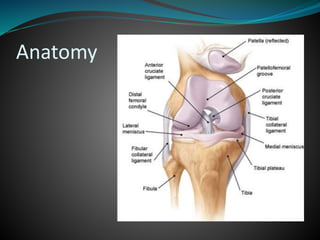
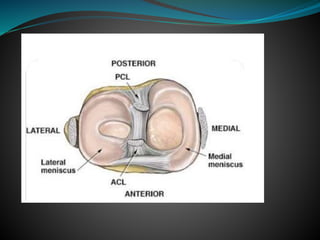
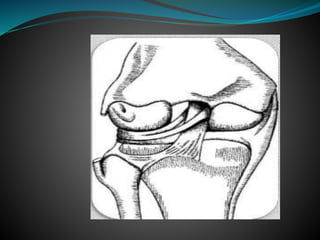
Anatomy
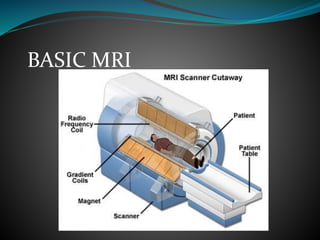
BASIC MRI
Tools in MSK imaging
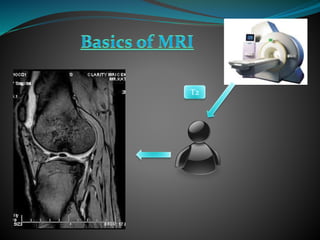
 T1W1
T2W1
FAT SAT T1
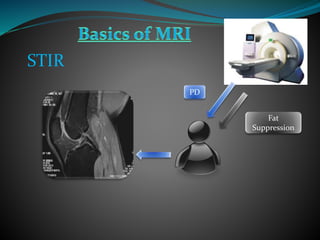
STIR
FAT SAT T2
Gadolinium studies
MR arthrography
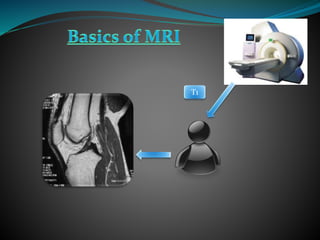
T1
T2
PD
Fat
Suppression
STIR
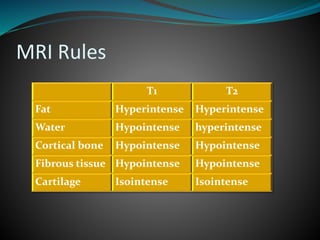
MRI Rules
T1 T2
Fat Hyperintense Hyperintense
Water Hypointense hyperintense
Cortical bone Hypointense Hypointense
Fibrous tissue Hypointense Hypointense
Cartilage Isointense Isointense
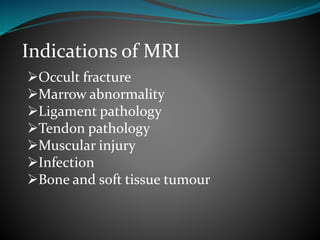
Indications of MRI
Occult fracture
Marrow abnormality
Ligament pathology
Tendon pathology
Muscular injury
Infection
Bone and soft tissue tumour
Sections
Coronal- Ant. To Post.
Saggital- Lateral to Medial
Axial- From above downward
Position for knee MRI-
Knee in full extension and 5 degree of
internal rotation
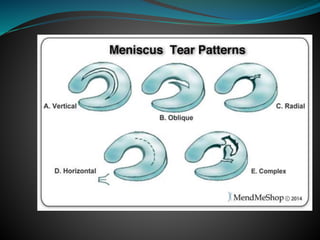
Meniscal Tear
 Imaging Criteria
1. Presence of linear signal intensity weather reaching
superior or inferior articular surface or not
2. Abnormal meniscal morphology
Meniscal Tear
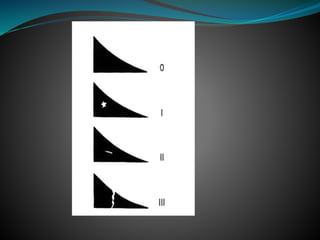
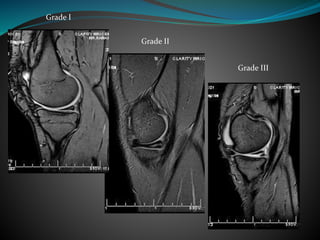
 Grade
Grade 1- Globular signal within the meniscus
Grade 2- Linear signal within the meniscus
not reaching the articular surface
Grade 3- Linear signal within the meniscus
reaching the articular surface
Grade I
Grade II
Grade III
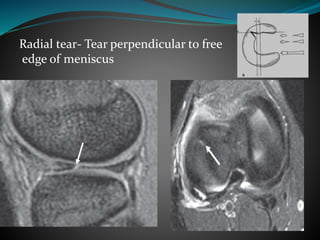
Radial tear- Tear perpendicular to free
edge of meniscus
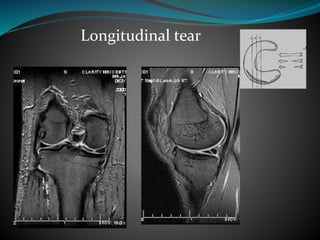
Longitudinal tear
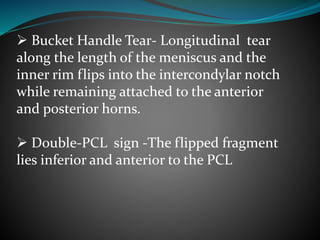
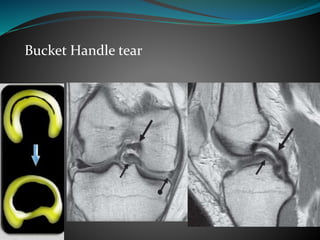
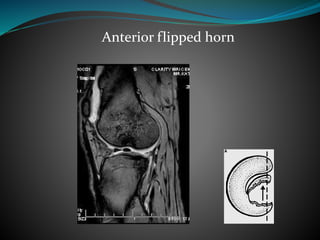
 Bucket Handle Tear- Longitudinal tear
along the length of the meniscus and the
inner rim flips into the intercondylar notch
while remaining attached to the anterior
and posterior horns.
 Double-PCL sign -The flipped fragment
lies inferior and anterior to the PCL
Bucket Handle tear
Anterior flipped horn
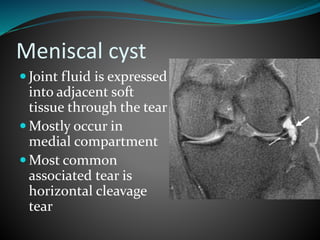
Meniscal cyst
 Joint fluid is expressed
into adjacent soft
tissue through the tear
 Mostly occur in
medial compartment
 Most common
associated tear is
horizontal cleavage
tear
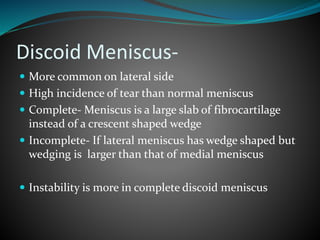
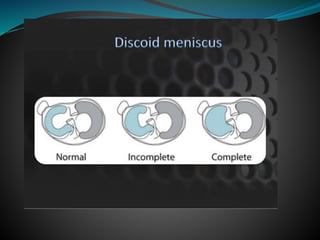
Discoid Meniscus-
 More common on lateral side
 High incidence of tear than normal meniscus
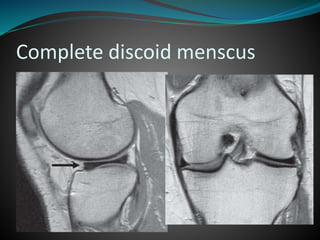
 Complete- Meniscus is a large slab of fibrocartilage
instead of a crescent shaped wedge
 Incomplete- If lateral meniscus has wedge shaped but
wedging is larger than that of medial meniscus
 Instability is more in complete discoid meniscus
Complete discoid menscus
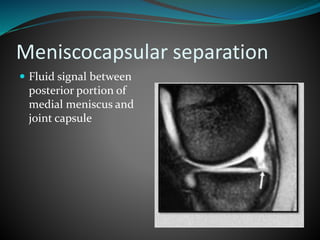
Meniscocapsular separation
 Fluid signal between
posterior portion of
medial meniscus and
joint capsule
Anterior Cruciate Ligament
 Straight, parallel to Blumensaat line
 Linear striated appearance with
intermediate signal intensity on T2 weighed
image
ACL Tear
Acute-
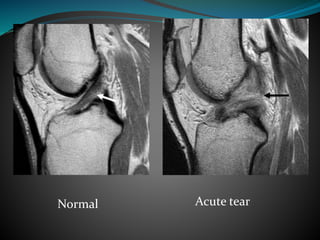
 Replacement of normal striated appearance by cloud
like high signal intensity
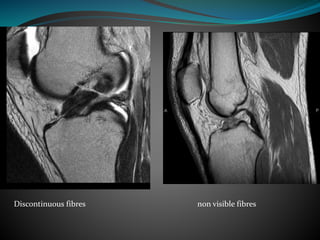
 Discontinuity of ligament and fibres don’t go parallel to
intercondylar roof
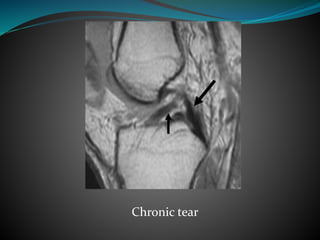
Chronic-
Nonvisualisation of ligament or
Angulation of ligament because of scarring
Shallow orientation not parallel to intercondylar
roof
Normal Acute tear
Discontinuous fibres non visible fibres
Chronic tear
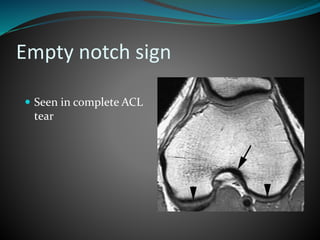
Empty notch sign
 Seen in complete ACL
tear
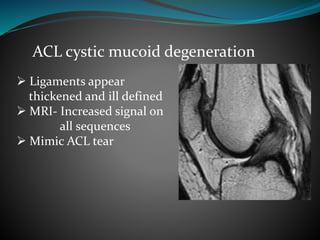
ACL cystic mucoid degeneration
 Ligaments appear
thickened and ill defined
 MRI- Increased signal on
all sequences
 Mimic ACL tear
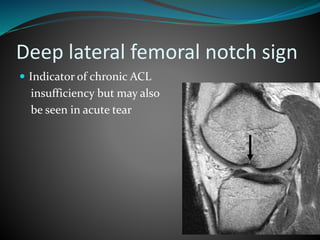
Deep lateral femoral notch sign
 Indicator of chronic ACL
insufficiency but may also
be seen in acute tear
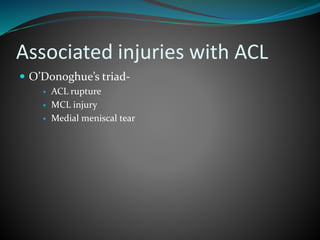
Associated injuries with ACL
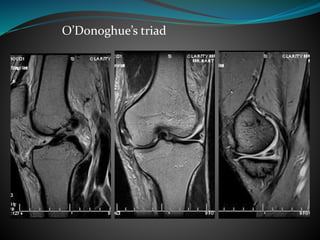
 O’Donoghue’s triad-
 ACL rupture
 MCL injury
 Medial meniscal tear
O’Donoghue’s triad
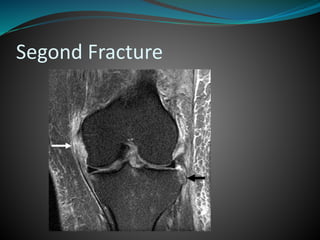
Segond Fracture
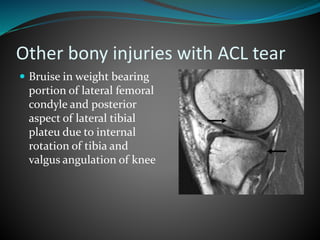
Other bony injuries with ACL tear
 Bruise in weight bearing
portion of lateral femoral
condyle and posterior
aspect of lateral tibial
plateu due to internal
rotation of tibia and
valgus angulation of knee
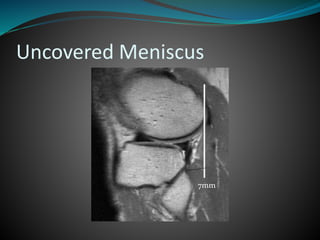
Uncovered Meniscus
7mm
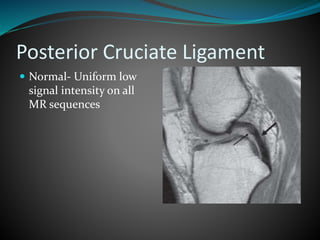
Posterior Cruciate Ligament
 Normal- Uniform low
signal intensity on all
MR sequences
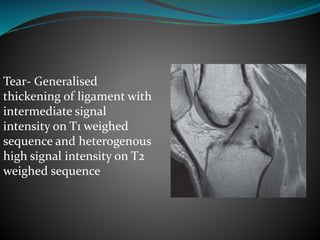
Tear- Generalised
thickening of ligament with
intermediate signal
intensity on T1 weighed
sequence and heterogenous
high signal intensity on T2
weighed sequence
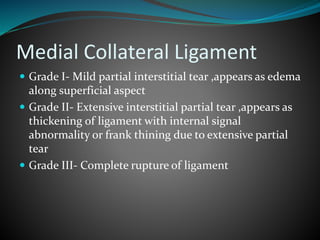
Medial Collateral Ligament
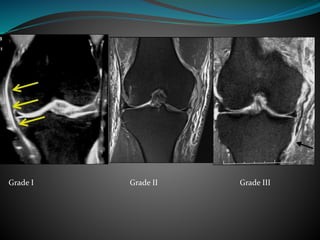
 Grade I- Mild partial interstitial tear ,appears as edema
along superficial aspect
 Grade II- Extensive interstitial partial tear ,appears as
thickening of ligament with internal signal
abnormality or frank thining due to extensive partial
tear
 Grade III- Complete rupture of ligament
Grade I Grade II Grade III
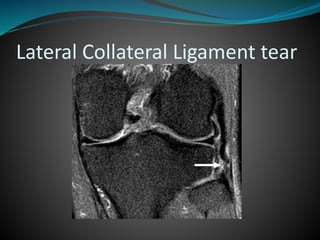
Lateral Collateral Ligament tear
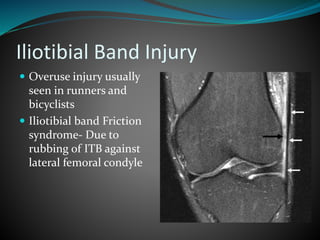
Iliotibial Band Injury
 Overuse injury usually
seen in runners and
bicyclists
 Iliotibial band Friction
syndrome- Due to
rubbing of ITB against
lateral femoral condyle
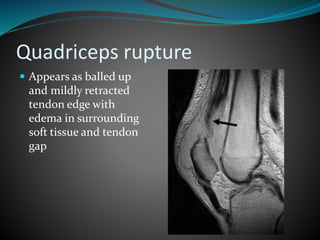
Quadriceps rupture
 Appears as balled up
and mildly retracted
tendon edge with
edema in surrounding
soft tissue and tendon
gap
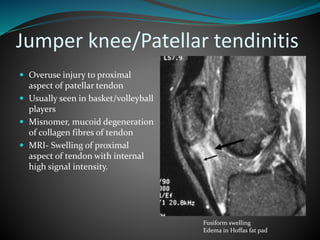
Jumper knee/Patellar tendinitis
 Overuse injury to proximal
aspect of patellar tendon
 Usually seen in basket/volleyball
players
 Misnomer, mucoid degeneration
of collagen fibres of tendon
 MRI- Swelling of proximal
aspect of tendon with internal
high signal intensity.
Fusiform swelling
Edema in Hoffas fat pad
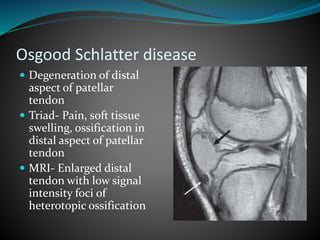
Osgood Schlatter disease
 Degeneration of distal
aspect of patellar
tendon
 Triad- Pain, soft tissue
swelling, ossification in
distal aspect of patellar
tendon
 MRI- Enlarged distal
tendon with low signal
intensity foci of
heterotopic ossification
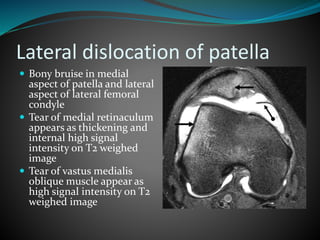
Lateral dislocation of patella
 Bony bruise in medial
aspect of patella and lateral
aspect of lateral femoral
condyle
 Tear of medial retinaculum
appears as thickening and
internal high signal
intensity on T2 weighed
image
 Tear of vastus medialis
oblique muscle appear as
high signal intensity on T2
weighed image
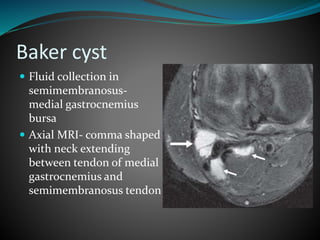
Baker cyst
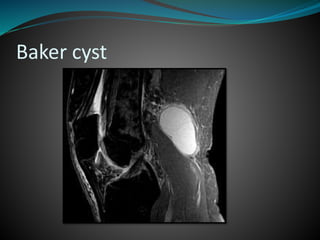
 Fluid collection in
semimembranosus-
medial gastrocnemius
bursa
 Axial MRI- comma shaped
with neck extending
between tendon of medial
gastrocnemius and
semimembranosus tendon
Baker cyst
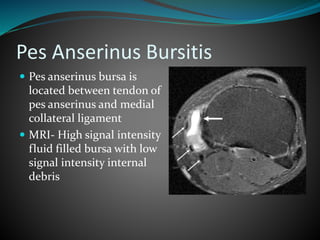
Pes Anserinus Bursitis
 Pes anserinus bursa is
located between tendon of
pes anserinus and medial
collateral ligament
 MRI- High signal intensity
fluid filled bursa with low
signal intensity internal
debris
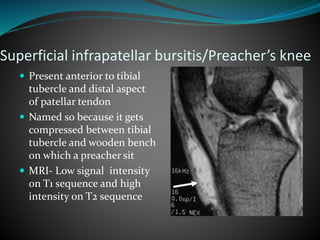
Superficial infrapatellar bursitis/Preacher’s knee
 Present anterior to tibial
tubercle and distal aspect
of patellar tendon
 Named so because it gets
compressed between tibial
tubercle and wooden bench
on which a preacher sit
 MRI- Low signal intensity
on T1 sequence and high
intensity on T2 sequence
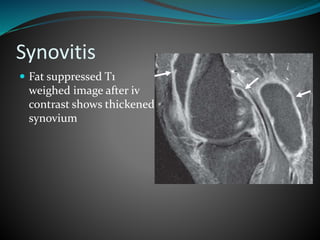
Synovitis
 Fat suppressed T1
weighed image after iv
contrast shows thickened
synovium
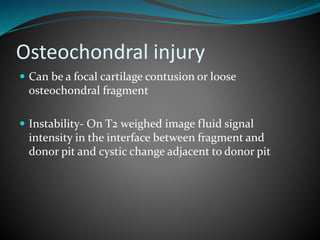
Osteochondral injury
 Can be a focal cartilage contusion or loose
osteochondral fragment
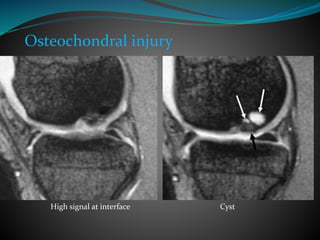
 Instability- On T2 weighed image fluid signal
intensity in the interface between fragment and
donor pit and cystic change adjacent to donor pit
High signal at interface Cyst
Osteochondral injury
Chondromalacia patella
 Inflammation of underside of patella and
softening of cartilage.
 Common in young adults, can mimic meniscal
tear
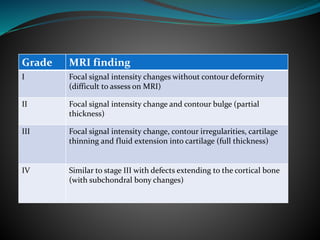
Grade MRI finding
I Focal signal intensity changes without contour deformity
(difficult to assess on MRI)
II Focal signal intensity change and contour bulge (partial
thickness)
III Focal signal intensity change, contour irregularities, cartilage
thinning and fluid extension into cartilage (full thickness)
IV Similar to stage III with defects extending to the cortical bone
(with subchondral bony changes)
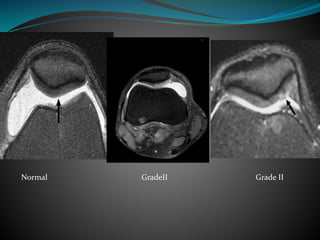
Normal GradeII Grade II
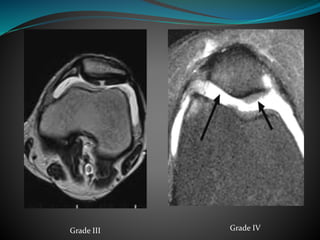
Grade IVGrade III
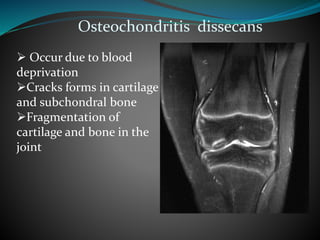
Osteochondritis dissecans
 Occur due to blood
deprivation
Cracks forms in cartilage
and subchondral bone
Fragmentation of
cartilage and bone in the
joint
Osteochondritis dissecans - Staging
Stage I : lesion 1-3cm ; intact cartilage
Stage II : Cartilage defect ; no loose body
Stage III : Partially detached ost.chond fragment
Stage IV : Complete separation ; loose body +
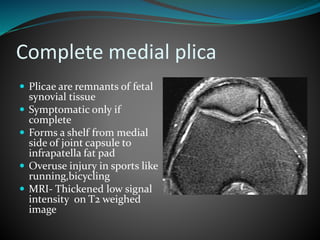
Complete medial plica
 Plicae are remnants of fetal
synovial tissue
 Symptomatic only if
complete
 Forms a shelf from medial
side of joint capsule to
infrapatella fat pad
 Overuse injury in sports like
running,bicycling
 MRI- Thickened low signal
intensity on T2 weighed
image
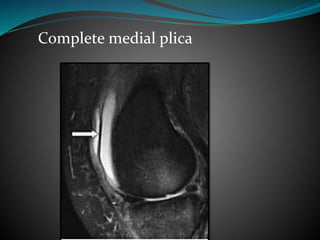
Complete medial plica
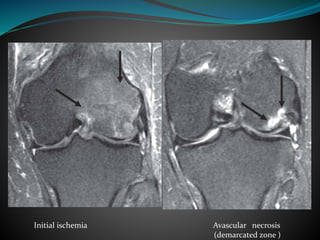
Avascular Necrosis
 Initial ischemia- Large area of ill defined marrow
edema
 If ischemia persists- avascular necrosis of bone occur
in subchondral portion manifested as single or double
rim of demarcation and may have appearance of fat,
edema,blood or sclerosis
Initial ischemia Avascular necrosis
(demarcated zone )
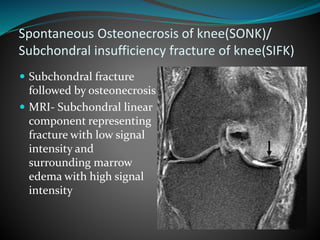
Spontaneous Osteonecrosis of knee(SONK)/
Subchondral insufficiency fracture of knee(SIFK)
 Subchondral fracture
followed by osteonecrosis
 MRI- Subchondral linear
component representing
fracture with low signal
intensity and
surrounding marrow
edema with high signal
intensity
Mri of knee

Mri of knee

  • 1.
    Medanta Bone &Joint Institute Presented By:- Dr Himanshu Bansal
  • 2.
  • 5.
  • 6.
    Tools in MSKimaging  T1W1 T2W1 FAT SAT T1 STIR FAT SAT T2 Gadolinium studies MR arthrography
  • 7.
  • 8.
  • 9.
  • 10.
    MRI Rules T1 T2 FatHyperintense Hyperintense Water Hypointense hyperintense Cortical bone Hypointense Hypointense Fibrous tissue Hypointense Hypointense Cartilage Isointense Isointense
  • 11.
    Indications of MRI Occultfracture Marrow abnormality Ligament pathology Tendon pathology Muscular injury Infection Bone and soft tissue tumour
  • 12.
    Sections Coronal- Ant. ToPost. Saggital- Lateral to Medial Axial- From above downward Position for knee MRI- Knee in full extension and 5 degree of internal rotation
  • 13.
    Meniscal Tear  ImagingCriteria 1. Presence of linear signal intensity weather reaching superior or inferior articular surface or not 2. Abnormal meniscal morphology
  • 14.
    Meniscal Tear  Grade Grade1- Globular signal within the meniscus Grade 2- Linear signal within the meniscus not reaching the articular surface Grade 3- Linear signal within the meniscus reaching the articular surface
  • 16.
  • 18.
    Radial tear- Tearperpendicular to free edge of meniscus
  • 19.
  • 20.
     Bucket HandleTear- Longitudinal tear along the length of the meniscus and the inner rim flips into the intercondylar notch while remaining attached to the anterior and posterior horns.  Double-PCL sign -The flipped fragment lies inferior and anterior to the PCL
  • 21.
  • 22.
  • 23.
    Meniscal cyst  Jointfluid is expressed into adjacent soft tissue through the tear  Mostly occur in medial compartment  Most common associated tear is horizontal cleavage tear
  • 24.
    Discoid Meniscus-  Morecommon on lateral side  High incidence of tear than normal meniscus  Complete- Meniscus is a large slab of fibrocartilage instead of a crescent shaped wedge  Incomplete- If lateral meniscus has wedge shaped but wedging is larger than that of medial meniscus  Instability is more in complete discoid meniscus
  • 26.
  • 27.
    Meniscocapsular separation  Fluidsignal between posterior portion of medial meniscus and joint capsule
  • 28.
    Anterior Cruciate Ligament Straight, parallel to Blumensaat line  Linear striated appearance with intermediate signal intensity on T2 weighed image
  • 29.
    ACL Tear Acute-  Replacementof normal striated appearance by cloud like high signal intensity  Discontinuity of ligament and fibres don’t go parallel to intercondylar roof Chronic- Nonvisualisation of ligament or Angulation of ligament because of scarring Shallow orientation not parallel to intercondylar roof
  • 30.
  • 31.
  • 32.
  • 33.
    Empty notch sign Seen in complete ACL tear
  • 34.
    ACL cystic mucoiddegeneration  Ligaments appear thickened and ill defined  MRI- Increased signal on all sequences  Mimic ACL tear
  • 35.
    Deep lateral femoralnotch sign  Indicator of chronic ACL insufficiency but may also be seen in acute tear
  • 36.
    Associated injuries withACL  O’Donoghue’s triad-  ACL rupture  MCL injury  Medial meniscal tear
  • 37.
  • 38.
  • 39.
    Other bony injurieswith ACL tear  Bruise in weight bearing portion of lateral femoral condyle and posterior aspect of lateral tibial plateu due to internal rotation of tibia and valgus angulation of knee
  • 40.
  • 41.
    Posterior Cruciate Ligament Normal- Uniform low signal intensity on all MR sequences
  • 42.
    Tear- Generalised thickening ofligament with intermediate signal intensity on T1 weighed sequence and heterogenous high signal intensity on T2 weighed sequence
  • 43.
    Medial Collateral Ligament Grade I- Mild partial interstitial tear ,appears as edema along superficial aspect  Grade II- Extensive interstitial partial tear ,appears as thickening of ligament with internal signal abnormality or frank thining due to extensive partial tear  Grade III- Complete rupture of ligament
  • 44.
    Grade I GradeII Grade III
  • 45.
  • 46.
    Iliotibial Band Injury Overuse injury usually seen in runners and bicyclists  Iliotibial band Friction syndrome- Due to rubbing of ITB against lateral femoral condyle
  • 47.
    Quadriceps rupture  Appearsas balled up and mildly retracted tendon edge with edema in surrounding soft tissue and tendon gap
  • 48.
    Jumper knee/Patellar tendinitis Overuse injury to proximal aspect of patellar tendon  Usually seen in basket/volleyball players  Misnomer, mucoid degeneration of collagen fibres of tendon  MRI- Swelling of proximal aspect of tendon with internal high signal intensity. Fusiform swelling Edema in Hoffas fat pad
  • 49.
    Osgood Schlatter disease Degeneration of distal aspect of patellar tendon  Triad- Pain, soft tissue swelling, ossification in distal aspect of patellar tendon  MRI- Enlarged distal tendon with low signal intensity foci of heterotopic ossification
  • 50.
    Lateral dislocation ofpatella  Bony bruise in medial aspect of patella and lateral aspect of lateral femoral condyle  Tear of medial retinaculum appears as thickening and internal high signal intensity on T2 weighed image  Tear of vastus medialis oblique muscle appear as high signal intensity on T2 weighed image
  • 51.
    Baker cyst  Fluidcollection in semimembranosus- medial gastrocnemius bursa  Axial MRI- comma shaped with neck extending between tendon of medial gastrocnemius and semimembranosus tendon
  • 52.
  • 53.
    Pes Anserinus Bursitis Pes anserinus bursa is located between tendon of pes anserinus and medial collateral ligament  MRI- High signal intensity fluid filled bursa with low signal intensity internal debris
  • 54.
    Superficial infrapatellar bursitis/Preacher’sknee  Present anterior to tibial tubercle and distal aspect of patellar tendon  Named so because it gets compressed between tibial tubercle and wooden bench on which a preacher sit  MRI- Low signal intensity on T1 sequence and high intensity on T2 sequence
  • 55.
    Synovitis  Fat suppressedT1 weighed image after iv contrast shows thickened synovium
  • 56.
    Osteochondral injury  Canbe a focal cartilage contusion or loose osteochondral fragment  Instability- On T2 weighed image fluid signal intensity in the interface between fragment and donor pit and cystic change adjacent to donor pit
  • 57.
    High signal atinterface Cyst Osteochondral injury
  • 58.
    Chondromalacia patella  Inflammationof underside of patella and softening of cartilage.  Common in young adults, can mimic meniscal tear
  • 59.
    Grade MRI finding IFocal signal intensity changes without contour deformity (difficult to assess on MRI) II Focal signal intensity change and contour bulge (partial thickness) III Focal signal intensity change, contour irregularities, cartilage thinning and fluid extension into cartilage (full thickness) IV Similar to stage III with defects extending to the cortical bone (with subchondral bony changes)
  • 60.
  • 61.
  • 62.
    Osteochondritis dissecans  Occurdue to blood deprivation Cracks forms in cartilage and subchondral bone Fragmentation of cartilage and bone in the joint
  • 63.
    Osteochondritis dissecans -Staging Stage I : lesion 1-3cm ; intact cartilage Stage II : Cartilage defect ; no loose body Stage III : Partially detached ost.chond fragment Stage IV : Complete separation ; loose body +
  • 64.
    Complete medial plica Plicae are remnants of fetal synovial tissue  Symptomatic only if complete  Forms a shelf from medial side of joint capsule to infrapatella fat pad  Overuse injury in sports like running,bicycling  MRI- Thickened low signal intensity on T2 weighed image
  • 65.
  • 66.
    Avascular Necrosis  Initialischemia- Large area of ill defined marrow edema  If ischemia persists- avascular necrosis of bone occur in subchondral portion manifested as single or double rim of demarcation and may have appearance of fat, edema,blood or sclerosis
  • 67.
    Initial ischemia Avascularnecrosis (demarcated zone )
  • 68.
    Spontaneous Osteonecrosis ofknee(SONK)/ Subchondral insufficiency fracture of knee(SIFK)  Subchondral fracture followed by osteonecrosis  MRI- Subchondral linear component representing fracture with low signal intensity and surrounding marrow edema with high signal intensity