MENISCAL INJURY
Presented by – Syed Adil
CONTENTS
• Anatomy
• Types of meniscal tear
• Etiology
• Clinical features including (special tests)
• Differential diagnosis
• Management
• Recent advance
INTRODUCTION
• Meniscus injuries are often seen in athletes as a result of a
sports injury and represent approximately 15% of all cases
sports injuries.
• Medial tears are reported more commonly than lateral tears.
• Meniscal injuries are more common in males, because they are
more involved in aggressive sporting.
Knieslijtage,http://www.knieslijtage.nl/knieaandoeningen/meniscus/wat-is-een-
meniscusscheur,geraadpleegd on 26 November 2011
Anatomy of menisci
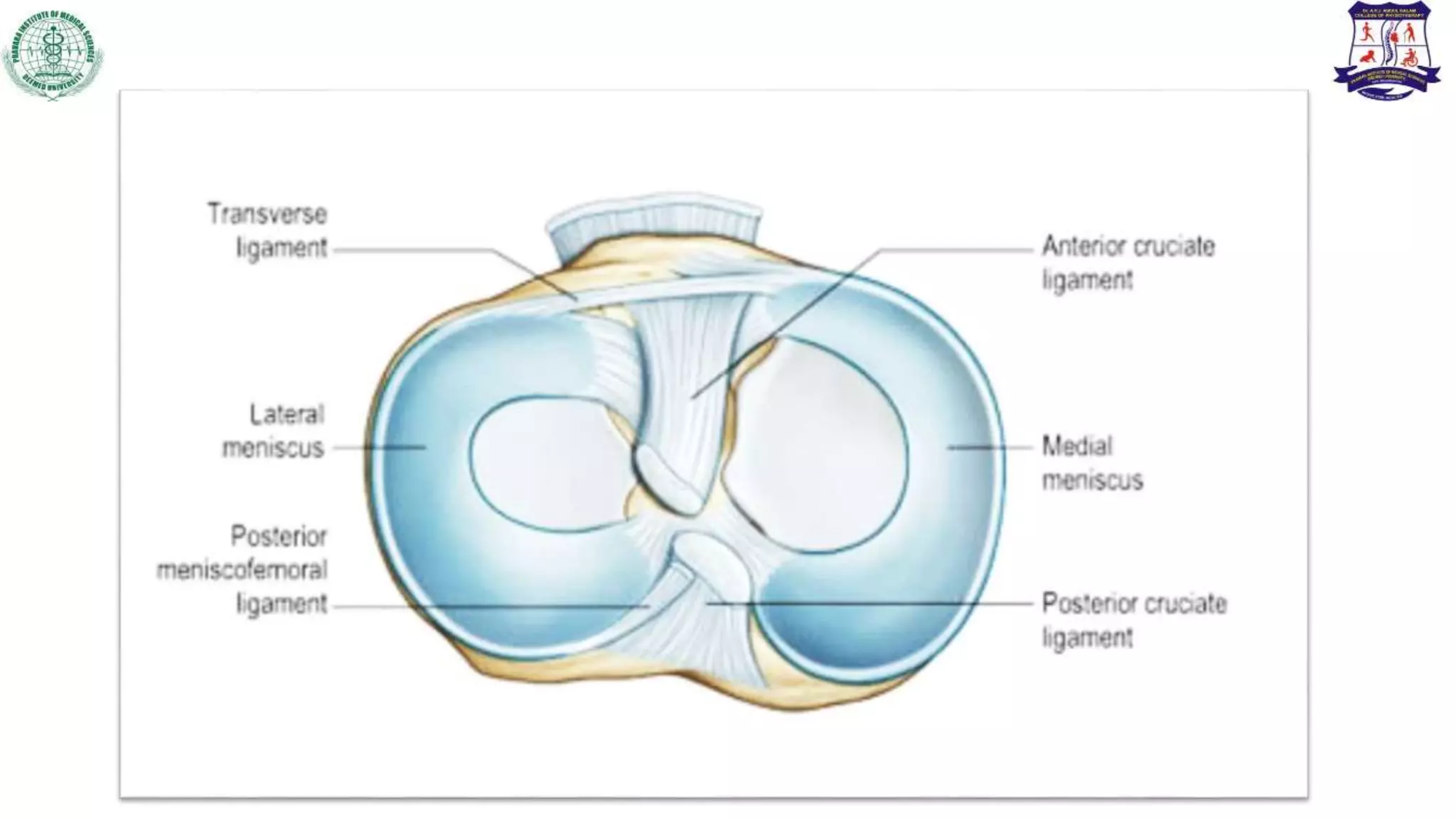
• The menisci are two fibrocartilaginous discs.
• They are shaped like cresents.
• The medial meniscus is ‘c’ shaped (semi-circular) and the lateral
meniscus is nearly circular.
• Anterior and posterior end of the menisci are attached to the tibia
and refered as anterior and posterior horn.
• Outer boreder of menisci is thick and convex while inner boreder is
thin and concave.
• The upper surface is concave for articulation with femur and lower
surface is flat lies on the tibial condyles.
• Meniscus is composed of type I collagen (90% dry weight) with
variable amounts of types II, III, V, and VI which is responsible for the
tensile strength of the menisci.
• The peripheral 1/3rd of the meniscus is vascular, and supplied by
medial and lateral genicular arteries the inner 2/3rd is avascular and
nourished by synovial fluid.
• Peripheral two-thirds is innervated by Type I and II nerve endings and
the posterior horns have highest concentration of mechanoreceptors
Functions
• Distribute and reduce the compressive load: by increasing the
effective contact area between the femur and the tibia, the menisci
lower the load per- unit area borne by the articular surfaces.
• Reduce pressure on the cartilage : The menisci transmit central
compressive loads out toward the periphery, further decreasing the
contact pressures on the articular cartilage.
• Proprioception - The horns of the menisci and the peripheral
vascularized portion of the meniscal bodies are well innervated with
free nerve endings and mechanoreceptors.
• Increase joint congruency
Menisci Increased congruence and conformity between the
femoral condyles and tibial plateaus
• Shock absorber
Menisci cushion the lower part of the leg from the weight of the rest of
the body.
• Joint lubrication
Types of meniscal tear
• Radial
• Vertical
• Horizontal
• Bucket handle
• Flap
• Root
• Complex
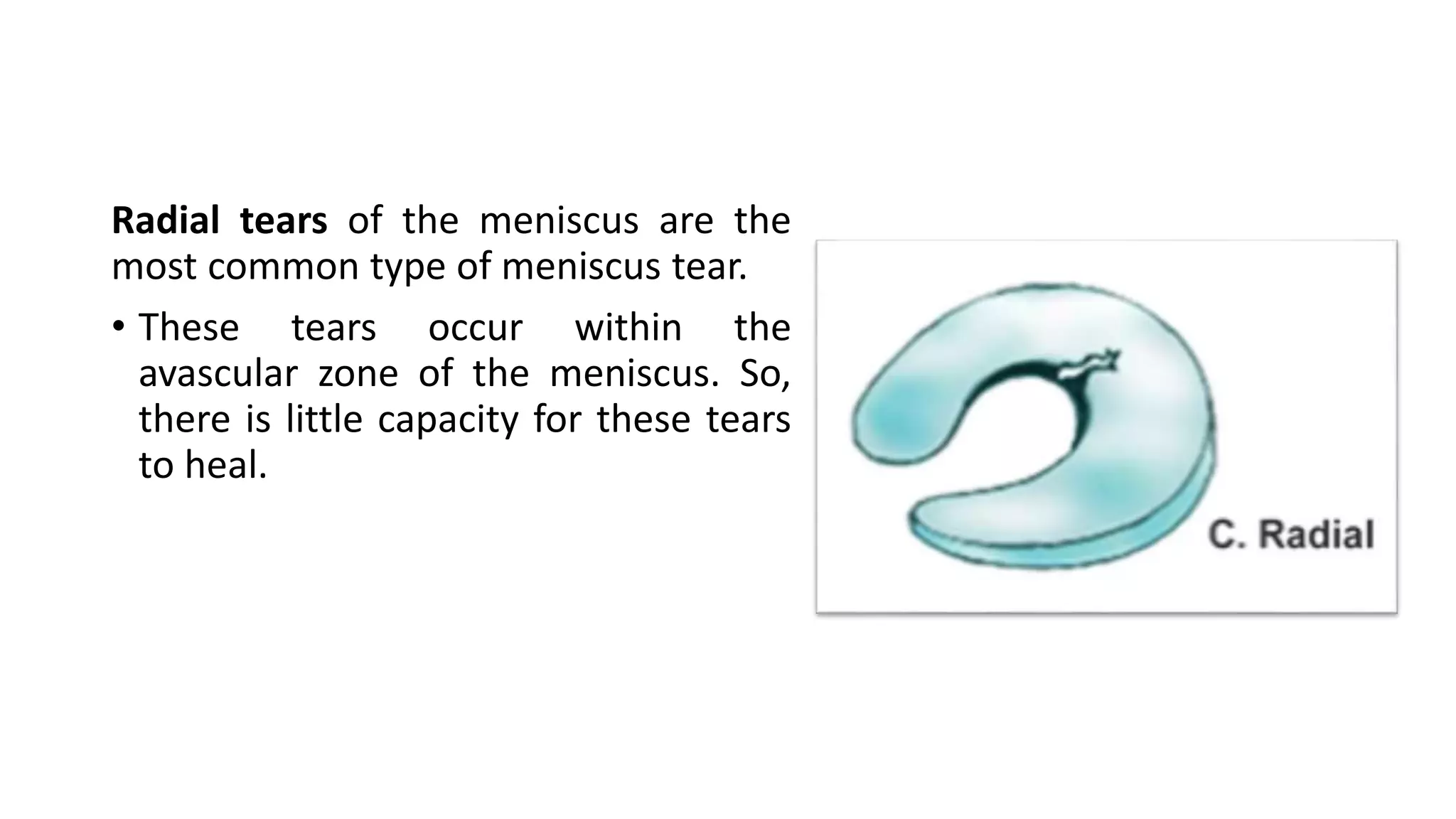
Radial tears of the meniscus are the
most common type of meniscus tear.
• These tears occur within the
avascular zone of the meniscus. So,
there is little capacity for these tears
to heal.
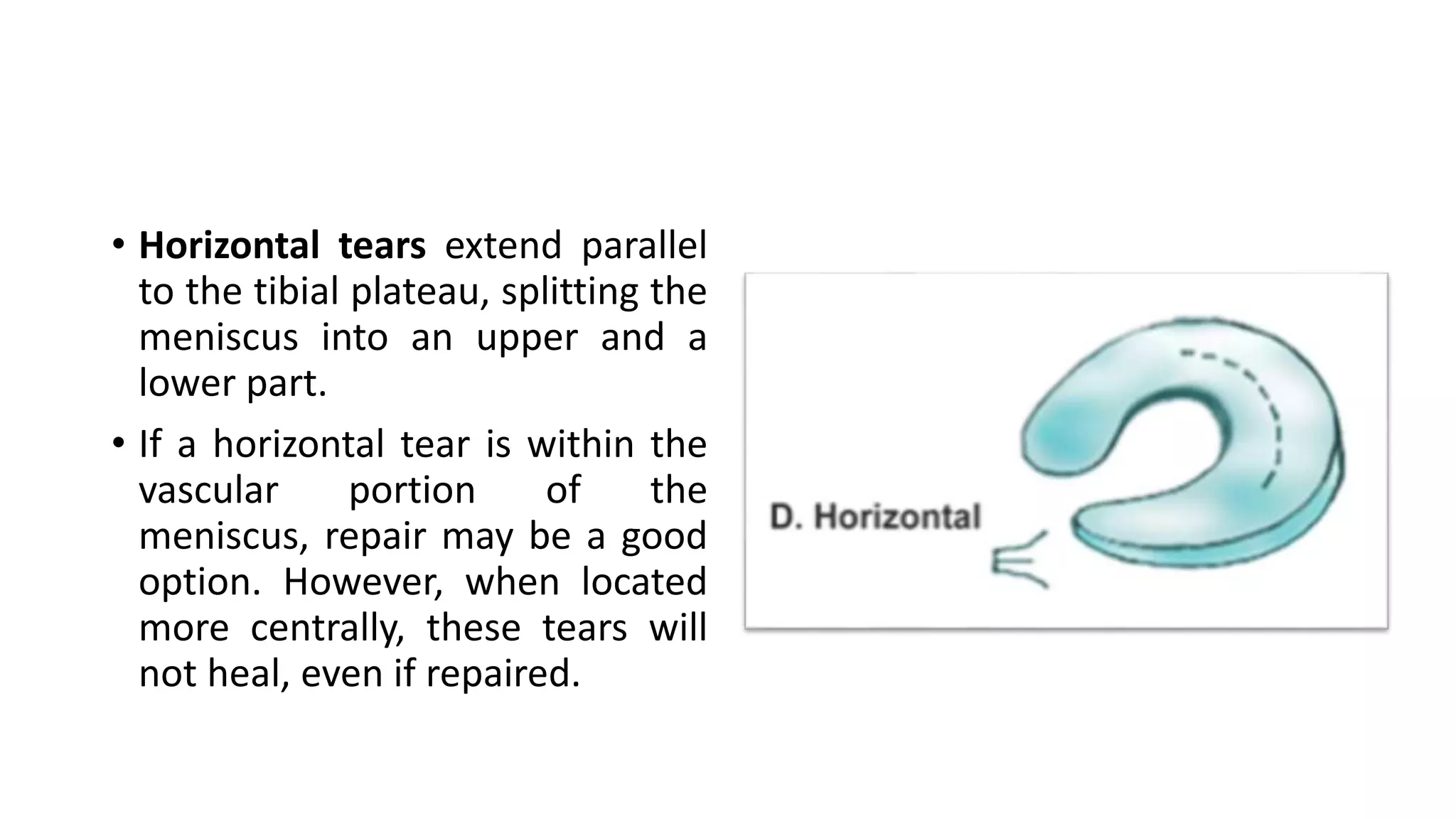
• Horizontal tears extend parallel
to the tibial plateau, splitting the
meniscus into an upper and a
lower part.
• If a horizontal tear is within the
vascular portion of the
meniscus, repair may be a good
option. However, when located
more centrally, these tears will
not heal, even if repaired.
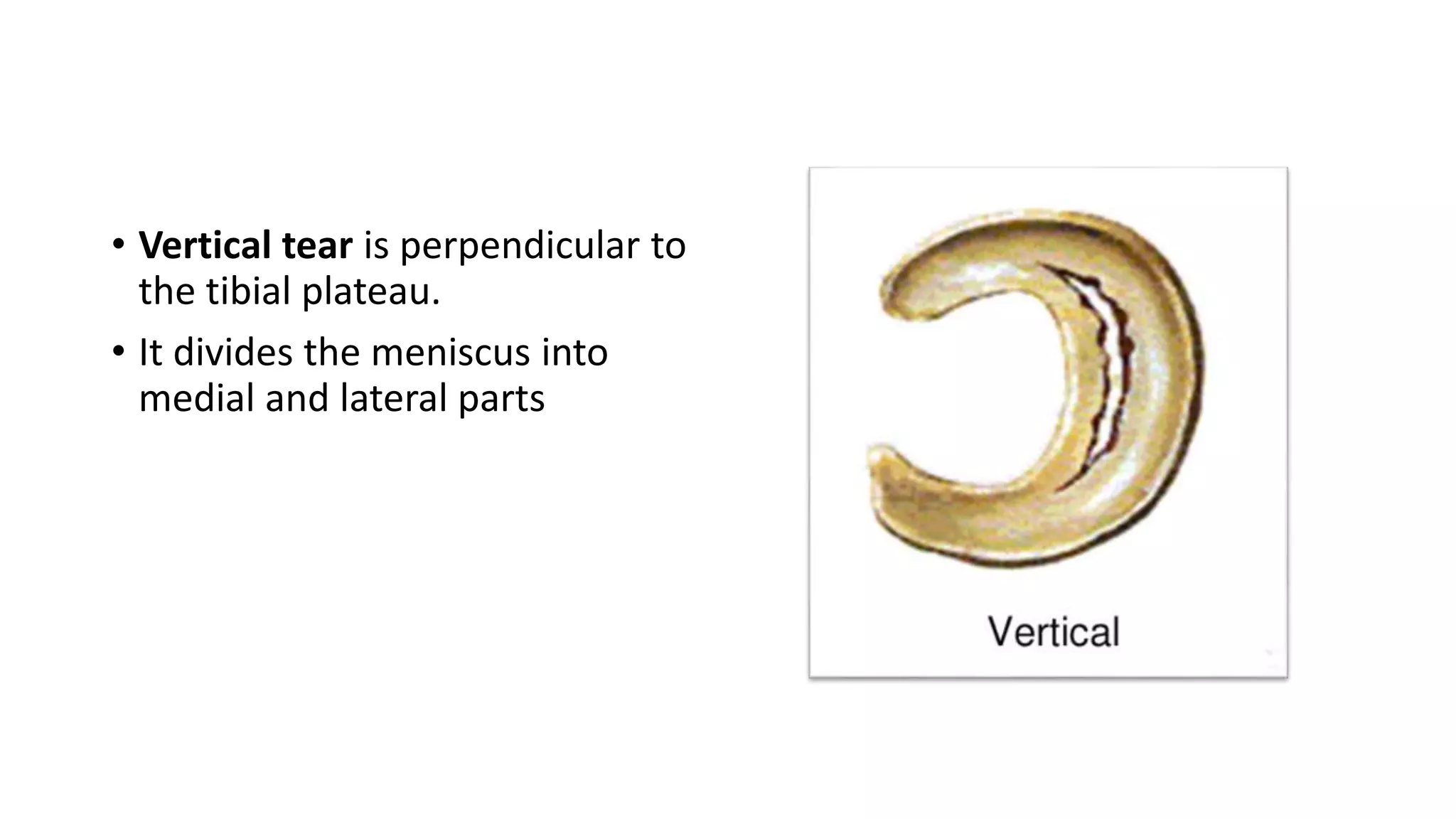
• Vertical tear is perpendicular to
the tibial plateau.
• It divides the meniscus into
medial and lateral parts
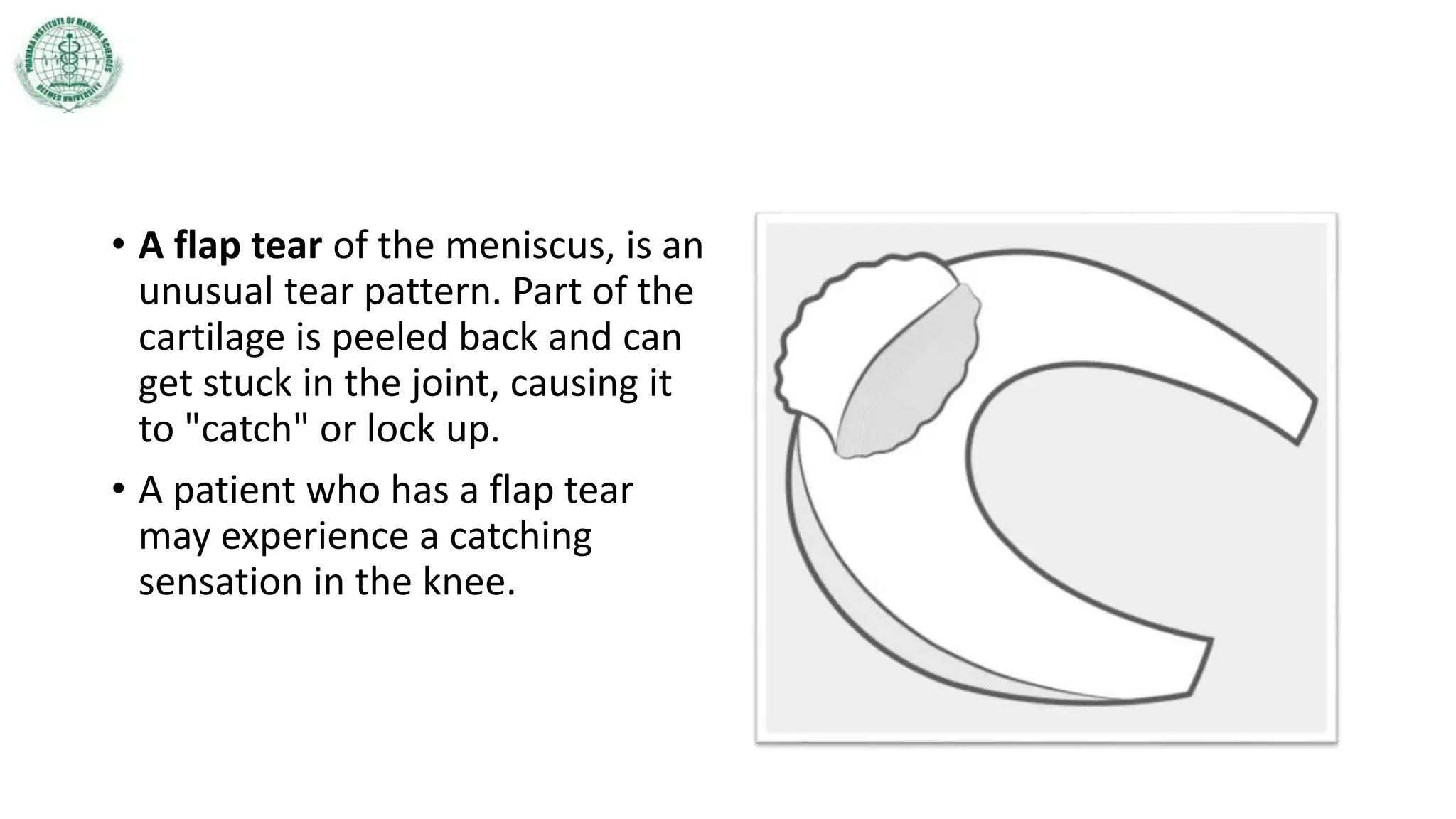
• A flap tear of the meniscus, is an
unusual tear pattern. Part of the
cartilage is peeled back and can
get stuck in the joint, causing it
to "catch" or lock up.
• A patient who has a flap tear
may experience a catching
sensation in the knee.
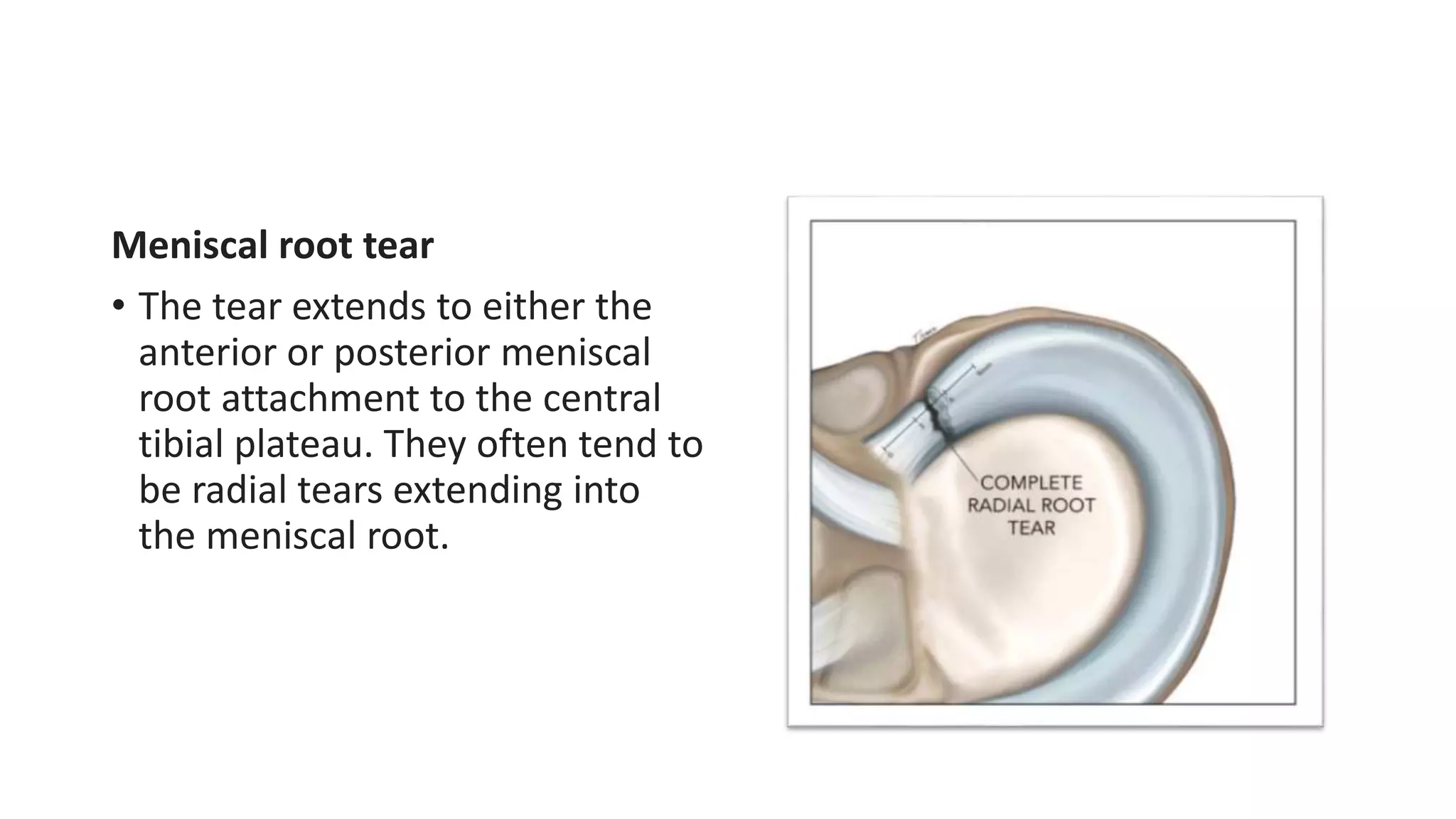
Meniscal root tear
• The tear extends to either the
anterior or posterior meniscal
root attachment to the central
tibial plateau. They often tend to
be radial tears extending into
the meniscal root.
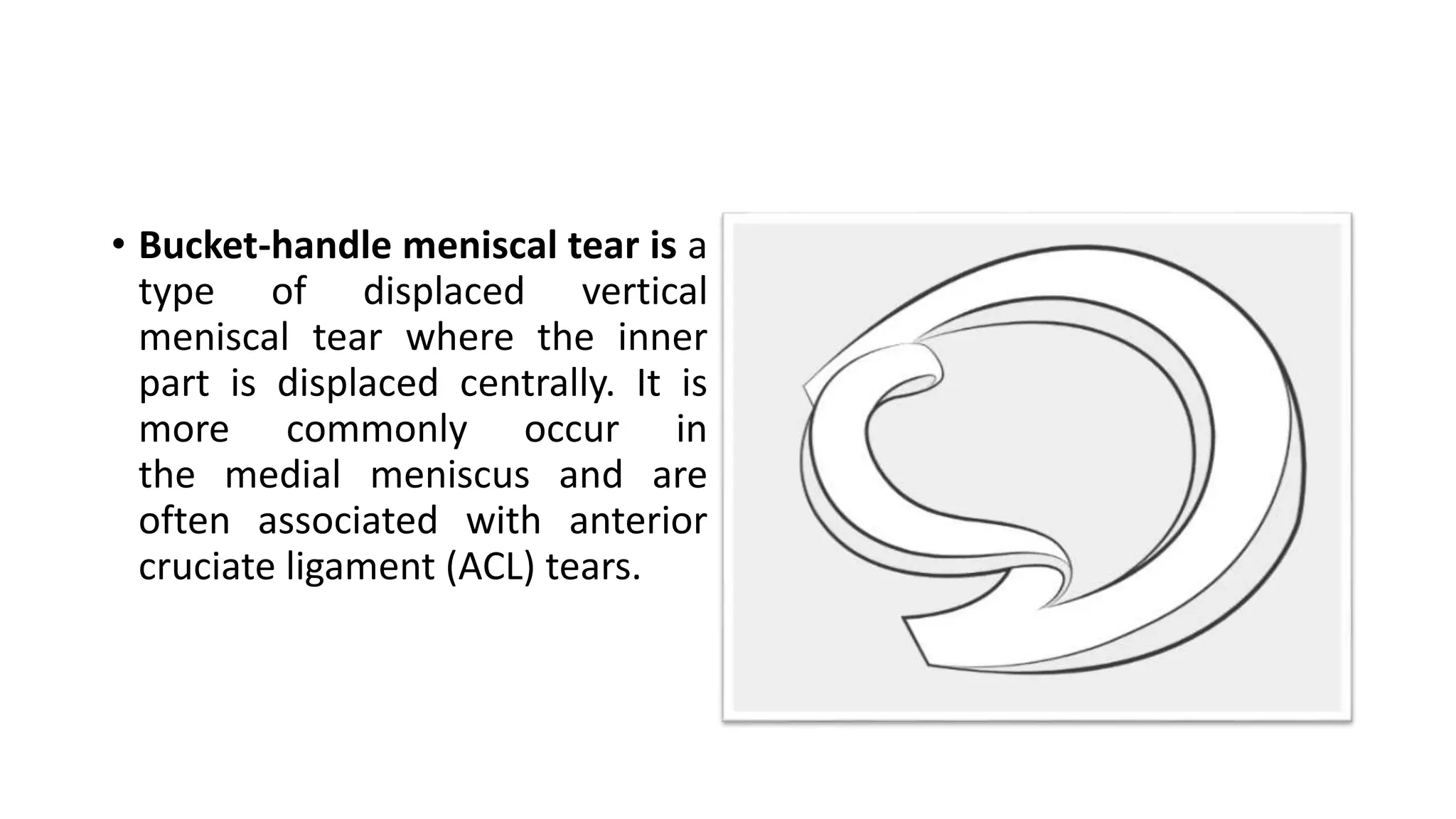
• Bucket-handle meniscal tear is a
type of displaced vertical
meniscal tear where the inner
part is displaced centrally. It is
more commonly occur in
the medial meniscus and are
often associated with anterior
cruciate ligament (ACL) tears.
• A complex meniscus tear
involves several tear patterns,
often involving patterns that are
signs of radial and horizontal
tears.
Etiology
Traumatic
Acute tears Chronic tears
Degenerative
Traumatic
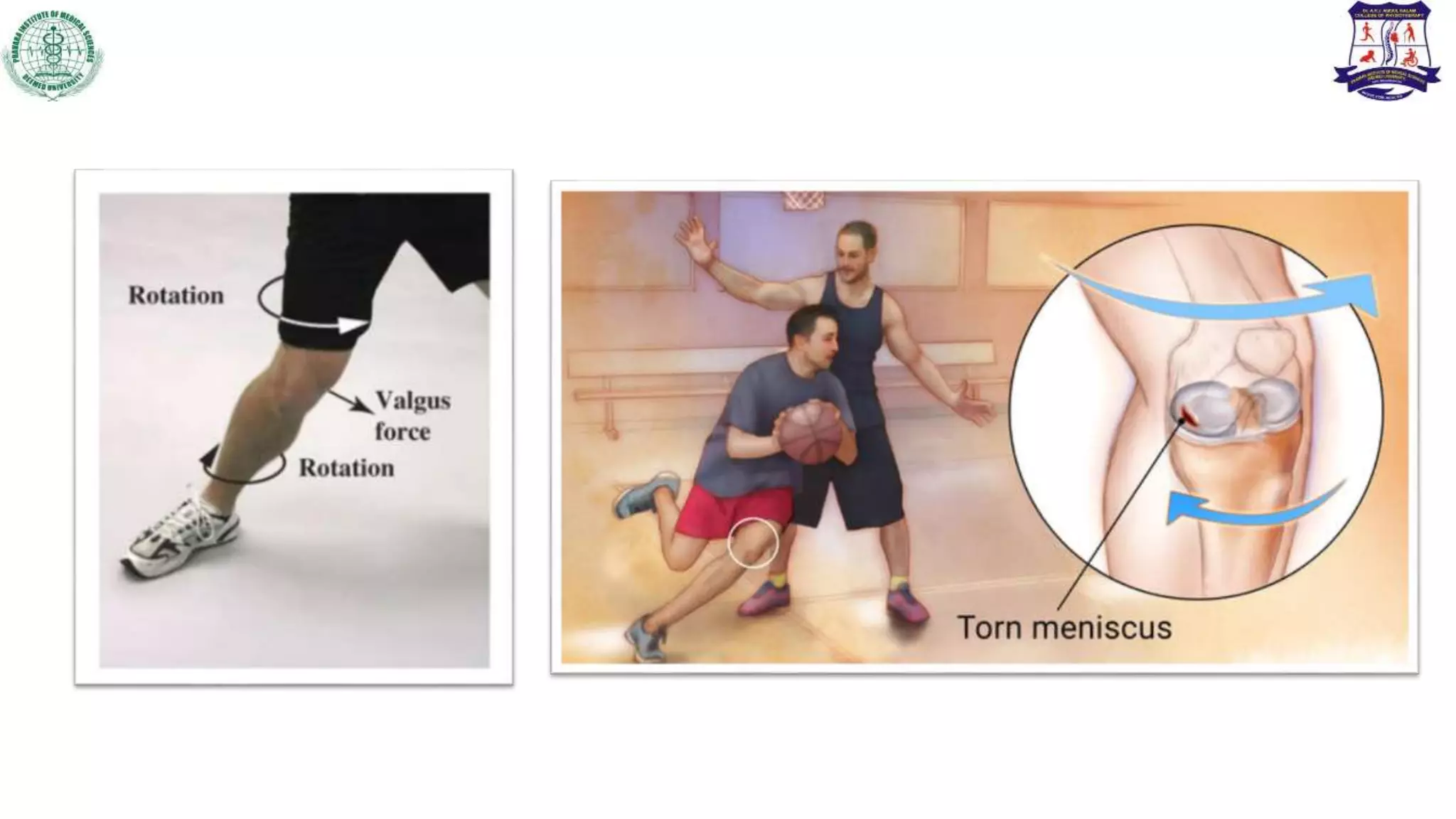
• Traumatic meniscal tears are either due to an excessive force applied
to a ‘normal' meniscus or a normal force (microtrauma) acting
on a degenerative meniscus.
• The most common mechanism of injury is a twisting injury on a semi-
flexed limb through a weight bearing knee.
• It may also be associated with other ligamentous injuries, typically
the ACL and the MCL.
There are two different types of meniscal tears:
• Acute tears - These are commonly the result of a trauma or a
sports injury (sports like tennis, jogging, soccer,…). Acute tears
have different shapes (horizontal, vertical, radial, oblique and
complex).
• If they do not respond to conservative management, surgical
management may be indicated.
• Chronic tears - These most often occur in elderly people, and
are degenerative meniscal tears that occur after minimal trauma
or stress on the knee. They are mostly treated with physical
therapy and anti-inflammatory medication.
Degenerative
• Occurs in the absence of a trauma.
• It Is due to the age of the person and everyday activities.
• The meniscal tissue has deteriorated to a certain degree.
• Men are more prone to a degenerative tear than women.
• A degenerative tear normally occurs in the fourth of the fifth
decade of life.
Mechanism of Injury
Mechanism of injury is a rotational force when a flexed knee extends.
• In young, it can occur only when weight is being taken, knee is flexed
and there is a twisting strain.
• Young active athletes are more prone. In middle life, fibrosis has
decreased the mobility of meniscus and hence tear occurs with less
force.
• In more than 80%, meniscus tears are accompanied by anterior
cruciate ligament (ACL) injury.
• Predisposing factors: These could be abnormal menisci shape,
abnormal stress due to chronic ligament laxity, etc.
Clinical presentation
ON EXAMINATION -
• Joint line tenderness (palpated with the knee flexed at 45–90°)
• Joint effusion: this is usually present, although absence of an effusion
does not necessarily rule out meniscal damage
• Pain: usually present on squatting, especially with posterior horn
tears
• Restricted range of motion of the knee joint: this may be due to the
torn meniscal flap or the effusion.
Investigations
MRI SCAN
CT SCAN
ARTHROSCOPY
SPECIAL TESTS –
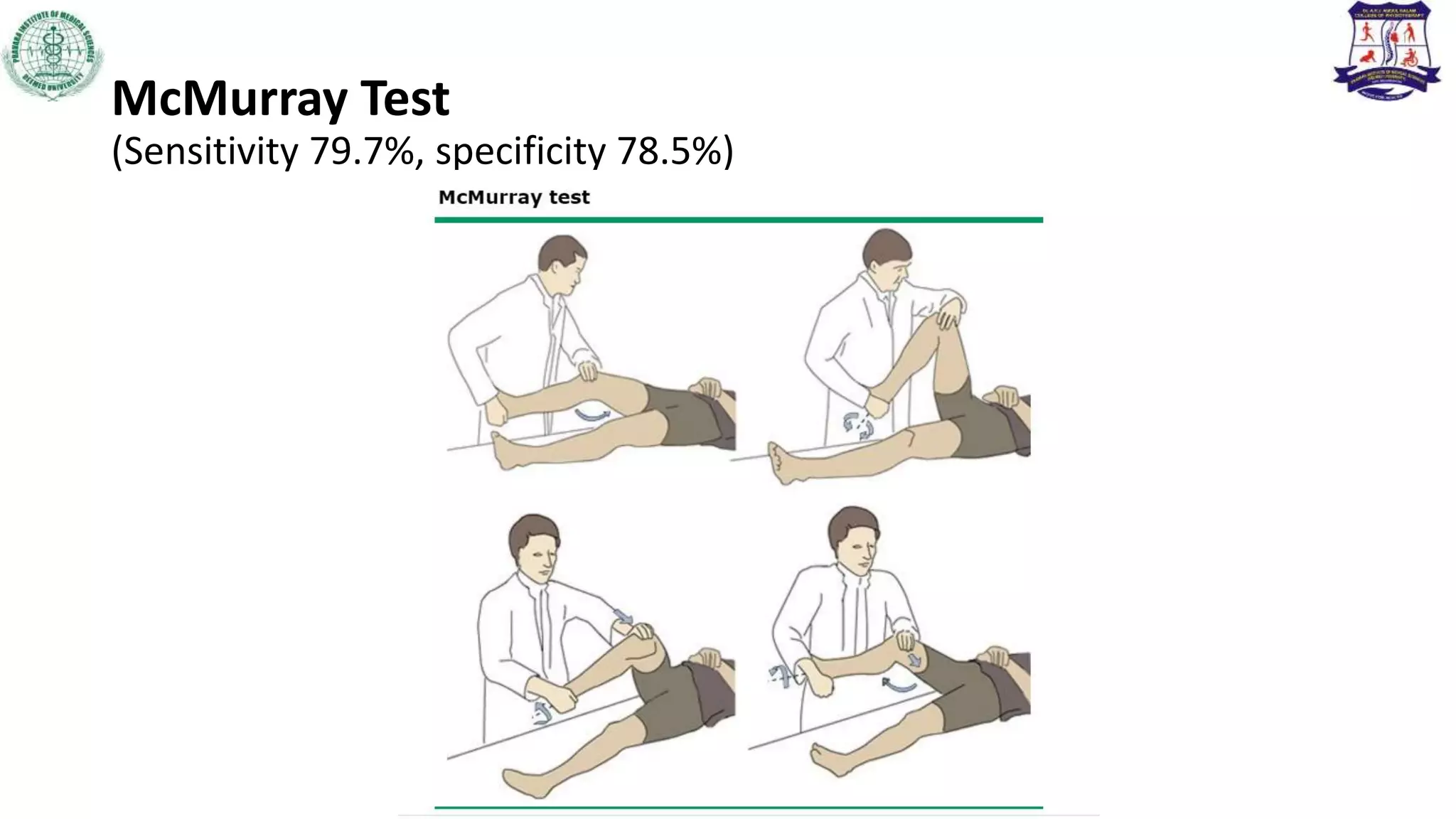
• McMurray Test
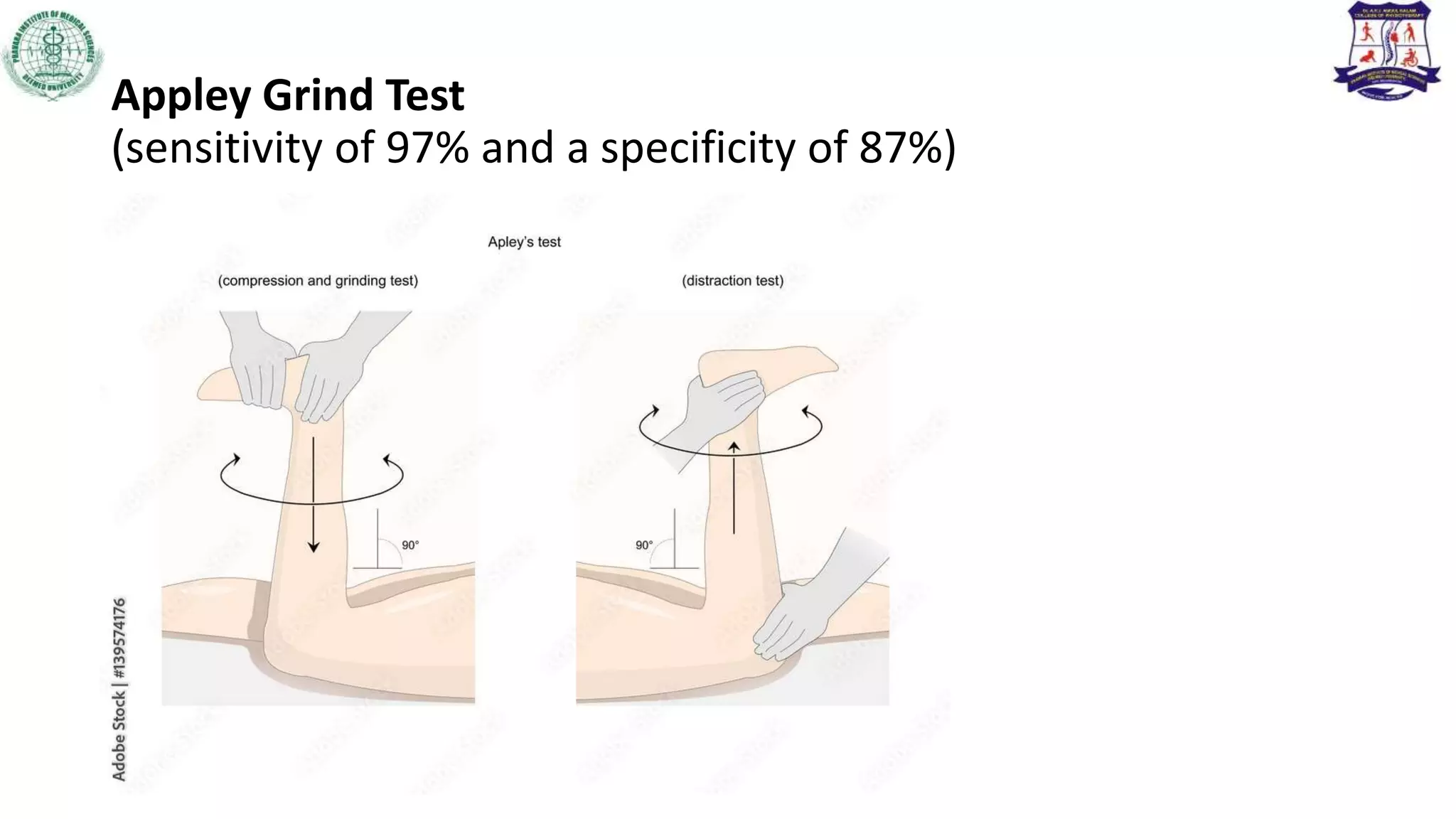
• Appley Grind Test
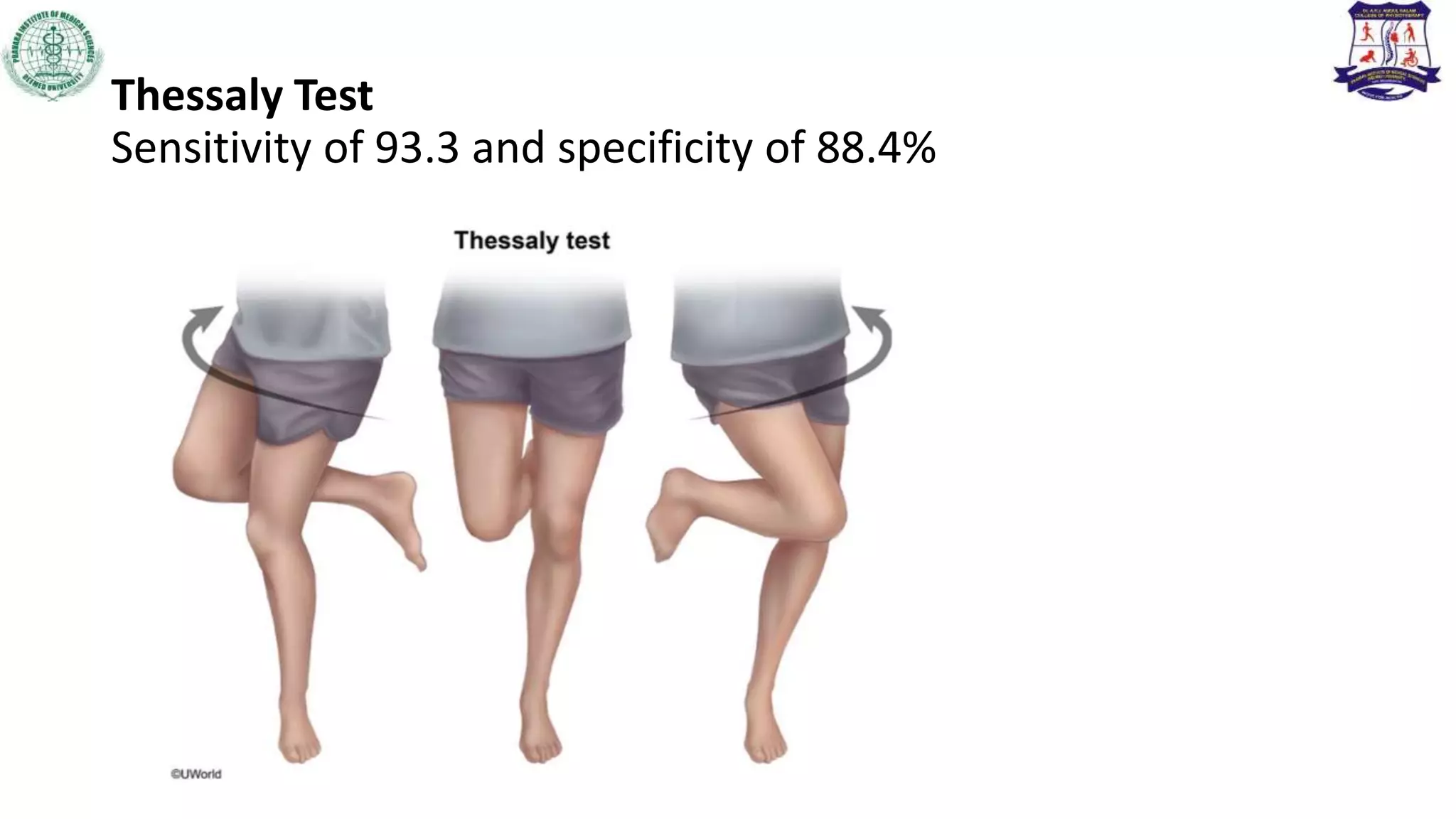
• Thessaly Test
McMurray Test
(Sensitivity 79.7%, specificity 78.5%)
Appley Grind Test
(sensitivity of 97% and a specificity of 87%)
Thessaly Test
Sensitivity of 93.3 and specificity of 88.4%
Differential diagnosis
In superomedial and inferomedial pain –
• Medial collateral injury
• Medial meniscal ligament injury
• Medial Synovial Plica Irritation
In superolateral and inferolateral pain –
• Lateral collateral ligament injury
• IT band syndrome
• Lateral meniscal tear
Anterior
• Patellofemoral Joint Syndromes
• Quadriceps tendinopathy
• Prepatellar bursitis
• Osgood-Schlatter’s disease
• Plica synovialis syndrome
• Knee bursitis/Hoffa’s disease
Posterior
• Lumbosacral radiculopathy
• PCL Injury
• Semi-membranous tendinopathy
• Hamstring strain
Clinical features as a guide for choosing either
conservative or surgical treatment.
Physiotherapy
Rehabilitation
Post-operative
Meniscal
repair
Meniscotomy
Conservative
Conservative Rehabilitation
Acute phase (Up to 1 week post surgery)
Control pain, edema, spasm
• RICE (rest, ice, compression, elevation)
• Cryotherapy 20 minutes every 2 hours for the first 48 to 72
hours
• Immobilize the part (rest, splint, tape, cast).
• Avoid positions of stress to the part.
• Gentle (grade I) joint oscillations with joint in pain-free position.
Maintain soft tissue and joint integrity and mobility -
• Isometrics ( quad sets, hamstring sets ) 15 secs hold – 10 reps
• Passive movements – knee flexion, extension within limit of pain – 10
reps – 3 sets
• Straight leg raise
• Active Aduction /Adduction
Maintain flexibility of soft tissue –
• Passive Stretching of hamstring in supine , quadriceps in
prone(Active/passive) (15 second hold – 6 reps )
Subacute phase (up to 3 weeks)
Promote healing of injured tissues
• Monitor response of tissue to exercise progression; decrease intensity
if inflammation increases.
• Protect healing tissue with assistive devices, splints, tape, or wrap;
• progressively increase amount of time the joint is free to move each
day and decrease use of assistive device as strength in supporting
muscles increases.
Note :- [Weight bearing considerations : Partial weight bearing within
the tolerance of the healing tissues may be used]
Restore soft tissue, muscle, and/or joint mobility
(Progress from passive to active-assistive to active ROM within limits of
pain)
• Active assisted/active
• Heel slides
• Dynamic knee extension
• Hamstring curls
• Straight leg raise
• Seated hamstring stretch (30 second hold)
• Use grade III sustained or grade III and IV oscillation techniques
Chronic phase (more than 3 weeks)
Continue stretching and mobility exercises
To improve strength
• Resisted exercise for hip and knee muscles with weight cuffs ( ½ to
2kg )
To improve functional status
• Squats, Lunges, Step ups, Step down
3 sets x 10 reps. 3 days per week with 1/2- day rest between
(approx. 30- 40% max weight)
Stationary Bicycle – to improve cardiovascular endurance
• Proprioceptive training
• Double limb standing balance utilizing uneven surface (wobble board)
• Single limb balance progress to uneven surface including perturbation
training
Rehabilitation after meniscal repair
Phase 1: Maximum Protection-Weeks 1-6
(Partial weight bearing as tolerated - Brace locked, crutches)
Goals :-
To Protect repair
To Reduce swelling, minimize pain
To Restore patellar mobility
Restore full extension
• ROM < 90 degrees up to 3 weeks- Gradual increase in flexion ROM is
based on assessment of pain.
• Ice, compression, elevation
• Electrical muscle stimulation - Supine knee extended
(2500 Hz, 75 bursts) 10 sec, 10 contractions, 2x/week
• Patellar mobilization – superior, inferior and medial,lateral glides
• Seated assisted knee flexion extension and heel slides
• Quadriceps and Hamstring sets
• Multi-angle isometrics 90 and 60 deg knee extension
• Active Hip abduction and adduction.
Stage 1: Immediate Postoperative Day 1-Week 3
Stage 2: Weeks 4-6
Additional interventions to phase 1
• Progressive resistance exercises (PREs) -1-5 pounds
• calf raises, mini-squats.
• Cycling (no resistance).
• Low intensity stretches: prone hang, heel prop (30 second hold)
• Seated hamstring stretch (30 second hold)
• Balance/proprioception - Double limb standing balance utilizing
uneven surface (wobble board)
Phase 2: Moderate Protection-Weeks 6-10
Criteria for Progression to Phase II
• ROM 0-90 degrees.
• No change in pain or effusion.
• Quadriceps control ("Good MMT").
Goals
• Increase strength, power, endurance.
• Normalize ROM of knee.
• Prepare patients for advanced exercises.
• Supine active hamstring stretch,
prone quad stretch, standing calf
stretch
• Strength- PRE progress the intensity
• Lateral step-ups
• partial-squats (0-60 degrees)
Cardio
• Endurance Program
• Cycling.
• Pool running
• Swimming (no frog kick).
Coordination Program
• Single limb balance progress to
uneven surface including
perturbation training
• Pool sprinting.
• Backward walking.
Phase 3: Advanced Phase-Weeks 11-15
Criteria for Progression to Phase-3
• Full, nonpainful ROM.
• No pain or tenderness.
• Satisfactory clinical examination.
Goals
• Increase power and endurance.
• Emphasize return-to-skill
activities.
• Prepare for return to full
unrestricted activities
Exercises in addition to phase 3
• Squat to chair
• Single leg progression: partial weight bearing single leg press,, step
ups and step ups with march,
• single leg squats, single leg wall slides
• Gym equipment: seated hamstring curl machine and hamstring curl
machine
Cardio
• Elliptical climber or stair climber
Rehabilitation of Partial meniscectomy
Phase 1 - Acute phase – day 1 to 2 weeks
Weight bearing as tolerated (two crutch)
Goals
• To reduce inflammation and swelling
• Restore range of motion
• Reestablish quadriceps muscle activity
• Cryotherapy
• Light compression wrap
• EMS to quadriceps – In supine with knee extended
(2500 Hz, 75 bursts) 10 sec, 10 contractions, 2x/week
• Knee extension 90-40 degrees
• Knee flexion 0-115 degrees
• Ankle pumps
• Quadriceps sets, Gluteal sets
• Active SLR
• Active Hip abduction, adduction, extension
• Heel slides
• Stationary bike (no resistance, for range of motion only)
• Partial squats
• Stretching: Active assistive range of motion stretching (quadriceps,
gastrocnemius, soleus and hamstring)
• Bicycle (when ROM is 0-102 degree with no swelling)
Phase 2- Internal phase
(2-4 weeks)
Goals
• Restore and improve muscular strength and endurance
• Re-establish full non-painful ROM
• Gradual return to functional activities
(Compression brace may be used during activities)
Additional intervention to phase 2
• Lateral lunges
• Front lunges
• Partial squats
• Leg press (not post 90 degrees)
• Lateral step-ups
• Bicycle for motion and
endurance
• Hamstring curls
• Toe raises
Proprioceptive training
• Double limb standing balance
utilizing uneven surface (wobble
board)
• Single limb balance progress to
uneven surface including
perturbation training
Cardio
• Stationary bicycle
• Pool program (deep water running
and leg exercises)
Phase 3 Advanced activity phase week 4 -7
Criteria for progression in phase 3
• Full , non-painful ROM
• No pain or tenderness
• Satisfactory clinical examination (minimal effusion)
Goals
• Enhance muscular strength and endurance
• Maintain full ROM
• Return to sport/ functional activities
• Continue to emphasize closed-kinetic chain exercise
• May begin plyometrics - jumping, single leg jumping, skipping
• Begin running program
Recent advance
Aquatic vs. land-based exercise after arthroscopic
partial meniscectomy in middle-aged active patients with
a degenerative meniscal tear: A randomized, controlled
study
MuratYesil et.al ,Journal of Orthopaedic Science, Nov 2021
Conclusion: Both AE and LBE programs had significantly
improved pain, function, isokinetic muscle strength, and quality of
life in patients after APM. Either type of exercise is essential as
part of the rehabilitation protocol for good clinical outcomes after
APM and should not be neglected (level II).
References
• S. Brent Brotzman. Kevin E. Wilk. Clinical Orthopedic Rehabilitation. 2nd
edition
• Carolyn Kisner. Lynn Allen Colby. Therapeutic exercise 5th edition
• John Ebnezar. Textbook of Orthopedics. 4th edition
• Peter Brukner. Karim khan. Clinical sports medicine 3rd edition
• MuratYesil et.al Aquatic vs. land-based exercise after arthroscopic
partial meniscectomy in middle-aged active patients with a
degenerative meniscal tear: A randomized, controlled study Journal
of Orthopaedic Science, 27. 1. 11-2021
• Knieslijtage,http://www.knieslijtage.nl/knieaandoeningen/meniscus/
wat-is-een-meniscusscheur,geraadpleegd on 26 November 2011
Thank you

Meniscal injuries and physiotherapy management

  • 1.
  • 2.
    CONTENTS • Anatomy • Typesof meniscal tear • Etiology • Clinical features including (special tests) • Differential diagnosis • Management • Recent advance
  • 3.
    INTRODUCTION • Meniscus injuriesare often seen in athletes as a result of a sports injury and represent approximately 15% of all cases sports injuries. • Medial tears are reported more commonly than lateral tears. • Meniscal injuries are more common in males, because they are more involved in aggressive sporting. Knieslijtage,http://www.knieslijtage.nl/knieaandoeningen/meniscus/wat-is-een- meniscusscheur,geraadpleegd on 26 November 2011
  • 5.
    Anatomy of menisci •The menisci are two fibrocartilaginous discs. • They are shaped like cresents. • The medial meniscus is ‘c’ shaped (semi-circular) and the lateral meniscus is nearly circular. • Anterior and posterior end of the menisci are attached to the tibia and refered as anterior and posterior horn. • Outer boreder of menisci is thick and convex while inner boreder is thin and concave.
  • 6.
    • The uppersurface is concave for articulation with femur and lower surface is flat lies on the tibial condyles. • Meniscus is composed of type I collagen (90% dry weight) with variable amounts of types II, III, V, and VI which is responsible for the tensile strength of the menisci. • The peripheral 1/3rd of the meniscus is vascular, and supplied by medial and lateral genicular arteries the inner 2/3rd is avascular and nourished by synovial fluid. • Peripheral two-thirds is innervated by Type I and II nerve endings and the posterior horns have highest concentration of mechanoreceptors
  • 7.
    Functions • Distribute andreduce the compressive load: by increasing the effective contact area between the femur and the tibia, the menisci lower the load per- unit area borne by the articular surfaces. • Reduce pressure on the cartilage : The menisci transmit central compressive loads out toward the periphery, further decreasing the contact pressures on the articular cartilage. • Proprioception - The horns of the menisci and the peripheral vascularized portion of the meniscal bodies are well innervated with free nerve endings and mechanoreceptors.
  • 8.
    • Increase jointcongruency Menisci Increased congruence and conformity between the femoral condyles and tibial plateaus • Shock absorber Menisci cushion the lower part of the leg from the weight of the rest of the body. • Joint lubrication
  • 9.
    Types of meniscaltear • Radial • Vertical • Horizontal • Bucket handle • Flap • Root • Complex
  • 10.
    Radial tears ofthe meniscus are the most common type of meniscus tear. • These tears occur within the avascular zone of the meniscus. So, there is little capacity for these tears to heal.
  • 11.
    • Horizontal tearsextend parallel to the tibial plateau, splitting the meniscus into an upper and a lower part. • If a horizontal tear is within the vascular portion of the meniscus, repair may be a good option. However, when located more centrally, these tears will not heal, even if repaired.
  • 12.
    • Vertical tearis perpendicular to the tibial plateau. • It divides the meniscus into medial and lateral parts
  • 13.
    • A flaptear of the meniscus, is an unusual tear pattern. Part of the cartilage is peeled back and can get stuck in the joint, causing it to "catch" or lock up. • A patient who has a flap tear may experience a catching sensation in the knee.
  • 14.
    Meniscal root tear •The tear extends to either the anterior or posterior meniscal root attachment to the central tibial plateau. They often tend to be radial tears extending into the meniscal root.
  • 15.
    • Bucket-handle meniscaltear is a type of displaced vertical meniscal tear where the inner part is displaced centrally. It is more commonly occur in the medial meniscus and are often associated with anterior cruciate ligament (ACL) tears.
  • 16.
    • A complexmeniscus tear involves several tear patterns, often involving patterns that are signs of radial and horizontal tears.
  • 17.
  • 18.
    Traumatic • Traumatic meniscaltears are either due to an excessive force applied to a ‘normal' meniscus or a normal force (microtrauma) acting on a degenerative meniscus. • The most common mechanism of injury is a twisting injury on a semi- flexed limb through a weight bearing knee. • It may also be associated with other ligamentous injuries, typically the ACL and the MCL.
  • 19.
    There are twodifferent types of meniscal tears: • Acute tears - These are commonly the result of a trauma or a sports injury (sports like tennis, jogging, soccer,…). Acute tears have different shapes (horizontal, vertical, radial, oblique and complex). • If they do not respond to conservative management, surgical management may be indicated.
  • 20.
    • Chronic tears- These most often occur in elderly people, and are degenerative meniscal tears that occur after minimal trauma or stress on the knee. They are mostly treated with physical therapy and anti-inflammatory medication.
  • 21.
    Degenerative • Occurs inthe absence of a trauma. • It Is due to the age of the person and everyday activities. • The meniscal tissue has deteriorated to a certain degree. • Men are more prone to a degenerative tear than women. • A degenerative tear normally occurs in the fourth of the fifth decade of life.
  • 22.
    Mechanism of Injury Mechanismof injury is a rotational force when a flexed knee extends. • In young, it can occur only when weight is being taken, knee is flexed and there is a twisting strain. • Young active athletes are more prone. In middle life, fibrosis has decreased the mobility of meniscus and hence tear occurs with less force. • In more than 80%, meniscus tears are accompanied by anterior cruciate ligament (ACL) injury. • Predisposing factors: These could be abnormal menisci shape, abnormal stress due to chronic ligament laxity, etc.
  • 24.
    Clinical presentation ON EXAMINATION- • Joint line tenderness (palpated with the knee flexed at 45–90°) • Joint effusion: this is usually present, although absence of an effusion does not necessarily rule out meniscal damage • Pain: usually present on squatting, especially with posterior horn tears • Restricted range of motion of the knee joint: this may be due to the torn meniscal flap or the effusion.
  • 25.
    Investigations MRI SCAN CT SCAN ARTHROSCOPY SPECIALTESTS – • McMurray Test • Appley Grind Test • Thessaly Test
  • 26.
  • 27.
    Appley Grind Test (sensitivityof 97% and a specificity of 87%)
  • 28.
    Thessaly Test Sensitivity of93.3 and specificity of 88.4%
  • 29.
    Differential diagnosis In superomedialand inferomedial pain – • Medial collateral injury • Medial meniscal ligament injury • Medial Synovial Plica Irritation In superolateral and inferolateral pain – • Lateral collateral ligament injury • IT band syndrome • Lateral meniscal tear
  • 30.
    Anterior • Patellofemoral JointSyndromes • Quadriceps tendinopathy • Prepatellar bursitis • Osgood-Schlatter’s disease • Plica synovialis syndrome • Knee bursitis/Hoffa’s disease Posterior • Lumbosacral radiculopathy • PCL Injury • Semi-membranous tendinopathy • Hamstring strain
  • 31.
    Clinical features asa guide for choosing either conservative or surgical treatment.
  • 32.
  • 33.
    Conservative Rehabilitation Acute phase(Up to 1 week post surgery) Control pain, edema, spasm • RICE (rest, ice, compression, elevation) • Cryotherapy 20 minutes every 2 hours for the first 48 to 72 hours • Immobilize the part (rest, splint, tape, cast). • Avoid positions of stress to the part. • Gentle (grade I) joint oscillations with joint in pain-free position.
  • 34.
    Maintain soft tissueand joint integrity and mobility - • Isometrics ( quad sets, hamstring sets ) 15 secs hold – 10 reps • Passive movements – knee flexion, extension within limit of pain – 10 reps – 3 sets • Straight leg raise • Active Aduction /Adduction Maintain flexibility of soft tissue – • Passive Stretching of hamstring in supine , quadriceps in prone(Active/passive) (15 second hold – 6 reps )
  • 35.
    Subacute phase (upto 3 weeks) Promote healing of injured tissues • Monitor response of tissue to exercise progression; decrease intensity if inflammation increases. • Protect healing tissue with assistive devices, splints, tape, or wrap; • progressively increase amount of time the joint is free to move each day and decrease use of assistive device as strength in supporting muscles increases. Note :- [Weight bearing considerations : Partial weight bearing within the tolerance of the healing tissues may be used]
  • 36.
    Restore soft tissue,muscle, and/or joint mobility (Progress from passive to active-assistive to active ROM within limits of pain) • Active assisted/active • Heel slides • Dynamic knee extension • Hamstring curls • Straight leg raise • Seated hamstring stretch (30 second hold) • Use grade III sustained or grade III and IV oscillation techniques
  • 37.
    Chronic phase (morethan 3 weeks) Continue stretching and mobility exercises To improve strength • Resisted exercise for hip and knee muscles with weight cuffs ( ½ to 2kg ) To improve functional status • Squats, Lunges, Step ups, Step down 3 sets x 10 reps. 3 days per week with 1/2- day rest between (approx. 30- 40% max weight) Stationary Bicycle – to improve cardiovascular endurance
  • 38.
    • Proprioceptive training •Double limb standing balance utilizing uneven surface (wobble board) • Single limb balance progress to uneven surface including perturbation training
  • 39.
  • 40.
    Phase 1: MaximumProtection-Weeks 1-6 (Partial weight bearing as tolerated - Brace locked, crutches) Goals :- To Protect repair To Reduce swelling, minimize pain To Restore patellar mobility Restore full extension • ROM < 90 degrees up to 3 weeks- Gradual increase in flexion ROM is based on assessment of pain.
  • 41.
    • Ice, compression,elevation • Electrical muscle stimulation - Supine knee extended (2500 Hz, 75 bursts) 10 sec, 10 contractions, 2x/week • Patellar mobilization – superior, inferior and medial,lateral glides • Seated assisted knee flexion extension and heel slides • Quadriceps and Hamstring sets • Multi-angle isometrics 90 and 60 deg knee extension • Active Hip abduction and adduction. Stage 1: Immediate Postoperative Day 1-Week 3
  • 42.
    Stage 2: Weeks4-6 Additional interventions to phase 1 • Progressive resistance exercises (PREs) -1-5 pounds • calf raises, mini-squats. • Cycling (no resistance). • Low intensity stretches: prone hang, heel prop (30 second hold) • Seated hamstring stretch (30 second hold) • Balance/proprioception - Double limb standing balance utilizing uneven surface (wobble board)
  • 43.
    Phase 2: ModerateProtection-Weeks 6-10 Criteria for Progression to Phase II • ROM 0-90 degrees. • No change in pain or effusion. • Quadriceps control ("Good MMT"). Goals • Increase strength, power, endurance. • Normalize ROM of knee. • Prepare patients for advanced exercises.
  • 44.
    • Supine activehamstring stretch, prone quad stretch, standing calf stretch • Strength- PRE progress the intensity • Lateral step-ups • partial-squats (0-60 degrees) Cardio • Endurance Program • Cycling. • Pool running • Swimming (no frog kick). Coordination Program • Single limb balance progress to uneven surface including perturbation training • Pool sprinting. • Backward walking.
  • 45.
    Phase 3: AdvancedPhase-Weeks 11-15 Criteria for Progression to Phase-3 • Full, nonpainful ROM. • No pain or tenderness. • Satisfactory clinical examination. Goals • Increase power and endurance. • Emphasize return-to-skill activities. • Prepare for return to full unrestricted activities
  • 46.
    Exercises in additionto phase 3 • Squat to chair • Single leg progression: partial weight bearing single leg press,, step ups and step ups with march, • single leg squats, single leg wall slides • Gym equipment: seated hamstring curl machine and hamstring curl machine Cardio • Elliptical climber or stair climber
  • 47.
    Rehabilitation of Partialmeniscectomy Phase 1 - Acute phase – day 1 to 2 weeks Weight bearing as tolerated (two crutch) Goals • To reduce inflammation and swelling • Restore range of motion • Reestablish quadriceps muscle activity
  • 48.
    • Cryotherapy • Lightcompression wrap • EMS to quadriceps – In supine with knee extended (2500 Hz, 75 bursts) 10 sec, 10 contractions, 2x/week • Knee extension 90-40 degrees • Knee flexion 0-115 degrees • Ankle pumps • Quadriceps sets, Gluteal sets • Active SLR • Active Hip abduction, adduction, extension • Heel slides
  • 49.
    • Stationary bike(no resistance, for range of motion only) • Partial squats • Stretching: Active assistive range of motion stretching (quadriceps, gastrocnemius, soleus and hamstring) • Bicycle (when ROM is 0-102 degree with no swelling)
  • 50.
    Phase 2- Internalphase (2-4 weeks) Goals • Restore and improve muscular strength and endurance • Re-establish full non-painful ROM • Gradual return to functional activities (Compression brace may be used during activities)
  • 51.
    Additional intervention tophase 2 • Lateral lunges • Front lunges • Partial squats • Leg press (not post 90 degrees) • Lateral step-ups • Bicycle for motion and endurance • Hamstring curls • Toe raises Proprioceptive training • Double limb standing balance utilizing uneven surface (wobble board) • Single limb balance progress to uneven surface including perturbation training Cardio • Stationary bicycle • Pool program (deep water running and leg exercises)
  • 52.
    Phase 3 Advancedactivity phase week 4 -7 Criteria for progression in phase 3 • Full , non-painful ROM • No pain or tenderness • Satisfactory clinical examination (minimal effusion) Goals • Enhance muscular strength and endurance • Maintain full ROM • Return to sport/ functional activities
  • 53.
    • Continue toemphasize closed-kinetic chain exercise • May begin plyometrics - jumping, single leg jumping, skipping • Begin running program
  • 54.
    Recent advance Aquatic vs.land-based exercise after arthroscopic partial meniscectomy in middle-aged active patients with a degenerative meniscal tear: A randomized, controlled study MuratYesil et.al ,Journal of Orthopaedic Science, Nov 2021 Conclusion: Both AE and LBE programs had significantly improved pain, function, isokinetic muscle strength, and quality of life in patients after APM. Either type of exercise is essential as part of the rehabilitation protocol for good clinical outcomes after APM and should not be neglected (level II).
  • 55.
    References • S. BrentBrotzman. Kevin E. Wilk. Clinical Orthopedic Rehabilitation. 2nd edition • Carolyn Kisner. Lynn Allen Colby. Therapeutic exercise 5th edition • John Ebnezar. Textbook of Orthopedics. 4th edition • Peter Brukner. Karim khan. Clinical sports medicine 3rd edition • MuratYesil et.al Aquatic vs. land-based exercise after arthroscopic partial meniscectomy in middle-aged active patients with a degenerative meniscal tear: A randomized, controlled study Journal of Orthopaedic Science, 27. 1. 11-2021 • Knieslijtage,http://www.knieslijtage.nl/knieaandoeningen/meniscus/ wat-is-een-meniscusscheur,geraadpleegd on 26 November 2011
  • 56.