Intertrochanteric Fracture
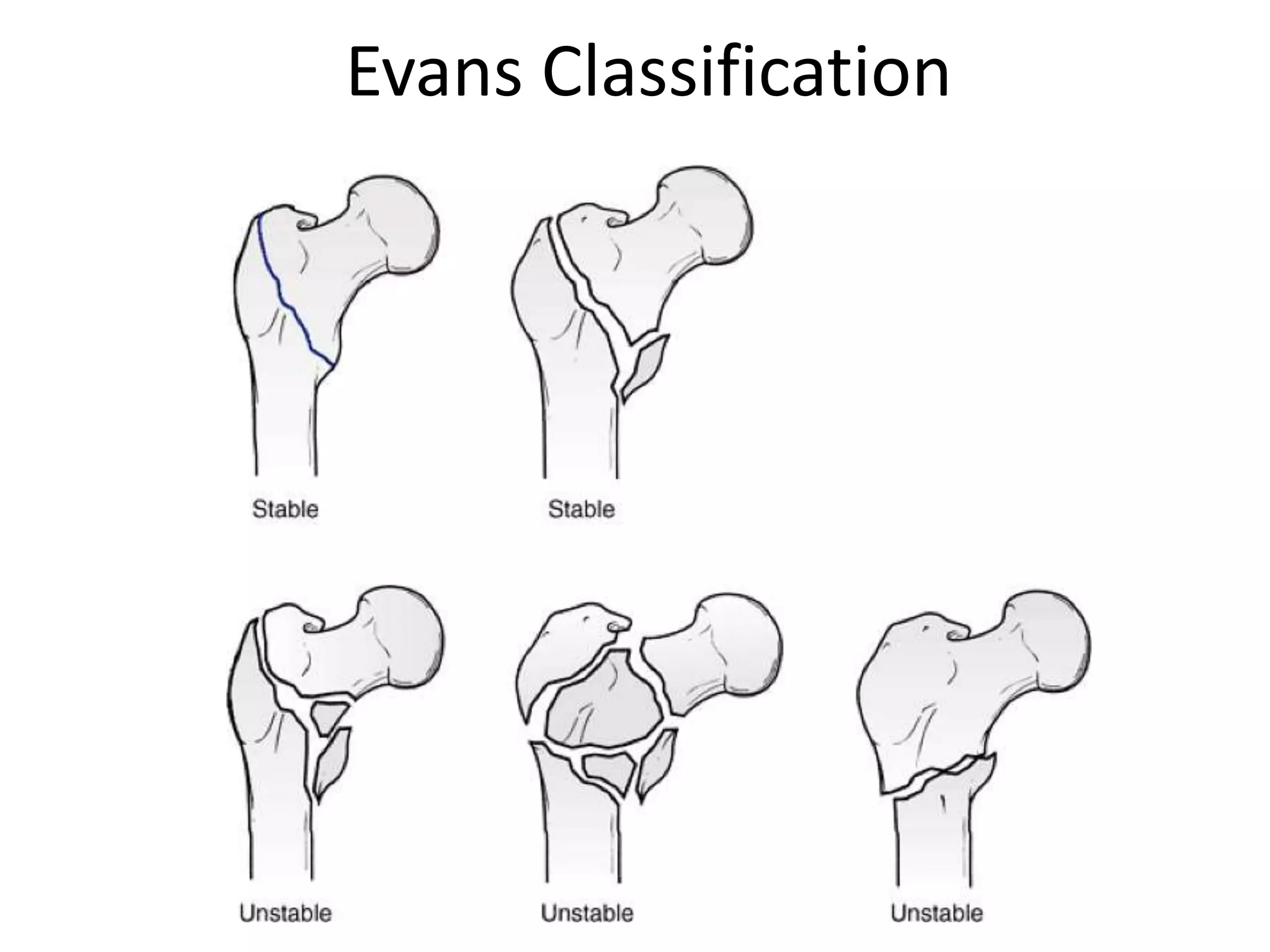
Evans Classification
• In stable fracture patterns, the posteromedial
cortex remains intact or has minimal
comminution, making it possible to obtain a
stable reduction.
• Unstable fracture patterns are characterized by
greater comminution of the posteromedial
cortex.
• The reverse obliquity pattern is inherently
unstable because of the tendency for medial
displacement of the femoral shaft.
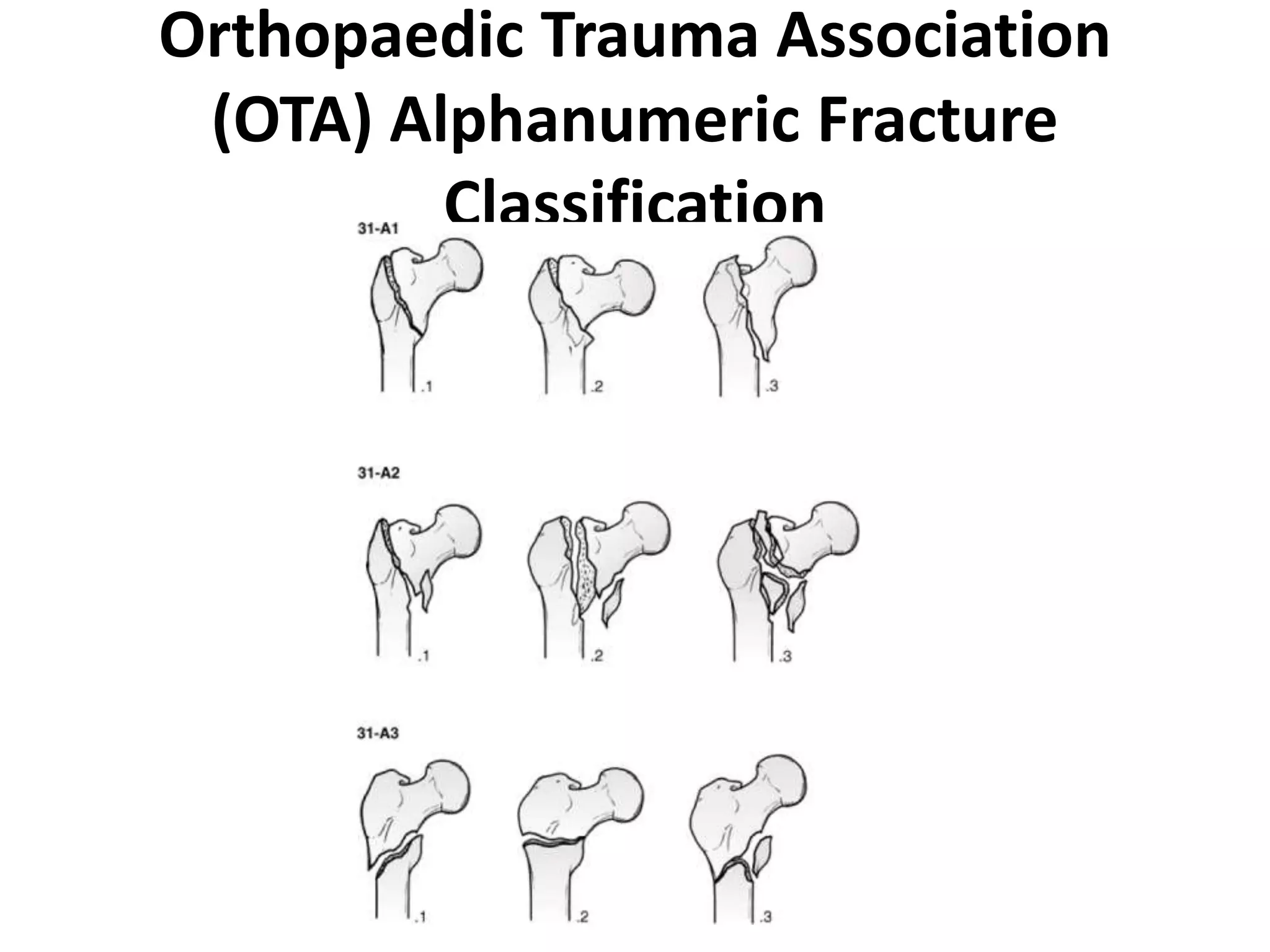
Orthopaedic Trauma Association (OTA)
Alphanumeric Fracture Classification
• 31-A Femur, proximal
trochanteric
• 31-A1 Peritrochanteric
simple
• 31-A1.1Along
intertrochanteric line
• 31-A1.2Through greater
trochanter
• 31-A1.3Below lesser
trochanter
• 31-A2 Peritrochanteric
multifragmentary
• 31-A2.1With one
intermediate fragment
• 31-A2.2With several
intermediate fragments
• 31-A2.3Extending more
than 1 cm below lesser
trochanter
• 31-A3 Intertrochanteric
• 31-A3.1Simple oblique
• 31-A3.2Simple transverse
• 31-A3.3Multifragmentary
Orthopaedic Trauma Association
(OTA) Alphanumeric Fracture
Classification
Subtrochanteric Fractures
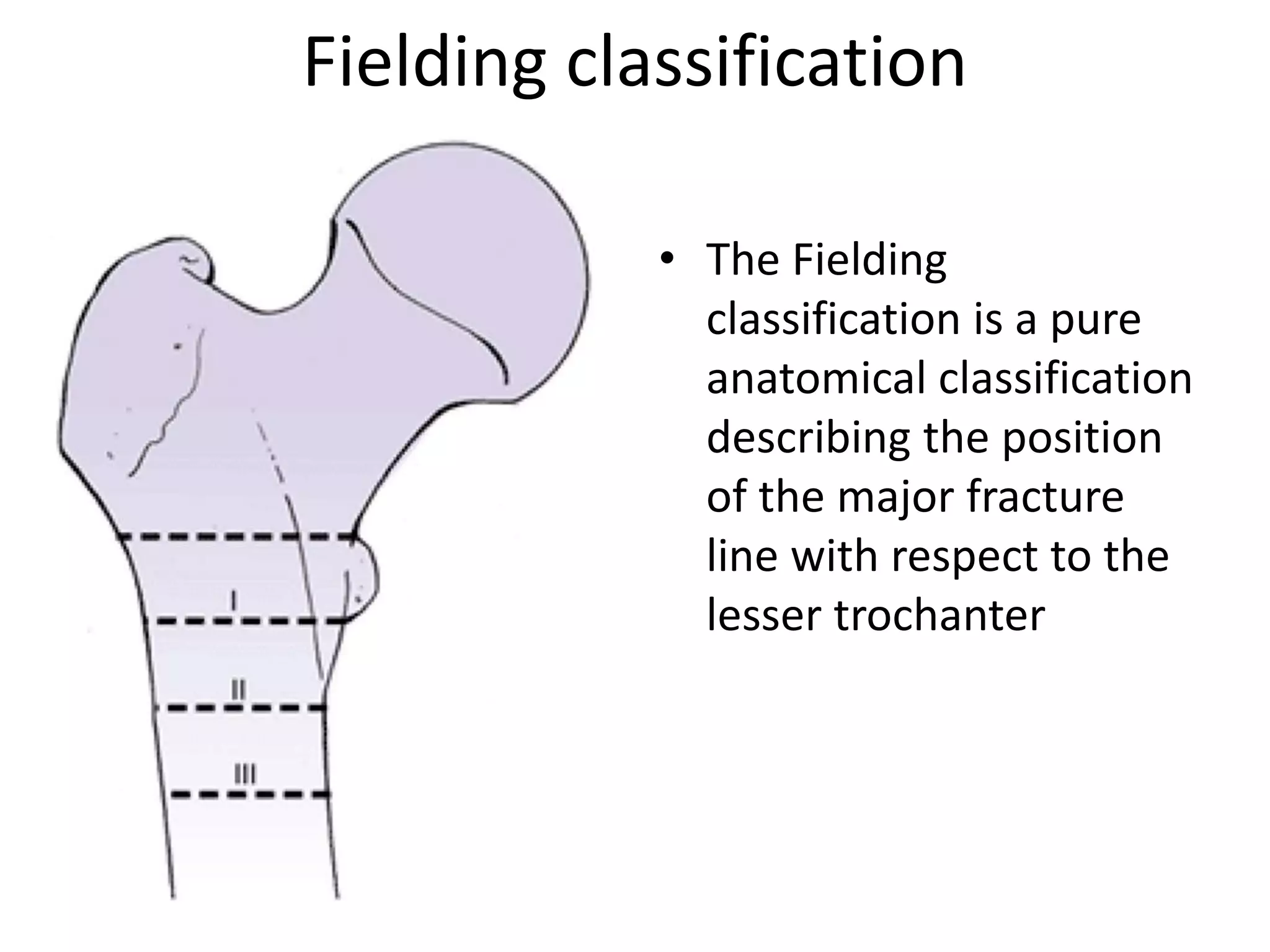
Fielding classification
• The Fielding
classification is a pure
anatomical classification
describing the position
of the major fracture
line with respect to the
lesser trochanter
Seinsheimer classification
• The Seinsheimer
classification takes into
account the factors affecting
the stability of the fractures.
It introduces the concept of
the posteromedial cortical
support, which has a direct
effect on the stability.
• It also indicates that the
more distal the primary
fracture line is, the higher the
incidence of complications
will be.
• This classification offers
guidelines for management
and prognosis
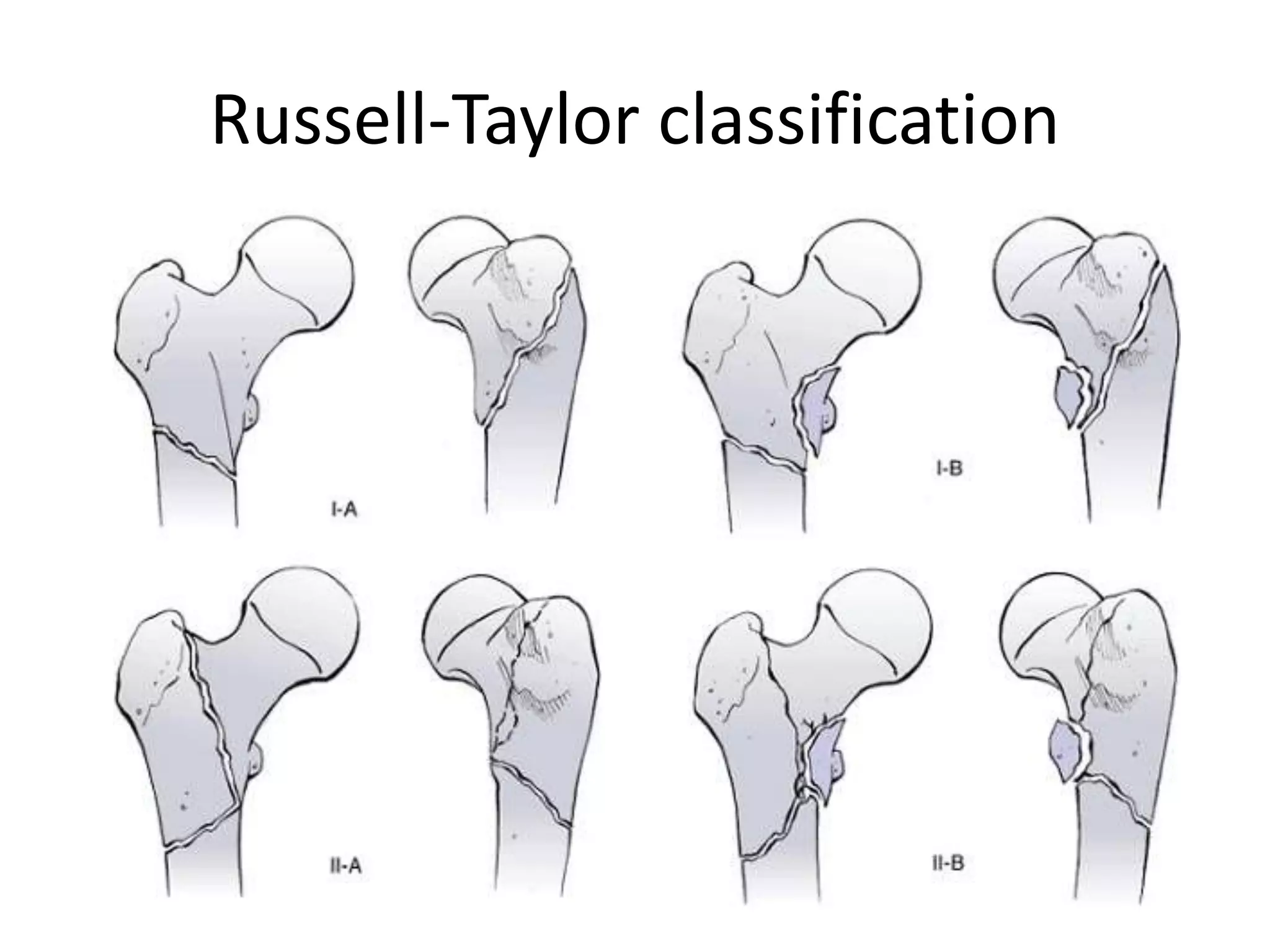
Russell-Taylor classification
• The Russell-Taylor classification (I and II with A
and B subgroups) is based on the integrity of the
piriformis fossa, which the author has advocated
as the entry point to the femoral medullary canal.
• This classification also takes into consideration
the involvement of the greater and lesser
trochanters in the fractures.
• Although it serves as a guideline for a special
technique in intramedullary nailing, the integrity
of the piriformis fossa to nailing may not be as
important as it used to be, due to a better
understanding of the entry point anatomy and
availability of implants with improved designs
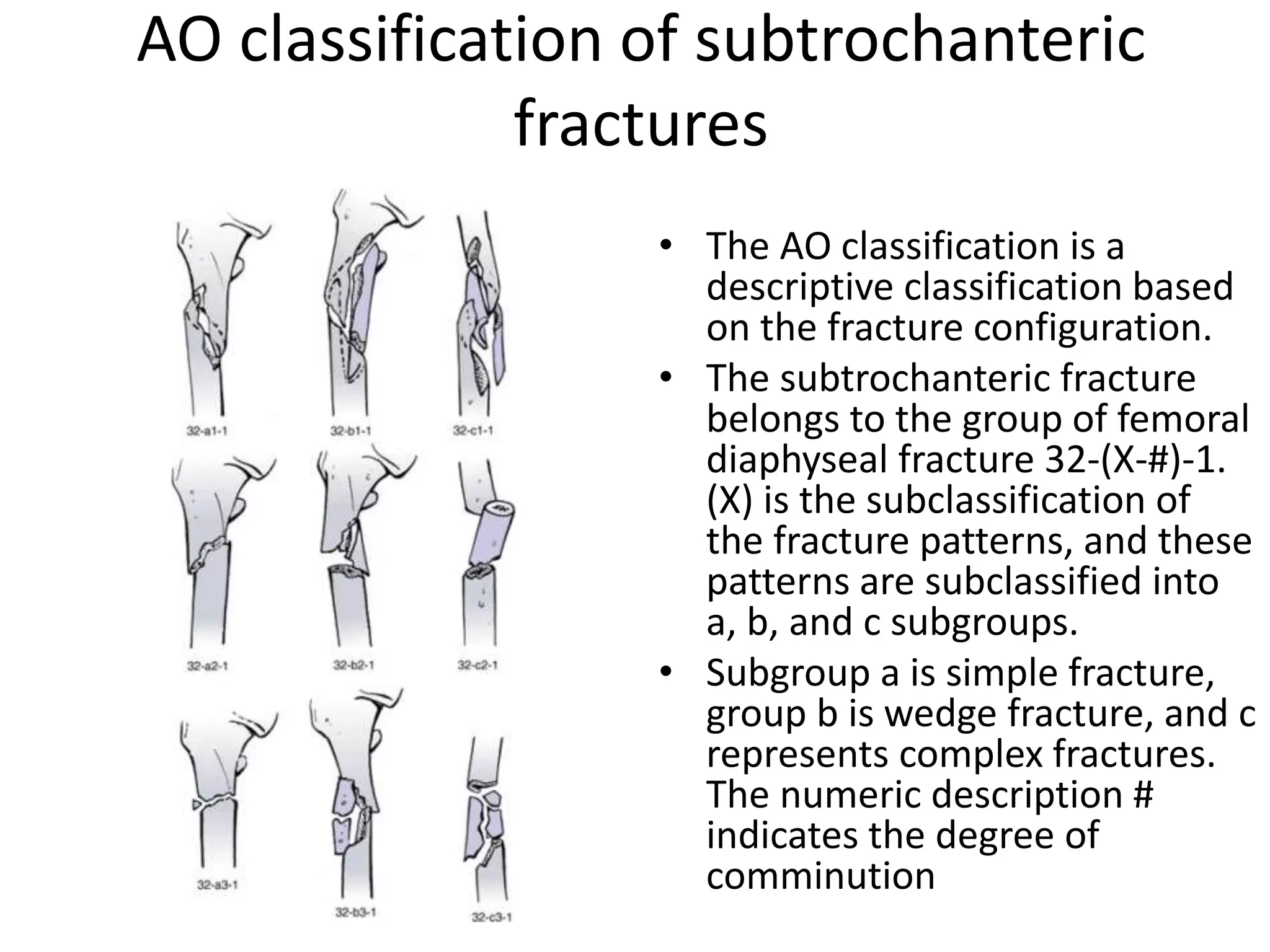
AO classification of subtrochanteric
fractures
• The AO classification is a
descriptive classification based
on the fracture configuration.
• The subtrochanteric fracture
belongs to the group of femoral
diaphyseal fracture 32-(X-#)-1.
(X) is the subclassification of
the fracture patterns, and these
patterns are subclassified into
a, b, and c subgroups.
• Subgroup a is simple fracture,
group b is wedge fracture, and c
represents complex fractures.
The numeric description #
indicates the degree of
comminution
Intertrochanteric & subtrochanteric fracture classification

Intertrochanteric & subtrochanteric fracture classification

  • 1.
  • 2.
  • 3.
    • In stablefracture patterns, the posteromedial cortex remains intact or has minimal comminution, making it possible to obtain a stable reduction. • Unstable fracture patterns are characterized by greater comminution of the posteromedial cortex. • The reverse obliquity pattern is inherently unstable because of the tendency for medial displacement of the femoral shaft.
  • 4.
    Orthopaedic Trauma Association(OTA) Alphanumeric Fracture Classification • 31-A Femur, proximal trochanteric • 31-A1 Peritrochanteric simple • 31-A1.1Along intertrochanteric line • 31-A1.2Through greater trochanter • 31-A1.3Below lesser trochanter • 31-A2 Peritrochanteric multifragmentary • 31-A2.1With one intermediate fragment • 31-A2.2With several intermediate fragments • 31-A2.3Extending more than 1 cm below lesser trochanter • 31-A3 Intertrochanteric • 31-A3.1Simple oblique • 31-A3.2Simple transverse • 31-A3.3Multifragmentary
  • 5.
    Orthopaedic Trauma Association (OTA)Alphanumeric Fracture Classification
  • 6.
  • 7.
    Fielding classification • TheFielding classification is a pure anatomical classification describing the position of the major fracture line with respect to the lesser trochanter
  • 8.
    Seinsheimer classification • TheSeinsheimer classification takes into account the factors affecting the stability of the fractures. It introduces the concept of the posteromedial cortical support, which has a direct effect on the stability. • It also indicates that the more distal the primary fracture line is, the higher the incidence of complications will be. • This classification offers guidelines for management and prognosis
  • 9.
  • 10.
    • The Russell-Taylorclassification (I and II with A and B subgroups) is based on the integrity of the piriformis fossa, which the author has advocated as the entry point to the femoral medullary canal. • This classification also takes into consideration the involvement of the greater and lesser trochanters in the fractures. • Although it serves as a guideline for a special technique in intramedullary nailing, the integrity of the piriformis fossa to nailing may not be as important as it used to be, due to a better understanding of the entry point anatomy and availability of implants with improved designs
  • 11.
    AO classification ofsubtrochanteric fractures • The AO classification is a descriptive classification based on the fracture configuration. • The subtrochanteric fracture belongs to the group of femoral diaphyseal fracture 32-(X-#)-1. (X) is the subclassification of the fracture patterns, and these patterns are subclassified into a, b, and c subgroups. • Subgroup a is simple fracture, group b is wedge fracture, and c represents complex fractures. The numeric description # indicates the degree of comminution