NEURAL
NETWORK
1
Presented by: Rabin BK
BSc.CSIT 4th Semester
History
 Introduction
Neural Network in Brief
Application areas
 References
2
In 1943, Warren S. McCulloch, a neuroscientist, and Walter Pitts, a logician,
developed the first conceptual model of an artificial neural network
 In their paper, they described the concept of a neuron, a single cell, living in
a network of cells that receives inputs, processes those inputs, and generates
an output.
Donald Hebb took the idea further and created a learning hypothesis based
on the mechanism of neural plasticity that became known as Hebbian
learning, often summarized by the phrase: “Cells that fire together, wire
together.”
The first Hebbian network was successfully implemented at MIT in 1954.
History
3
 Neural plasticity or Neuroplasticity
 The ability of the brain to change throughout an individual's life, e.g., brain activity
associated with a given function can be transferred to a different location, the proportion of
grey matter can change, and synapses may strengthen or weaken over time.
 “Cells that fire together, wire together.”
 Our brain cells communicate with one another via synaptic transmission–one brain cell
releases a chemical (neurotransmitter) that the next brain cell absorbs known as “neuronal
firing”
 When brain cells communicate frequently, the connection between them strengthens.
 Messages that travel the same pathway in the brain over & over begin to transmit faster &
faster. With enough repetition, they become automatic.
 That’s why we practice things like hitting a golf ball–with enough practice, we can go on
automatic pilot.
History contd...
4
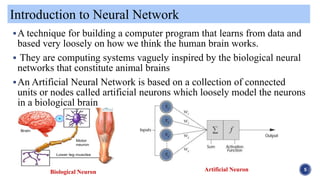
A technique for building a computer program that learns from data and
based very loosely on how we think the human brain works.
 They are computing systems vaguely inspired by the biological neural
networks that constitute animal brains
An Artificial Neural Network is based on a collection of connected
units or nodes called artificial neurons which loosely model the neurons
in a biological brain
Introduction to Neural Network
5
Biological Neuron Artificial Neuron
Neural Network in Brief
6
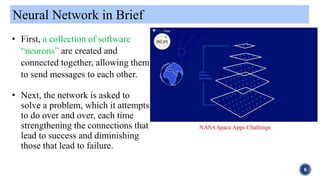
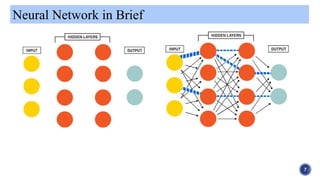
• First, a collection of software
“neurons” are created and
connected together, allowing them
to send messages to each other.
• Next, the network is asked to
solve a problem, which it attempts
to do over and over, each time
strengthening the connections that
lead to success and diminishing
those that lead to failure.
NASA Space Apps Challenge
Neural Network in Brief
7
Neural Network in Brief
8
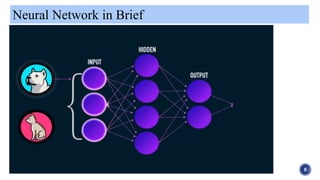
 Pattern Recognition
 Examples are facial recognition, optical character recognition, etc.
 Time Series Prediction
 Neural networks can be used to make predictions. For e.g., Will the stock rise or fall
tomorrow? Will it rain or be sunny?
 Signal Processing
 Cochlear implants and hearing aids need to filter out unnecessary noise and amplify the
important sounds. Neural networks can be trained to process an audio signal and filter it
appropriately.
 Control
 In self-driving cars Neural networks are often used to manage steering decisions of
physical vehicles (or simulated ones).
Application of Neural Network
9
 Soft Sensors
 A soft sensor refers to the process of analyzing a collection of many measurements.
A thermometer can tell you the temperature of the air, but what if you also knew
the humidity, barometric pressure, dewpoint, air quality, air density, etc.?
 Neural networks can be employed to process the input data from many individual
sensors and evaluate them as a whole.
 Anomaly detection
 Because neural networks are so good at recognizing patterns, they can also be
trained to generate an output when something occurs that doesn’t fit the pattern
 Think of a neural network monitoring your daily routine over a long period of
time.
 After learning the patterns of your behavior, it could alert you when something is
amiss.
Application of Neural Network contd...
10
• https://natureofcode.com/book/chapter-10-neural-networks/
• https://medium.com/@Jaconda/a-concise-history-of-neural-networks-
2070655d3fec
• https://www.dailyshoring.com/neurons-that-fire-together-wire-
together/
• https://en.wikipedia.org/wiki/Artificial_neural_network#History
• M., Bishop, Christopher (1995). Neural networks for pattern
recognition. Clarendon Press. ISBN 0198538499. OCLC 33101074.
• https://2016.spaceappschallenge.org/challenges/solar-system/near-
earth-objects-machine-learning/projects/deep-asteriod
11
References
Queries
12

Neural Netwrok

  • 1.
    NEURAL NETWORK 1 Presented by: RabinBK BSc.CSIT 4th Semester
  • 2.
    History  Introduction Neural Networkin Brief Application areas  References 2
  • 3.
    In 1943, WarrenS. McCulloch, a neuroscientist, and Walter Pitts, a logician, developed the first conceptual model of an artificial neural network  In their paper, they described the concept of a neuron, a single cell, living in a network of cells that receives inputs, processes those inputs, and generates an output. Donald Hebb took the idea further and created a learning hypothesis based on the mechanism of neural plasticity that became known as Hebbian learning, often summarized by the phrase: “Cells that fire together, wire together.” The first Hebbian network was successfully implemented at MIT in 1954. History 3
  • 4.
     Neural plasticityor Neuroplasticity  The ability of the brain to change throughout an individual's life, e.g., brain activity associated with a given function can be transferred to a different location, the proportion of grey matter can change, and synapses may strengthen or weaken over time.  “Cells that fire together, wire together.”  Our brain cells communicate with one another via synaptic transmission–one brain cell releases a chemical (neurotransmitter) that the next brain cell absorbs known as “neuronal firing”  When brain cells communicate frequently, the connection between them strengthens.  Messages that travel the same pathway in the brain over & over begin to transmit faster & faster. With enough repetition, they become automatic.  That’s why we practice things like hitting a golf ball–with enough practice, we can go on automatic pilot. History contd... 4
  • 5.
    A technique forbuilding a computer program that learns from data and based very loosely on how we think the human brain works.  They are computing systems vaguely inspired by the biological neural networks that constitute animal brains An Artificial Neural Network is based on a collection of connected units or nodes called artificial neurons which loosely model the neurons in a biological brain Introduction to Neural Network 5 Biological Neuron Artificial Neuron
  • 6.
    Neural Network inBrief 6 • First, a collection of software “neurons” are created and connected together, allowing them to send messages to each other. • Next, the network is asked to solve a problem, which it attempts to do over and over, each time strengthening the connections that lead to success and diminishing those that lead to failure. NASA Space Apps Challenge
  • 7.
  • 8.
  • 9.
     Pattern Recognition Examples are facial recognition, optical character recognition, etc.  Time Series Prediction  Neural networks can be used to make predictions. For e.g., Will the stock rise or fall tomorrow? Will it rain or be sunny?  Signal Processing  Cochlear implants and hearing aids need to filter out unnecessary noise and amplify the important sounds. Neural networks can be trained to process an audio signal and filter it appropriately.  Control  In self-driving cars Neural networks are often used to manage steering decisions of physical vehicles (or simulated ones). Application of Neural Network 9
  • 10.
     Soft Sensors A soft sensor refers to the process of analyzing a collection of many measurements. A thermometer can tell you the temperature of the air, but what if you also knew the humidity, barometric pressure, dewpoint, air quality, air density, etc.?  Neural networks can be employed to process the input data from many individual sensors and evaluate them as a whole.  Anomaly detection  Because neural networks are so good at recognizing patterns, they can also be trained to generate an output when something occurs that doesn’t fit the pattern  Think of a neural network monitoring your daily routine over a long period of time.  After learning the patterns of your behavior, it could alert you when something is amiss. Application of Neural Network contd... 10
  • 11.
    • https://natureofcode.com/book/chapter-10-neural-networks/ • https://medium.com/@Jaconda/a-concise-history-of-neural-networks- 2070655d3fec •https://www.dailyshoring.com/neurons-that-fire-together-wire- together/ • https://en.wikipedia.org/wiki/Artificial_neural_network#History • M., Bishop, Christopher (1995). Neural networks for pattern recognition. Clarendon Press. ISBN 0198538499. OCLC 33101074. • https://2016.spaceappschallenge.org/challenges/solar-system/near- earth-objects-machine-learning/projects/deep-asteriod 11 References
  • 12.