BLUETOOTH
1
Presented by: BSc.CSIT 5th Semester
Rabin BK
Prism Karki
Puja Nupane
Niraj Koirala
 Introduction
 History
Implementation
Security
List of applications
References
2
Introduction
3
RS-232 data cable
 A wireless technology standard for exchanging data over short distances
 The purpose of Bluetooth is to replace the cables that normally connect
devices, while still keeping the communications between them secure
Uses short-wavelength UHF(Ultra high frequency) radio waves
It was originally conceived as a wireless alternative to RS-232 data cables
 Bluetooth is managed by the Bluetooth Special
Interest Group (SIG)
A manufacturer must meet Bluetooth SIG standards to market it as a
Bluetooth device
History
4
The "Bluetooth" name is taken from a the tenth-century king Harald
Bluetooth who united dissonant Danish tribes into a single kingdom
 The idea of this name was proposed in 1997 by Jim Kardach of Intel
who developed a system that would allow mobile phones to
communicate with computers
 At the time of this proposal he was reading Frans G. Bengtsson's
historical novel The Long Ships about Vikings and King Harald
Bluetooth
 The Bluetooth logo is a bind rune merging the Younger Futhark runes
(ᚼ, Hagall) and (ᛒ, Bjarkan)
Implementation
5
 Bluetooth uses a radio technology called frequency-hopping spread spectrum
 Bluetooth divides transmitted data into packets, and transmits each packet on
one of 79 designated Bluetooth channels
 Bluetooth Low Energy uses 2 MHz spacing, which accommodates 40
channels
 Each channel has a bandwidth of 1 MHz. It usually performs 1600 hops per
second, with adaptive frequency-hopping (AFH) enabled
Frequency hopping
Implementation contd..
6
 Bluetooth is a packet-based protocol with a master/slave architecture. One
master may communicate with up to seven slaves in a piconet
 All devices share the master's clock. Packet exchange is based on the basic
clock, defined by the master, which ticks at 312.5 µs intervals
 Two clock ticks make up a slot of 625 µs, and two slots make up a slot pair
of 1250 µs
 In the simple case of single-slot packets, the master transmits in even slots
and receives in odd slots. The slave, conversely, receives in even slots and
transmits in odd slots
 Packets maybe 1, 3 or 5 slots long, but in all cases the master's transmission
begins in even slots and the slave's in odd slots.
Security
7
 Bluetooth implements confidentiality, authentication and key derivation with
custom algorithms based on the SAFER(Secure And Fast Encryption
Routine)+ block cipher.
 Bluetooth key generation is generally based on a Bluetooth PIN, which must
be entered into both devices
 During pairing, an initialization key or master key is generated, using the
E22 algorithm. The E0 stream cipher is used for encrypting packets, granting
confidentiality, and is based on a shared cryptographic secret, namely a
previously generated link key or master key.
 E0 is a stream cipher used in the Bluetooth protocol. It generates a sequence
of pseudorandom numbers and combines it with the data using the XOR
operator. The key length may vary, but is generally 128 bits.
Security
8
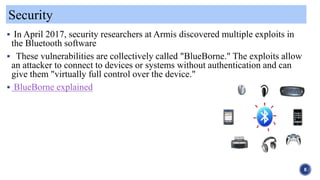
 In April 2017, security researchers at Armis discovered multiple exploits in
the Bluetooth software
 These vulnerabilities are collectively called "BlueBorne." The exploits allow
an attacker to connect to devices or systems without authentication and can
give them "virtually full control over the device."
 BlueBorne explained
List of Applications
9
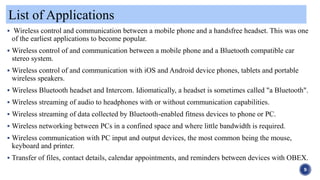
 Wireless control and communication between a mobile phone and a handsfree headset. This was one
of the earliest applications to become popular.
 Wireless control of and communication between a mobile phone and a Bluetooth compatible car
stereo system.
 Wireless control of and communication with iOS and Android device phones, tablets and portable
wireless speakers.
 Wireless Bluetooth headset and Intercom. Idiomatically, a headset is sometimes called "a Bluetooth".
 Wireless streaming of audio to headphones with or without communication capabilities.
 Wireless streaming of data collected by Bluetooth-enabled fitness devices to phone or PC.
 Wireless networking between PCs in a confined space and where little bandwidth is required.
 Wireless communication with PC input and output devices, the most common being the mouse,
keyboard and printer.
 Transfer of files, contact details, calendar appointments, and reminders between devices with OBEX.
References
• "Basics Bluetooth Technology Website". Bluetooth.com. 23 May 2010.
• "Bluetooth.org". Bluetooth.org. Retrieved 3 May 2011.
• "Brand Enforcement Program". Bluetooth.org. Archived from the original on 4
November 2013. Retrieved 2 November 2013.
• "The Bluetooth Blues". Information Age. 24 May 2001. Archived from the original
on 22 December 2007. Retrieved 1 February 2008.
• "Bluetooth traveler". hoovers.com. Archived from the original on 11 January 2011.
Retrieved 9 April 2010.
• Google Images
[https://www.google.com/search?q=bluetooth+gif&source=lnms&tbm=isch&sa=X
&ved=0ahUKEwjvjKGK7PHfAhVMpI8KHe3eABsQ_AUIDigB&biw=1319&bih
=672#imgrc=Jz5fCtFclxU_fM:]
• Youtube video[https://www.youtube.com/watch?v=LLNtZKpL0P8&t=7s]
10
Queries
11

Bluetooth

  • 1.
    BLUETOOTH 1 Presented by: BSc.CSIT5th Semester Rabin BK Prism Karki Puja Nupane Niraj Koirala
  • 2.
  • 3.
    Introduction 3 RS-232 data cable A wireless technology standard for exchanging data over short distances  The purpose of Bluetooth is to replace the cables that normally connect devices, while still keeping the communications between them secure Uses short-wavelength UHF(Ultra high frequency) radio waves It was originally conceived as a wireless alternative to RS-232 data cables  Bluetooth is managed by the Bluetooth Special Interest Group (SIG) A manufacturer must meet Bluetooth SIG standards to market it as a Bluetooth device
  • 4.
    History 4 The "Bluetooth" nameis taken from a the tenth-century king Harald Bluetooth who united dissonant Danish tribes into a single kingdom  The idea of this name was proposed in 1997 by Jim Kardach of Intel who developed a system that would allow mobile phones to communicate with computers  At the time of this proposal he was reading Frans G. Bengtsson's historical novel The Long Ships about Vikings and King Harald Bluetooth  The Bluetooth logo is a bind rune merging the Younger Futhark runes (ᚼ, Hagall) and (ᛒ, Bjarkan)
  • 5.
    Implementation 5  Bluetooth usesa radio technology called frequency-hopping spread spectrum  Bluetooth divides transmitted data into packets, and transmits each packet on one of 79 designated Bluetooth channels  Bluetooth Low Energy uses 2 MHz spacing, which accommodates 40 channels  Each channel has a bandwidth of 1 MHz. It usually performs 1600 hops per second, with adaptive frequency-hopping (AFH) enabled Frequency hopping
  • 6.
    Implementation contd.. 6  Bluetoothis a packet-based protocol with a master/slave architecture. One master may communicate with up to seven slaves in a piconet  All devices share the master's clock. Packet exchange is based on the basic clock, defined by the master, which ticks at 312.5 µs intervals  Two clock ticks make up a slot of 625 µs, and two slots make up a slot pair of 1250 µs  In the simple case of single-slot packets, the master transmits in even slots and receives in odd slots. The slave, conversely, receives in even slots and transmits in odd slots  Packets maybe 1, 3 or 5 slots long, but in all cases the master's transmission begins in even slots and the slave's in odd slots.
  • 7.
    Security 7  Bluetooth implementsconfidentiality, authentication and key derivation with custom algorithms based on the SAFER(Secure And Fast Encryption Routine)+ block cipher.  Bluetooth key generation is generally based on a Bluetooth PIN, which must be entered into both devices  During pairing, an initialization key or master key is generated, using the E22 algorithm. The E0 stream cipher is used for encrypting packets, granting confidentiality, and is based on a shared cryptographic secret, namely a previously generated link key or master key.  E0 is a stream cipher used in the Bluetooth protocol. It generates a sequence of pseudorandom numbers and combines it with the data using the XOR operator. The key length may vary, but is generally 128 bits.
  • 8.
    Security 8  In April2017, security researchers at Armis discovered multiple exploits in the Bluetooth software  These vulnerabilities are collectively called "BlueBorne." The exploits allow an attacker to connect to devices or systems without authentication and can give them "virtually full control over the device."  BlueBorne explained
  • 9.
    List of Applications 9 Wireless control and communication between a mobile phone and a handsfree headset. This was one of the earliest applications to become popular.  Wireless control of and communication between a mobile phone and a Bluetooth compatible car stereo system.  Wireless control of and communication with iOS and Android device phones, tablets and portable wireless speakers.  Wireless Bluetooth headset and Intercom. Idiomatically, a headset is sometimes called "a Bluetooth".  Wireless streaming of audio to headphones with or without communication capabilities.  Wireless streaming of data collected by Bluetooth-enabled fitness devices to phone or PC.  Wireless networking between PCs in a confined space and where little bandwidth is required.  Wireless communication with PC input and output devices, the most common being the mouse, keyboard and printer.  Transfer of files, contact details, calendar appointments, and reminders between devices with OBEX.
  • 10.
    References • "Basics BluetoothTechnology Website". Bluetooth.com. 23 May 2010. • "Bluetooth.org". Bluetooth.org. Retrieved 3 May 2011. • "Brand Enforcement Program". Bluetooth.org. Archived from the original on 4 November 2013. Retrieved 2 November 2013. • "The Bluetooth Blues". Information Age. 24 May 2001. Archived from the original on 22 December 2007. Retrieved 1 February 2008. • "Bluetooth traveler". hoovers.com. Archived from the original on 11 January 2011. Retrieved 9 April 2010. • Google Images [https://www.google.com/search?q=bluetooth+gif&source=lnms&tbm=isch&sa=X &ved=0ahUKEwjvjKGK7PHfAhVMpI8KHe3eABsQ_AUIDigB&biw=1319&bih =672#imgrc=Jz5fCtFclxU_fM:] • Youtube video[https://www.youtube.com/watch?v=LLNtZKpL0P8&t=7s] 10
  • 11.