16-bit microprocessors
Zahra Sadeghi
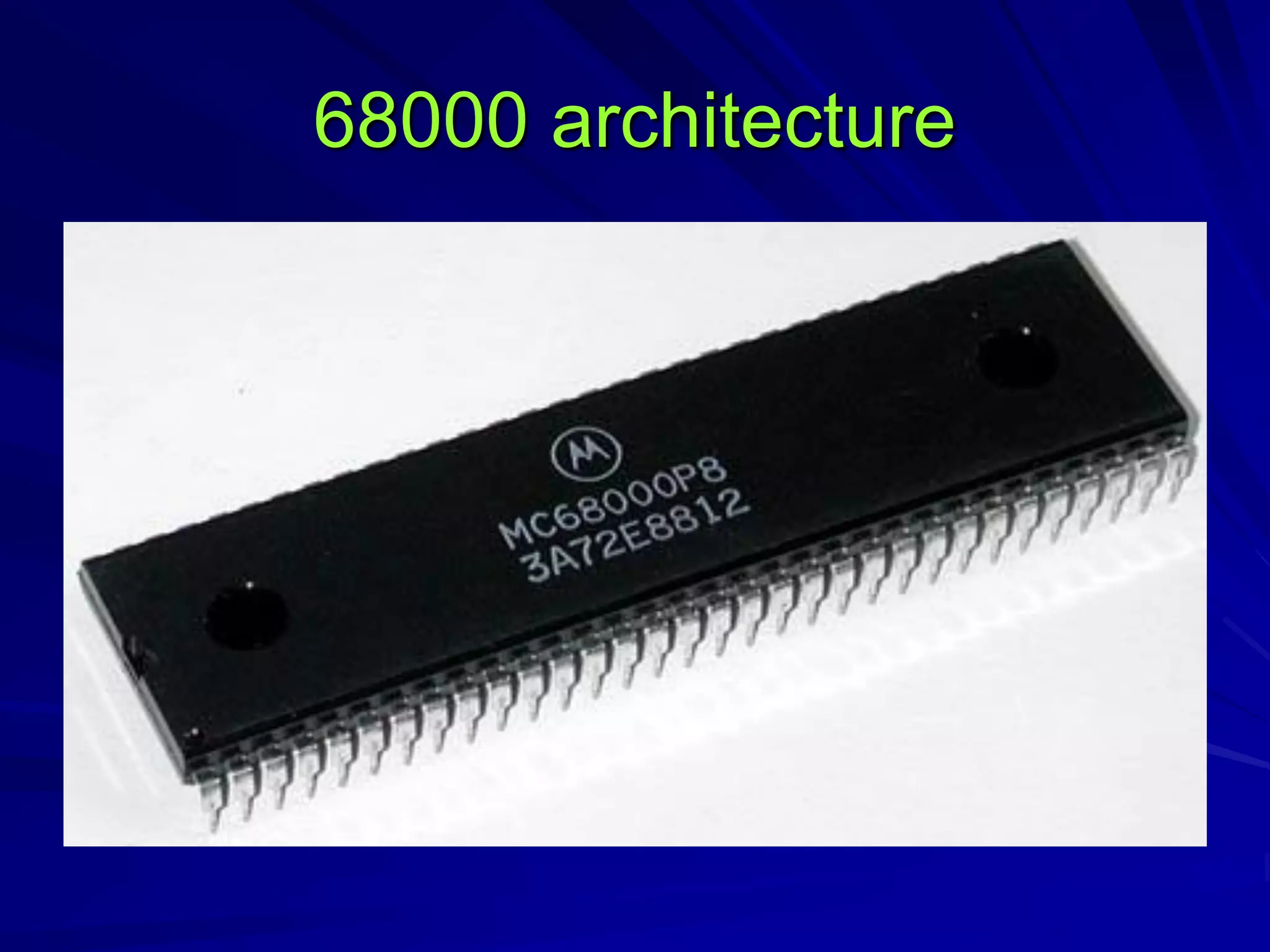
68000 architecture
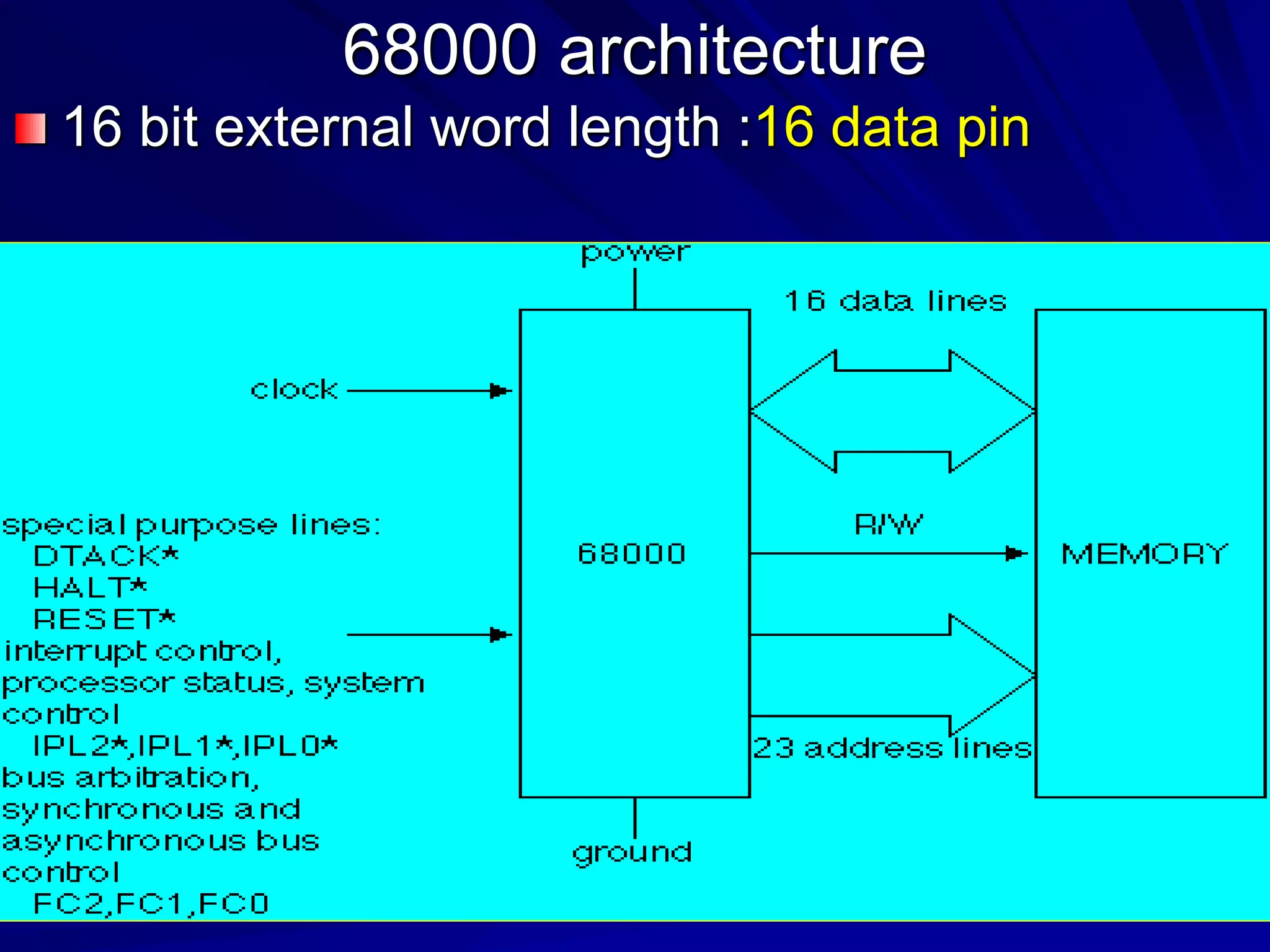
68000 architecture
16 bit external word length :16 data pin
Register organization
Register:32 bits 8 data registers:D0-D7
7 address registers:A0-A6
Data registers: accumulator + counter
Data and address register:index register
Addressable space=2^24~16MB
Data registers address registers
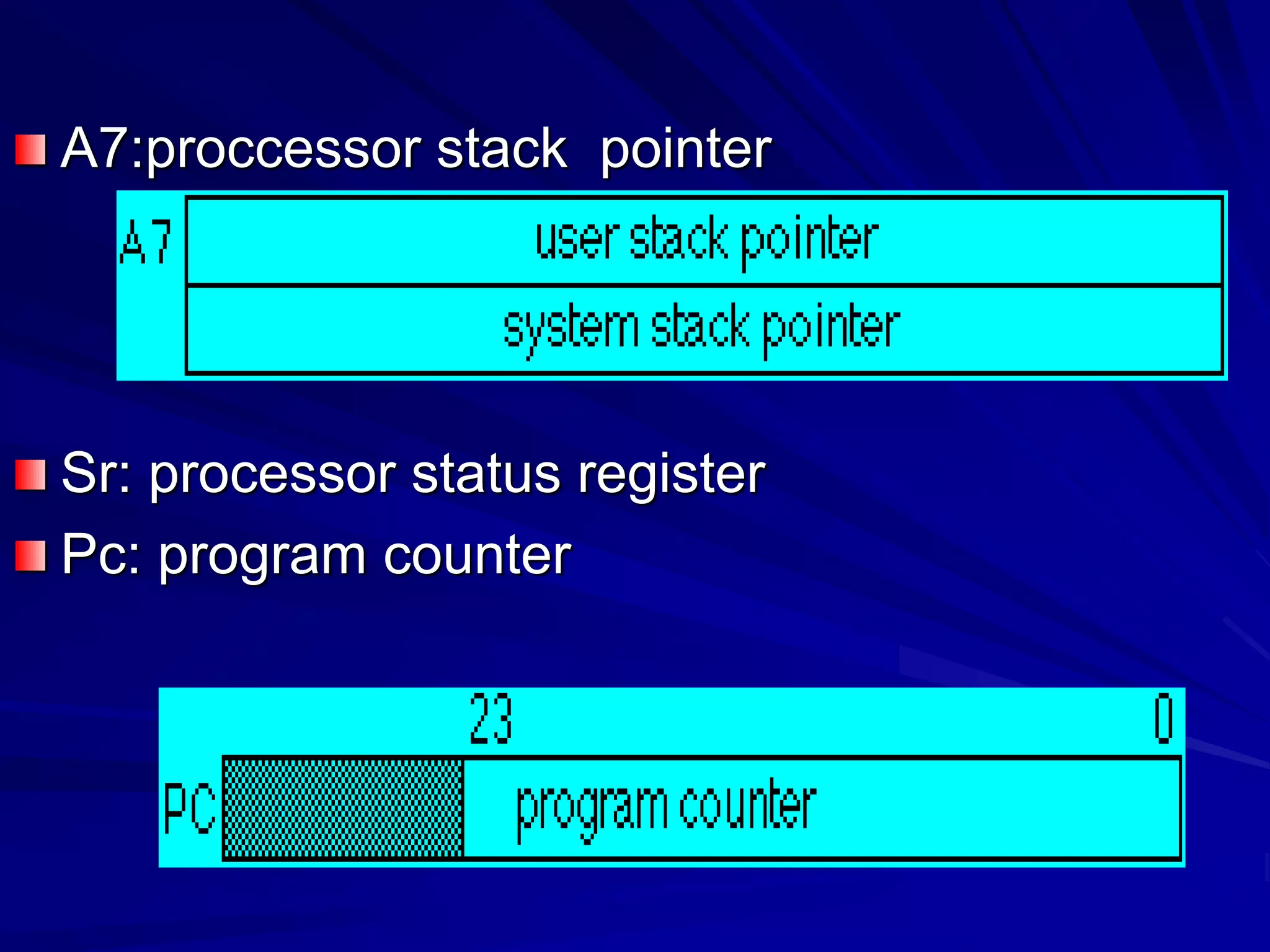
A7:proccessor stack pointer
Sr: processor status register
Pc: program counter
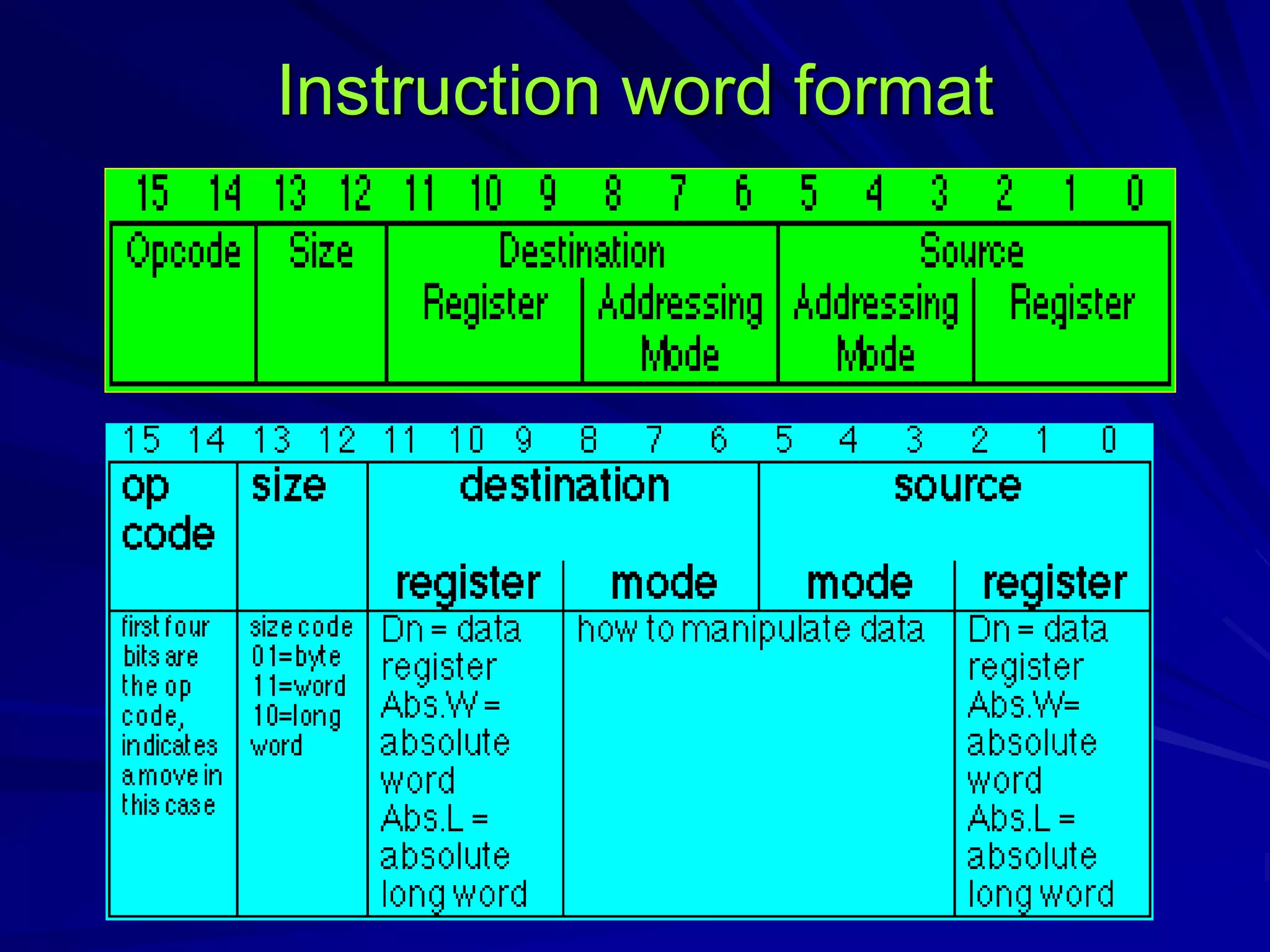
Instruction word format
instructions
One operand and two operand
two operand: OP src,dst
Ex: add #9,d3
dst [src]+[dst]
Source op or destination op must be in Dn
Second op:register or memory location
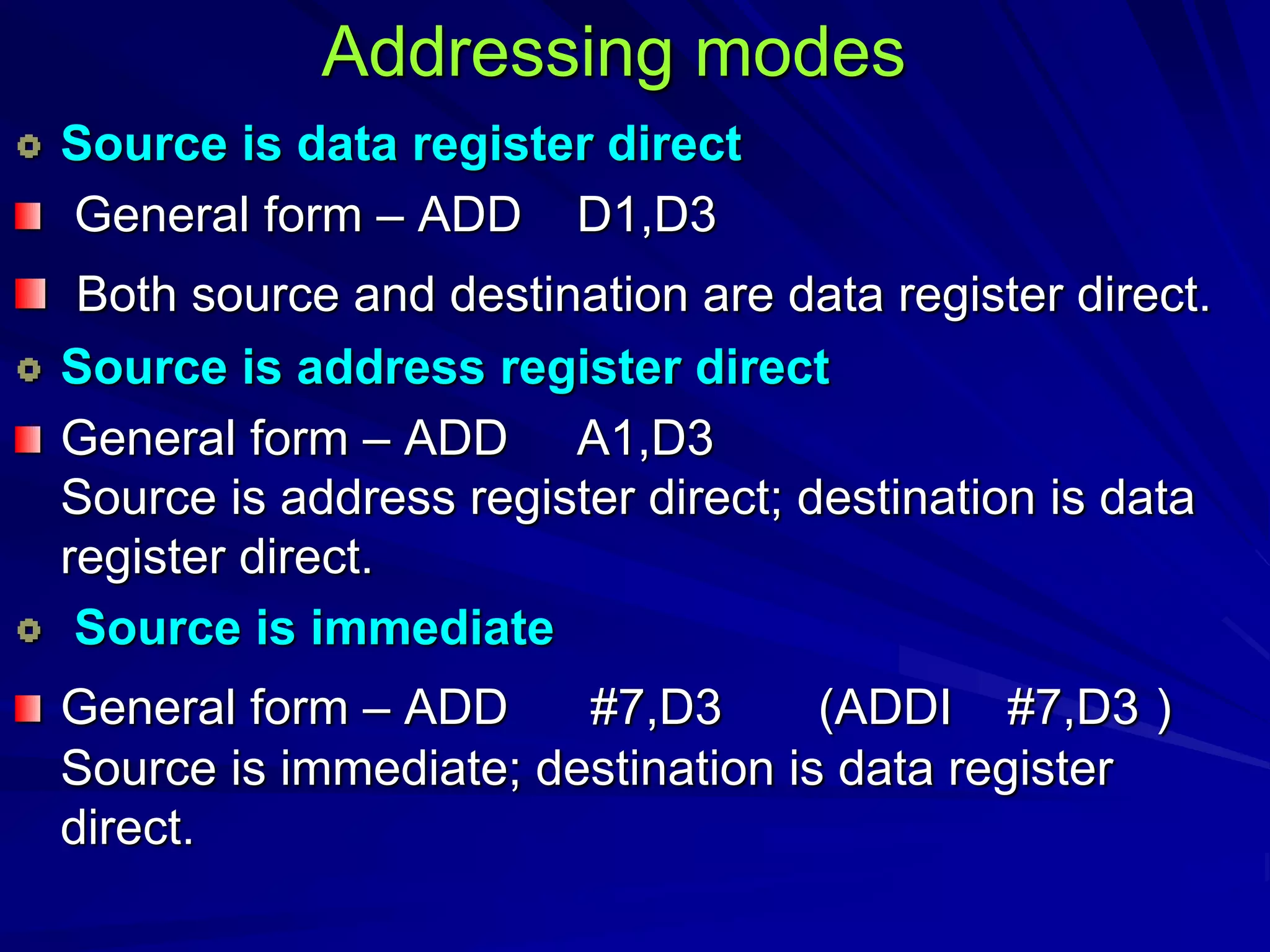
Addressing modes
Source is data register direct
General form – ADD D1,D3
Both source and destination are data register direct.
Source is address register direct
General form – ADD A1,D3
Source is address register direct; destination is data
register direct.
Source is immediate
General form – ADD #7,D3 (ADDI #7,D3 )
Source is immediate; destination is data register
direct.
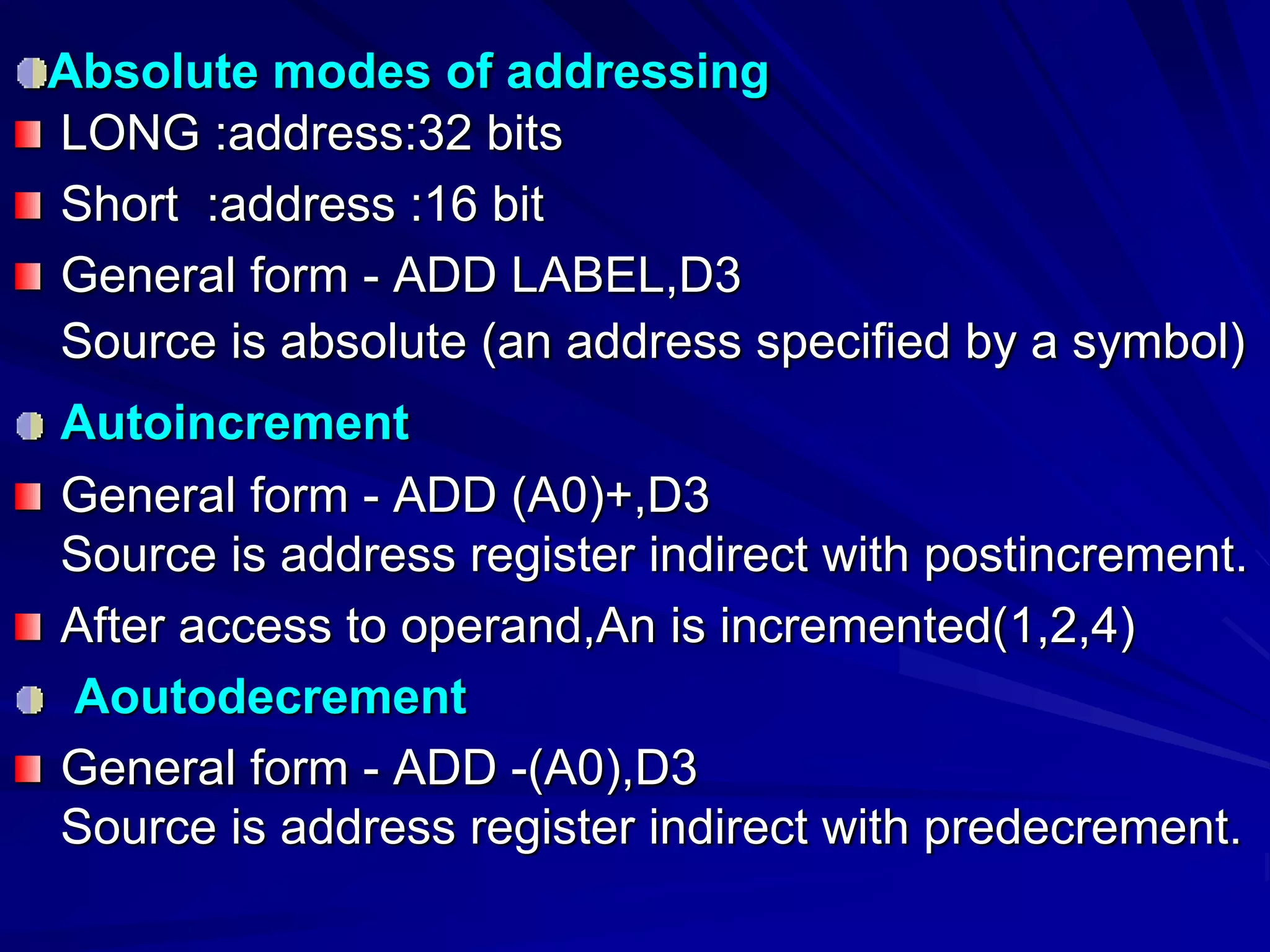
Absolute modes of addressing
LONG :address:32 bits
Short :address :16 bit
General form - ADD LABEL,D3
Source is absolute (an address specified by a symbol)
Autoincrement
General form - ADD (A0)+,D3
Source is address register indirect with postincrement.
After access to operand,An is incremented(1,2,4)
Aoutodecrement
General form - ADD -(A0),D3
Source is address register indirect with predecrement.
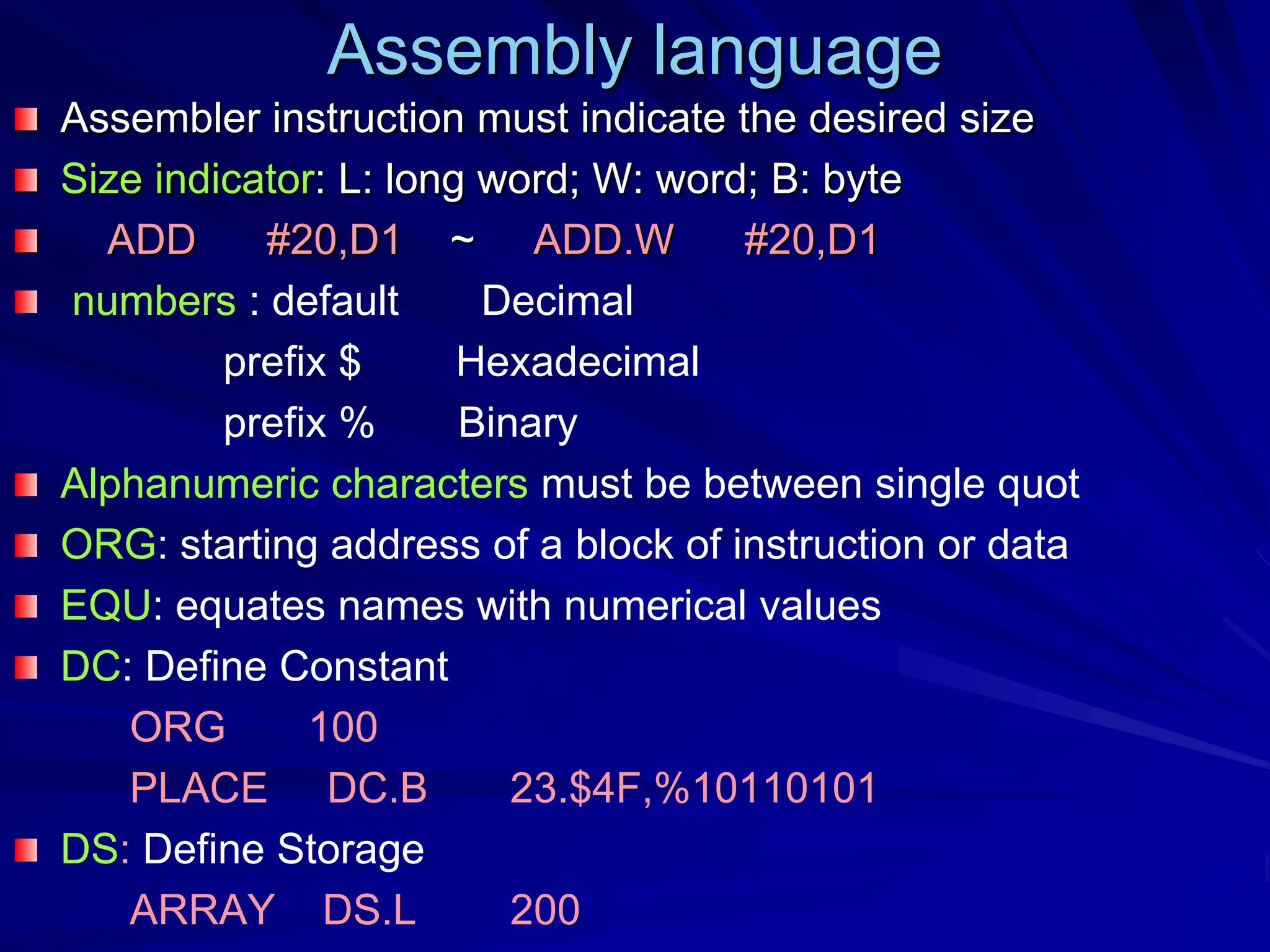
Assembly language
Assembler instruction must indicate the desired size
Size indicator: L: long word; W: word; B: byte
ADD #20,D1 ~ ADD.W #20,D1
numbers : default Decimal
prefix $ Hexadecimal
prefix % Binary
Alphanumeric characters must be between single quot
ORG: starting address of a block of instruction or data
EQU: equates names with numerical values
DC: Define Constant
ORG 100
PLACE DC.B 23.$4F,%10110101
DS: Define Storage
ARRAY DS.L 200
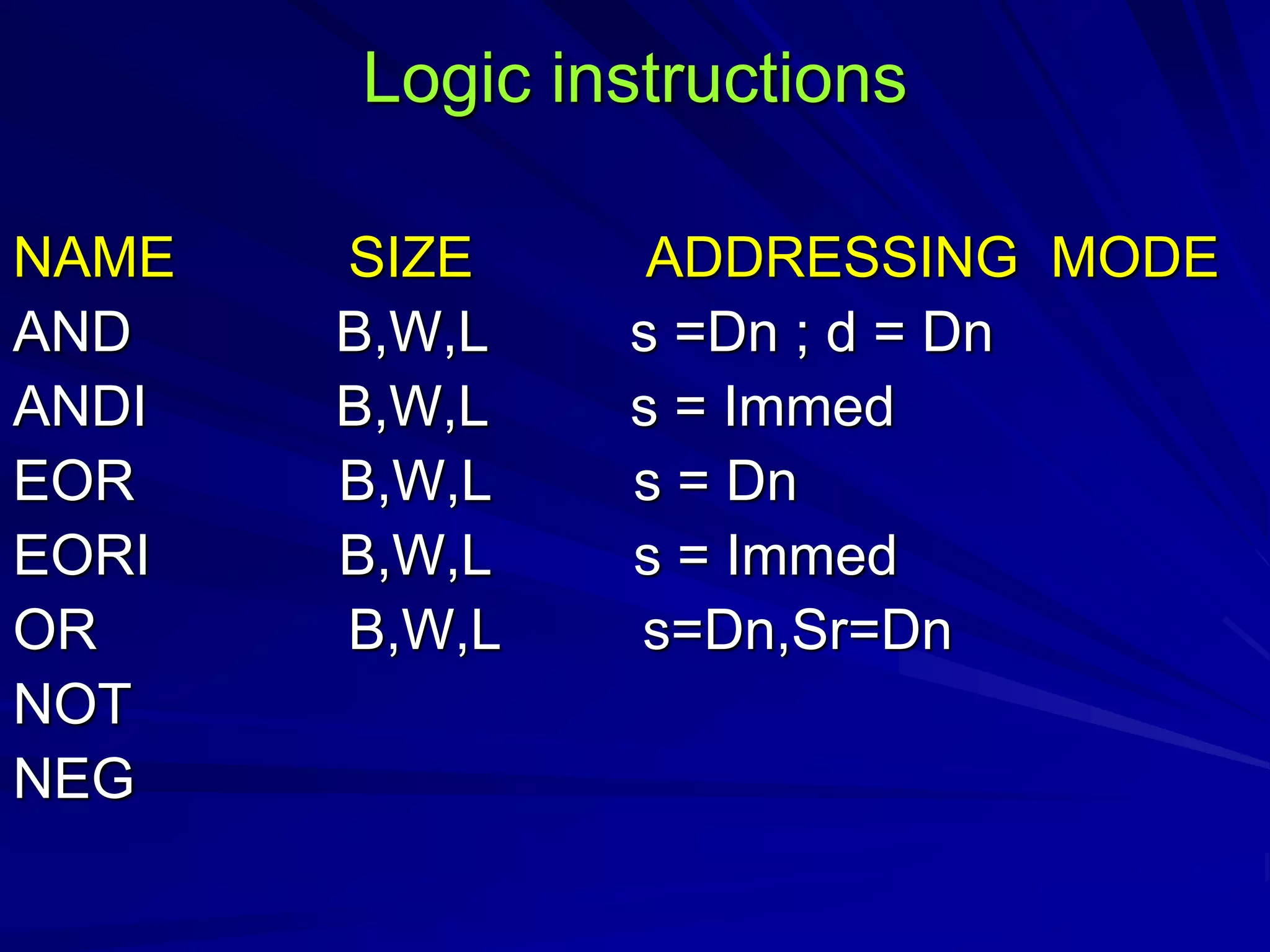
Logic instructions
NAME SIZE ADDRESSING MODE
AND B,W,L s =Dn ; d = Dn
ANDI B,W,L s = Immed
EOR B,W,L s = Dn
EORI B,W,L s = Immed
OR B,W,L s=Dn,Sr=Dn
NOT
NEG
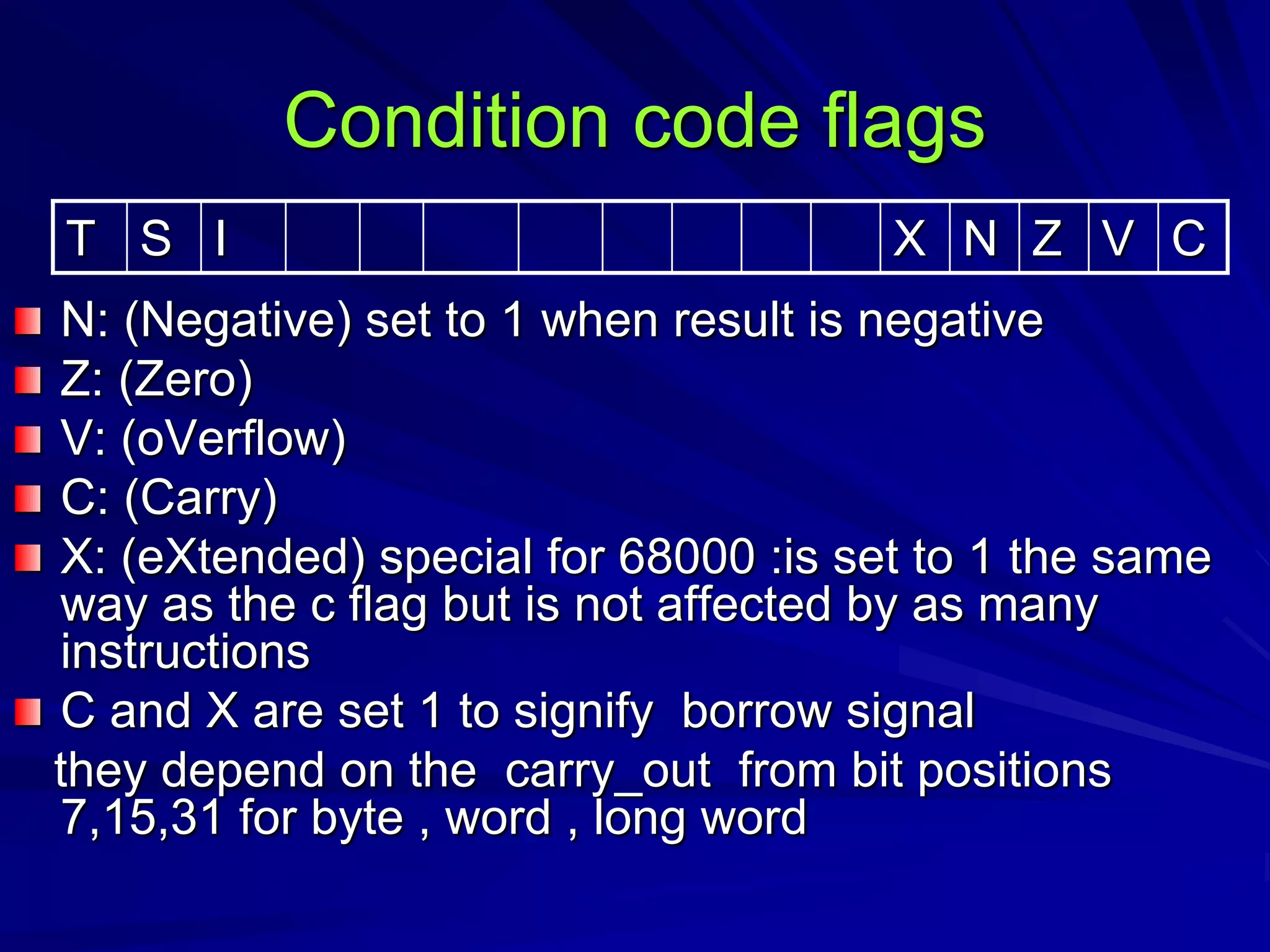
Condition code flags
N: (Negative) set to 1 when result is negative
Z: (Zero)
V: (oVerflow)
C: (Carry)
X: (eXtended) special for 68000 :is set to 1 the same
way as the c flag but is not affected by as many
instructions
C and X are set 1 to signify borrow signal
they depend on the carry_out from bit positions
7,15,31 for byte , word , long word
T S I X N Z V C
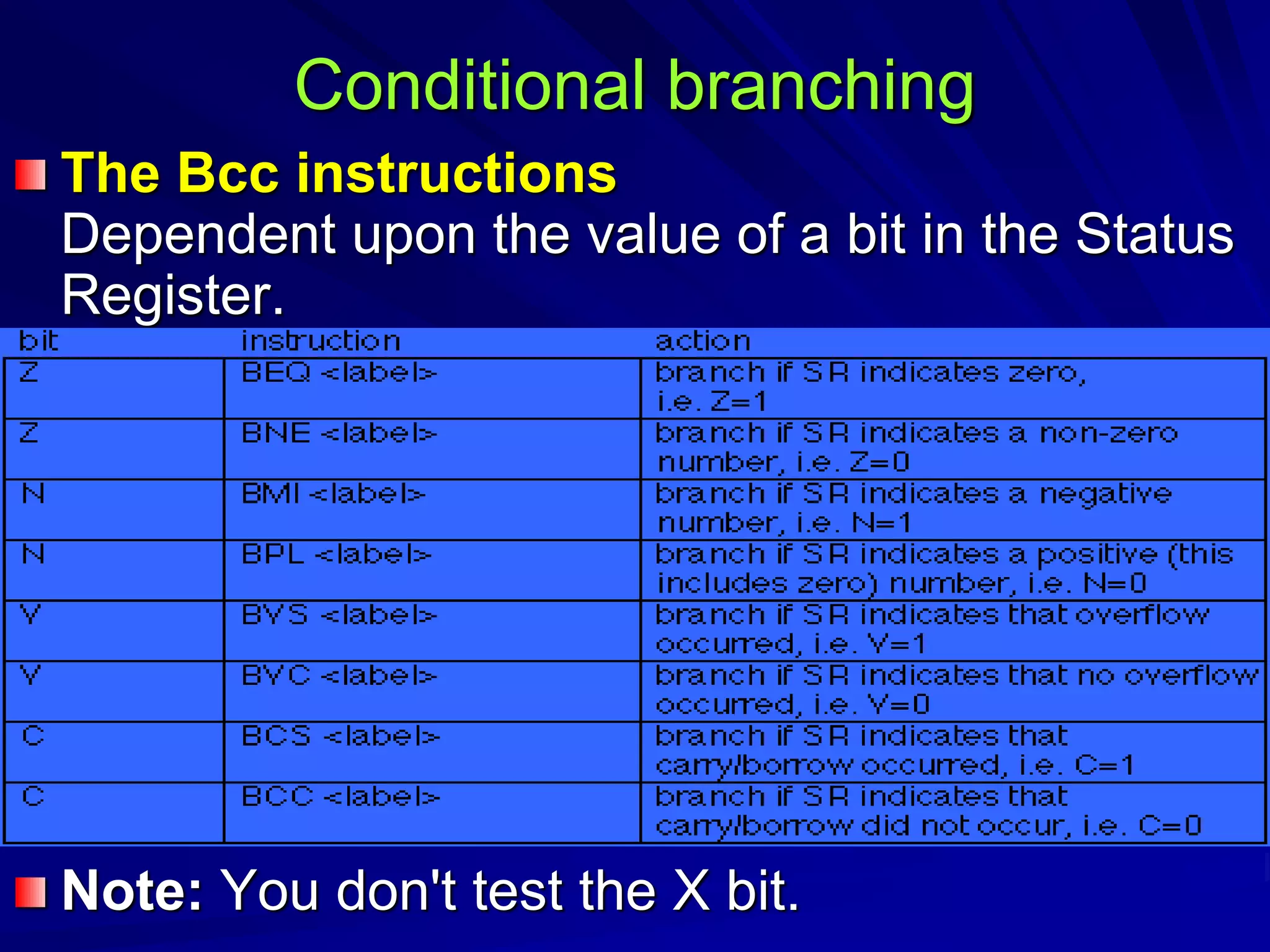
Conditional branching
The Bcc instructions
Dependent upon the value of a bit in the Status
Register.
Note: You don't test the X bit.
Branch instruction)conditional)
Branch address=[updated PC]+ offset
Offset: the distance from the word that follows the branch
instruction op_code word
8 bit offset : 8 bit in op_code :+127…-128 bytes
16 bit offset :+32… -32 k
1000 LOOP ADD.W (A2)+,D0
1002 SUB.W #1,D1
1004 BGT LOOP
1006
Op_code offset
Op_code word
Op_code word
Op code -6
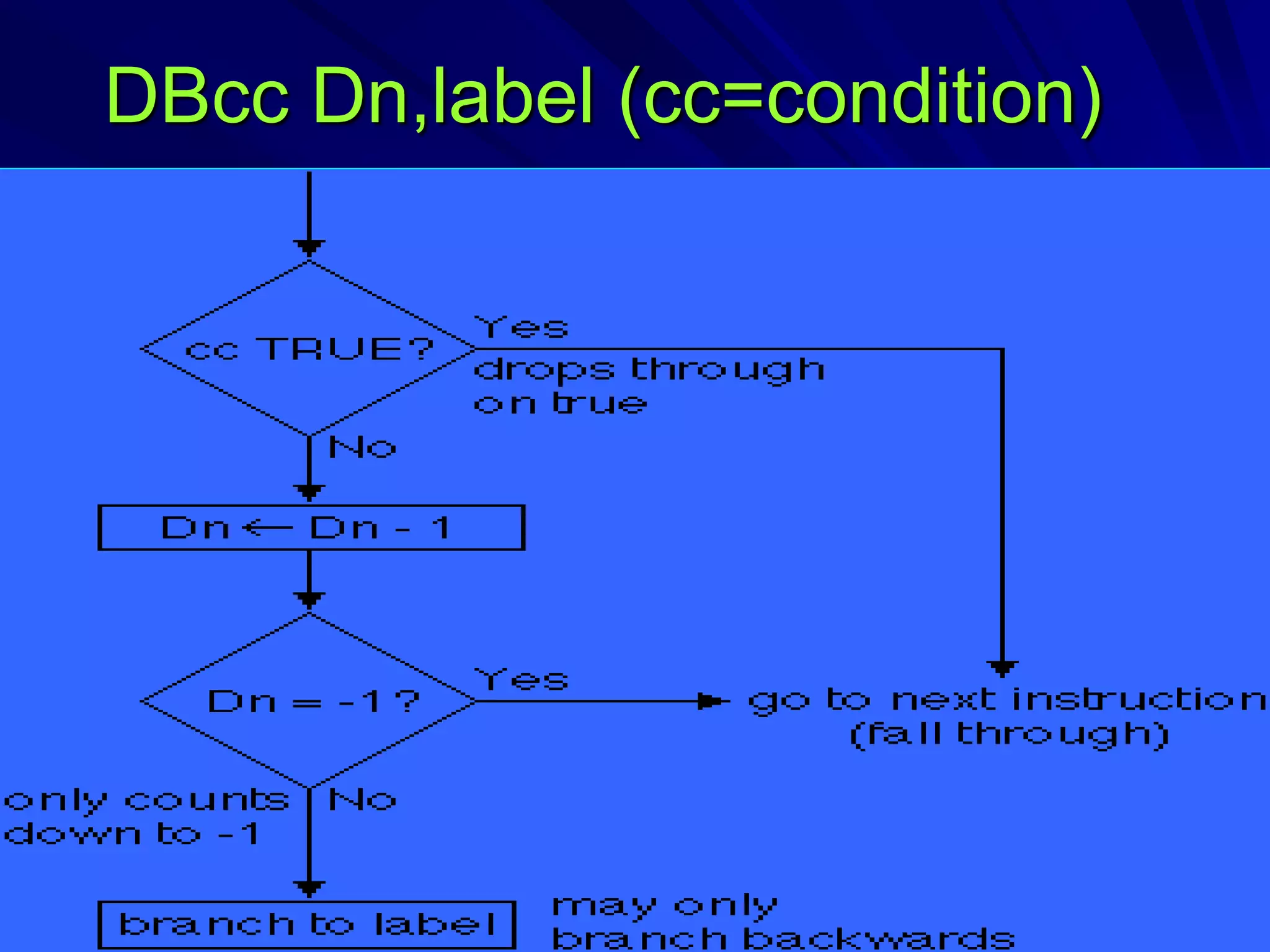
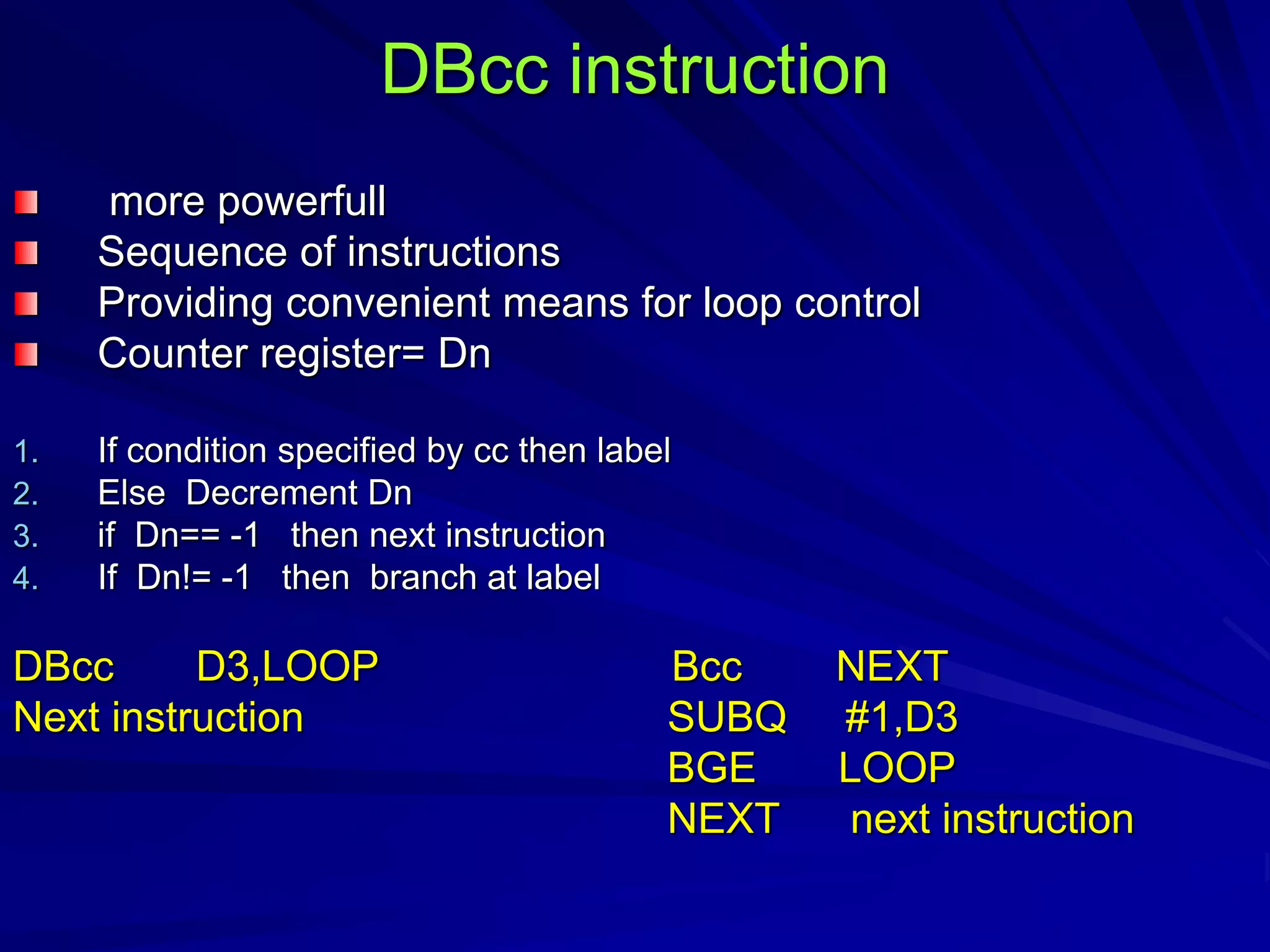
DBcc Dn,label (cc=condition)
DBcc instruction
more powerfull
Sequence of instructions
Providing convenient means for loop control
Counter register= Dn
1. If condition specified by cc then label
2. Else Decrement Dn
3. if Dn== -1 then next instruction
4. If Dn!= -1 then branch at label
DBcc D3,LOOP Bcc NEXT
Next instruction SUBQ #1,D3
BGE LOOP
NEXT next instruction
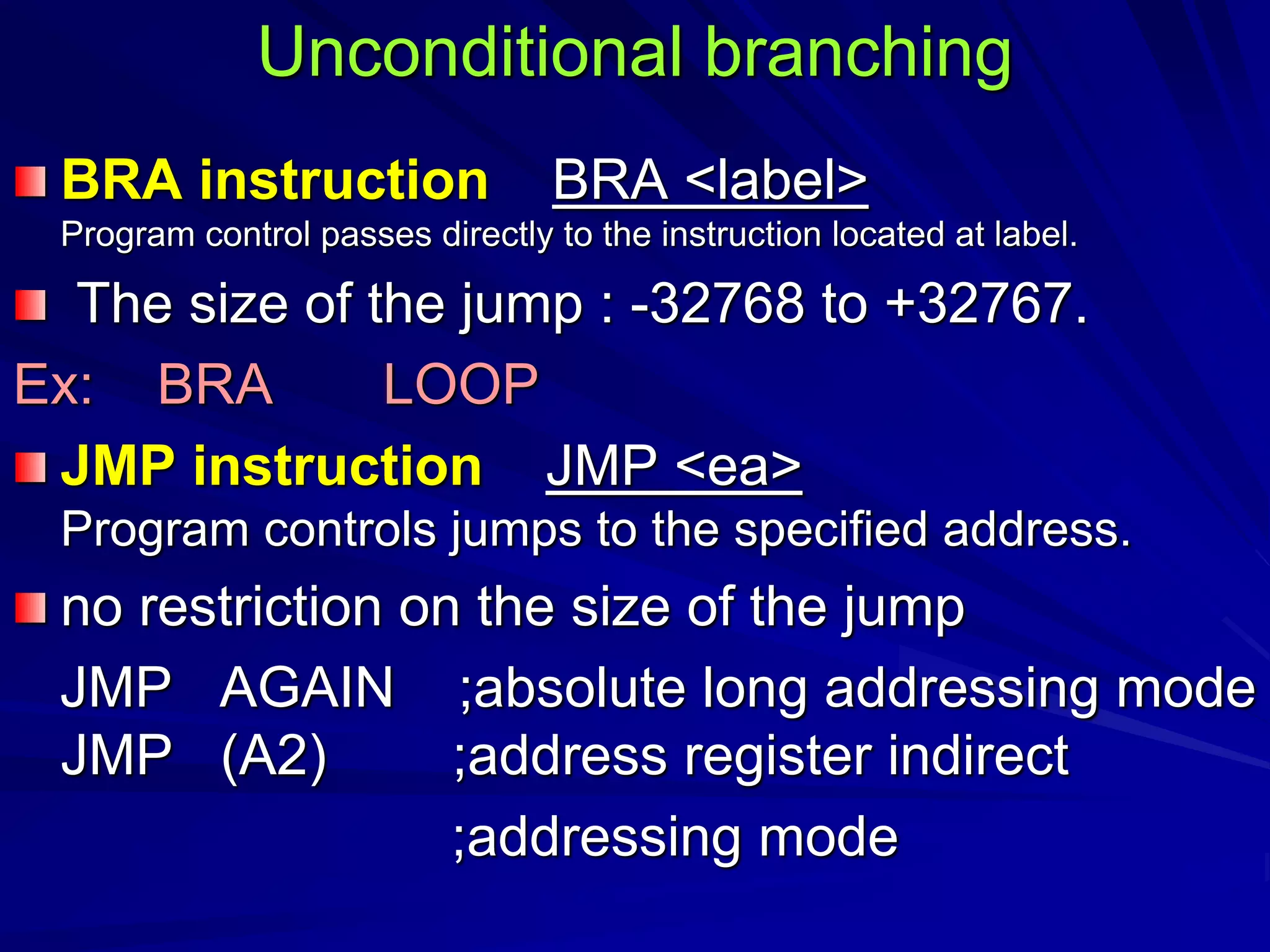
Unconditional branching
BRA instruction BRA <label>
Program control passes directly to the instruction located at label.
The size of the jump : -32768 to +32767.
Ex: BRA LOOP
JMP instruction JMP <ea>
Program controls jumps to the specified address.
no restriction on the size of the jump
JMP AGAIN ;absolute long addressing mode
JMP (A2) ;address register indirect
;addressing mode
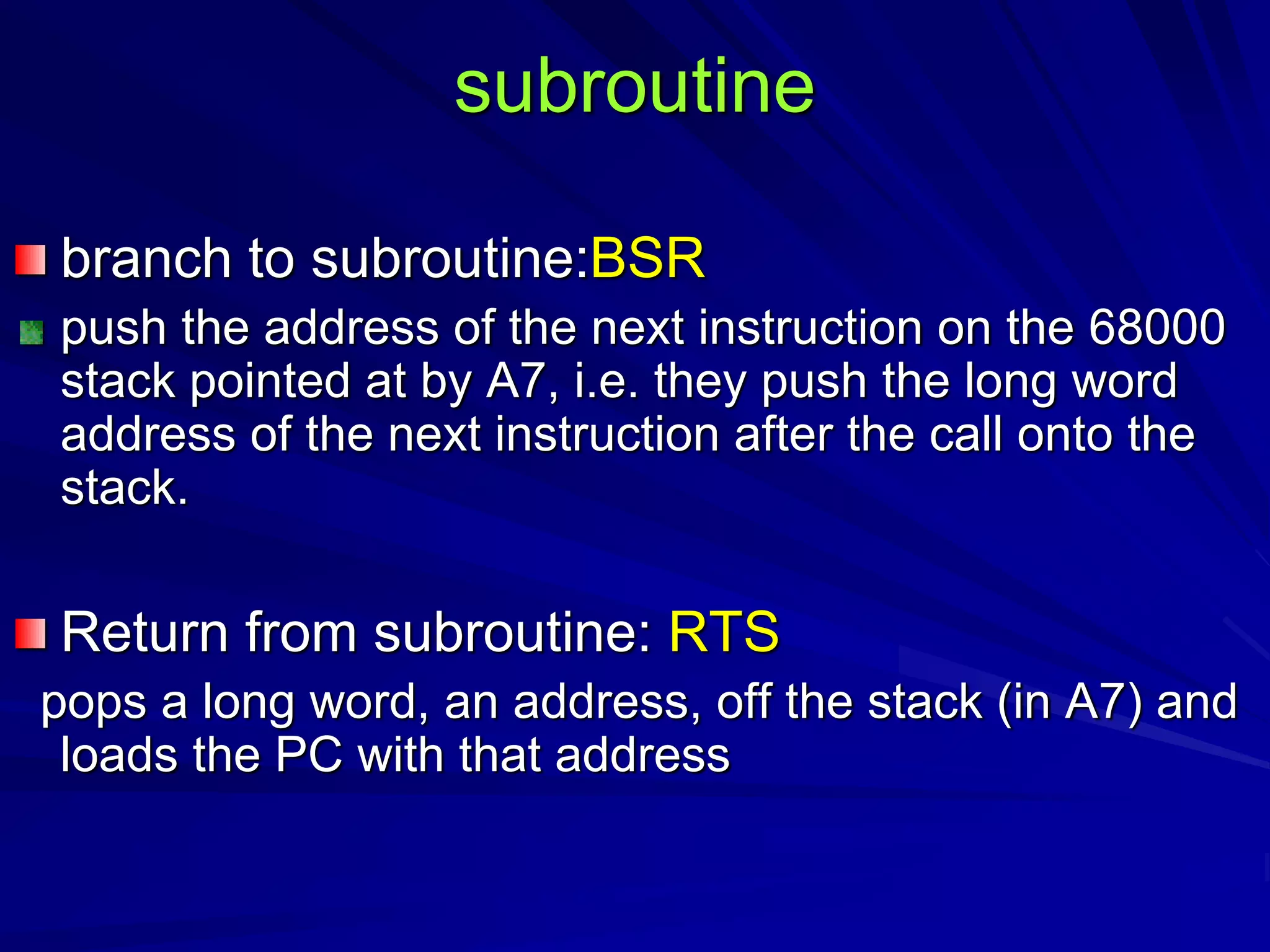
subroutine
branch to subroutine:BSR
push the address of the next instruction on the 68000
stack pointed at by A7, i.e. they push the long word
address of the next instruction after the call onto the
stack.
Return from subroutine: RTS
pops a long word, an address, off the stack (in A7) and
loads the PC with that address
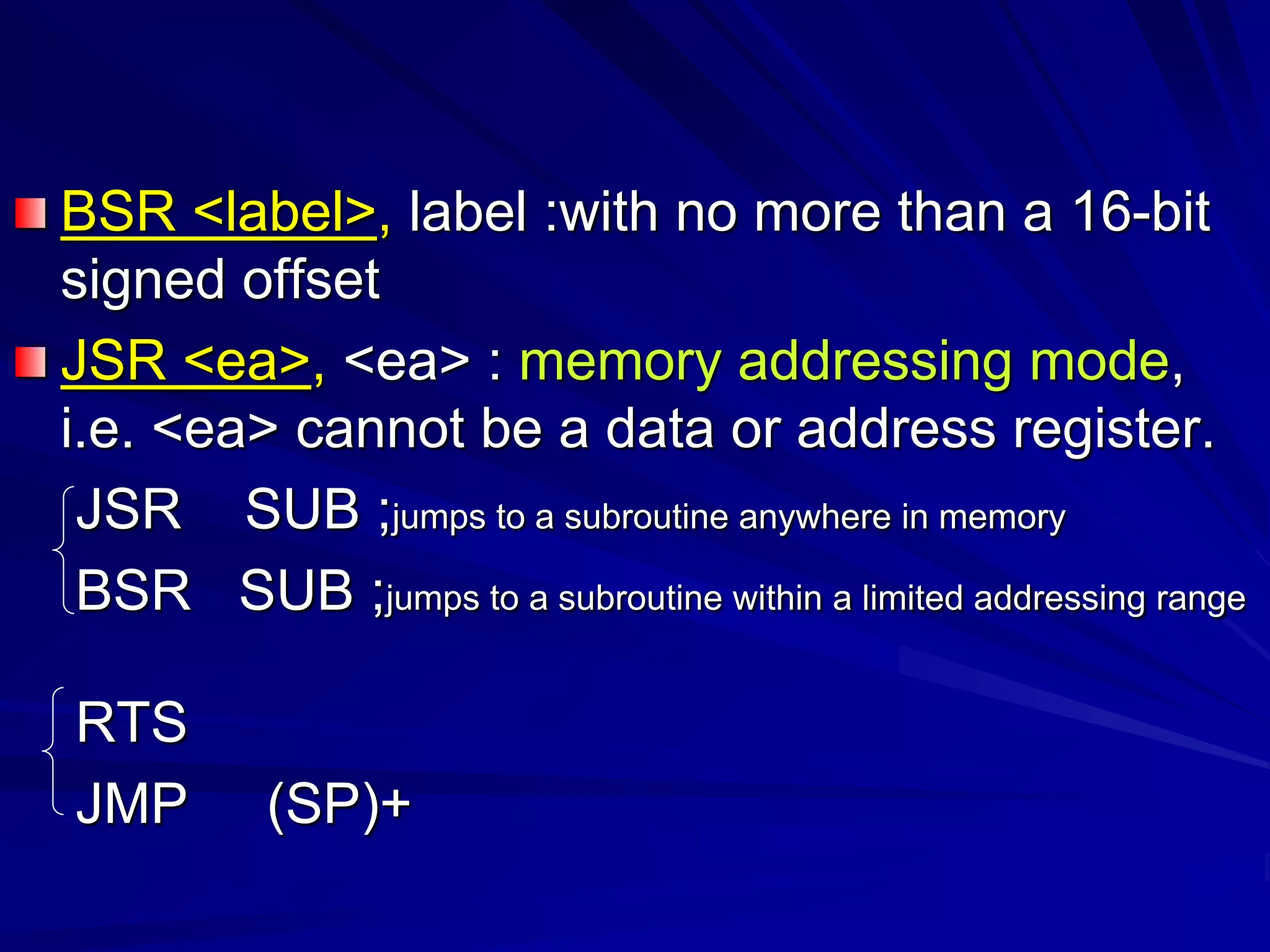
BSR <label>, label :with no more than a 16-bit
signed offset
JSR <ea>, <ea> : memory addressing mode,
i.e. <ea> cannot be a data or address register.
JSR SUB ;jumps to a subroutine anywhere in memory
BSR SUB ;jumps to a subroutine within a limited addressing range
RTS
JMP (SP)+
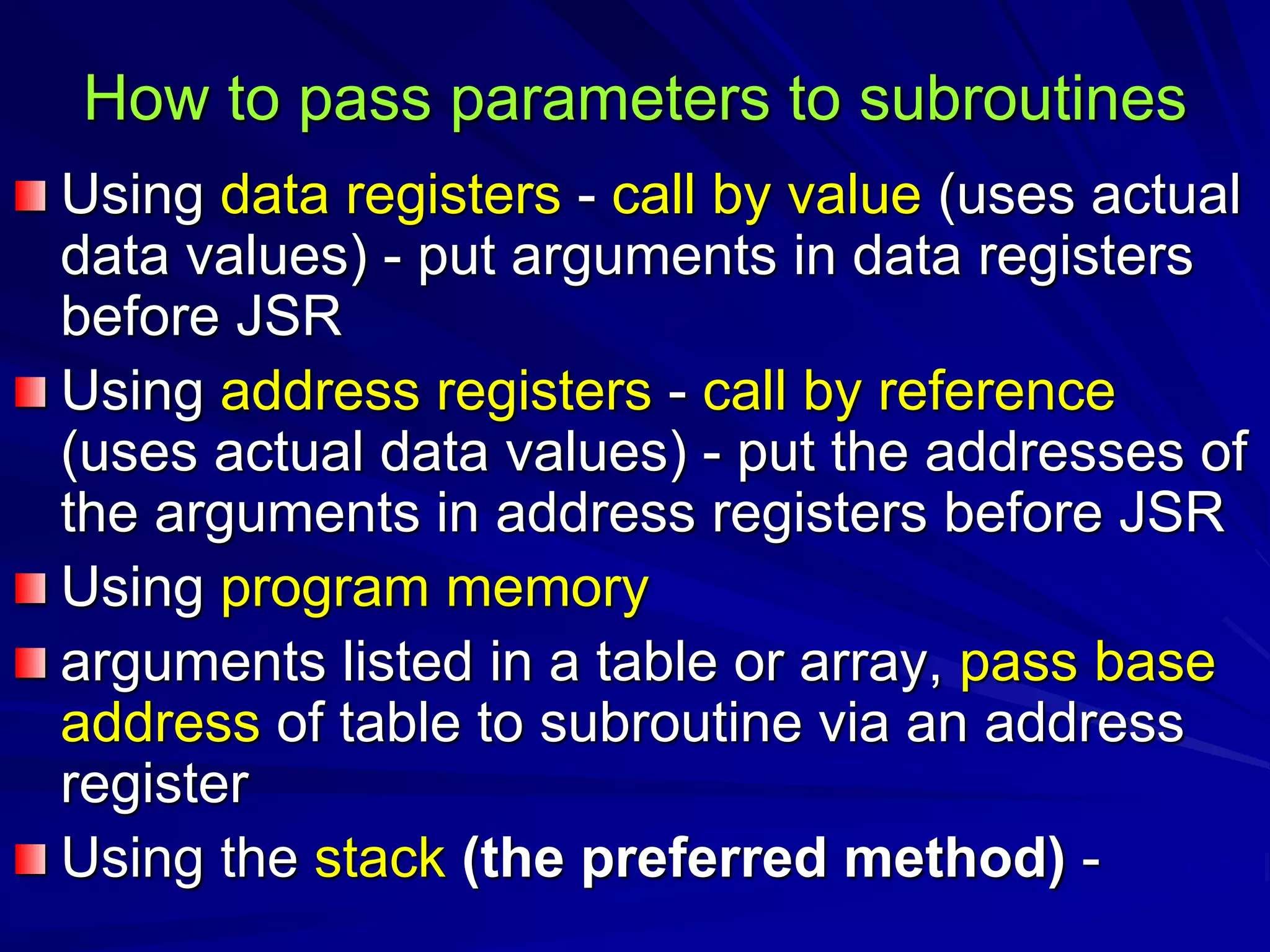
How to pass parameters to subroutines
Using data registers - call by value (uses actual
data values) - put arguments in data registers
before JSR
Using address registers - call by reference
(uses actual data values) - put the addresses of
the arguments in address registers before JSR
Using program memory
arguments listed in a table or array, pass base
address of table to subroutine via an address
register
Using the stack (the preferred method) -
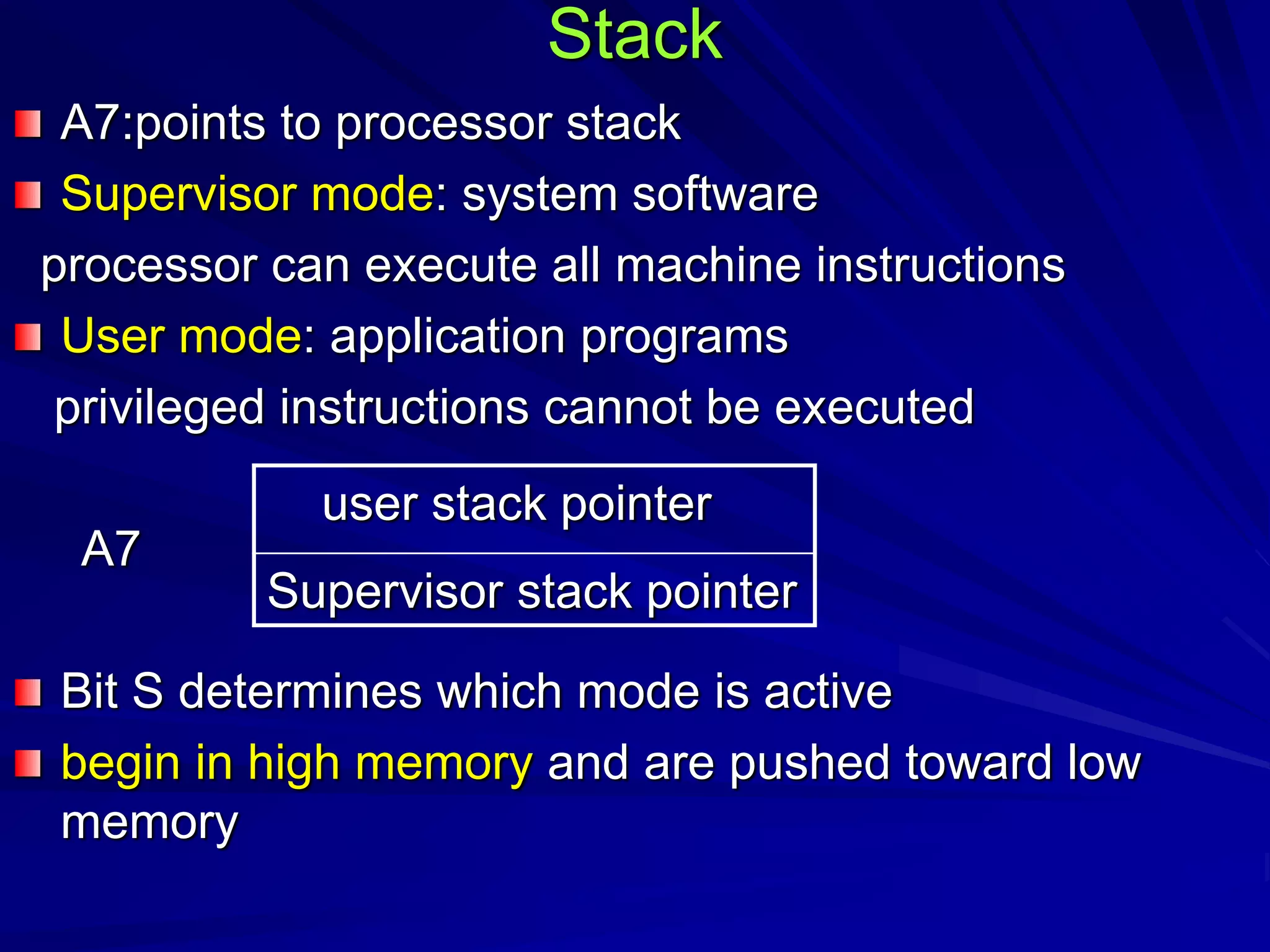
Stack
A7:points to processor stack
Supervisor mode: system software
processor can execute all machine instructions
User mode: application programs
privileged instructions cannot be executed
A7
Bit S determines which mode is active
begin in high memory and are pushed toward low
memory
user stack pointer
Supervisor stack pointer
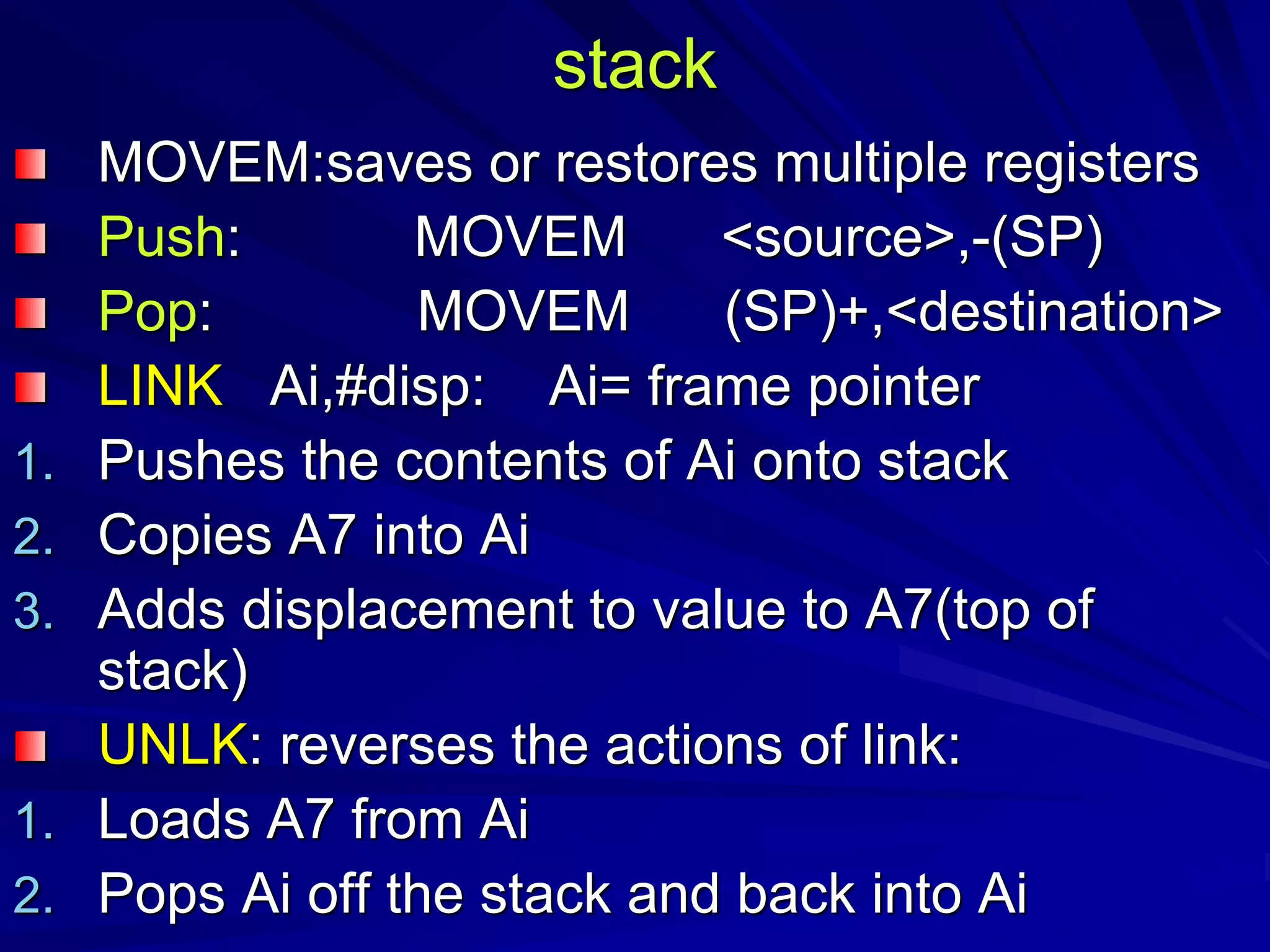
stack
MOVEM:saves or restores multiple registers
Push: MOVEM <source>,-(SP)
Pop: MOVEM (SP)+,<destination>
LINK Ai,#disp: Ai= frame pointer
1. Pushes the contents of Ai onto stack
2. Copies A7 into Ai
3. Adds displacement to value to A7(top of
stack)
UNLK: reverses the actions of link:
1. Loads A7 from Ai
2. Pops Ai off the stack and back into Ai
…
MOVE.L P2,-(A7)
MOVE.L P1,-(A7)
BSR SUB1
2014 MOVE.L (A7),RES [D0]
ADDI.L #8,A7 [D1]
… [D2]
2100 SUB1 LINK A6,#0 [A0]
MOVEM.L D0-D2/A0,A7 [A6]
MOVEA.L 8(A6),A0 2014
… P1
UNLK A6 P2
RTS
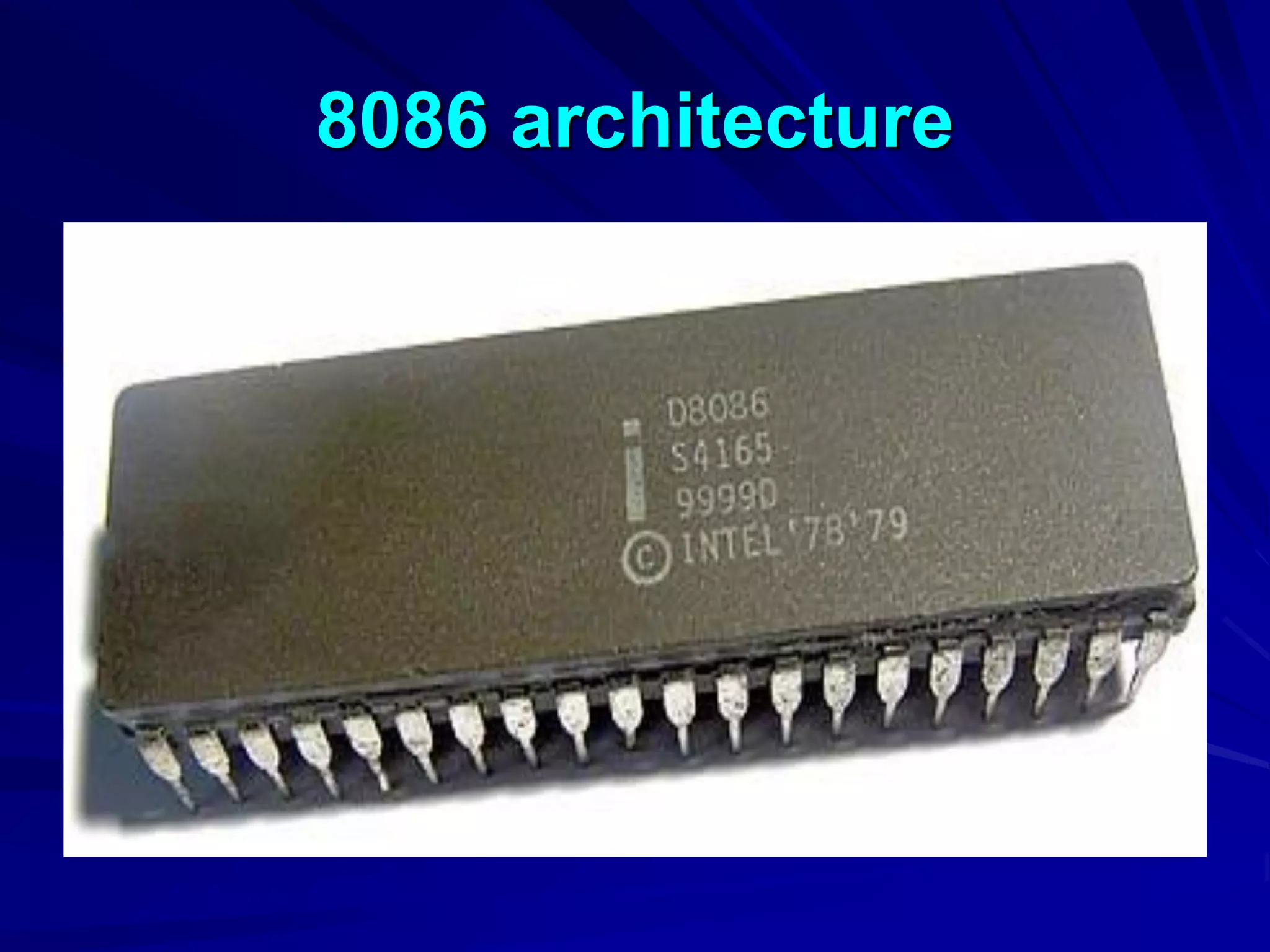
8086 architecture
8086 architecture
Addressing pins:20;
memory addressing capacity=2^20~1MB
data pins=16
Use of pins:both address and datum cannot be
sent to bus at the same time
One supply voltage of +5V;
One clock phase up to 5MHz
Two other versions of 8086 8086-1(10 MHz)
8086-2(8 MHz)
Registers
Control unit and working registers:
1. Data group: set of arithmetic instruction
2. Pointer group:base and index registers
3. Segment group
Data group consists of :Ax,Bx,Cx,Dx
Bx:Base register in addressing calculations
Cx: is used as an counter
Dx: hold I/O address
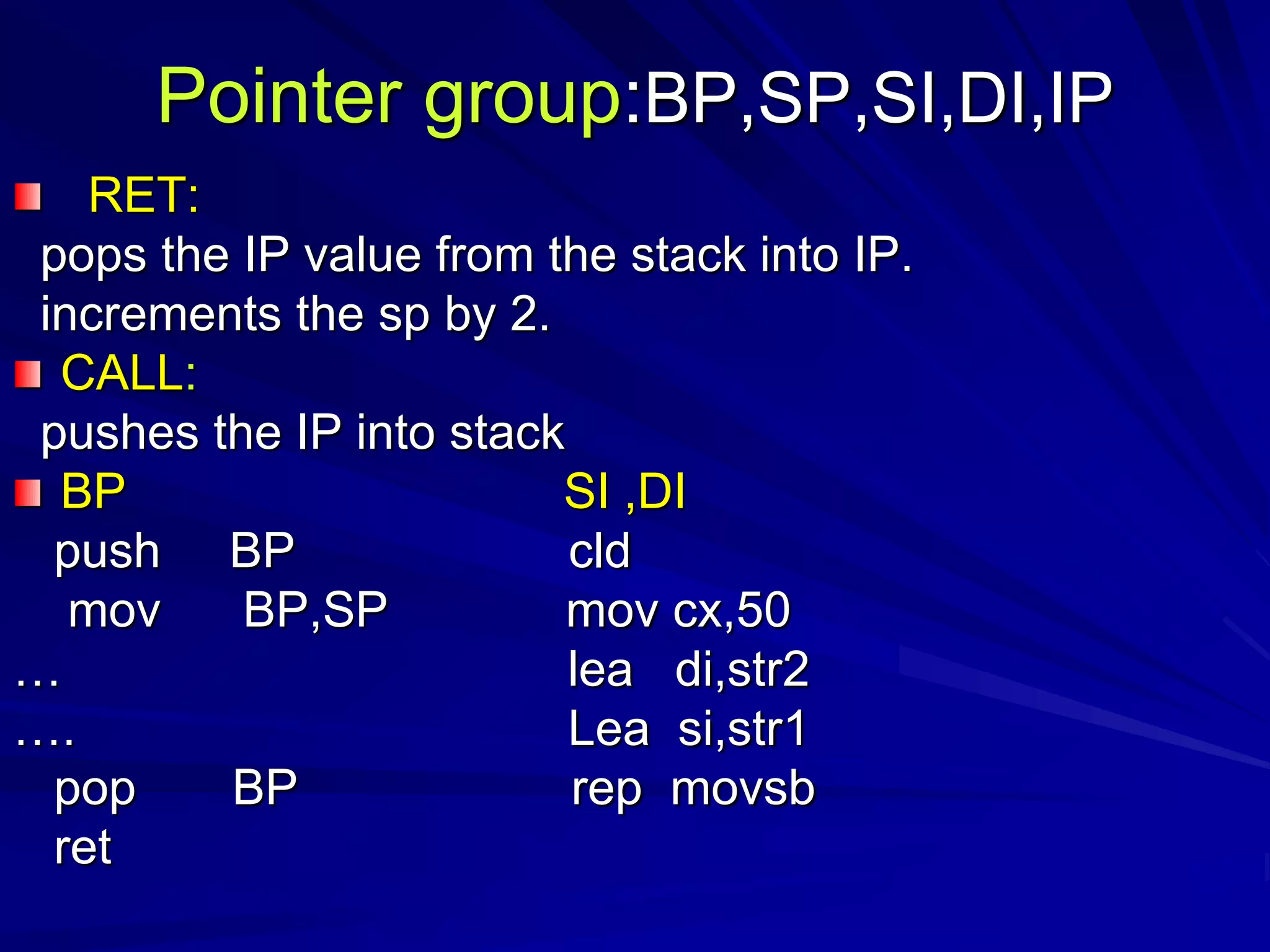
Pointer group:BP,SP,SI,DI,IP
RET:
pops the IP value from the stack into IP.
increments the sp by 2.
CALL:
pushes the IP into stack
BP SI ,DI
push BP cld
mov BP,SP mov cx,50
… lea di,str2
…. Lea si,str1
pop BP rep movsb
ret
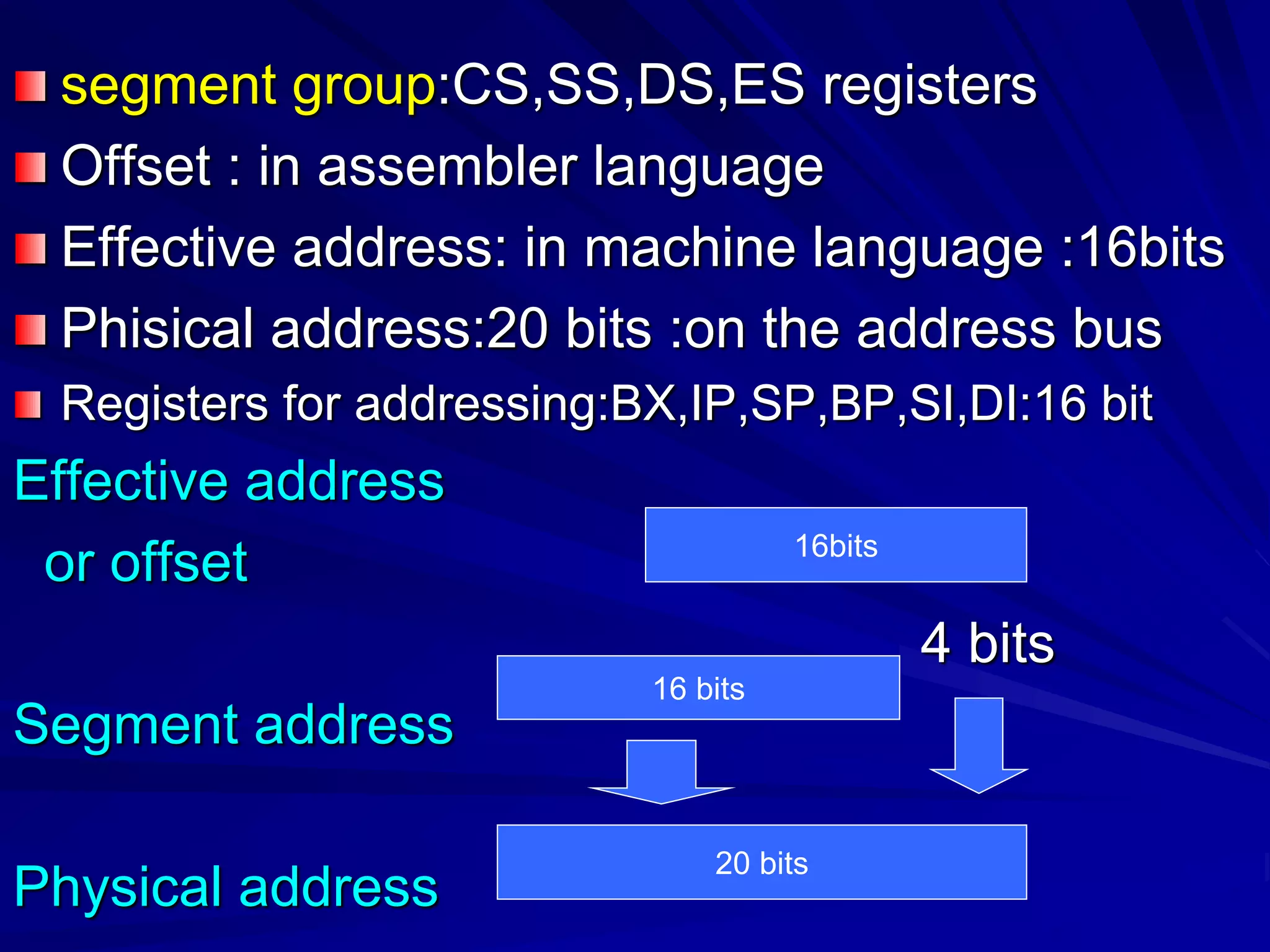
segment group:CS,SS,DS,ES registers
Offset : in assembler language
Effective address: in machine language :16bits
Phisical address:20 bits :on the address bus
Registers for addressing:BX,IP,SP,BP,SI,DI:16 bit
Effective address
or offset
4 bits
Segment address
Physical address
16 bits
20 bits
16bits
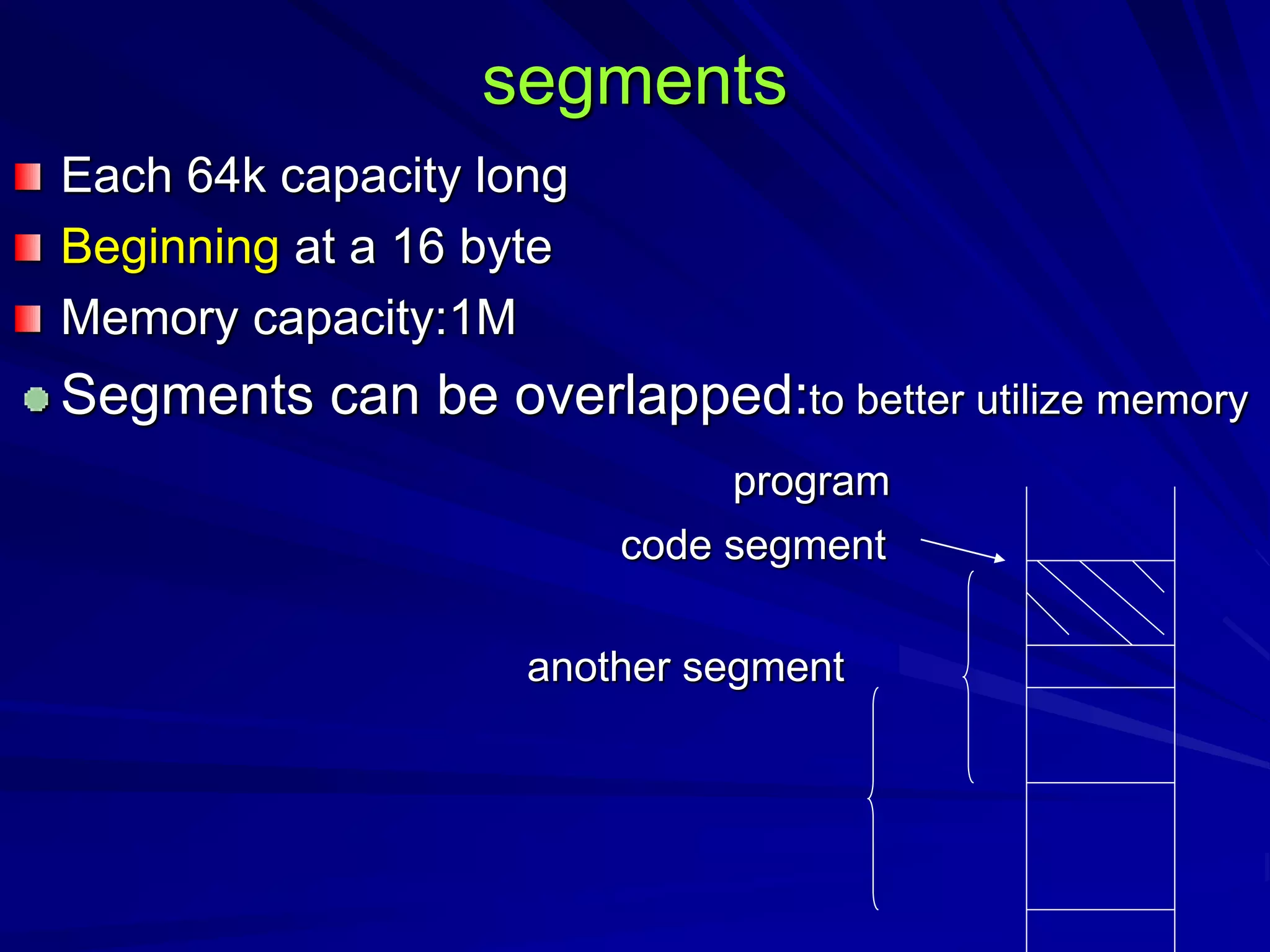
segments
Each 64k capacity long
Beginning at a 16 byte
Memory capacity:1M
Segments can be overlapped:to better utilize memory
program
code segment
another segment
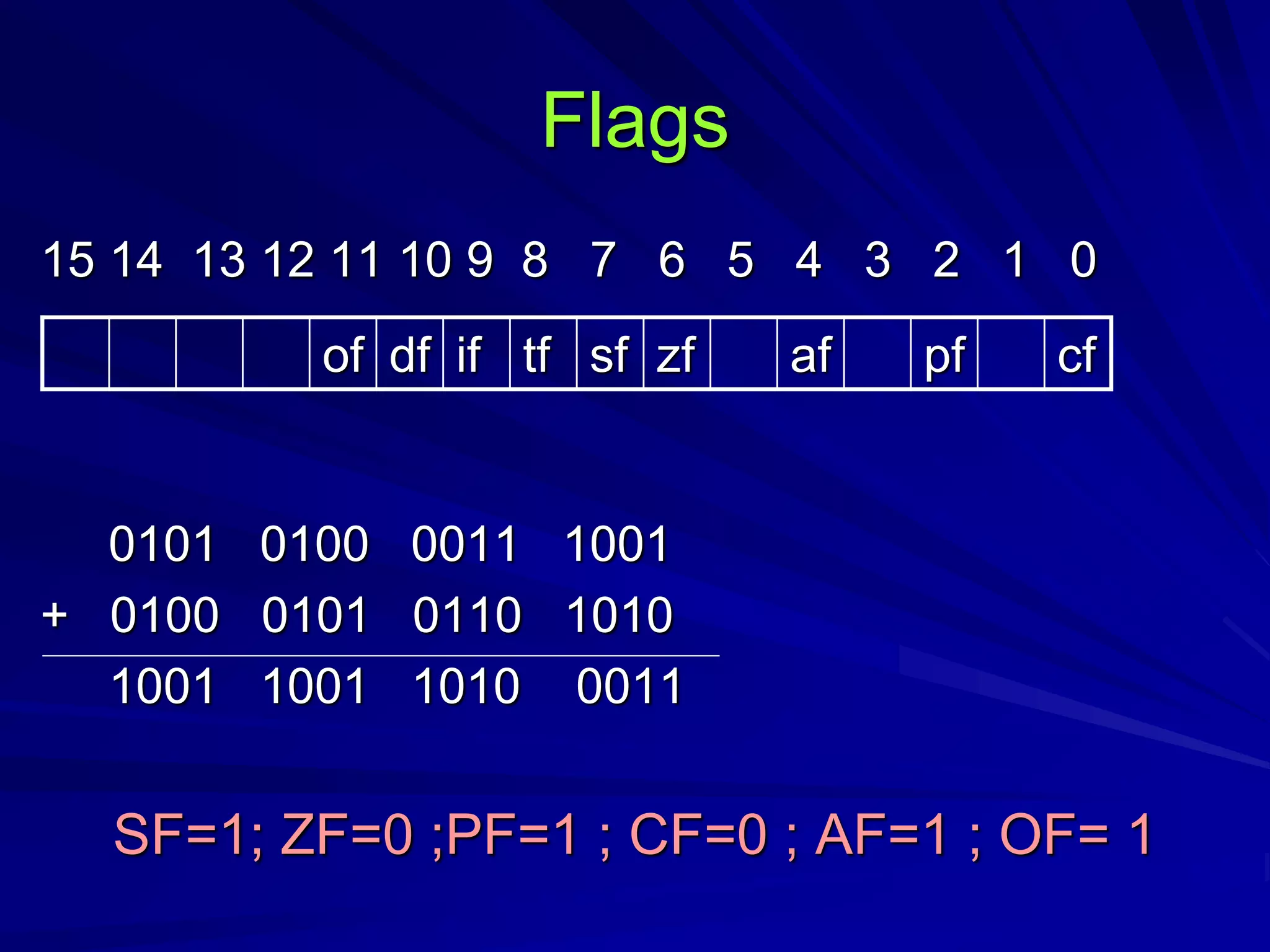
Flags
15 14 13 12 11 10 9 8 7 6 5 4 3 2 1 0
0101 0100 0011 1001
+ 0100 0101 0110 1010
1001 1001 1010 0011
SF=1; ZF=0 ;PF=1 ; CF=0 ; AF=1 ; OF= 1
of df if tf sf zf af pf cf
Addressing modes
Instruction instruction memory instruction register
a) Immediate b) direct c) register
Mov ax,50 mov ax,place mov ax,bx
Instruction register memory
d) register indirect EA= BX
DI,SI
mov bx,offset place
mov ax,[bx]
datum EA datum register datum
register EA datum
Addressing modes
instruction
memory
EA
register
mov al,list+1
e) register relative
instruction register
index:si,di
base:bp,bx
register
f) based index
mov al,[bx+si]
address
+
datum
register displacement
Base reg. displacement
Base address
+ datum
index
g)relative base address
BX SI
mov al,[bx+si+3] EA= BP + DI + displacement
index
Base addr
+
Base reg Index reg displacement
datum
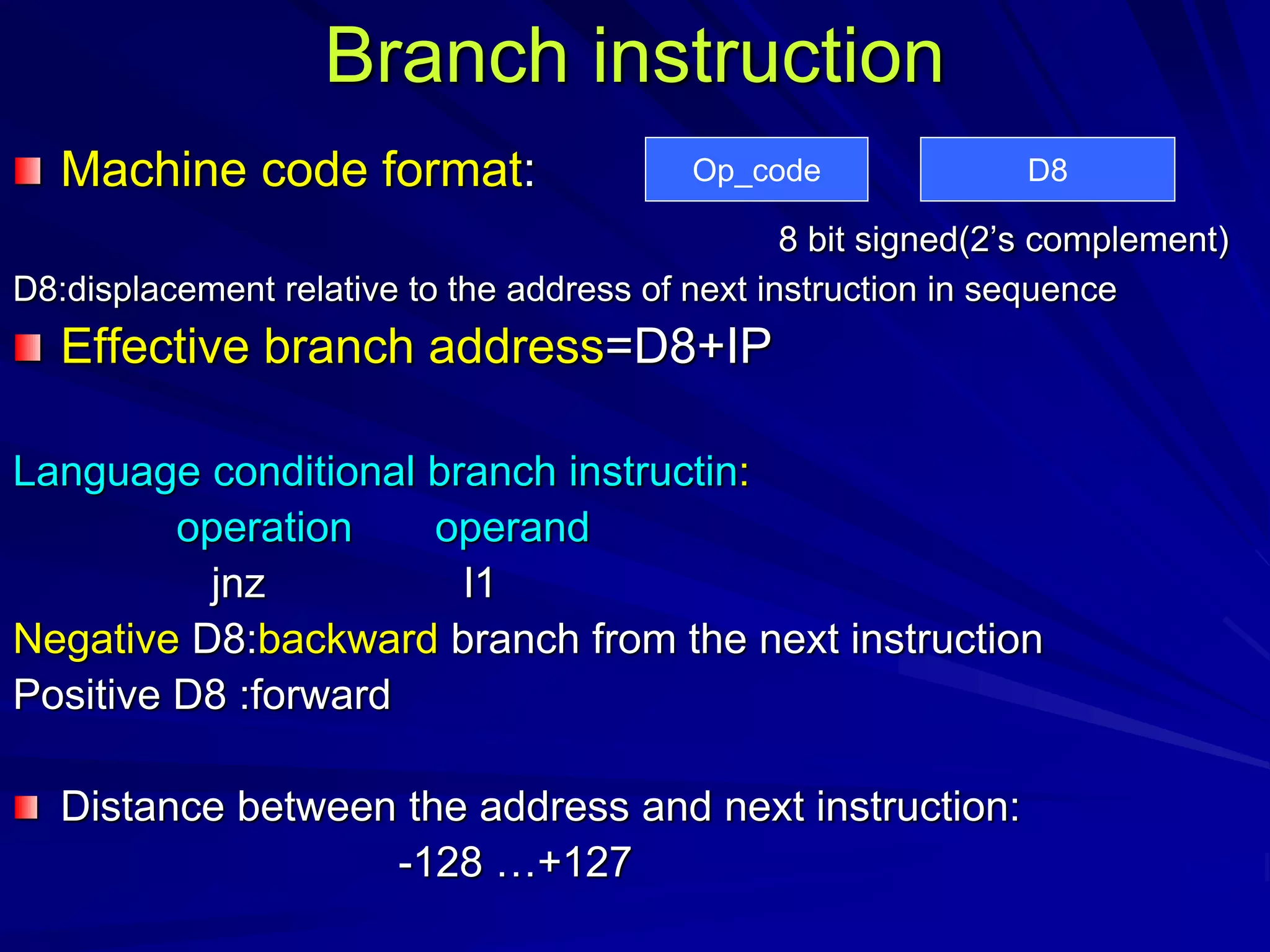
Branch instruction
Machine code format:
8 bit signed(2’s complement)
D8:displacement relative to the address of next instruction in sequence
Effective branch address=D8+IP
Language conditional branch instructin:
operation operand
jnz l1
Negative D8:backward branch from the next instruction
Positive D8 :forward
Distance between the address and next instruction:
-128 …+127
Op_code D8
Example:
0050 AGAIN: INC CX
0052 ADD AX,[BX]
0054 JNZ AGAIN
0056 NEXT: MOV RESULT,CX
0050 effective branch address
- 0056 (IP)when jnz branch decision is made
-6
‫منابع‬:
COMPUTER ORGANIZATIONB
by:Carl Hamacher,Zvonko Vranesic,Safwat Zaky
STRUCTURED COMPUTER ORGANIZATION
by: A.S Tornenbaum
THE ART OF ASSEMBLY LANGUAGE
PROGRAMMING
by:James F.Peters, Reston Pubco
The 80x86 IBM PC and compatible computrs
by: Muhammad Ali Mazidi , Janice Gillispie Mazidi
www.cwru.edu
www.old_computers.com
www.library.nci.com
www.informit.com
www.peyuide.com
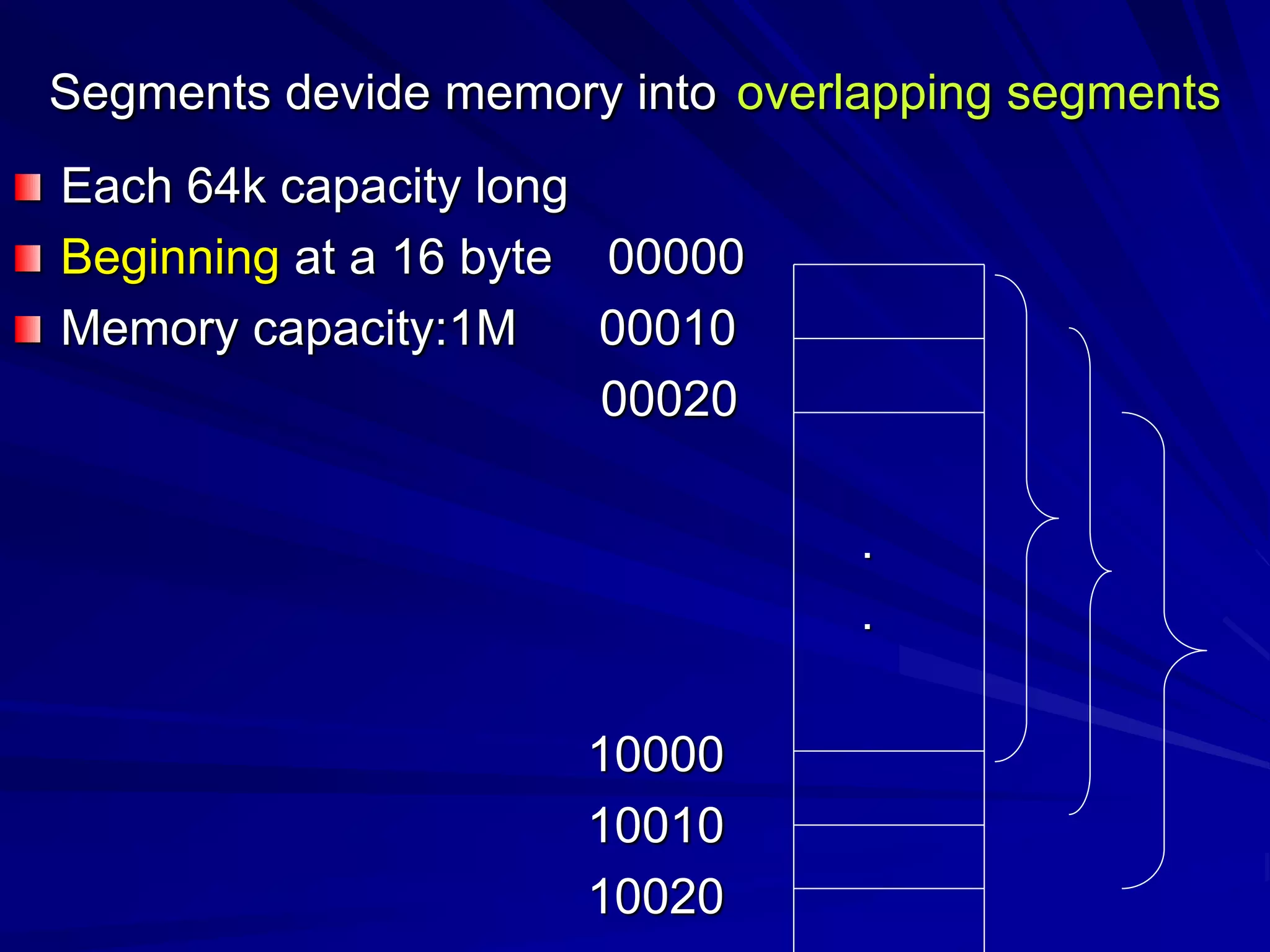
Segments devide memory into overlapping segments
Each 64k capacity long
Beginning at a 16 byte 00000
Memory capacity:1M 00010
00020
.
.
10000
10010
10020
Name addressing symbol addressing function
Immediate #value operand=value
Absolute short value EA=sign extended w value
Absolute long value EA=value
Register Rn EA=Rn
Register indirect (An) EA=[An]
Autoincrement (An)+ EA=[An]
Auodecrement (An)- EA=[An]
Indexed basic w value (An) EA=w value +[An]
Indexed full w value (An,Rk,s) EA=B value +[An]+[Rk]
relative basic w value or label EA=w value +[pc]
Relative full B value (pc,Rk,s) EA=B value +[pc]+[Rk]
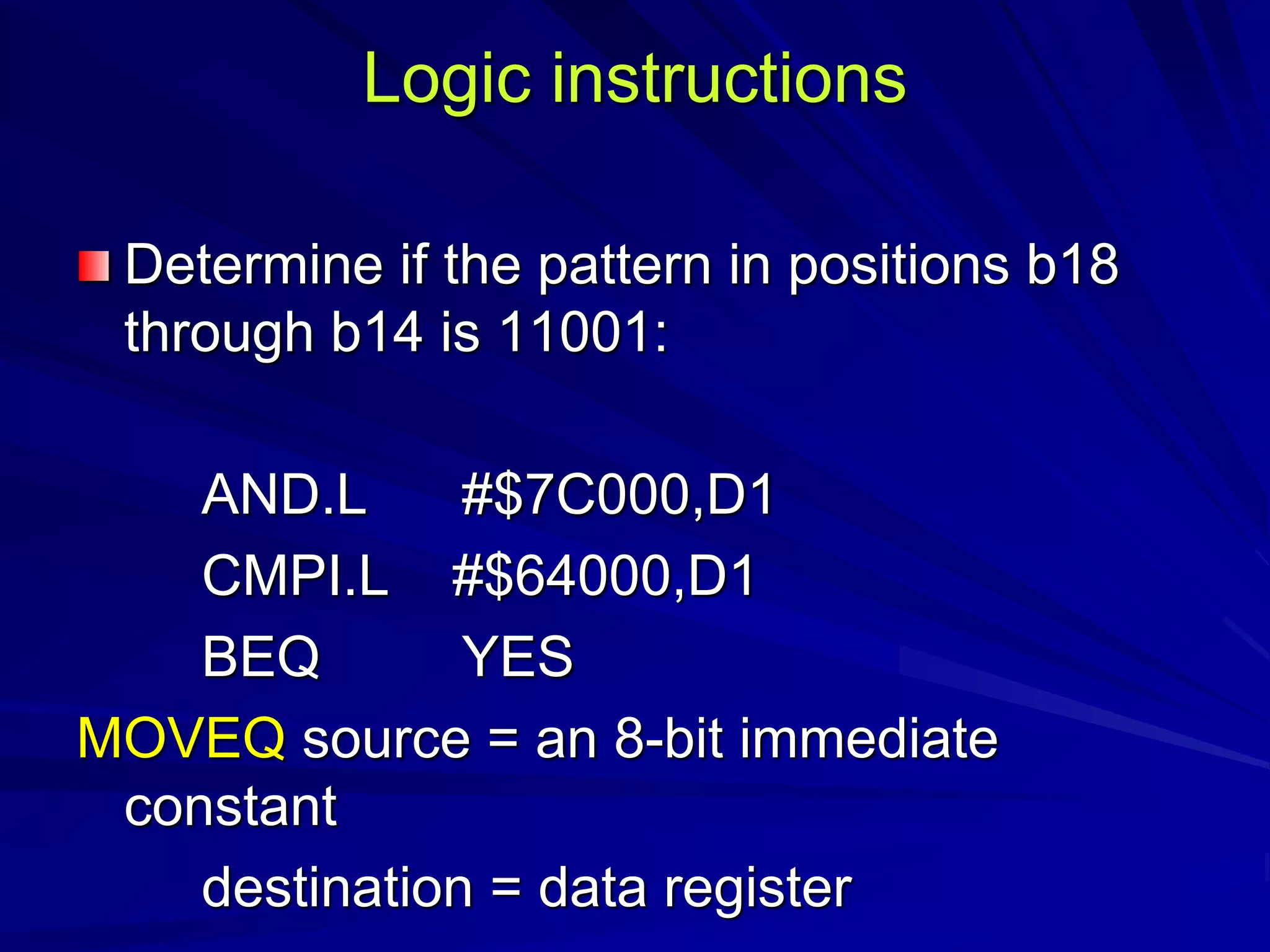
Logic instructions
Determine if the pattern in positions b18
through b14 is 11001:
AND.L #$7C000,D1
CMPI.L #$64000,D1
BEQ YES
MOVEQ source = an 8-bit immediate
constant
destination = data register

16-bit microprocessors

  • 1.
  • 2.
  • 3.
    68000 architecture 16 bitexternal word length :16 data pin
  • 4.
    Register organization Register:32 bits8 data registers:D0-D7 7 address registers:A0-A6 Data registers: accumulator + counter Data and address register:index register Addressable space=2^24~16MB Data registers address registers
  • 5.
    A7:proccessor stack pointer Sr:processor status register Pc: program counter
  • 6.
  • 7.
    instructions One operand andtwo operand two operand: OP src,dst Ex: add #9,d3 dst [src]+[dst] Source op or destination op must be in Dn Second op:register or memory location
  • 8.
    Addressing modes Source isdata register direct General form – ADD D1,D3 Both source and destination are data register direct. Source is address register direct General form – ADD A1,D3 Source is address register direct; destination is data register direct. Source is immediate General form – ADD #7,D3 (ADDI #7,D3 ) Source is immediate; destination is data register direct.
  • 9.
    Absolute modes ofaddressing LONG :address:32 bits Short :address :16 bit General form - ADD LABEL,D3 Source is absolute (an address specified by a symbol) Autoincrement General form - ADD (A0)+,D3 Source is address register indirect with postincrement. After access to operand,An is incremented(1,2,4) Aoutodecrement General form - ADD -(A0),D3 Source is address register indirect with predecrement.
  • 10.
    Assembly language Assembler instructionmust indicate the desired size Size indicator: L: long word; W: word; B: byte ADD #20,D1 ~ ADD.W #20,D1 numbers : default Decimal prefix $ Hexadecimal prefix % Binary Alphanumeric characters must be between single quot ORG: starting address of a block of instruction or data EQU: equates names with numerical values DC: Define Constant ORG 100 PLACE DC.B 23.$4F,%10110101 DS: Define Storage ARRAY DS.L 200
  • 11.
    Logic instructions NAME SIZEADDRESSING MODE AND B,W,L s =Dn ; d = Dn ANDI B,W,L s = Immed EOR B,W,L s = Dn EORI B,W,L s = Immed OR B,W,L s=Dn,Sr=Dn NOT NEG
  • 12.
    Condition code flags N:(Negative) set to 1 when result is negative Z: (Zero) V: (oVerflow) C: (Carry) X: (eXtended) special for 68000 :is set to 1 the same way as the c flag but is not affected by as many instructions C and X are set 1 to signify borrow signal they depend on the carry_out from bit positions 7,15,31 for byte , word , long word T S I X N Z V C
  • 13.
    Conditional branching The Bccinstructions Dependent upon the value of a bit in the Status Register. Note: You don't test the X bit.
  • 14.
    Branch instruction)conditional) Branch address=[updatedPC]+ offset Offset: the distance from the word that follows the branch instruction op_code word 8 bit offset : 8 bit in op_code :+127…-128 bytes 16 bit offset :+32… -32 k 1000 LOOP ADD.W (A2)+,D0 1002 SUB.W #1,D1 1004 BGT LOOP 1006 Op_code offset Op_code word Op_code word Op code -6
  • 15.
  • 16.
    DBcc instruction more powerfull Sequenceof instructions Providing convenient means for loop control Counter register= Dn 1. If condition specified by cc then label 2. Else Decrement Dn 3. if Dn== -1 then next instruction 4. If Dn!= -1 then branch at label DBcc D3,LOOP Bcc NEXT Next instruction SUBQ #1,D3 BGE LOOP NEXT next instruction
  • 17.
    Unconditional branching BRA instructionBRA <label> Program control passes directly to the instruction located at label. The size of the jump : -32768 to +32767. Ex: BRA LOOP JMP instruction JMP <ea> Program controls jumps to the specified address. no restriction on the size of the jump JMP AGAIN ;absolute long addressing mode JMP (A2) ;address register indirect ;addressing mode
  • 18.
    subroutine branch to subroutine:BSR pushthe address of the next instruction on the 68000 stack pointed at by A7, i.e. they push the long word address of the next instruction after the call onto the stack. Return from subroutine: RTS pops a long word, an address, off the stack (in A7) and loads the PC with that address
  • 19.
    BSR <label>, label:with no more than a 16-bit signed offset JSR <ea>, <ea> : memory addressing mode, i.e. <ea> cannot be a data or address register. JSR SUB ;jumps to a subroutine anywhere in memory BSR SUB ;jumps to a subroutine within a limited addressing range RTS JMP (SP)+
  • 20.
    How to passparameters to subroutines Using data registers - call by value (uses actual data values) - put arguments in data registers before JSR Using address registers - call by reference (uses actual data values) - put the addresses of the arguments in address registers before JSR Using program memory arguments listed in a table or array, pass base address of table to subroutine via an address register Using the stack (the preferred method) -
  • 21.
    Stack A7:points to processorstack Supervisor mode: system software processor can execute all machine instructions User mode: application programs privileged instructions cannot be executed A7 Bit S determines which mode is active begin in high memory and are pushed toward low memory user stack pointer Supervisor stack pointer
  • 22.
    stack MOVEM:saves or restoresmultiple registers Push: MOVEM <source>,-(SP) Pop: MOVEM (SP)+,<destination> LINK Ai,#disp: Ai= frame pointer 1. Pushes the contents of Ai onto stack 2. Copies A7 into Ai 3. Adds displacement to value to A7(top of stack) UNLK: reverses the actions of link: 1. Loads A7 from Ai 2. Pops Ai off the stack and back into Ai
  • 23.
    … MOVE.L P2,-(A7) MOVE.L P1,-(A7) BSRSUB1 2014 MOVE.L (A7),RES [D0] ADDI.L #8,A7 [D1] … [D2] 2100 SUB1 LINK A6,#0 [A0] MOVEM.L D0-D2/A0,A7 [A6] MOVEA.L 8(A6),A0 2014 … P1 UNLK A6 P2 RTS
  • 24.
  • 25.
    8086 architecture Addressing pins:20; memoryaddressing capacity=2^20~1MB data pins=16 Use of pins:both address and datum cannot be sent to bus at the same time One supply voltage of +5V; One clock phase up to 5MHz Two other versions of 8086 8086-1(10 MHz) 8086-2(8 MHz)
  • 26.
    Registers Control unit andworking registers: 1. Data group: set of arithmetic instruction 2. Pointer group:base and index registers 3. Segment group Data group consists of :Ax,Bx,Cx,Dx Bx:Base register in addressing calculations Cx: is used as an counter Dx: hold I/O address
  • 27.
    Pointer group:BP,SP,SI,DI,IP RET: pops theIP value from the stack into IP. increments the sp by 2. CALL: pushes the IP into stack BP SI ,DI push BP cld mov BP,SP mov cx,50 … lea di,str2 …. Lea si,str1 pop BP rep movsb ret
  • 28.
    segment group:CS,SS,DS,ES registers Offset: in assembler language Effective address: in machine language :16bits Phisical address:20 bits :on the address bus Registers for addressing:BX,IP,SP,BP,SI,DI:16 bit Effective address or offset 4 bits Segment address Physical address 16 bits 20 bits 16bits
  • 29.
    segments Each 64k capacitylong Beginning at a 16 byte Memory capacity:1M Segments can be overlapped:to better utilize memory program code segment another segment
  • 30.
    Flags 15 14 1312 11 10 9 8 7 6 5 4 3 2 1 0 0101 0100 0011 1001 + 0100 0101 0110 1010 1001 1001 1010 0011 SF=1; ZF=0 ;PF=1 ; CF=0 ; AF=1 ; OF= 1 of df if tf sf zf af pf cf
  • 31.
    Addressing modes Instruction instructionmemory instruction register a) Immediate b) direct c) register Mov ax,50 mov ax,place mov ax,bx Instruction register memory d) register indirect EA= BX DI,SI mov bx,offset place mov ax,[bx] datum EA datum register datum register EA datum
  • 32.
    Addressing modes instruction memory EA register mov al,list+1 e)register relative instruction register index:si,di base:bp,bx register f) based index mov al,[bx+si] address + datum register displacement Base reg. displacement Base address + datum index
  • 33.
    g)relative base address BXSI mov al,[bx+si+3] EA= BP + DI + displacement index Base addr + Base reg Index reg displacement datum
  • 34.
    Branch instruction Machine codeformat: 8 bit signed(2’s complement) D8:displacement relative to the address of next instruction in sequence Effective branch address=D8+IP Language conditional branch instructin: operation operand jnz l1 Negative D8:backward branch from the next instruction Positive D8 :forward Distance between the address and next instruction: -128 …+127 Op_code D8
  • 35.
    Example: 0050 AGAIN: INCCX 0052 ADD AX,[BX] 0054 JNZ AGAIN 0056 NEXT: MOV RESULT,CX 0050 effective branch address - 0056 (IP)when jnz branch decision is made -6
  • 36.
    ‫منابع‬: COMPUTER ORGANIZATIONB by:Carl Hamacher,ZvonkoVranesic,Safwat Zaky STRUCTURED COMPUTER ORGANIZATION by: A.S Tornenbaum THE ART OF ASSEMBLY LANGUAGE PROGRAMMING by:James F.Peters, Reston Pubco The 80x86 IBM PC and compatible computrs by: Muhammad Ali Mazidi , Janice Gillispie Mazidi www.cwru.edu www.old_computers.com www.library.nci.com www.informit.com www.peyuide.com
  • 37.
    Segments devide memoryinto overlapping segments Each 64k capacity long Beginning at a 16 byte 00000 Memory capacity:1M 00010 00020 . . 10000 10010 10020
  • 38.
    Name addressing symboladdressing function Immediate #value operand=value Absolute short value EA=sign extended w value Absolute long value EA=value Register Rn EA=Rn Register indirect (An) EA=[An] Autoincrement (An)+ EA=[An] Auodecrement (An)- EA=[An] Indexed basic w value (An) EA=w value +[An] Indexed full w value (An,Rk,s) EA=B value +[An]+[Rk] relative basic w value or label EA=w value +[pc] Relative full B value (pc,Rk,s) EA=B value +[pc]+[Rk]
  • 39.
    Logic instructions Determine ifthe pattern in positions b18 through b14 is 11001: AND.L #$7C000,D1 CMPI.L #$64000,D1 BEQ YES MOVEQ source = an 8-bit immediate constant destination = data register