INPUT

Sensory
Store

STM

LTM
Sensory
-

register

Modality specific (taste held as taste, visual
image as an icon)
Capacity is large but duration limited approx
½ a second.
Processing is largely unconscious so info is
taken from experiments.
 Encoding is mainly acoustic
 Capacity is limited to an average 7 items
 Duration is limited to 30 seconds

LTM
 Encoding is semantic

 Capacity unlimited
 Duration unlimited
 Murdock

(1962)
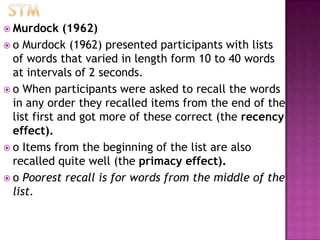
 o Murdock (1962) presented participants with lists
of words that varied in length form 10 to 40 words
at intervals of 2 seconds.
 o When participants were asked to recall the words
in any order they recalled items from the end of the
list first and got more of these correct (the recency
effect).
 o Items from the beginning of the list are also
recalled quite well (the primacy effect).
 o Poorest recall is for words from the middle of the
list.
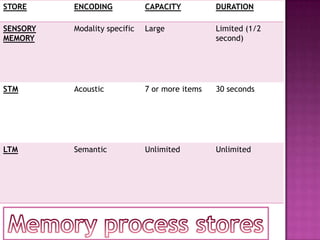
STORE

ENCODING

CAPACITY

DURATION

SENSORY
MEMORY

Modality specific

Large

Limited (1/2
second)

STM

Acoustic

7 or more items

30 seconds

LTM

Semantic

Unlimited

Unlimited
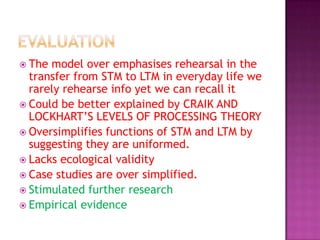
 The

model over emphasises rehearsal in the
transfer from STM to LTM in everyday life we
rarely rehearse info yet we can recall it
 Could be better explained by CRAIK AND
LOCKHART’S LEVELS OF PROCESSING THEORY
 Oversimplifies functions of STM and LTM by
suggesting they are uniformed.
 Lacks ecological validity
 Case studies are over simplified.
 Stimulated further research
 Empirical evidence
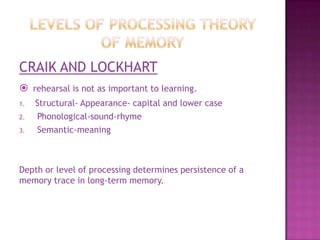
CRAIK AND LOCKHART
 rehearsal is not as important to learning.
1.
2.

3.

Structural- Appearance- capital and lower case
Phonological-sound-rhyme
Semantic-meaning

Depth or level of processing determines persistence of a
memory trace in long-term memory.
Aim: investigate effects of types of processing on
the recall of words
 Method- participants were presented with 60
words and asked about each one
 1-word in caps (shallow)
 2- rhyme(phonetic)
 3-fit in a sentence(semantic)
 RESULTS- Better recognition with deeper levels
of processing
 CONLUSION- deeper levels of processing based
on meaning of info is better than shallower
recall methods.

 Credible

alternative- ELIAS AND PERFETTI –
PPs had greater recognition of words.
 Flashbulb- amount of info we recall e.g
bumping into David Bekham
 Elaborative-rather than repition
LIMITATIONS
 Lack ecological validity
 Isn’t up to date
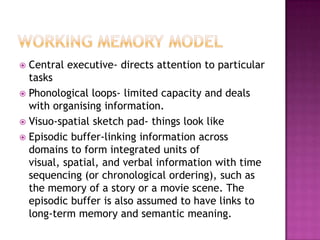
Central executive- directs attention to particular
tasks
 Phonological loops- limited capacity and deals
with organising information.
 Visuo-spatial sketch pad- things look like
 Episodic buffer-linking information across
domains to form integrated units of
visual, spatial, and verbal information with time
sequencing (or chronological ordering), such as
the memory of a story or a movie scene. The
episodic buffer is also assumed to have links to
long-term memory and semantic meaning.

 Flexible

system
 Understanding of central exec is limited
 WMM only explains our biology and not our
socialisation
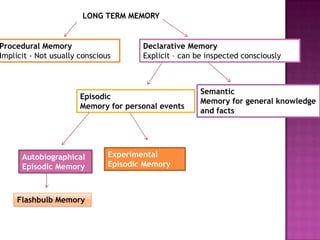
LONG TERM MEMORY

Procedural Memory
Implicit - Not usually conscious

Declarative Memory
Explicit – can be inspected consciously

Episodic
Memory for personal events

Autobiographical
Episodic Memory

Flashbulb Memory

Experimental
Episodic Memory

Semantic
Memory for general knowledge
and facts
Procedural memory is a motor or
action based memory and it is
sometimes referred to as
knowing how. One example of
procedural memory would be
remembering how to swim.
 Procedural memory:

does not call on our conscious
memory

cannot be consciously
inspected
  non-declarative (meaning it
is
is difficult to put into words)

 Declarative

memory is sometimes referred as
knowing that.
 Declarative memory:

can be put into words quite easily

can be inspected consciously, e.g. you
could tell someone about your first day at St.
Christopher’s
  includes both semantic and episodic
it
memory and both are very closely linked
Semantic memory is long-term
memory for information about the
world or general knowledge. This
includes memory about the
meaning of words.

Examples of semantic memory
would be to know that grass is green
or that Paris is the capital of France.

Such semantic memories can be
used without reference to when and
where the information was learned.

 Episodic

memory is the long-term memory
for events or episodes that we have
experienced ourselves or heard about
from another source.

This is the memory for
specific life events that
have personal meaning.

Being able to remember
the events of your first day
at college would
 be an example of
autobiographical memory.
  is very difficult to
It
check the accuracy of this
type of memory, but a
 way it can be checked is to
use a diary or photographs.

A

flashbulb memory is a
detailed and vivid memory of
an event that is stored after
one occasion and lasts a
lifetime. Such events are
often life changing, such as
births or deaths or may be
associated with important
historical events such as 9/11.
There is usually fear or
excitement associated with
the event and this is what
makes it particularly vivid.






AIM: To see whether episodic memory and semantic memory are separate
memory systems located in different areas of the brain.
METHOD:

Tulving injected quantities of radioactive gold into his own blood stream.
 then thought about semantic memories e.g. historical facts or about episodic
He
memories e.g. events from his summer holidays when he was a child.

Scanners were used to monitor the blood flow in his brain.








RESULTS:
The two different memory tasks showed distinct patterns of blood flow in the brain:

Episodic memories involved increased blood flow in the front of the brain

Semantic memories involved increased blood flow in areas toward the back of the
brain.




CONCLUSION: The results supported the view that episodic memory and
semantic memory are located in different areas of the brain. However, as this
was a preliminary study involving a single participant, the findings should be
interpreted with caution.






AIM: To investigate the ability to acquire new procedural
skills in a person with amnesia.
METHOD:
 case study of an amnesic patient (HM) was carried out.
A
 memory problems were so serious that he appeared
His
to be unable to remember new information.
 was trained to carry out a task which involved
HM
tracking or following a curvy line in a rotating disc.






RESULTS:
 first, his performance at the tracking tasks was poor,
At
but he improved with practise.

Several days later, when he carried out the task again he
had no conscious memory of the
 To
-

understand the nature of forgetting we
have to make a distinction between:
Availability-is the info still stored?
Accessibility- can it be retrieved at will?
 Learning

something creates a memory or an
‘ENGRAM’ which gradually fades
 This affects both STM/LTM –
 STUDY- Waugh and Norman
 Limited

number of slots in the STM
 If new info is taken in then other info will be
 KNOCKED OUT
 Memory
-

is distorted in someway either by:

Something learned in the past (proactive

interference)
-

Something learned in the future (retroactive

interference)
 STUDY- Tulving & Psotka
 When

we take in new info a certain amount
of time is necessary for changes in the
nervous system to take place
 In the consolidation process forgetting can
occur when consolidation is prevented.
 STUDY-

Yarnell & Lynch
 ‘cues’

are important- we are likely to
remember info better if we recall it in the
same state and context that it was rehearsed
in the first place.
 STUDY- Abernethy-when sat in the same
room the instructor got better marks from
his pupils
 People

unconsiously ‘repress’ (push back)
painful or disturbing memories.
 This is a LTM theory of forgetting

Memory Psychology powerpoint

  • 2.
  • 3.
    Sensory - register Modality specific (tasteheld as taste, visual image as an icon) Capacity is large but duration limited approx ½ a second. Processing is largely unconscious so info is taken from experiments.
  • 4.
     Encoding ismainly acoustic  Capacity is limited to an average 7 items  Duration is limited to 30 seconds LTM  Encoding is semantic  Capacity unlimited  Duration unlimited
  • 5.
     Murdock (1962)  oMurdock (1962) presented participants with lists of words that varied in length form 10 to 40 words at intervals of 2 seconds.  o When participants were asked to recall the words in any order they recalled items from the end of the list first and got more of these correct (the recency effect).  o Items from the beginning of the list are also recalled quite well (the primacy effect).  o Poorest recall is for words from the middle of the list.
  • 6.
  • 7.
     The model overemphasises rehearsal in the transfer from STM to LTM in everyday life we rarely rehearse info yet we can recall it  Could be better explained by CRAIK AND LOCKHART’S LEVELS OF PROCESSING THEORY  Oversimplifies functions of STM and LTM by suggesting they are uniformed.  Lacks ecological validity  Case studies are over simplified.  Stimulated further research  Empirical evidence
  • 8.
    CRAIK AND LOCKHART rehearsal is not as important to learning. 1. 2. 3. Structural- Appearance- capital and lower case Phonological-sound-rhyme Semantic-meaning Depth or level of processing determines persistence of a memory trace in long-term memory.
  • 9.
    Aim: investigate effectsof types of processing on the recall of words  Method- participants were presented with 60 words and asked about each one  1-word in caps (shallow)  2- rhyme(phonetic)  3-fit in a sentence(semantic)  RESULTS- Better recognition with deeper levels of processing  CONLUSION- deeper levels of processing based on meaning of info is better than shallower recall methods. 
  • 10.
     Credible alternative- ELIASAND PERFETTI – PPs had greater recognition of words.  Flashbulb- amount of info we recall e.g bumping into David Bekham  Elaborative-rather than repition LIMITATIONS  Lack ecological validity  Isn’t up to date
  • 11.
    Central executive- directsattention to particular tasks  Phonological loops- limited capacity and deals with organising information.  Visuo-spatial sketch pad- things look like  Episodic buffer-linking information across domains to form integrated units of visual, spatial, and verbal information with time sequencing (or chronological ordering), such as the memory of a story or a movie scene. The episodic buffer is also assumed to have links to long-term memory and semantic meaning. 
  • 13.
     Flexible system  Understandingof central exec is limited  WMM only explains our biology and not our socialisation
  • 16.
    LONG TERM MEMORY ProceduralMemory Implicit - Not usually conscious Declarative Memory Explicit – can be inspected consciously Episodic Memory for personal events Autobiographical Episodic Memory Flashbulb Memory Experimental Episodic Memory Semantic Memory for general knowledge and facts
  • 17.
    Procedural memory isa motor or action based memory and it is sometimes referred to as knowing how. One example of procedural memory would be remembering how to swim.  Procedural memory:  does not call on our conscious memory  cannot be consciously inspected   non-declarative (meaning it is is difficult to put into words) 
  • 18.
     Declarative memory issometimes referred as knowing that.  Declarative memory:  can be put into words quite easily  can be inspected consciously, e.g. you could tell someone about your first day at St. Christopher’s   includes both semantic and episodic it memory and both are very closely linked
  • 19.
    Semantic memory islong-term memory for information about the world or general knowledge. This includes memory about the meaning of words.  Examples of semantic memory would be to know that grass is green or that Paris is the capital of France.  Such semantic memories can be used without reference to when and where the information was learned. 
  • 20.
     Episodic memory isthe long-term memory for events or episodes that we have experienced ourselves or heard about from another source.
  • 21.
     This is thememory for specific life events that have personal meaning.  Being able to remember the events of your first day at college would  be an example of autobiographical memory.   is very difficult to It check the accuracy of this type of memory, but a  way it can be checked is to use a diary or photographs. 
  • 22.
    A flashbulb memory isa detailed and vivid memory of an event that is stored after one occasion and lasts a lifetime. Such events are often life changing, such as births or deaths or may be associated with important historical events such as 9/11. There is usually fear or excitement associated with the event and this is what makes it particularly vivid.
  • 25.
         AIM: To seewhether episodic memory and semantic memory are separate memory systems located in different areas of the brain. METHOD:  Tulving injected quantities of radioactive gold into his own blood stream.  then thought about semantic memories e.g. historical facts or about episodic He memories e.g. events from his summer holidays when he was a child.  Scanners were used to monitor the blood flow in his brain.      RESULTS: The two different memory tasks showed distinct patterns of blood flow in the brain:  Episodic memories involved increased blood flow in the front of the brain  Semantic memories involved increased blood flow in areas toward the back of the brain.   CONCLUSION: The results supported the view that episodic memory and semantic memory are located in different areas of the brain. However, as this was a preliminary study involving a single participant, the findings should be interpreted with caution.
  • 26.
         AIM: To investigatethe ability to acquire new procedural skills in a person with amnesia. METHOD:  case study of an amnesic patient (HM) was carried out. A  memory problems were so serious that he appeared His to be unable to remember new information.  was trained to carry out a task which involved HM tracking or following a curvy line in a rotating disc.     RESULTS:  first, his performance at the tracking tasks was poor, At but he improved with practise.  Several days later, when he carried out the task again he had no conscious memory of the
  • 27.
     To - understand thenature of forgetting we have to make a distinction between: Availability-is the info still stored? Accessibility- can it be retrieved at will?
  • 28.
     Learning something createsa memory or an ‘ENGRAM’ which gradually fades  This affects both STM/LTM –  STUDY- Waugh and Norman
  • 29.
     Limited number ofslots in the STM  If new info is taken in then other info will be  KNOCKED OUT
  • 30.
     Memory - is distortedin someway either by: Something learned in the past (proactive interference) - Something learned in the future (retroactive interference)  STUDY- Tulving & Psotka
  • 31.
     When we takein new info a certain amount of time is necessary for changes in the nervous system to take place  In the consolidation process forgetting can occur when consolidation is prevented.  STUDY- Yarnell & Lynch
  • 32.
     ‘cues’ are important-we are likely to remember info better if we recall it in the same state and context that it was rehearsed in the first place.  STUDY- Abernethy-when sat in the same room the instructor got better marks from his pupils
  • 33.
     People unconsiously ‘repress’(push back) painful or disturbing memories.  This is a LTM theory of forgetting