Nervous System Development
Overview The human nervous system begins to form at 3 weeks Brain development continues throughout life. the same events that shape the brain during development are responsible for storing information throughout life.  Critical periods occur throughout development periods when a neuron is in the process of becoming a specific type of neuron Neurons are generated at the rate of a quarter million per minute during development The finished adult network contains 100 billion neurons which interact to produce movement, perception, emotion, etc.
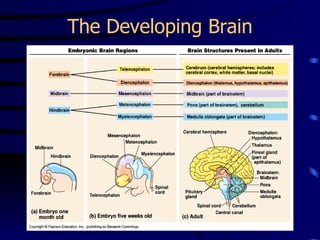
The Beginning The neural plate starts to thicken at 3-4 weeks  embryo is 1/10 inch long Parallel ridges form Ridges fold in toward each other   Fuse to form the neural tube Top of tube thickens into 3 bulges: hindbrain, midbrain, forebrain
Development of the Brain The rostral (front) part of the neural tubes goes on to develop into the brain and the rest of the neural tube develops into the spinal cord.  Neural crest cells become the peripheral nervous system. At the front end of the neural tube, three major brain areas are formed: forebrain, midbrain and hindbrain.  By the 7th week of development, these areas divide again = encephalization.
Birth of Neurons Formed by interaction between 2 of the embryo’s 3 cell layers Signals from one layer transform adjacent layer into neural tissue This develops into the neural plate Growth factors in the embryo act on the first cell layer, which causes formation of neural tissue Various signals, some triggered by homeobox genes play a role in this process
Studying Neural Development Many initial steps in neural development are the same across species Studies in roundworms, fruit flies, frogs, zebra fish, mouse, rat, chicken, cat, monkey
Steps in Neuron Development Cell proliferation Cell migration Cell differentiation
Cell Proliferation Neurons are initially produced in the neural tube Migrate to a final destination in the brain Collect together to form various structures Neural circuits form Improper or redundant connections are eliminated
Cell Fate As neurons are generated, the first cells become part of the deepest cortical layer Cells formed later populate superficial areas What determines neuron type? determined early in development Mother neurons generate young neurons that migrate from deep in the brain to predetermined points in the cortex Alternate theory: all neurons are = before migration Area specific differences arise later Later interactions determine where a neuron finally resides
Neurotransmitter Determination Neurons grown in a petri dish without any other cell types produce norepinephrine If the same neurons are cultured with other cells , they produce acetylcholine The final determination of the substance a neuron produces is influenced by chemical factors in the environment Signals from target cell
Cell Migration As neurons are produced, they move from the neural tube’s  ventricular zone  (inner surface) to the outer surface, near the border of the  marginal zone When neurons stop dividing, they form a layer between these 2 zones, the  intermediate zone This thickens as the developing brain In some parts of the brain, a layer forms between the  ventricular  &  intermediate zones , the  subventricular zone Here cells continue to be produced Give rise to many neurons & glia that migrate to form the forebrain
Glial Cells Direct Migration Direct the movement of many neurons to their destination Neurons hitch onto long glial fibers Move monorail fashion to different areas of the developing mammalian brain Neuron binding to a glial cell triggers changes in the glial cell that induce migration Young neurons follow scaffolding of glial fibers of varying lengths & directions
Factors Effecting Movement Adhesion molecules bind neurons to glia Play a key role in migration of neurons along glial fibers
Pathfinding Within Targets Once in final location, neurons must make proper connections They do this through axons Initially growth is genetically determined Later influenced by chemical & mechanical cues Axon growth is directed  by enlargements at their tips, called growth cones Penetrate dense tissue ‘til reach destination
Direction of Growth Direction of growth influenced by 3 factors: Differences in texture and stickiness of tissue on which it grows Molecular cues from cells it encounters Scattered gradients of molecules produced by the target or other remote cells In grasshoppers, guidepost cells trigger change in the direction of migration of the growth cone
Neural Cell Adhesion Molecules (NCAMs) Pathfinding is guided by special recognition molecules on both the growth cone & the target cell Neural Cell Adhesion Molecules (NCAMs) Related molecules play similar roles in pathway recognition in both vertebrates and invertebrates Related molecules play similar role in vertebrates & invertebrates
Nerve Growth Factor A protein that directs the growth of axons Orientation of axons is determined by gradients, or concentration changes of NGF Suggests growth cones can sense & respond to gradients of chemical signals
Evidence for Importance of Gradients Using cells from chick brains, characterized a molecule that guides retinal axons Likely to be involved in the formation of connections from the retina within the optic tectum part of chick brain that processes visual information
Neuron Survival Twice as many neurons are generated as survive Survival of a young neuron depends on interactions with the target neuron  Target cells secrete ‘survival molecules’ = tropic factors Extent of activity among neural connections strengthens or weakens connections
Tropic Factors Neurons compete for survival chemicals called  tropic factors , supplied by the target Include:   NGF Brain-derived neurotropic factor Neurotropin 3 Ciliary neurotropc factor Each supports survival of a distinct group of neurons
Formation of Synapses Involves complex interactions between the neuron and its target The neuron may play a role in organizing the membrane of the target cell to ensure good connection The neuron regulates the number and distribution of receptors
Critical Periods Brain cells prune away incorrect connections This occurs during critical periods The brain’s precise wiring is not in place at birth Organism’s interaction with the environment fine tunes connections After the critical period connections are less likely to change
Demonstrating Critical Periods If a monkey is raised from birth to 6 mos. with one eyelid sewn shut, it permanently loses vision in the shut eye Loss of vision is caused by interruption of necessary stages of development of special structures in the visual cortex Critical periods exist throughout development Capabilities for language, music, or math must develop before puberty Injury or social deprivation at a critical stage may affect perceptual or personality development
Unanswered Questions How do many cell types arise from one population? What controls the number of neurons? How do neurons find their targets? How does experience effect development? How do contacts form & become functional circuits?
The Developing Brain
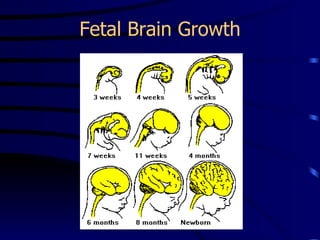
Fetal Brain Growth
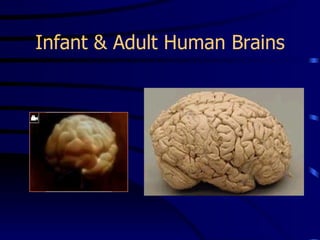
Infant & Adult Human Brains

Development

  • 1.
  • 2.
    Overview The humannervous system begins to form at 3 weeks Brain development continues throughout life. the same events that shape the brain during development are responsible for storing information throughout life. Critical periods occur throughout development periods when a neuron is in the process of becoming a specific type of neuron Neurons are generated at the rate of a quarter million per minute during development The finished adult network contains 100 billion neurons which interact to produce movement, perception, emotion, etc.
  • 3.
    The Beginning Theneural plate starts to thicken at 3-4 weeks embryo is 1/10 inch long Parallel ridges form Ridges fold in toward each other   Fuse to form the neural tube Top of tube thickens into 3 bulges: hindbrain, midbrain, forebrain
  • 4.
    Development of theBrain The rostral (front) part of the neural tubes goes on to develop into the brain and the rest of the neural tube develops into the spinal cord. Neural crest cells become the peripheral nervous system. At the front end of the neural tube, three major brain areas are formed: forebrain, midbrain and hindbrain. By the 7th week of development, these areas divide again = encephalization.
  • 5.
    Birth of NeuronsFormed by interaction between 2 of the embryo’s 3 cell layers Signals from one layer transform adjacent layer into neural tissue This develops into the neural plate Growth factors in the embryo act on the first cell layer, which causes formation of neural tissue Various signals, some triggered by homeobox genes play a role in this process
  • 6.
    Studying Neural DevelopmentMany initial steps in neural development are the same across species Studies in roundworms, fruit flies, frogs, zebra fish, mouse, rat, chicken, cat, monkey
  • 7.
    Steps in NeuronDevelopment Cell proliferation Cell migration Cell differentiation
  • 8.
    Cell Proliferation Neuronsare initially produced in the neural tube Migrate to a final destination in the brain Collect together to form various structures Neural circuits form Improper or redundant connections are eliminated
  • 9.
    Cell Fate Asneurons are generated, the first cells become part of the deepest cortical layer Cells formed later populate superficial areas What determines neuron type? determined early in development Mother neurons generate young neurons that migrate from deep in the brain to predetermined points in the cortex Alternate theory: all neurons are = before migration Area specific differences arise later Later interactions determine where a neuron finally resides
  • 10.
    Neurotransmitter Determination Neuronsgrown in a petri dish without any other cell types produce norepinephrine If the same neurons are cultured with other cells , they produce acetylcholine The final determination of the substance a neuron produces is influenced by chemical factors in the environment Signals from target cell
  • 11.
    Cell Migration Asneurons are produced, they move from the neural tube’s ventricular zone (inner surface) to the outer surface, near the border of the marginal zone When neurons stop dividing, they form a layer between these 2 zones, the intermediate zone This thickens as the developing brain In some parts of the brain, a layer forms between the ventricular & intermediate zones , the subventricular zone Here cells continue to be produced Give rise to many neurons & glia that migrate to form the forebrain
  • 12.
    Glial Cells DirectMigration Direct the movement of many neurons to their destination Neurons hitch onto long glial fibers Move monorail fashion to different areas of the developing mammalian brain Neuron binding to a glial cell triggers changes in the glial cell that induce migration Young neurons follow scaffolding of glial fibers of varying lengths & directions
  • 13.
    Factors Effecting MovementAdhesion molecules bind neurons to glia Play a key role in migration of neurons along glial fibers
  • 14.
    Pathfinding Within TargetsOnce in final location, neurons must make proper connections They do this through axons Initially growth is genetically determined Later influenced by chemical & mechanical cues Axon growth is directed by enlargements at their tips, called growth cones Penetrate dense tissue ‘til reach destination
  • 15.
    Direction of GrowthDirection of growth influenced by 3 factors: Differences in texture and stickiness of tissue on which it grows Molecular cues from cells it encounters Scattered gradients of molecules produced by the target or other remote cells In grasshoppers, guidepost cells trigger change in the direction of migration of the growth cone
  • 16.
    Neural Cell AdhesionMolecules (NCAMs) Pathfinding is guided by special recognition molecules on both the growth cone & the target cell Neural Cell Adhesion Molecules (NCAMs) Related molecules play similar roles in pathway recognition in both vertebrates and invertebrates Related molecules play similar role in vertebrates & invertebrates
  • 17.
    Nerve Growth FactorA protein that directs the growth of axons Orientation of axons is determined by gradients, or concentration changes of NGF Suggests growth cones can sense & respond to gradients of chemical signals
  • 18.
    Evidence for Importanceof Gradients Using cells from chick brains, characterized a molecule that guides retinal axons Likely to be involved in the formation of connections from the retina within the optic tectum part of chick brain that processes visual information
  • 19.
    Neuron Survival Twiceas many neurons are generated as survive Survival of a young neuron depends on interactions with the target neuron Target cells secrete ‘survival molecules’ = tropic factors Extent of activity among neural connections strengthens or weakens connections
  • 20.
    Tropic Factors Neuronscompete for survival chemicals called tropic factors , supplied by the target Include: NGF Brain-derived neurotropic factor Neurotropin 3 Ciliary neurotropc factor Each supports survival of a distinct group of neurons
  • 21.
    Formation of SynapsesInvolves complex interactions between the neuron and its target The neuron may play a role in organizing the membrane of the target cell to ensure good connection The neuron regulates the number and distribution of receptors
  • 22.
    Critical Periods Braincells prune away incorrect connections This occurs during critical periods The brain’s precise wiring is not in place at birth Organism’s interaction with the environment fine tunes connections After the critical period connections are less likely to change
  • 23.
    Demonstrating Critical PeriodsIf a monkey is raised from birth to 6 mos. with one eyelid sewn shut, it permanently loses vision in the shut eye Loss of vision is caused by interruption of necessary stages of development of special structures in the visual cortex Critical periods exist throughout development Capabilities for language, music, or math must develop before puberty Injury or social deprivation at a critical stage may affect perceptual or personality development
  • 24.
    Unanswered Questions Howdo many cell types arise from one population? What controls the number of neurons? How do neurons find their targets? How does experience effect development? How do contacts form & become functional circuits?
  • 25.
  • 26.
  • 27.
    Infant & AdultHuman Brains