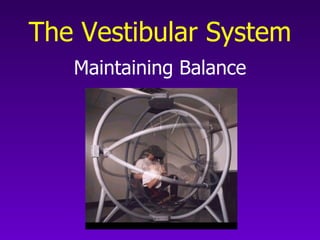
The Vestibular System   Maintaining Balance
Maintaining Balance The vestibular system determines the position and motion of your head in space.  There are two components to monitoring motion: Detecting rotation what happens when you shake or nod your head. This is called  angular acceleration.   Detecting motion along a line  what happens when the elevator drops beneath you or when your body begins to lean to one side This is called  linear acceleration.  The vestibular system has two receptor organs to accomplish these tasks.
Elements of the Vestibular Labyrinth   Continuous with the cochlea  Three semicircular canals  Detect angular acceleration Two otolith organs:  Utricle  &  saccule   Detect linear acceleration Vestibular nerve fibers  synapse with hair cells have cell bodies in  Scarpa's ganglion
The Vestibular Labyrinth
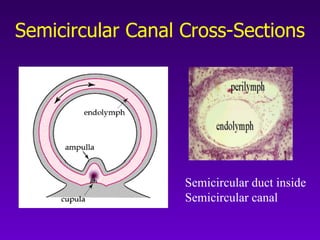
Semicircular Canals   Detect angular acceleration  There are 3 canals correspond to the three dimensions in which you move each canal detects motion in a single plane.  Paired on opposite sides of the head Each canal is a continuous endolymph-filled hoop. The actual hair cells sit in a small swelling at the base called the  ampula .            
View of Semicircular Canals
Semicircular Canal Cross-Sections Semicircular duct inside  Semicircular canal
The Ampulla Bulge at end =  ampulla  Contains a sheet of cells =  cristae  The hair cells are arranged as a single tuft that projects up Cilia of hair cells extend upward into a gelatinous  cupula
How it Works Angular acceleration (moving your head in the plane of the canal) causes the endolymph fluid to move. This pushes the cupula . . .  which stimulates the hair cells . . .  which synapse onto vestibular nerve fibers.
Around & Around! If you keep turning in circles, the fluid catches up with the canal. There is  no more pressure on the cupula.  If you stop spinning, the moving fluid will slosh up against a suddenly still cupula You feel as though you are turning in the opposite direction!
Left and Right Input Each tuft of hair cells is polarized  If you push it one way, it will be excited; if you push it the other way, it will be inhibited.  The same arrangement is present on both sides of the head.  The canals on either side of the head operate in a push-pull rhythm. When one is excited, the other is inhibited.
Picturing Left & Right Input
Disagreement Produces Vertigo It is important that both sides agree what the head is doing.  If both sides push at once, you will feel vertigo and nausea. Infections of the endolymph or damage to the inner ear can cause vertigo.  If one vestibular nerve is cut, the brain will get used to listening to one side  this can be a treatment for intractable vertigo.
Interaction with the Visual System The semicircular canal system keeps your eyes still in space while your head moves. If you nod and shake and swivel your head, your eyes stay focused The semicircular canals exert direct control over the eyes, so they can directly compensate for head movements.  This compensatory system is called the vestibulo-ocular reflex (VOR).
Vestibulo-ocular reflex (V.O.R.) Recall that the eye is controlled by three pairs of muscles: the medial and lateral rectus, the superior and inferior rectus, and the inferior and superior oblique.  Their directions of motion are matched closely by the planes of the three semicircular canals a single canal (in general) interacts with a single muscle pair.
One Piece of the V.O.R. The medial-lateral rectus pair, coupled to the horizontal canal, is shown The lateral rectus muscle pulls the eye laterally The medial rectus pulls the eye medially Both in the horizontal plane.  The horizontal canal detects rotation in the horizontal plane.
How It Works If you  move your head to the left, you will excite the left horizontal canal, Which inhibits the right. To keep your eyes fixed on a stationary point, you need to fire the right lateral rectus and the left medial rectus, to move the eyes to the right.
Pathway of the V.O.R. The vestibular nerve enters the brainstem  synapses in the vestibular nucleus.  Cells that received information from the left horizontal canal project to the  abducens nucleus  on the right side, to stimulate the lateral rectus. They also project to the  oculomotor nucleus  on the left side, to stimulate the medial rectus.  The same vestibular cells also inhibit the opposing muscles (in this case, the right medial rectus, and the left lateral rectus).
What Happens on the Other Side The right horizontal canal is wired to the complementary set of muscles.  Since it is inhibited, it will not excite its target muscles (the right medial rectus and the left lateral rectus), nor will it inhibit the muscles you want to use (the right lateral rectus and the left medial rectus).
Medial Longitudinal Fasciculus Much of the VOR axon traffic travels via a fiber highway  The  medial longitudinal fasciculus  (MLF) The integrity of this tract is crucial for the VOR to work properly.  It can be damaged by medial brainstem strokes.
Otolith Organs Detect linear acceleration, e.g. gravity  The  utricle  and  saccule  Each organ has a sheet of hair cells =  macula Cilia  of hair cells are embedded in a gelatinous cap like the semicircular canals. This gel has small crystals embedded in it = otoliths (otogonia) crystals of biogenic calcium carbonate
The Otolith Organs
Function of Otolith Organs Deflection of cilia on top of the hair cells causes excitation  The otoliths provide the inertia.  Tilting the macula causes the otoliths to pull the gelatin and bend the cilia Once you are moving at a constant speed, such as in a car, the otoliths come to equilibrium and you no longer perceive the motion. Different hair cells are arranged in different orientations so that a full range of tilt can be detected
The Macula
Range of Motion Detection The hair cells in the utricle and saccule are polarized They are arrayed in different directions so that a single sheet of hair cells can detect motion forward and back, side to side.  Each macula can thus cover two dimensions of movement.  The utricle lays horizontally in the ear, and can detect any motion in the horizontal plane.  The saccule is oriented vertically, so it can detect motion in the sagittal plane (up and down, forward and back).
Dealing with Gravity A major role of the saccule and utricle is to keep you vertically oriented with respect to gravity.  If your head and body start to tilt, the vestibular nuclei will automatically compensate with the correct postural adjustments.  If you watch someone trying to stand still, you notice constant small shifts
Central Vestibular Pathways   Connections to  medial  and  lateral vestibular nuclei  Also inputs to vestibular nuclei from cerebellum, visual system, somatosensory system  Outputs to cerebellum, extraocular motor neurons, limb motor neurons, neck motor neurons Integrates body position and movement information  Connections to neocortex through  ventral posterior nucleus  of the thalamus
Vestibular System Problems Result in loss of balance and vertigo.  Often there is slow recovery as brain learns to rely on visual and proprioceptive inputs

Vestibular System

  • 1.
    The Vestibular System Maintaining Balance
  • 2.
    Maintaining Balance Thevestibular system determines the position and motion of your head in space. There are two components to monitoring motion: Detecting rotation what happens when you shake or nod your head. This is called angular acceleration. Detecting motion along a line what happens when the elevator drops beneath you or when your body begins to lean to one side This is called linear acceleration. The vestibular system has two receptor organs to accomplish these tasks.
  • 3.
    Elements of theVestibular Labyrinth Continuous with the cochlea Three semicircular canals Detect angular acceleration Two otolith organs: Utricle & saccule Detect linear acceleration Vestibular nerve fibers synapse with hair cells have cell bodies in Scarpa's ganglion
  • 4.
  • 5.
    Semicircular Canals Detect angular acceleration There are 3 canals correspond to the three dimensions in which you move each canal detects motion in a single plane. Paired on opposite sides of the head Each canal is a continuous endolymph-filled hoop. The actual hair cells sit in a small swelling at the base called the ampula .            
  • 6.
  • 7.
    Semicircular Canal Cross-SectionsSemicircular duct inside Semicircular canal
  • 8.
    The Ampulla Bulgeat end = ampulla Contains a sheet of cells = cristae The hair cells are arranged as a single tuft that projects up Cilia of hair cells extend upward into a gelatinous cupula
  • 9.
    How it WorksAngular acceleration (moving your head in the plane of the canal) causes the endolymph fluid to move. This pushes the cupula . . . which stimulates the hair cells . . . which synapse onto vestibular nerve fibers.
  • 10.
    Around & Around!If you keep turning in circles, the fluid catches up with the canal. There is no more pressure on the cupula. If you stop spinning, the moving fluid will slosh up against a suddenly still cupula You feel as though you are turning in the opposite direction!
  • 11.
    Left and RightInput Each tuft of hair cells is polarized If you push it one way, it will be excited; if you push it the other way, it will be inhibited. The same arrangement is present on both sides of the head. The canals on either side of the head operate in a push-pull rhythm. When one is excited, the other is inhibited.
  • 12.
    Picturing Left &Right Input
  • 13.
    Disagreement Produces VertigoIt is important that both sides agree what the head is doing. If both sides push at once, you will feel vertigo and nausea. Infections of the endolymph or damage to the inner ear can cause vertigo. If one vestibular nerve is cut, the brain will get used to listening to one side this can be a treatment for intractable vertigo.
  • 14.
    Interaction with theVisual System The semicircular canal system keeps your eyes still in space while your head moves. If you nod and shake and swivel your head, your eyes stay focused The semicircular canals exert direct control over the eyes, so they can directly compensate for head movements. This compensatory system is called the vestibulo-ocular reflex (VOR).
  • 15.
    Vestibulo-ocular reflex (V.O.R.)Recall that the eye is controlled by three pairs of muscles: the medial and lateral rectus, the superior and inferior rectus, and the inferior and superior oblique. Their directions of motion are matched closely by the planes of the three semicircular canals a single canal (in general) interacts with a single muscle pair.
  • 16.
    One Piece ofthe V.O.R. The medial-lateral rectus pair, coupled to the horizontal canal, is shown The lateral rectus muscle pulls the eye laterally The medial rectus pulls the eye medially Both in the horizontal plane. The horizontal canal detects rotation in the horizontal plane.
  • 17.
    How It WorksIf you move your head to the left, you will excite the left horizontal canal, Which inhibits the right. To keep your eyes fixed on a stationary point, you need to fire the right lateral rectus and the left medial rectus, to move the eyes to the right.
  • 18.
    Pathway of theV.O.R. The vestibular nerve enters the brainstem synapses in the vestibular nucleus. Cells that received information from the left horizontal canal project to the abducens nucleus on the right side, to stimulate the lateral rectus. They also project to the oculomotor nucleus on the left side, to stimulate the medial rectus. The same vestibular cells also inhibit the opposing muscles (in this case, the right medial rectus, and the left lateral rectus).
  • 19.
    What Happens onthe Other Side The right horizontal canal is wired to the complementary set of muscles. Since it is inhibited, it will not excite its target muscles (the right medial rectus and the left lateral rectus), nor will it inhibit the muscles you want to use (the right lateral rectus and the left medial rectus).
  • 20.
    Medial Longitudinal FasciculusMuch of the VOR axon traffic travels via a fiber highway The medial longitudinal fasciculus (MLF) The integrity of this tract is crucial for the VOR to work properly. It can be damaged by medial brainstem strokes.
  • 21.
    Otolith Organs Detectlinear acceleration, e.g. gravity The utricle and saccule Each organ has a sheet of hair cells = macula Cilia of hair cells are embedded in a gelatinous cap like the semicircular canals. This gel has small crystals embedded in it = otoliths (otogonia) crystals of biogenic calcium carbonate
  • 22.
  • 23.
    Function of OtolithOrgans Deflection of cilia on top of the hair cells causes excitation The otoliths provide the inertia. Tilting the macula causes the otoliths to pull the gelatin and bend the cilia Once you are moving at a constant speed, such as in a car, the otoliths come to equilibrium and you no longer perceive the motion. Different hair cells are arranged in different orientations so that a full range of tilt can be detected
  • 24.
  • 25.
    Range of MotionDetection The hair cells in the utricle and saccule are polarized They are arrayed in different directions so that a single sheet of hair cells can detect motion forward and back, side to side. Each macula can thus cover two dimensions of movement. The utricle lays horizontally in the ear, and can detect any motion in the horizontal plane. The saccule is oriented vertically, so it can detect motion in the sagittal plane (up and down, forward and back).
  • 26.
    Dealing with GravityA major role of the saccule and utricle is to keep you vertically oriented with respect to gravity. If your head and body start to tilt, the vestibular nuclei will automatically compensate with the correct postural adjustments. If you watch someone trying to stand still, you notice constant small shifts
  • 27.
    Central Vestibular Pathways Connections to medial and lateral vestibular nuclei Also inputs to vestibular nuclei from cerebellum, visual system, somatosensory system Outputs to cerebellum, extraocular motor neurons, limb motor neurons, neck motor neurons Integrates body position and movement information Connections to neocortex through ventral posterior nucleus of the thalamus
  • 28.
    Vestibular System ProblemsResult in loss of balance and vertigo. Often there is slow recovery as brain learns to rely on visual and proprioceptive inputs