NEUROBIOLOGY OF MEMORY
Chair: Dr. D. Raju
Co- chair: Dr. Indu P. V.
Presenter: Dr. Indu V. Nair
“Memory is a man's real
possession...In nothing else is he
rich, in nothing else is he poor.”
-Alexander Smith (1830 - 1867)
Memory - introduction
 A mental process that allows individuals to
store information for later recall.
 Timespan- few seconds to many years
 Commonest problem in organically based
beh. syndromes- dementia, delirium,
amnestic syndromes etc.
 Psych. problems- depression , anxiety,
any emotionally disturbed person
 In trt. –ECT, drugs (benzodiazepines)
Stages of memory
1. Information– received & registered, held
in short term memory
2. Storing or retaining information in more
permanent form
3. Recall or retrieval of information
Clinical types of memory
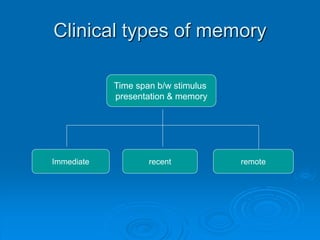
Time span b/w stimulus
presentation & memory
Immediate recent remote
Immediate memory
 Recall of a memory trace in few seconds
 Repetition of a series of digits
 Requires initial registration, short term
holding, verbal repetition
 Exact mech. not known
 Entire process by language cortex
surrounding Sylvian fissure
 Reverberating circuits, pattern of after
image
Contd.
 Reverberating circuits --- neuronal
activity being maintained in a closed loop.
 Sensory register --- Contains only
unprocessed information
 Raw image remains in sensory system
 Fleeting visual image -- icon
 Auditory image -- echo
contd
 Can be transferred to STM or working
memory
 Stage of temporary storage, <30 sec.
 Limited capacity
 Av. for adults – 7 +/- 2
 Less for children
Contd.
 Many factors favor STM like
 Active mental rehearsal
 Grouping digits
 Association of new material with
previously learned --- digit sequence
similar to old phone no.
Contd.
 Intact language system essential in DST,
so aphasia can disrupt memory fn.
Repetition failure notable in conduction
aphasia
 Attention strays during stimulus prsntn.–
information imperfectly registered
 So also in repetition phase
 Impaired in delerium, dementia, anxiety,
depression
WORKING MEMORY
 Ability to temporarily store & process
information online.
 Associated with prefrontal portex
• Very flexible
• Capacity to store is limited
• Decays rapidly
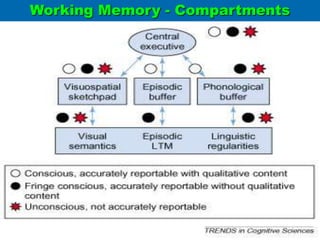
Working Memory - Compartments
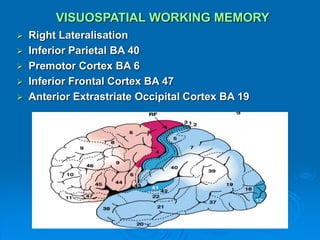
 Right Lateralisation
 Inferior Parietal BA 40
 Premotor Cortex BA 6
 Inferior Frontal Cortex BA 47
 Anterior Extrastriate Occipital Cortex BA 19
VISUOSPATIAL WORKING MEMORY
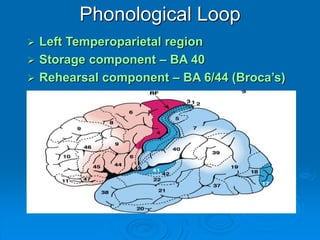
 Left Temperoparietal region
 Storage component – BA 40
 Rehearsal component – BA 6/44 (Broca’s)
Phonological Loop
DORSOLATERAL PREFRONTAL
SYNDROME
WORKING MEMORY
 Working memory:
 In PFL lesions:
• Severe defect in working memory
• Tested by delayed response task
• Due to interference from extraneous sources:
 ( Distractibility hypothesis)
DORSOLATERAL PREFRONTAL
SYNDROME
MEMORY PROBLEMS
 No true memory loss
 Tests of long term memory functions are normal.
 Defects in retrieval
 (“Forgetting to remember”)
 Recall with “ Cues”

Recent memory
 Ability to store & retrieve new material
 Needs intact registration, retention & short
term storage
 2 main regions of brain imp. In this fn.
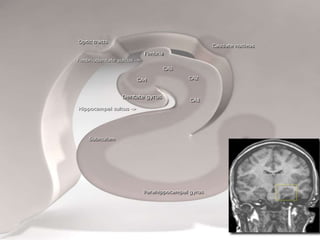
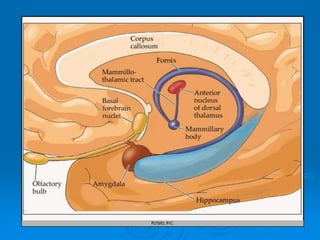
 Hippocampal apparatus
 Hypothalamic diencephalic region
Remote memory
 As time passes some memories forgotten,
some get stronger
 Initial encoding, gradual consolidation,& in
retrieval -- med. temporal & diencephalic
structures imp.
 Distributed neocortical regions –
permanent repositories of memory
 Distributed storage system makes LTM
more or less indestructible
Neuroanatomical correlates of
memory
1. MTL – hippocampus & related structure
amygdala
2. Medial diencephalon
3. Basal forebrain
4. Prefrontal cortex
5. Sub cortical nuclei & white matter
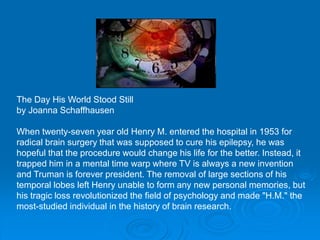
The Day His World Stood Still
by Joanna Schaffhausen
When twenty-seven year old Henry M. entered the hospital in 1953 for
radical brain surgery that was supposed to cure his epilepsy, he was
hopeful that the procedure would change his life for the better. Instead, it
trapped him in a mental time warp where TV is always a new invention
and Truman is forever president. The removal of large sections of his
temporal lobes left Henry unable to form any new personal memories, but
his tragic loss revolutionized the field of psychology and made "H.M." the
most-studied individual in the history of brain research.
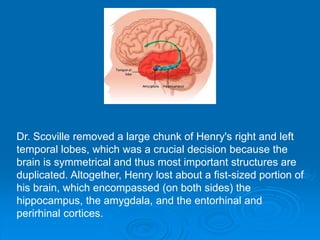
Dr. Scoville removed a large chunk of Henry's right and left
temporal lobes, which was a crucial decision because the
brain is symmetrical and thus most important structures are
duplicated. Altogether, Henry lost about a fist-sized portion of
his brain, which encompassed (on both sides) the
hippocampus, the amygdala, and the entorhinal and
perirhinal cortices.
As for Henry's current status, he lives in a
nursing home in Hartford and still travels
occasionally to MIT for memory testing. He
enjoys doing crossword puzzles and watching
detective shows on television. His life is
peaceful, if not completely happy. He worries
often that he has done something wrong, and
it is not possible for him to make any real
friends since he cannot remember a person
from ten minutes to the next.
Contd.
 Hippocampus – initial encoding, processing for a
variable period~ 2 yrs
 Any info. integrated by HC apparatus to form a memory
trace – an ensemble of HC – neocortical neurons
 Rapid consolidation --short term process,
Prolonged consolidation
 lot of work during sleep
 Contributes to REM sleep phenomenon
Long term potentiation
 Brief burst of high frequency presynaptic
stimulation
 Persistent depolarisation of post synaptic
neuron
 Induction of LTP mediated post
synaptically via NMDA receptor
 LTP occurs prominently in hippocampus
 The physiological substrate of memory
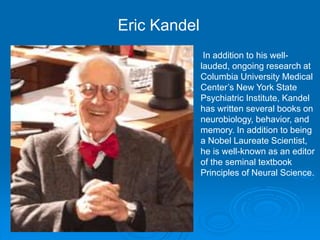
In addition to his well-
lauded, ongoing research at
Columbia University Medical
Center’s New York State
Psychiatric Institute, Kandel
has written several books on
neurobiology, behavior, and
memory. In addition to being
a Nobel Laureate Scientist,
he is well-known as an editor
of the seminal textbook
Principles of Neural Science.
Eric Kandel
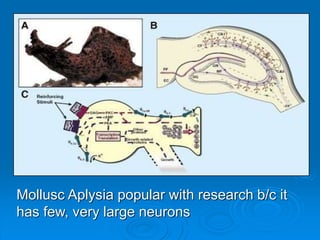
Mollusc Aplysia popular with research b/c it
has few, very large neurons
Contd.
 Kandel showed, STM –change in existing
synapses like in NT release
 LTM –creating new synapses, new protein
syn. ,growth of neural processes
Amygdala & memory
 Storage of emotional memory
 Emotional events remembered better than
neutral events
 When emotional more attentive, more
activity in brain
 Unusual events, we tend to go over & over
in our mind
 Emotions usually benefit memory, long
lasting stress detrimental --PTSD
Contd.
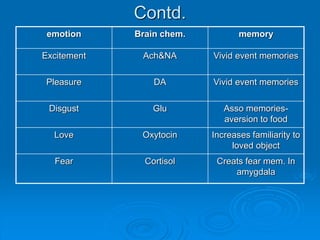
emotion Brain chem. memory
Excitement Ach&NA Vivid event memories
Pleasure DA Vivid event memories
Disgust Glu Asso memories-
aversion to food
Love Oxytocin Increases familiarity to
loved object
Fear Cortisol Creats fear mem. In
amygdala
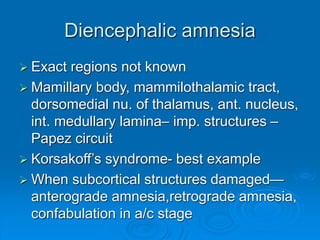
Diencephalic amnesia
 Exact regions not known
 Mamillary body, mammilothalamic tract,
dorsomedial nu. of thalamus, ant. nucleus,
int. medullary lamina– imp. structures –
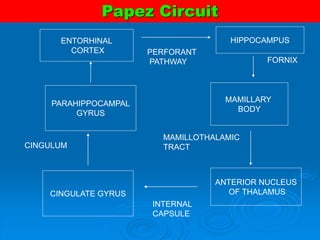
Papez circuit
 Korsakoff’s syndrome- best example
 When subcortical structures damaged—
anterograde amnesia,retrograde amnesia,
confabulation in a/c stage
HIPPOCAMPUS
MAMILLARY
BODY
ANTERIOR NUCLEUS
OF THALAMUS
CINGULATE GYRUS
PARAHIPPOCAMPAL
GYRUS
ENTORHINAL
CORTEX
FORNIX
MAMILLOTHALAMIC
TRACT
INTERNAL
CAPSULE
CINGULUM
PERFORANT
PATHWAY
Papez Circuit
Basal fore brain
 Includes medial septal nuclei, nucleus
accumbens, ant. HT, diagonal band of
Broca, nucleus basalis of Meynert & part
of PFC
 Rich in Ach, imp to memory functioning
 Septal nu. & nu. Basalis of Meynert –
extensive connections to & from HC,
amygdala & neocortex
 Extensive damage seen in Alzheimer’s
Sub cortical nuclei & white matter
 Role in searching & retrieving information
from LTM
 Parkinson’s d/s, Huntington’s d/s ,CVA,
MS
 Slowed information processing, inefficient
learning, poor free recall
 Recognition memory good
Role of cerebellum
 Contains essential circuitry for learned
association
 Synaptic changes in cere. cortex– learned
timing
 Deep nuclei critical for forming association
b/w conditioned & unconditioned stimuli
Theories of memory
 Traditional consolidation model
 Cognitive map theory
 Multiple trace theory – most recent
Consolidation theory
 Described by Muller & Pilzecker in 1900
 2 processes described :
 physiological / biochemical process for
formation & storage of a memory trace or
“engram”
 Psychological process needed to
assimilate newly formed memory into
existing knowledge
Multiple trace theory
 Each time an old memory is retrieved , a
new hippocampally mediated trace is
created
 Old ones replaced by more or stronger
HC/MTL neocortical traces
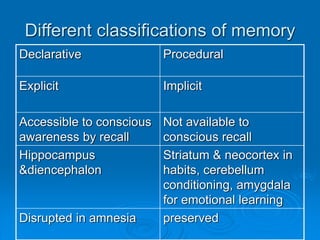
Different classifications of memory
Declarative Procedural
Explicit Implicit
Accessible to conscious
awareness by recall
Not available to
conscious recall
Hippocampus
&diencephalon
Striatum & neocortex in
habits, cerebellum
conditioning, amygdala
for emotional learning
Disrupted in amnesia preserved
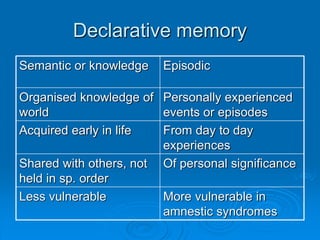
Declarative memory
Semantic or knowledge Episodic
Organised knowledge of
world
Personally experienced
events or episodes
Acquired early in life From day to day
experiences
Shared with others, not
held in sp. order
Of personal significance
Less vulnerable More vulnerable in
amnestic syndromes
Procedural memory
 Skill learning – riding a bicycle
 Cognitive tasks – solving puzzles
 Simple forms of conditioning
 priming
Priming
 Ability to detect or identify a particular
stimulus based on recent experience with
same stimulus
 A distinct class independent of med.
temporal region
 Intact in amnesia
 Neocortex
Assessment of memory function
 Immediate memory – DST
 Recent memory -- orientation
new learning ability – 3 object recall
--address recall
--24 hr recall
verbal story for recall
visual memory (hidden object)
paired associate learning
 Remote memory -- remote events –semantic &
episodic
metamemory
 Ability to judge one’s own memory ability
 Self rating scales available
 Able to distinguish memory complaints b/w
amnesia & depression
 Depressed patients rate their memory
poor ,self reports match objective tests
 Amnesia –some items more than others,
no difficulty with remote events
Psychogenic amnesia
 New learning capacity not affected
 Extensive , severe retrograde amnesia
 Unable to recall even ‘own name’
 Circumscribed memory loss of particular
time periods
Infantile amnesia
 Apparent absence for conscious memory
for first 3 yrs of life
 Mech. –repression (psychoanalytic theory)
--retrieval failure (dev. psychology)
-- capacity for decl. memory not
available
 Development & differentiation of neocortex
not complete
Retrospective falsification of
memories
 Possible to remember events which never
happened
 ? Same brain regions involved as visual
imagery
 Illusory memories can be created esp in
children
 Important in eyewitness testimony & recall
of traumatic events
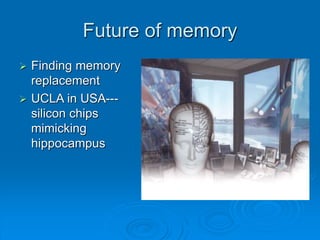
Future of memory
 Finding memory
replacement
 UCLA in USA---
silicon chips
mimicking
hippocampus
Thank you

60)NEUROBIOLOGY_OF_MEMORY[1].pptx

  • 1.
    NEUROBIOLOGY OF MEMORY Chair:Dr. D. Raju Co- chair: Dr. Indu P. V. Presenter: Dr. Indu V. Nair
  • 2.
    “Memory is aman's real possession...In nothing else is he rich, in nothing else is he poor.” -Alexander Smith (1830 - 1867)
  • 3.
    Memory - introduction A mental process that allows individuals to store information for later recall.  Timespan- few seconds to many years  Commonest problem in organically based beh. syndromes- dementia, delirium, amnestic syndromes etc.  Psych. problems- depression , anxiety, any emotionally disturbed person  In trt. –ECT, drugs (benzodiazepines)
  • 4.
    Stages of memory 1.Information– received & registered, held in short term memory 2. Storing or retaining information in more permanent form 3. Recall or retrieval of information
  • 5.
    Clinical types ofmemory Time span b/w stimulus presentation & memory Immediate recent remote
  • 6.
    Immediate memory  Recallof a memory trace in few seconds  Repetition of a series of digits  Requires initial registration, short term holding, verbal repetition  Exact mech. not known  Entire process by language cortex surrounding Sylvian fissure  Reverberating circuits, pattern of after image
  • 7.
    Contd.  Reverberating circuits--- neuronal activity being maintained in a closed loop.  Sensory register --- Contains only unprocessed information  Raw image remains in sensory system  Fleeting visual image -- icon  Auditory image -- echo
  • 8.
    contd  Can betransferred to STM or working memory  Stage of temporary storage, <30 sec.  Limited capacity  Av. for adults – 7 +/- 2  Less for children
  • 9.
    Contd.  Many factorsfavor STM like  Active mental rehearsal  Grouping digits  Association of new material with previously learned --- digit sequence similar to old phone no.
  • 10.
    Contd.  Intact languagesystem essential in DST, so aphasia can disrupt memory fn. Repetition failure notable in conduction aphasia  Attention strays during stimulus prsntn.– information imperfectly registered  So also in repetition phase  Impaired in delerium, dementia, anxiety, depression
  • 11.
    WORKING MEMORY  Abilityto temporarily store & process information online.  Associated with prefrontal portex • Very flexible • Capacity to store is limited • Decays rapidly
  • 12.
    Working Memory -Compartments
  • 13.
     Right Lateralisation Inferior Parietal BA 40  Premotor Cortex BA 6  Inferior Frontal Cortex BA 47  Anterior Extrastriate Occipital Cortex BA 19 VISUOSPATIAL WORKING MEMORY
  • 14.
     Left Temperoparietalregion  Storage component – BA 40  Rehearsal component – BA 6/44 (Broca’s) Phonological Loop
  • 15.
    DORSOLATERAL PREFRONTAL SYNDROME WORKING MEMORY Working memory:  In PFL lesions: • Severe defect in working memory • Tested by delayed response task • Due to interference from extraneous sources:  ( Distractibility hypothesis)
  • 16.
    DORSOLATERAL PREFRONTAL SYNDROME MEMORY PROBLEMS No true memory loss  Tests of long term memory functions are normal.  Defects in retrieval  (“Forgetting to remember”)  Recall with “ Cues” 
  • 17.
    Recent memory  Abilityto store & retrieve new material  Needs intact registration, retention & short term storage  2 main regions of brain imp. In this fn.  Hippocampal apparatus  Hypothalamic diencephalic region
  • 18.
    Remote memory  Astime passes some memories forgotten, some get stronger  Initial encoding, gradual consolidation,& in retrieval -- med. temporal & diencephalic structures imp.  Distributed neocortical regions – permanent repositories of memory  Distributed storage system makes LTM more or less indestructible
  • 19.
    Neuroanatomical correlates of memory 1.MTL – hippocampus & related structure amygdala 2. Medial diencephalon 3. Basal forebrain 4. Prefrontal cortex 5. Sub cortical nuclei & white matter
  • 20.
    The Day HisWorld Stood Still by Joanna Schaffhausen When twenty-seven year old Henry M. entered the hospital in 1953 for radical brain surgery that was supposed to cure his epilepsy, he was hopeful that the procedure would change his life for the better. Instead, it trapped him in a mental time warp where TV is always a new invention and Truman is forever president. The removal of large sections of his temporal lobes left Henry unable to form any new personal memories, but his tragic loss revolutionized the field of psychology and made "H.M." the most-studied individual in the history of brain research.
  • 21.
    Dr. Scoville removeda large chunk of Henry's right and left temporal lobes, which was a crucial decision because the brain is symmetrical and thus most important structures are duplicated. Altogether, Henry lost about a fist-sized portion of his brain, which encompassed (on both sides) the hippocampus, the amygdala, and the entorhinal and perirhinal cortices.
  • 22.
    As for Henry'scurrent status, he lives in a nursing home in Hartford and still travels occasionally to MIT for memory testing. He enjoys doing crossword puzzles and watching detective shows on television. His life is peaceful, if not completely happy. He worries often that he has done something wrong, and it is not possible for him to make any real friends since he cannot remember a person from ten minutes to the next.
  • 24.
    Contd.  Hippocampus –initial encoding, processing for a variable period~ 2 yrs  Any info. integrated by HC apparatus to form a memory trace – an ensemble of HC – neocortical neurons  Rapid consolidation --short term process, Prolonged consolidation  lot of work during sleep  Contributes to REM sleep phenomenon
  • 25.
    Long term potentiation Brief burst of high frequency presynaptic stimulation  Persistent depolarisation of post synaptic neuron  Induction of LTP mediated post synaptically via NMDA receptor  LTP occurs prominently in hippocampus  The physiological substrate of memory
  • 26.
    In addition tohis well- lauded, ongoing research at Columbia University Medical Center’s New York State Psychiatric Institute, Kandel has written several books on neurobiology, behavior, and memory. In addition to being a Nobel Laureate Scientist, he is well-known as an editor of the seminal textbook Principles of Neural Science. Eric Kandel
  • 27.
    Mollusc Aplysia popularwith research b/c it has few, very large neurons
  • 28.
    Contd.  Kandel showed,STM –change in existing synapses like in NT release  LTM –creating new synapses, new protein syn. ,growth of neural processes
  • 29.
    Amygdala & memory Storage of emotional memory  Emotional events remembered better than neutral events  When emotional more attentive, more activity in brain  Unusual events, we tend to go over & over in our mind  Emotions usually benefit memory, long lasting stress detrimental --PTSD
  • 30.
    Contd. emotion Brain chem.memory Excitement Ach&NA Vivid event memories Pleasure DA Vivid event memories Disgust Glu Asso memories- aversion to food Love Oxytocin Increases familiarity to loved object Fear Cortisol Creats fear mem. In amygdala
  • 32.
    Diencephalic amnesia  Exactregions not known  Mamillary body, mammilothalamic tract, dorsomedial nu. of thalamus, ant. nucleus, int. medullary lamina– imp. structures – Papez circuit  Korsakoff’s syndrome- best example  When subcortical structures damaged— anterograde amnesia,retrograde amnesia, confabulation in a/c stage
  • 33.
    HIPPOCAMPUS MAMILLARY BODY ANTERIOR NUCLEUS OF THALAMUS CINGULATEGYRUS PARAHIPPOCAMPAL GYRUS ENTORHINAL CORTEX FORNIX MAMILLOTHALAMIC TRACT INTERNAL CAPSULE CINGULUM PERFORANT PATHWAY Papez Circuit
  • 34.
    Basal fore brain Includes medial septal nuclei, nucleus accumbens, ant. HT, diagonal band of Broca, nucleus basalis of Meynert & part of PFC  Rich in Ach, imp to memory functioning  Septal nu. & nu. Basalis of Meynert – extensive connections to & from HC, amygdala & neocortex  Extensive damage seen in Alzheimer’s
  • 35.
    Sub cortical nuclei& white matter  Role in searching & retrieving information from LTM  Parkinson’s d/s, Huntington’s d/s ,CVA, MS  Slowed information processing, inefficient learning, poor free recall  Recognition memory good
  • 36.
    Role of cerebellum Contains essential circuitry for learned association  Synaptic changes in cere. cortex– learned timing  Deep nuclei critical for forming association b/w conditioned & unconditioned stimuli
  • 37.
    Theories of memory Traditional consolidation model  Cognitive map theory  Multiple trace theory – most recent
  • 38.
    Consolidation theory  Describedby Muller & Pilzecker in 1900  2 processes described :  physiological / biochemical process for formation & storage of a memory trace or “engram”  Psychological process needed to assimilate newly formed memory into existing knowledge
  • 39.
    Multiple trace theory Each time an old memory is retrieved , a new hippocampally mediated trace is created  Old ones replaced by more or stronger HC/MTL neocortical traces
  • 40.
    Different classifications ofmemory Declarative Procedural Explicit Implicit Accessible to conscious awareness by recall Not available to conscious recall Hippocampus &diencephalon Striatum & neocortex in habits, cerebellum conditioning, amygdala for emotional learning Disrupted in amnesia preserved
  • 41.
    Declarative memory Semantic orknowledge Episodic Organised knowledge of world Personally experienced events or episodes Acquired early in life From day to day experiences Shared with others, not held in sp. order Of personal significance Less vulnerable More vulnerable in amnestic syndromes
  • 42.
    Procedural memory  Skilllearning – riding a bicycle  Cognitive tasks – solving puzzles  Simple forms of conditioning  priming
  • 43.
    Priming  Ability todetect or identify a particular stimulus based on recent experience with same stimulus  A distinct class independent of med. temporal region  Intact in amnesia  Neocortex
  • 44.
    Assessment of memoryfunction  Immediate memory – DST  Recent memory -- orientation new learning ability – 3 object recall --address recall --24 hr recall verbal story for recall visual memory (hidden object) paired associate learning  Remote memory -- remote events –semantic & episodic
  • 45.
    metamemory  Ability tojudge one’s own memory ability  Self rating scales available  Able to distinguish memory complaints b/w amnesia & depression  Depressed patients rate their memory poor ,self reports match objective tests  Amnesia –some items more than others, no difficulty with remote events
  • 46.
    Psychogenic amnesia  Newlearning capacity not affected  Extensive , severe retrograde amnesia  Unable to recall even ‘own name’  Circumscribed memory loss of particular time periods
  • 47.
    Infantile amnesia  Apparentabsence for conscious memory for first 3 yrs of life  Mech. –repression (psychoanalytic theory) --retrieval failure (dev. psychology) -- capacity for decl. memory not available  Development & differentiation of neocortex not complete
  • 48.
    Retrospective falsification of memories Possible to remember events which never happened  ? Same brain regions involved as visual imagery  Illusory memories can be created esp in children  Important in eyewitness testimony & recall of traumatic events
  • 49.
    Future of memory Finding memory replacement  UCLA in USA--- silicon chips mimicking hippocampus
  • 50.