Cognition From Sensory Perception to Memory & Learning
Sensation & Perception Different modes of interaction are processed in parallel by different sensory systems The receptors in each system analyze and deconstruct stimulus information Each sensory system then represents this information in specific pathways This constant flux of information is edited in a continuum of perceptions
Perception & Cognition The appearance of perceptions as direct and precise is an illusion Perception is the result of a myriad of connections Connections can be altered by learning and activity The goal of cognitive neural science is the study of the internal representation of mental events How we “know” what we know
History of Cognitive Science   Hermann Ebbinghaus - 1885 German psychologist 1  st  studies of mental processing  who pioneered in the development of experimental methods for the measurement of rote learning and   memory.  Ivan Pavlov - 1926 Russian physiologist and experimental psychologist.  Demonstrated  classical conditioning Demonstrated that specific areas in the cerebral cortex are concerned with specific reflexes  Mechanistic theory of human behavior
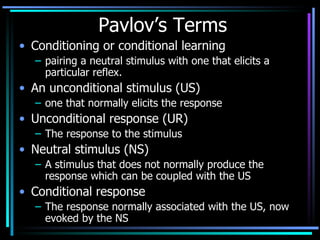
Pavlov’s Terms Conditioning or conditional learning pairing a neutral stimulus with one that elicits a particular reflex. An unconditional stimulus (US)  one that normally elicits the response Unconditional response (UR) The response to the stimulus Neutral stimulus (NS) A stimulus that does not normally produce the response which can be coupled with the US Conditional response The response normally associated with the US, now evoked by the NS
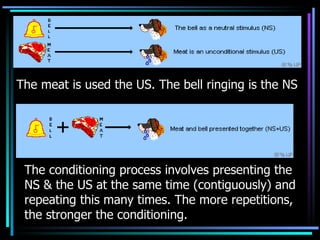
The meat is used the US. The bell ringing is the NS The conditioning process involves presenting the  NS & the US at the same time (contiguously) and  repeating this many times. The more repetitions,  the stronger the conditioning.
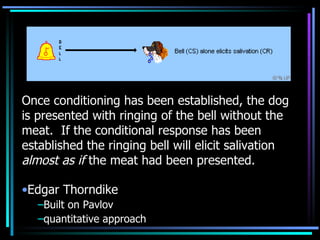
Once conditioning has been established, the dog is presented with ringing of the bell without the meat.  If the conditional response has been established the ringing bell will elicit salivation  almost as if  the meat had been presented.  Edgar Thorndike  Built on Pavlov quantitative approach
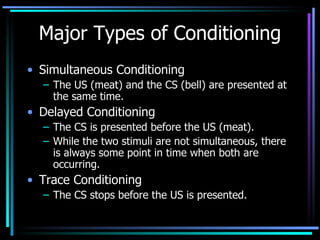
Major Types of Conditioning Simultaneous Conditioning  The US (meat) and the CS (bell) are presented at the same time. Delayed Conditioning  The CS is presented before the US (meat).  While the two stimuli are not simultaneous, there is always some point in time when both are occurring. Trace Conditioning  The CS stops before the US is presented.
Behaviorism J.B. Watson –1925 focused on observable aspects of behavior (response to controlled stimuli) ignored constructive brain processes such as thinking, planning, memory,etc. led to  behaviorism “ Give me a dozen healthy infants, well-formed, and my own specified world to bring them up and I'll guarantee to take any one at random and train him to become any type of specialist I might select--doctor, lawyer, merchant-chief, and yes, even beggarman and thief, regardless of his talents, penchants, tendencies, abilities, vocations, and race of his ancestors." (1930)
Cognitive Psychology & Neurology A response to behaviorism began in the 1960’s  Perception shapes behavior Perception itself is a constructive process It depends not only on the information of the stimulus, but also the mental structure of  the receiver =  internal representation
Five Aspects of Cognitive Neural Science  The activity of single cells Information processing how you get a response Behavioral neurology  study of patients with brain lesions Imaging techniques  PET, MRI, voltage sensitive dyes Computer modeling of neural networks  understanding brain circuitry

Cognition

  • 1.
    Cognition From SensoryPerception to Memory & Learning
  • 2.
    Sensation & PerceptionDifferent modes of interaction are processed in parallel by different sensory systems The receptors in each system analyze and deconstruct stimulus information Each sensory system then represents this information in specific pathways This constant flux of information is edited in a continuum of perceptions
  • 3.
    Perception & CognitionThe appearance of perceptions as direct and precise is an illusion Perception is the result of a myriad of connections Connections can be altered by learning and activity The goal of cognitive neural science is the study of the internal representation of mental events How we “know” what we know
  • 4.
    History of CognitiveScience   Hermann Ebbinghaus - 1885 German psychologist 1 st studies of mental processing who pioneered in the development of experimental methods for the measurement of rote learning and memory. Ivan Pavlov - 1926 Russian physiologist and experimental psychologist. Demonstrated classical conditioning Demonstrated that specific areas in the cerebral cortex are concerned with specific reflexes Mechanistic theory of human behavior
  • 5.
    Pavlov’s Terms Conditioningor conditional learning pairing a neutral stimulus with one that elicits a particular reflex. An unconditional stimulus (US) one that normally elicits the response Unconditional response (UR) The response to the stimulus Neutral stimulus (NS) A stimulus that does not normally produce the response which can be coupled with the US Conditional response The response normally associated with the US, now evoked by the NS
  • 6.
    The meat isused the US. The bell ringing is the NS The conditioning process involves presenting the NS & the US at the same time (contiguously) and repeating this many times. The more repetitions, the stronger the conditioning.
  • 7.
    Once conditioning hasbeen established, the dog is presented with ringing of the bell without the meat. If the conditional response has been established the ringing bell will elicit salivation almost as if the meat had been presented. Edgar Thorndike Built on Pavlov quantitative approach
  • 8.
    Major Types ofConditioning Simultaneous Conditioning The US (meat) and the CS (bell) are presented at the same time. Delayed Conditioning The CS is presented before the US (meat). While the two stimuli are not simultaneous, there is always some point in time when both are occurring. Trace Conditioning The CS stops before the US is presented.
  • 9.
    Behaviorism J.B. Watson–1925 focused on observable aspects of behavior (response to controlled stimuli) ignored constructive brain processes such as thinking, planning, memory,etc. led to behaviorism “ Give me a dozen healthy infants, well-formed, and my own specified world to bring them up and I'll guarantee to take any one at random and train him to become any type of specialist I might select--doctor, lawyer, merchant-chief, and yes, even beggarman and thief, regardless of his talents, penchants, tendencies, abilities, vocations, and race of his ancestors." (1930)
  • 10.
    Cognitive Psychology &Neurology A response to behaviorism began in the 1960’s Perception shapes behavior Perception itself is a constructive process It depends not only on the information of the stimulus, but also the mental structure of the receiver = internal representation
  • 11.
    Five Aspects ofCognitive Neural Science The activity of single cells Information processing how you get a response Behavioral neurology study of patients with brain lesions Imaging techniques PET, MRI, voltage sensitive dyes Computer modeling of neural networks understanding brain circuitry