Learning and Memory
The brain changes its
functioning in response
to experience
 Learning
 relatively permanent change in behavior as a
function of training, practice or experience
 how experience changes the brain
 The process by which we acquire knowledge about
the world
 “more or less a permanent change in behavior
which occurs as a result of practice
The Stages of Learning
 Acquiring wherein one masters a new
activity…
 Retaining the new acquisition for a period of
time
 Remembering which enables one to
reproduce the learned act or memorized
material.
MEMORY IS A PHASE OF
LEARNING
 Memory
 How changes are stored and
subsequently reactive
 The process by which that
knowledge of the world is encoded,
stored, and later retrieved
Three Major Categories of
Memory
 Awareness of briefly presented information
and perception of its aftereffects refers to
sensory memory
 Two forms:
Echoic Memory auditory stimuli stored
for a few seconds that is necessary for
comprehending sounds.
Iconic Memory the visual representation
of information in the environment
 Short term Memory retains small amounts
of information for a few seconds or less than
30 seconds.
 Long Term Memory is a mental storage
where we keep our knowledge and
experiences for a relatively permanent period
of time.
Categories of LTM
Declarative Memory
 Holds information that are easily verbalized and
described such names of people, concepts, events and
experiences.
Sub types:
Semantic memory
Episodic Memory
Procedural Memory
 holds relatively permanent information that are not
easily verbalized.
 Explicit Memory
 knowledge of facts- people, places and the
things-meaning of these facts.
 Conscious memory
 Implicit Memory
 Involves information on how to perform
something; it is recalled unconsciously
 Used in trained, reflexive motor or perceptual
skills.
Where are Memories Stored?
 Memory Storage
 Stored diffusely throughout the
structures of the brain.
 Five areas of the brain have been
implicated in the storage of man’s
memory.
 They are Inferotemporal Cortex,
Amygdala, Prefrontal Cortex,
Cerebellum and Striatum
INFEROTEMPORAL CORTEX
 Is the cortex of the inferior
temporal lobe. It is involved in the
visual perception of objects. It is
thought to participate in storing
memories of visual patterns.
Amygdala
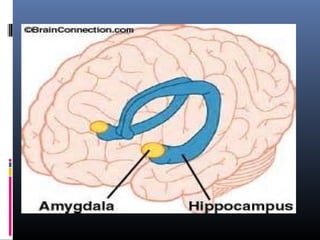
 An almond shaped nucleus in the
anterior temporal lobe. It play a role
in memory for emotional significance
of experiences.
Prefrontal Cortex
 It is composed of numerous anatomically
distinct areas that have different connections
and functions. There are regions of prefrontal
cortex that perform fundamental cognitive
processes during all working memory tasks.
Involved in the memory for the temporal
order of events.
Cerebellum
 Is thought to store memories of
learned sensorimotor skills.
Striatum
 it stores memories for consistent
relationships between stimuli and responses-
the type of memories that develop
incrementally over man trials.
The Hippocampus and Memory for
Spatial Location
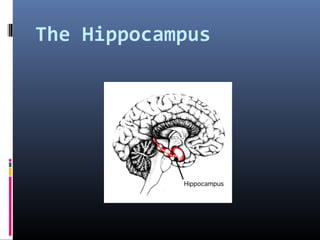
The Hippocampus
 It forms part of the limbic system
which is composed of brain structures
that play a role in memory, emotion
and motivation.
 The hippocampus and surrounding
structures are thought to play crucial
roles in the encoding and retrieval of
memories
Spatial Orientation
 Three types of Spatial Ability
 Ability to visualize rotation and flipping
over of shapes and diagrams
 Ability to reorient objects from different
angles
 Finding relations between different
spatial objects.
The Hippocampus and Spatial
Orientation
 The hippocampus helps construct
a 3D “mental map” of our
surroundings, and is crucial for our
ability to move around in the real
world.
What is:
Lobectomy – removal of a lobe or
major part of one from the brain.
Lobotomy – Separation of a lobe or a
major part of one from the rest of the
brain by a large cut but is not
removed
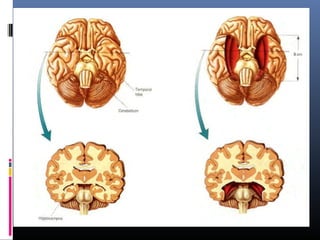
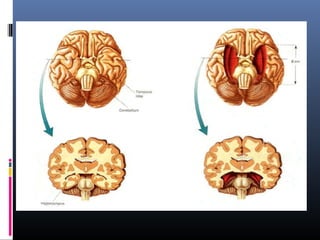
 Bilateral Medial Temporal Lobectomy
the removal of the medial portions
of both temporal lobes, including
most of the hippocampus, amygdala
and adjacent cortex.
Amnesic Effects of Bilateral
MedialTemporal
Lobectomy
AMNESIA
is a deficit in memory
caused by brain
damage, disease, or
psychological trauma.
There are two main types of
amnesia:
retrograde amnesia
and anterograde
amnesia.
Retrograde amnesia is the
inability to retrieve
information that was acquired
before a particular date,
usually the date of an accident
or operation.
Anterograde amnesia is the
inability to transfer new
information from the
short-term store into the
long-term store.
The Brain’s ability to
change its
functioning in
response to
experience.
 Learning deals with how
experience changes the brain.
 Memory deals with how these
changes are stored and
subsequently reactivated.
What is:
 Lobectomy:is an operation in
which a lobe, or a major part of
one, is removed from the brain.
 Lobotomy: Separation of a lobe
or a major part of one from the
rest of the brain by large cut but
is not removed.
What is:
 Bilateral Medial Temporal Lobectomy
The removal of the medial
portions of both temporal
lobes, including most of the
hippocampus, and amygdala.
Effects of Bilateral Medial
Temporal Lobectomy
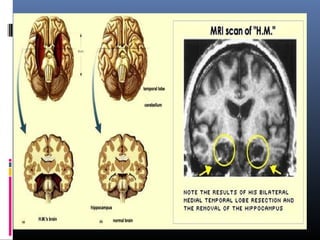
The Case of H. M., The Man Who Changed
the Study of Memory
Henry Molaison also known as H.M. – an
epileptic who had his temporal lobes
removed in 1953.
His seizures were
dramatically reduces- but so
was his memory
Mild retrograde amnesia and
severe anterograde amnesia
Formal Assessment of H.M.
 Digit Span – H.M. can repeat
digits provided the time between
learning and recall is within the
duration of STM.
Formal Assessment of H.M.
 Block-tapping memory –span test
– this test demonstrated that
H.M. has global amnesia–
amnesia for information
presented in all sensory modality
Formal Assessment of H.M.
 H.M. readily “learns” responses through
classical conditioning, but has no
memory of conditioning trials
Scientific Contributions of
H.M.’s Case
 Medial temporal lobes are
involved in memory
 STM and LTM are distinctly
separate – H.M. is unable to
move memories from STM to
LTM, a problem with memory
consolidation
Medial Temporal Lobe Amnesia
 Semantic Memory (General
information) may function
normally while episodic memory
(events that one has experienced)
does not- they are able to learn
facts, but do not remember doing
so.
Medial Temporal Lobe Amnesia
Not all with this form of
amnesia are unable to form
new explicit long-term
memories
Amnesia after Concussion :Amnesia after Concussion :
Evidence for ConsolidationEvidence for Consolidation
Amnesia of Korsakoff’sAmnesia of Korsakoff’s
SyndromeSyndrome
What is:
Concussion
- a temporary disturbance of consciousness
produced by a nonpenetrating head injury
Posttraumatic Amnesia
-an amnesia following a nonpenetrating blow
in the head
Amnesia after
Concussion: Evidence for
Consolidation Concussions may cause retrograde amnesia for
the period before the blow and some anterograde
amnesia after
 The same is seen with comas, with the severity of
the amnesia correlated with the duration of the
coma
 Period of anterograde amnesia suggests a
temporary failure of memory consolidation
Gradients of Retrograde Amnesia and
Memory Consolidation
 Concussions disrupt consolidation (storage) of recent
memories
 Hebb’s theory – memories are stored in the short term
by neural activity
 Interference with this activity prevents memory
consolidation. Examples:
 Blows to the head (i.e., concussion)
 ECS (electronconvulsive shock)
 Long gradients of retrograde amnesia are inconsistent
with consolidation theory
Reconsolidation
 Each time a memory is retrieved
from LTM, it is temporarily held in
STM
 Memory in STM is susceptible to
post-traumatic amnesia until it is
reconsolidated
The Hippocampus and
Consolidation
 H.M. has some retrograde amnesia
 Perhaps the hippocampus stores memories
temporarily (standard consolidation theory)
 Consistent with the temporally graded
retrograde amnesia seen in experimental
animals with temporal lobe lesions
 Or, perhaps the hippocampus stores memories
permanently, but they become “stronger” over
time
What is:
Korsakoff’s (Korsakov’s) Syndrome
- a brain disorder caused by the lack of
thiamine (vit.B1) in the brain
- it was named after the
neuropsychiatrist Sergei Korsakoff
who popularized the theory
Six Major Symptoms:
1. Anterograde Amnesia
2. Retrograde Amnesia
3. Confabulation- invented memories
which are taken as true due to gaps
in memory
4. Meager content in conversation
5. Lack of insight
Amnesia of Korsakoff’s
Syndrome
 Most commonly seen in alcoholics
(or others with a thiamine
deficiency)
 Amnesia, confusion, personality
changes, and physical problems
 Typically damage in the pre frontal
cortex – medial thalamus + medial
hypothalamus
Amnesia of Korsakoff’s
Syndrome (continued)
 Amnesia comparable to medial temporal
lobe amnesia in the early stages
 Anterograde amnesia for episodic
memories
 Differs in later stages
 Severe retrograde amnesia develops
 Differs in that it is progressive,
complicating its study
• Alzheimer’s disease is associated
with a gradually progressive loss of
memory often occurring in old age.
• Affects 50% of people over 85.
• Early onset seems to be influenced
by genes, but 99% of cases are late
onset.
• About half of all patients with late
onset have no known relative with
the disease.
• Alzheimer’s disease is associated with
an accumulation and clumping of the
following brain proteins:
Amyloid beta protein 42 which produces
widespread atrophy of the cerebral cortex,
hippocampus and other areas.
An abnormal form of the tau protein, part
of the intracellular support system of
neurons.
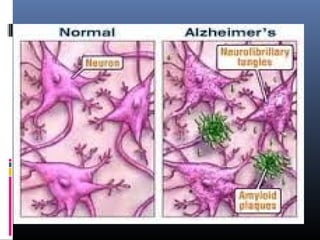
 Accumulation of the tau protein results
in:
 Plaques – structures formed from
degenerating neurons.
 Tangles – structures formed from
degenerating structures within a
neuronal body.
 A major area of damage is the basal forebrain and
treatment includes enhancing acetylcholine
activity.
 One experimental treatment includes the
stimulation of cannabinoid receptors that limits
overstimulation by glutamate.
 Research with mice suggests the possibility of
immunizing against Alzheimer’s by stimulating the
production of antibodies against amyloid beta
protein.

learning,memory and amnesia

  • 1.
  • 2.
    The brain changesits functioning in response to experience  Learning  relatively permanent change in behavior as a function of training, practice or experience  how experience changes the brain  The process by which we acquire knowledge about the world  “more or less a permanent change in behavior which occurs as a result of practice
  • 3.
    The Stages ofLearning  Acquiring wherein one masters a new activity…  Retaining the new acquisition for a period of time  Remembering which enables one to reproduce the learned act or memorized material.
  • 4.
    MEMORY IS APHASE OF LEARNING
  • 5.
     Memory  Howchanges are stored and subsequently reactive  The process by which that knowledge of the world is encoded, stored, and later retrieved
  • 6.
    Three Major Categoriesof Memory  Awareness of briefly presented information and perception of its aftereffects refers to sensory memory  Two forms: Echoic Memory auditory stimuli stored for a few seconds that is necessary for comprehending sounds. Iconic Memory the visual representation of information in the environment
  • 7.
     Short termMemory retains small amounts of information for a few seconds or less than 30 seconds.  Long Term Memory is a mental storage where we keep our knowledge and experiences for a relatively permanent period of time.
  • 8.
    Categories of LTM DeclarativeMemory  Holds information that are easily verbalized and described such names of people, concepts, events and experiences. Sub types: Semantic memory Episodic Memory Procedural Memory  holds relatively permanent information that are not easily verbalized.
  • 9.
     Explicit Memory knowledge of facts- people, places and the things-meaning of these facts.  Conscious memory  Implicit Memory  Involves information on how to perform something; it is recalled unconsciously  Used in trained, reflexive motor or perceptual skills.
  • 10.
    Where are MemoriesStored?  Memory Storage  Stored diffusely throughout the structures of the brain.  Five areas of the brain have been implicated in the storage of man’s memory.  They are Inferotemporal Cortex, Amygdala, Prefrontal Cortex, Cerebellum and Striatum
  • 11.
    INFEROTEMPORAL CORTEX  Isthe cortex of the inferior temporal lobe. It is involved in the visual perception of objects. It is thought to participate in storing memories of visual patterns.
  • 12.
    Amygdala  An almondshaped nucleus in the anterior temporal lobe. It play a role in memory for emotional significance of experiences.
  • 13.
    Prefrontal Cortex  Itis composed of numerous anatomically distinct areas that have different connections and functions. There are regions of prefrontal cortex that perform fundamental cognitive processes during all working memory tasks. Involved in the memory for the temporal order of events.
  • 14.
    Cerebellum  Is thoughtto store memories of learned sensorimotor skills.
  • 15.
    Striatum  it storesmemories for consistent relationships between stimuli and responses- the type of memories that develop incrementally over man trials.
  • 16.
    The Hippocampus andMemory for Spatial Location
  • 17.
  • 18.
     It formspart of the limbic system which is composed of brain structures that play a role in memory, emotion and motivation.  The hippocampus and surrounding structures are thought to play crucial roles in the encoding and retrieval of memories
  • 19.
    Spatial Orientation  Threetypes of Spatial Ability  Ability to visualize rotation and flipping over of shapes and diagrams  Ability to reorient objects from different angles  Finding relations between different spatial objects.
  • 20.
    The Hippocampus andSpatial Orientation  The hippocampus helps construct a 3D “mental map” of our surroundings, and is crucial for our ability to move around in the real world.
  • 21.
    What is: Lobectomy –removal of a lobe or major part of one from the brain. Lobotomy – Separation of a lobe or a major part of one from the rest of the brain by a large cut but is not removed
  • 22.
     Bilateral MedialTemporal Lobectomy the removal of the medial portions of both temporal lobes, including most of the hippocampus, amygdala and adjacent cortex.
  • 24.
    Amnesic Effects ofBilateral MedialTemporal Lobectomy
  • 25.
    AMNESIA is a deficitin memory caused by brain damage, disease, or psychological trauma.
  • 26.
    There are twomain types of amnesia: retrograde amnesia and anterograde amnesia.
  • 27.
    Retrograde amnesia isthe inability to retrieve information that was acquired before a particular date, usually the date of an accident or operation.
  • 28.
    Anterograde amnesia isthe inability to transfer new information from the short-term store into the long-term store.
  • 29.
    The Brain’s abilityto change its functioning in response to experience.
  • 30.
     Learning dealswith how experience changes the brain.  Memory deals with how these changes are stored and subsequently reactivated.
  • 31.
    What is:  Lobectomy:isan operation in which a lobe, or a major part of one, is removed from the brain.  Lobotomy: Separation of a lobe or a major part of one from the rest of the brain by large cut but is not removed.
  • 32.
    What is:  BilateralMedial Temporal Lobectomy The removal of the medial portions of both temporal lobes, including most of the hippocampus, and amygdala.
  • 35.
    Effects of BilateralMedial Temporal Lobectomy The Case of H. M., The Man Who Changed the Study of Memory Henry Molaison also known as H.M. – an epileptic who had his temporal lobes removed in 1953.
  • 37.
    His seizures were dramaticallyreduces- but so was his memory Mild retrograde amnesia and severe anterograde amnesia
  • 38.
    Formal Assessment ofH.M.  Digit Span – H.M. can repeat digits provided the time between learning and recall is within the duration of STM.
  • 39.
    Formal Assessment ofH.M.  Block-tapping memory –span test – this test demonstrated that H.M. has global amnesia– amnesia for information presented in all sensory modality
  • 40.
    Formal Assessment ofH.M.  H.M. readily “learns” responses through classical conditioning, but has no memory of conditioning trials
  • 41.
    Scientific Contributions of H.M.’sCase  Medial temporal lobes are involved in memory  STM and LTM are distinctly separate – H.M. is unable to move memories from STM to LTM, a problem with memory consolidation
  • 42.
    Medial Temporal LobeAmnesia  Semantic Memory (General information) may function normally while episodic memory (events that one has experienced) does not- they are able to learn facts, but do not remember doing so.
  • 43.
    Medial Temporal LobeAmnesia Not all with this form of amnesia are unable to form new explicit long-term memories
  • 44.
    Amnesia after Concussion:Amnesia after Concussion : Evidence for ConsolidationEvidence for Consolidation Amnesia of Korsakoff’sAmnesia of Korsakoff’s SyndromeSyndrome
  • 45.
    What is: Concussion - atemporary disturbance of consciousness produced by a nonpenetrating head injury Posttraumatic Amnesia -an amnesia following a nonpenetrating blow in the head
  • 46.
    Amnesia after Concussion: Evidencefor Consolidation Concussions may cause retrograde amnesia for the period before the blow and some anterograde amnesia after  The same is seen with comas, with the severity of the amnesia correlated with the duration of the coma  Period of anterograde amnesia suggests a temporary failure of memory consolidation
  • 47.
    Gradients of RetrogradeAmnesia and Memory Consolidation  Concussions disrupt consolidation (storage) of recent memories  Hebb’s theory – memories are stored in the short term by neural activity  Interference with this activity prevents memory consolidation. Examples:  Blows to the head (i.e., concussion)  ECS (electronconvulsive shock)  Long gradients of retrograde amnesia are inconsistent with consolidation theory
  • 48.
    Reconsolidation  Each timea memory is retrieved from LTM, it is temporarily held in STM  Memory in STM is susceptible to post-traumatic amnesia until it is reconsolidated
  • 49.
    The Hippocampus and Consolidation H.M. has some retrograde amnesia  Perhaps the hippocampus stores memories temporarily (standard consolidation theory)  Consistent with the temporally graded retrograde amnesia seen in experimental animals with temporal lobe lesions  Or, perhaps the hippocampus stores memories permanently, but they become “stronger” over time
  • 50.
    What is: Korsakoff’s (Korsakov’s)Syndrome - a brain disorder caused by the lack of thiamine (vit.B1) in the brain - it was named after the neuropsychiatrist Sergei Korsakoff who popularized the theory
  • 51.
    Six Major Symptoms: 1.Anterograde Amnesia 2. Retrograde Amnesia 3. Confabulation- invented memories which are taken as true due to gaps in memory 4. Meager content in conversation 5. Lack of insight
  • 52.
    Amnesia of Korsakoff’s Syndrome Most commonly seen in alcoholics (or others with a thiamine deficiency)  Amnesia, confusion, personality changes, and physical problems  Typically damage in the pre frontal cortex – medial thalamus + medial hypothalamus
  • 53.
    Amnesia of Korsakoff’s Syndrome(continued)  Amnesia comparable to medial temporal lobe amnesia in the early stages  Anterograde amnesia for episodic memories  Differs in later stages  Severe retrograde amnesia develops  Differs in that it is progressive, complicating its study
  • 55.
    • Alzheimer’s diseaseis associated with a gradually progressive loss of memory often occurring in old age. • Affects 50% of people over 85. • Early onset seems to be influenced by genes, but 99% of cases are late onset. • About half of all patients with late onset have no known relative with the disease.
  • 56.
    • Alzheimer’s diseaseis associated with an accumulation and clumping of the following brain proteins: Amyloid beta protein 42 which produces widespread atrophy of the cerebral cortex, hippocampus and other areas. An abnormal form of the tau protein, part of the intracellular support system of neurons.
  • 57.
     Accumulation ofthe tau protein results in:  Plaques – structures formed from degenerating neurons.  Tangles – structures formed from degenerating structures within a neuronal body.
  • 59.
     A majorarea of damage is the basal forebrain and treatment includes enhancing acetylcholine activity.  One experimental treatment includes the stimulation of cannabinoid receptors that limits overstimulation by glutamate.  Research with mice suggests the possibility of immunizing against Alzheimer’s by stimulating the production of antibodies against amyloid beta protein.

Editor's Notes

  • #18 Located at the medial edge of the cerebral cortex as it fold back on itself in the medial temporal lobe The folding produces a shape that is, in cross-section, somewhat reminiscent of a sea horse.
  • #33 The hippocampus is a horse-shoe shaped area of the brain that plays an important role in consolidating information from short-term memory into long-term memory. It is part of the limbic system, a system associated with emotions and long-term memories. The hippocampus is involved in such complex processes as forming, organizing, and storing memories.
  • #34 The hippocampus is a horse-shoe shaped area of the brain that plays an important role in consolidating information from short-term memory into long-term memory. It is part of the limbic system, a system associated with emotions and long-term memories. The hippocampus is involved in such complex processes as forming, organizing, and storing memories.
  • #40 He was asked to watch the psychologist touch a sequence of them and repeat the same sequences, but he could not learn correctly touch a sequence of 6 blocks even when the same sequence was repeated 12 times.
  • #48 CONSOLIDATION OF LONG TERM MEMORY according to HEBB any memory that stayed in short term storage long enough would be gradually consolidated into a long term memory. The short term memory might be represented by a reverberating circuit of neural activity in the brain, with a self exciting loop of neurons. If the reverberating circuit remained active long enough, some permanent chemical or structural change would occur. Emotional events , they excite the sympathetic nervous system, which increase the epinephrine