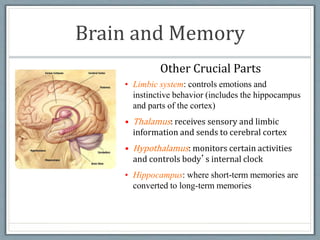
• Limbic system: controls emotions and
instinctive behavior (includes the hippocampus
and parts of the cortex)
• Thalamus: receives sensory and limbic
information and sends to cerebral cortex
• Hypothalamus: monitors certain activities
and controls body’s internal clock
• Hippocampus: where short-term memories are
converted to long-term memories
Other Crucial Parts
Brain and Memory
McGaugh, 2000
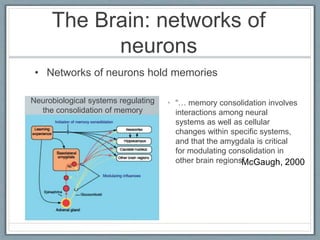
• “… memory consolidation involves
interactions among neural
systems as well as cellular
changes within specific systems,
and that the amygdala is critical
for modulating consolidation in
other brain regions”
Neurobiological systems regulating
the consolidation of memory
• Networks of neurons hold memories
The Brain: networks of
neurons
The Brain: networks of
neurons
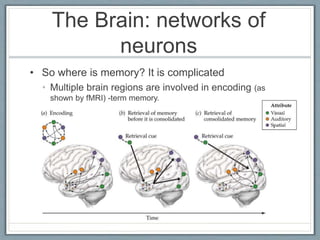
• So where is memory? It is complicated
• Multiple brain regions are involved in encoding (as
shown by fMRI) -term memory.
Brain and Memory
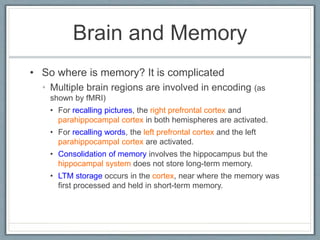
• So where is memory? It is complicated
• Multiple brain regions are involved in encoding (as
shown by fMRI)
• For recalling pictures, the right prefrontal cortex and
parahippocampal cortex in both hemispheres are activated.
• For recalling words, the left prefrontal cortex and the left
parahippocampal cortex are activated.
• Consolidation of memory involves the hippocampus but the
hippocampal system does not store long-term memory.
• LTM storage occurs in the cortex, near where the memory was
first processed and held in short-term memory.
Brain and Memory
• So where is memory? It is complicated
• Seven Sins of Memory
• Hippocampus and nearby structures related to sin of
transience
• Parts of the frontal lobe related to transience, but even
more central to absent-mindedness and misattribution (and
maybe suggestibility)
• Area near front of temporal lobe related to blocking
• Amygdala closely related to persistence
• Not much is known about bias
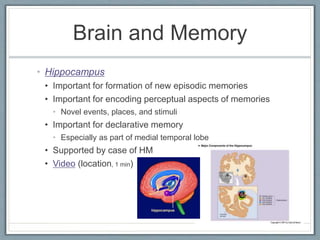
• Hippocampus
• Important for formation of new episodic memories
• Important for encoding perceptual aspects of memories
• Novel events, places, and stimuli
• Important for declarative memory
• Especially as part of medial temporal lobe
• Supported by case of HM
• Video (location, 1 min)
Brain and Memory
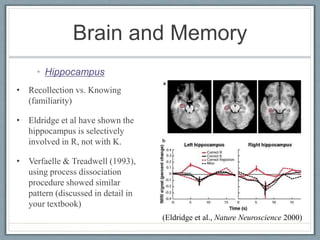
• Recollection vs. Knowing
(familiarity)
• Eldridge et al have shown the
hippocampus is selectively
involved in R, not with K.
• Verfaelle & Treadwell (1993),
using process dissociation
procedure showed similar
pattern (discussed in detail in
your textbook)
(Eldridge et al., Nature Neuroscience 2000)
Brain and Memory
• Hippocampus
Brain and Memory: Amnesia
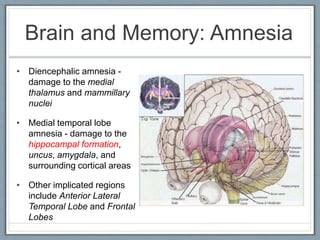
• Diencephalic amnesia -
damage to the medial
thalamus and mammillary
nuclei
• Medial temporal lobe
amnesia - damage to the
hippocampal formation,
uncus, amygdala, and
surrounding cortical areas
• Other implicated regions
include Anterior Lateral
Temporal Lobe and Frontal
Lobes
Amnesia
• Loss of memory ability - usually due to lesion or
surgical removal of various parts of the brain
• Relatively spared performance in other domains
• A pure amnesia is relatively rare
• video (#18, 10 mins)
• Video (~ 7 mins)
• Video 3 (Clive Wearing, 7 mins)
Amnesia
• Loss of memory ability - usually due to lesion or
surgical removal of various parts of the brain
• Three different kinds of classifications
• Source of the disease (e.g., illness, injury)
• Location of the area of damage
• Functional deficit (i.e., what kind of memory is impaired)
• This mixed way of categorizing amnesia causes
some difficulties
Amnesia
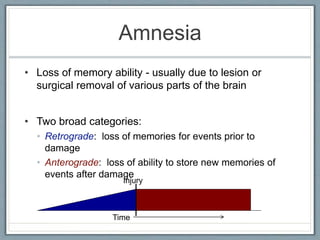
• Loss of memory ability - usually due to lesion or
surgical removal of various parts of the brain
• Two broad categories:
• Retrograde: loss of memories for events prior to
damage
• Anterograde: loss of ability to store new memories of
events after damage
Injury
Time
Causes of Amnesia
• Korsakoff’s syndrome
• Traumatic Brain Injury (TBI) (Concussion)
• Alzheimer’s disease
• Other causes include
• Specific brain lesions (i.e.
surgical removal)
• Psychological
• Dissociative Fugue
• Psychogenic
• Migraines
• Hypoglycemia
• Epilepsy
• Electroconvulsive shock
therapy
• Drugs (esp. anesthetics)
• Infection
• Nutritional deficiency
Amnesia
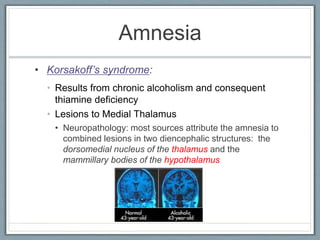
• Results from chronic alcoholism and consequent
thiamine deficiency
• Lesions to Medial Thalamus
• Neuropathology: most sources attribute the amnesia to
combined lesions in two diencephalic structures: the
dorsomedial nucleus of the thalamus and the
mammillary bodies of the hypothalamus
• Korsakoff’s syndrome:
Amnesia
• Generally preserved IQ, including a normal digit span.
• Personality changes, the most common of which is
apathy, passivity and indifference
• inability to formulate and follow through a series of plans
• Lack of insight into their condition.
• How can someone with a shattered memory remember that
he has become unable to remember?
• Korsakoff’s syndrome
Amnesia
• Korsakoff’s syndrome
• Retrograde amnesia with a temporal gradient
• Anterograde amnesia
• Confabulation, which is a tendency to "fill in the gaps" of
one's memories with plausible made-up stories.
• confabulations are rare among chronic Korsakoff patients
who've had the disease for more than 5 years. Patients in
the chronic stage are more likely to say "I don't know" or
remain silent when faced with memory failures rather than to
invent stories.
Amnesia
• Korsakoff’s syndrome
• Worst impairments are on episodic memory tests,
including list learning of words, figures, or faces,
paragraph recall.
• Relatively preserved semantic memory, including normal
verbal fluency, vocabulary, rules of syntax, and basic
arithmetic operations
• Intact sensori-motor memory (mirror tracing, mirror
reading, pursuit rotor)
• Intact performance on perceptual tasks (e.g., perceptual
identification, generating category exemplars)
• Post-traumatic amnesia
• Damage due to lesions as well as twisting and
tearing of microstructure of brain
• Symptomology
• After severe TBI, individuals typically lose
consciousness
• After they begin to regain consciousness, there is often
a gradual recovery during which patients have difficulty
keeping tracking of and remembering on-going events,
though there may be islands of lucidity and memory
• In the news
• Football (ESPN video)
• Soldiers (6 part video series)
Amnesia
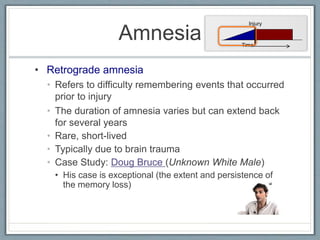
• Retrograde amnesia
• Refers to difficulty remembering events that occurred
prior to injury
• The duration of amnesia varies but can extend back
for several years
• Rare, short-lived
• Typically due to brain trauma
• Case Study: Doug Bruce (Unknown White Male)
• His case is exceptional (the extent and persistence of
the memory loss)
Amnesia
Injury
Time
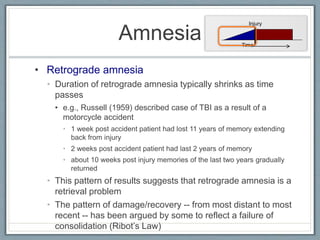
• Retrograde amnesia
• Duration of retrograde amnesia typically shrinks as time
passes
• e.g., Russell (1959) described case of TBI as a result of a
motorcycle accident
• 1 week post accident patient had lost 11 years of memory extending
back from injury
• 2 weeks post accident patient had last 2 years of memory
• about 10 weeks post injury memories of the last two years gradually
returned
• This pattern of results suggests that retrograde amnesia is a
retrieval problem
• The pattern of damage/recovery -- from most distant to most
recent -- has been argued by some to reflect a failure of
consolidation (Ribot’s Law)
Amnesia
Injury
Time
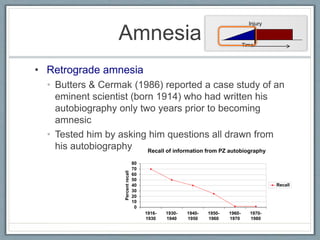
• Retrograde amnesia
• Butters & Cermak (1986) reported a case study of an
eminent scientist (born 1914) who had written his
autobiography only two years prior to becoming
amnesic
• Tested him by asking him questions all drawn from
his autobiography
Amnesia
Injury
Time
Recall of information from PZ autobiography
0
10
20
30
40
50
60
70
80
1916-
1930
1930-
1940
1940-
1950
1950-
1960
1960-
1970
1970-
1980
Percent
recall
Recall
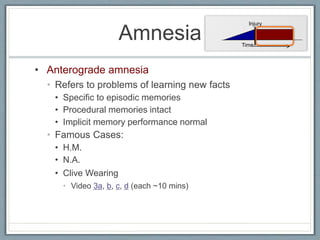
• Anterograde amnesia
• Refers to problems of learning new facts
• Specific to episodic memories
• Procedural memories intact
• Implicit memory performance normal
• Famous Cases:
• H.M.
• N.A.
• Clive Wearing
• Video 3a, b, c, d (each ~10 mins)
Amnesia
Injury
Time
Amnesia
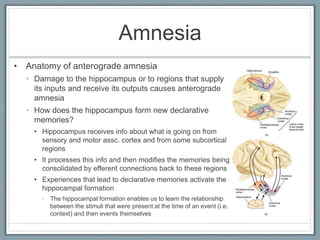
• Anatomy of anterograde amnesia
• Damage to the hippocampus or to regions that supply
its inputs and receive its outputs causes anterograde
amnesia
• How does the hippocampus form new declarative
memories?
• Hippocampus receives info about what is going on from
sensory and motor assc. cortex and from some subcortical
regions
• It processes this info and then modifies the memories being
consolidated by efferent connections back to these regions
• Experiences that lead to declarative memories activate the
hippocampal formation
• The hippocampal formation enables us to learn the relationship
between the stimuli that were present at the time of an event (i.e.
context) and then events themselves
Amnesia
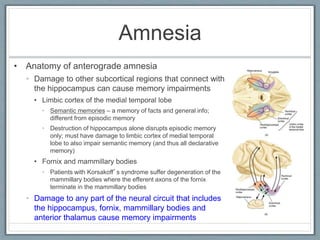
• Anatomy of anterograde amnesia
• Damage to other subcortical regions that connect with
the hippocampus can cause memory impairments
• Limbic cortex of the medial temporal lobe
• Semantic memories – a memory of facts and general info;
different from episodic memory
• Destruction of hippocampus alone disrupts episodic memory
only; must have damage to limbic cortex of medial temporal
lobe to also impair semantic memory (and thus all declarative
memory)
• Fornix and mammillary bodies
• Patients with Korsakoff’s syndrome suffer degeneration of the
mammillary bodies where the efferent axons of the fornix
terminate in the mammillary bodies
• Damage to any part of the neural circuit that includes
the hippocampus, fornix, mammillary bodies and
anterior thalamus cause memory impairments
Amnesia
• Theoretical implications of amnesia
• Provides evidence for STM versus LTM distinction
• Supports the notion that there are different systems
mediating explicit (episodic) and implicit (procedural
memory)
• May indicate that semantic and episodic memory can
be fractionated
• May provide insight into nature of consciousness

15.pptx

  • 1.
    • Limbic system:controls emotions and instinctive behavior (includes the hippocampus and parts of the cortex) • Thalamus: receives sensory and limbic information and sends to cerebral cortex • Hypothalamus: monitors certain activities and controls body’s internal clock • Hippocampus: where short-term memories are converted to long-term memories Other Crucial Parts Brain and Memory
  • 2.
    McGaugh, 2000 • “…memory consolidation involves interactions among neural systems as well as cellular changes within specific systems, and that the amygdala is critical for modulating consolidation in other brain regions” Neurobiological systems regulating the consolidation of memory • Networks of neurons hold memories The Brain: networks of neurons
  • 3.
    The Brain: networksof neurons • So where is memory? It is complicated • Multiple brain regions are involved in encoding (as shown by fMRI) -term memory.
  • 4.
    Brain and Memory •So where is memory? It is complicated • Multiple brain regions are involved in encoding (as shown by fMRI) • For recalling pictures, the right prefrontal cortex and parahippocampal cortex in both hemispheres are activated. • For recalling words, the left prefrontal cortex and the left parahippocampal cortex are activated. • Consolidation of memory involves the hippocampus but the hippocampal system does not store long-term memory. • LTM storage occurs in the cortex, near where the memory was first processed and held in short-term memory.
  • 5.
    Brain and Memory •So where is memory? It is complicated • Seven Sins of Memory • Hippocampus and nearby structures related to sin of transience • Parts of the frontal lobe related to transience, but even more central to absent-mindedness and misattribution (and maybe suggestibility) • Area near front of temporal lobe related to blocking • Amygdala closely related to persistence • Not much is known about bias
  • 6.
    • Hippocampus • Importantfor formation of new episodic memories • Important for encoding perceptual aspects of memories • Novel events, places, and stimuli • Important for declarative memory • Especially as part of medial temporal lobe • Supported by case of HM • Video (location, 1 min) Brain and Memory
  • 7.
    • Recollection vs.Knowing (familiarity) • Eldridge et al have shown the hippocampus is selectively involved in R, not with K. • Verfaelle & Treadwell (1993), using process dissociation procedure showed similar pattern (discussed in detail in your textbook) (Eldridge et al., Nature Neuroscience 2000) Brain and Memory • Hippocampus
  • 8.
    Brain and Memory:Amnesia • Diencephalic amnesia - damage to the medial thalamus and mammillary nuclei • Medial temporal lobe amnesia - damage to the hippocampal formation, uncus, amygdala, and surrounding cortical areas • Other implicated regions include Anterior Lateral Temporal Lobe and Frontal Lobes
  • 9.
    Amnesia • Loss ofmemory ability - usually due to lesion or surgical removal of various parts of the brain • Relatively spared performance in other domains • A pure amnesia is relatively rare • video (#18, 10 mins) • Video (~ 7 mins) • Video 3 (Clive Wearing, 7 mins)
  • 10.
    Amnesia • Loss ofmemory ability - usually due to lesion or surgical removal of various parts of the brain • Three different kinds of classifications • Source of the disease (e.g., illness, injury) • Location of the area of damage • Functional deficit (i.e., what kind of memory is impaired) • This mixed way of categorizing amnesia causes some difficulties
  • 11.
    Amnesia • Loss ofmemory ability - usually due to lesion or surgical removal of various parts of the brain • Two broad categories: • Retrograde: loss of memories for events prior to damage • Anterograde: loss of ability to store new memories of events after damage Injury Time
  • 12.
    Causes of Amnesia •Korsakoff’s syndrome • Traumatic Brain Injury (TBI) (Concussion) • Alzheimer’s disease • Other causes include • Specific brain lesions (i.e. surgical removal) • Psychological • Dissociative Fugue • Psychogenic • Migraines • Hypoglycemia • Epilepsy • Electroconvulsive shock therapy • Drugs (esp. anesthetics) • Infection • Nutritional deficiency
  • 13.
    Amnesia • Results fromchronic alcoholism and consequent thiamine deficiency • Lesions to Medial Thalamus • Neuropathology: most sources attribute the amnesia to combined lesions in two diencephalic structures: the dorsomedial nucleus of the thalamus and the mammillary bodies of the hypothalamus • Korsakoff’s syndrome:
  • 14.
    Amnesia • Generally preservedIQ, including a normal digit span. • Personality changes, the most common of which is apathy, passivity and indifference • inability to formulate and follow through a series of plans • Lack of insight into their condition. • How can someone with a shattered memory remember that he has become unable to remember? • Korsakoff’s syndrome
  • 15.
    Amnesia • Korsakoff’s syndrome •Retrograde amnesia with a temporal gradient • Anterograde amnesia • Confabulation, which is a tendency to "fill in the gaps" of one's memories with plausible made-up stories. • confabulations are rare among chronic Korsakoff patients who've had the disease for more than 5 years. Patients in the chronic stage are more likely to say "I don't know" or remain silent when faced with memory failures rather than to invent stories.
  • 16.
    Amnesia • Korsakoff’s syndrome •Worst impairments are on episodic memory tests, including list learning of words, figures, or faces, paragraph recall. • Relatively preserved semantic memory, including normal verbal fluency, vocabulary, rules of syntax, and basic arithmetic operations • Intact sensori-motor memory (mirror tracing, mirror reading, pursuit rotor) • Intact performance on perceptual tasks (e.g., perceptual identification, generating category exemplars)
  • 17.
    • Post-traumatic amnesia •Damage due to lesions as well as twisting and tearing of microstructure of brain • Symptomology • After severe TBI, individuals typically lose consciousness • After they begin to regain consciousness, there is often a gradual recovery during which patients have difficulty keeping tracking of and remembering on-going events, though there may be islands of lucidity and memory • In the news • Football (ESPN video) • Soldiers (6 part video series) Amnesia
  • 18.
    • Retrograde amnesia •Refers to difficulty remembering events that occurred prior to injury • The duration of amnesia varies but can extend back for several years • Rare, short-lived • Typically due to brain trauma • Case Study: Doug Bruce (Unknown White Male) • His case is exceptional (the extent and persistence of the memory loss) Amnesia Injury Time
  • 19.
    • Retrograde amnesia •Duration of retrograde amnesia typically shrinks as time passes • e.g., Russell (1959) described case of TBI as a result of a motorcycle accident • 1 week post accident patient had lost 11 years of memory extending back from injury • 2 weeks post accident patient had last 2 years of memory • about 10 weeks post injury memories of the last two years gradually returned • This pattern of results suggests that retrograde amnesia is a retrieval problem • The pattern of damage/recovery -- from most distant to most recent -- has been argued by some to reflect a failure of consolidation (Ribot’s Law) Amnesia Injury Time
  • 20.
    • Retrograde amnesia •Butters & Cermak (1986) reported a case study of an eminent scientist (born 1914) who had written his autobiography only two years prior to becoming amnesic • Tested him by asking him questions all drawn from his autobiography Amnesia Injury Time Recall of information from PZ autobiography 0 10 20 30 40 50 60 70 80 1916- 1930 1930- 1940 1940- 1950 1950- 1960 1960- 1970 1970- 1980 Percent recall Recall
  • 21.
    • Anterograde amnesia •Refers to problems of learning new facts • Specific to episodic memories • Procedural memories intact • Implicit memory performance normal • Famous Cases: • H.M. • N.A. • Clive Wearing • Video 3a, b, c, d (each ~10 mins) Amnesia Injury Time
  • 22.
    Amnesia • Anatomy ofanterograde amnesia • Damage to the hippocampus or to regions that supply its inputs and receive its outputs causes anterograde amnesia • How does the hippocampus form new declarative memories? • Hippocampus receives info about what is going on from sensory and motor assc. cortex and from some subcortical regions • It processes this info and then modifies the memories being consolidated by efferent connections back to these regions • Experiences that lead to declarative memories activate the hippocampal formation • The hippocampal formation enables us to learn the relationship between the stimuli that were present at the time of an event (i.e. context) and then events themselves
  • 23.
    Amnesia • Anatomy ofanterograde amnesia • Damage to other subcortical regions that connect with the hippocampus can cause memory impairments • Limbic cortex of the medial temporal lobe • Semantic memories – a memory of facts and general info; different from episodic memory • Destruction of hippocampus alone disrupts episodic memory only; must have damage to limbic cortex of medial temporal lobe to also impair semantic memory (and thus all declarative memory) • Fornix and mammillary bodies • Patients with Korsakoff’s syndrome suffer degeneration of the mammillary bodies where the efferent axons of the fornix terminate in the mammillary bodies • Damage to any part of the neural circuit that includes the hippocampus, fornix, mammillary bodies and anterior thalamus cause memory impairments
  • 24.
    Amnesia • Theoretical implicationsof amnesia • Provides evidence for STM versus LTM distinction • Supports the notion that there are different systems mediating explicit (episodic) and implicit (procedural memory) • May indicate that semantic and episodic memory can be fractionated • May provide insight into nature of consciousness