Meeting the Challenges of the 21 st  Century Learner CPTLA Conference, 21 May 2010 Karen Bonanno Australia http://www.kb.com.au http://www.schoollibrarymanagement.com http://www.karenbonanno.com.au
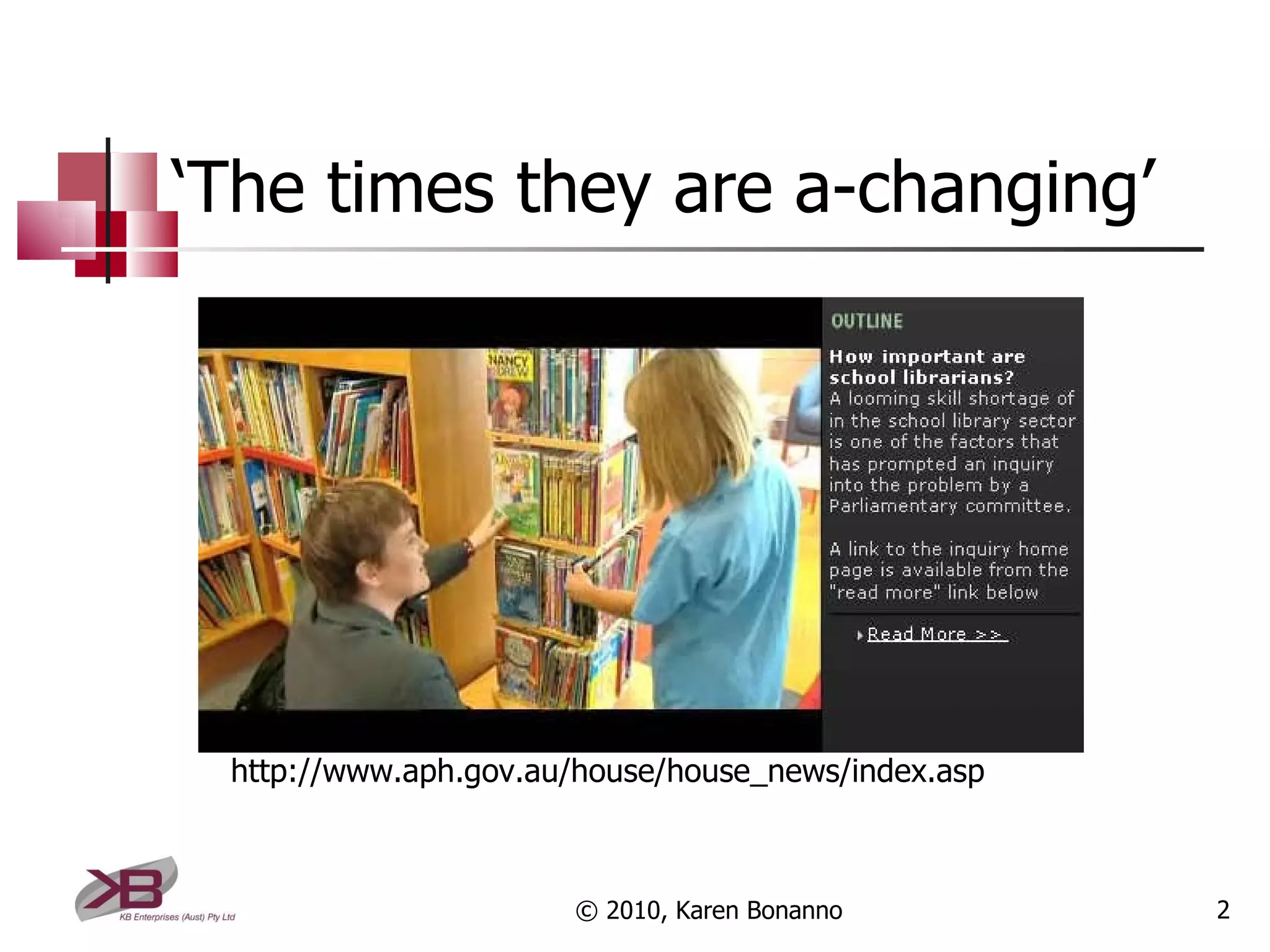
‘ The times they are a-changing’ © 2010, Karen Bonanno http://www.aph.gov.au/house/house_news/index.asp
Re-thinking the role “ It is one of the paradoxes of success that the things and the ways which got you where you are, are seldom the things that keep you there.” Handy, C 1995,  The empty raincoat: making sense of the future , Arrow Books, London, p. 49.  © 2010, Karen Bonanno
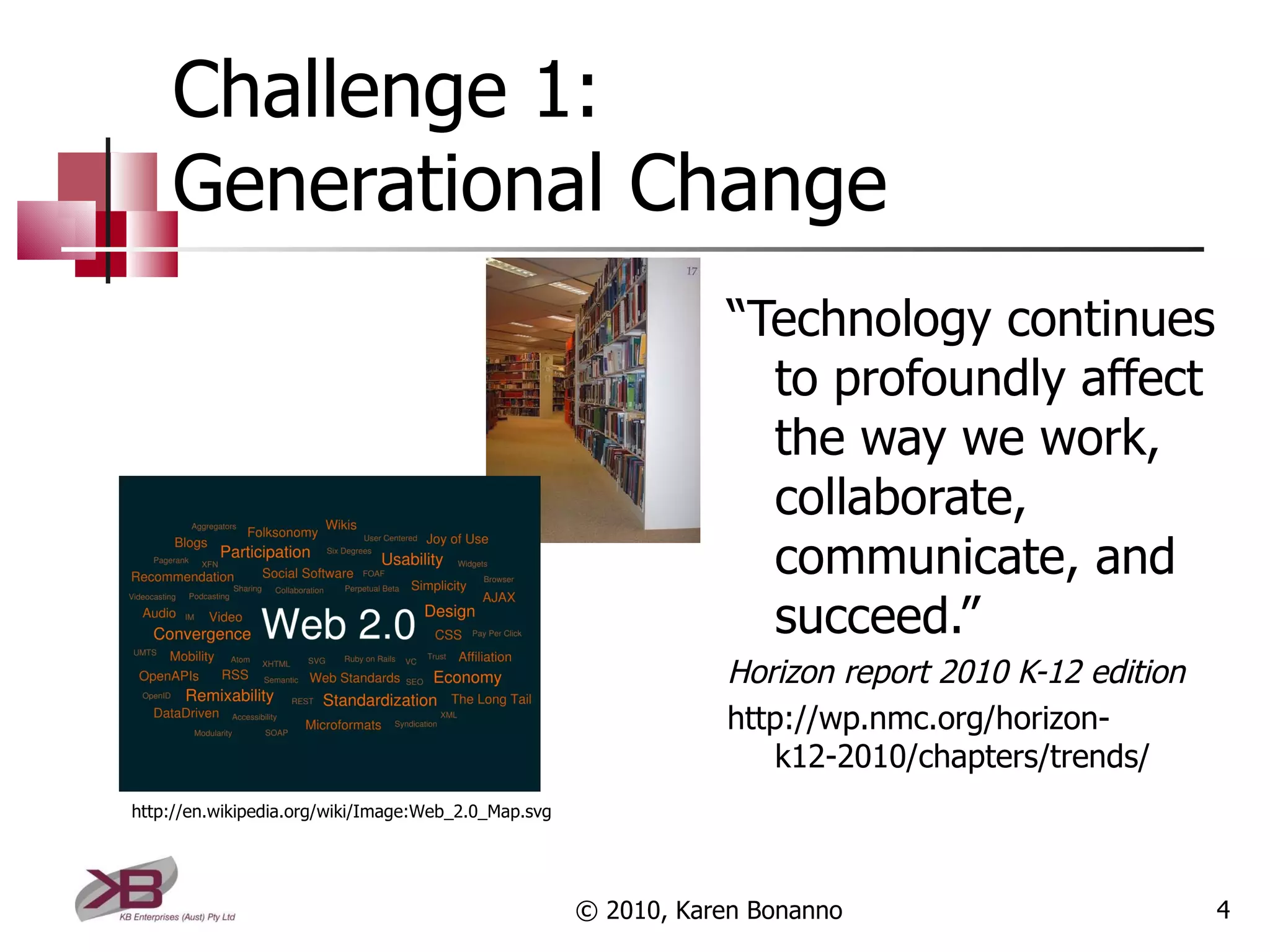
Challenge 1:  Generational Change “ Technology continues to profoundly affect the way we work, collaborate, communicate, and succeed.” Horizon report 2010 K-12 edition http://wp.nmc.org/horizon-k12-2010/chapters/trends/ © 2010, Karen Bonanno http://en.wikipedia.org/wiki/Image:Web_2.0_Map.svg
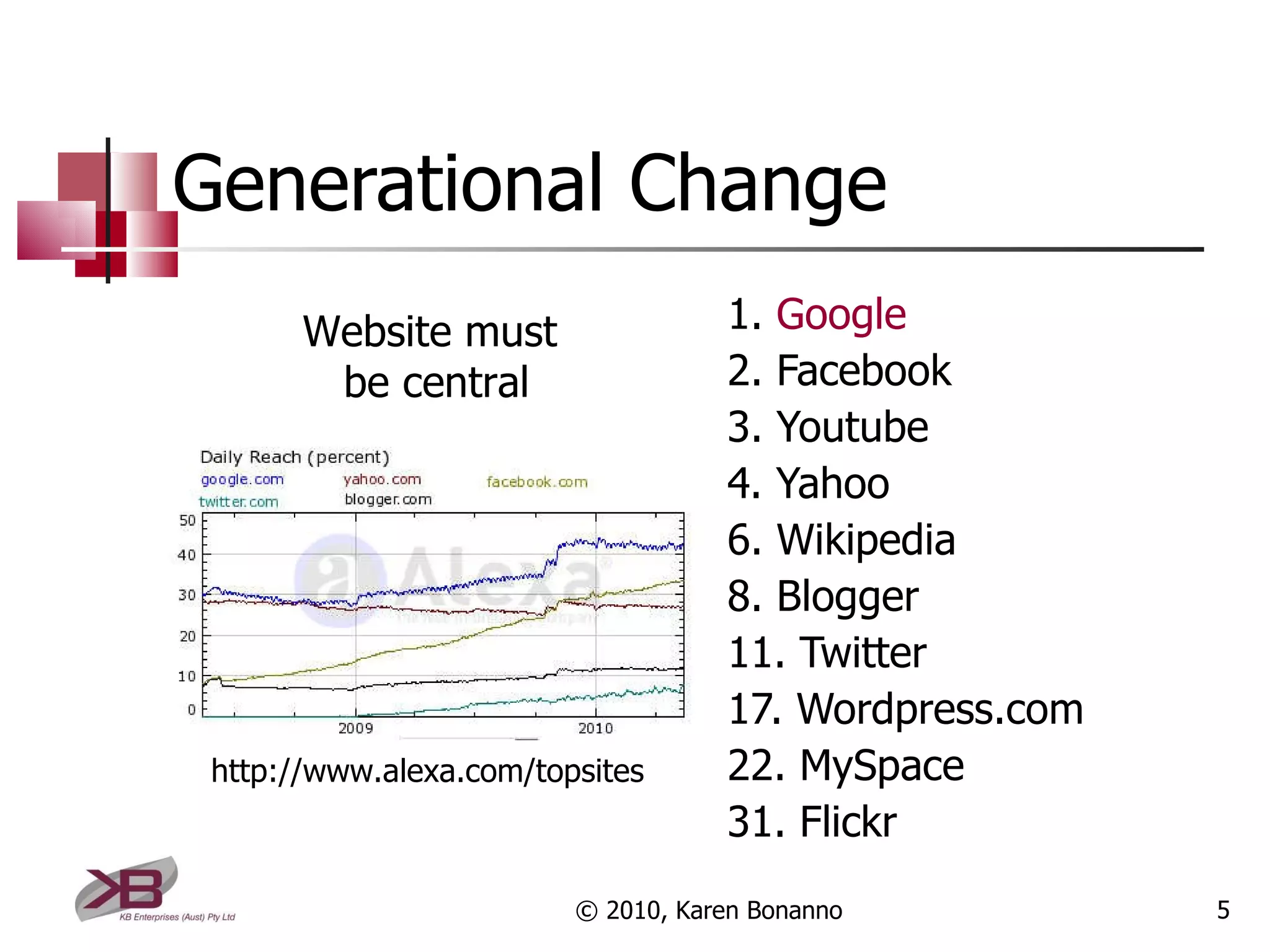
Generational Change 1.  Google 2. Facebook 3. Youtube 4. Yahoo 6. Wikipedia 8. Blogger 11. Twitter 17. Wordpress.com 22. MySpace 31. Flickr © 2010, Karen Bonanno http://www.alexa.com/topsites Website must  be central
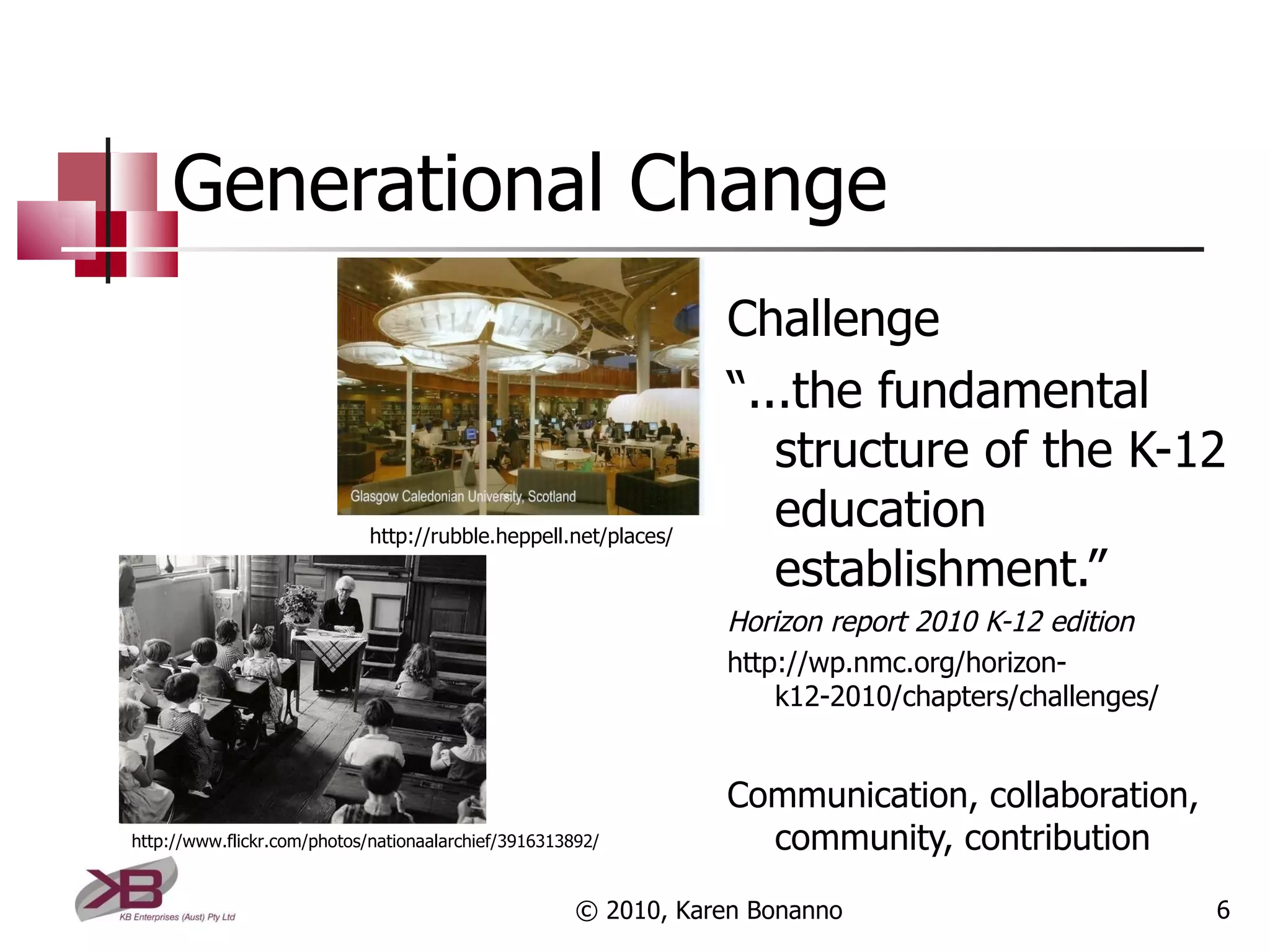
Generational Change Challenge “ ...the fundamental structure of the K-12 education establishment.” Horizon report 2010 K-12 edition http://wp.nmc.org/horizon-k12-2010/chapters/challenges/ Communication, collaboration, community, contribution © 2010, Karen Bonanno http://www.flickr.com/photos/nationaalarchief/3916313892/ http://rubble.heppell.net/places/
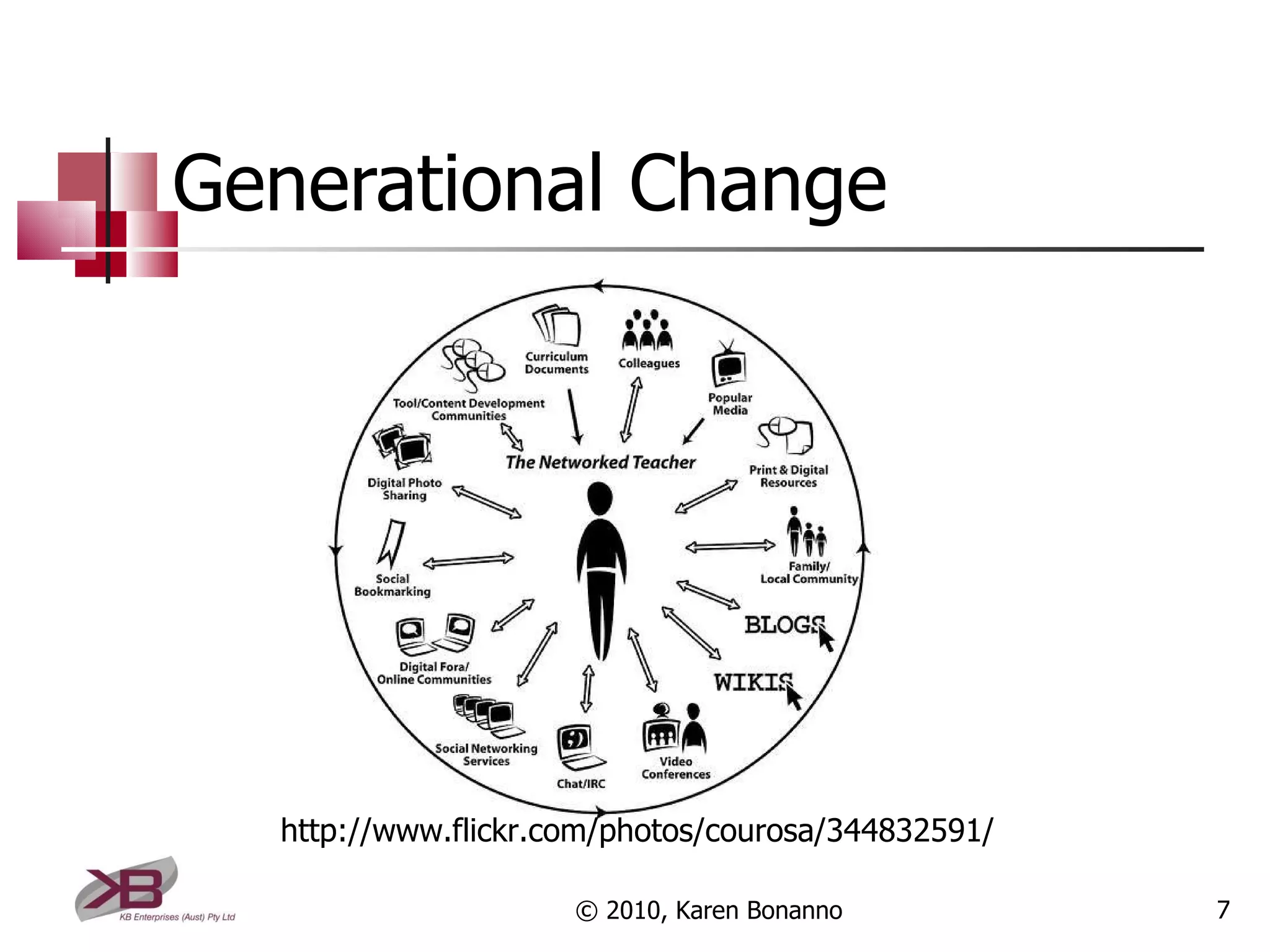
Generational Change © 2010, Karen Bonanno http://www.flickr.com/photos/courosa/344832591/
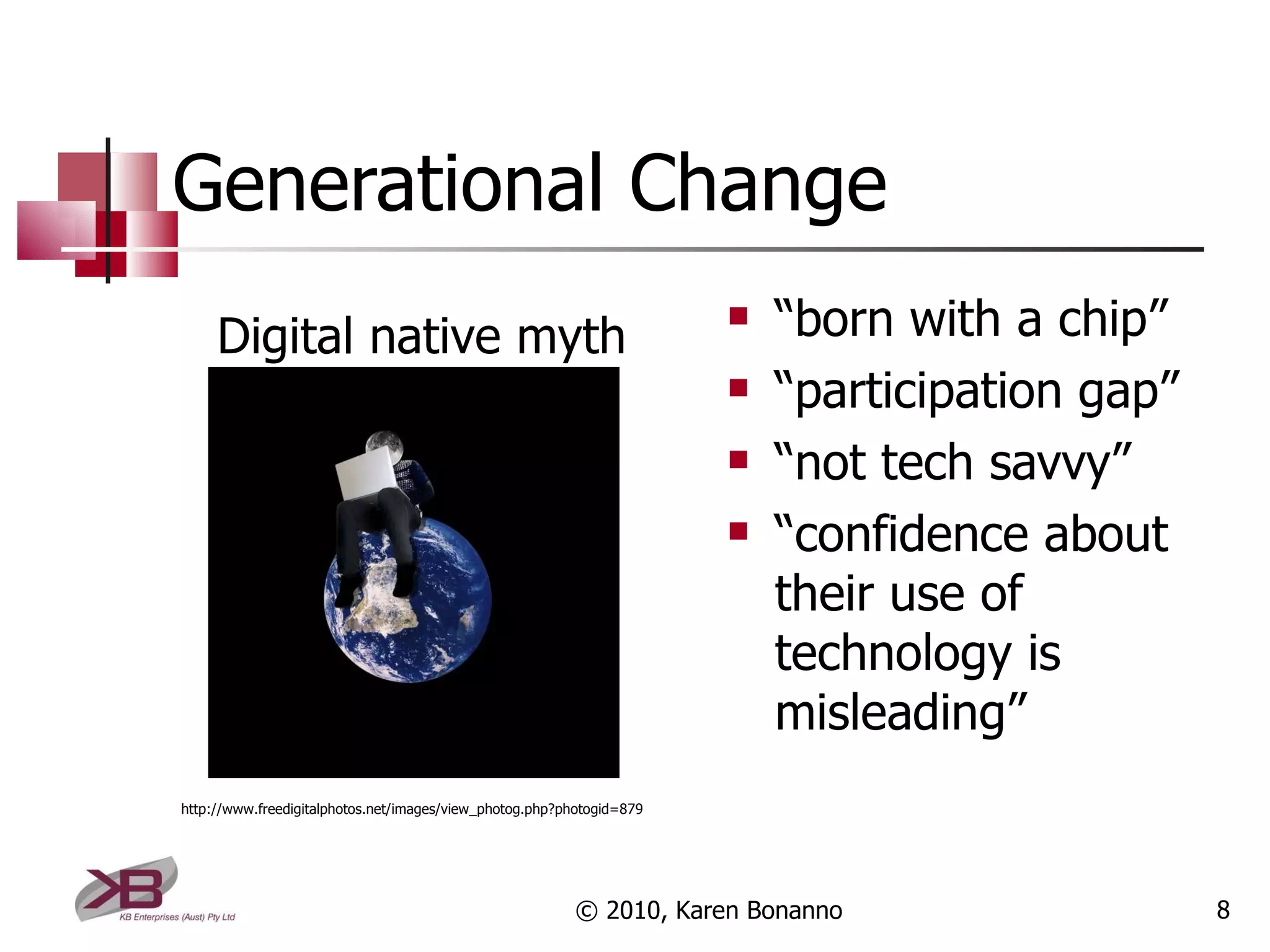
Generational Change “ born with a chip” “ participation gap” “ not tech savvy” “ confidence about their use of technology is misleading” © 2010, Karen Bonanno Digital native myth http://www.freedigitalphotos.net/images/view_photog.php?photogid=879
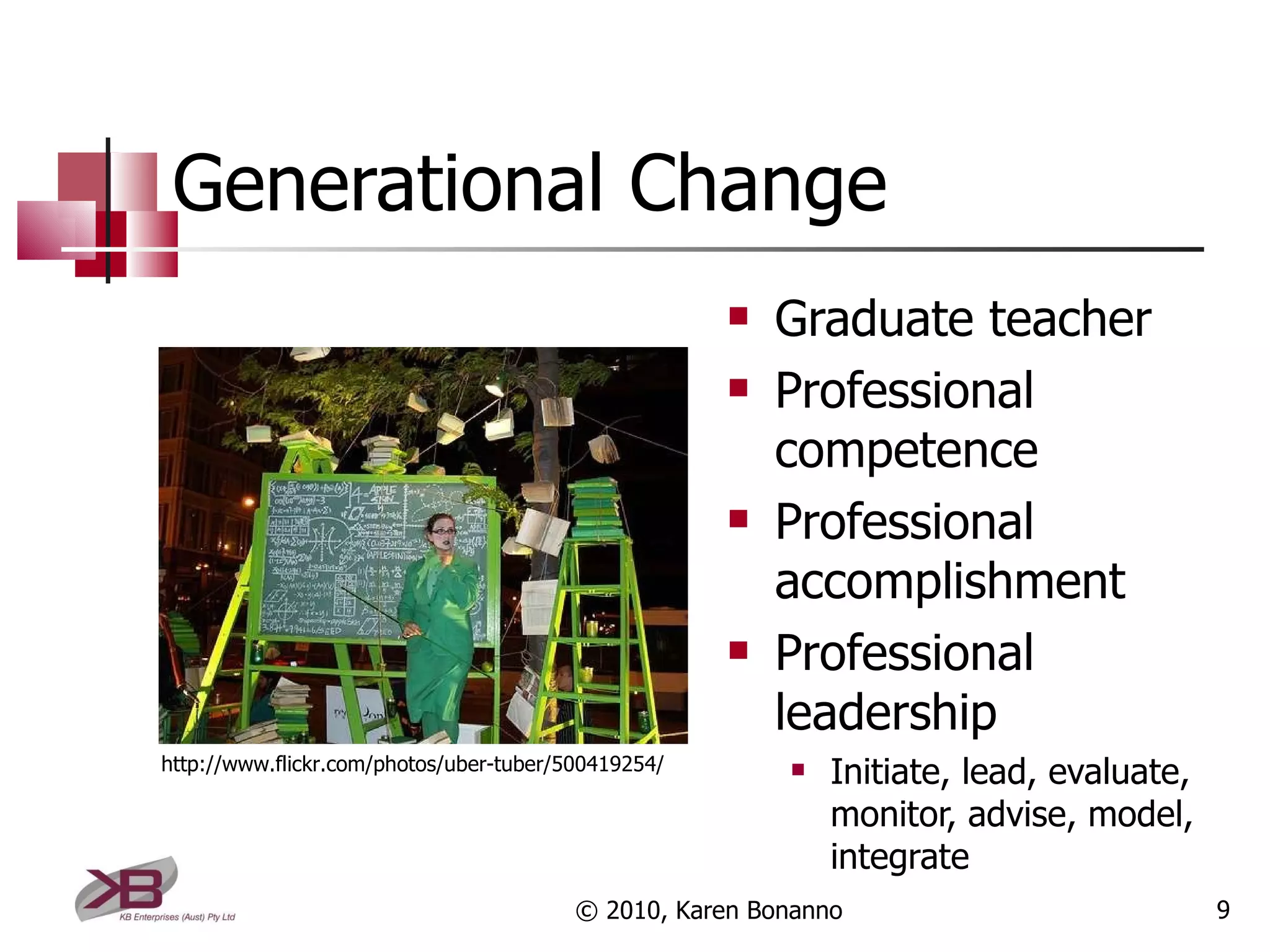
Generational Change Graduate teacher Professional competence Professional accomplishment Professional leadership Initiate, lead, evaluate, monitor, advise, model, integrate © 2010, Karen Bonanno http://www.flickr.com/photos/uber-tuber/500419254/
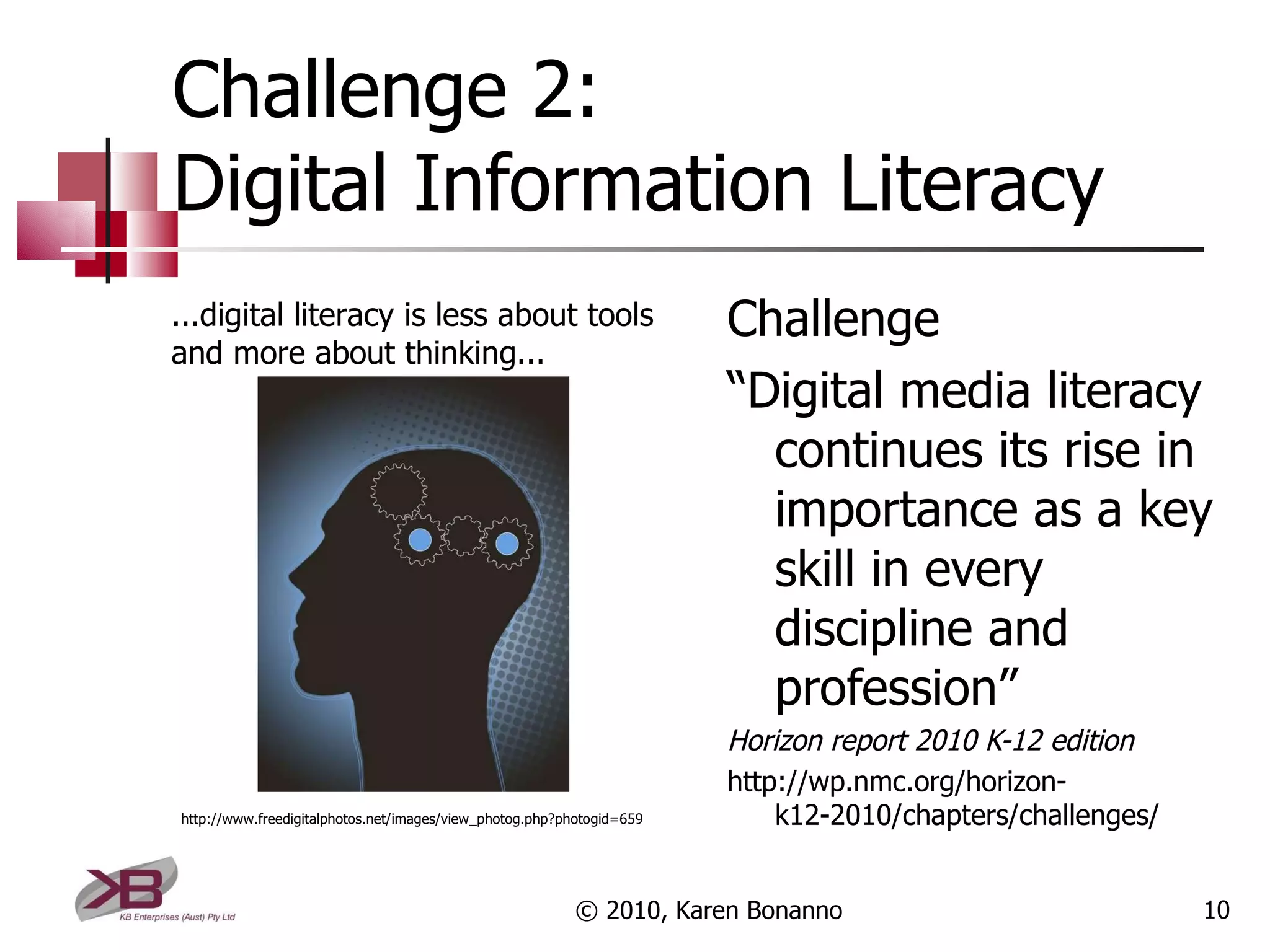
Challenge 2: Digital Information Literacy Challenge “ Digital media literacy continues its rise in importance as a key skill in every discipline and profession” Horizon report 2010 K-12 edition http://wp.nmc.org/horizon-k12-2010/chapters/challenges/ © 2010, Karen Bonanno ...digital literacy is less about tools and more about thinking... http://www.freedigitalphotos.net/images/view_photog.php?photogid=659
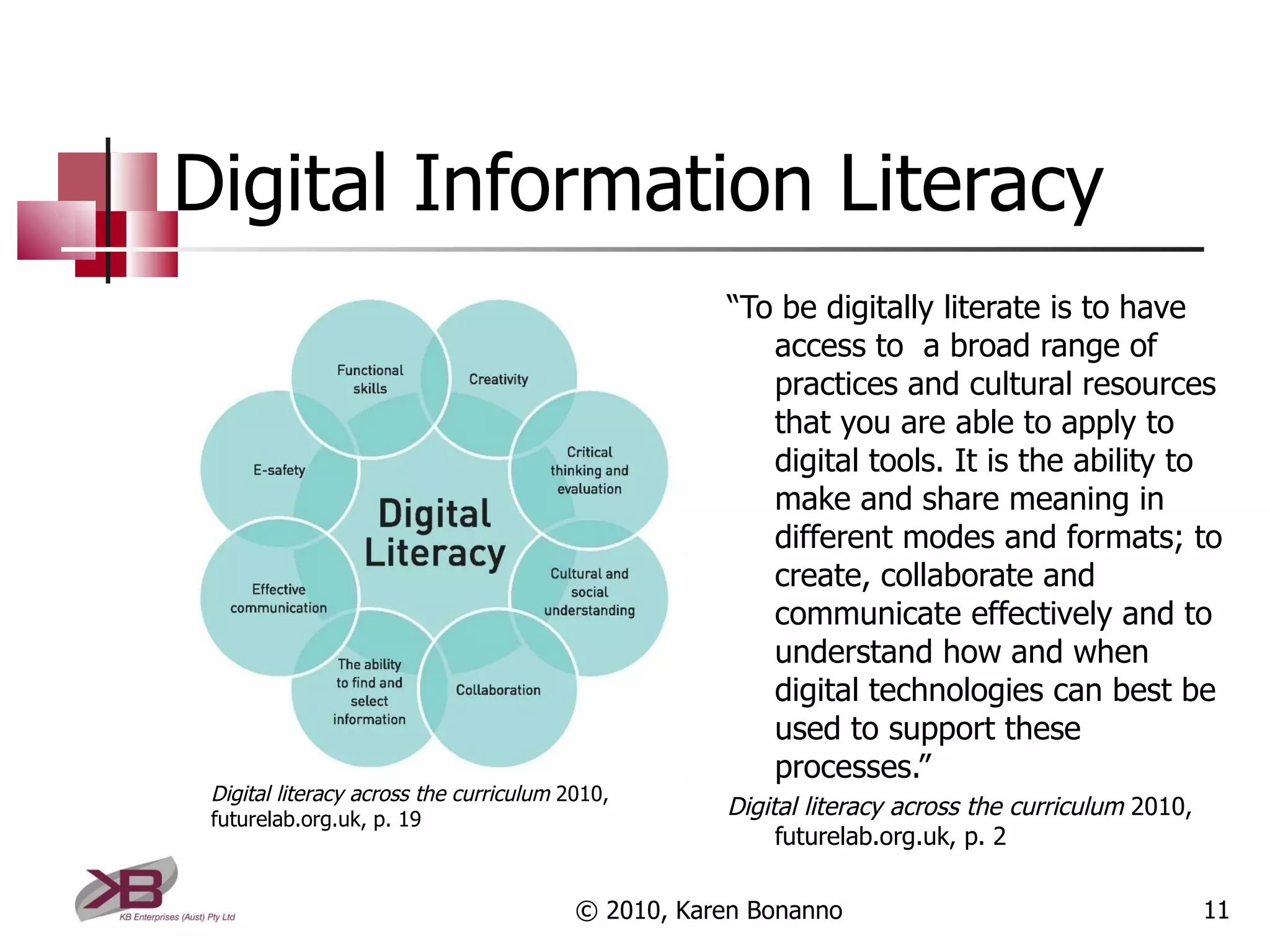
Digital Information Literacy “ To be digitally literate is to have access to  a broad range of practices and cultural resources that you are able to apply to digital tools. It is the ability to make and share meaning in different modes and formats; to create, collaborate and communicate effectively and to understand how and when digital technologies can best be used to support these processes.” Digital literacy across the curriculum  2010, futurelab.org.uk, p. 2 © 2010, Karen Bonanno Digital literacy across the curriculum  2010, futurelab.org.uk, p. 19
Standards for the  21 st  Century Learner (AASL) Inquire, think critically, and gain knowledge Draw conclusions, make informed decisions, apply knowledge to new situations, and create new knowledge Share knowledge and participate ethically and productively as members of our democratic society Pursue personal and aesthetic growth http://www.ala.org/ala/mgrps/divs/aasl/guidelinesandstandards/learningstandards/standards.cfm © 2010, Karen Bonanno
Challenge 3: National Curriculum Challenge “ Students are different, but educational practice and materials that support it are changing only slowly” Horizon report 2010 K-12 edition http://wp.nmc.org/horizon-k12-2010/chapters/challenges/ © 2010, Karen Bonanno www.acara.edu.au/default.asp www.australiancurriculum.edu.au/Home
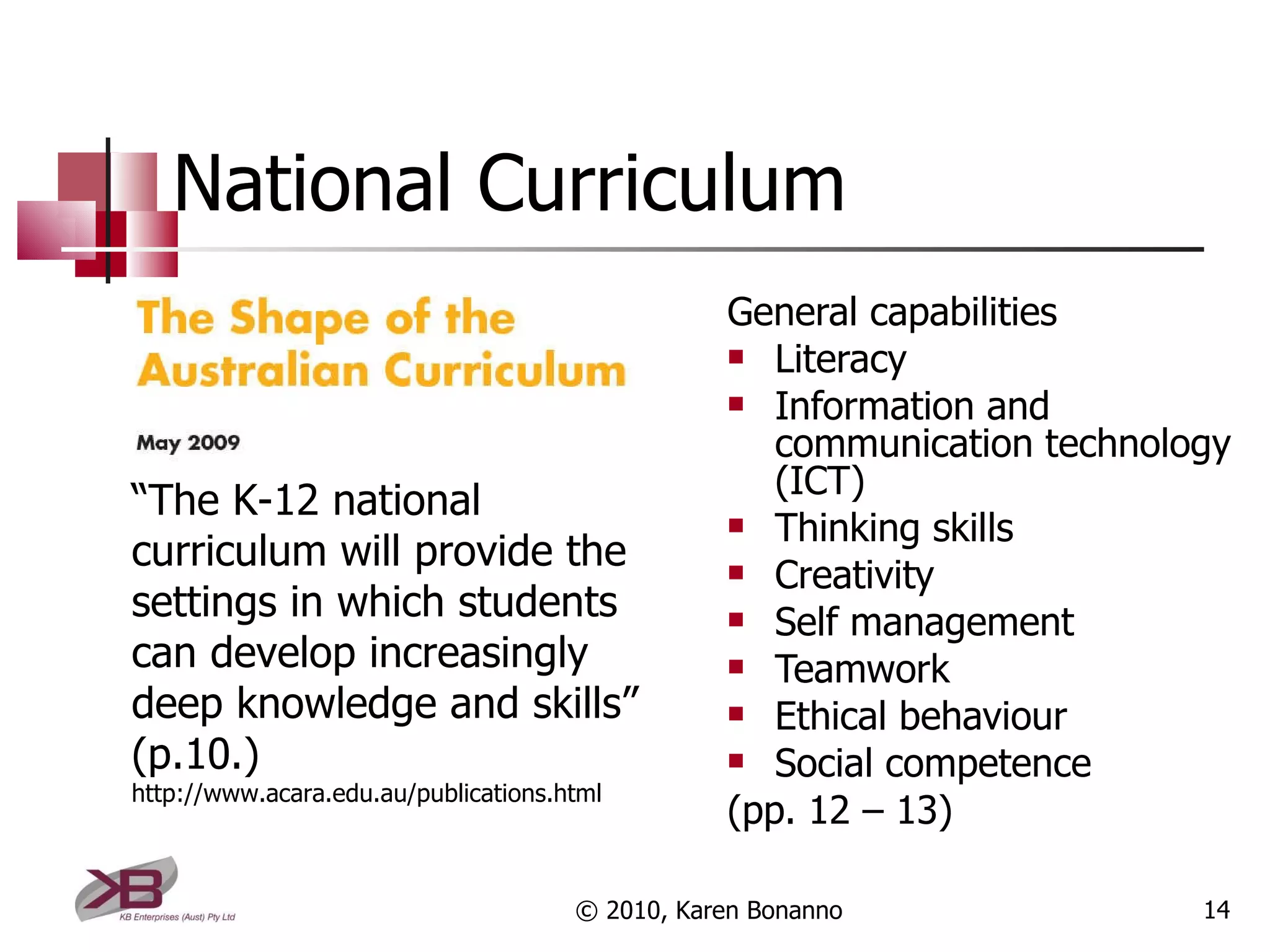
National Curriculum General capabilities Literacy Information and communication technology (ICT) Thinking skills Creativity Self management Teamwork Ethical behaviour Social competence (pp. 12 – 13) © 2010, Karen Bonanno “ The K-12 national curriculum will provide the settings in which students can develop increasingly deep knowledge and skills” (p.10.) http://www.acara.edu.au/publications.html
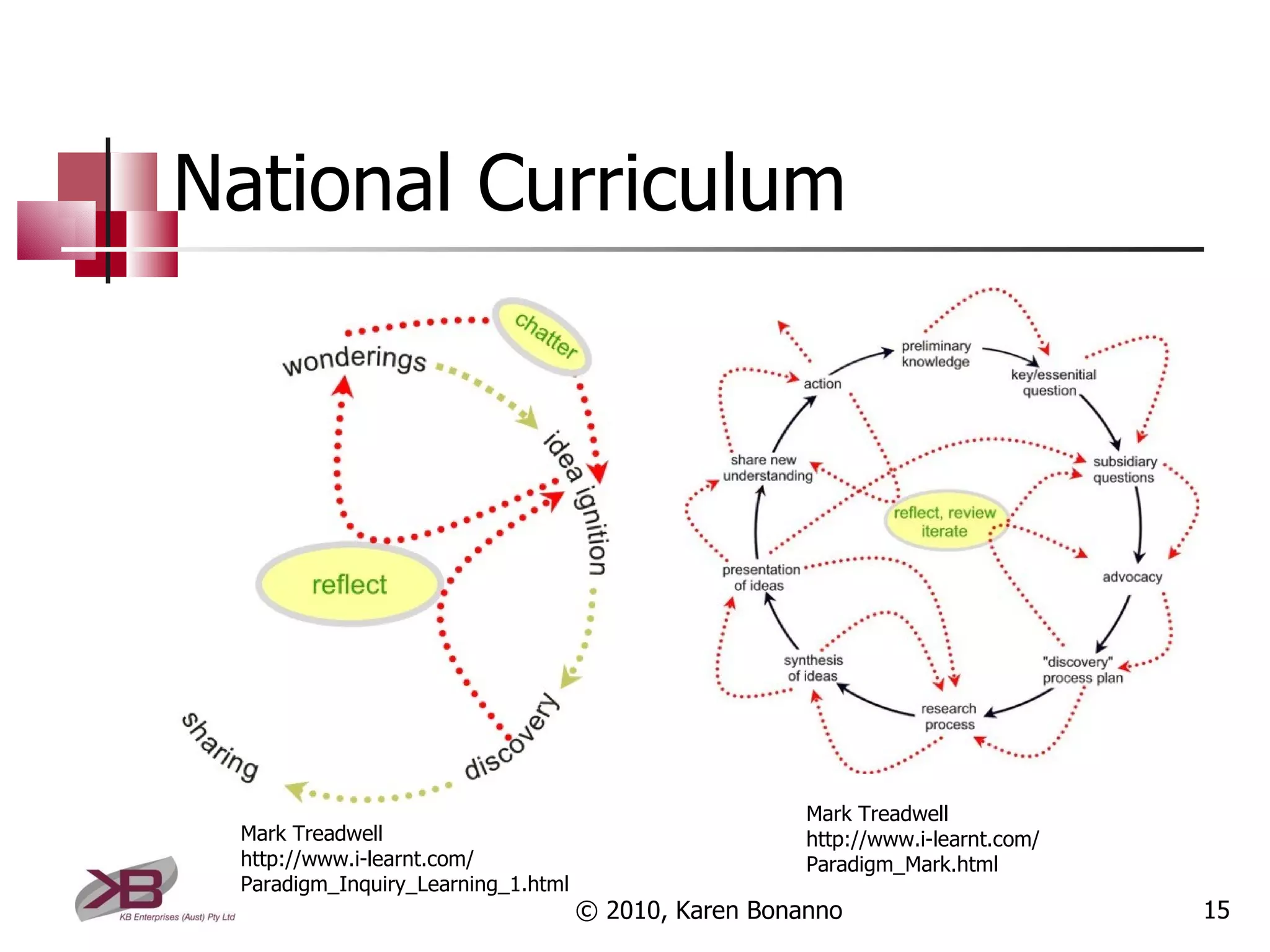
National Curriculum © 2010, Karen Bonanno Mark Treadwell http://www.i-learnt.com/ Paradigm_Inquiry_Learning_1.html Mark Treadwell http://www.i-learnt.com/ Paradigm_Mark.html
National Curriculum Challenge “ ..learning that incorporates real life experiences ...too often undervalued when it does take place.”  Horizon report 2010 K-12 edition http://wp.nmc.org/horizon-k12-2010/chapters/challenges/ © 2010, Karen Bonanno http://www.climatechange.gov.au/
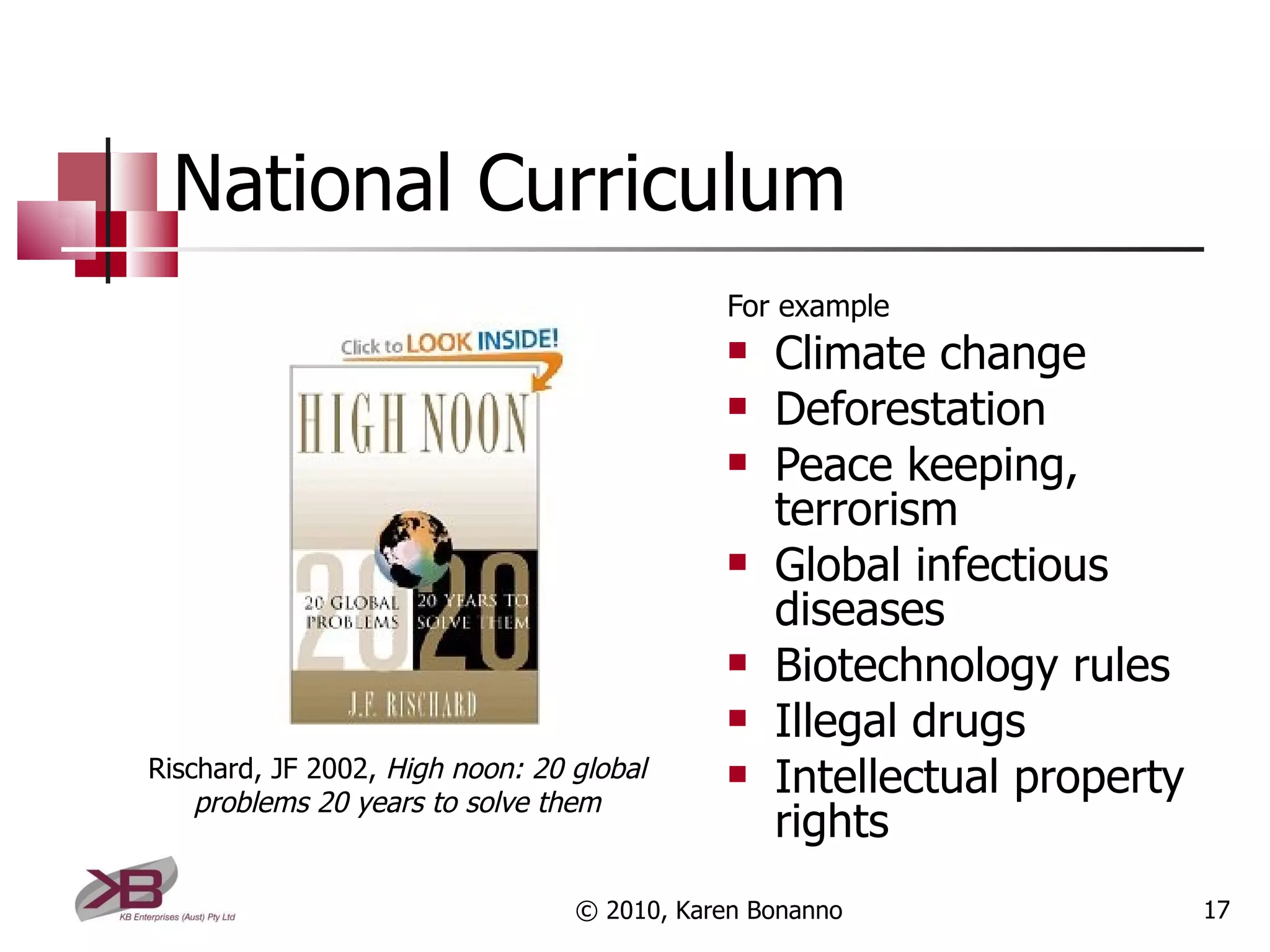
National Curriculum For example Climate change Deforestation Peace keeping, terrorism Global infectious diseases Biotechnology rules Illegal drugs Intellectual property rights © 2010, Karen Bonanno Rischard, JF 2002,  High noon: 20 global problems 20 years to solve them
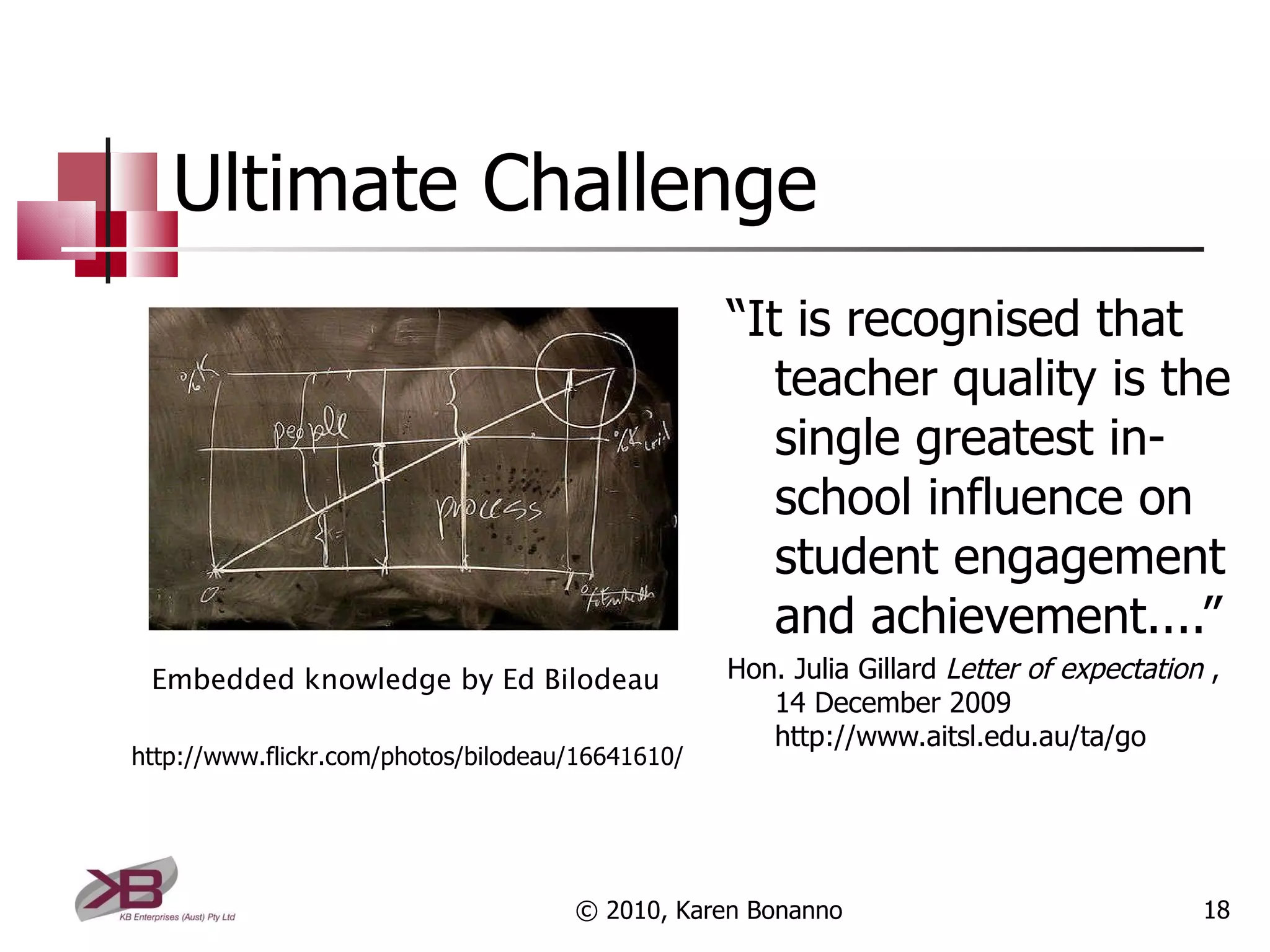
Ultimate Challenge “ It is recognised that teacher quality is the single greatest in-school influence on student engagement and achievement....” Hon. Julia Gillard  Letter of expectation  , 14 December 2009 http://www.aitsl.edu.au/ta/go © 2010, Karen Bonanno http://www.flickr.com/photos/bilodeau/16641610/ Embedded knowledge by Ed Bilodeau

Meeting the challenges of the 21st Century Learner

  • 1.
    Meeting the Challengesof the 21 st Century Learner CPTLA Conference, 21 May 2010 Karen Bonanno Australia http://www.kb.com.au http://www.schoollibrarymanagement.com http://www.karenbonanno.com.au
  • 2.
    ‘ The timesthey are a-changing’ © 2010, Karen Bonanno http://www.aph.gov.au/house/house_news/index.asp
  • 3.
    Re-thinking the role“ It is one of the paradoxes of success that the things and the ways which got you where you are, are seldom the things that keep you there.” Handy, C 1995, The empty raincoat: making sense of the future , Arrow Books, London, p. 49. © 2010, Karen Bonanno
  • 4.
    Challenge 1: Generational Change “ Technology continues to profoundly affect the way we work, collaborate, communicate, and succeed.” Horizon report 2010 K-12 edition http://wp.nmc.org/horizon-k12-2010/chapters/trends/ © 2010, Karen Bonanno http://en.wikipedia.org/wiki/Image:Web_2.0_Map.svg
  • 5.
    Generational Change 1. Google 2. Facebook 3. Youtube 4. Yahoo 6. Wikipedia 8. Blogger 11. Twitter 17. Wordpress.com 22. MySpace 31. Flickr © 2010, Karen Bonanno http://www.alexa.com/topsites Website must be central
  • 6.
    Generational Change Challenge“ ...the fundamental structure of the K-12 education establishment.” Horizon report 2010 K-12 edition http://wp.nmc.org/horizon-k12-2010/chapters/challenges/ Communication, collaboration, community, contribution © 2010, Karen Bonanno http://www.flickr.com/photos/nationaalarchief/3916313892/ http://rubble.heppell.net/places/
  • 7.
    Generational Change ©2010, Karen Bonanno http://www.flickr.com/photos/courosa/344832591/
  • 8.
    Generational Change “born with a chip” “ participation gap” “ not tech savvy” “ confidence about their use of technology is misleading” © 2010, Karen Bonanno Digital native myth http://www.freedigitalphotos.net/images/view_photog.php?photogid=879
  • 9.
    Generational Change Graduateteacher Professional competence Professional accomplishment Professional leadership Initiate, lead, evaluate, monitor, advise, model, integrate © 2010, Karen Bonanno http://www.flickr.com/photos/uber-tuber/500419254/
  • 10.
    Challenge 2: DigitalInformation Literacy Challenge “ Digital media literacy continues its rise in importance as a key skill in every discipline and profession” Horizon report 2010 K-12 edition http://wp.nmc.org/horizon-k12-2010/chapters/challenges/ © 2010, Karen Bonanno ...digital literacy is less about tools and more about thinking... http://www.freedigitalphotos.net/images/view_photog.php?photogid=659
  • 11.
    Digital Information Literacy“ To be digitally literate is to have access to a broad range of practices and cultural resources that you are able to apply to digital tools. It is the ability to make and share meaning in different modes and formats; to create, collaborate and communicate effectively and to understand how and when digital technologies can best be used to support these processes.” Digital literacy across the curriculum 2010, futurelab.org.uk, p. 2 © 2010, Karen Bonanno Digital literacy across the curriculum 2010, futurelab.org.uk, p. 19
  • 12.
    Standards for the 21 st Century Learner (AASL) Inquire, think critically, and gain knowledge Draw conclusions, make informed decisions, apply knowledge to new situations, and create new knowledge Share knowledge and participate ethically and productively as members of our democratic society Pursue personal and aesthetic growth http://www.ala.org/ala/mgrps/divs/aasl/guidelinesandstandards/learningstandards/standards.cfm © 2010, Karen Bonanno
  • 13.
    Challenge 3: NationalCurriculum Challenge “ Students are different, but educational practice and materials that support it are changing only slowly” Horizon report 2010 K-12 edition http://wp.nmc.org/horizon-k12-2010/chapters/challenges/ © 2010, Karen Bonanno www.acara.edu.au/default.asp www.australiancurriculum.edu.au/Home
  • 14.
    National Curriculum Generalcapabilities Literacy Information and communication technology (ICT) Thinking skills Creativity Self management Teamwork Ethical behaviour Social competence (pp. 12 – 13) © 2010, Karen Bonanno “ The K-12 national curriculum will provide the settings in which students can develop increasingly deep knowledge and skills” (p.10.) http://www.acara.edu.au/publications.html
  • 15.
    National Curriculum ©2010, Karen Bonanno Mark Treadwell http://www.i-learnt.com/ Paradigm_Inquiry_Learning_1.html Mark Treadwell http://www.i-learnt.com/ Paradigm_Mark.html
  • 16.
    National Curriculum Challenge“ ..learning that incorporates real life experiences ...too often undervalued when it does take place.” Horizon report 2010 K-12 edition http://wp.nmc.org/horizon-k12-2010/chapters/challenges/ © 2010, Karen Bonanno http://www.climatechange.gov.au/
  • 17.
    National Curriculum Forexample Climate change Deforestation Peace keeping, terrorism Global infectious diseases Biotechnology rules Illegal drugs Intellectual property rights © 2010, Karen Bonanno Rischard, JF 2002, High noon: 20 global problems 20 years to solve them
  • 18.
    Ultimate Challenge “It is recognised that teacher quality is the single greatest in-school influence on student engagement and achievement....” Hon. Julia Gillard Letter of expectation , 14 December 2009 http://www.aitsl.edu.au/ta/go © 2010, Karen Bonanno http://www.flickr.com/photos/bilodeau/16641610/ Embedded knowledge by Ed Bilodeau