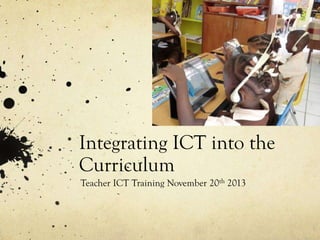
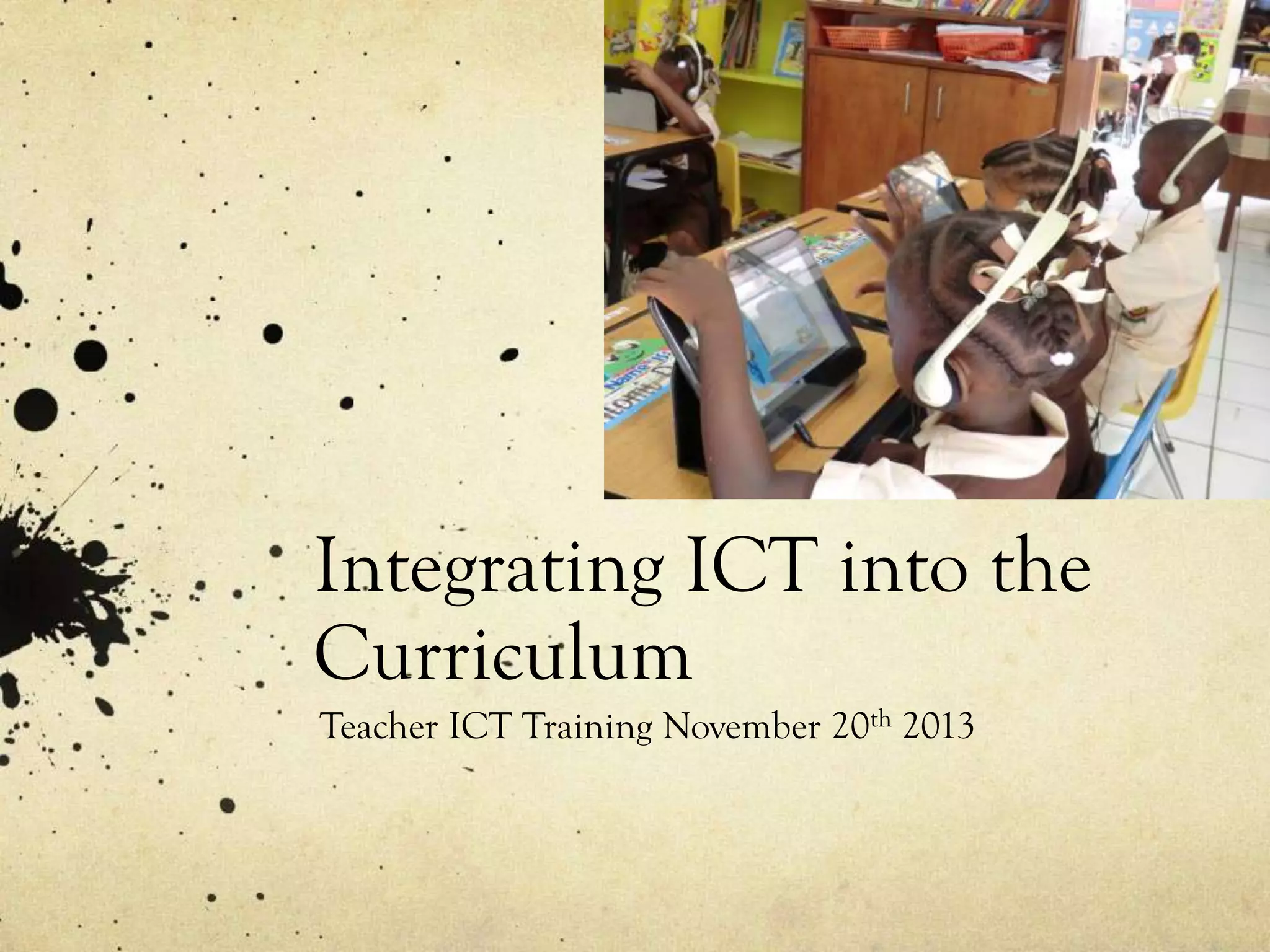
Integrating ICT into the
Curriculum
Teacher ICT Training November 20th 2013
What do we want to do with
ICT?
We want to create and support 21st Century
Learners/Learning
What characterizes the 21st Century Learner?
How is the environment created to support 21st Century
Learning?
How Do You Define 21stCentury Learning?
http://www.edweek.org/tsb/articles/2010/10/12/01pa
nel.h04.html
The term "21st-century skills" is generally used to refer to
certain core competencies such as collaboration, digital
literacy, critical thinking, and problem-solving that advocates
believe schools need to teach to help students thrive in today's
world.
The idea of what learning in the 21st century should look like
is still open to interpretation—and controversy.
Perspectives on 21st Century
Learning
I cannot understand why classrooms have whiteboards
but no classroom libraries.
The research, to date, has provided no evidence that
having either computers or whiteboards in schools has
any positive effect on students’ reading and writing
proficiencies.
But school and classroom libraries are well established
as essential if we plan to develop a literate citizenry.
Perspectives on 21st Century
Learning
Twenty-first-century learning means that students master
content while producing, synthesizing, and evaluating
information from a wide variety of subjects and sources with
an understanding of and respect for diverse cultures.
Students demonstrate the 3 Rs, but also the 4 Cs: critical
thinking, creativity, communication, and collaboration.

They demonstrate digital literacy as well as civic
responsibility.
Learning of this nature demands well-prepared teachers who
draw on advances in cognitive science and are strategically
organized in teams, in and out of cyberspace.
Perspectives on 21st Century
Learning
Success in the 21st century requires knowing how to
learn.
Students today will likely have several careers in their
lifetime. They must develop strong critical thinking
and interpersonal communication skills in order to be
successful in an increasingly fluid, interconnected, and
complex world.
Technology allows for 24/7 access to information,
constant social interaction, and easily created and
shared digital content.
Perspectives on 21st Century
Learning
In this setting, educators can leverage technology to
create an engaging and personalized environment to
meet the emerging educational needs of this
generation.
No longer does learning have to be one-size-fits-all or
confined to the classroom.
The opportunities afforded by technology should be
used to re-imagine 21st-century education, focusing on
preparing students to be learners for life.
Perspectives on 21st Century
Learning
But being able to Google is no substitute for true
understanding. Students still need to know and deeply
understand...
They need to be able to … to speak a language besides their
mother tongue.
According to most 21st-century skills’ advocates, students
needn’t actually walk around with such knowledge in their
heads, they need only to have the skills to find it. I disagree.
Twenty-first-century technology should be seen as an
opportunity to acquire more knowledge, not an excuse to
know less.
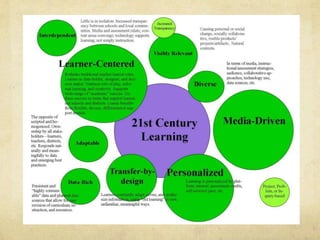
11 Characteristics Of 21st
Century Learning
1. Learner-centered

2. Media-driven (this doesn’t have to mean digital
media)
3. Personalized
4. Transfer-by-Design
5. Visibly Relevant
6. Data-Rich
11 Characteristics Of 21st
Century Learning
7. Adaptable

8. Interdependent
9. Diverse
10. Opportunity to play, develop passion, find
purpose, to be creative and innovative
11. Equality
Limits and Challenges of Technology Insecurity
…There is a constant insecurity that someone somewhere is
doing it better–faster, smarter, for less money, with better
results. The trouble is that the data for these “other people”
that are undoubtedly “doing it better” is usually scant:
The desire to maintain, keep up, and “embrace,” it is
possible to run roughshod over common sense and
planning–and miss the why the technology does or does not work.
Without this careful attention to the ins and outs of
pedagogy and how people learn, such adoption becomes a
me-too contest that works with the precision of a grenade.
Limits and Challenges of Technology –
Blind Adoption
For technology to be effective beyond cursory notions of
“engagement” or publicity, it must be holistically married to
curriculum, instruction, and assessment.
Very little coverage actually delves into the cognitive, emotional, or
cultural mechanisms that are enacted by great technology. It may
be a relative lack of pedagogical expertise, too little experience
with instructional design, or that there is simply little perceived
interest in how it all works.
Technology is expensive, ages fast, and can be irrationally
frustrating when it doesn’t do what it’s supposed to do. This can lead
to disillusionment by users–learners and educators–a misplaced
anger that can deter future adoption on shaky logical grounds.
Limits and Challenges of Technology –
Blind Adoption
Aggressive technology adoption is a recipe for waste.

Widespread implementation of anything that is hoped to
literally transform learning needs to be done with a macro
view of the entire learning ecology, not an insecure notion
of keeping up with the Jones’.
Understanding why technology works also helps us
understand its limits, not simply to inform future tech
evolution, but to more accurately re-evaluate the role of
teachers, curriculum experts, app developers, and most
critically the communities that technology should ultimately
serve.
How can ICT support?
ICTs should be used to effectively marry Content with
Skills.
We already have the content;
So what are 21st Century learning SKILLS?
Problem Solving
Critical Thinking
Communication
Collaboration

Creativity
Self-Directed Learning
Information & Media Literacy
Accountability & Adaptability
Social Responsibility
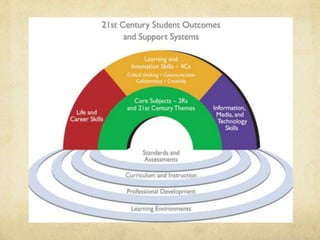
A framework for 21st Century
Learning
Framework
ICT Objectives
We want learners to learn and practice these skills
while using technology
The acquisition of those skills will help reveal the
relevance of the content

The skilled learner will master the acquisition of
content and the application of knowledge
A model for Integrating ICT
Integration of ICT into the curriculum requires an
understanding of how ICT could be integrated into the
smaller components of the curriculum.
Thus we must think about:
ICT integration into a topic, and
ICT integration into a lesson

That takes planning!!
Systematic Planning for ICT Integration in
Topic Learning
Systematic Planning for ICT Integration in Topic
Learning
Qiyun Wang and Huay Lit Woo
2007
End of Presentation
Check out

http://www.teachthought.com/technology/12powerful-new-ideas-for-21st-century-learning/

Integrating ict into the curriculum

  • 1.
    Integrating ICT intothe Curriculum Teacher ICT Training November 20th 2013
  • 2.
    What do wewant to do with ICT? We want to create and support 21st Century Learners/Learning What characterizes the 21st Century Learner? How is the environment created to support 21st Century Learning?
  • 3.
    How Do YouDefine 21stCentury Learning? http://www.edweek.org/tsb/articles/2010/10/12/01pa nel.h04.html The term "21st-century skills" is generally used to refer to certain core competencies such as collaboration, digital literacy, critical thinking, and problem-solving that advocates believe schools need to teach to help students thrive in today's world. The idea of what learning in the 21st century should look like is still open to interpretation—and controversy.
  • 4.
    Perspectives on 21stCentury Learning I cannot understand why classrooms have whiteboards but no classroom libraries. The research, to date, has provided no evidence that having either computers or whiteboards in schools has any positive effect on students’ reading and writing proficiencies. But school and classroom libraries are well established as essential if we plan to develop a literate citizenry.
  • 5.
    Perspectives on 21stCentury Learning Twenty-first-century learning means that students master content while producing, synthesizing, and evaluating information from a wide variety of subjects and sources with an understanding of and respect for diverse cultures. Students demonstrate the 3 Rs, but also the 4 Cs: critical thinking, creativity, communication, and collaboration. They demonstrate digital literacy as well as civic responsibility. Learning of this nature demands well-prepared teachers who draw on advances in cognitive science and are strategically organized in teams, in and out of cyberspace.
  • 6.
    Perspectives on 21stCentury Learning Success in the 21st century requires knowing how to learn. Students today will likely have several careers in their lifetime. They must develop strong critical thinking and interpersonal communication skills in order to be successful in an increasingly fluid, interconnected, and complex world. Technology allows for 24/7 access to information, constant social interaction, and easily created and shared digital content.
  • 7.
    Perspectives on 21stCentury Learning In this setting, educators can leverage technology to create an engaging and personalized environment to meet the emerging educational needs of this generation. No longer does learning have to be one-size-fits-all or confined to the classroom. The opportunities afforded by technology should be used to re-imagine 21st-century education, focusing on preparing students to be learners for life.
  • 8.
    Perspectives on 21stCentury Learning But being able to Google is no substitute for true understanding. Students still need to know and deeply understand... They need to be able to … to speak a language besides their mother tongue. According to most 21st-century skills’ advocates, students needn’t actually walk around with such knowledge in their heads, they need only to have the skills to find it. I disagree. Twenty-first-century technology should be seen as an opportunity to acquire more knowledge, not an excuse to know less.
  • 9.
    11 Characteristics Of21st Century Learning 1. Learner-centered 2. Media-driven (this doesn’t have to mean digital media) 3. Personalized 4. Transfer-by-Design 5. Visibly Relevant 6. Data-Rich
  • 10.
    11 Characteristics Of21st Century Learning 7. Adaptable 8. Interdependent 9. Diverse 10. Opportunity to play, develop passion, find purpose, to be creative and innovative 11. Equality
  • 12.
    Limits and Challengesof Technology Insecurity …There is a constant insecurity that someone somewhere is doing it better–faster, smarter, for less money, with better results. The trouble is that the data for these “other people” that are undoubtedly “doing it better” is usually scant: The desire to maintain, keep up, and “embrace,” it is possible to run roughshod over common sense and planning–and miss the why the technology does or does not work. Without this careful attention to the ins and outs of pedagogy and how people learn, such adoption becomes a me-too contest that works with the precision of a grenade.
  • 13.
    Limits and Challengesof Technology – Blind Adoption For technology to be effective beyond cursory notions of “engagement” or publicity, it must be holistically married to curriculum, instruction, and assessment. Very little coverage actually delves into the cognitive, emotional, or cultural mechanisms that are enacted by great technology. It may be a relative lack of pedagogical expertise, too little experience with instructional design, or that there is simply little perceived interest in how it all works. Technology is expensive, ages fast, and can be irrationally frustrating when it doesn’t do what it’s supposed to do. This can lead to disillusionment by users–learners and educators–a misplaced anger that can deter future adoption on shaky logical grounds.
  • 14.
    Limits and Challengesof Technology – Blind Adoption Aggressive technology adoption is a recipe for waste. Widespread implementation of anything that is hoped to literally transform learning needs to be done with a macro view of the entire learning ecology, not an insecure notion of keeping up with the Jones’. Understanding why technology works also helps us understand its limits, not simply to inform future tech evolution, but to more accurately re-evaluate the role of teachers, curriculum experts, app developers, and most critically the communities that technology should ultimately serve.
  • 15.
    How can ICTsupport? ICTs should be used to effectively marry Content with Skills. We already have the content; So what are 21st Century learning SKILLS?
  • 16.
    Problem Solving Critical Thinking Communication Collaboration Creativity Self-DirectedLearning Information & Media Literacy Accountability & Adaptability Social Responsibility
  • 18.
    A framework for21st Century Learning Framework
  • 19.
    ICT Objectives We wantlearners to learn and practice these skills while using technology The acquisition of those skills will help reveal the relevance of the content The skilled learner will master the acquisition of content and the application of knowledge
  • 20.
    A model forIntegrating ICT Integration of ICT into the curriculum requires an understanding of how ICT could be integrated into the smaller components of the curriculum. Thus we must think about: ICT integration into a topic, and ICT integration into a lesson That takes planning!!
  • 21.
    Systematic Planning forICT Integration in Topic Learning Systematic Planning for ICT Integration in Topic Learning Qiyun Wang and Huay Lit Woo 2007
  • 22.
    End of Presentation Checkout http://www.teachthought.com/technology/12powerful-new-ideas-for-21st-century-learning/