Education in America by Darlene Westinghouse 06/02/09
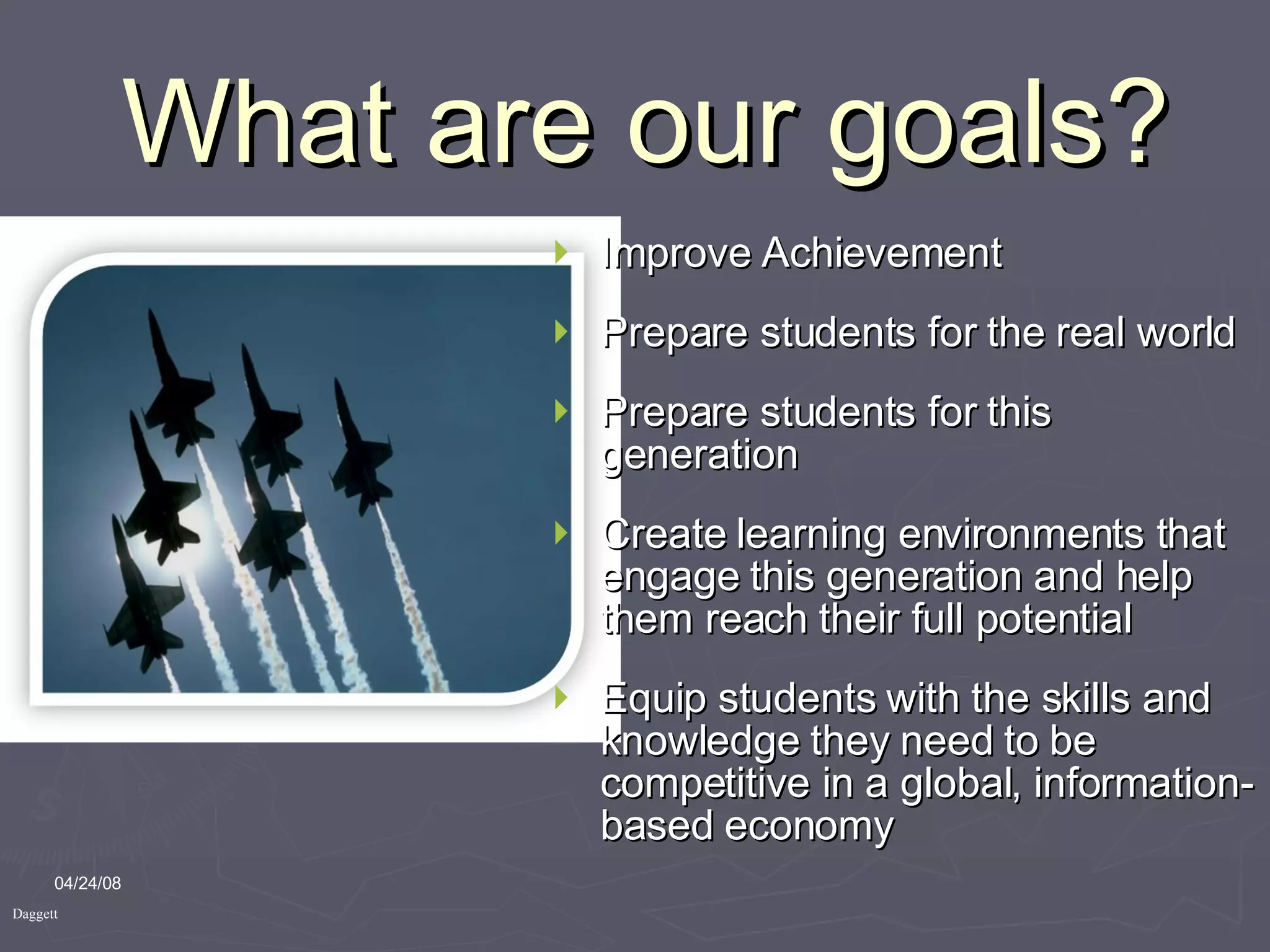
What are our goals? Improve Achievement Prepare students for the real world Prepare students for this generation Create learning environments that engage this generation and help them reach their full potential Equip students with the skills and knowledge they need to be competitive in a global, information-based economy 06/02/09 Daggett
Ask these questions: 06/02/09 WHY do we need change? WHAT needs to be done? HOW   do we do it?
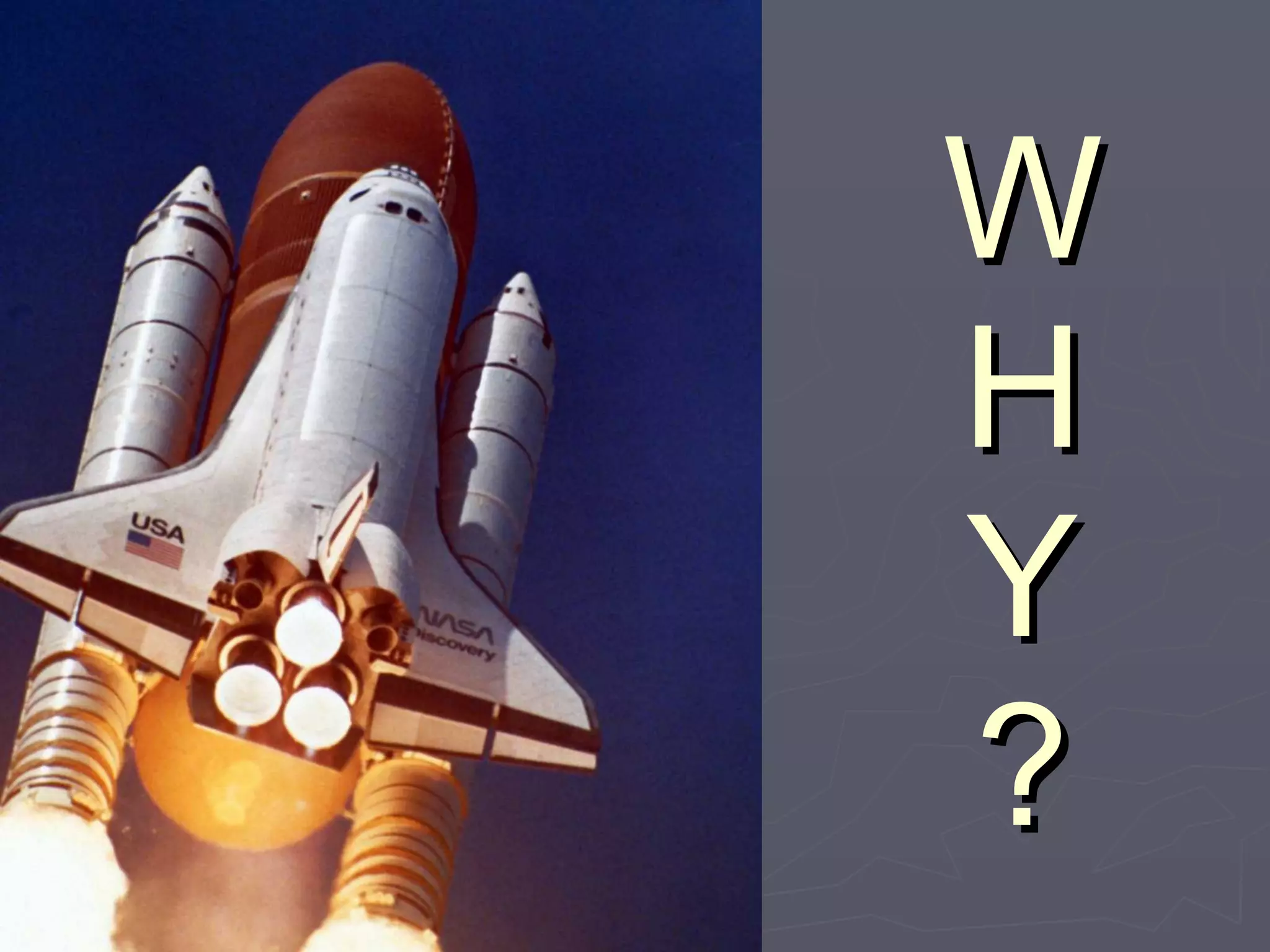
W H Y ? 06/02/09
Nano-Technology 06/02/09 Central Processing Unit - 8 MB Memory
Advancements 06/02/09 Chips are now 1/1000 of a human hair in size.
Bio-Technology 06/02/09
Bioinformatics 06/02/09 Combines information systems and the life sciences. For example, it can interlock the binary code of information systems with a genetic code.
Other Bioinformatic alterations 06/02/09 In Japan, farmers have produced square watermelons to make them easier and more economical to pack and ship. In two years we will be able to take a DNA test at a pharmacy to reveal predispositions to over 4000 diseases.
06/02/09 It is estimated that in the next four years, technology advancements will increase more than in all of mankind. 80% of jobs in 2010 do not exist today (US Dept. of Labor) Other countries are working hard, moving fast and using technology to accelerate progress.
Foreign Scholars Physical Science 43% Mathematics 42% Computer Science 46% Physics 36% Engineering Science 56% 06/02/09
Other Cultures Korea Little time reading newspapers or watching TV.  Life moves at the speed of the net and being connected is the only way to remain current Japan Laptops are viewed as dinosauric technology.  The cell phone provides the privacy and instant connectivity individuals crave
 
Two Million Minutes Documentary 06/02/09
06/02/09 “ American society needs to both leverage and keep pace with emerging computer technologies. Our well-being as a nation depends on our willingness to invest in education and research that will prepare today’s K-12 students to be leaders in the field.” w ww.businessweek.com/magazine/content05_16/b3929120_mz018.htm   Education Trends
06/02/09 “ Education is the only business still debating the usefulness of technology. Schools remain unchanged for the most part, despite numerous reforms and increased investments in computers and networks.” U.S. Secretary of Education Rod Paige
06/02/09
“ This is a story about the big public conversation the nation is not having about education…  whether an entire generation of kids will fail to make the grade in the global economy because they can’t think their way through abstract problems, work in teams, distinguish good information from bad, or speak a language other than English.” How to Build a Student for the 21 st  Century,  TIME Magazine, December 18, 2006 http://www.time.com/time/printout/0,8816,1568480,00.html
Full Report:  http://21stcenturyskills.org/documents/P21_pollreport_singlepg.pdf
http://www.21stcenturyschools.com/Professional_Development_Needs_Assessment.pdf Professional Development Needs Assessment
Alternative
 
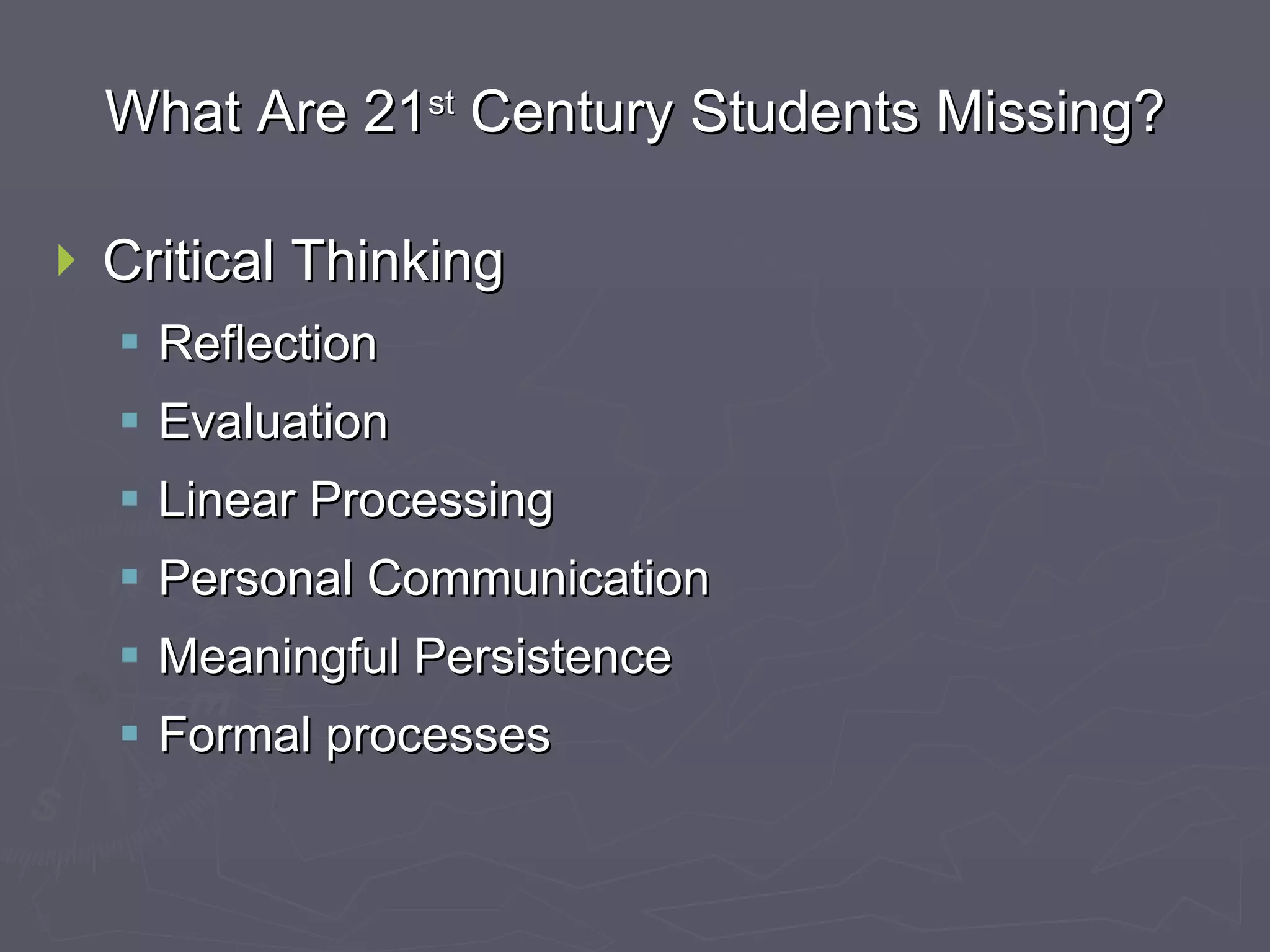
What Are 21 st  Century Students Missing? Critical Thinking Reflection Evaluation Linear Processing Personal Communication Meaningful Persistence Formal processes
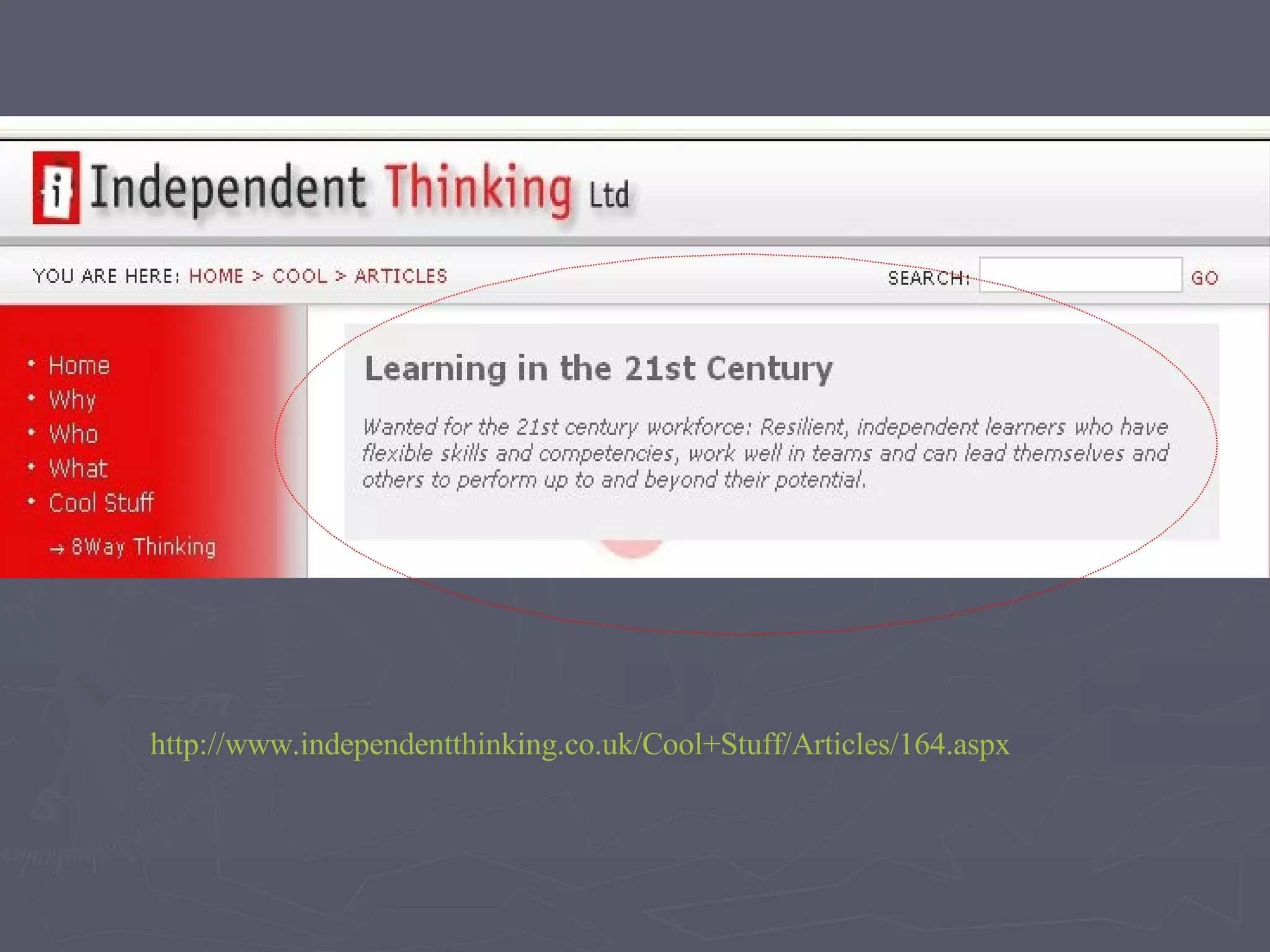
http://www.independentthinking.co.uk/Cool+Stuff/Articles/164.aspx
Workforce Survey: “ Are They Really Ready to Work?” Why 21 st  Century Skills? Released October 2, 2006, by The Conference Board, Corporate Voices for Working Families, Partnership for 21 st  Century Skills, and the Society for Human Resource Management groups.
Why 21 st  Century Skills? What skills are most important for job success when hiring a High School graduate?  Work Ethic 80% Collaboration 75% Good Communication 70% Social Responsibility 63% Critical Thinking & Problem Solving 58%
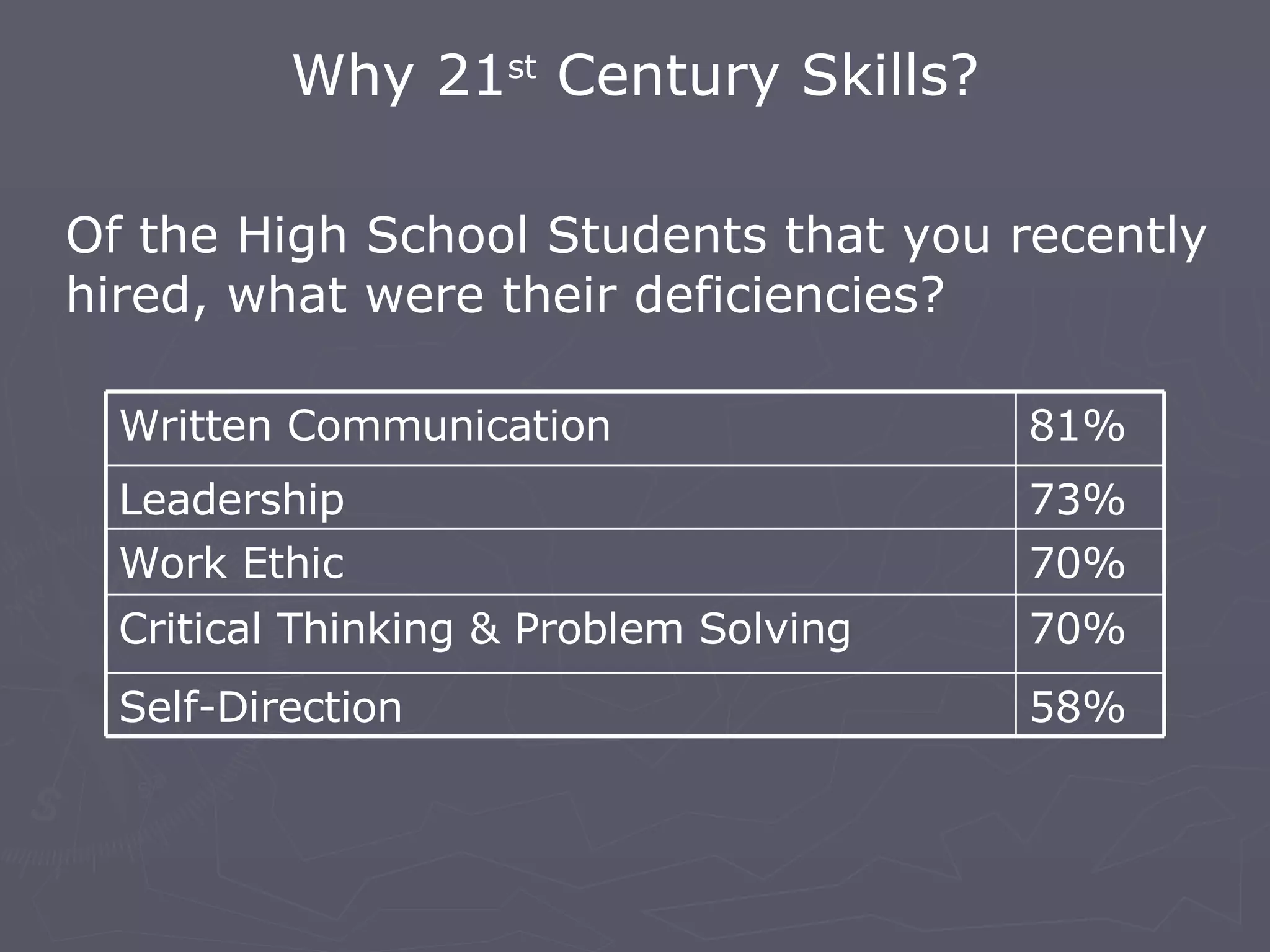
Why 21 st  Century Skills? Of the High School Students that you recently hired, what were their deficiencies? Written Communication 81% Leadership 73% Work Ethic 70% Critical Thinking & Problem Solving 70% Self-Direction 58%
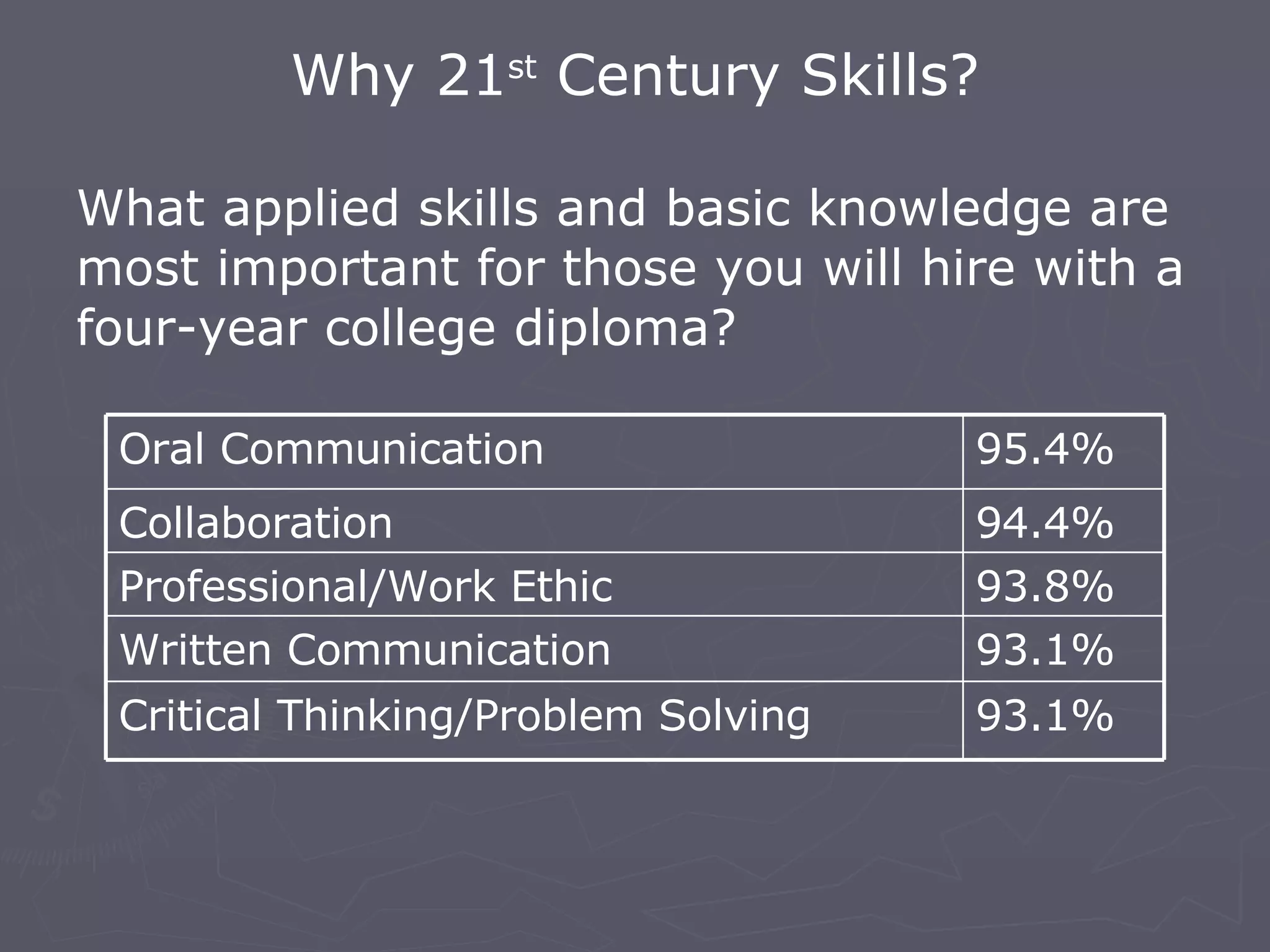
Why 21 st  Century Skills? What applied skills and basic knowledge are most important for those you will hire with a four-year college diploma? Oral Communication 95.4% Collaboration 94.4% Professional/Work Ethic 93.8% Written Communication 93.1% Critical Thinking/Problem Solving 93.1%
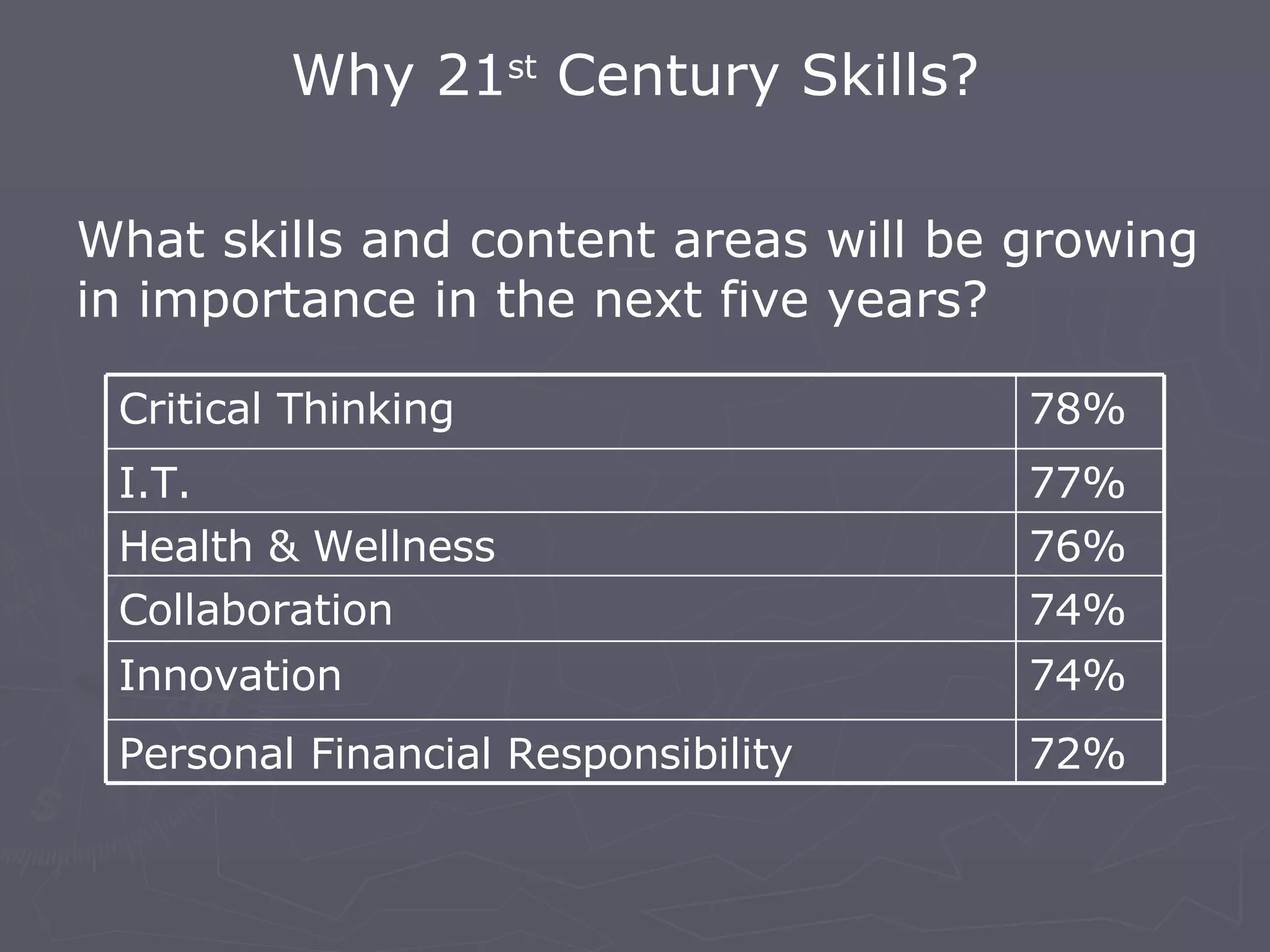
Why 21 st  Century Skills? What skills and content areas will be growing in importance in the next five years? Critical Thinking 78% I.T. 77% Health & Wellness 76% Collaboration 74% Innovation 74% Personal Financial Responsibility 72%
WHAT needs to be done and HOW  ? 06/02/09
“ The illiterate of the 21st century will not be those who cannot read and write, but those who cannot learn, unlearn, and relearn. ”  - Alvin Toffler
A research-based synthesis consisting of 30 years of educational research indicates: participation in social practice is a fundamental form of learning  learning is increased by a diversity of cultural experience and community participation  Brown, Ann L, Cocking, Rodney R & Bransford , John D.  How People Learn: Brain, Mind, Experience, and School . Washington: National Academies Press, 2000.  How People Learn
Who are 21 st  Century Learners? As large in number as Baby Boomers Consumers- $150 billion annually Digital Media Users – 6 ½ hrs daily (Exposed to 8 ½ hours) Multi-taskers: online - phone - print Hyper-Communicators -socially & civically Gamers-interactive learning Risk-Takers Depersonalization Pursuers of ongoing education Futurists & Optimistic IQ is up by 17 points between 1947-2001 with most gains post 1972
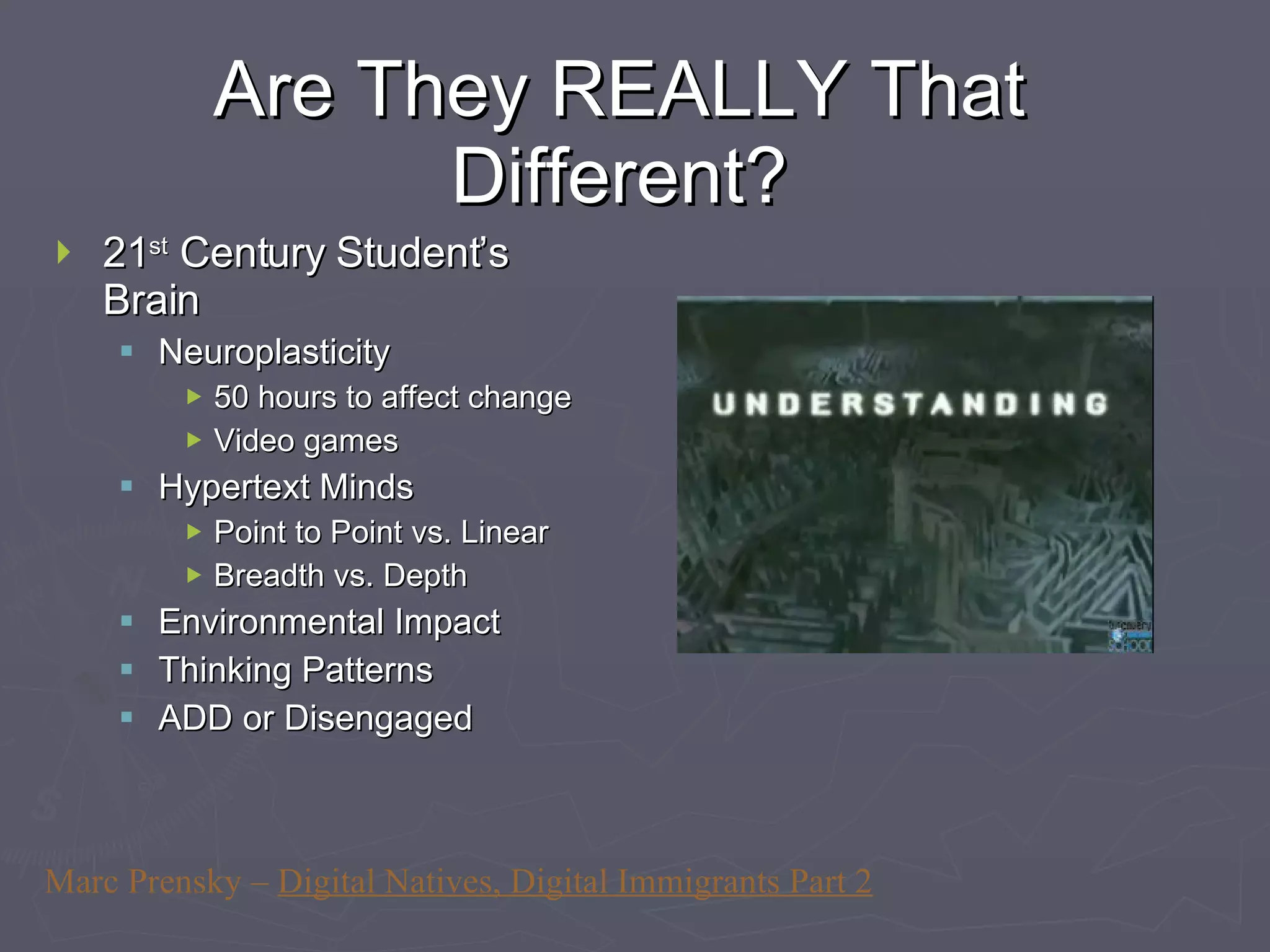
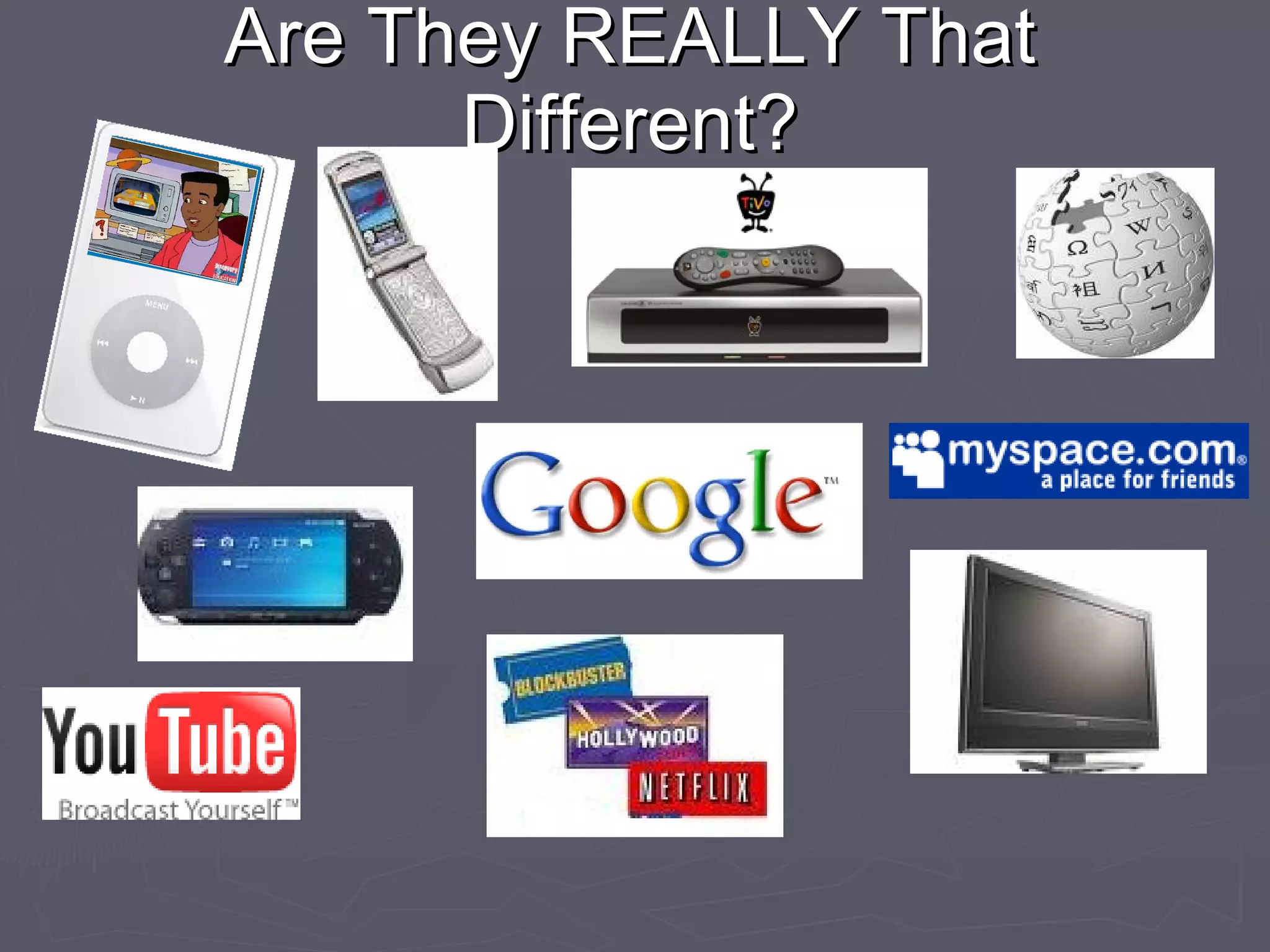
Are They REALLY That Different? 21 st  Century Student’s Brain Neuroplasticity 50 hours to affect change Video games Hypertext Minds Point to Point vs. Linear Breadth vs. Depth Environmental Impact Thinking Patterns ADD or Disengaged Marc Prensky –  Digital Natives, Digital Immigrants Part 2
Are They REALLY That Different?
Who are 21 st  Century Learners? Portable Game Device Cell Phone Computer Video Game Console MP3 Player/iPods Top Five Gifts for Teenagers Source:  Starkman, Neal (2007).Leave Me Alone.... T.H.E. Journal.  33-38.
Four week period ending June 24, 2006 23,696 searches sent traffic to video sites Four week period ending June 23, 2007 110,775 searches sent traffic to video sites -John Seely Brown Search Engines moving toward video Hitwise, Phil Butler, profy.com YouTube other sites
 
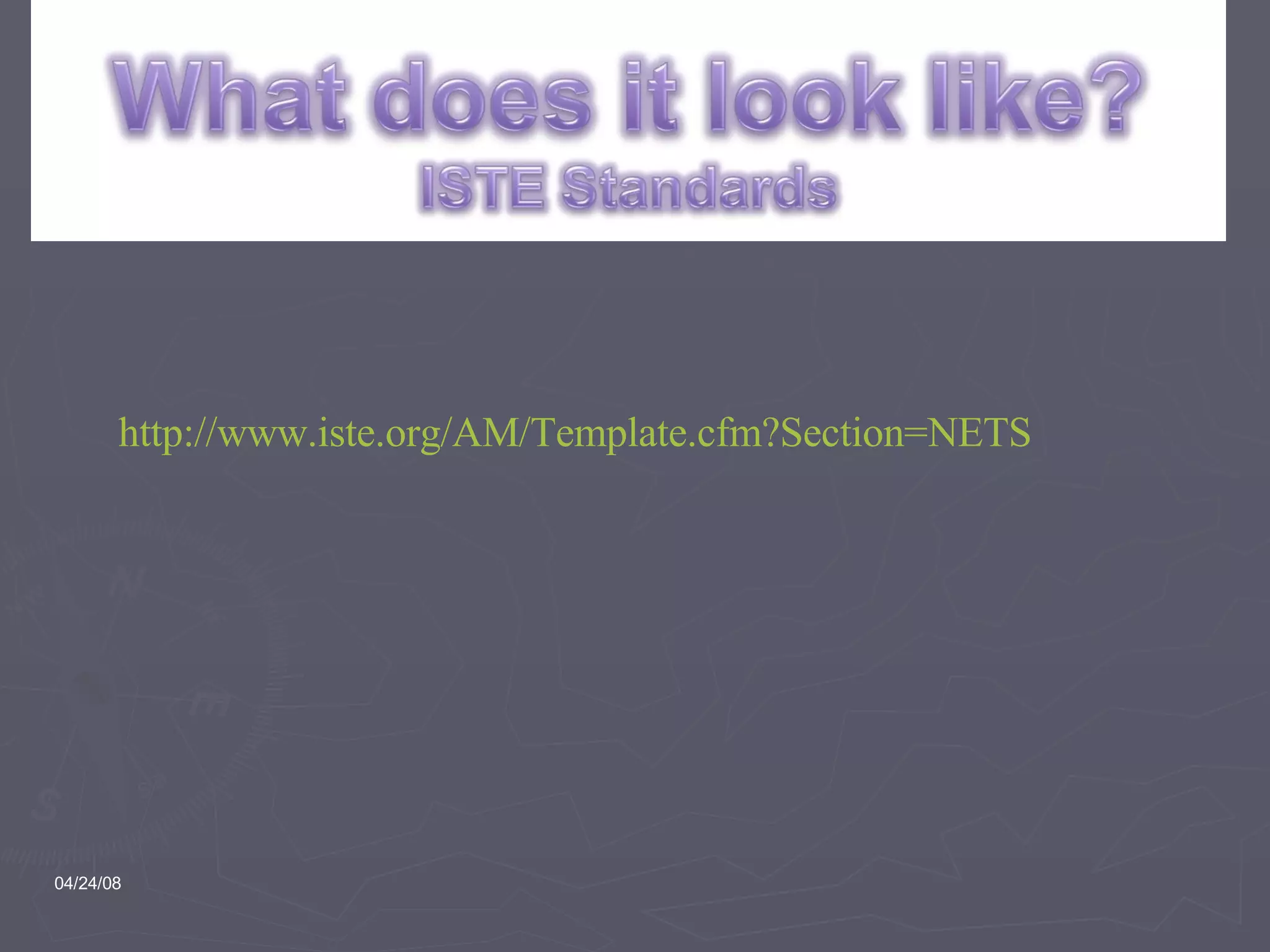
06/02/09 http://www.iste.org/AM/Template.cfm?Section=NETS
The Curriculum Twenty-first century curriculum has certain critical attributes.   It is interdisciplinary, project-based, and research-driven.  It is connected to the community – local, state, national and global.  Sometimes students are collaborating with people around the world in various projects.  The curriculum incorporates higher order thinking skills, multiple intelligences, technology and multimedia, the multiple literacy's of the 21st century, and authentic assessments.   Service learning is an important component.   06/02/09
The Curriculum (Cont’d) The classroom is expanded to include the greater community.   Students are self-directed, and work both independently and interdependently.   The curriculum and instruction are designed to challenge all students, and provides for differentiation.   06/02/09
The Curriculum (Cont’d) The curriculum is not textbook-driven or fragmented, but is thematic, project-based and integrated.    Skills and content are not taught as an end in themselves, but students learn them through their research and application in their projects.   Textbooks, if they have them, are just one of many resources.   06/02/09
The Curriculum (Cont’d) Knowledge is not memorization of facts and figures, but is constructed through research and application, and connected to previous knowledge and personal experience.   The skills and content become relevant and needed as students require this information to complete their projects.   The content and basic skills are applied within the context of the curriculum, and are not ends in themselves.   06/02/09
Curriculum (Cont’d) Assessment moves from regurgitation of memorized facts and disconnected processes to demonstration of understanding through application in a variety of contexts.   Real-world audiences are an important part of the assessment process, as is self-assessment.   06/02/09
So What Does this Mean for Teachers and Schools?
Being Literate Today Means… Finding the information Processing different media Decoding the information Analyzing the information Critically evaluating the information Organizing it into personal digital libraries Creating information in a variety of media Teaching the information to find the user Filtering the information gleaned
Establishing New Learning Environments Traditional Learning New Learning Teacher-Centered  Student Centered Single Media Multimedia Isolated work Collaborative Work Passive learning Active/exploratory Factual, knowledge Critical thinking  Based learning Informed decision Isolated Context Authentic/Real World 06/02/09
          Aliteracy Poem   Mrs. Thompson's second graders are amazing!  The principal says they can comprehend anything-- Even a medical textbook. Mrs. Thompson's second graders are incredible!  The superintendent says their oral reading is completely seamless-- Like the gentle flow of an eternal spring. Mrs. Thompson's second graders are fantastic! The PTA president says they finished the reading workbook and the  phonics workbook before the end of the Third Quarter.  Mrs. Thompson's second graders worry me. Po You see, I'm the aide who works in Mrs. Thompson's classroom, And I know something that others don't. Mrs. Thompson's second graders don't like to read. Poetry for Literacy Teachers from "Life's Literacy Lessons" by Steven L. Layne. Newark, DE: International Reading Association. 2001
Putting it into practice.
“ If you are not prepared to be wrong, you’ll never come up with anything original.  By the time students become adults they have lost that capacity. And national education systems are where mistakes are the worst things you can make.  The result is we are educating people out of their creative capacities. ”  - Sir Ken Robinson
Where do I Start?
Web 2.0 What is Web 2.0?   There are various definitions of Web 2.0.  Basically, it is not a new technology, but a new interactive use of the technology that exists.  (also known as the read/write Web)   06/02/09
Web 2.0 "Web 2.0 is social, it’s open (or at least it should be), it’s letting go of control over your data, it’s mixing the global with the local. Web 2.0 is about new interfaces - new ways of searching and accessing Web content. And last but not least, Web 2.0 is a platform - and not just for developers to create web applications like  Gmail   and  Flickr . The Web is a platform to build on for educators, media, politics, community, for virtually everyone in fact! 06/02/09
What is Web 2.0 06/02/09
Web 2.0 Back to School with the Class of Web 2.0 06/02/09
Tools of the Trade Online Collaborations Blogs Wikis Google Docs/Spreadsheets Skype Flickr Digital Storytelling Photostory 3 Movie Maker 2 Adobe Premiere Elements/iMovie Audacity Freeplay Music
Tools of the Trade Google Earth Podcasts  VoiceThread Slideshare NewsMap Toondoo Surveys http://www.rossdawsonblog.com/Web2_framework_p3.jpg
More Tools of the Trade YouTube Wetpaint Skype TalkShoe WordReference Google Products Conjugemos Quizlet VoiceThread Scribd 06/02/09 ChinSwing Curriki Instacalc Bitstrips Delicious Netvibes SketchCast Flickr SlideShare Twitter   Grazr Facebook Zentation ConvinceMe CLEAR
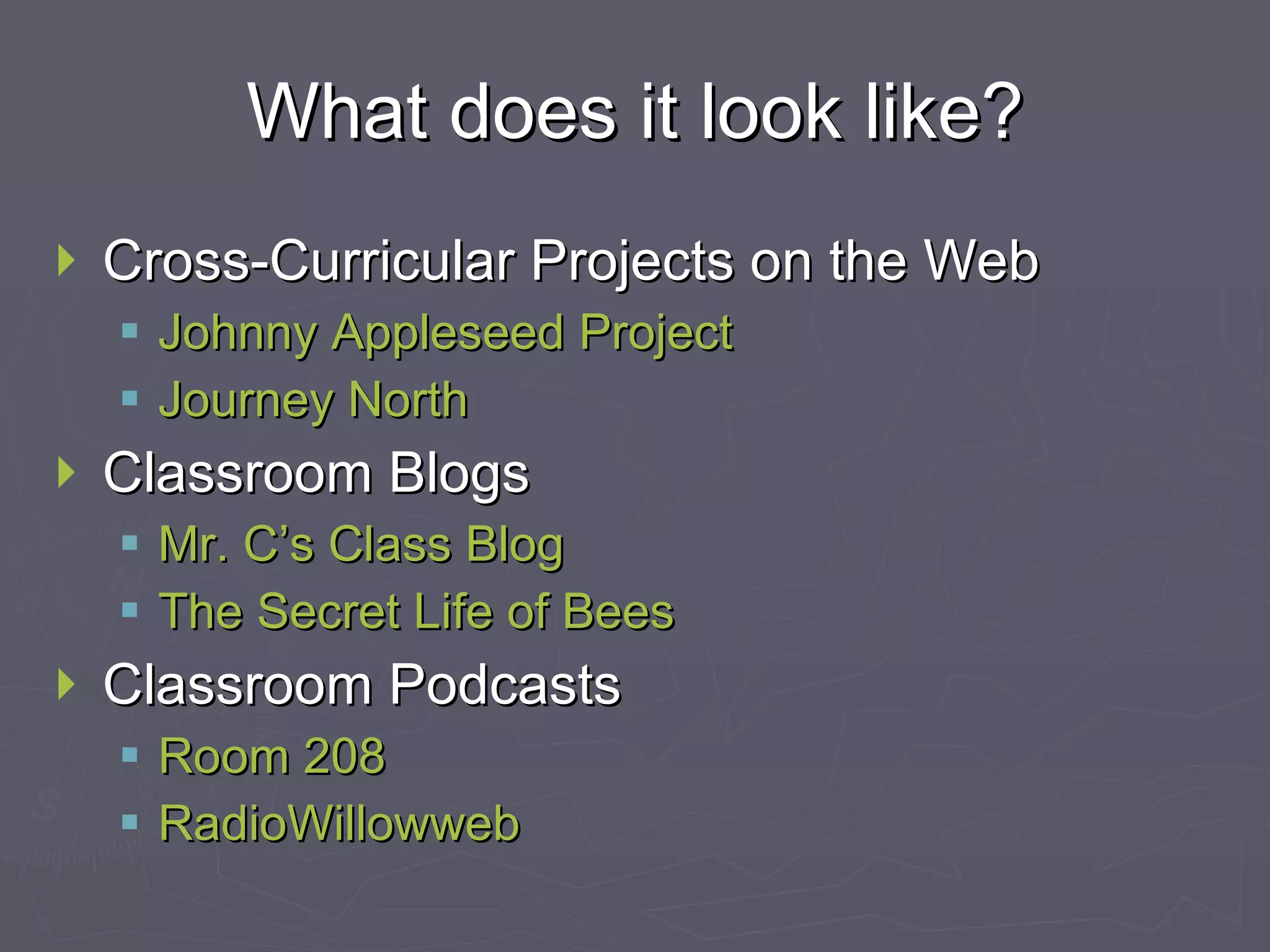
What does it look like? Cross-Curricular Projects on the Web Johnny Appleseed Project Journey North Classroom Blogs Mr. C’s Class Blog The Secret Life of Bees Classroom Podcasts Room 208 RadioWillowweb
Example: Using 21 st  Century Skills in Real Life Situations   http://www.edutopia.org/clearfield-high-school-technology-video
Expeditionary Learning http://www.elschools.org/ http://www.elschools.org/publications/webarchive/index.html   Expeditionary Learning Schools Outward Bound (ELS)   is a comprehensive K-12 educational design. Our approach combines rigorous academic content and real world projects -- learning expeditions -- with active teaching and community service. The ELS design focuses on teaching in an engaging way. Faculty members receive intensive professional development in curriculum, teaching practices, and building a strong school culture. Expeditionary Learning is now being implemented in over 140 urban, rural, and suburban schools. 06/02/09
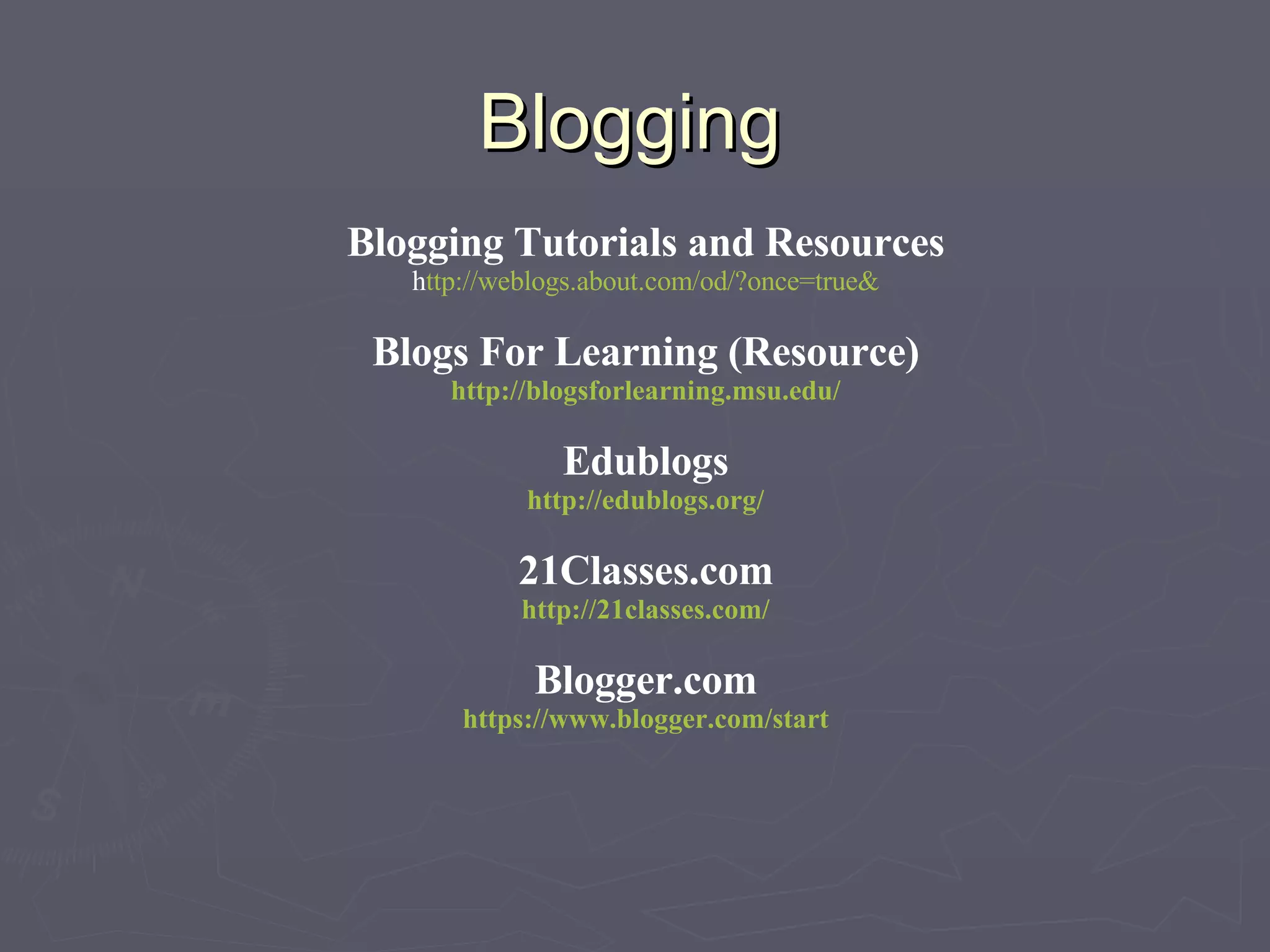
Blogging Blogging Tutorials and Resources h ttp://weblogs.about.com/od/?once=true& Blogs For Learning (Resource) http://blogsforlearning.msu.edu/ Edublogs http://edublogs.org/ 21Classes.com http://21classes.com/ Blogger.com https://www.blogger.com/start
Wiki’s Wiki Matrix: Compare Them All http://www.wikimatrix.org/ Teachers First: Wiki Walk Through This site is especially made for teachers. They cover: What is a Wiki; Who Uses Wikis; How to Use a Wiki in the Classroom; and What is the Difference Between a Wiki and a Blog. http://www.teachersfirst.com/content/wiki/ Wikispaces.com Create simple web pages that groups, friends, & families can edit together. Easy to use and very popular wiki site. http://wikispaces.com
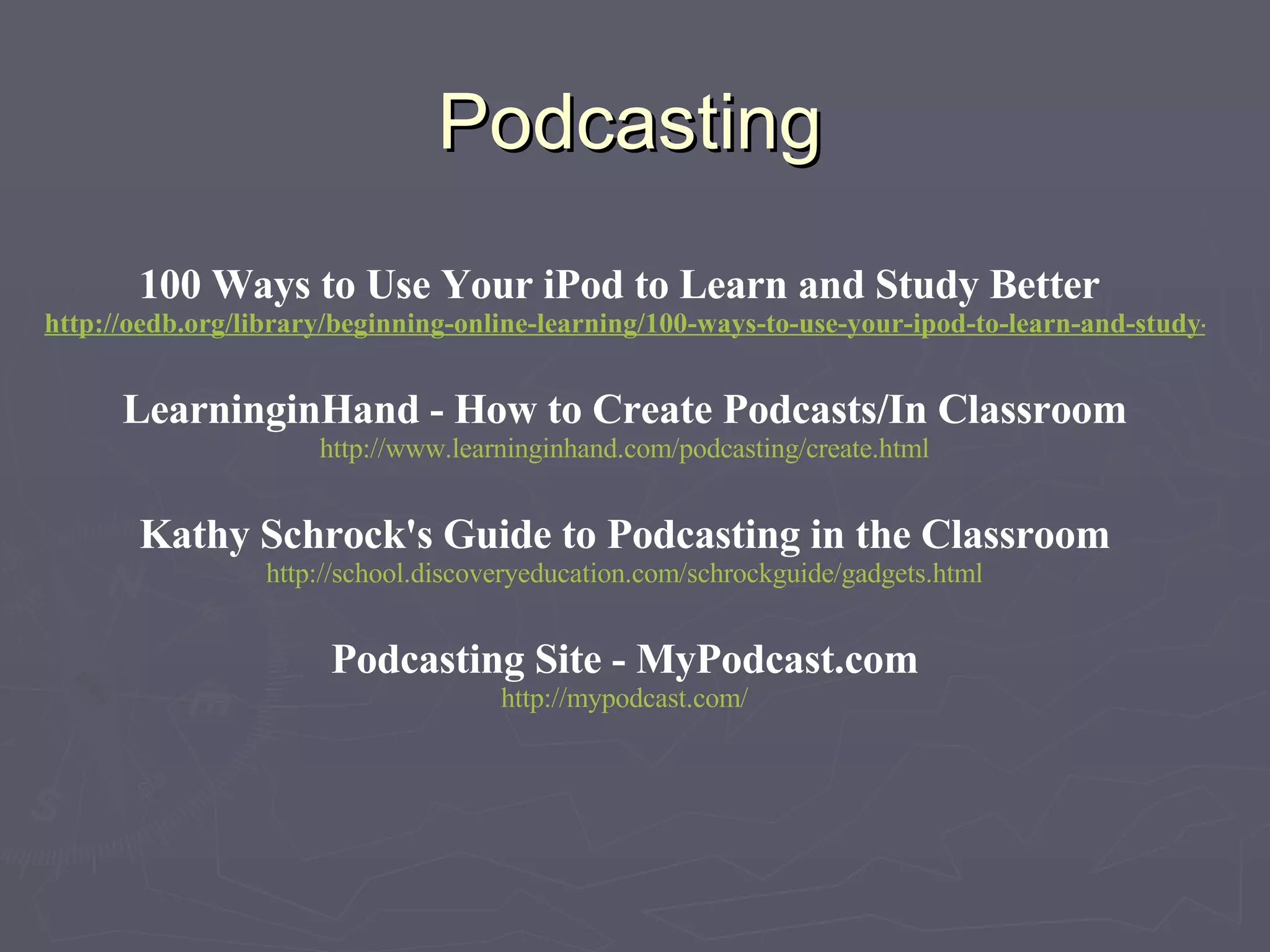
Podcasting 100 Ways to Use Your iPod to Learn and Study Better  http://oedb.org/library/beginning-online-learning/100-ways-to-use-your-ipod-to-learn-and-study-better LearninginHand - How to Create Podcasts/In Classroom http://www.learninginhand.com/podcasting/create.html Kathy Schrock's Guide to Podcasting in the Classroom http://school.discoveryeducation.com/schrockguide/gadgets.html Podcasting Site - MyPodcast.com http://mypodcast.com/
http://www.kn.att.com/wired/21stcent/
http://www.dell.com/content/topics/global.aspx/services/tnc/tnc_integration?c=us&cs=RC957063&l=en&s=k12   Dell Academy
http://www.21stcenturyschools.com/ 21 st  Century Schools
06/02/09
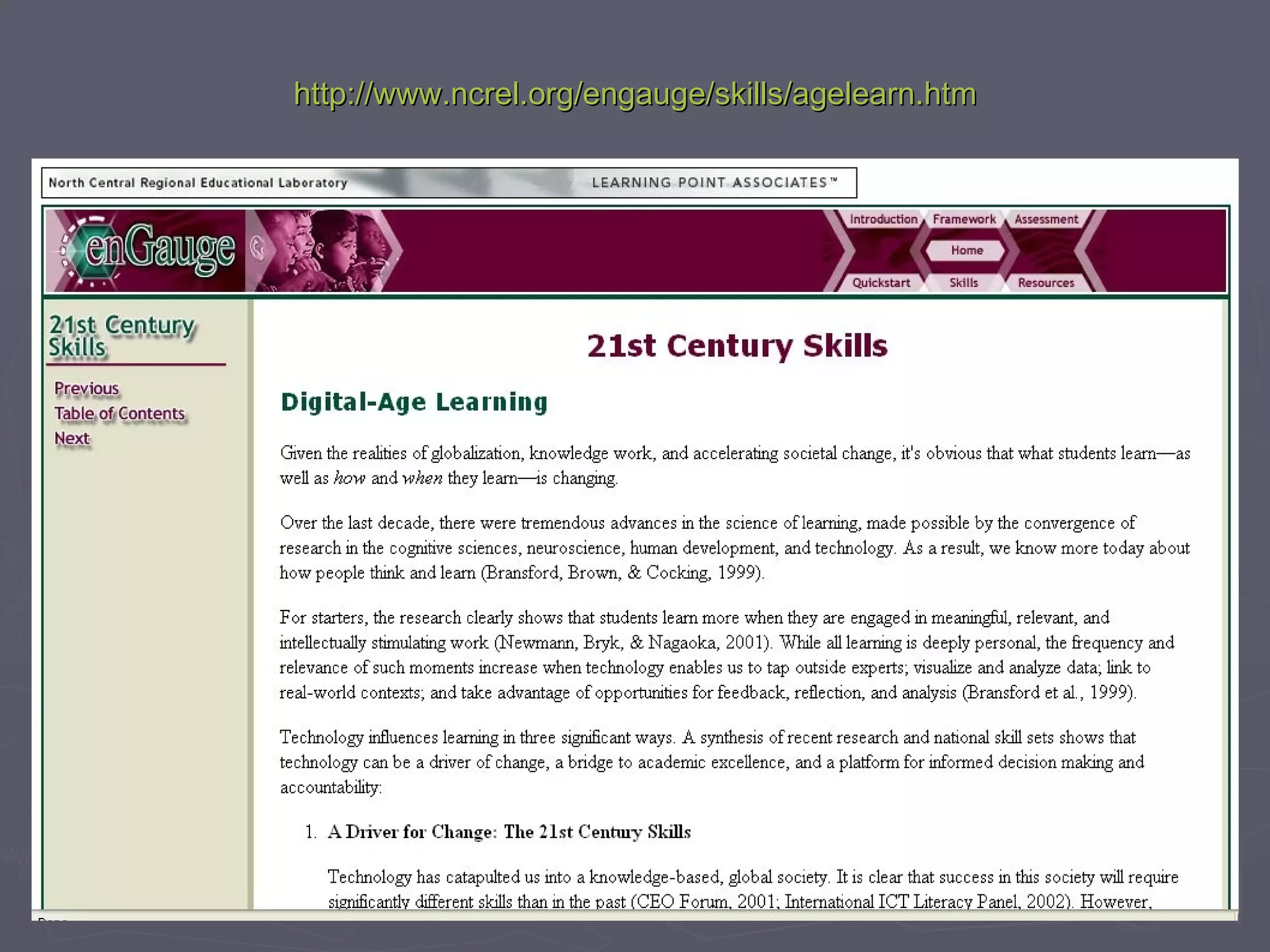
http://www.ncrel.org/engauge/skills/agelearn.htm
ePals http://www.epals.com/
M. U. V. E’s Multi-User Virtual Environments Second Life Active Worlds Club Penguin Webkins Phillip Long, Associate Director, Office of Educational Innovation and technology, MIT stated that by 2011, 80% of the population will have a avatar and virtual world. 06/02/09
http://muve.gse.harvard.edu/rivercityproject/ River City Project
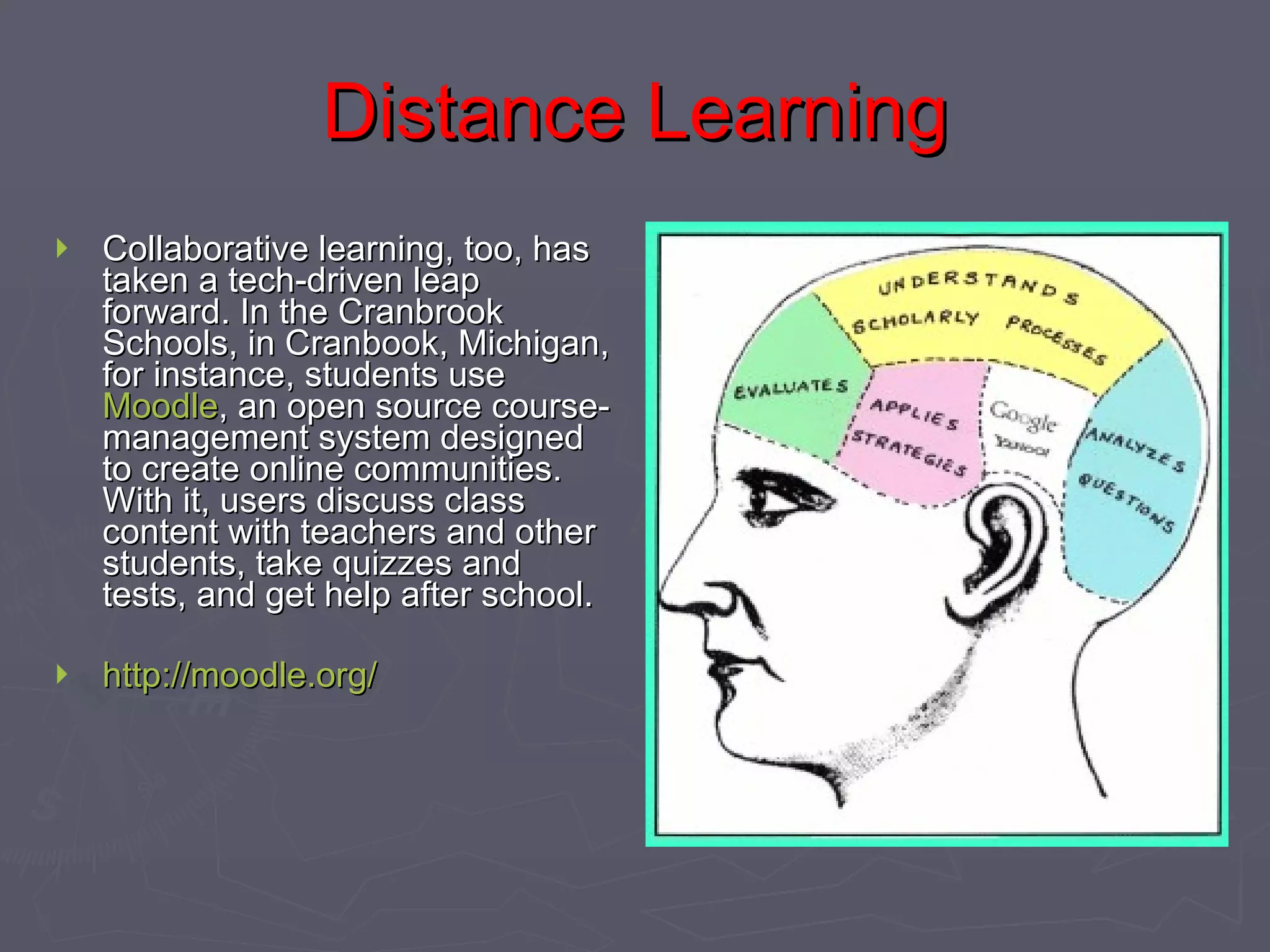
Distance Learning Collaborative learning, too, has taken a tech-driven leap forward. In the Cranbrook Schools, in Cranbook, Michigan, for instance, students use  Moodle , an open source course-management system designed to create online communities. With it, users discuss class content with teachers and other students, take quizzes and tests, and get help after school.  http://moodle.org/
How can I help my school? How to Bring Our Schools Out of the 20 th  Century There's a dark little joke exchanged by educators with a dissident streak: Rip Van Winkle awakens in the 21st century after a hundred-year snooze and is, of course, utterly bewildered by what he sees. Men and women dash about, talking to small metal devices pinned to their ears. Young people sit at home on sofas, moving miniature athletes around on electronic screens. Older folk defy death and disability with metronomes in their chests and with hips made of metal and plastic. Airports, hospitals, shopping malls--every place Rip goes just baffles him. But when he finally walks into a schoolroom, the old man knows exactly where he is. "This is a school," he declares. "We used to have these back in 1906. Only now the blackboards are green."
Some good reads… Blogs 2 Cents Worth – David Warlick Teach42 – Steve Dembo The Strength of Weak Ties – David Jakes Moving at the Speed of Creativity – Wes Fryer Weblogg-ed – Will Richardson Dangerously Irrelevant – Scott McLeod Beth’s Thoughts on Technology in the Classroom – Beth Knittle Books Tested  – Linda Perlstein Don’t Bother Me Mom—I’m Learning!  – Marc Prensky A Whole New Mind  – Daniel Pink The World is Flat  – Thomas Friedman What Video Games Have to Teach us About Literacy and Learning  – James Paul Gee
What Will You Do to Make A Difference?
http://www.evalutech.sreb.org/21stcentury/21st_century.pdf
What will the future hold? Future Forces Affecting Education
Raising Small Souls Raising Small Souls Video  06/02/09
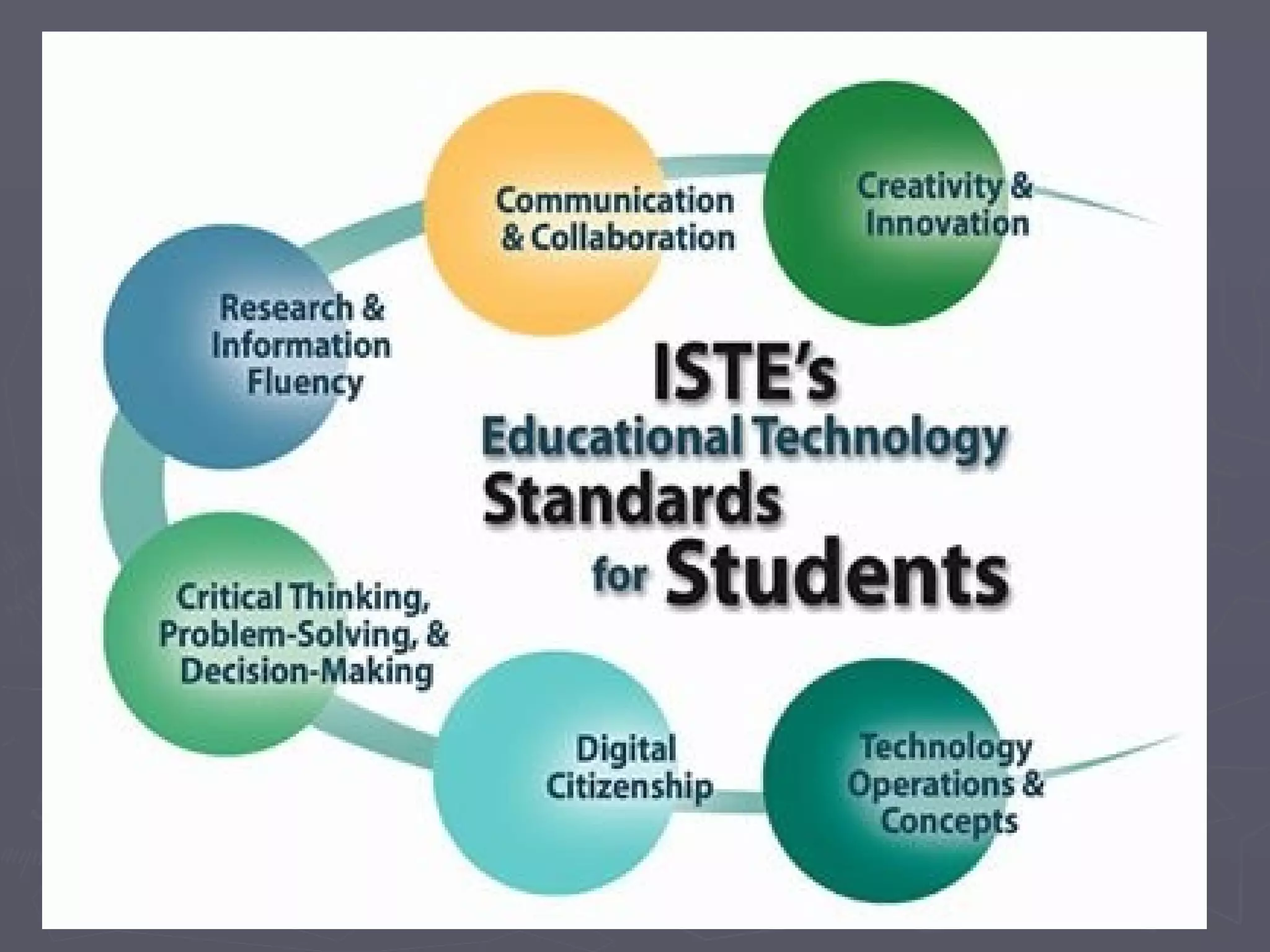
Resources http://www.21stcenturyskills.org/route21/ http://21stcenturyskills.org/documents/P21_pollreport_singlepg.pdf http://www.edutopia.org/magazine/feb08 http://blog.discoveryeducation.com/pennsylvania/2007/11/19/21st-century-learning/ http://www.ncrel.org/sdrs/areas/issues/methods/technlgy/te800.htm http://www.ncrel.org/engauge/skills/agelearn.htm http://www.21stcenturyskills.org/ http://www.techlearning.com/blog/2007/12/a_model_for_permeable_classroo.php   http://teachdigital.pbwiki.com/lead http://www.evalutech.sreb.org/21stcentury/21st_century.pdf http://www.evalutech.sreb.org/21stcentury/index.asp   International Center for Leadership in Education - Dr. Willard Daggett 21 st  Century Teaching for 21 st  Century Students – Brad Fountain, Discovery Education

21st Century Presentation

  • 1.
    Education in Americaby Darlene Westinghouse 06/02/09
  • 2.
    What are ourgoals? Improve Achievement Prepare students for the real world Prepare students for this generation Create learning environments that engage this generation and help them reach their full potential Equip students with the skills and knowledge they need to be competitive in a global, information-based economy 06/02/09 Daggett
  • 3.
    Ask these questions:06/02/09 WHY do we need change? WHAT needs to be done? HOW do we do it?
  • 4.
    W H Y? 06/02/09
  • 5.
    Nano-Technology 06/02/09 CentralProcessing Unit - 8 MB Memory
  • 6.
    Advancements 06/02/09 Chipsare now 1/1000 of a human hair in size.
  • 7.
  • 8.
    Bioinformatics 06/02/09 Combinesinformation systems and the life sciences. For example, it can interlock the binary code of information systems with a genetic code.
  • 9.
    Other Bioinformatic alterations06/02/09 In Japan, farmers have produced square watermelons to make them easier and more economical to pack and ship. In two years we will be able to take a DNA test at a pharmacy to reveal predispositions to over 4000 diseases.
  • 10.
    06/02/09 It isestimated that in the next four years, technology advancements will increase more than in all of mankind. 80% of jobs in 2010 do not exist today (US Dept. of Labor) Other countries are working hard, moving fast and using technology to accelerate progress.
  • 11.
    Foreign Scholars PhysicalScience 43% Mathematics 42% Computer Science 46% Physics 36% Engineering Science 56% 06/02/09
  • 12.
    Other Cultures KoreaLittle time reading newspapers or watching TV. Life moves at the speed of the net and being connected is the only way to remain current Japan Laptops are viewed as dinosauric technology. The cell phone provides the privacy and instant connectivity individuals crave
  • 13.
  • 14.
    Two Million MinutesDocumentary 06/02/09
  • 15.
    06/02/09 “ Americansociety needs to both leverage and keep pace with emerging computer technologies. Our well-being as a nation depends on our willingness to invest in education and research that will prepare today’s K-12 students to be leaders in the field.” w ww.businessweek.com/magazine/content05_16/b3929120_mz018.htm Education Trends
  • 16.
    06/02/09 “ Educationis the only business still debating the usefulness of technology. Schools remain unchanged for the most part, despite numerous reforms and increased investments in computers and networks.” U.S. Secretary of Education Rod Paige
  • 17.
  • 18.
    “ This isa story about the big public conversation the nation is not having about education… whether an entire generation of kids will fail to make the grade in the global economy because they can’t think their way through abstract problems, work in teams, distinguish good information from bad, or speak a language other than English.” How to Build a Student for the 21 st Century, TIME Magazine, December 18, 2006 http://www.time.com/time/printout/0,8816,1568480,00.html
  • 19.
    Full Report: http://21stcenturyskills.org/documents/P21_pollreport_singlepg.pdf
  • 20.
  • 21.
  • 22.
  • 23.
    What Are 21st Century Students Missing? Critical Thinking Reflection Evaluation Linear Processing Personal Communication Meaningful Persistence Formal processes
  • 24.
  • 25.
    Workforce Survey: “Are They Really Ready to Work?” Why 21 st Century Skills? Released October 2, 2006, by The Conference Board, Corporate Voices for Working Families, Partnership for 21 st Century Skills, and the Society for Human Resource Management groups.
  • 26.
    Why 21 st Century Skills? What skills are most important for job success when hiring a High School graduate? Work Ethic 80% Collaboration 75% Good Communication 70% Social Responsibility 63% Critical Thinking & Problem Solving 58%
  • 27.
    Why 21 st Century Skills? Of the High School Students that you recently hired, what were their deficiencies? Written Communication 81% Leadership 73% Work Ethic 70% Critical Thinking & Problem Solving 70% Self-Direction 58%
  • 28.
    Why 21 st Century Skills? What applied skills and basic knowledge are most important for those you will hire with a four-year college diploma? Oral Communication 95.4% Collaboration 94.4% Professional/Work Ethic 93.8% Written Communication 93.1% Critical Thinking/Problem Solving 93.1%
  • 29.
    Why 21 st Century Skills? What skills and content areas will be growing in importance in the next five years? Critical Thinking 78% I.T. 77% Health & Wellness 76% Collaboration 74% Innovation 74% Personal Financial Responsibility 72%
  • 30.
    WHAT needs tobe done and HOW ? 06/02/09
  • 31.
    “ The illiterateof the 21st century will not be those who cannot read and write, but those who cannot learn, unlearn, and relearn. ” - Alvin Toffler
  • 32.
    A research-based synthesisconsisting of 30 years of educational research indicates: participation in social practice is a fundamental form of learning learning is increased by a diversity of cultural experience and community participation Brown, Ann L, Cocking, Rodney R & Bransford , John D. How People Learn: Brain, Mind, Experience, and School . Washington: National Academies Press, 2000. How People Learn
  • 33.
    Who are 21st Century Learners? As large in number as Baby Boomers Consumers- $150 billion annually Digital Media Users – 6 ½ hrs daily (Exposed to 8 ½ hours) Multi-taskers: online - phone - print Hyper-Communicators -socially & civically Gamers-interactive learning Risk-Takers Depersonalization Pursuers of ongoing education Futurists & Optimistic IQ is up by 17 points between 1947-2001 with most gains post 1972
  • 34.
    Are They REALLYThat Different? 21 st Century Student’s Brain Neuroplasticity 50 hours to affect change Video games Hypertext Minds Point to Point vs. Linear Breadth vs. Depth Environmental Impact Thinking Patterns ADD or Disengaged Marc Prensky – Digital Natives, Digital Immigrants Part 2
  • 35.
    Are They REALLYThat Different?
  • 36.
    Who are 21st Century Learners? Portable Game Device Cell Phone Computer Video Game Console MP3 Player/iPods Top Five Gifts for Teenagers Source: Starkman, Neal (2007).Leave Me Alone.... T.H.E. Journal. 33-38.
  • 37.
    Four week periodending June 24, 2006 23,696 searches sent traffic to video sites Four week period ending June 23, 2007 110,775 searches sent traffic to video sites -John Seely Brown Search Engines moving toward video Hitwise, Phil Butler, profy.com YouTube other sites
  • 38.
  • 39.
  • 40.
    The Curriculum Twenty-firstcentury curriculum has certain critical attributes.  It is interdisciplinary, project-based, and research-driven.  It is connected to the community – local, state, national and global.  Sometimes students are collaborating with people around the world in various projects.  The curriculum incorporates higher order thinking skills, multiple intelligences, technology and multimedia, the multiple literacy's of the 21st century, and authentic assessments.  Service learning is an important component.  06/02/09
  • 41.
    The Curriculum (Cont’d)The classroom is expanded to include the greater community.  Students are self-directed, and work both independently and interdependently.  The curriculum and instruction are designed to challenge all students, and provides for differentiation.  06/02/09
  • 42.
    The Curriculum (Cont’d)The curriculum is not textbook-driven or fragmented, but is thematic, project-based and integrated.   Skills and content are not taught as an end in themselves, but students learn them through their research and application in their projects.  Textbooks, if they have them, are just one of many resources.  06/02/09
  • 43.
    The Curriculum (Cont’d)Knowledge is not memorization of facts and figures, but is constructed through research and application, and connected to previous knowledge and personal experience.  The skills and content become relevant and needed as students require this information to complete their projects.  The content and basic skills are applied within the context of the curriculum, and are not ends in themselves.  06/02/09
  • 44.
    Curriculum (Cont’d) Assessmentmoves from regurgitation of memorized facts and disconnected processes to demonstration of understanding through application in a variety of contexts.  Real-world audiences are an important part of the assessment process, as is self-assessment.  06/02/09
  • 45.
    So What Doesthis Mean for Teachers and Schools?
  • 46.
    Being Literate TodayMeans… Finding the information Processing different media Decoding the information Analyzing the information Critically evaluating the information Organizing it into personal digital libraries Creating information in a variety of media Teaching the information to find the user Filtering the information gleaned
  • 47.
    Establishing New LearningEnvironments Traditional Learning New Learning Teacher-Centered Student Centered Single Media Multimedia Isolated work Collaborative Work Passive learning Active/exploratory Factual, knowledge Critical thinking Based learning Informed decision Isolated Context Authentic/Real World 06/02/09
  • 48.
             AliteracyPoem Mrs. Thompson's second graders are amazing!  The principal says they can comprehend anything-- Even a medical textbook. Mrs. Thompson's second graders are incredible!  The superintendent says their oral reading is completely seamless-- Like the gentle flow of an eternal spring. Mrs. Thompson's second graders are fantastic! The PTA president says they finished the reading workbook and the phonics workbook before the end of the Third Quarter.  Mrs. Thompson's second graders worry me. Po You see, I'm the aide who works in Mrs. Thompson's classroom, And I know something that others don't. Mrs. Thompson's second graders don't like to read. Poetry for Literacy Teachers from "Life's Literacy Lessons" by Steven L. Layne. Newark, DE: International Reading Association. 2001
  • 49.
    Putting it intopractice.
  • 50.
    “ If youare not prepared to be wrong, you’ll never come up with anything original. By the time students become adults they have lost that capacity. And national education systems are where mistakes are the worst things you can make. The result is we are educating people out of their creative capacities. ” - Sir Ken Robinson
  • 51.
    Where do IStart?
  • 52.
    Web 2.0 Whatis Web 2.0?   There are various definitions of Web 2.0.  Basically, it is not a new technology, but a new interactive use of the technology that exists. (also known as the read/write Web)   06/02/09
  • 53.
    Web 2.0 "Web2.0 is social, it’s open (or at least it should be), it’s letting go of control over your data, it’s mixing the global with the local. Web 2.0 is about new interfaces - new ways of searching and accessing Web content. And last but not least, Web 2.0 is a platform - and not just for developers to create web applications like Gmail   and Flickr . The Web is a platform to build on for educators, media, politics, community, for virtually everyone in fact! 06/02/09
  • 54.
    What is Web2.0 06/02/09
  • 55.
    Web 2.0 Backto School with the Class of Web 2.0 06/02/09
  • 56.
    Tools of theTrade Online Collaborations Blogs Wikis Google Docs/Spreadsheets Skype Flickr Digital Storytelling Photostory 3 Movie Maker 2 Adobe Premiere Elements/iMovie Audacity Freeplay Music
  • 57.
    Tools of theTrade Google Earth Podcasts VoiceThread Slideshare NewsMap Toondoo Surveys http://www.rossdawsonblog.com/Web2_framework_p3.jpg
  • 58.
    More Tools ofthe Trade YouTube Wetpaint Skype TalkShoe WordReference Google Products Conjugemos Quizlet VoiceThread Scribd 06/02/09 ChinSwing Curriki Instacalc Bitstrips Delicious Netvibes SketchCast Flickr SlideShare Twitter Grazr Facebook Zentation ConvinceMe CLEAR
  • 59.
    What does itlook like? Cross-Curricular Projects on the Web Johnny Appleseed Project Journey North Classroom Blogs Mr. C’s Class Blog The Secret Life of Bees Classroom Podcasts Room 208 RadioWillowweb
  • 60.
    Example: Using 21st Century Skills in Real Life Situations http://www.edutopia.org/clearfield-high-school-technology-video
  • 61.
    Expeditionary Learning http://www.elschools.org/http://www.elschools.org/publications/webarchive/index.html Expeditionary Learning Schools Outward Bound (ELS) is a comprehensive K-12 educational design. Our approach combines rigorous academic content and real world projects -- learning expeditions -- with active teaching and community service. The ELS design focuses on teaching in an engaging way. Faculty members receive intensive professional development in curriculum, teaching practices, and building a strong school culture. Expeditionary Learning is now being implemented in over 140 urban, rural, and suburban schools. 06/02/09
  • 62.
    Blogging Blogging Tutorialsand Resources h ttp://weblogs.about.com/od/?once=true& Blogs For Learning (Resource) http://blogsforlearning.msu.edu/ Edublogs http://edublogs.org/ 21Classes.com http://21classes.com/ Blogger.com https://www.blogger.com/start
  • 63.
    Wiki’s Wiki Matrix:Compare Them All http://www.wikimatrix.org/ Teachers First: Wiki Walk Through This site is especially made for teachers. They cover: What is a Wiki; Who Uses Wikis; How to Use a Wiki in the Classroom; and What is the Difference Between a Wiki and a Blog. http://www.teachersfirst.com/content/wiki/ Wikispaces.com Create simple web pages that groups, friends, & families can edit together. Easy to use and very popular wiki site. http://wikispaces.com
  • 64.
    Podcasting 100 Waysto Use Your iPod to Learn and Study Better http://oedb.org/library/beginning-online-learning/100-ways-to-use-your-ipod-to-learn-and-study-better LearninginHand - How to Create Podcasts/In Classroom http://www.learninginhand.com/podcasting/create.html Kathy Schrock's Guide to Podcasting in the Classroom http://school.discoveryeducation.com/schrockguide/gadgets.html Podcasting Site - MyPodcast.com http://mypodcast.com/
  • 65.
  • 66.
  • 67.
  • 68.
  • 69.
  • 70.
  • 71.
    M. U. V.E’s Multi-User Virtual Environments Second Life Active Worlds Club Penguin Webkins Phillip Long, Associate Director, Office of Educational Innovation and technology, MIT stated that by 2011, 80% of the population will have a avatar and virtual world. 06/02/09
  • 72.
  • 73.
    Distance Learning Collaborativelearning, too, has taken a tech-driven leap forward. In the Cranbrook Schools, in Cranbook, Michigan, for instance, students use Moodle , an open source course-management system designed to create online communities. With it, users discuss class content with teachers and other students, take quizzes and tests, and get help after school. http://moodle.org/
  • 74.
    How can Ihelp my school? How to Bring Our Schools Out of the 20 th Century There's a dark little joke exchanged by educators with a dissident streak: Rip Van Winkle awakens in the 21st century after a hundred-year snooze and is, of course, utterly bewildered by what he sees. Men and women dash about, talking to small metal devices pinned to their ears. Young people sit at home on sofas, moving miniature athletes around on electronic screens. Older folk defy death and disability with metronomes in their chests and with hips made of metal and plastic. Airports, hospitals, shopping malls--every place Rip goes just baffles him. But when he finally walks into a schoolroom, the old man knows exactly where he is. "This is a school," he declares. "We used to have these back in 1906. Only now the blackboards are green."
  • 75.
    Some good reads…Blogs 2 Cents Worth – David Warlick Teach42 – Steve Dembo The Strength of Weak Ties – David Jakes Moving at the Speed of Creativity – Wes Fryer Weblogg-ed – Will Richardson Dangerously Irrelevant – Scott McLeod Beth’s Thoughts on Technology in the Classroom – Beth Knittle Books Tested – Linda Perlstein Don’t Bother Me Mom—I’m Learning! – Marc Prensky A Whole New Mind – Daniel Pink The World is Flat – Thomas Friedman What Video Games Have to Teach us About Literacy and Learning – James Paul Gee
  • 76.
    What Will YouDo to Make A Difference?
  • 77.
  • 78.
    What will thefuture hold? Future Forces Affecting Education
  • 79.
    Raising Small SoulsRaising Small Souls Video 06/02/09
  • 80.
    Resources http://www.21stcenturyskills.org/route21/ http://21stcenturyskills.org/documents/P21_pollreport_singlepg.pdfhttp://www.edutopia.org/magazine/feb08 http://blog.discoveryeducation.com/pennsylvania/2007/11/19/21st-century-learning/ http://www.ncrel.org/sdrs/areas/issues/methods/technlgy/te800.htm http://www.ncrel.org/engauge/skills/agelearn.htm http://www.21stcenturyskills.org/ http://www.techlearning.com/blog/2007/12/a_model_for_permeable_classroo.php http://teachdigital.pbwiki.com/lead http://www.evalutech.sreb.org/21stcentury/21st_century.pdf http://www.evalutech.sreb.org/21stcentury/index.asp International Center for Leadership in Education - Dr. Willard Daggett 21 st Century Teaching for 21 st Century Students – Brad Fountain, Discovery Education

Editor's Notes

  • #2 06/02/09 I feel passionately about technology in education. My goal today is to present to you information that will give you vision of the changing face of education in America, where we need to go, and what we need to do to take education into the 21st Century.