Technology for 21 st  Century Learning LINDA BRUNING SEPTEMBER 26, 2011 DISTRICT SCHOOL BOARD MEETING
Menu Twenty First Century Skills What Lies Ahead What is Digital Age Literacy Inventive Thinking-Intellectual Capitol Communication Effective Problem Solving and Results Management 21 st  Century Skills What Do We Do Getting There From Here Bibliography
Twenty First Century Skills Digital Age Literacy Inventive Thinking-Intellectual Capitol “ In the New Economy, knowledge, rather than natural resources, is the raw material of business.” — Center for Regional Studies, 2002
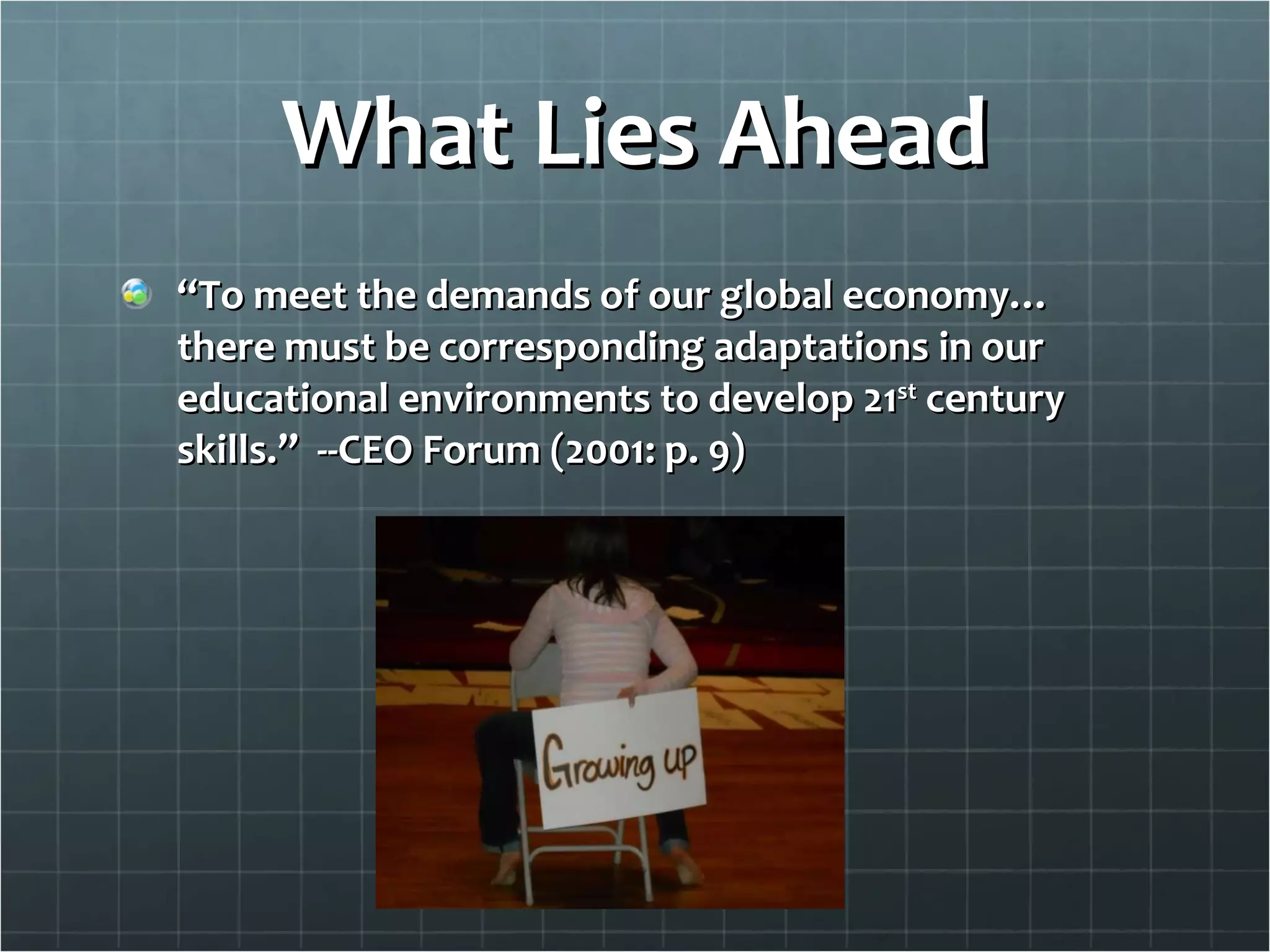
What Lies Ahead “ To meet the demands of our global economy…there must be corresponding adaptations in our educational environments to develop 21 st  century skills.”  --CEO Forum (2001: p. 9)
What is Digital Age Literacy Basic, Scientific & Technological Literacy  (Read, Write and Solve Math and Science Problems) Visual and Informational Literacy (Use Visual and Digital Graphics and Access Information Quickly and Accurately) Cultural and Global Awareness  (Globalization Demands Cultural Awareness) <iframe width=&quot;420&quot; height=&quot;315&quot; src=&quot;http://www.youtube.com/embed/Wn0_H-kvxkU&quot; frameborder=&quot;0&quot; allowfullscreen></iframe> What it Means to be Literate in the 21 st  Century - uTube
Inventive Thinking – Intellectual Capitol Adaptable, Can Manage Complexity, Self Directed Can Multi-Task,  React Quickly to Rapidly Changing Situations,  Can Work Independently Creative Thinking and Risk Taking Inventive, Out of the Box,  Willing  to Experiment, Higher Order Thinking and Reasoning Plan, Design, Execute and Evaluate <iframe width=&quot;560&quot; height=&quot;315&quot; src=&quot;http://www.youtube.com/embed/2s6PIrXwt7M&quot; frameborder=&quot;0&quot; allowfullscreen></iframe> 21 st  Century Skills in Action – Critical Thinking, Creative Thinking and Problem Solving  - UTUBE
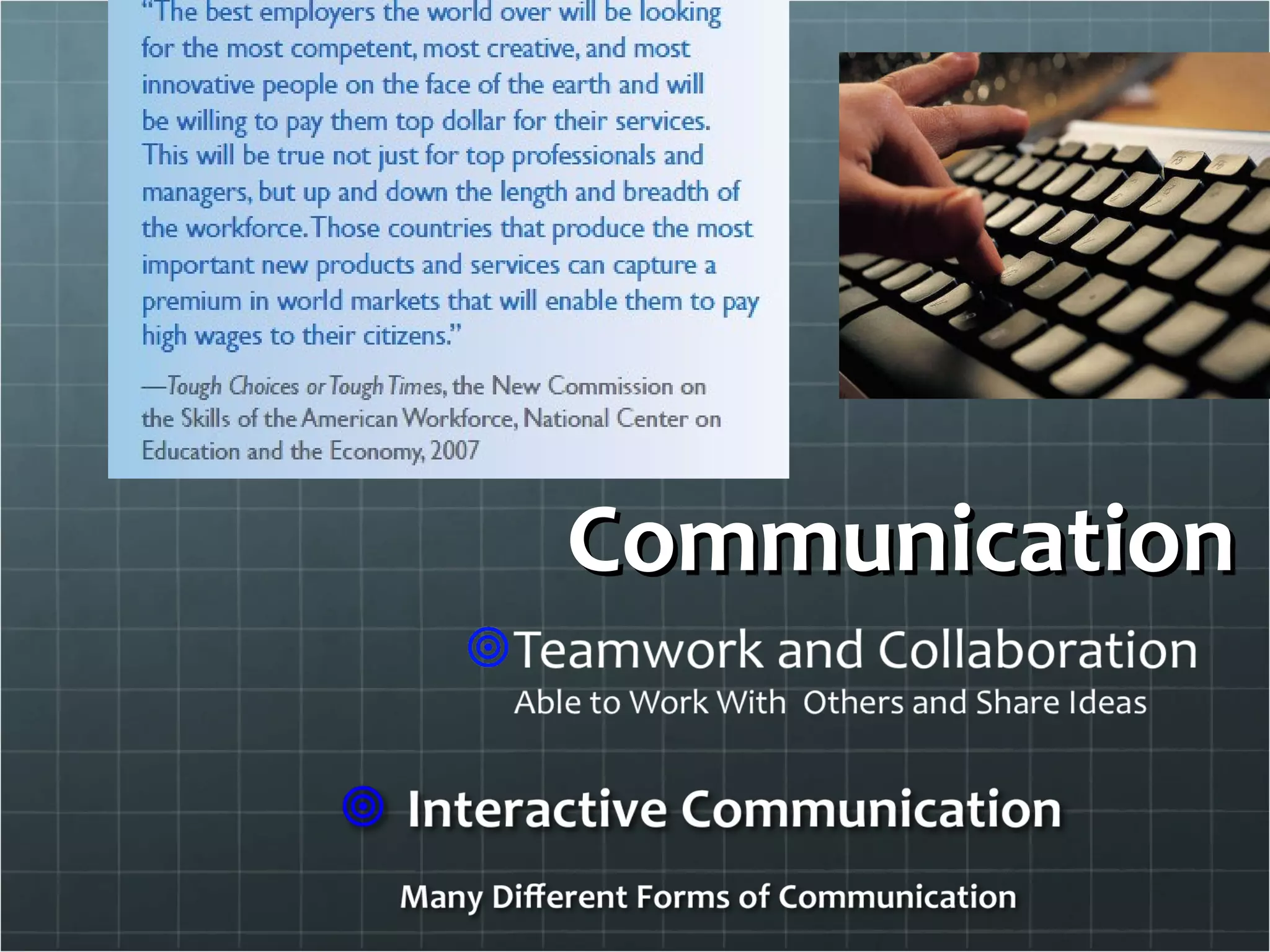
Communication
Effective Problem Solving  and Results Management Planning, Prioritizing and Managing Results Planners,  Organizers, Data Bases Effective Use of Real World Tools Software, Hardware, Communication Tools, Digital And Media Applications. Real World Applications Use in the Classroom What they Will Use on the Job
21 st  Century Skills What Do We Do <iframe width=&quot;420&quot; height=&quot;315&quot; src=&quot;http://www.youtube.com/embed/0AvZ5ulVyLc&quot; frameborder=&quot;0&quot; allowfullscreen></iframe> Video from UTube
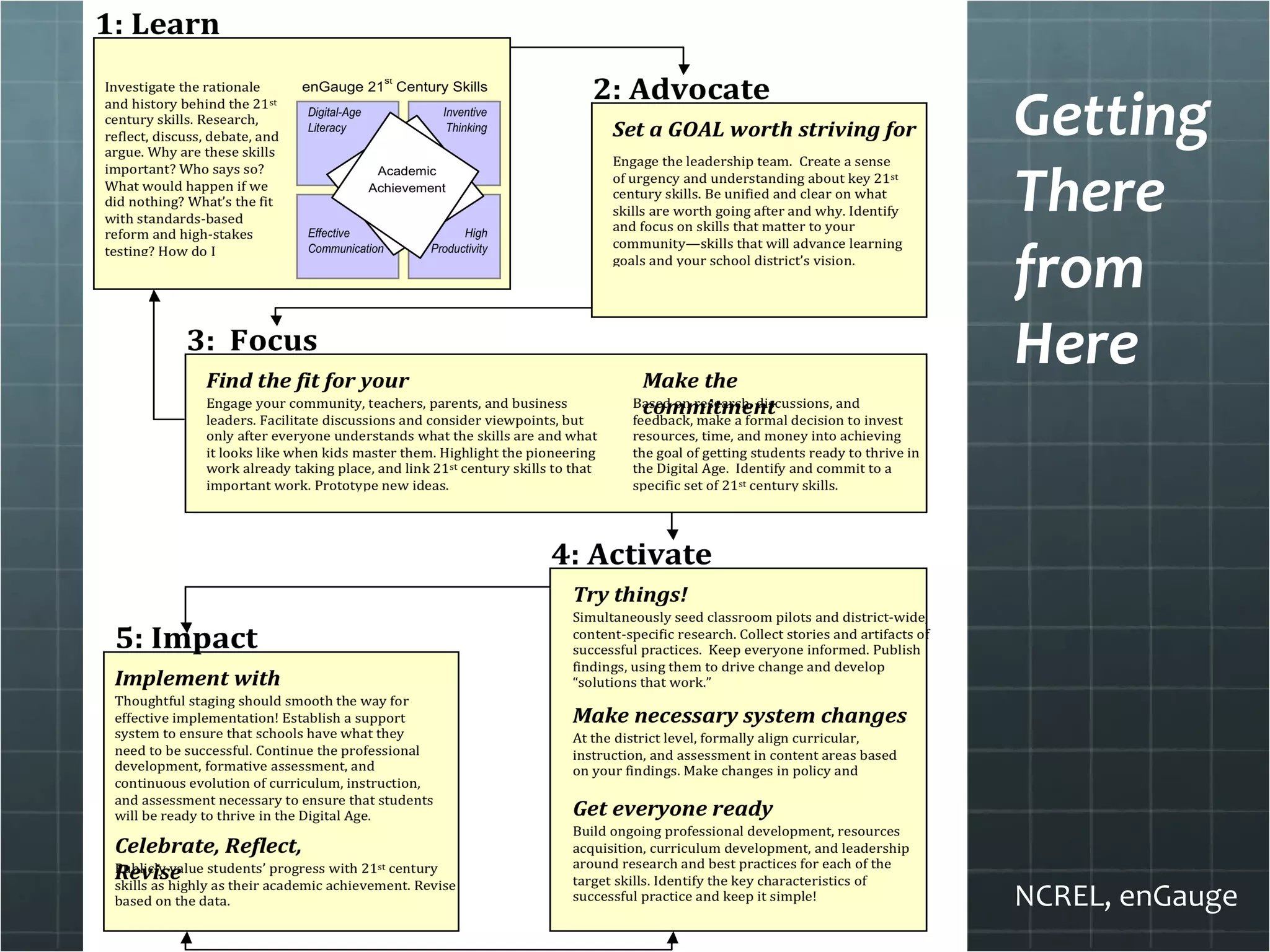
I Getting There from Here NCREL, enGauge
Bibliography Center for Regional Studies.  (2002).  Salverson, David and Ranski, Henry.  “The Importance of Quality of Life in the Location Decision of New Economy Firms.  Chapel Hills, NC:  Univeristy of NC. The CEO Forum.  (2001) School Technology and Readiness Report: Key Building Blocks for Student Achievement in the 21st Century  enGauge 21 st  Century Skills, Literacy in the Digital Age; North Carolina Regional Educational Laboratories. www.ncrel.org/engauge/skills/skills.htm National Center on Education and the Economy.  (2007) Tough Choices for Tough Times:  The Report of the Commission on the Skills of the American Workforce.  Washington, D.C.  21 st  Century Skills, Education and Competitiveness:  A Resource and Policy Guide.  (2008)  Partnership for 21 st  Century Skills.  Tucson, AZ. Utube.  (2011)  What does it Mean to Be Literate in the 21 st  Century.  http://youtu.be/WnOtl-kvkU Utube.  (2011)  21 st  Century Skills in Action:  Critical Thinking, Creative Thinking and Problem Solving http://youtu.be/2s6PlrXwt uTube.  (2011)  21 st  Century Skills – What Do We Do. http://youtu.be/OAvZ5ulVyLc

Technology and 21st Century Learning

  • 1.
    Technology for 21st Century Learning LINDA BRUNING SEPTEMBER 26, 2011 DISTRICT SCHOOL BOARD MEETING
  • 2.
    Menu Twenty FirstCentury Skills What Lies Ahead What is Digital Age Literacy Inventive Thinking-Intellectual Capitol Communication Effective Problem Solving and Results Management 21 st Century Skills What Do We Do Getting There From Here Bibliography
  • 3.
    Twenty First CenturySkills Digital Age Literacy Inventive Thinking-Intellectual Capitol “ In the New Economy, knowledge, rather than natural resources, is the raw material of business.” — Center for Regional Studies, 2002
  • 4.
    What Lies Ahead“ To meet the demands of our global economy…there must be corresponding adaptations in our educational environments to develop 21 st century skills.” --CEO Forum (2001: p. 9)
  • 5.
    What is DigitalAge Literacy Basic, Scientific & Technological Literacy (Read, Write and Solve Math and Science Problems) Visual and Informational Literacy (Use Visual and Digital Graphics and Access Information Quickly and Accurately) Cultural and Global Awareness (Globalization Demands Cultural Awareness) <iframe width=&quot;420&quot; height=&quot;315&quot; src=&quot;http://www.youtube.com/embed/Wn0_H-kvxkU&quot; frameborder=&quot;0&quot; allowfullscreen></iframe> What it Means to be Literate in the 21 st Century - uTube
  • 6.
    Inventive Thinking –Intellectual Capitol Adaptable, Can Manage Complexity, Self Directed Can Multi-Task, React Quickly to Rapidly Changing Situations, Can Work Independently Creative Thinking and Risk Taking Inventive, Out of the Box, Willing to Experiment, Higher Order Thinking and Reasoning Plan, Design, Execute and Evaluate <iframe width=&quot;560&quot; height=&quot;315&quot; src=&quot;http://www.youtube.com/embed/2s6PIrXwt7M&quot; frameborder=&quot;0&quot; allowfullscreen></iframe> 21 st Century Skills in Action – Critical Thinking, Creative Thinking and Problem Solving - UTUBE
  • 7.
  • 8.
    Effective Problem Solving and Results Management Planning, Prioritizing and Managing Results Planners, Organizers, Data Bases Effective Use of Real World Tools Software, Hardware, Communication Tools, Digital And Media Applications. Real World Applications Use in the Classroom What they Will Use on the Job
  • 9.
    21 st Century Skills What Do We Do <iframe width=&quot;420&quot; height=&quot;315&quot; src=&quot;http://www.youtube.com/embed/0AvZ5ulVyLc&quot; frameborder=&quot;0&quot; allowfullscreen></iframe> Video from UTube
  • 10.
    I Getting Therefrom Here NCREL, enGauge
  • 11.
    Bibliography Center forRegional Studies. (2002). Salverson, David and Ranski, Henry. “The Importance of Quality of Life in the Location Decision of New Economy Firms. Chapel Hills, NC: Univeristy of NC. The CEO Forum. (2001) School Technology and Readiness Report: Key Building Blocks for Student Achievement in the 21st Century enGauge 21 st Century Skills, Literacy in the Digital Age; North Carolina Regional Educational Laboratories. www.ncrel.org/engauge/skills/skills.htm National Center on Education and the Economy. (2007) Tough Choices for Tough Times: The Report of the Commission on the Skills of the American Workforce. Washington, D.C. 21 st Century Skills, Education and Competitiveness: A Resource and Policy Guide. (2008) Partnership for 21 st Century Skills. Tucson, AZ. Utube. (2011) What does it Mean to Be Literate in the 21 st Century. http://youtu.be/WnOtl-kvkU Utube. (2011) 21 st Century Skills in Action: Critical Thinking, Creative Thinking and Problem Solving http://youtu.be/2s6PlrXwt uTube. (2011) 21 st Century Skills – What Do We Do. http://youtu.be/OAvZ5ulVyLc

Editor's Notes

  • #2 Will speak about the concept of learning for 21 st century job market. How we are training students for jobs that don’t yet exist. Will ask what is 21 st Century Learning and why is technology an important element.
  • #3 These are the areas I will cover in my presentation.
  • #4 In this section I will list these skills and briefly define each, indicating that in depth discussions will follow on up coming slides
  • #6 In this section I will explain each division and subdivision of the main title . Then we will view the embedded uTube video “What Does it Mean to Be Literate in the 21 st Century. Take questions and answer
  • #7 Discussion will revolve around what each of these skills means and what we need to do to help our students gain these skills. These are not skills that are developed by “teaching to the test”. Show the uTube and do question and answer
  • #8 Once again, I will talk about what each of these skills demand and how we can expose our students to situations in order to learn these skills.
  • #9 Discussion about what each of these points means in real world terms away from the textbook and test paper.
  • #10 Move right to the next slide – Begin with how do we get there from here – on each of the points take any questions and answer them. Ask board members to think about how this could work for our district.
  • #11 Discuss each of the points and ask members to consider how we would do this in our district.