A Simple Review for Medical Students on Major Databases and Their Differences**
*(NIH, Elsevier, PubMed, Google Scholar, etc.)*
*By Dr. El Mahdi, M.Sc., Toxicology Researcher
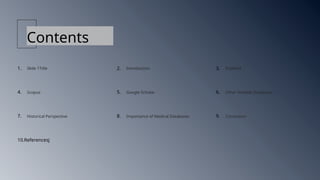
Introduction
2.
1. Slide 1TitlePubMed
3.
Google Scholar
Scopus
4. 5. Other Notable Databases
6.
Importance of Medical Databases
Historical Perspective
7. 8. Conclusion
9.
10.Referencesj
Contents
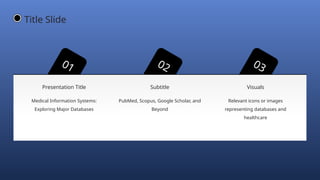
4.
02 03
01
Presentation Title
MedicalInformation Systems:
Exploring Major Databases
Subtitle
PubMed, Scopus, Google Scholar, and
Beyond
Visuals
Relevant icons or images
representing databases and
healthcare
Title Slide
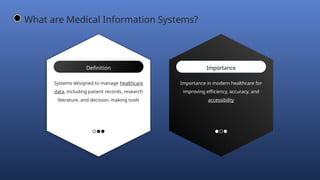
Definition
Systems designed tomanage healthcare
data, including patient records, research
literature, and decision- making tools
Importance
Importance in modern healthcare for
improving efficiency, accuracy, and
accessibility
What are Medical Information Systems?
7.
Objective
To explore keydatabases used in medical research and healthcare
information systems
Objective of the Presentation
Description Data
Launched in1996, revolutionizing access to
biomedical literature.
Contains over 38 million citations and abstracts from
MEDLINE, life sciences journals, and books
Overview
10.
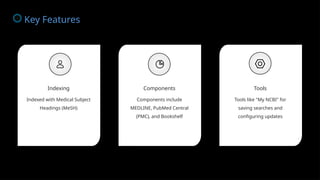
Indexing
Indexed with MedicalSubject
Headings (MeSH)
Components
Components include
MEDLINE, PubMed Central
(PMC), and Bookshelf
Tools
Tools like "My NCBI" for
saving searches and
configuring updates
Key Features
11.
Imagine a researcherin 1995 spending hours in a library.
Today, with PubMed, the same search takes seconds."
History
Historical hint
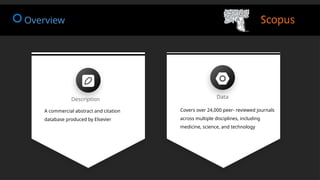
Description
A commercial abstractand citation
database produced by Elsevier
Data
Covers over 24,000 peer- reviewed journals
across multiple disciplines, including
medicine, science, and technology
Overview
14.
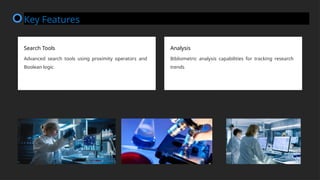
Search Tools
Advanced searchtools using proximity operators and
Boolean logic
Analysis
Bibliometric analysis capabilities for tracking research
trends
Key Features
15.
Broader scope butless accessible due to subscription costs.
Coverage
Comparison with PubMed
”
A freely accessibleacademic search engine indexing
scholarly literature across disciplines
Description
Overview
18.
01 02
Includes articles,theses, books, conference papers,
and more
Content
Advanced search options for refining results
Search Options
Key Features
19.
• Lacks thestructured indexing of PubMed or Scopus.
• Think of Google Scholar as the friendly librarian who knows a
little about everything but doesn’t specialize in one area."
Indexing
Limitations
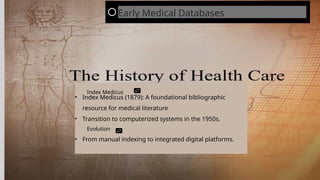
• Index Medicus(1879): A foundational bibliographic
resource for medical literature
• Transition to computerized systems in the 1950s.
Evolution
• From manual indexing to integrated digital platforms.
Early Medical Databases
Index Medicus
26.
"Imagine flipping throughhundreds of pages in
Index Medicus. Now, think of typing a keyword
into PubMed. That’s progress."
transformation
Key Points
Medical databaseslike PubMed, Scopus, and Google
Scholar are essential tools for healthcare and research
Unique Features
Each database offers unique features tailored to different
needs
Summary
33.
Encourage exploration andutilization of these resources for academic and professional growth
Enrolling