Pathology Informatics:
Past, Present, and Future
Mike Hogarth, MD, FACP
UCDHS Medical Dir. of Clinical Registries
Professor and Vice Chair, Pathology and Lab Medicine
Professor, Internal Medicine
mahogarth@ucdavis.edu
Overview
โ€ข What is โ€œinformaticsโ€?
โ€ข What is โ€œmedical informaticsโ€?
โ€ข A history of medical informatics
โ€ข History of UCDHS informatics (in pathology)
โ€ข What is โ€œpathology informaticsโ€?
โ€ข UCDHS pathology informatics โ€“ what do we do?
โ€ข Thoughts on pathology informatics and the future of
healthcare -- ?what does the future hold?
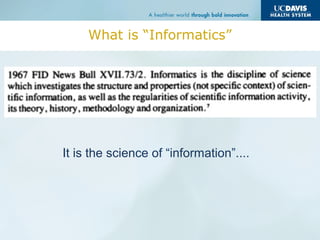
What is โ€œInformaticsโ€
It is the science of โ€œinformationโ€....
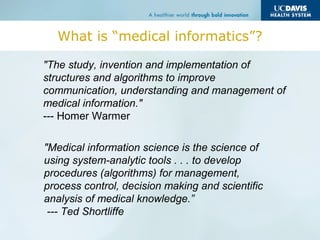
What is โ€œmedical informaticsโ€?
"The study, invention and implementation of
structures and algorithms to improve
communication, understanding and management of
medical information."
--- Homer Warmer
"Medical information science is the science of
using system-analytic tools . . . to develop
procedures (algorithms) for management,
process control, decision making and scientific
analysis of medical knowledge.โ€
--- Ted Shortliffe
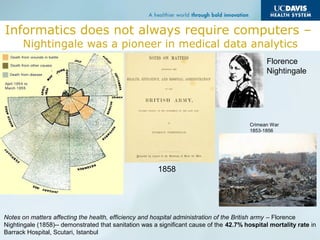
Informatics does not always require computers โ€“
Nightingale was a pioneer in medical data analytics
Notes on matters affecting the health, efficiency and hospital administration of the British army โ€“ Florence
Nightingale (1858)-- demonstrated that sanitation was a significant cause of the 42.7% hospital mortality rate in
Barrack Hospital, Scutari, Istanbul
Crimean War
1853-1856
Florence
Nightingale
1858
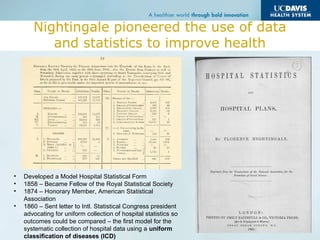
Nightingale pioneered the use of data
and statistics to improve health
โ€ข Developed a Model Hospital Statistical Form
โ€ข 1858 โ€“ Became Fellow of the Royal Statistical Society
โ€ข 1874 โ€“ Honorary Member, American Statistical
Association
โ€ข 1860 โ€“ Sent letter to Intl. Statistical Congress president
advocating for uniform collection of hospital statistics so
outcomes could be compared โ€“ the first model for the
systematic collection of hospital data using a uniform
classification of diseases (ICD)
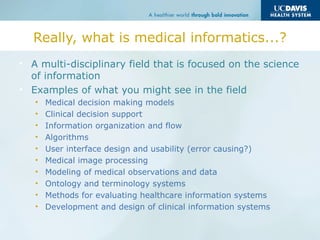
Really, what is medical informatics...?
โ€ข A multi-disciplinary field that is focused on the science
of information
โ€ข Examples of what you might see in the field
โ€ข Medical decision making models
โ€ข Clinical decision support
โ€ข Information organization and flow
โ€ข Algorithms
โ€ข User interface design and usability (error causing?)
โ€ข Medical image processing
โ€ข Modeling of medical observations and data
โ€ข Ontology and terminology systems
โ€ข Methods for evaluating healthcare information systems
โ€ข Development and design of clinical information systems
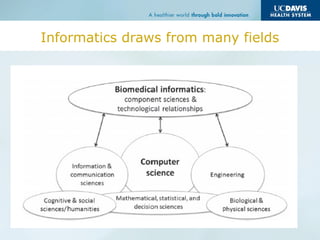
Informatics draws from many fields
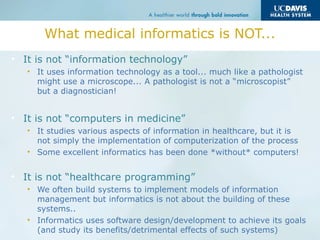
What medical informatics is NOT...
โ€ข It is not โ€œinformation technologyโ€
โ€ข It uses information technology as a tool... much like a pathologist
might use a microscope... A pathologist is not a โ€œmicroscopistโ€
but a diagnostician!
โ€ข It is not โ€œcomputers in medicineโ€
โ€ข It studies various aspects of information in healthcare, but it is
not simply the implementation of computerization of the process
โ€ข Some excellent informatics has been done *without* computers!
โ€ข It is not โ€œhealthcare programmingโ€
โ€ข We often build systems to implement models of information
management but informatics is not about the building of these
systems..
โ€ข Informatics uses software design/development to achieve its goals
(and study its benefits/detrimental effects of such systems)
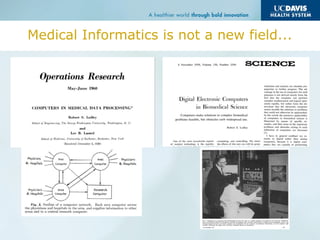
Medical Informatics is not a new field...
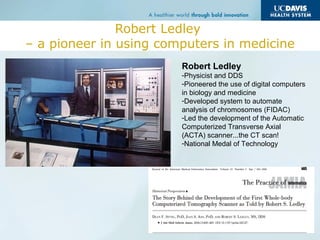
Robert Ledley
โ€“ a pioneer in using computers in medicine
Robert Ledley
-Physicist and DDS
-Pioneered the use of digital computers
in biology and medicine
-Developed system to automate
analysis of chromosomes (FIDAC)
-Led the development of the Automatic
Computerized Transverse Axial
(ACTA) scanner...the CT scan!
-National Medal of Technology
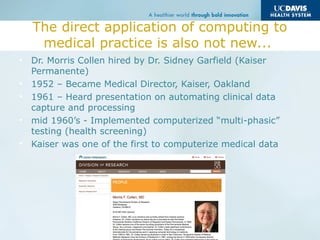
The direct application of computing to
medical practice is also not new...
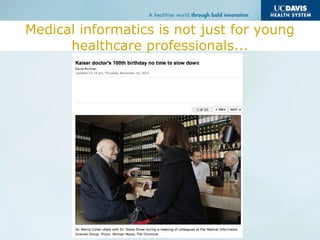
โ€ข Dr. Morris Collen hired by Dr. Sidney Garfield (Kaiser
Permanente)
โ€ข 1952 โ€“ Became Medical Director, Kaiser, Oakland
โ€ข 1961 โ€“ Heard presentation on automating clinical data
capture and processing
โ€ข mid 1960โ€™s - Implemented computerized โ€œmulti-phasicโ€
testing (health screening)
โ€ข Kaiser was one of the first to computerize medical data
Medical informatics is not just for young
healthcare professionals...
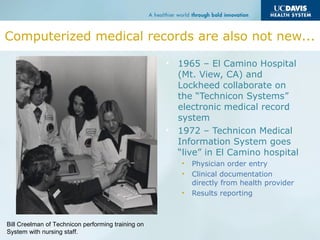
Computerized medical records are also not new...
โ€ข 1965 โ€“ El Camino Hospital
(Mt. View, CA) and
Lockheed collaborate on
the โ€œTechnicon Systemsโ€
electronic medical record
system
โ€ข 1972 โ€“ Technicon Medical
Information System goes
โ€œliveโ€ in El Camino hospital
โ€ข Physician order entry
โ€ข Clinical documentation
directly from health provider
โ€ข Results reporting
Bill Creelman of Technicon performing training on
System with nursing staff.
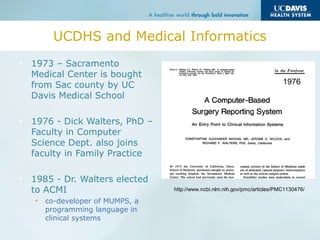
UCDHS and Medical Informatics
โ€ข 1973 โ€“ Sacramento
Medical Center is bought
from Sac county by UC
Davis Medical School
โ€ข 1976 - Dick Walters, PhD โ€“
Faculty in Computer
Science Dept. also joins
faculty in Family Practice
โ€ข 1985 - Dr. Walters elected
to ACMI
โ€ข co-developer of MUMPS, a
programming language in
clinical systems
http://www.ncbi.nlm.nih.gov/pmc/articles/PMC1130476/
1976
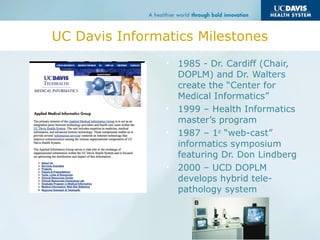
UC Davis Informatics Milestones
โ€ข 1985 - Dr. Cardiff (Chair,
DOPLM) and Dr. Walters
create the โ€œCenter for
Medical Informaticsโ€
โ€ข 1999 โ€“ Health Informatics
masterโ€™s program
โ€ข 1987 โ€“ 1st
โ€œweb-castโ€
informatics symposium
featuring Dr. Don Lindberg
โ€ข 2000 โ€“ UCD DOPLM
develops hybrid tele-
pathology system
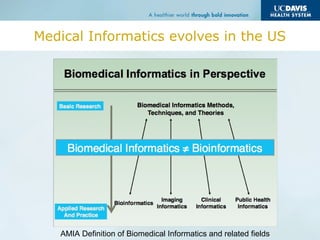
Medical Informatics evolves in the US
AMIA Definition of Biomedical Informatics and related fields
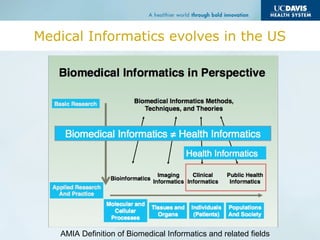
Medical Informatics evolves in the US
AMIA Definition of Biomedical Informatics and related fields
Pathology Informatics
-- Association of Pathology Informatics (API)
โ€ข 2000 โ€“ founded with the goal of defining pathology
informatics as a clinical subspecialty within pathology
โ€ข Develops standards for managing pathology-related
information
โ€ข Promotes education in pathology informatics
โ€ข โ€œPathology informatics involves collecting, examining,
reporting, and storing large complex sets of data
derived from tests performed in clinical laboratories,
anatomic pathology laboratories, or research
laboratories in order to improve patient care and
enhance our understanding of disease-related
processesโ€
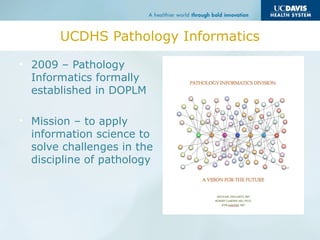
UCDHS Pathology Informatics
โ€ข 2009 โ€“ Pathology
Informatics formally
established in DOPLM
โ€ข Mission โ€“ to apply
information science to
solve challenges in the
discipline of pathology
So what is โ€œpathology informaticsโ€ here?
โ€ข The application of information science to support the scope of
pathology practice (or research)
โ€ข What does it entail?
โ€ข Laboratory Information Systems
โ€ข Managing clinical information systems supporting anatomic pathology, clinical
pathology, transfusion medicine, and molecular diagnostics
โ€ข Laboratory automation
โ€ข Digital Pathology Imaging Systems
โ€ข Image capture methods, diagnostic fidelity
โ€ข Whole-slide scanning systems, tele-pathology systems, Image archives/path-
PACS
โ€ข Data mining (of pathology information)
โ€ข Natural language processing of surgical pathology reports
โ€ข Decision support
โ€ข Provide CDSS for diagnostic testing by health providers
โ€ข Analytics and Registries
โ€ข to support performance/quality improvement
UCDHS Pathology Informatics: 2014-
2015
โ€ข Information Management
โ€ข Implement, operate/manage systems that support UCDHS anatomic pathology,
clinical pathology, transfusion medicine
โ€ข Integration of LIS data with EHR
โ€ข Integration of LIS data with external referral labs (ie, ARUP)
โ€ข Whole slide scanning systems (in collab with health IT)
โ€ข Education
โ€ข PGY Pathology informatics rotation
โ€ข Health informatics certificate for pathology fellows
โ€ข Health informatics masterโ€™s program (leadership, teaching courses)
โ€ข Masterโ€™s of Public Health (public health informatics)
โ€ข Grants/Contracts -- ~$25M in grants/contracts since 2005
โ€ข California Electronic Death Registration System (2005)
โ€ข Maryland EDRS (2014)
โ€ข MediCal โ€œBig Dataโ€ analytics and EHRs (2014)
โ€ข TRANSCEND Clinical Trial Information System (supporting I-SPY2 since 2009)
โ€ข pSCANNER โ€“ PCORI Clinical Data Research Network (2014)
โ€ข UC-ReX (founding member, 2009)
โ€ข Athena Breast Health Network (2008)
โ€ข Oversight of UCDHS clinical registries (2011)
โ€ข UC Health Quality Improvement analytics (2014)
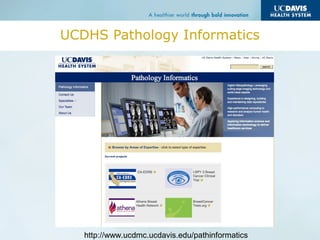
UCDHS Pathology Informatics
http://www.ucdmc.ucdavis.edu/pathinformatics
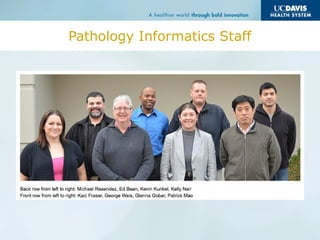
Pathology Informatics Staff
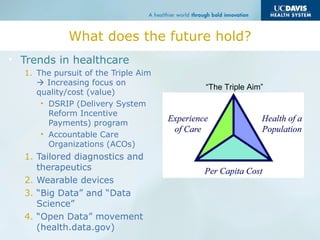
What does the future hold?
โ€ข Trends in healthcare
1. The pursuit of the Triple Aim
๏ƒ  Increasing focus on
quality/cost (value)
โ€ข DSRIP (Delivery System
Reform Incentive
Payments) program
โ€ข Accountable Care
Organizations (ACOs)
1. Tailored diagnostics and
therapeutics
2. Wearable devices
3. โ€œBig Dataโ€ and โ€œData
Scienceโ€
4. โ€œOpen Dataโ€ movement
(health.data.gov)
โ€œThe Triple Aimโ€
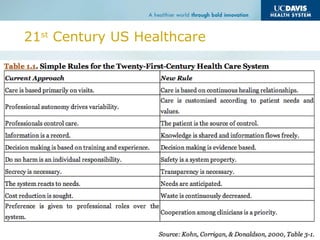
21st
Century US Healthcare
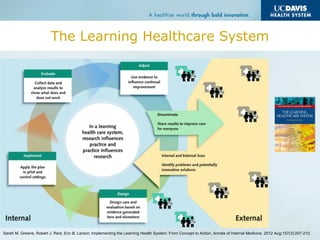
The Learning Healthcare System
Sarah M. Greene, Robert J. Reid, Eric B. Larson; Implementing the Learning Health System: From Concept to Action. Annals of Internal Medicine. 2012 Aug;157(3):207-210.
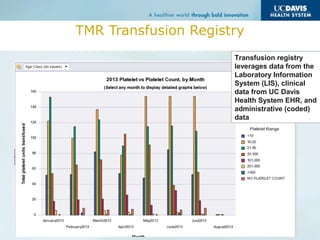
TMR Transfusion Registry
Transfusion registry
leverages data from the
Laboratory Information
System (LIS), clinical
data from UC Davis
Health System EHR, and
administrative (coded)
data
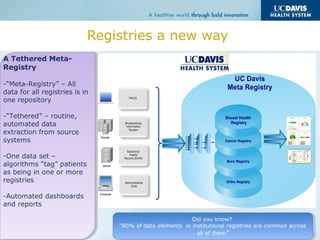
Registries a new way
A Tethered Meta-
Registry
-โ€œMeta-Registryโ€ โ€“ All
data for all registries is in
one repository
-โ€œTetheredโ€ โ€“ routine,
automated data
extraction from source
systems
-One data set โ€“
algorithms โ€œtagโ€ patients
as being in one or more
registries
-Automated dashboards
and reports
A Tethered Meta-
Registry
-โ€œMeta-Registryโ€ โ€“ All
data for all registries is in
one repository
-โ€œTetheredโ€ โ€“ routine,
automated data
extraction from source
systems
-One data set โ€“
algorithms โ€œtagโ€ patients
as being in one or more
registries
-Automated dashboards
and reports
Did you know?
โ€œ80% of data elements in institutional registries are common across
all of themโ€
Did you know?
โ€œ80% of data elements in institutional registries are common across
all of themโ€
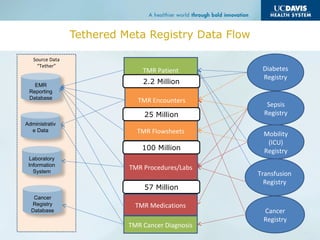
Tethered Meta Registry Data Flow
Sepsis
Registry
Mobility
(ICU)
Registry
Diabetes
Registry
Source Data
โ€œTetherโ€
EMR
Reporting
Database
Administrativ
e Data
Laboratory
Information
System
TMR Patient
TMR Encounters
TMR Flowsheets
TMR Procedures/Labs
TMR Medications
2.2 Million
25 Million
100 Million
57 Million
Cancer
Registry
Database
TMR Cancer Diagnosis
Transfusion
Registry
Cancer
Registry
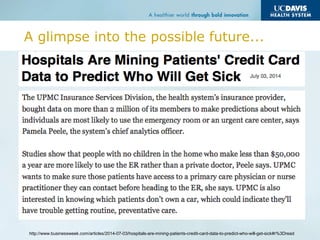
A glimpse into the possible future...
http://www.businessweek.com/articles/2014-07-03/hospitals-are-mining-patients-credit-card-data-to-predict-who-will-get-sick#r%3Dread
Pathology Informatics and future trends
โ€ข โ€œTeam Medicineโ€ / Integrated care
โ€ข Will require tight data integration between EHR and LIS functions
โ€ข Consolidation of LIS as a core EHR component
โ€ข Computerized clinical decision support
โ€ข Will require structured data from pathologists
โ€ข Structured reporting (synoptic reporting) using XML CAP โ€œelectronic checklistsโ€
(eCC XML)
โ€ข We are currently collaborating with ASCO and CAP on improving structured data
capture in cancer care
โ€ข Population health management
โ€ข Will require clinical data analytics and registries
โ€ข Combining data from multiple sources for predictive analytics.
โ€ข Creation/management of data sets (registries) to support performance
improvement within pathology, as well as externally
โ€ข Analytics platform to characterize care
โ€ข Patient-centered care
โ€ข Will require new ways of โ€œreportingโ€ information
โ€ข Patient-directed reports?
โ€ข Mobile/mhealth
Questions...
Slide deck download โ€“ http://www.hogarth.org

Pathology Informatics: Past, Present, and Future

  • 1.
    Pathology Informatics: Past, Present,and Future Mike Hogarth, MD, FACP UCDHS Medical Dir. of Clinical Registries Professor and Vice Chair, Pathology and Lab Medicine Professor, Internal Medicine mahogarth@ucdavis.edu
  • 2.
    Overview โ€ข What isโ€œinformaticsโ€? โ€ข What is โ€œmedical informaticsโ€? โ€ข A history of medical informatics โ€ข History of UCDHS informatics (in pathology) โ€ข What is โ€œpathology informaticsโ€? โ€ข UCDHS pathology informatics โ€“ what do we do? โ€ข Thoughts on pathology informatics and the future of healthcare -- ?what does the future hold?
  • 3.
    What is โ€œInformaticsโ€ Itis the science of โ€œinformationโ€....
  • 4.
    What is โ€œmedicalinformaticsโ€? "The study, invention and implementation of structures and algorithms to improve communication, understanding and management of medical information." --- Homer Warmer "Medical information science is the science of using system-analytic tools . . . to develop procedures (algorithms) for management, process control, decision making and scientific analysis of medical knowledge.โ€ --- Ted Shortliffe
  • 5.
    Informatics does notalways require computers โ€“ Nightingale was a pioneer in medical data analytics Notes on matters affecting the health, efficiency and hospital administration of the British army โ€“ Florence Nightingale (1858)-- demonstrated that sanitation was a significant cause of the 42.7% hospital mortality rate in Barrack Hospital, Scutari, Istanbul Crimean War 1853-1856 Florence Nightingale 1858
  • 6.
    Nightingale pioneered theuse of data and statistics to improve health โ€ข Developed a Model Hospital Statistical Form โ€ข 1858 โ€“ Became Fellow of the Royal Statistical Society โ€ข 1874 โ€“ Honorary Member, American Statistical Association โ€ข 1860 โ€“ Sent letter to Intl. Statistical Congress president advocating for uniform collection of hospital statistics so outcomes could be compared โ€“ the first model for the systematic collection of hospital data using a uniform classification of diseases (ICD)
  • 7.
    Really, what ismedical informatics...? โ€ข A multi-disciplinary field that is focused on the science of information โ€ข Examples of what you might see in the field โ€ข Medical decision making models โ€ข Clinical decision support โ€ข Information organization and flow โ€ข Algorithms โ€ข User interface design and usability (error causing?) โ€ข Medical image processing โ€ข Modeling of medical observations and data โ€ข Ontology and terminology systems โ€ข Methods for evaluating healthcare information systems โ€ข Development and design of clinical information systems
  • 8.
  • 9.
    What medical informaticsis NOT... โ€ข It is not โ€œinformation technologyโ€ โ€ข It uses information technology as a tool... much like a pathologist might use a microscope... A pathologist is not a โ€œmicroscopistโ€ but a diagnostician! โ€ข It is not โ€œcomputers in medicineโ€ โ€ข It studies various aspects of information in healthcare, but it is not simply the implementation of computerization of the process โ€ข Some excellent informatics has been done *without* computers! โ€ข It is not โ€œhealthcare programmingโ€ โ€ข We often build systems to implement models of information management but informatics is not about the building of these systems.. โ€ข Informatics uses software design/development to achieve its goals (and study its benefits/detrimental effects of such systems)
  • 10.
    Medical Informatics isnot a new field...
  • 11.
    Robert Ledley โ€“ apioneer in using computers in medicine Robert Ledley -Physicist and DDS -Pioneered the use of digital computers in biology and medicine -Developed system to automate analysis of chromosomes (FIDAC) -Led the development of the Automatic Computerized Transverse Axial (ACTA) scanner...the CT scan! -National Medal of Technology
  • 12.
    The direct applicationof computing to medical practice is also not new... โ€ข Dr. Morris Collen hired by Dr. Sidney Garfield (Kaiser Permanente) โ€ข 1952 โ€“ Became Medical Director, Kaiser, Oakland โ€ข 1961 โ€“ Heard presentation on automating clinical data capture and processing โ€ข mid 1960โ€™s - Implemented computerized โ€œmulti-phasicโ€ testing (health screening) โ€ข Kaiser was one of the first to computerize medical data
  • 13.
    Medical informatics isnot just for young healthcare professionals...
  • 14.
    Computerized medical recordsare also not new... โ€ข 1965 โ€“ El Camino Hospital (Mt. View, CA) and Lockheed collaborate on the โ€œTechnicon Systemsโ€ electronic medical record system โ€ข 1972 โ€“ Technicon Medical Information System goes โ€œliveโ€ in El Camino hospital โ€ข Physician order entry โ€ข Clinical documentation directly from health provider โ€ข Results reporting Bill Creelman of Technicon performing training on System with nursing staff.
  • 15.
    UCDHS and MedicalInformatics โ€ข 1973 โ€“ Sacramento Medical Center is bought from Sac county by UC Davis Medical School โ€ข 1976 - Dick Walters, PhD โ€“ Faculty in Computer Science Dept. also joins faculty in Family Practice โ€ข 1985 - Dr. Walters elected to ACMI โ€ข co-developer of MUMPS, a programming language in clinical systems http://www.ncbi.nlm.nih.gov/pmc/articles/PMC1130476/ 1976
  • 16.
    UC Davis InformaticsMilestones โ€ข 1985 - Dr. Cardiff (Chair, DOPLM) and Dr. Walters create the โ€œCenter for Medical Informaticsโ€ โ€ข 1999 โ€“ Health Informatics masterโ€™s program โ€ข 1987 โ€“ 1st โ€œweb-castโ€ informatics symposium featuring Dr. Don Lindberg โ€ข 2000 โ€“ UCD DOPLM develops hybrid tele- pathology system
  • 17.
    Medical Informatics evolvesin the US AMIA Definition of Biomedical Informatics and related fields
  • 18.
    Medical Informatics evolvesin the US AMIA Definition of Biomedical Informatics and related fields
  • 19.
    Pathology Informatics -- Associationof Pathology Informatics (API) โ€ข 2000 โ€“ founded with the goal of defining pathology informatics as a clinical subspecialty within pathology โ€ข Develops standards for managing pathology-related information โ€ข Promotes education in pathology informatics โ€ข โ€œPathology informatics involves collecting, examining, reporting, and storing large complex sets of data derived from tests performed in clinical laboratories, anatomic pathology laboratories, or research laboratories in order to improve patient care and enhance our understanding of disease-related processesโ€
  • 20.
    UCDHS Pathology Informatics โ€ข2009 โ€“ Pathology Informatics formally established in DOPLM โ€ข Mission โ€“ to apply information science to solve challenges in the discipline of pathology
  • 21.
    So what isโ€œpathology informaticsโ€ here? โ€ข The application of information science to support the scope of pathology practice (or research) โ€ข What does it entail? โ€ข Laboratory Information Systems โ€ข Managing clinical information systems supporting anatomic pathology, clinical pathology, transfusion medicine, and molecular diagnostics โ€ข Laboratory automation โ€ข Digital Pathology Imaging Systems โ€ข Image capture methods, diagnostic fidelity โ€ข Whole-slide scanning systems, tele-pathology systems, Image archives/path- PACS โ€ข Data mining (of pathology information) โ€ข Natural language processing of surgical pathology reports โ€ข Decision support โ€ข Provide CDSS for diagnostic testing by health providers โ€ข Analytics and Registries โ€ข to support performance/quality improvement
  • 22.
    UCDHS Pathology Informatics:2014- 2015 โ€ข Information Management โ€ข Implement, operate/manage systems that support UCDHS anatomic pathology, clinical pathology, transfusion medicine โ€ข Integration of LIS data with EHR โ€ข Integration of LIS data with external referral labs (ie, ARUP) โ€ข Whole slide scanning systems (in collab with health IT) โ€ข Education โ€ข PGY Pathology informatics rotation โ€ข Health informatics certificate for pathology fellows โ€ข Health informatics masterโ€™s program (leadership, teaching courses) โ€ข Masterโ€™s of Public Health (public health informatics) โ€ข Grants/Contracts -- ~$25M in grants/contracts since 2005 โ€ข California Electronic Death Registration System (2005) โ€ข Maryland EDRS (2014) โ€ข MediCal โ€œBig Dataโ€ analytics and EHRs (2014) โ€ข TRANSCEND Clinical Trial Information System (supporting I-SPY2 since 2009) โ€ข pSCANNER โ€“ PCORI Clinical Data Research Network (2014) โ€ข UC-ReX (founding member, 2009) โ€ข Athena Breast Health Network (2008) โ€ข Oversight of UCDHS clinical registries (2011) โ€ข UC Health Quality Improvement analytics (2014)
  • 23.
  • 24.
  • 25.
    What does thefuture hold? โ€ข Trends in healthcare 1. The pursuit of the Triple Aim ๏ƒ  Increasing focus on quality/cost (value) โ€ข DSRIP (Delivery System Reform Incentive Payments) program โ€ข Accountable Care Organizations (ACOs) 1. Tailored diagnostics and therapeutics 2. Wearable devices 3. โ€œBig Dataโ€ and โ€œData Scienceโ€ 4. โ€œOpen Dataโ€ movement (health.data.gov) โ€œThe Triple Aimโ€
  • 26.
  • 27.
    The Learning HealthcareSystem Sarah M. Greene, Robert J. Reid, Eric B. Larson; Implementing the Learning Health System: From Concept to Action. Annals of Internal Medicine. 2012 Aug;157(3):207-210.
  • 28.
    TMR Transfusion Registry Transfusionregistry leverages data from the Laboratory Information System (LIS), clinical data from UC Davis Health System EHR, and administrative (coded) data
  • 29.
    Registries a newway A Tethered Meta- Registry -โ€œMeta-Registryโ€ โ€“ All data for all registries is in one repository -โ€œTetheredโ€ โ€“ routine, automated data extraction from source systems -One data set โ€“ algorithms โ€œtagโ€ patients as being in one or more registries -Automated dashboards and reports A Tethered Meta- Registry -โ€œMeta-Registryโ€ โ€“ All data for all registries is in one repository -โ€œTetheredโ€ โ€“ routine, automated data extraction from source systems -One data set โ€“ algorithms โ€œtagโ€ patients as being in one or more registries -Automated dashboards and reports Did you know? โ€œ80% of data elements in institutional registries are common across all of themโ€ Did you know? โ€œ80% of data elements in institutional registries are common across all of themโ€
  • 30.
    Tethered Meta RegistryData Flow Sepsis Registry Mobility (ICU) Registry Diabetes Registry Source Data โ€œTetherโ€ EMR Reporting Database Administrativ e Data Laboratory Information System TMR Patient TMR Encounters TMR Flowsheets TMR Procedures/Labs TMR Medications 2.2 Million 25 Million 100 Million 57 Million Cancer Registry Database TMR Cancer Diagnosis Transfusion Registry Cancer Registry
  • 31.
    A glimpse intothe possible future... http://www.businessweek.com/articles/2014-07-03/hospitals-are-mining-patients-credit-card-data-to-predict-who-will-get-sick#r%3Dread
  • 32.
    Pathology Informatics andfuture trends โ€ข โ€œTeam Medicineโ€ / Integrated care โ€ข Will require tight data integration between EHR and LIS functions โ€ข Consolidation of LIS as a core EHR component โ€ข Computerized clinical decision support โ€ข Will require structured data from pathologists โ€ข Structured reporting (synoptic reporting) using XML CAP โ€œelectronic checklistsโ€ (eCC XML) โ€ข We are currently collaborating with ASCO and CAP on improving structured data capture in cancer care โ€ข Population health management โ€ข Will require clinical data analytics and registries โ€ข Combining data from multiple sources for predictive analytics. โ€ข Creation/management of data sets (registries) to support performance improvement within pathology, as well as externally โ€ข Analytics platform to characterize care โ€ข Patient-centered care โ€ข Will require new ways of โ€œreportingโ€ information โ€ข Patient-directed reports? โ€ข Mobile/mhealth
  • 33.
    Questions... Slide deck downloadโ€“ http://www.hogarth.org