Library Research 101 International University of Nursing Ann Celestine  BA  MLS  AHIP Director of Library Services
Information Quest IUON Library Catalogue Databases Internet
Navigating a Sea of Information The Library & the Librarians are your Life Savers  ~ Help you navigate Keep you afloat Teach you to sail Avoid the rocks Sweet too!!  “ To study the phenomena of disease without books is to sail an uncharted sea” Sir William Osler
What is the ‘Catalogue’? Index to materials housed in the library Search by title, author, subject or keyword Access  IUON  WebCAT   online
What is a Database? A database is a collection of information stored in a computer in a systematic way, such that a computer program can consult it to answer questions. The software used to manage and query a database is known as a ‘database management system’ (DBMS).
I am trying to find... What kind of information am I searching for? Where would I find that ? dictionary encyclopedia journal book multi-media
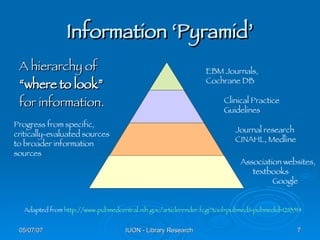
Information ‘Pyramid’ A hierarchy of “ where to look” for information. EBM Journals, Cochrane DB Clinical Practice Guidelines  Journal research CINAHL, Medline Association websites, textbooks Google Progress from specific, critically-evaluated sources to broader information sources  Adapted from  http:// www.pubmedcentral.nih.gov/articlerender.fcgi?tool = pubmed&pubmedid =12113514
What is EBM? “ Evidence based medicine is the conscientious, explicit, and judicious use of current best evidence in making decisions about the care of individual patients. The practice of evidence based medicine means integrating individual clinical expertise with the best available external clinical evidence from systematic research.” Sackett DL, Rosenberg WMC, Gray JAM, Haynes RB, Richardson WS.  Evidence based medicine: what it is and what it isn't . BMJ. 1996 Jan 13; 312 (7023): 71-2.
Setting sail… EBSCO  DB’s NLM databases Internet indexes Search engines Links provided on the  Library  Blog
… close to shore… EBSCO databases : CINAHL Academic Search Premier Medline Pre-Medline Dyna-Med GIDEON SMART Images
… further out to sea… Science Direct Intute  [UK] NLM databases : PubMed /Medline Clinical Queries MedlinePlus PubMed  Bookshelf
…  deep water … Internet indexes: DMOZ NOAH HardinMD HON
… open ocean… Search engines: Scirus MedHunt Kosmix Medstory Google Google Scholar Search Engine Partnertship Chart http://www.ihelpyou.com/search-engine-chart.htm
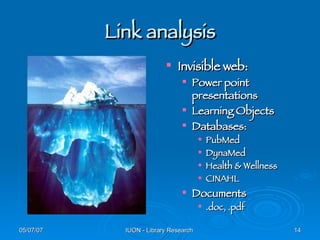
Link analysis Invisible web:  Power point presentations Learning Objects Databases:  PubMed DynaMed Health & Wellness CINAHL Documents .doc, .pdf
Diagnosing Websites Who When Where Why What
KISS Method ‘ Keep it Simple Searching’ ~Rita Vine Use search engines to find known org.’s & people, or “needle-in-a-haystack” searches. Use subject starters to find high-quality web directories for topical searches. Use quick fact lookup tools for quick facts, phone numbers, definitions, etc. http:// www.workingfaster.com/links.html
Tips & Tricks Phrases  ( )  [ ]  “ “ Wildcard  ? Truncation  * Tilde  ~  Boolean operators  AND, OR, NOT  +, pipe |, - http:// www.searchengineshowdown.com /features /
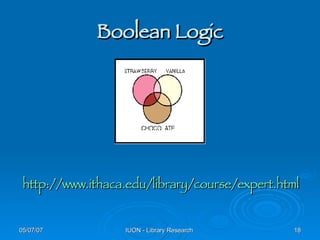
Boolean Logic http:// www.ithaca.edu/library/course/expert.html
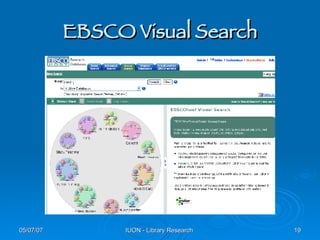
EBSCO Visual Search
Customization EBSCO: myEBSCO Host PubMed:  myNBCI RSS feeds: watch for symbol  Blogs: (search with  Google  Blog   search) Email alerts: updates, newsletters, etc.
… piece by piece…
Happy Searching ! Ann Celestine Library Director International University of Nursing

Library Research 101

  • 1.
    Library Research 101International University of Nursing Ann Celestine BA MLS AHIP Director of Library Services
  • 2.
    Information Quest IUONLibrary Catalogue Databases Internet
  • 3.
    Navigating a Seaof Information The Library & the Librarians are your Life Savers ~ Help you navigate Keep you afloat Teach you to sail Avoid the rocks Sweet too!! “ To study the phenomena of disease without books is to sail an uncharted sea” Sir William Osler
  • 4.
    What is the‘Catalogue’? Index to materials housed in the library Search by title, author, subject or keyword Access IUON WebCAT online
  • 5.
    What is aDatabase? A database is a collection of information stored in a computer in a systematic way, such that a computer program can consult it to answer questions. The software used to manage and query a database is known as a ‘database management system’ (DBMS).
  • 6.
    I am tryingto find... What kind of information am I searching for? Where would I find that ? dictionary encyclopedia journal book multi-media
  • 7.
    Information ‘Pyramid’ Ahierarchy of “ where to look” for information. EBM Journals, Cochrane DB Clinical Practice Guidelines Journal research CINAHL, Medline Association websites, textbooks Google Progress from specific, critically-evaluated sources to broader information sources Adapted from http:// www.pubmedcentral.nih.gov/articlerender.fcgi?tool = pubmed&pubmedid =12113514
  • 8.
    What is EBM?“ Evidence based medicine is the conscientious, explicit, and judicious use of current best evidence in making decisions about the care of individual patients. The practice of evidence based medicine means integrating individual clinical expertise with the best available external clinical evidence from systematic research.” Sackett DL, Rosenberg WMC, Gray JAM, Haynes RB, Richardson WS. Evidence based medicine: what it is and what it isn't . BMJ. 1996 Jan 13; 312 (7023): 71-2.
  • 9.
    Setting sail… EBSCO DB’s NLM databases Internet indexes Search engines Links provided on the Library Blog
  • 10.
    … close toshore… EBSCO databases : CINAHL Academic Search Premier Medline Pre-Medline Dyna-Med GIDEON SMART Images
  • 11.
    … further outto sea… Science Direct Intute [UK] NLM databases : PubMed /Medline Clinical Queries MedlinePlus PubMed Bookshelf
  • 12.
    … deepwater … Internet indexes: DMOZ NOAH HardinMD HON
  • 13.
    … open ocean…Search engines: Scirus MedHunt Kosmix Medstory Google Google Scholar Search Engine Partnertship Chart http://www.ihelpyou.com/search-engine-chart.htm
  • 14.
    Link analysis Invisibleweb: Power point presentations Learning Objects Databases: PubMed DynaMed Health & Wellness CINAHL Documents .doc, .pdf
  • 15.
    Diagnosing Websites WhoWhen Where Why What
  • 16.
    KISS Method ‘Keep it Simple Searching’ ~Rita Vine Use search engines to find known org.’s & people, or “needle-in-a-haystack” searches. Use subject starters to find high-quality web directories for topical searches. Use quick fact lookup tools for quick facts, phone numbers, definitions, etc. http:// www.workingfaster.com/links.html
  • 17.
    Tips & TricksPhrases ( ) [ ] “ “ Wildcard ? Truncation * Tilde ~ Boolean operators AND, OR, NOT +, pipe |, - http:// www.searchengineshowdown.com /features /
  • 18.
    Boolean Logic http://www.ithaca.edu/library/course/expert.html
  • 19.
  • 20.
    Customization EBSCO: myEBSCOHost PubMed: myNBCI RSS feeds: watch for symbol Blogs: (search with Google Blog search) Email alerts: updates, newsletters, etc.
  • 21.
    … piece bypiece…
  • 22.
    Happy Searching !Ann Celestine Library Director International University of Nursing