ALTMETRICS
Nadeem Nazir
Mphil Scholar
Roll No. Mphil 202210
Department of library & Information science, University of Delhi
CONTENTS
1. Introduction
2. Scholarly communication and social media
3. Scholarly communication to social media
4. What are altmetrics?
5. Birth of altmetrics
6. Before altmetrics
7. From metrics to altmetrics
8. Why they matter?
9. How they work?
10. Service providers
11. Altmetrics by item type
12. Benefits of altmetrics
13. Role of altmetrics in library & information science
14. References
INTRODUCTION
Scholarly communication is the system through which research and other scholarly writings are created,
evaluated for quality, disseminated to the scholarly community, and preserved for future use. The system
includes both formal means of communication, such as publication in peer-reviewed journals, and
informal channels, such as electronic channels.
During earlier times or classic research era when the journals were published in printed form, there were
very few or less people engaged with research. With passing time more and more people start writing
which gave rise to information explosion, ultimately lead to information overload, making it difficult to
rely on printed material. The revolution of IT and the emergence of IT in Academic writing gave rise to
electronic publishing by which information became more accessible, useful and available worldwide.
With the abundance of scholarly literature available and the continuous flow of research outputs it
becomes obligatory to check the quality and validity of everything that gets published in order to build
trust among the people who are relying on the scholarly information. The process by which the quality,
validity or authenticity of any scholarly content is checked is called as peer review process.
INTRODUCTION (Contd…)
The goal of any peer review process or research assessment is to
evaluate the value or quality of the research in comparison to other
research. As quality is highly subjective and difficult to measure,
citations are used as a proxy.
Citations are an important part of scholarly communication and a
significant component of research evaluation, with the assumption being
that highly cited work has influenced the work of many other
researchers and hence it is more valuable.
SCHOLARLY COMMUNICATION & SOCIAL MEDIA
Every researcher wants to know the practical impact of their research in a society or an
academic community, so they are trying to interact with many latest technologies or
tools to know the influence of research.
Nowadays researchers are using social media to increase their research impact.
For a researcher,
Social media = Citations
Blogging = Reputation & Presence
Twitter = Dissemination & Engagement
SCHOLARLY COMMUNICATION TO SOCIAL MEDIA
The advent of social media has already changed many aspects of scholarly
communication; researchers can now present their ideas in blogs, discuss their
research with colleagues on Facebook, and share their articles on Twitter and
Mendeley. Because research is increasingly being brought out from the closed
scientific ecosystems to the open web, even people other than just researchers can
participate in discussing research and disseminating new discoveries to a wider
audience.
New forms of scholarly communication require new methods for measurement of
impact.
ALT+METRICS
The term Altmetrics was originally defined by Jason Priem as “the creation and
study of new metrics based on the Social Web for tracking, analyzing, and informing
scholarship or as a form of information filtering tool”.
Altmetrics are metrics and qualitative data that are complementary to traditional,
citation-based metrics. They can include (but are not limited to) peer reviews on
Faculty of 1000, citations on Wikipedia and in public policy documents, discussions
on research blogs, mainstream media coverage, bookmarks on reference managers
like Mendeley, and mentions on social networks such as Twitter.
Source: https://www.altmetrics.com
What are Altmetrics?
Altmetrics stands for "alternative metrics." The "alternative" part references
traditional measurements of academic success such as citation counts, journal
prestige (impact factor), and author H-index. Altmetrics are meant to
complement, not totally replace, these traditional measures. Altmetrics let us
measure and monitor the reach and impact of scholarship and research through
online interactions.
Altmetrics expand our view of what impact looks like, but also of what’s
making the impact. This matters because expressions of scholarship are
becoming more diverse.
Simply, altmetrics are metrics beyond traditional citations.
Source: http://altmetrics.org/manifesto/
Scholarship
The character, qualities, activity, or
attainments of a scholar. (Merriam-Webster)
BIRTH OF ALTMETRICS
The birth of Altmetrics can be traced back to a few developmental steps and a few events that
have changed scholarly communication and the way we look at research evaluation.
Chronologically, the first step happened when researchers started to use the web in
general, and later on social media in particular, for scholarly communication.
The second step happened when the Public Library of Science (PLoS) developed a system
to present article-level metrics or ALMs, showing not just the impact of articles, but also how
articles had been viewed, discussed and shared. The way how PLoS presents its ALMs had
developed a sophisticated system, presenting many different levels of engagement with the
articles and, with that, different levels of impact.
In 2010 Jason Priem, Dario Taraborelli, Paul Groth, and Cameron Neylon published the
Altmetrics Manifesto (http://altmetrics.org/manifesto/), which begins by stating that “No one
can read everything. We rely on filters to make sense of the scholarly literature, but the narrow,
traditional filters are being swamped. However, the growth of new, online scholarly tools
allows us to make new filters; these altmetrics reflect the broad, rapid impact of scholarship in
the burgeoning ecosystem. We call for more tools and research based on altmetrics.”
BEFORE ALTMETRICS
Traditional products and measures of
academic success:-
 Publications
 Conference Presentations
 Number of times cited
 Impact Factor and Journal Rank
 H-Index
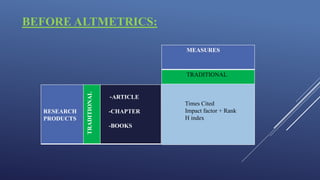
RESEARCH
PRODUCTS
TRADITIONAL
-ARTICLE
-CHAPTER
-BOOKS
MEASURES
TRADITIONAL
Times Cited
Impact factor + Rank
H index
BEFORE ALTMETRICS:
RESEARCH
PRODUCTS
TRADITIONAL
-ARTICLE
-CHAPTER
-BOOKS
MEASURES
TRADITIONAL
Times Cited
Impact factor + Rank
H index
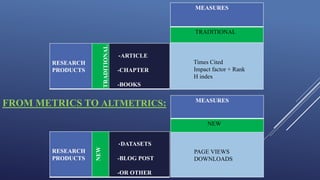
FROM METRICS TO ALTMETRICS:
RESEARCH
PRODUCTS
NEW
-DATASETS
-BLOG POST
-OR OTHER
MEASURES
NEW
PAGE VIEWS
DOWNLOADS
WHY THEY MATTER
 There is increasing understanding that scholarly research has moved beyond the printed
page and that traditional measures of impact are inadequate.
 Citations are only a small part of the scholarly ecosystem and only represent one type of
impact.
 Other media types of increasing importance such as data, tools, software, websites, videos,
etc. produced for or during the research process may be just as, or more, important than
the articles that accompany them.
 Since most research, including journal articles, are now electronic and networked we can
track how many times they are accessed, used, and shared.
 These numbers provide a more complete picture of the reach and impact of research and
scholarship; one that goes beyond citations in peer-reviewed publications.
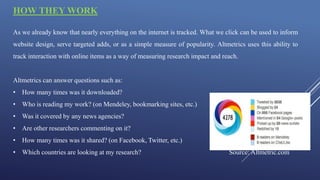
HOW THEY WORK
As we already know that nearly everything on the internet is tracked. What we click can be used to inform
website design, serve targeted adds, or as a simple measure of popularity. Altmetrics uses this ability to
track interaction with online items as a way of measuring research impact and reach.
Altmetrics can answer questions such as:
• How many times was it downloaded?
• Who is reading my work? (on Mendeley, bookmarking sites, etc.)
• Was it covered by any news agencies?
• Are other researchers commenting on it?
• How many times was it shared? (on Facebook, Twitter, etc.)
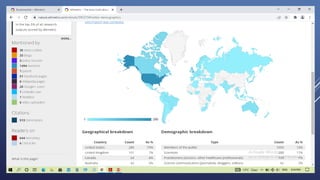
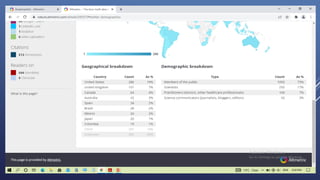
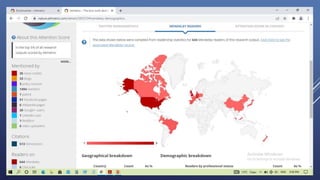
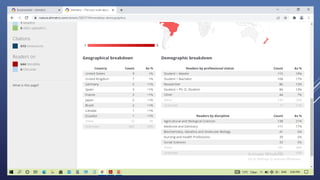
• Which countries are looking at my research? Source: Altmetric.com
HOW THEY WORK FOR RESEARCHERS
Altmetrics works in the following way for the researchers:
Monitor and track early engagement: It starts its tracking work as soon as the
article published with immediate feedback before any citation data arrived.
Showcase influence: It helps to show the evidences for the impact of work and
broader influence of work in a society or an academic community.
Identify most effective channels: It is useful to identify the channels where the
research work is discussed maximum i.e., where the work is gaining maximum
attention.
Seek out collaborators: it is helpful to know what is discussed about the work
and where it is discussing. Sometimes one can find the collaborators for research.
SERVICE PROVIDERS
Currently, four service providers stand out as pioneers that already have a product around
altmetrics: PLoS, Altmetric LLP, Impactstory, and PlumAnalytics.
The Public Library of Science-PLOS
The Public Library of Science (http://www.plosone.org/), or PLoS for short, was one of
the first publishers to provide article level metrics. Article Level Metrics (ALM) emerged
from an initiative of the PLoS to provide an alternative category for the classification of
articles as citable or non-citable items. Launched in 2009, ALM now provides different
impact and performance indicators, collecting data of different sources: views, saves,
discussions, recommendations, and citations.
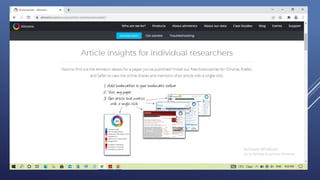
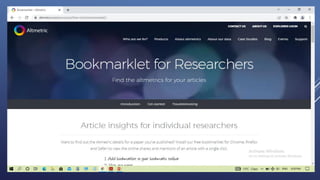
Altmetric.com
Altmetric.com has been set up in 2011 as a commercial enterprise providing social media outreach for
individual researchers and publishers. Its goal is to provide its customers information about the
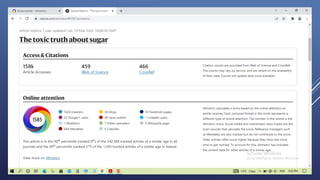
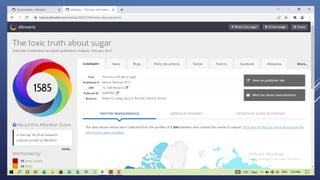
attention a single article receives. Altmetric.com has established a composite indicator that combines
different sources of data (news, videos, policy documents, Facebook, Twitter, LinkedIn, and Pinterest),
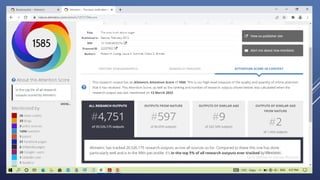
resulting in a single indicator visualized by different colors which is often termed ‘altmetric donut’.
The altmetric donut aims to inform about both ‘the quantity and quality of attention received by each
item’.
“Altmetric collects article level metrics and the online conversations around research on behalf of
publishers, institutions and funders, combining a selection of online indicators (both scholarly and
non-scholarly) to give a measurement of digital impact and reach. We do this by tracking, collecting
and measuring large amounts of data collected from all of the places where scientists, patient
advocates, journalists, nurses, engineers and members of the public talk about science online – for
example, blogs, Twitter, Facebook.”
http://www.altmetric.com/article-level-metrics.php
Plum Analytics
Plum Analytics was launched in the same year (2011) as a ‘for profit start up’ and has been set
up to provide new scholarly measures. Data and measures are collected at the group level of
organizations such as departments, museums, and labs. PlumAnalytics uses data of PloS ALM
and is hence regarded to be a ‘secondary aggregator’. Since 2014, PlumAnalytics is part of
EBSCO Information Services, a large provider of scientific information in the net. Similar to
Impact Story and ALM, PlumAnalytics covers four categories of data: Usage, Captures,
Mentions, Social Media, and Citations. In 2017, Plum Analytics joined Elsevier.
“Plum Analytics tracks more than 20 different types of artifacts, including journal articles,
books, videos, presentations, conference proceedings, datasets, source code, cases, and more…
We founded PlumTM Analytics to give researchers and funders a data advantage when it comes
to conveying a more comprehensive and time impact of their output.”
-http://www.plumanalytics.com/about.html/
Impactstory
Impact story launched in 2011 under the label ‘Total Impact’. Impactstory takes a completely different
approach and is mainly designed to give insights to researchers about their online visibility and impact
Researchers can connect their different online profiles (on, for instance, Figshare, GitHub, Google
Scholar, ORCID, Publons, Slideshare, and Twitter) to Impactstory and basically bring their research
products to Impactstory. Impactstory then aggregates the altmetrics from various sources (Including
Altmetric LLP and PLoS) to the research products and presents the metrics in the researcher’s profile on
Impactstory. Researchers can then use these profiles to enhance their CVs and demonstrate the attention
their research products and activities have received.
“Impactstory is an open-source, web-based tool that helps scientists explore and share the diverse
impacts of all their research products-from traditional ones like journal articles, to emerging products
like blog posts, datasets, and software. By helping scientists tell data-driven stories about their impacts.
We’re helping to build a new scholarly reward system that values and encourages web-native
scholarship.”
-https://impactstory.org.about
ALTMETRICS BY ITEM TYPE
ARTICLES
 Citations: Scopus, Web of Science, PubMed Central, and Google Scholar citations;
citations in policy documents
 Bookmarks: scholarly bookmarks on Mendeley & CiteULike; Twitter favorites
 Discussion: peer reviews on F1000, Publons, and other post-publication peer review
websites; Twitter mentions and Facebook wall posts; newspaper articles, videos, and
podcasts; mentions on scholarly blog networks like ResearchBlogging
 Shares: Twitter mentions, Facebook shares
 Views: Pageview & download statistics from the journal website or repository where
paper is archived
BOOKS AND BOOK CHAPTERS
 Citations: Web of Science and Scopus citations; Google Book citations
 WorldCat holdings: the number of libraries worldwide that have purchased the
book
 Views: Pageview & download statistics from your publisher's website or the
repository where book/chapter is archived.
 Ratings: Amazon.com and Goodreads ratings
DATA
 Citations: Data Citation Index and Google Scholar citations
 Views: views and downloads from Figshare, Zenodo, Dryad, ICPSR, or
other subject or institutional repositories
 Reuse: GitHub forks
 Discussion: Figshare comments.
SOFTWARE
 Citations: Google Scholar citations
 Downloads: download statistics from GitHub, Bitbucket, Sourceforge, or other
institutional or subject repository
 Adaptations: GitHub forks, Bitbucket clones
 Collaborators: GitHub collaborators
 Discussion: GitHub gists, mentions on Twitter, Figshare comments
VIDEOS
 Views: Youtube, Vimeo, and Figshare views
 Likes/Dislikes: Youtube likes and dislikes; Vimeo likes
 Discussion: Youtube, Vimeo, and Figshare comments
BENEFITS OF ALTMETRICS
 Capture elements of societal impact
Altmetrics data can inform researchers of elements of the societal impact of their research. For example,
altmetrics data can help researchers understand how their research is being interacted with by the public,
government, policy makers, and other researchers.
 Complement traditional metrics
Altmetrics provide a wider range of data, from a wider range of sources than traditional metrics. Altmetrics
data is also highly nuanced and can be provided in high detail and in the context in which it originates.
 Offer speed and discoverability
Altmetrics data accumulates at a faster speed compared to traditional metrics. In disciplines where citations
grow slowly, or in the context of new researchers, this speed helps determine which outputs are gaining
online attention.
 Open access advantage
Providers like Altmetric.com and ImpactStory provide access to their API and source code. Altmetrics
providers also pull their data from open sources, who give access to their APIs or raw usage data, which
makes altmetrics data more easily replicable than data in proprietary databases.
ROLE OF ALTMETRICS IN LIBRARY & INFORMATION SCIENCE
Now a day's librarians have a keen interest in new trends and their usage in libraries to provide effecive
services to its users. Altmetric is one such metrics which helps librarians to support their institution and
researcher with the help of its various tools. So, the role of altmetrics in supporting librarians is as follows:
ACADEMIC LIBRARIES: As altmetrics is just adding the value to what the librarians are doing
traditionally by filling up gaps. So, altmetrics provides opportunities for the academic librarians for
effective decision making by providing in depth quantiative measurement of recent trends. It also uses the
concept of big data in presenting the moving trend of researchers to digital world and research
conversations on social media sites.
INSTITUTIONAL SUPPORT: use of altmetrics for the scholarly research work i.e. measuring the
research impact via altmetrics is one of the activities of academic libraries in order to support or help
researcher or institutions to understand their own research impact.
OPEN ACCESS: Open acces is one of a major factor in the development of altmetrics, as the articles
present in open access are the first one to get read, review and to provide article level altmetrics.
ROLE OF ALTMETRICS IN LIBRARY & INFORMATION SCIENCE
(CONTD…)
COLLECTION DEVELOPMENT: Altmetrics helps in good collection development rather than just a
collection growth in academic libraries by providing altmetric overlay for the usage of journals that will
complement the standard COUNTER for statistics provided by the publishers. There are some of the
categories for the established citations and usage by plum but it is planning to expand these categories:
captures(bookmarks, favourities on slideshare, followers on GitHub, groups in Mendeley, etc),
mentions(reviews on Amazon, SourceForge, links from Wikipedia, comments on YouTube, etc) and
social media(Tweets, shares, recommendations on Figshare, ratings on SourceForge, etc).
In short, Altmetrics helps in identifying prominent journals for institutions and also helps them in taking
decisions on which journals they should subscribe or retain. With their ability to track the online activity
of scholarly publications they can help libraries in collection development, intergration of scholarly
publication in institutional repository, open access platforms and supporting research.
REFERENCES:
Altmetrics Eveything you need to get you started with altmetrics. Iowa state university university library.
https://instr.iastate.libguides.com/altmetrics/home
Altmetric.com, "What are altmetrics?," Available: www.altmetric.com
Altmetrics: What Are Altmetrics? University of Waterloo.
https://subjectguides.uwaterloo.ca/c.php?g=695622&p=5174428
Alternative Metrics Initiative Phase 1 White Paper. National Information Standards Organization
(NISO). (2014, June 6). https://groups.niso.org/apps/group_public/download.php/13809/Altmetris
project_phase1_white_paper
Course & Subject Guides, Introduction to altmetrics. University of Pittsburg Library system.
https://pitt.libguides.com/altmetrics
Heydari, S., Shekofteh, M., & Kazerani, M. (2019). Relationship between Altmetrics and Citations A
Study on the Highly Cited Research Papers. DESIDOC Journal of Library & Information
Technology, 39(4), 169-174. https://doi.org/10.14429/djlit.39.4.14204
CONT…
REFERENCES (Contd…)
Holmberg, Kim. (2015). Altmetrics for Information Professionals: Past, Present and Future.
J. Priem, D. Taraborelli, P. Groth, C. Neylon (2010), Altmetrics: A manifesto, 26 October
2010. http://altmetrics.org/manifesto
Moed, H. F., De Bruin, R. E., & Van Leeuwen, T. N. (1995). New bibliometric tools for the
assessment of national research performance-Database description, overview of indicators
and first applications. Scientometrics, 33(3), 381-422.
Publication Metrics: Article Metrics. Duke university medical central library & archives.
https://guides.mclibrary.duke.edu/researchimpact/article
"Principles and Strategies for the Reform of Scholarly Communication 1", American Library
Association, September 1, 2006.
http://www.ala.org/acrl/publications/whitepapers/principlesstrategies (Accessed March 19,
2022)
REFERENCES (Contd…)
Sutton, Sarah. (2014). Altmetrics: What Good are They to Academic Libraries?. Kansas Library
Association College and University Libraries Section Proceedings. 4. 10.4148/2160-942X.1041.
Verma, Sapna & Margam, Madhusudhan & Ks, Abu. (2018). Altmetrics: A new way of assessing
research impact beyond citations.
Verma, Sapna. (2018). Altmetrics: Working for Scholarly Communication.
THANK YOU

ALTMETRICS

  • 1.
    ALTMETRICS Nadeem Nazir Mphil Scholar RollNo. Mphil 202210 Department of library & Information science, University of Delhi
  • 2.
    CONTENTS 1. Introduction 2. Scholarlycommunication and social media 3. Scholarly communication to social media 4. What are altmetrics? 5. Birth of altmetrics 6. Before altmetrics 7. From metrics to altmetrics 8. Why they matter? 9. How they work? 10. Service providers 11. Altmetrics by item type 12. Benefits of altmetrics 13. Role of altmetrics in library & information science 14. References
  • 3.
    INTRODUCTION Scholarly communication isthe system through which research and other scholarly writings are created, evaluated for quality, disseminated to the scholarly community, and preserved for future use. The system includes both formal means of communication, such as publication in peer-reviewed journals, and informal channels, such as electronic channels. During earlier times or classic research era when the journals were published in printed form, there were very few or less people engaged with research. With passing time more and more people start writing which gave rise to information explosion, ultimately lead to information overload, making it difficult to rely on printed material. The revolution of IT and the emergence of IT in Academic writing gave rise to electronic publishing by which information became more accessible, useful and available worldwide. With the abundance of scholarly literature available and the continuous flow of research outputs it becomes obligatory to check the quality and validity of everything that gets published in order to build trust among the people who are relying on the scholarly information. The process by which the quality, validity or authenticity of any scholarly content is checked is called as peer review process.
  • 4.
    INTRODUCTION (Contd…) The goalof any peer review process or research assessment is to evaluate the value or quality of the research in comparison to other research. As quality is highly subjective and difficult to measure, citations are used as a proxy. Citations are an important part of scholarly communication and a significant component of research evaluation, with the assumption being that highly cited work has influenced the work of many other researchers and hence it is more valuable.
  • 5.
    SCHOLARLY COMMUNICATION &SOCIAL MEDIA Every researcher wants to know the practical impact of their research in a society or an academic community, so they are trying to interact with many latest technologies or tools to know the influence of research. Nowadays researchers are using social media to increase their research impact. For a researcher, Social media = Citations Blogging = Reputation & Presence Twitter = Dissemination & Engagement
  • 6.
    SCHOLARLY COMMUNICATION TOSOCIAL MEDIA The advent of social media has already changed many aspects of scholarly communication; researchers can now present their ideas in blogs, discuss their research with colleagues on Facebook, and share their articles on Twitter and Mendeley. Because research is increasingly being brought out from the closed scientific ecosystems to the open web, even people other than just researchers can participate in discussing research and disseminating new discoveries to a wider audience. New forms of scholarly communication require new methods for measurement of impact.
  • 7.
    ALT+METRICS The term Altmetricswas originally defined by Jason Priem as “the creation and study of new metrics based on the Social Web for tracking, analyzing, and informing scholarship or as a form of information filtering tool”. Altmetrics are metrics and qualitative data that are complementary to traditional, citation-based metrics. They can include (but are not limited to) peer reviews on Faculty of 1000, citations on Wikipedia and in public policy documents, discussions on research blogs, mainstream media coverage, bookmarks on reference managers like Mendeley, and mentions on social networks such as Twitter. Source: https://www.altmetrics.com
  • 8.
    What are Altmetrics? Altmetricsstands for "alternative metrics." The "alternative" part references traditional measurements of academic success such as citation counts, journal prestige (impact factor), and author H-index. Altmetrics are meant to complement, not totally replace, these traditional measures. Altmetrics let us measure and monitor the reach and impact of scholarship and research through online interactions. Altmetrics expand our view of what impact looks like, but also of what’s making the impact. This matters because expressions of scholarship are becoming more diverse. Simply, altmetrics are metrics beyond traditional citations. Source: http://altmetrics.org/manifesto/ Scholarship The character, qualities, activity, or attainments of a scholar. (Merriam-Webster)
  • 9.
    BIRTH OF ALTMETRICS Thebirth of Altmetrics can be traced back to a few developmental steps and a few events that have changed scholarly communication and the way we look at research evaluation. Chronologically, the first step happened when researchers started to use the web in general, and later on social media in particular, for scholarly communication. The second step happened when the Public Library of Science (PLoS) developed a system to present article-level metrics or ALMs, showing not just the impact of articles, but also how articles had been viewed, discussed and shared. The way how PLoS presents its ALMs had developed a sophisticated system, presenting many different levels of engagement with the articles and, with that, different levels of impact. In 2010 Jason Priem, Dario Taraborelli, Paul Groth, and Cameron Neylon published the Altmetrics Manifesto (http://altmetrics.org/manifesto/), which begins by stating that “No one can read everything. We rely on filters to make sense of the scholarly literature, but the narrow, traditional filters are being swamped. However, the growth of new, online scholarly tools allows us to make new filters; these altmetrics reflect the broad, rapid impact of scholarship in the burgeoning ecosystem. We call for more tools and research based on altmetrics.”
  • 10.
    BEFORE ALTMETRICS Traditional productsand measures of academic success:-  Publications  Conference Presentations  Number of times cited  Impact Factor and Journal Rank  H-Index
  • 11.
  • 12.
    RESEARCH PRODUCTS TRADITIONAL -ARTICLE -CHAPTER -BOOKS MEASURES TRADITIONAL Times Cited Impact factor+ Rank H index FROM METRICS TO ALTMETRICS: RESEARCH PRODUCTS NEW -DATASETS -BLOG POST -OR OTHER MEASURES NEW PAGE VIEWS DOWNLOADS
  • 13.
    WHY THEY MATTER There is increasing understanding that scholarly research has moved beyond the printed page and that traditional measures of impact are inadequate.  Citations are only a small part of the scholarly ecosystem and only represent one type of impact.  Other media types of increasing importance such as data, tools, software, websites, videos, etc. produced for or during the research process may be just as, or more, important than the articles that accompany them.  Since most research, including journal articles, are now electronic and networked we can track how many times they are accessed, used, and shared.  These numbers provide a more complete picture of the reach and impact of research and scholarship; one that goes beyond citations in peer-reviewed publications.
  • 14.
    HOW THEY WORK Aswe already know that nearly everything on the internet is tracked. What we click can be used to inform website design, serve targeted adds, or as a simple measure of popularity. Altmetrics uses this ability to track interaction with online items as a way of measuring research impact and reach. Altmetrics can answer questions such as: • How many times was it downloaded? • Who is reading my work? (on Mendeley, bookmarking sites, etc.) • Was it covered by any news agencies? • Are other researchers commenting on it? • How many times was it shared? (on Facebook, Twitter, etc.) • Which countries are looking at my research? Source: Altmetric.com
  • 15.
    HOW THEY WORKFOR RESEARCHERS Altmetrics works in the following way for the researchers: Monitor and track early engagement: It starts its tracking work as soon as the article published with immediate feedback before any citation data arrived. Showcase influence: It helps to show the evidences for the impact of work and broader influence of work in a society or an academic community. Identify most effective channels: It is useful to identify the channels where the research work is discussed maximum i.e., where the work is gaining maximum attention. Seek out collaborators: it is helpful to know what is discussed about the work and where it is discussing. Sometimes one can find the collaborators for research.
  • 16.
    SERVICE PROVIDERS Currently, fourservice providers stand out as pioneers that already have a product around altmetrics: PLoS, Altmetric LLP, Impactstory, and PlumAnalytics. The Public Library of Science-PLOS The Public Library of Science (http://www.plosone.org/), or PLoS for short, was one of the first publishers to provide article level metrics. Article Level Metrics (ALM) emerged from an initiative of the PLoS to provide an alternative category for the classification of articles as citable or non-citable items. Launched in 2009, ALM now provides different impact and performance indicators, collecting data of different sources: views, saves, discussions, recommendations, and citations.
  • 17.
    Altmetric.com Altmetric.com has beenset up in 2011 as a commercial enterprise providing social media outreach for individual researchers and publishers. Its goal is to provide its customers information about the attention a single article receives. Altmetric.com has established a composite indicator that combines different sources of data (news, videos, policy documents, Facebook, Twitter, LinkedIn, and Pinterest), resulting in a single indicator visualized by different colors which is often termed ‘altmetric donut’. The altmetric donut aims to inform about both ‘the quantity and quality of attention received by each item’. “Altmetric collects article level metrics and the online conversations around research on behalf of publishers, institutions and funders, combining a selection of online indicators (both scholarly and non-scholarly) to give a measurement of digital impact and reach. We do this by tracking, collecting and measuring large amounts of data collected from all of the places where scientists, patient advocates, journalists, nurses, engineers and members of the public talk about science online – for example, blogs, Twitter, Facebook.” http://www.altmetric.com/article-level-metrics.php
  • 18.
    Plum Analytics Plum Analyticswas launched in the same year (2011) as a ‘for profit start up’ and has been set up to provide new scholarly measures. Data and measures are collected at the group level of organizations such as departments, museums, and labs. PlumAnalytics uses data of PloS ALM and is hence regarded to be a ‘secondary aggregator’. Since 2014, PlumAnalytics is part of EBSCO Information Services, a large provider of scientific information in the net. Similar to Impact Story and ALM, PlumAnalytics covers four categories of data: Usage, Captures, Mentions, Social Media, and Citations. In 2017, Plum Analytics joined Elsevier. “Plum Analytics tracks more than 20 different types of artifacts, including journal articles, books, videos, presentations, conference proceedings, datasets, source code, cases, and more… We founded PlumTM Analytics to give researchers and funders a data advantage when it comes to conveying a more comprehensive and time impact of their output.” -http://www.plumanalytics.com/about.html/
  • 19.
    Impactstory Impact story launchedin 2011 under the label ‘Total Impact’. Impactstory takes a completely different approach and is mainly designed to give insights to researchers about their online visibility and impact Researchers can connect their different online profiles (on, for instance, Figshare, GitHub, Google Scholar, ORCID, Publons, Slideshare, and Twitter) to Impactstory and basically bring their research products to Impactstory. Impactstory then aggregates the altmetrics from various sources (Including Altmetric LLP and PLoS) to the research products and presents the metrics in the researcher’s profile on Impactstory. Researchers can then use these profiles to enhance their CVs and demonstrate the attention their research products and activities have received. “Impactstory is an open-source, web-based tool that helps scientists explore and share the diverse impacts of all their research products-from traditional ones like journal articles, to emerging products like blog posts, datasets, and software. By helping scientists tell data-driven stories about their impacts. We’re helping to build a new scholarly reward system that values and encourages web-native scholarship.” -https://impactstory.org.about
  • 20.
  • 21.
    ARTICLES  Citations: Scopus,Web of Science, PubMed Central, and Google Scholar citations; citations in policy documents  Bookmarks: scholarly bookmarks on Mendeley & CiteULike; Twitter favorites  Discussion: peer reviews on F1000, Publons, and other post-publication peer review websites; Twitter mentions and Facebook wall posts; newspaper articles, videos, and podcasts; mentions on scholarly blog networks like ResearchBlogging  Shares: Twitter mentions, Facebook shares  Views: Pageview & download statistics from the journal website or repository where paper is archived
  • 22.
    BOOKS AND BOOKCHAPTERS  Citations: Web of Science and Scopus citations; Google Book citations  WorldCat holdings: the number of libraries worldwide that have purchased the book  Views: Pageview & download statistics from your publisher's website or the repository where book/chapter is archived.  Ratings: Amazon.com and Goodreads ratings
  • 23.
    DATA  Citations: DataCitation Index and Google Scholar citations  Views: views and downloads from Figshare, Zenodo, Dryad, ICPSR, or other subject or institutional repositories  Reuse: GitHub forks  Discussion: Figshare comments.
  • 24.
    SOFTWARE  Citations: GoogleScholar citations  Downloads: download statistics from GitHub, Bitbucket, Sourceforge, or other institutional or subject repository  Adaptations: GitHub forks, Bitbucket clones  Collaborators: GitHub collaborators  Discussion: GitHub gists, mentions on Twitter, Figshare comments
  • 25.
    VIDEOS  Views: Youtube,Vimeo, and Figshare views  Likes/Dislikes: Youtube likes and dislikes; Vimeo likes  Discussion: Youtube, Vimeo, and Figshare comments
  • 36.
    BENEFITS OF ALTMETRICS Capture elements of societal impact Altmetrics data can inform researchers of elements of the societal impact of their research. For example, altmetrics data can help researchers understand how their research is being interacted with by the public, government, policy makers, and other researchers.  Complement traditional metrics Altmetrics provide a wider range of data, from a wider range of sources than traditional metrics. Altmetrics data is also highly nuanced and can be provided in high detail and in the context in which it originates.  Offer speed and discoverability Altmetrics data accumulates at a faster speed compared to traditional metrics. In disciplines where citations grow slowly, or in the context of new researchers, this speed helps determine which outputs are gaining online attention.  Open access advantage Providers like Altmetric.com and ImpactStory provide access to their API and source code. Altmetrics providers also pull their data from open sources, who give access to their APIs or raw usage data, which makes altmetrics data more easily replicable than data in proprietary databases.
  • 37.
    ROLE OF ALTMETRICSIN LIBRARY & INFORMATION SCIENCE Now a day's librarians have a keen interest in new trends and their usage in libraries to provide effecive services to its users. Altmetric is one such metrics which helps librarians to support their institution and researcher with the help of its various tools. So, the role of altmetrics in supporting librarians is as follows: ACADEMIC LIBRARIES: As altmetrics is just adding the value to what the librarians are doing traditionally by filling up gaps. So, altmetrics provides opportunities for the academic librarians for effective decision making by providing in depth quantiative measurement of recent trends. It also uses the concept of big data in presenting the moving trend of researchers to digital world and research conversations on social media sites. INSTITUTIONAL SUPPORT: use of altmetrics for the scholarly research work i.e. measuring the research impact via altmetrics is one of the activities of academic libraries in order to support or help researcher or institutions to understand their own research impact. OPEN ACCESS: Open acces is one of a major factor in the development of altmetrics, as the articles present in open access are the first one to get read, review and to provide article level altmetrics.
  • 38.
    ROLE OF ALTMETRICSIN LIBRARY & INFORMATION SCIENCE (CONTD…) COLLECTION DEVELOPMENT: Altmetrics helps in good collection development rather than just a collection growth in academic libraries by providing altmetric overlay for the usage of journals that will complement the standard COUNTER for statistics provided by the publishers. There are some of the categories for the established citations and usage by plum but it is planning to expand these categories: captures(bookmarks, favourities on slideshare, followers on GitHub, groups in Mendeley, etc), mentions(reviews on Amazon, SourceForge, links from Wikipedia, comments on YouTube, etc) and social media(Tweets, shares, recommendations on Figshare, ratings on SourceForge, etc). In short, Altmetrics helps in identifying prominent journals for institutions and also helps them in taking decisions on which journals they should subscribe or retain. With their ability to track the online activity of scholarly publications they can help libraries in collection development, intergration of scholarly publication in institutional repository, open access platforms and supporting research.
  • 39.
    REFERENCES: Altmetrics Eveything youneed to get you started with altmetrics. Iowa state university university library. https://instr.iastate.libguides.com/altmetrics/home Altmetric.com, "What are altmetrics?," Available: www.altmetric.com Altmetrics: What Are Altmetrics? University of Waterloo. https://subjectguides.uwaterloo.ca/c.php?g=695622&p=5174428 Alternative Metrics Initiative Phase 1 White Paper. National Information Standards Organization (NISO). (2014, June 6). https://groups.niso.org/apps/group_public/download.php/13809/Altmetris project_phase1_white_paper Course & Subject Guides, Introduction to altmetrics. University of Pittsburg Library system. https://pitt.libguides.com/altmetrics Heydari, S., Shekofteh, M., & Kazerani, M. (2019). Relationship between Altmetrics and Citations A Study on the Highly Cited Research Papers. DESIDOC Journal of Library & Information Technology, 39(4), 169-174. https://doi.org/10.14429/djlit.39.4.14204 CONT…
  • 40.
    REFERENCES (Contd…) Holmberg, Kim.(2015). Altmetrics for Information Professionals: Past, Present and Future. J. Priem, D. Taraborelli, P. Groth, C. Neylon (2010), Altmetrics: A manifesto, 26 October 2010. http://altmetrics.org/manifesto Moed, H. F., De Bruin, R. E., & Van Leeuwen, T. N. (1995). New bibliometric tools for the assessment of national research performance-Database description, overview of indicators and first applications. Scientometrics, 33(3), 381-422. Publication Metrics: Article Metrics. Duke university medical central library & archives. https://guides.mclibrary.duke.edu/researchimpact/article "Principles and Strategies for the Reform of Scholarly Communication 1", American Library Association, September 1, 2006. http://www.ala.org/acrl/publications/whitepapers/principlesstrategies (Accessed March 19, 2022)
  • 41.
    REFERENCES (Contd…) Sutton, Sarah.(2014). Altmetrics: What Good are They to Academic Libraries?. Kansas Library Association College and University Libraries Section Proceedings. 4. 10.4148/2160-942X.1041. Verma, Sapna & Margam, Madhusudhan & Ks, Abu. (2018). Altmetrics: A new way of assessing research impact beyond citations. Verma, Sapna. (2018). Altmetrics: Working for Scholarly Communication.
  • 42.