Biochemical Activities
Bacteria
BIOCHEMICAL TESTS FOR IDENTIFICATION OF BACTERIA
 Biochemical activities of bacteria are used for their identification.
These
activities include nutrient utilization, enzyme production, .
 The types of biochemical reactions each organism undergoes act
as a
"thumbprint" for its identification.
 This is based on the following chain of logic:
 Each different species of bacterium has a different molecule of DNA, which
codes for protein synthesis.
 Different species of bacteria must, by way of their unique DNA, be able to
synthesize different protein enzymes.
 Enzymes catalyze all the various chemical reactions of which the organism is
capable.
 This in turn means that different species of bacteria must carry out different and
unique sets of biochemical reactions.
BIOCHEMICAL TESTS FOR IDENTIFICATION OF BACTERIA
Carbohydrate Fermentation
• Aim To determine the ability of microorganisms to degrade and
ferment
carbohydrate with the production of acid and gas Principle
• Most microorganisms use carbohydrate differently depending on
their
enzymes components.
• In fermentation, substrate and alcohols undergo anaerobic dissimilation and
produce an organic acid (For example lactic acid, formic acid or acetic acid).
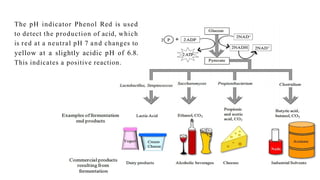
The pH indicator Phenol Red is used
to detect the production of acid, which
is red at a neutral pH 7 and changes to
yellow at a slightly acidic pH of 6.8.
This indicates a positive reaction.
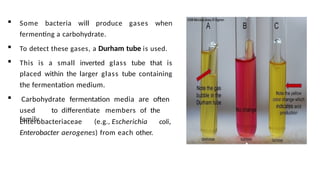
 Some bacteria will produce gases when
fermenting a carbohydrate.
 To detect these gases, a Durham tube is used.
 This is a small inverted glass tube that is
placed within the larger glass tube containing
the fermentation medium.
 Carbohydrate fermentation media are often
used to differentiate members of the
family
Enterobacteriaceae (e.g., Escherichia
Enterobacter aerogenes) from each other.
coli,
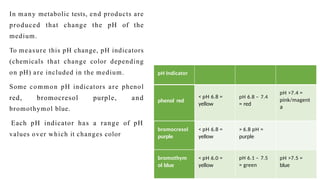
pH Indicator
phenol red
< pH 6.8 =
yellow
pH 6.8 – 7.4
= red
pH >7.4 =
pink/magent
a
bromocresol
purple
< pH 6.8 =
yellow
> 6.8 pH =
purple
bromothym
ol blue
< pH 6.0 =
yellow
pH 6.1 – 7.5
= green
pH >7.5 =
blue
In many metabolic tests, end products are
produced that change the pH of the
medium.
To measure this pH change, pH indicators
(chemicals that change color depending
on pH) are included in the medium.
Some common pH indicators are phenol
red, bromocresol purple, and
bromothymol blue.
Each pH indicator has a range of pH
values over which it changes color
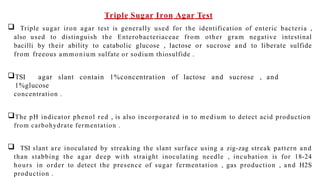
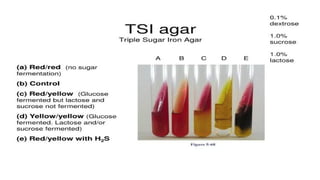
Triple Sugar Iron Agar Test
 Triple sugar iron agar test is generally used for the identification of enteric bacteria ,
also used to distinguish the Enterobacteriaceae from other gram negative intestinal
bacilli by their ability to catabolic glucose , lactose or sucrose and to liberate sulfide
from freeous ammonium sulfate or sodium thiosulfide .
TSI agar slant contain 1%concentration of lactose and sucrose , and
1%glucose
concentration .
The pH indicator phenol red , is also incorporated in to medium to detect acid production
from carbohydrate fermentation .
 TSI slant are inoculated by streaking the slant surface using a zig-zag streak pattern and
than stabbing the agar deep with straight inoculating needle , incubation is for 18-24
hours in order to detect the presence of sugar fermentation , gas production , and H2S
production .
Urease
• Detects hydrolysis of urea to ammonia by urease enzyme
• Ammonia causes an increase in pH which is detected by the pH indicator
(orange ‡ pink) Urease +ve bacteria: – Proteus – Klebsiella
Oxidase
• Detects cytochrome oxidase enzyme that converts dimethylphenyldiamine to
indophenol blue (clear to blue)
• Oxidase +ve bacteria: – Pseudomonas – Vibrio
Nitrate
• Detects nitrate reductase enzyme which converts nitrate to nitrite.
• Nitrite then revealed by addition of naphthylamine and sulfinic acid to form diazonium
dye (clear to red) Nitrate +ve bacteria: – E.coli – Klebsiella
Catalase
• To determine the ability of bacteria that produces Catalase enzyme which degrades the
hydrogen peroxide.
• In aerobic organisms, during aerobic respiration, oxygen serves as hydrogen acceptor
and hydrogen peroxide is formed in the cell.
• High concentration of H2O2 is formed which is toxic to cell.
• Bacteria posses the catalase enzyme converts hydrogen peroxide into oxygen and water
Coagulase
• Staphylococcus aureus is known to produce coagulase, which can clot plasma into gel in
tube or agglutinate cocci in slide.
• This test is useful in differentiating S.aureus from other coagulase-negative staphylococci.
• Most strains of S.aureus produce two types of coagulase, free coagulase and
bound
coagulase.
• While free coagulase is an enzyme that is secreted extracellularly, bound coagulase is a cell
wall associated protein.
• Free coagulase is detected in tube coagulase test and bound coagulase is detected in slide
coagulase test.
• Slide coagulase test may be used to screen isolates of S. aureus and tube coagulase may be
used for confirmation..
Gelatinase
• Principle of Gelatin Hydrolysis Test
• This test is used to determine the ability of an organism to produce
extracellular
proteolytic enzymes, gelatinases that hydrolyze gelatin.
• The reaction occurs in two sequential steps: in first reaction gelatinases hydrolyze gelatin
into polypeptides and then polypeptides are further converted into amino acids
• The amino acids are taken up by the cell and used for metabolic purposes.
• It distinguishes the gelatinase-positive, pathogenic Staphylococcus
aureus
gelatinase-negative, non-pathogenic S. epidermidis
from the
• The test can also be used to differentiate genera of gelatinase-producing bacteria
• such Serratia and Proteus from other members of the family Enterobacteriaceae.
IMViC Test
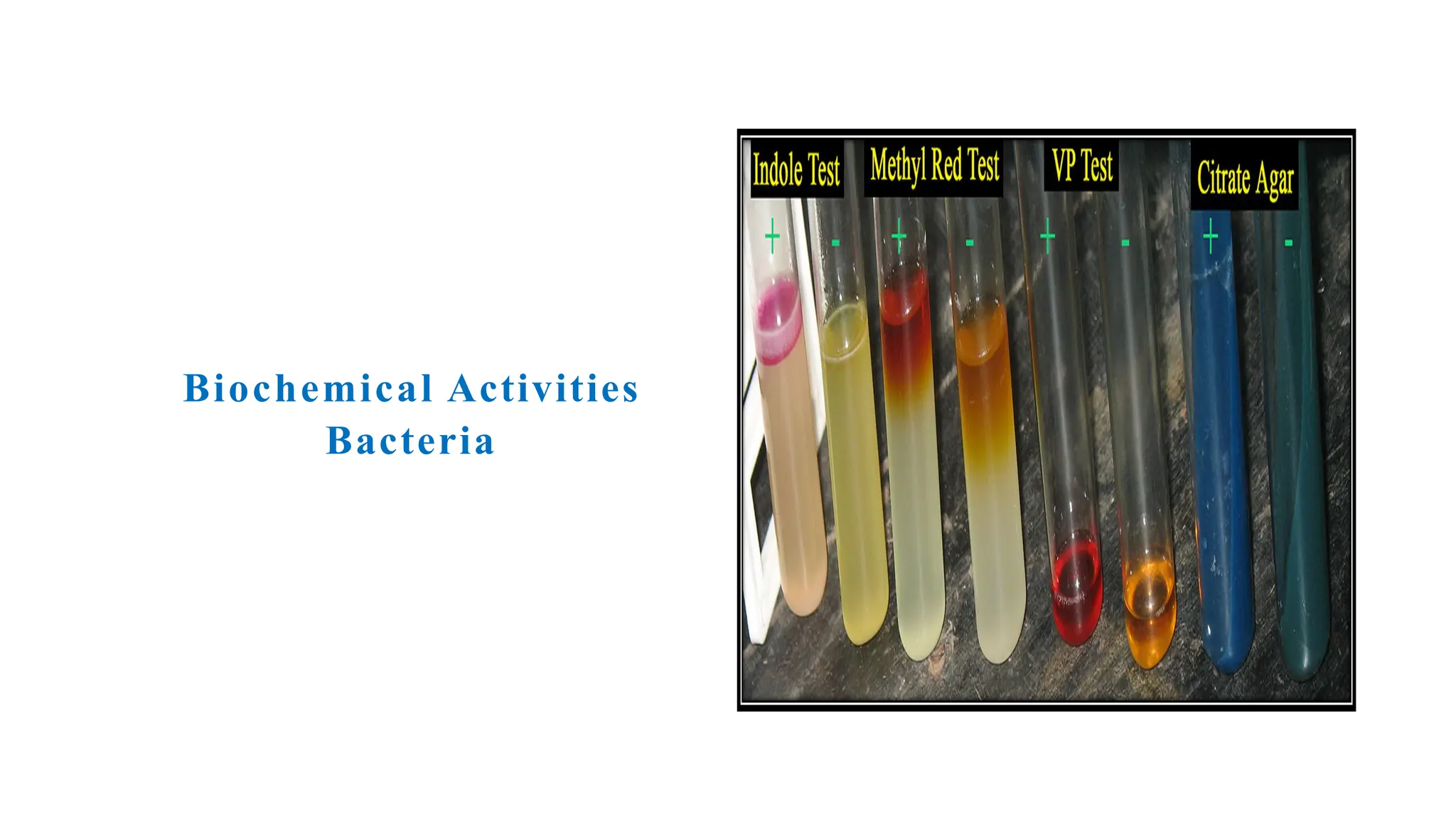
I = test for production indole from tryptophan.
M = methyl red test for acid production from glucose .
V = voges-proskauer test for production of acetoin from glucose .
C = test for the use of citrate as the sole for carbon source .
The IMViC Test
The identification of enteric bacteria is of prime importance in determining
certain food born and water borne disease .
Many of the bacteria that are found in the intestines of humans and
mammals belong to the family of Enterobacteriaceae .
These bacteria are short , gram negative , non sporing bacilli .
They can be subdivided into lactose fermenters and non fermenters
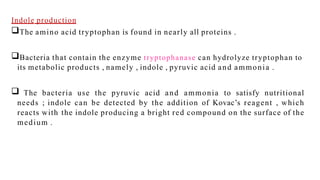
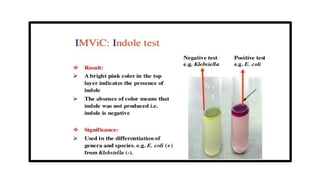
Indole production
The amino acid tryptophan is found in nearly all proteins .
Bacteria that contain the enzyme tryptophanase can hydrolyze tryptophan to
its metabolic products , namely , indole , pyruvic acid and ammonia .
 The bacteria use the pyruvic acid and ammonia to satisfy nutritional
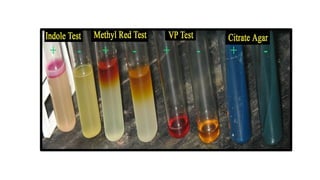
needs ; indole can be detected by the addition of Kovac’s reagent , which
reacts with the indole producing a bright red compound on the surface of the
medium .
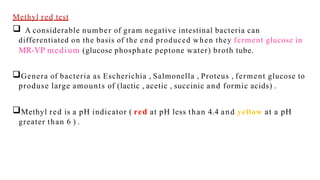
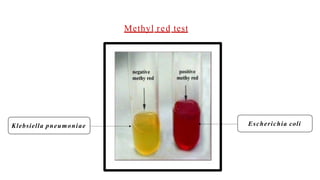
Methyl red test
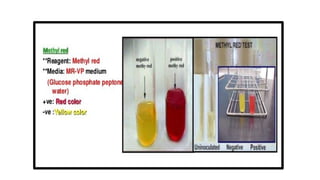
 A considerable number of gram negative intestinal bacteria can
differentiated on the basis of the end produced when they ferment glucose in
MR-VP medium (glucose phosphate peptone water) broth tube.
Genera of bacteria as Escherichia , Salmonella , Proteus , ferment glucose to
produse large amounts of (lactic , acetic , succinic and formic acids) .
Methyl red is a pH indicator ( red at pH less than 4.4 and yellow at a pH
greater than 6 ) .
Escherichia coli
Klebsiella pneumoniae
Methyl red test
Voges-Proskauer test
 The Voges – Proskauer test identifies the bacteria that ferment
glucose , leading to 2,3 butanediol accumulation in the medium the
addition of 40% KOH and 5% solution of α-naphthol in absolute ethanol
( Barrit’s reagent ).
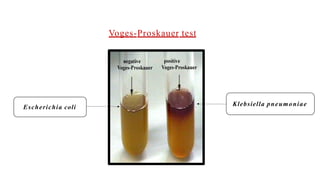
 In the presence of the reagent and action a cherry red color develops in
the culture medium 15 minutes following the addition of Barrit’s
reagent represents apositive VP test ; absence of red color is negative VP
test.
Klebsiella pneumoniae
Escherichia coli
Voges-Proskauer test
Citrate utilization
This test determines the ability of bacteria to use citrate as a sole carbon
source for their energy needs .
This ability depends on the presence of citrate permease that facilitates
transport of citrate into the bacterium .
Once inside the bacterium , citrate is converted to pyruvic acid and CO2.
 Simmon citrate agar slant contain sodium citrate as the ( carbon
source) ammonium ion (NH4) as the ( nitrogen source) & the pH
indicator (Bromothymol blue) .
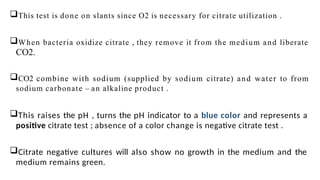
This test is done on slants since O2 is necessary for citrate utilization .
When bacteria oxidize citrate , they remove it from the medium and liberate
CO2.
CO2 combine with sodium (supplied by sodium citrate) and water to from
sodium carbonate – an alkaline product .
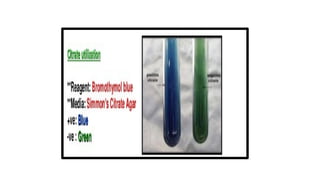
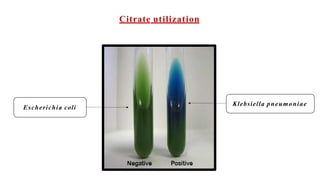
This raises the pH , turns the pH indicator to a blue color and represents a
positive citrate test ; absence of a color change is negative citrate test .
Citrate negative cultures will also show no growth in the medium and the
medium remains green.
Klebsiella pneumoniae
Escherichia coli
Citrate utilization
biochimical test_Converted for med lab tech.pptx

biochimical test_Converted for med lab tech.pptx

  • 1.
  • 2.
    BIOCHEMICAL TESTS FORIDENTIFICATION OF BACTERIA  Biochemical activities of bacteria are used for their identification. These activities include nutrient utilization, enzyme production, .  The types of biochemical reactions each organism undergoes act as a "thumbprint" for its identification.  This is based on the following chain of logic:  Each different species of bacterium has a different molecule of DNA, which codes for protein synthesis.
  • 3.
     Different speciesof bacteria must, by way of their unique DNA, be able to synthesize different protein enzymes.  Enzymes catalyze all the various chemical reactions of which the organism is capable.  This in turn means that different species of bacteria must carry out different and unique sets of biochemical reactions. BIOCHEMICAL TESTS FOR IDENTIFICATION OF BACTERIA
  • 4.
    Carbohydrate Fermentation • AimTo determine the ability of microorganisms to degrade and ferment carbohydrate with the production of acid and gas Principle • Most microorganisms use carbohydrate differently depending on their enzymes components. • In fermentation, substrate and alcohols undergo anaerobic dissimilation and produce an organic acid (For example lactic acid, formic acid or acetic acid).
  • 5.
    The pH indicatorPhenol Red is used to detect the production of acid, which is red at a neutral pH 7 and changes to yellow at a slightly acidic pH of 6.8. This indicates a positive reaction.
  • 6.
     Some bacteriawill produce gases when fermenting a carbohydrate.  To detect these gases, a Durham tube is used.  This is a small inverted glass tube that is placed within the larger glass tube containing the fermentation medium.  Carbohydrate fermentation media are often used to differentiate members of the family Enterobacteriaceae (e.g., Escherichia Enterobacter aerogenes) from each other. coli,
  • 7.
    pH Indicator phenol red <pH 6.8 = yellow pH 6.8 – 7.4 = red pH >7.4 = pink/magent a bromocresol purple < pH 6.8 = yellow > 6.8 pH = purple bromothym ol blue < pH 6.0 = yellow pH 6.1 – 7.5 = green pH >7.5 = blue In many metabolic tests, end products are produced that change the pH of the medium. To measure this pH change, pH indicators (chemicals that change color depending on pH) are included in the medium. Some common pH indicators are phenol red, bromocresol purple, and bromothymol blue. Each pH indicator has a range of pH values over which it changes color
  • 8.
    Triple Sugar IronAgar Test  Triple sugar iron agar test is generally used for the identification of enteric bacteria , also used to distinguish the Enterobacteriaceae from other gram negative intestinal bacilli by their ability to catabolic glucose , lactose or sucrose and to liberate sulfide from freeous ammonium sulfate or sodium thiosulfide . TSI agar slant contain 1%concentration of lactose and sucrose , and 1%glucose concentration . The pH indicator phenol red , is also incorporated in to medium to detect acid production from carbohydrate fermentation .  TSI slant are inoculated by streaking the slant surface using a zig-zag streak pattern and than stabbing the agar deep with straight inoculating needle , incubation is for 18-24 hours in order to detect the presence of sugar fermentation , gas production , and H2S production .
  • 10.
    Urease • Detects hydrolysisof urea to ammonia by urease enzyme • Ammonia causes an increase in pH which is detected by the pH indicator (orange ‡ pink) Urease +ve bacteria: – Proteus – Klebsiella Oxidase • Detects cytochrome oxidase enzyme that converts dimethylphenyldiamine to indophenol blue (clear to blue) • Oxidase +ve bacteria: – Pseudomonas – Vibrio
  • 11.
    Nitrate • Detects nitratereductase enzyme which converts nitrate to nitrite. • Nitrite then revealed by addition of naphthylamine and sulfinic acid to form diazonium dye (clear to red) Nitrate +ve bacteria: – E.coli – Klebsiella Catalase • To determine the ability of bacteria that produces Catalase enzyme which degrades the hydrogen peroxide. • In aerobic organisms, during aerobic respiration, oxygen serves as hydrogen acceptor and hydrogen peroxide is formed in the cell. • High concentration of H2O2 is formed which is toxic to cell. • Bacteria posses the catalase enzyme converts hydrogen peroxide into oxygen and water
  • 12.
    Coagulase • Staphylococcus aureusis known to produce coagulase, which can clot plasma into gel in tube or agglutinate cocci in slide. • This test is useful in differentiating S.aureus from other coagulase-negative staphylococci. • Most strains of S.aureus produce two types of coagulase, free coagulase and bound coagulase. • While free coagulase is an enzyme that is secreted extracellularly, bound coagulase is a cell wall associated protein. • Free coagulase is detected in tube coagulase test and bound coagulase is detected in slide coagulase test. • Slide coagulase test may be used to screen isolates of S. aureus and tube coagulase may be used for confirmation..
  • 13.
    Gelatinase • Principle ofGelatin Hydrolysis Test • This test is used to determine the ability of an organism to produce extracellular proteolytic enzymes, gelatinases that hydrolyze gelatin. • The reaction occurs in two sequential steps: in first reaction gelatinases hydrolyze gelatin into polypeptides and then polypeptides are further converted into amino acids • The amino acids are taken up by the cell and used for metabolic purposes. • It distinguishes the gelatinase-positive, pathogenic Staphylococcus aureus gelatinase-negative, non-pathogenic S. epidermidis from the • The test can also be used to differentiate genera of gelatinase-producing bacteria • such Serratia and Proteus from other members of the family Enterobacteriaceae.
  • 15.
    IMViC Test I =test for production indole from tryptophan. M = methyl red test for acid production from glucose . V = voges-proskauer test for production of acetoin from glucose . C = test for the use of citrate as the sole for carbon source .
  • 16.
    The IMViC Test Theidentification of enteric bacteria is of prime importance in determining certain food born and water borne disease . Many of the bacteria that are found in the intestines of humans and mammals belong to the family of Enterobacteriaceae . These bacteria are short , gram negative , non sporing bacilli . They can be subdivided into lactose fermenters and non fermenters
  • 17.
    Indole production The aminoacid tryptophan is found in nearly all proteins . Bacteria that contain the enzyme tryptophanase can hydrolyze tryptophan to its metabolic products , namely , indole , pyruvic acid and ammonia .  The bacteria use the pyruvic acid and ammonia to satisfy nutritional needs ; indole can be detected by the addition of Kovac’s reagent , which reacts with the indole producing a bright red compound on the surface of the medium .
  • 19.
    Methyl red test A considerable number of gram negative intestinal bacteria can differentiated on the basis of the end produced when they ferment glucose in MR-VP medium (glucose phosphate peptone water) broth tube. Genera of bacteria as Escherichia , Salmonella , Proteus , ferment glucose to produse large amounts of (lactic , acetic , succinic and formic acids) . Methyl red is a pH indicator ( red at pH less than 4.4 and yellow at a pH greater than 6 ) .
  • 21.
  • 22.
    Voges-Proskauer test  TheVoges – Proskauer test identifies the bacteria that ferment glucose , leading to 2,3 butanediol accumulation in the medium the addition of 40% KOH and 5% solution of α-naphthol in absolute ethanol ( Barrit’s reagent ).  In the presence of the reagent and action a cherry red color develops in the culture medium 15 minutes following the addition of Barrit’s reagent represents apositive VP test ; absence of red color is negative VP test.
  • 23.
  • 24.
    Citrate utilization This testdetermines the ability of bacteria to use citrate as a sole carbon source for their energy needs . This ability depends on the presence of citrate permease that facilitates transport of citrate into the bacterium . Once inside the bacterium , citrate is converted to pyruvic acid and CO2.  Simmon citrate agar slant contain sodium citrate as the ( carbon source) ammonium ion (NH4) as the ( nitrogen source) & the pH indicator (Bromothymol blue) .
  • 25.
    This test isdone on slants since O2 is necessary for citrate utilization . When bacteria oxidize citrate , they remove it from the medium and liberate CO2. CO2 combine with sodium (supplied by sodium citrate) and water to from sodium carbonate – an alkaline product . This raises the pH , turns the pH indicator to a blue color and represents a positive citrate test ; absence of a color change is negative citrate test . Citrate negative cultures will also show no growth in the medium and the medium remains green.
  • 27.