
By.S.D.Mankar
S.D.Mankar
Principle
To determine the ability of the organism to split Indole from the tryptophan
molecule
Indole is one of the metabolic degradation product of the amino acid
tryptophan
Bacteria that possess the enzyme tryptophanase are capable of hydrolyzing
and deaminating tryptophan with the production of Indole, Pyruvic acid and
ammonia.
S.D.Mankar
Media & Reagents
Media: Tryptophan 1% or peptonebroth
Reagents a) Ehrlich’s
b) Kovac’s
Ehrlich’s : p - dimethylaminobenzaldehyde
Ethyl alcohol & HCL
Kovac’s : p - dimethylaminobenzaldehyde
Pure amyl or iso amyl alcohol & HCL
S.D.Mankar
Other media which can be used for indole production
Sulphide indole motility agar
Motility indole ornithine agar
Quality Control
Positive control : E.coli
Negative control : Klebsiella pneumoniae
S.D.Mankar
Procedure
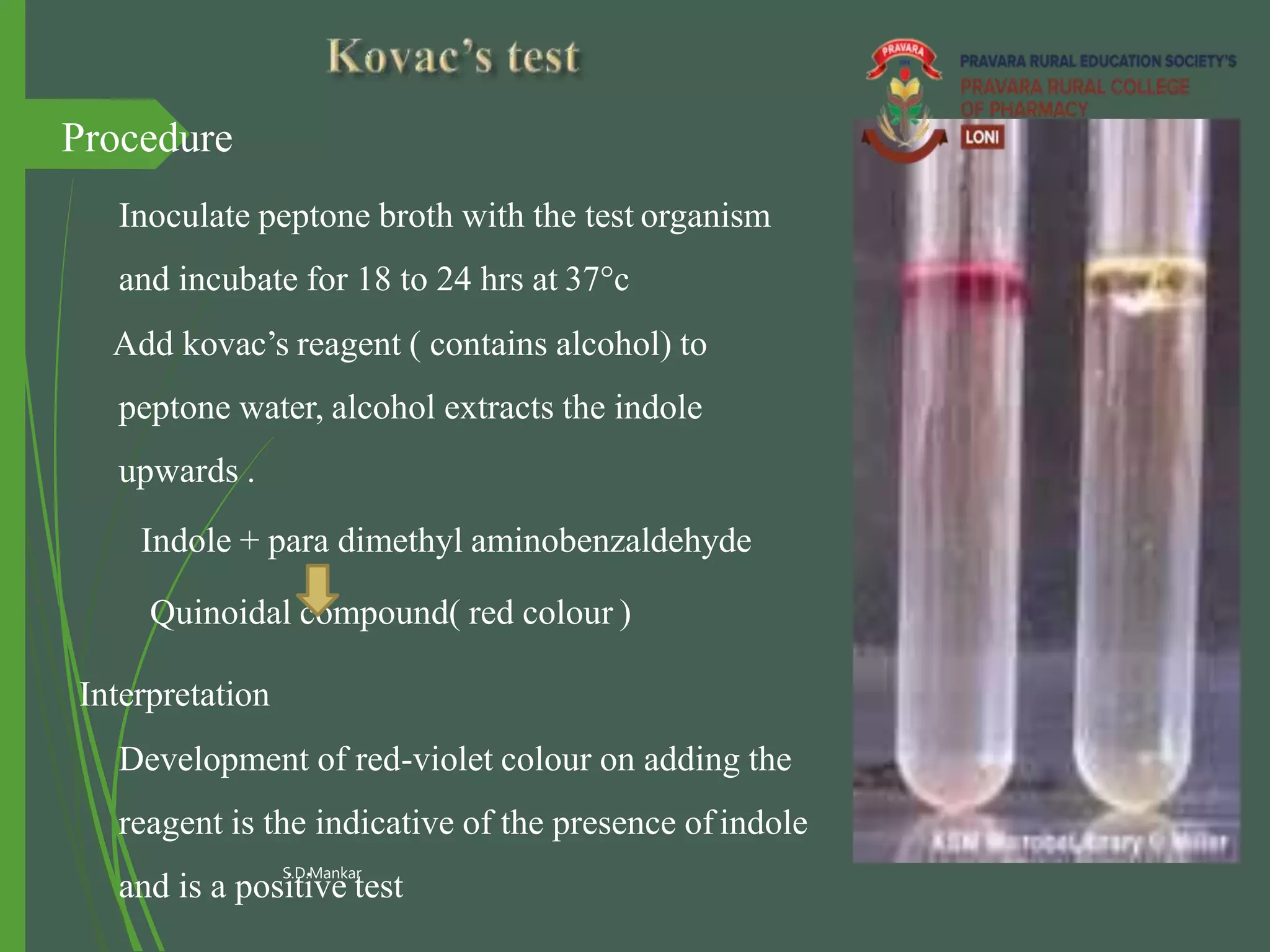
Inoculate peptone broth with the test organism
and incubate for 18 to 24 hrs at 37°c
Add kovac’s reagent ( contains alcohol) to
peptone water, alcohol extracts the indole
upwards .
Indole + para dimethyl aminobenzaldehyde
Quinoidal compound( red colour )
Interpretation
Development of red-violet colour on adding the
reagent is the indicative of the presence of indole
and is a positive test
S.D.Mankar
Indole rapid tests
Indole spot test(filter paper)
Indole spot test for anaerobic bacteria
Indole micro technique(indole test strip)
S.D.Mankar
Positive
 E.coli
 Proteus vulgaris
 K.oxytoca
 K.ornitholytica
 Citrobacter diversus
 Citrobacter amalonaticus
 E.tarda
 Morganella morganii
Negative
 Salmonella
 Klebsiella
 Enterobacter
 Proteus mirabilis
S.D.Mankar
Principle
To test the ability of the organism to produce and maintain stable acid end
products from glucose fermentation and to overcome the buffering
capacity of the system
This is a qualitative test for acid production
S.D.Mankar
Biochemistry
 Methyl red is a pH indicator with a range between 6(Y) and 4.4(R)
 The pH at which the MR detects acid is considerably lower than the pH
of other indicators
 Thus to produce a color change the test organism must produce a large
quantity of acid from the substrate being used
S.D.Mankar
Media & Reagents
MR/VP Broth : Polypeptone, Glucose, Di potassium phosphate&
Distilled water
MR pH indicator : MR 0.1 g in 300ml of 95%
Ethanol & Distilled water 200ml
Quality Control
Positive : E.coli
Negative : E. aerogenes
S.D.Mankar
Procedure
Inoculate the MR/VP broth with a pure culture
of the test organism and incubate at 35°c for 48
to 72 hrs
Add 5 drops of MR reagent to the broth
Interpretation
Positive : Culture sufficiently acid to allow the
MR reagent to remain a distinct red
color(pH4.4) at the surface of the medium
Negative : Yellow color (pH 6.0) at thesurface
of the mediumS.D.Mankar
Positive
 E.coli
 Yersinia spp
 Listeria monocytogenes
Negative
 Enterobacter aerogenes
 Enterobacter cloacae
 Klebsiella
 Gram negative non enteric
bacilli
S.D.Mankar
Principle
To determine the ability of the organisms to produce neutral end product
acetyl methyl carbinol (acetoin) from glucose fermentation
Quality control
Positive : Enterobacter aerogenes
Negative : E.coli
S.D.Mankar
Media
MR/VP Broth : pH 6.9
Polypeptone
Glucose
Di potassium phosphate
Distilled water
Reagents
VP (A) : Alpha naphthol 5% (colorintensifier)
Absolute ethylalcohol
VP (B) : 40% potassium hydroxide (oxidisingagent)
Distilled water
S.D.Mankar
Procedure : Inoculate pure culture of the test organism
into MR/VP broth and incubate for 24 hrs at37°c
Aliquot 1 ml of the broth to a sterile test tube and
add 0.6ml of VP(A) followed by 0.2ml ofVP(B)
Shake the tube gently to expose the medium to
atmospheric oxygen and allow the tube to remain
undisturbed for 10 to 15 min
Interpretation
Positive : Pinkish red color at the surface of the
medium Negative : Yellow color at the surface of
the mediumS.D.Mankar
GLUCOSE ACETOIN
ACETOIN
KOH
DIACETYL+H2O
Atmospheric oxygen
DIACETYL+GUANIDINE
COMPNENT
OF
PEPTONE
PINK COLOUR
Alpha-naphthol
S.D.Mankar
Alternate Tests
 Gas liquid chromatography measure of diacetyl
 Electron capture gas liquid chromatography
 Gas chromatography – chemical ionization mass spectrography
 Calorimetric method of measurement of diacetyl
Rapid test
 Reagent impregnated VPstrip
S.D.Mankar
Precautions
 Organisms which are MR Positive is VP Negative or vice versa is truefor
most of the organisms belonging to Enterobacteriacea
 Organism like Hafnia alvei & Proteus mirabilis may give both MR &VP
positive results although VP reaction isdelayed
 Excess KOH may mask a weak VP positive reactions
S.D.Mankar
Positive
 Klebseilla pneumoniae
 Enterobacter
 Staphylococcus
 Hafinia alvei(25°cpositive)
Hafinia alvei(37°cvariable)
 Yersinia enterocolitica 25°c
 Listeria monocytogenes
Negative
 E.coli
 Micrococcus
 K.ozanae
 K.rhinoscleromatis
 Y.enterocolitica 37°c
S.D.Mankar
• CITRATE UTILIZATION TEST
S.D.Mankar
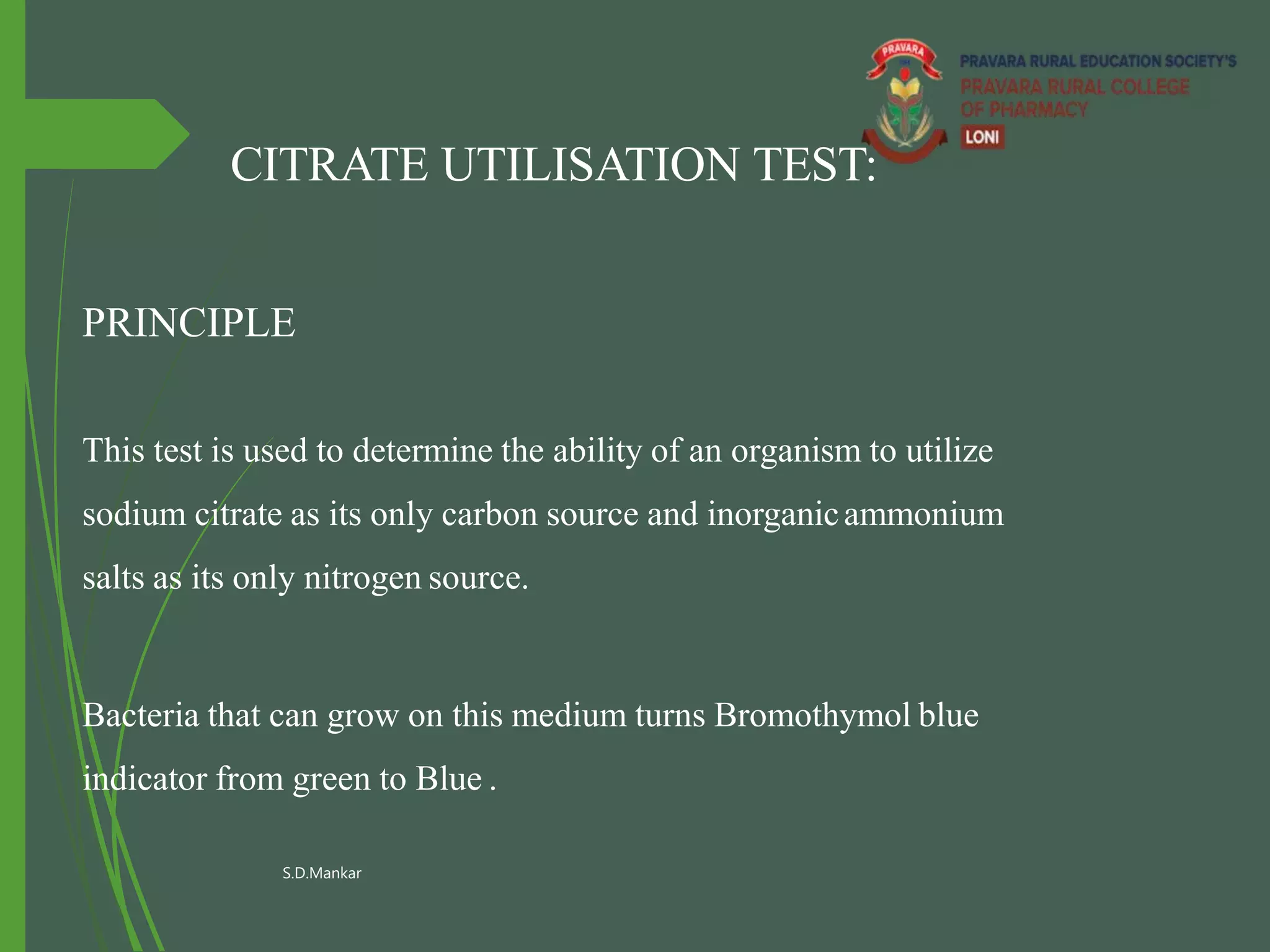
CITRATE UTILISATION TEST:
PRINCIPLE
This test is used to determine the ability of an organism to utilize
sodium citrate as its only carbon source and inorganicammonium
salts as its only nitrogen source.
Bacteria that can grow on this medium turns Bromothymol blue
indicator from green to Blue .
S.D.Mankar
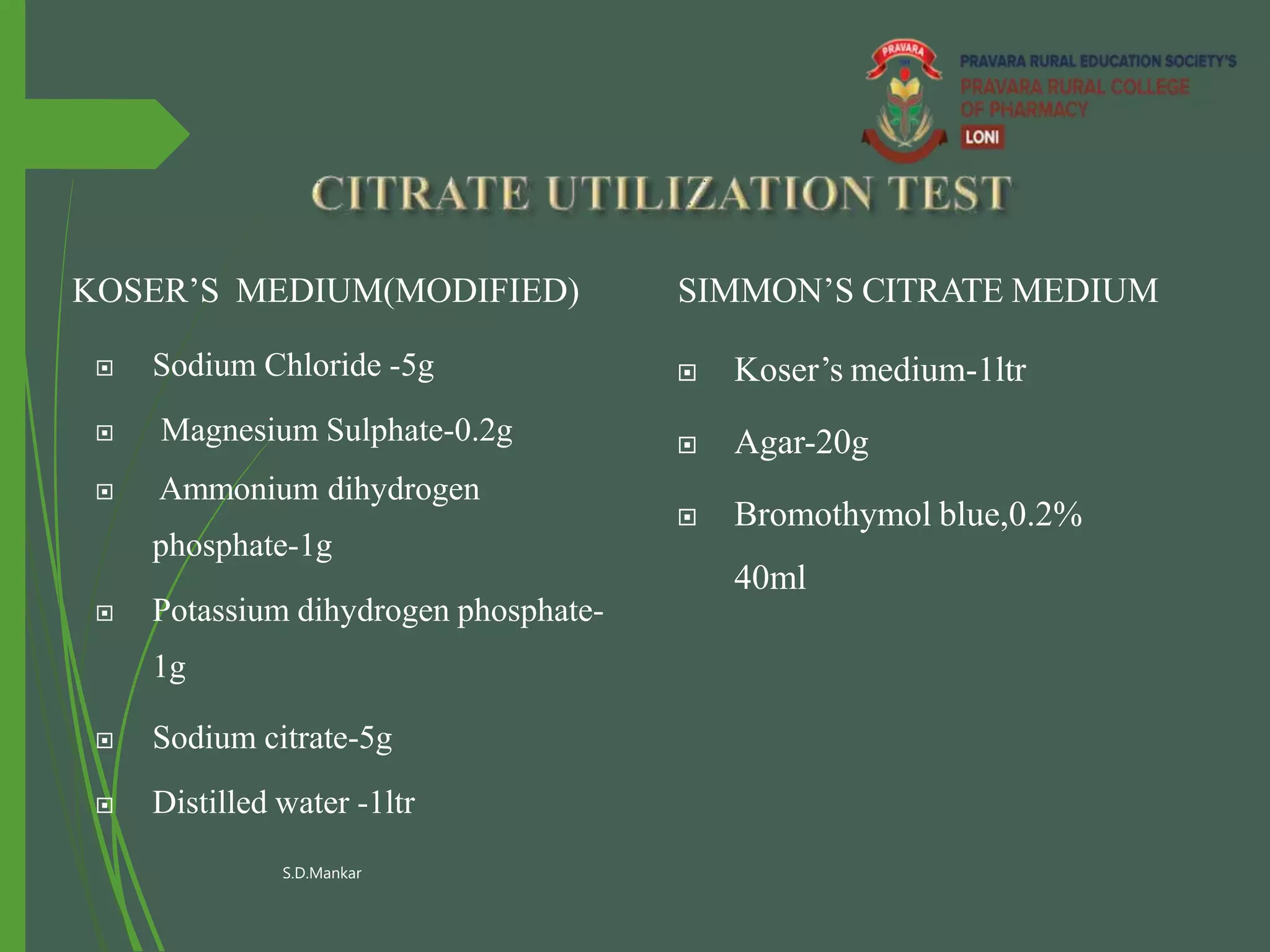
KOSER’S MEDIUM(MODIFIED) SIMMON’S CITRATE MEDIUM
 Sodium Chloride -5g
 Magnesium Sulphate-0.2g
 Ammonium dihydrogen
phosphate-1g
 Potassium dihydrogen phosphate-
1g
 Sodium citrate-5g
 Distilled water -1ltr
 Koser’s medium-1ltr
 Agar-20g
 Bromothymol blue,0.2%
40ml
S.D.Mankar
PROCEDURE:
 Using sterile technique, inoculate bacteria into its appropriately labelled
simmon’s citrate tubes by means of a spot inoculation and incubate all
cultures for 24-48hrs at 37˚c
Quality control:
 Positive control=Klebsiella pneumoniae
 Negative control = E.coli
S.D.Mankar
RESULTS:
 Positive test = development of DEEPBLUE
colour within 24-48 hrs, indicating that the
test organism has been able to utilize citrate
present in medium, with production of
alkaline products
 Negative test = no change in colour (green)
S.D.Mankar
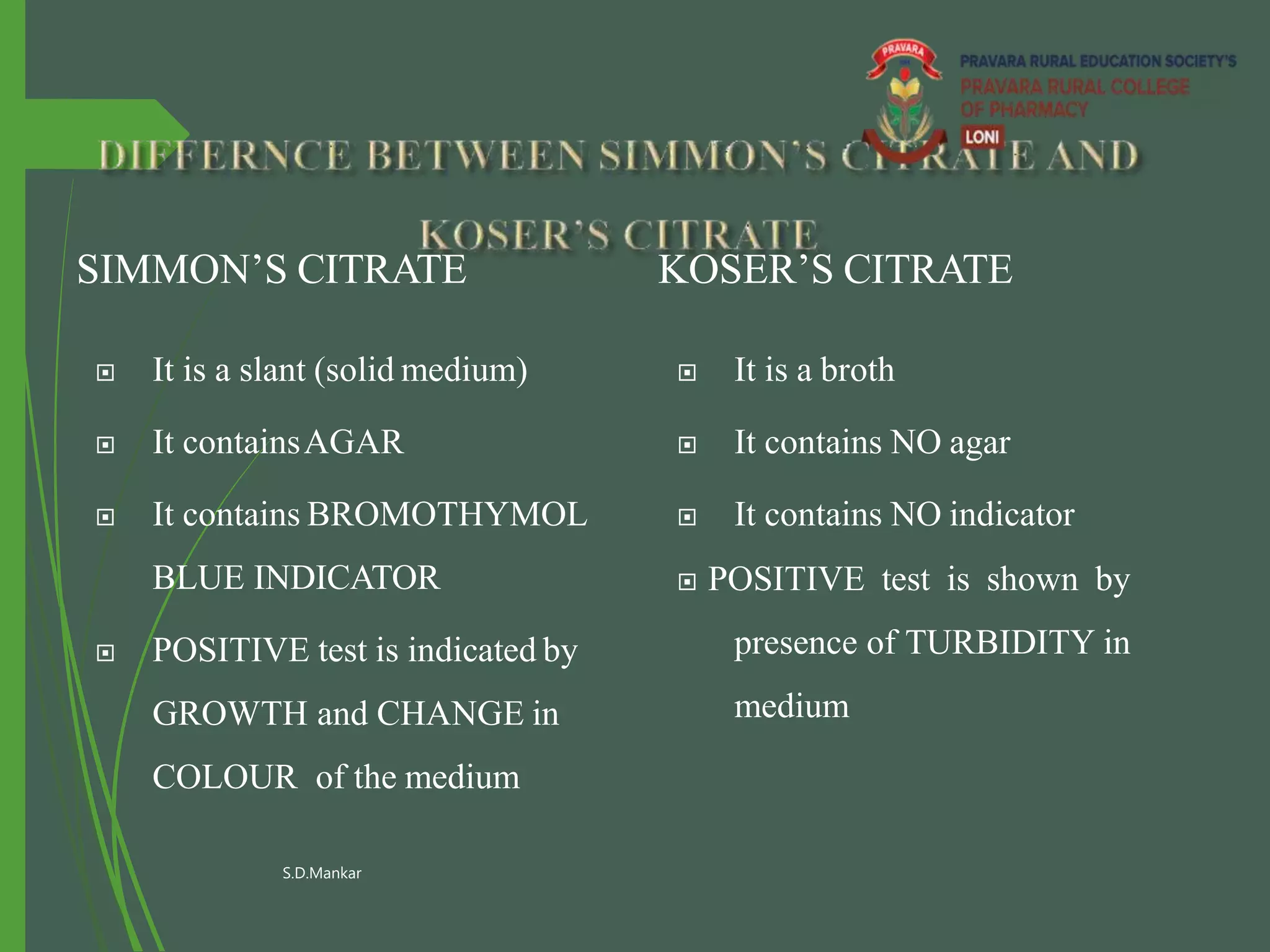
SIMMON’S CITRATE KOSER’S CITRATE
 It is a slant (solid medium)
 It containsAGAR
 It contains BROMOTHYMOL
BLUE INDICATOR
 POSITIVE test is indicated by
GROWTH and CHANGE in
COLOUR of the medium
 It is a broth
 It contains NO agar
 It contains NO indicator
 POSITIVE test is shown by
presence of TURBIDITY in
medium
S.D.Mankar
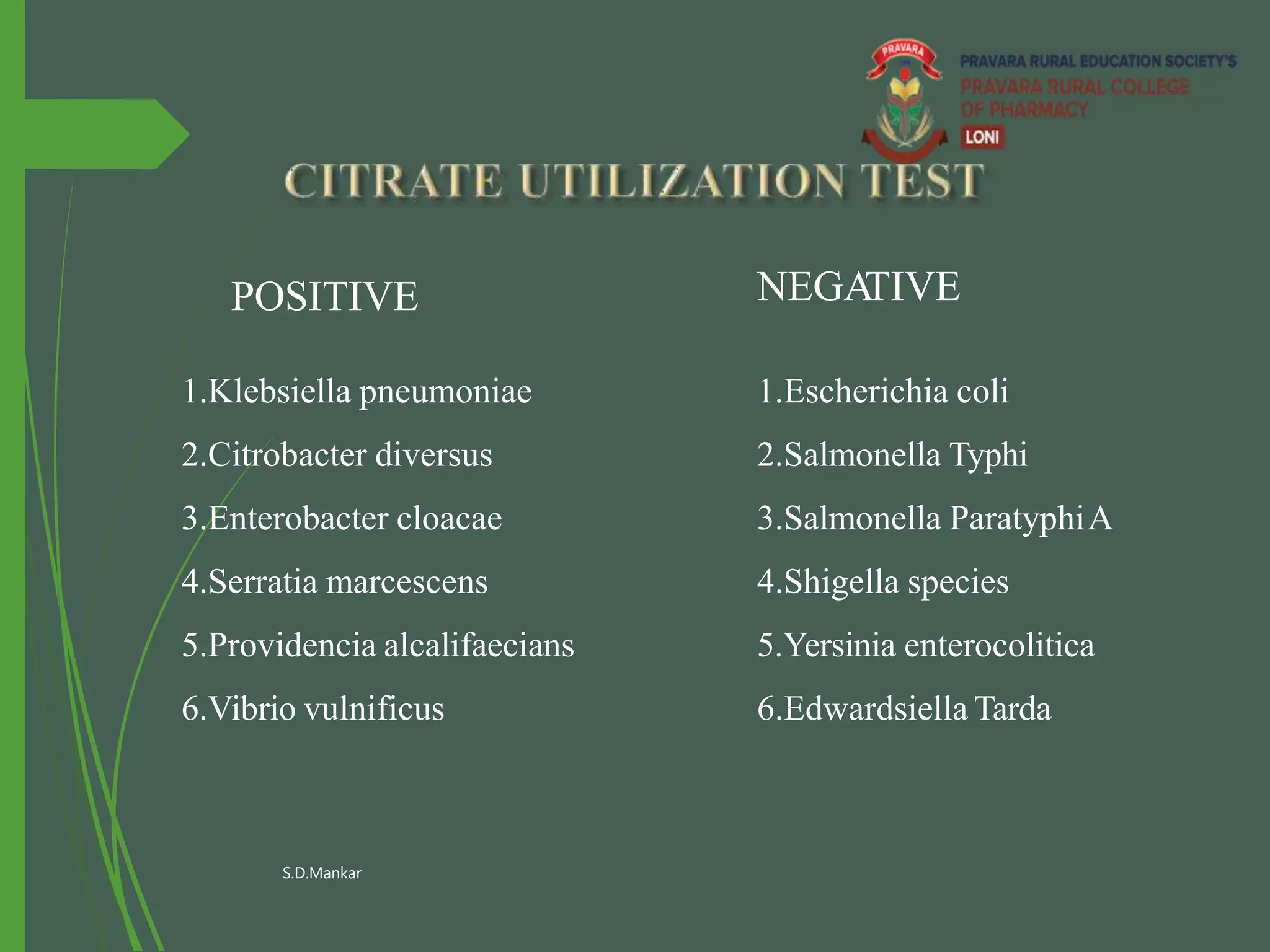
POSITIVE NEGATIVE
1.Klebsiella pneumoniae
2.Citrobacter diversus
3.Enterobacter cloacae
4.Serratia marcescens
5.Providencia alcalifaecians
6.Vibrio vulnificus
1.Escherichia coli
2.Salmonella Typhi
3.Salmonella ParatyphiA
4.Shigella species
5.Yersinia enterocolitica
6.Edwardsiella Tarda
S.D.Mankar

Biochemical test for identification of Bacteria

  • 1.
  • 2.
    Principle To determine theability of the organism to split Indole from the tryptophan molecule Indole is one of the metabolic degradation product of the amino acid tryptophan Bacteria that possess the enzyme tryptophanase are capable of hydrolyzing and deaminating tryptophan with the production of Indole, Pyruvic acid and ammonia. S.D.Mankar
  • 3.
    Media & Reagents Media:Tryptophan 1% or peptonebroth Reagents a) Ehrlich’s b) Kovac’s Ehrlich’s : p - dimethylaminobenzaldehyde Ethyl alcohol & HCL Kovac’s : p - dimethylaminobenzaldehyde Pure amyl or iso amyl alcohol & HCL S.D.Mankar
  • 4.
    Other media whichcan be used for indole production Sulphide indole motility agar Motility indole ornithine agar Quality Control Positive control : E.coli Negative control : Klebsiella pneumoniae S.D.Mankar
  • 5.
    Procedure Inoculate peptone brothwith the test organism and incubate for 18 to 24 hrs at 37°c Add kovac’s reagent ( contains alcohol) to peptone water, alcohol extracts the indole upwards . Indole + para dimethyl aminobenzaldehyde Quinoidal compound( red colour ) Interpretation Development of red-violet colour on adding the reagent is the indicative of the presence of indole and is a positive test S.D.Mankar
  • 6.
    Indole rapid tests Indolespot test(filter paper) Indole spot test for anaerobic bacteria Indole micro technique(indole test strip) S.D.Mankar
  • 7.
    Positive  E.coli  Proteusvulgaris  K.oxytoca  K.ornitholytica  Citrobacter diversus  Citrobacter amalonaticus  E.tarda  Morganella morganii Negative  Salmonella  Klebsiella  Enterobacter  Proteus mirabilis S.D.Mankar
  • 8.
    Principle To test theability of the organism to produce and maintain stable acid end products from glucose fermentation and to overcome the buffering capacity of the system This is a qualitative test for acid production S.D.Mankar
  • 9.
    Biochemistry  Methyl redis a pH indicator with a range between 6(Y) and 4.4(R)  The pH at which the MR detects acid is considerably lower than the pH of other indicators  Thus to produce a color change the test organism must produce a large quantity of acid from the substrate being used S.D.Mankar
  • 10.
    Media & Reagents MR/VPBroth : Polypeptone, Glucose, Di potassium phosphate& Distilled water MR pH indicator : MR 0.1 g in 300ml of 95% Ethanol & Distilled water 200ml Quality Control Positive : E.coli Negative : E. aerogenes S.D.Mankar
  • 11.
    Procedure Inoculate the MR/VPbroth with a pure culture of the test organism and incubate at 35°c for 48 to 72 hrs Add 5 drops of MR reagent to the broth Interpretation Positive : Culture sufficiently acid to allow the MR reagent to remain a distinct red color(pH4.4) at the surface of the medium Negative : Yellow color (pH 6.0) at thesurface of the mediumS.D.Mankar
  • 12.
    Positive  E.coli  Yersiniaspp  Listeria monocytogenes Negative  Enterobacter aerogenes  Enterobacter cloacae  Klebsiella  Gram negative non enteric bacilli S.D.Mankar
  • 13.
    Principle To determine theability of the organisms to produce neutral end product acetyl methyl carbinol (acetoin) from glucose fermentation Quality control Positive : Enterobacter aerogenes Negative : E.coli S.D.Mankar
  • 14.
    Media MR/VP Broth :pH 6.9 Polypeptone Glucose Di potassium phosphate Distilled water Reagents VP (A) : Alpha naphthol 5% (colorintensifier) Absolute ethylalcohol VP (B) : 40% potassium hydroxide (oxidisingagent) Distilled water S.D.Mankar
  • 15.
    Procedure : Inoculatepure culture of the test organism into MR/VP broth and incubate for 24 hrs at37°c Aliquot 1 ml of the broth to a sterile test tube and add 0.6ml of VP(A) followed by 0.2ml ofVP(B) Shake the tube gently to expose the medium to atmospheric oxygen and allow the tube to remain undisturbed for 10 to 15 min Interpretation Positive : Pinkish red color at the surface of the medium Negative : Yellow color at the surface of the mediumS.D.Mankar
  • 16.
  • 17.
    Alternate Tests  Gasliquid chromatography measure of diacetyl  Electron capture gas liquid chromatography  Gas chromatography – chemical ionization mass spectrography  Calorimetric method of measurement of diacetyl Rapid test  Reagent impregnated VPstrip S.D.Mankar
  • 18.
    Precautions  Organisms whichare MR Positive is VP Negative or vice versa is truefor most of the organisms belonging to Enterobacteriacea  Organism like Hafnia alvei & Proteus mirabilis may give both MR &VP positive results although VP reaction isdelayed  Excess KOH may mask a weak VP positive reactions S.D.Mankar
  • 19.
    Positive  Klebseilla pneumoniae Enterobacter  Staphylococcus  Hafinia alvei(25°cpositive) Hafinia alvei(37°cvariable)  Yersinia enterocolitica 25°c  Listeria monocytogenes Negative  E.coli  Micrococcus  K.ozanae  K.rhinoscleromatis  Y.enterocolitica 37°c S.D.Mankar
  • 20.
    • CITRATE UTILIZATIONTEST S.D.Mankar
  • 21.
    CITRATE UTILISATION TEST: PRINCIPLE Thistest is used to determine the ability of an organism to utilize sodium citrate as its only carbon source and inorganicammonium salts as its only nitrogen source. Bacteria that can grow on this medium turns Bromothymol blue indicator from green to Blue . S.D.Mankar
  • 22.
    KOSER’S MEDIUM(MODIFIED) SIMMON’SCITRATE MEDIUM  Sodium Chloride -5g  Magnesium Sulphate-0.2g  Ammonium dihydrogen phosphate-1g  Potassium dihydrogen phosphate- 1g  Sodium citrate-5g  Distilled water -1ltr  Koser’s medium-1ltr  Agar-20g  Bromothymol blue,0.2% 40ml S.D.Mankar
  • 23.
    PROCEDURE:  Using steriletechnique, inoculate bacteria into its appropriately labelled simmon’s citrate tubes by means of a spot inoculation and incubate all cultures for 24-48hrs at 37˚c Quality control:  Positive control=Klebsiella pneumoniae  Negative control = E.coli S.D.Mankar
  • 24.
    RESULTS:  Positive test= development of DEEPBLUE colour within 24-48 hrs, indicating that the test organism has been able to utilize citrate present in medium, with production of alkaline products  Negative test = no change in colour (green) S.D.Mankar
  • 25.
    SIMMON’S CITRATE KOSER’SCITRATE  It is a slant (solid medium)  It containsAGAR  It contains BROMOTHYMOL BLUE INDICATOR  POSITIVE test is indicated by GROWTH and CHANGE in COLOUR of the medium  It is a broth  It contains NO agar  It contains NO indicator  POSITIVE test is shown by presence of TURBIDITY in medium S.D.Mankar
  • 26.
    POSITIVE NEGATIVE 1.Klebsiella pneumoniae 2.Citrobacterdiversus 3.Enterobacter cloacae 4.Serratia marcescens 5.Providencia alcalifaecians 6.Vibrio vulnificus 1.Escherichia coli 2.Salmonella Typhi 3.Salmonella ParatyphiA 4.Shigella species 5.Yersinia enterocolitica 6.Edwardsiella Tarda S.D.Mankar