Compound Pendulum
# Topics
a) Time period of compound pendulum
b) Maximum and Minimum Time periods of a compound pendulum
Simple Pendulum
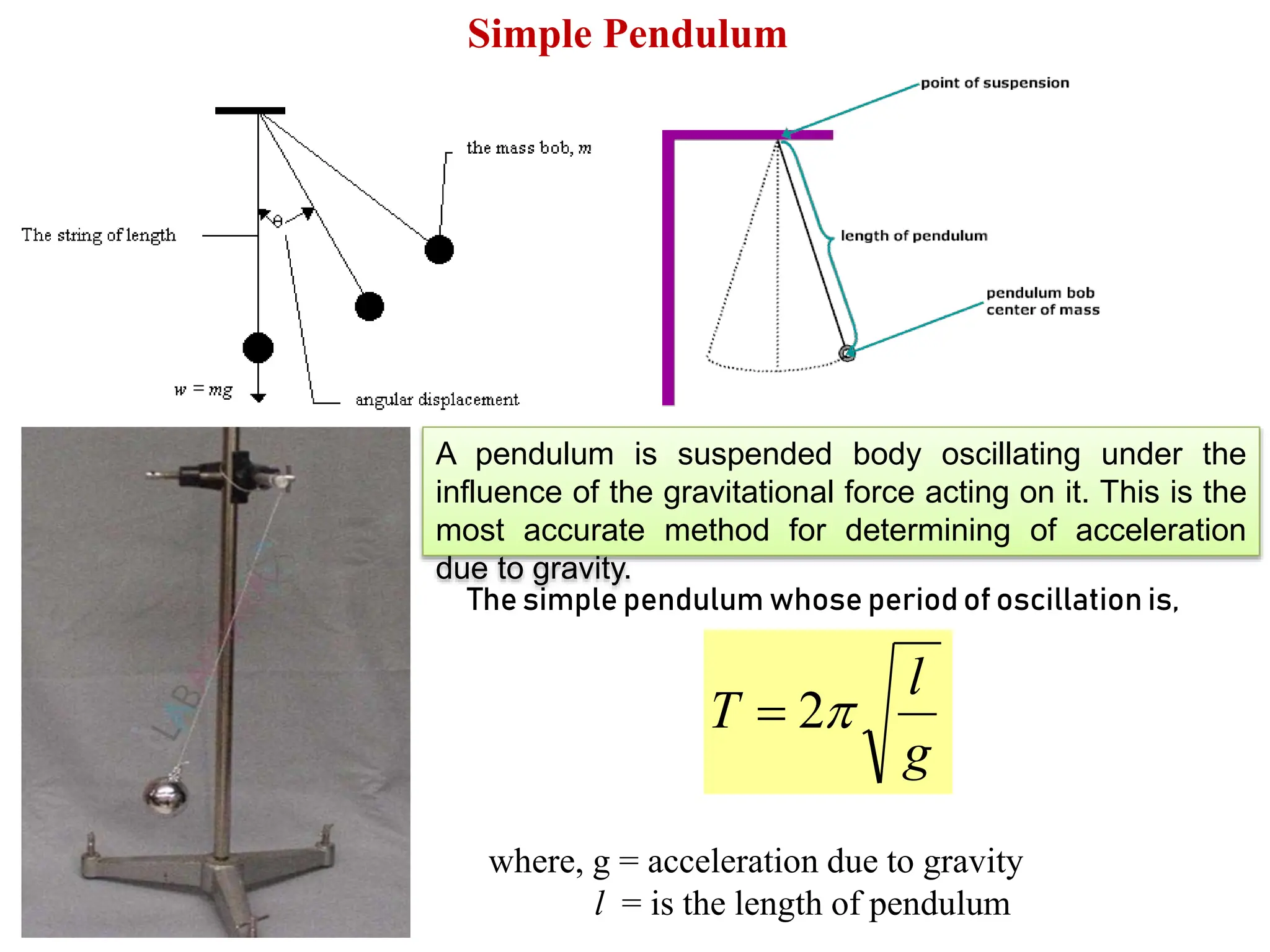
A pendulum is suspended body oscillating under the
influence of the gravitational force acting on it. This is the
most accurate method for determining of acceleration
due to gravity.
The simple pendulum whose period of oscillation is,
g
l
T 
2

where, g = acceleration due to gravity
l = is the length of pendulum
Compound Pendulum
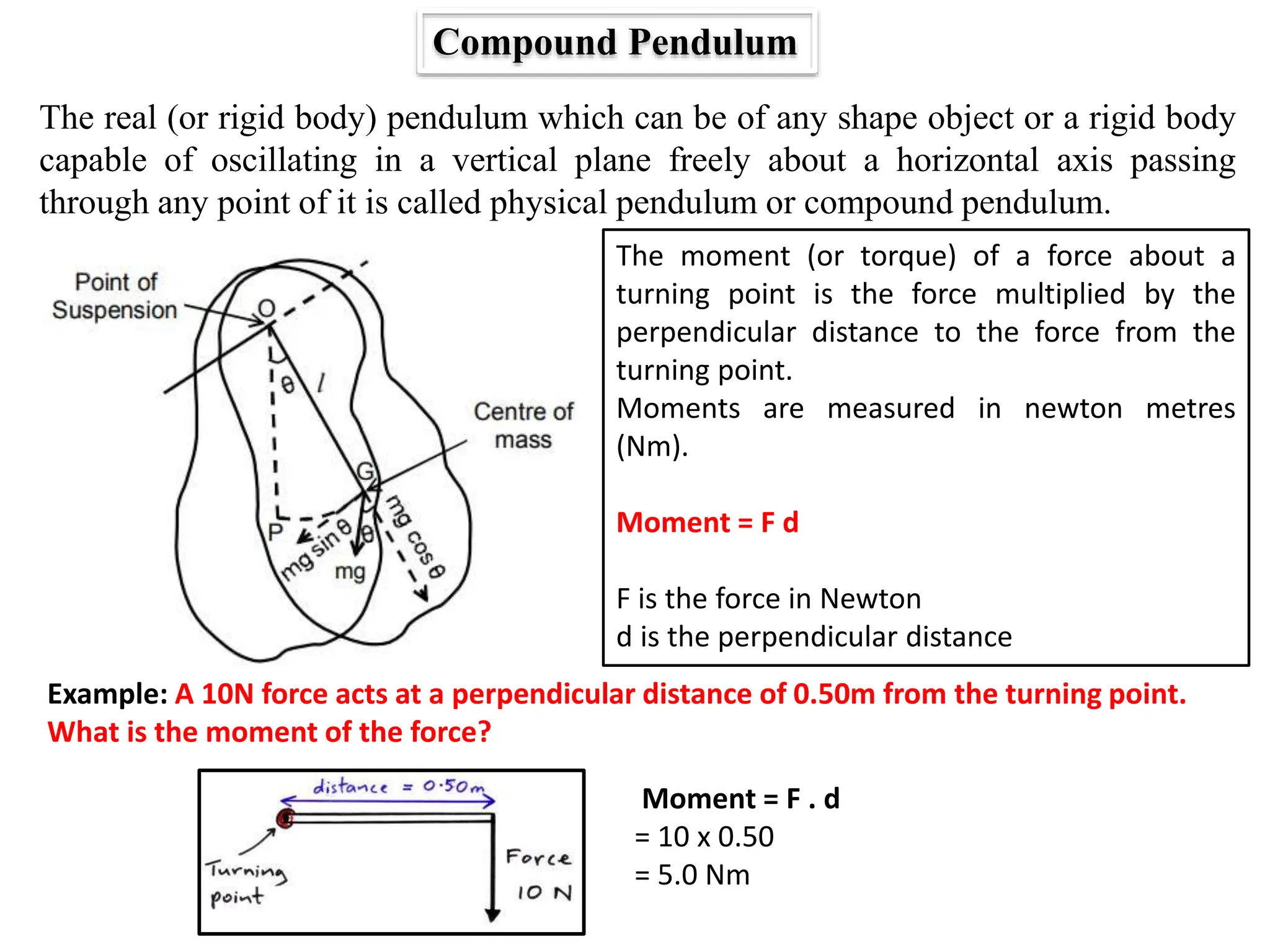
The real (or rigid body) pendulum which can be of any shape object or a rigid body
capable of oscillating in a vertical plane freely about a horizontal axis passing
through any point of it is called physical pendulum or compound pendulum.
The moment (or torque) of a force about a
turning point is the force multiplied by the
perpendicular distance to the force from the
turning point.
Moments are measured in newton metres
(Nm).
Moment = F d
F is the force in Newton
d is the perpendicular distance
Example: A 10N force acts at a perpendicular distance of 0.50m from the turning point.
What is the moment of the force?
Moment = F . d
= 10 x 0.50
= 5.0 Nm
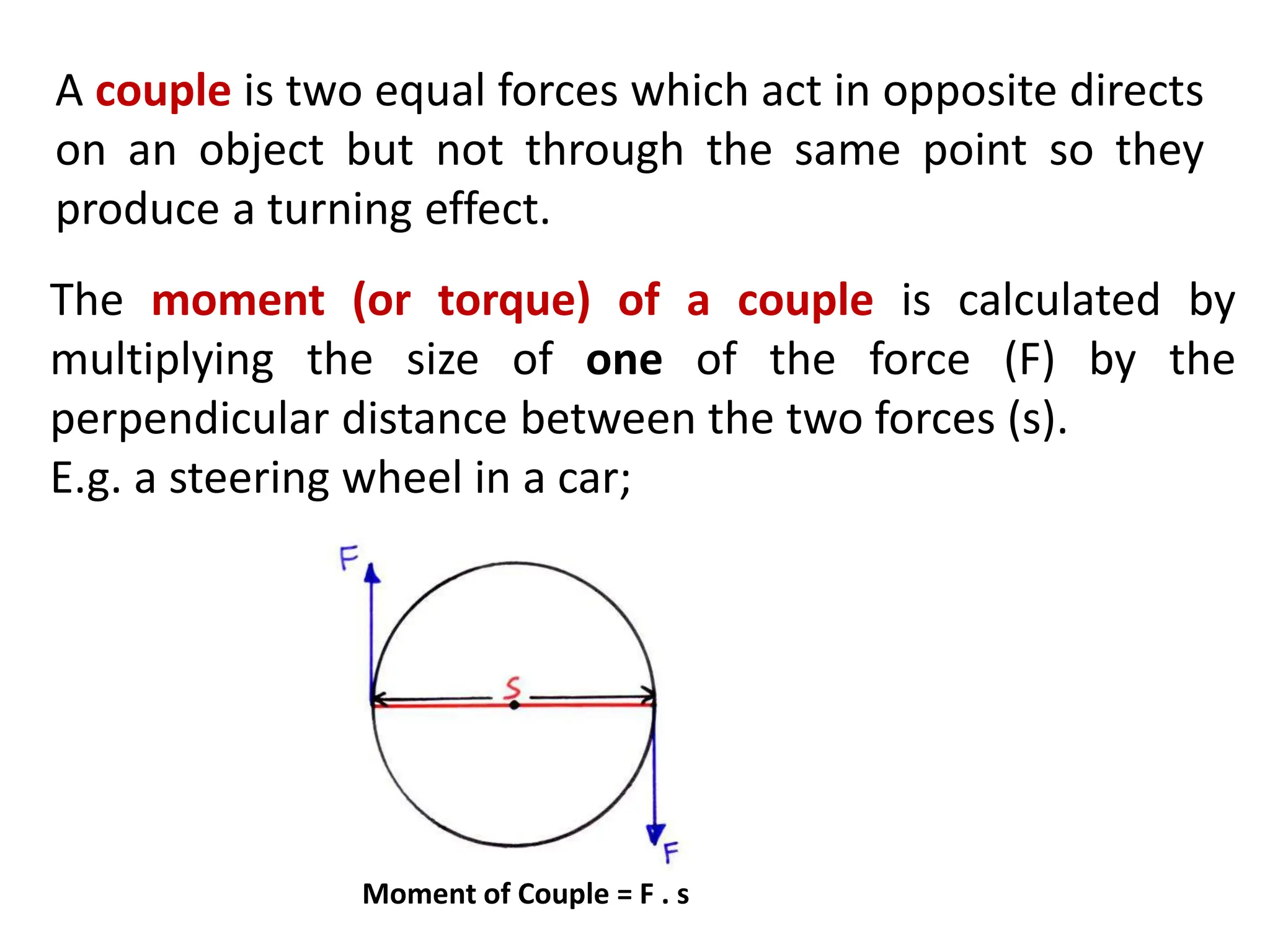
A couple is two equal forces which act in opposite directs
on an object but not through the same point so they
produce a turning effect.
The moment (or torque) of a couple is calculated by
multiplying the size of one of the force (F) by the
perpendicular distance between the two forces (s).
E.g. a steering wheel in a car;
Moment of Couple = F . s
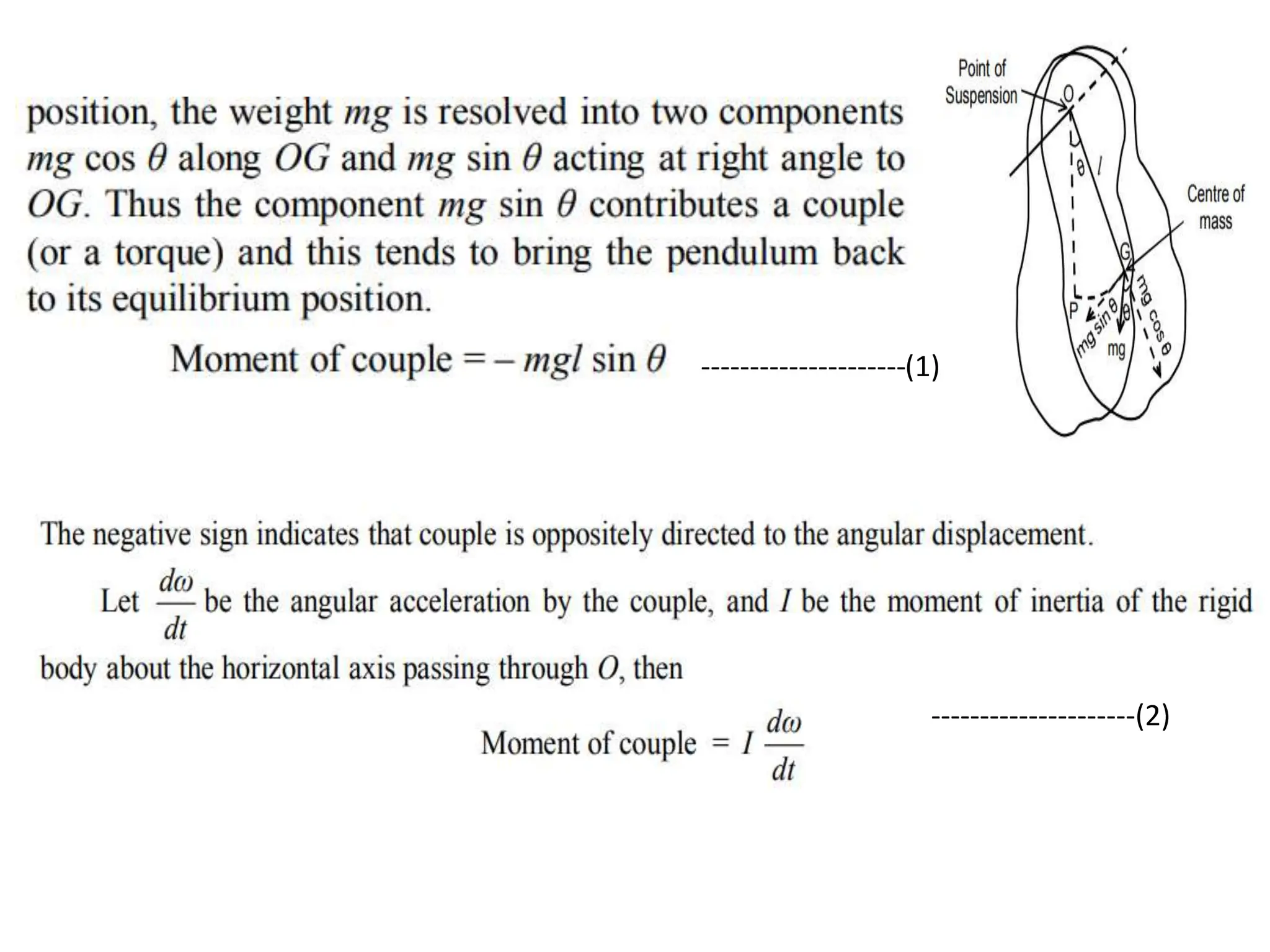
---------------------(1)
---------------------(2)
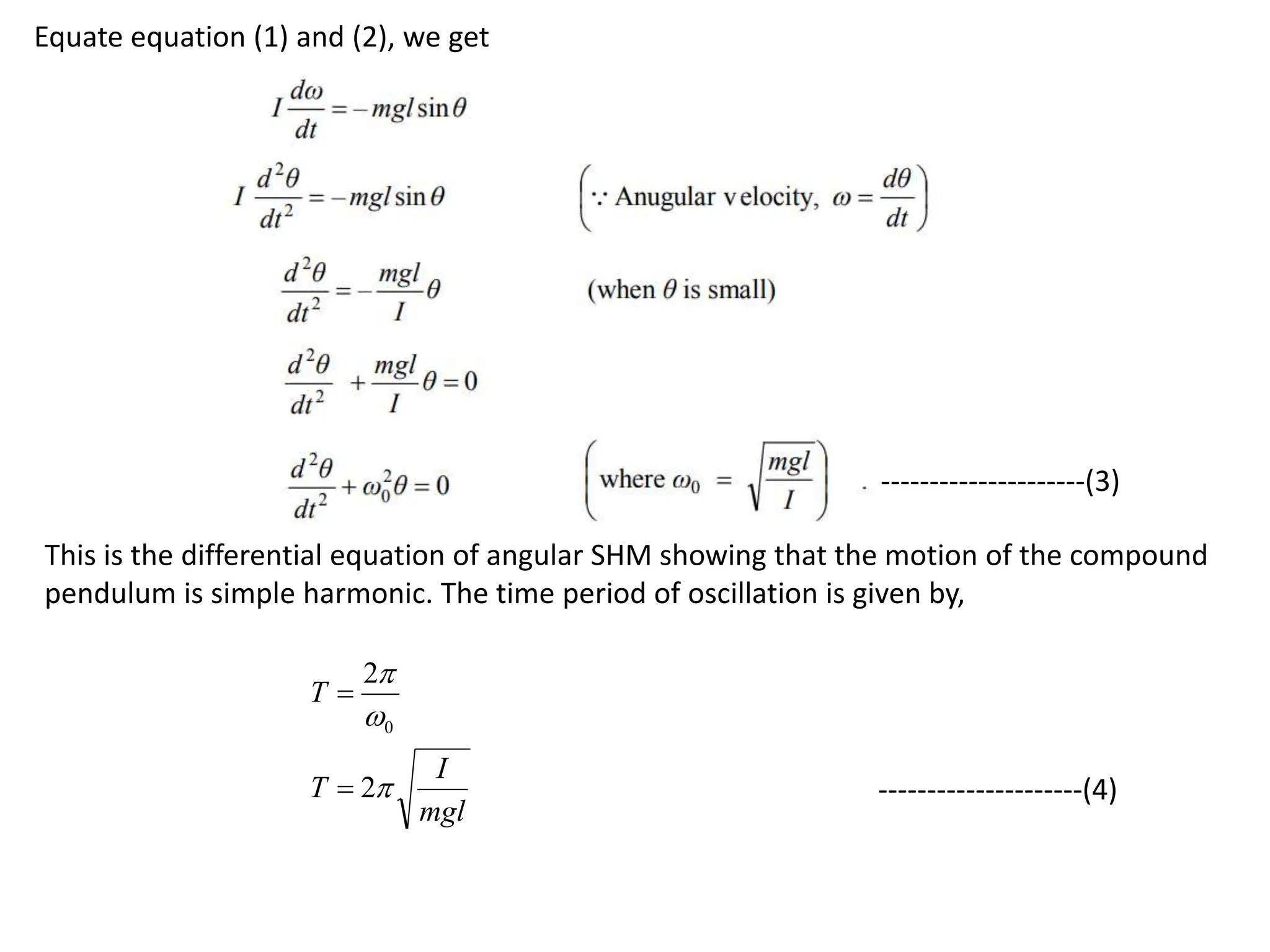
Equate equation (1) and (2), we get
This is the differential equation of angular SHM showing that the motion of the compound
pendulum is simple harmonic. The time period of oscillation is given by,
mgl
I
T
T



2
2
0


---------------------(3)
---------------------(4)
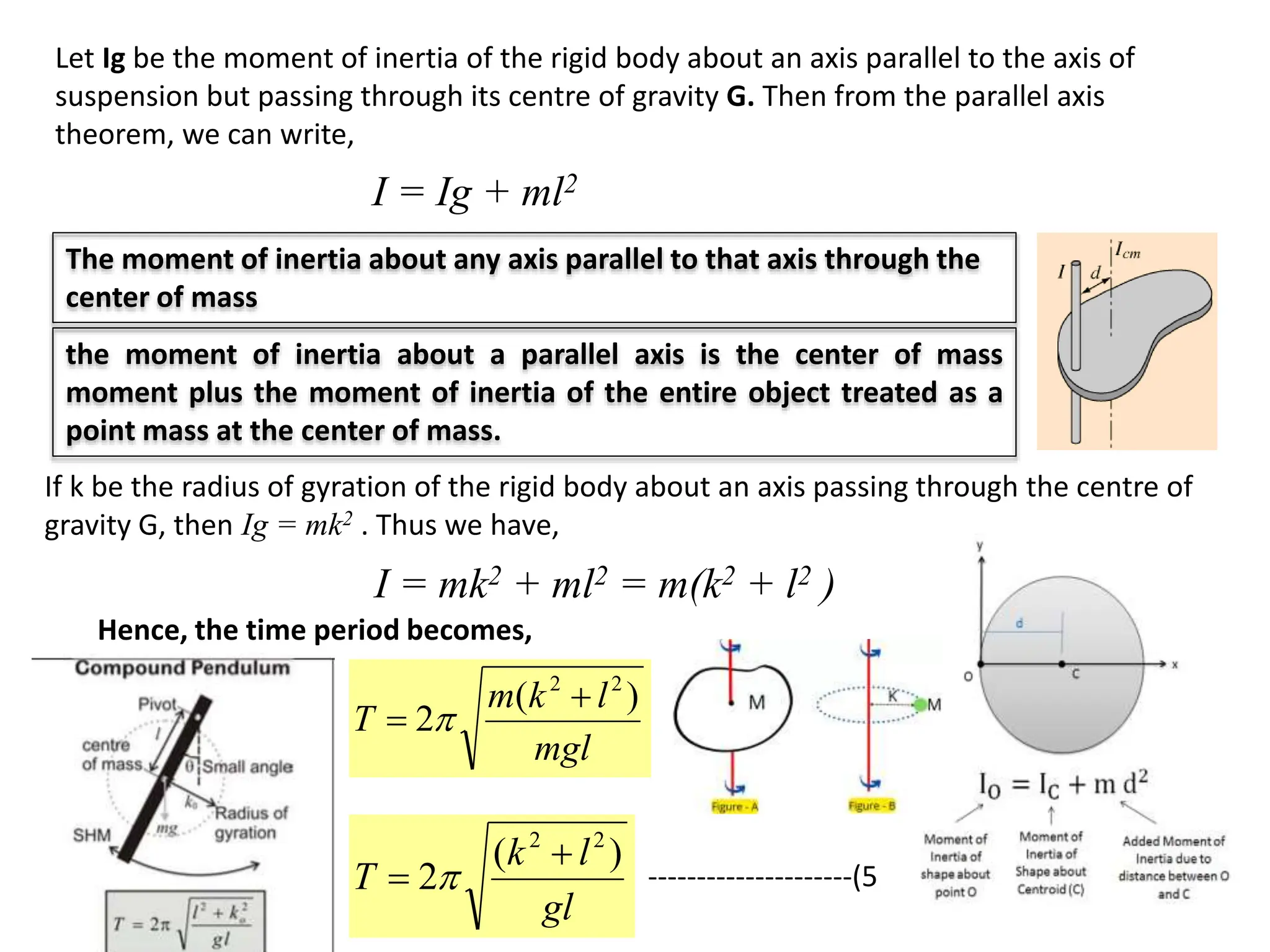
Let Ig be the moment of inertia of the rigid body about an axis parallel to the axis of
suspension but passing through its centre of gravity G. Then from the parallel axis
theorem, we can write,
I = Ig + ml2
If k be the radius of gyration of the rigid body about an axis passing through the centre of
gravity G, then Ig = mk2 . Thus we have,
I = mk2 + ml2 = m(k2 + l2 )
Hence, the time period becomes,
mgl
l
k
m
T
)
(
2
2
2

 
gl
l
k
T
)
(
2
2
2

  ---------------------(5)
The moment of inertia about any axis parallel to that axis through the
center of mass
the moment of inertia about a parallel axis is the center of mass
moment plus the moment of inertia of the entire object treated as a
point mass at the center of mass.
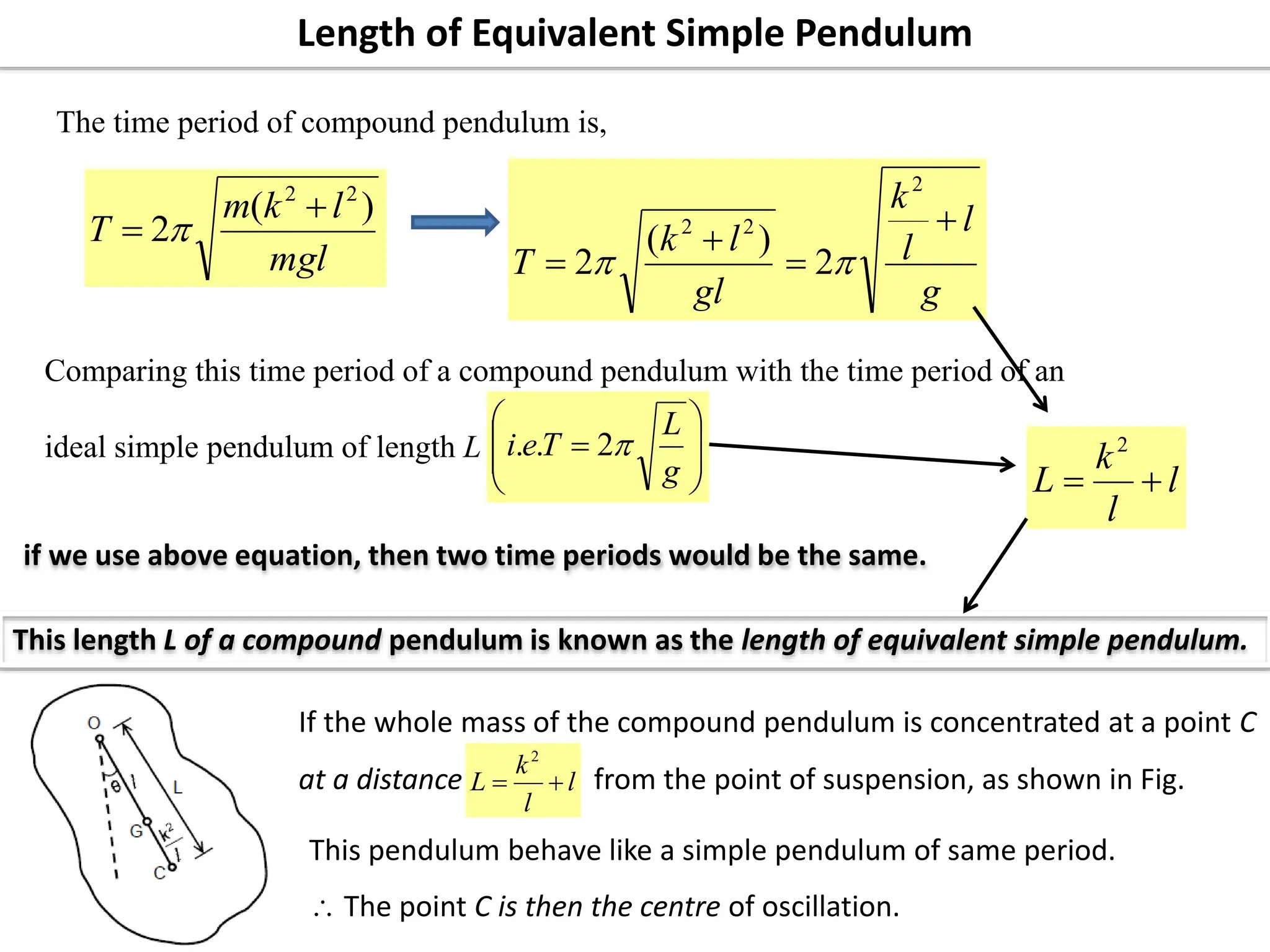
Length of Equivalent Simple Pendulum
mgl
l
k
m
T
)
(
2
2
2

 
The time period of compound pendulum is,
g
l
l
k
gl
l
k
T




2
2
2
2
)
(
2 

Comparing this time period of a compound pendulum with the time period of an
ideal simple pendulum of length L 








g
L
T
e
i 
2
.
.
l
l
k
L 

2
if we use above equation, then two time periods would be the same.
This length L of a compound pendulum is known as the length of equivalent simple pendulum.
If the whole mass of the compound pendulum is concentrated at a point C
at a distance from the point of suspension, as shown in Fig.
l
l
k
L 

2
This pendulum behave like a simple pendulum of same period.
 The point C is then the centre of oscillation.
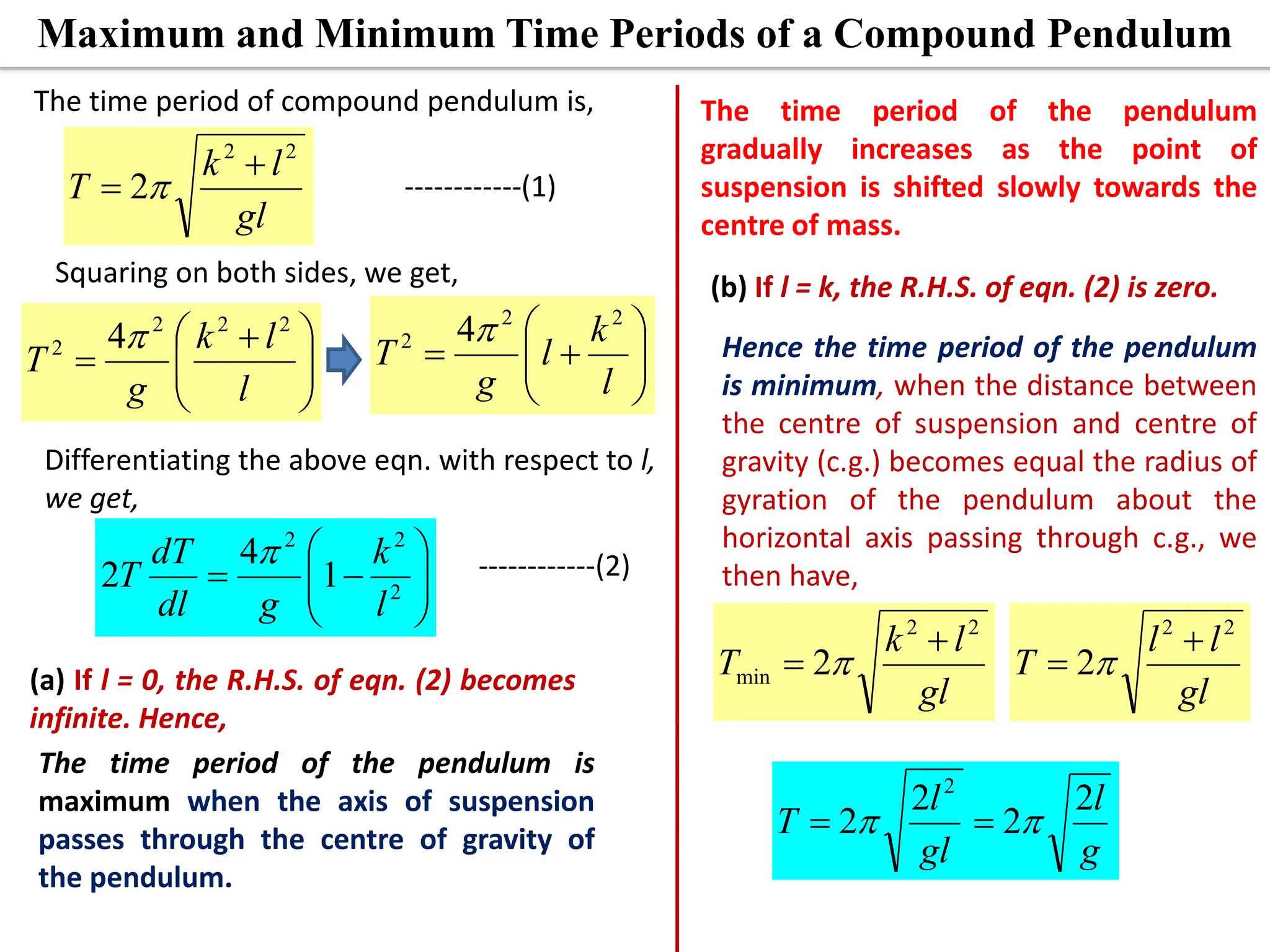
Maximum and Minimum Time Periods of a Compound Pendulum
gl
l
k
T
2
2
2

 
The time period of compound pendulum is,
Squaring on both sides, we get,







 

l
l
k
g
T
2
2
2
2 4










l
k
l
g
T
2
2
2 4
Differentiating the above eqn. with respect to l,
we get,









 2
2
2
1
4
2
l
k
g
dl
dT
T

(a) If l = 0, the R.H.S. of eqn. (2) becomes
infinite. Hence,
------------(1)
------------(2)
The time period of the pendulum
gradually increases as the point of
suspension is shifted slowly towards the
centre of mass.
The time period of the pendulum is
maximum when the axis of suspension
passes through the centre of gravity of
the pendulum.
Hence the time period of the pendulum
is minimum, when the distance between
the centre of suspension and centre of
gravity (c.g.) becomes equal the radius of
gyration of the pendulum about the
horizontal axis passing through c.g., we
then have,
(b) If l = k, the R.H.S. of eqn. (2) is zero.
gl
l
k
T
2
2
min 2

 
gl
l
l
T
2
2
2

 
g
l
gl
l
T
2
2
2
2
2

 

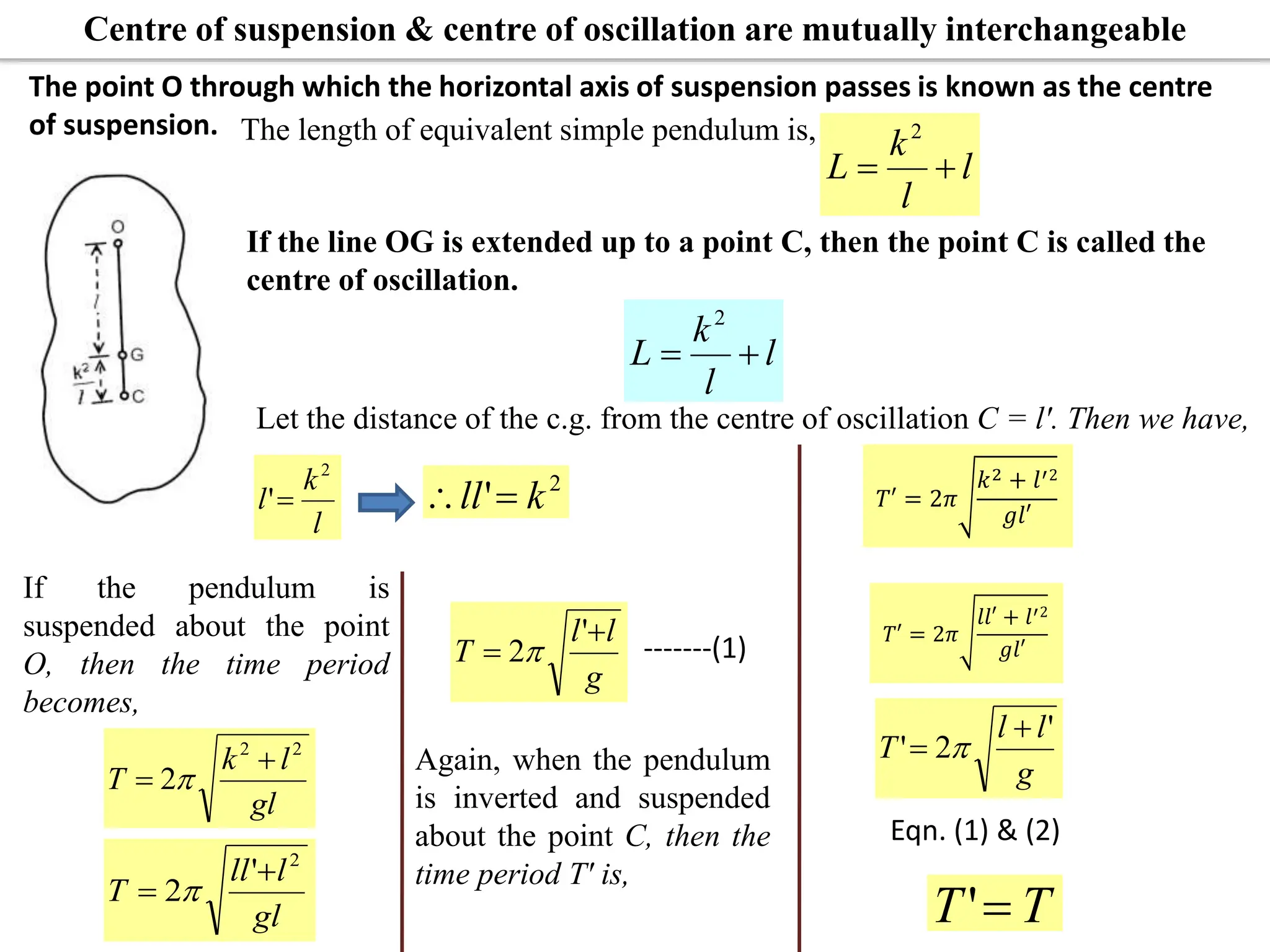
Centre of suspension & centre of oscillation are mutually interchangeable
The point O through which the horizontal axis of suspension passes is known as the centre
of suspension. The length of equivalent simple pendulum is,
l
l
k
L 

2
If the line OG is extended up to a point C, then the point C is called the
centre of oscillation. Thus, OC = OG + GC
l
l
k
L 

2
Let the distance of the c.g. from the centre of oscillation C = l′. Then we have,
l
k
l
2
'
2
' k
ll 

If the pendulum is
suspended about the point
O, then the time period
becomes,
gl
l
k
T
2
2
2

 
gl
l
ll
T
2
'
2

 
g
l
l
T


'
2
Again, when the pendulum
is inverted and suspended
about the point C, then the
time period T′ is,
𝑇′ = 2𝜋
𝑘2 + 𝑙′2
𝑔𝑙′
𝑇′ = 2𝜋
𝑙𝑙′ + 𝑙′2
𝑔𝑙′
g
l
l
T
'
2
'

 
T
T 
'
-------(1)
-------(2)
Eqn. (1) & (2)
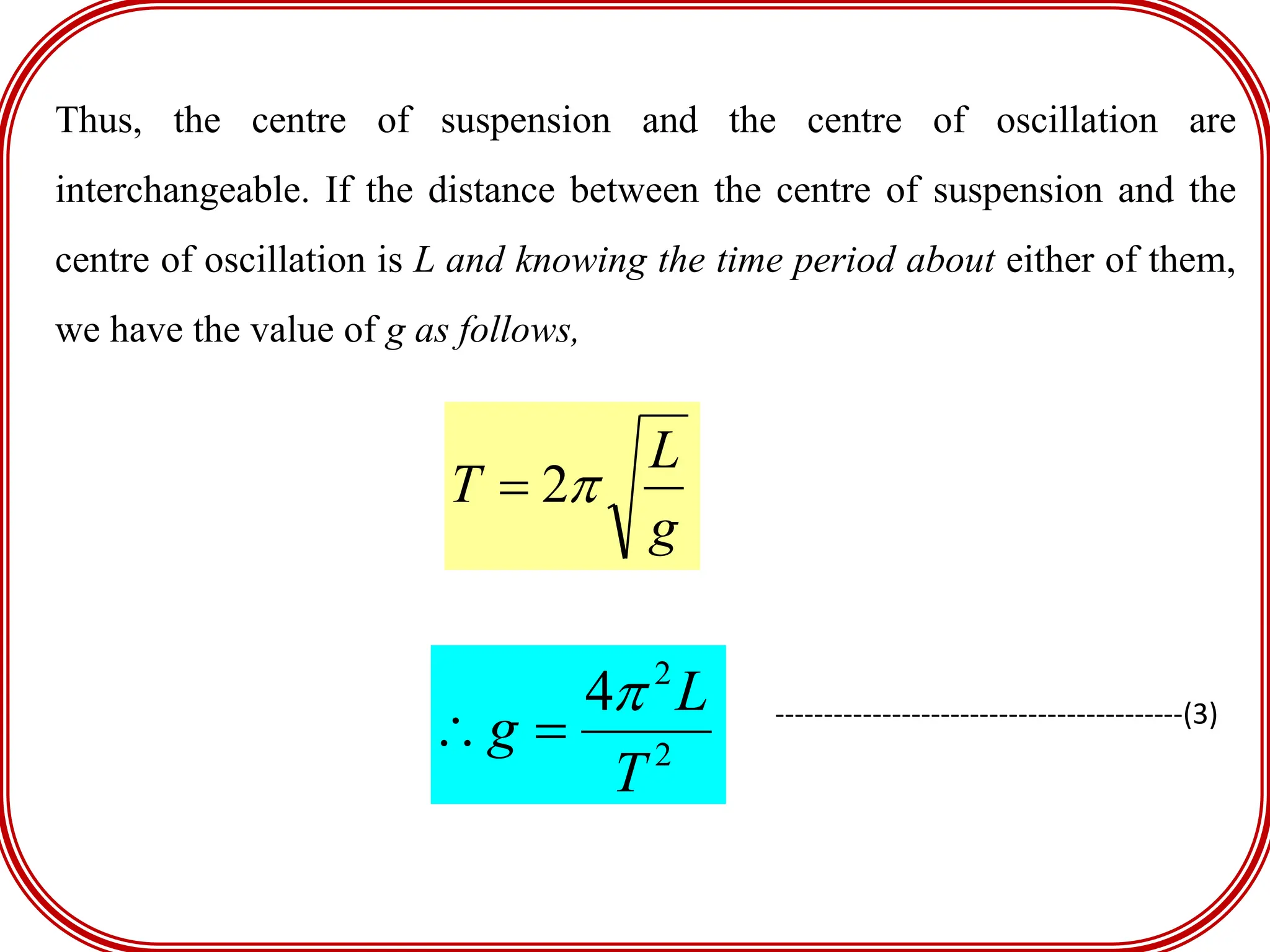
Thus, the centre of suspension and the centre of oscillation are
interchangeable. If the distance between the centre of suspension and the
centre of oscillation is L and knowing the time period about either of them,
we have the value of g as follows,
g
L
T 
2

2
2
4
T
L
g


 ------------------------------------------(3)
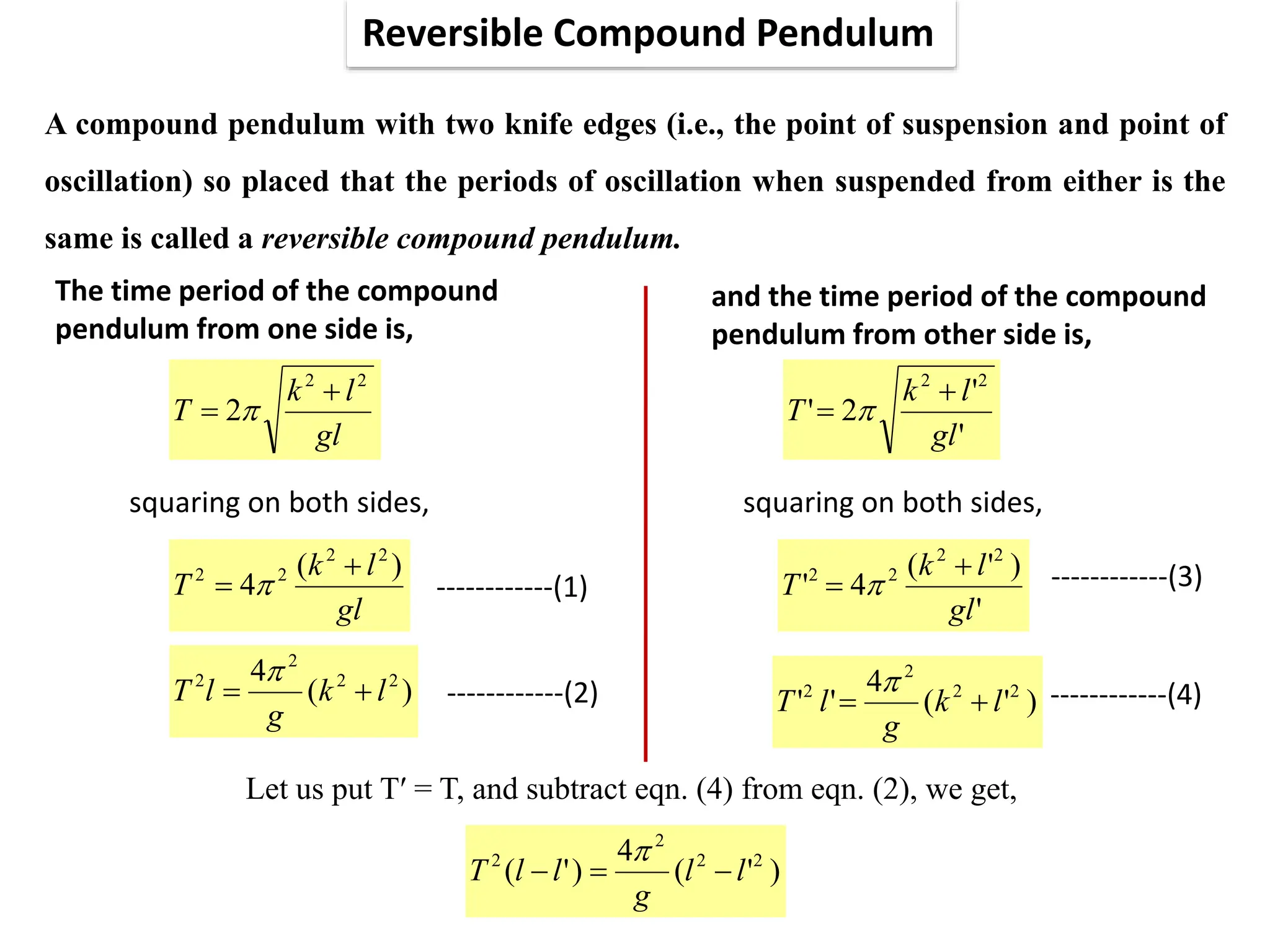
Reversible Compound Pendulum
A compound pendulum with two knife edges (i.e., the point of suspension and point of
oscillation) so placed that the periods of oscillation when suspended from either is the
same is called a reversible compound pendulum.
The time period of the compound
pendulum from one side is,
gl
l
k
T
2
2
2

 
squaring on both sides,
gl
l
k
T
)
(
4
2
2
2
2 
 
)
(
4 2
2
2
2
l
k
g
l
T 


and the time period of the compound
pendulum from other side is,
'
'
2
'
2
2
gl
l
k
T

 
------------(1)
------------(2)
squaring on both sides,
'
)
'
(
4
'
2
2
2
2
gl
l
k
T

 
)
'
(
4
'
' 2
2
2
2
l
k
g
l
T 


------------(3)
------------(4)
Let us put T′ = T, and subtract eqn. (4) from eqn. (2), we get,
)
'
(
4
)
'
( 2
2
2
2
l
l
g
l
l
T 



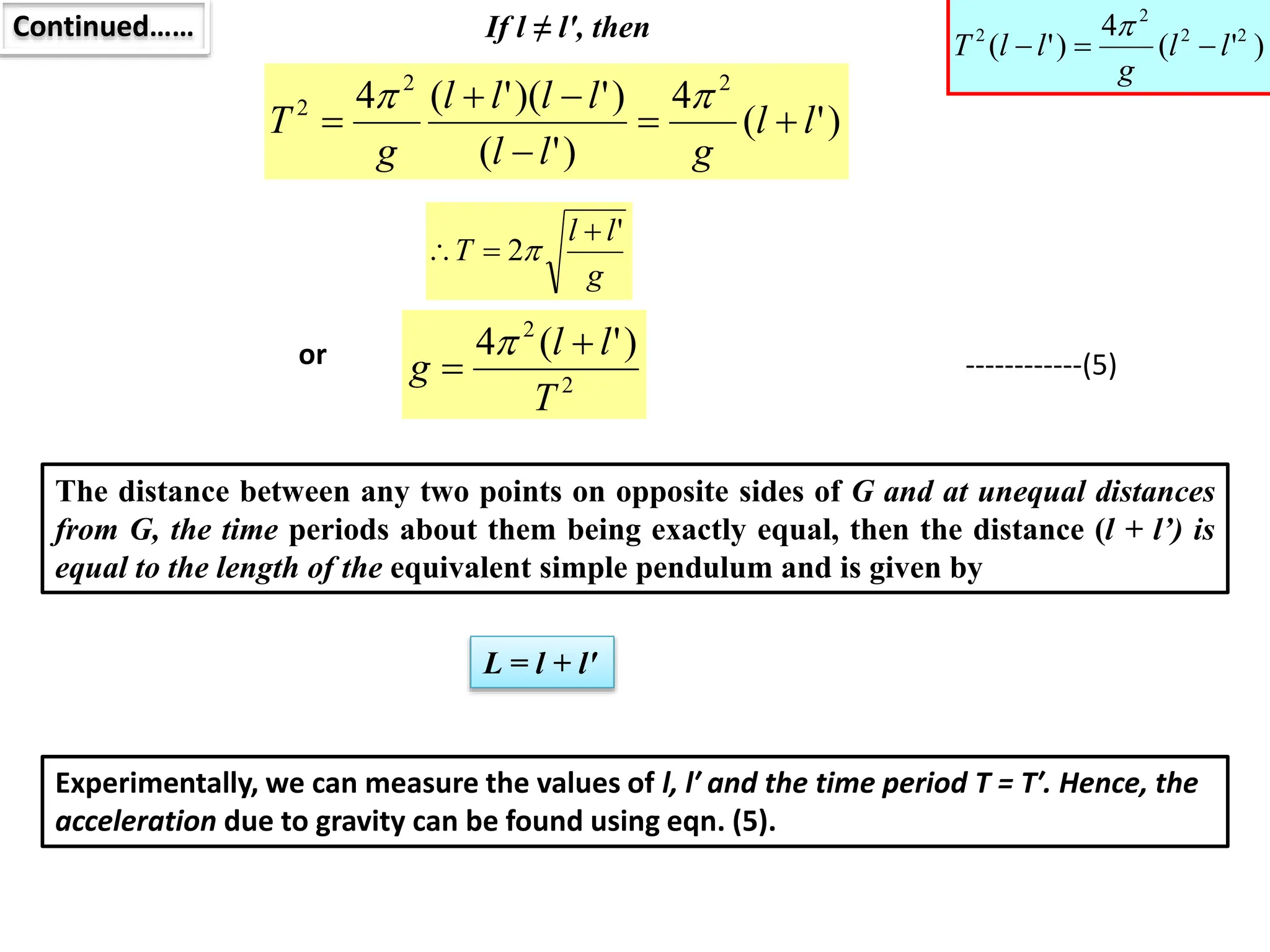
Continued…… If l ≠ l′, then
)
'
(
4
)
'
(
)
'
)(
'
(
4 2
2
2
l
l
g
l
l
l
l
l
l
g
T 







g
l
l
T
'
2


 
2
2
)
'
(
4
T
l
l
g



or ------------(5)
The distance between any two points on opposite sides of G and at unequal distances
from G, the time periods about them being exactly equal, then the distance (l + l’) is
equal to the length of the equivalent simple pendulum and is given by
L = l + l′
Experimentally, we can measure the values of l, l′ and the time period T = T′. Hence, the
acceleration due to gravity can be found using eqn. (5).
)
'
(
4
)
'
( 2
2
2
2
l
l
g
l
l
T 



In actual practice, it is extremely difficult to find the positions of the axes for the time
period T and T′ to be exactly equal.
Continued……
According to Friedrich Wilhelm Bessel, it is found that, if the two periods are nearly equal is
also sufficient.
Then the time periods of the compound pendulum of both sides (after squaring) using eqns.
(1) and (3) can be written as,
gl
l
k
T
)
(
4
2
2
2
2 
  ------------(1)
'
)
'
(
4
2
2
2
2
gl
l
k
T

  ------------(3)
2
2
2
2
4
l
k
glT



2
2
2
2
'
4
'
l
k
glT



On subtracting, above equations, we get,
2
2
2
2
2
'
]
'
'
[
4
l
l
T
l
lT
g




2
2
2
2
2
'
'
'
4
l
l
T
l
lT
g 



------------(6) ------------(7)
)
'
)(
'
(
'
'
4 2
2
2
l
l
l
l
T
l
lT
g 



 ------------(8)
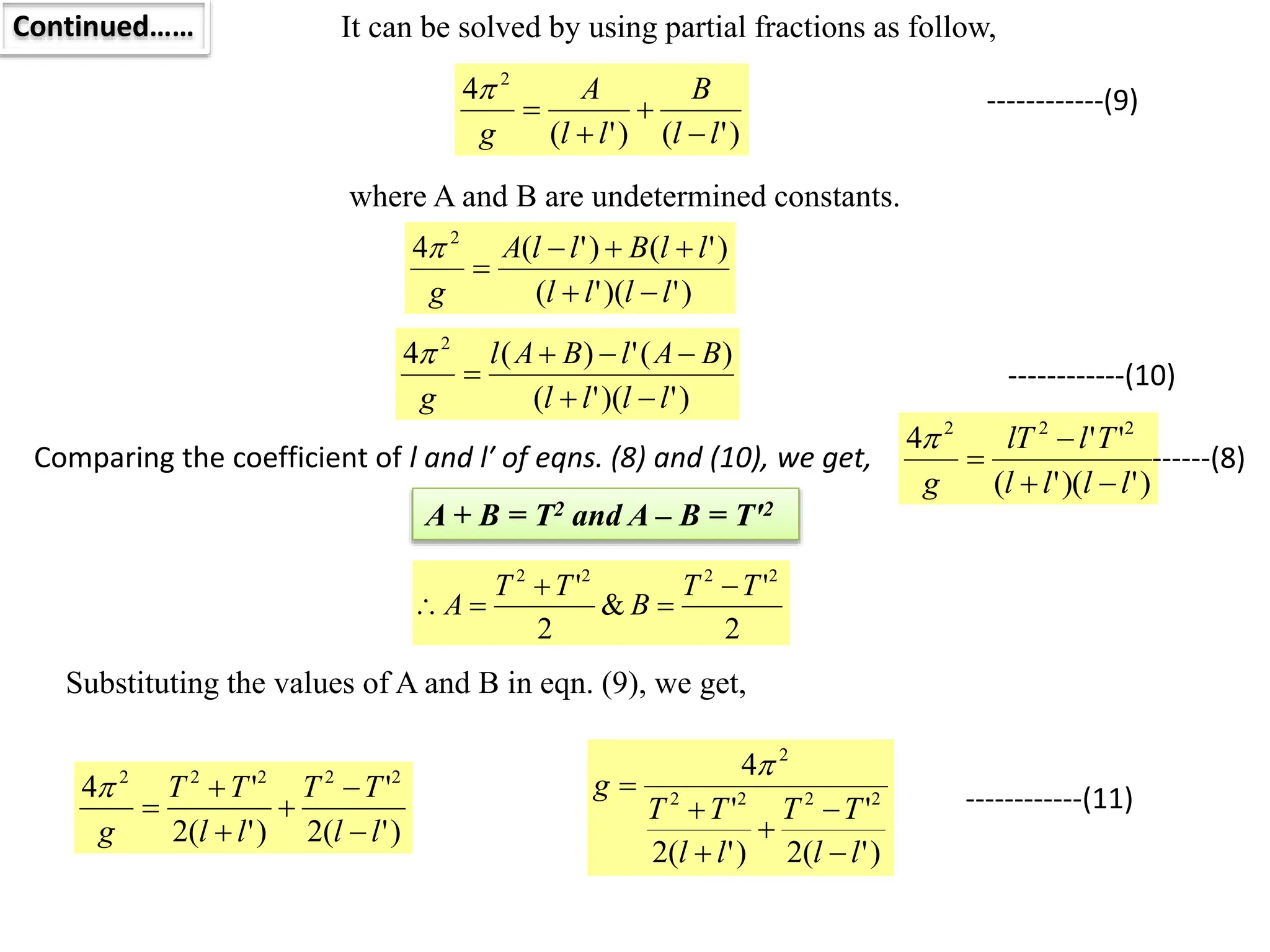
Continued…… It can be solved by using partial fractions as follow,
)
'
(
)
'
(
4 2
l
l
B
l
l
A
g 




where A and B are undetermined constants.
)
'
)(
'
(
)
'
(
)
'
(
4 2
l
l
l
l
l
l
B
l
l
A
g 






)
'
)(
'
(
)
(
'
)
(
4 2
l
l
l
l
B
A
l
B
A
l
g 






Comparing the coefficient of l and l′ of eqns. (8) and (10), we get,
------------(9)
------------(10)
)
'
)(
'
(
'
'
4 2
2
2
l
l
l
l
T
l
lT
g 




------(8)
A + B = T2 and A – B = T′2
2
'
&
2
' 2
2
2
2
T
T
B
T
T
A





Substituting the values of A and B in eqn. (9), we get,
)
'
(
2
'
)
'
(
2
'
4 2
2
2
2
2
l
l
T
T
l
l
T
T
g 






)
'
(
2
'
)
'
(
2
'
4
2
2
2
2
2
l
l
T
T
l
l
T
T
g







------------(11)
Continued……
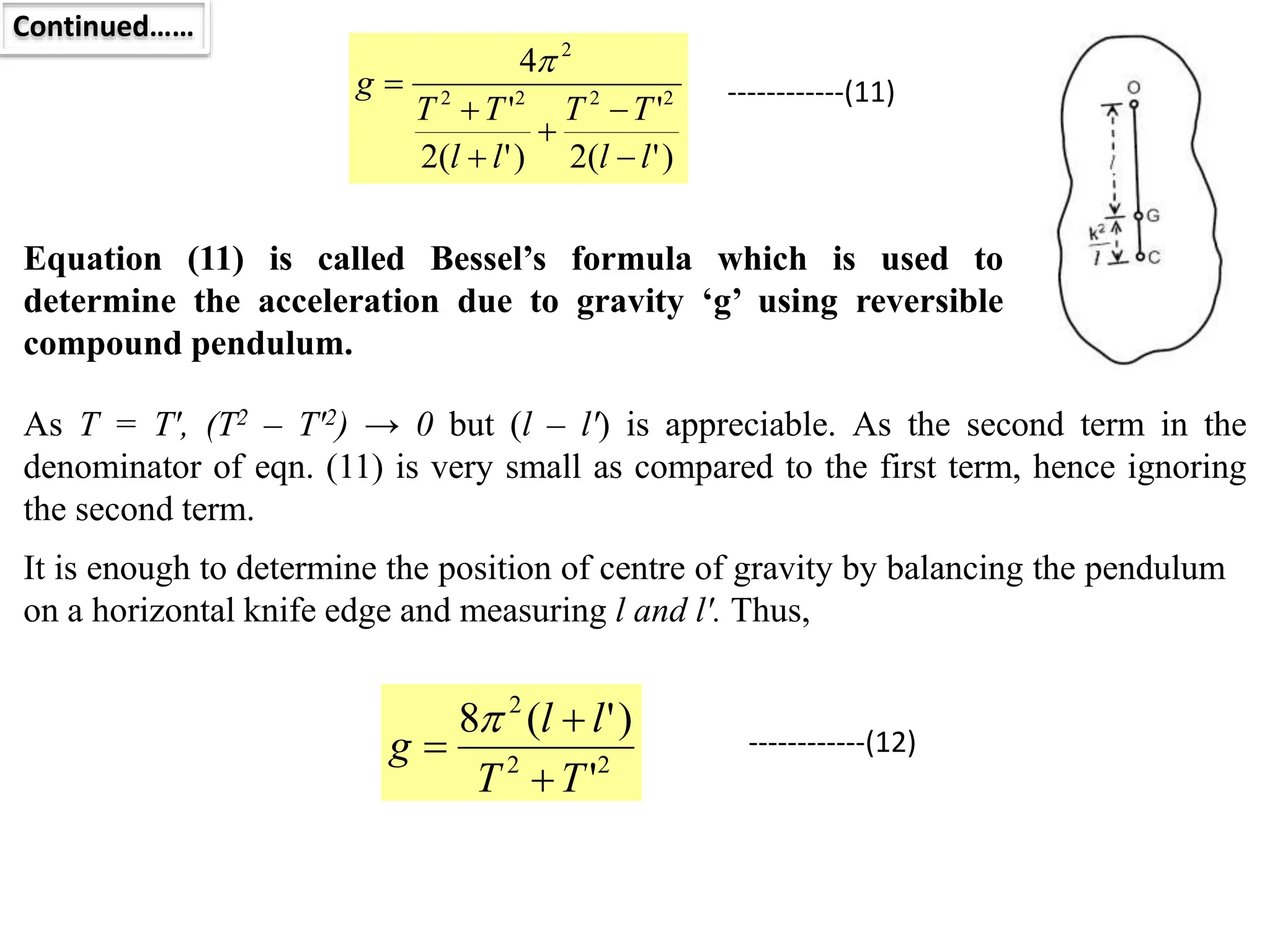
Equation (11) is called Bessel’s formula which is used to
determine the acceleration due to gravity ‘g’ using reversible
compound pendulum.
)
'
(
2
'
)
'
(
2
'
4
2
2
2
2
2
l
l
T
T
l
l
T
T
g







------------(11)
As T = T′, (T2 – T′2) → 0 but (l – l′) is appreciable. As the second term in the
denominator of eqn. (11) is very small as compared to the first term, hence ignoring
the second term.
It is enough to determine the position of centre of gravity by balancing the pendulum
on a horizontal knife edge and measuring l and l′. Thus,
2
2
2
'
)
'
(
8
T
T
l
l
g



 ------------(12)
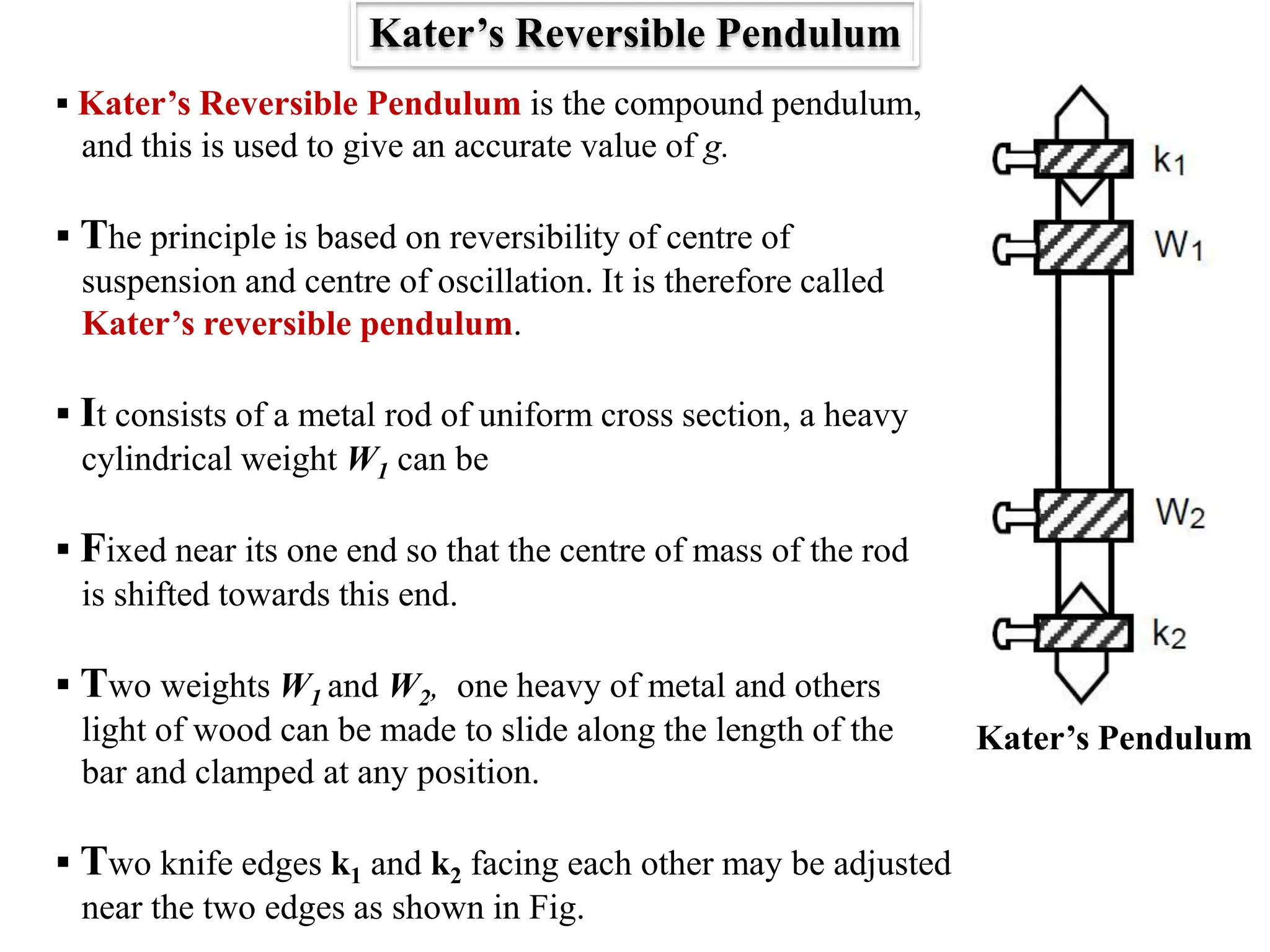
 Kater’s Reversible Pendulum is the compound pendulum,
and this is used to give an accurate value of g.
 The principle is based on reversibility of centre of
suspension and centre of oscillation. It is therefore called
Kater’s reversible pendulum.
 It consists of a metal rod of uniform cross section, a heavy
cylindrical weight W1 can be
 Fixed near its one end so that the centre of mass of the rod
is shifted towards this end.
 Two weights W1 and W2, one heavy of metal and others
light of wood can be made to slide along the length of the
bar and clamped at any position.
 Two knife edges k1 and k2 facing each other may be adjusted
near the two edges as shown in Fig.
Kater’s Reversible Pendulum
Kater’s Pendulum
Kater’s Reversible Pendulum
Continued……
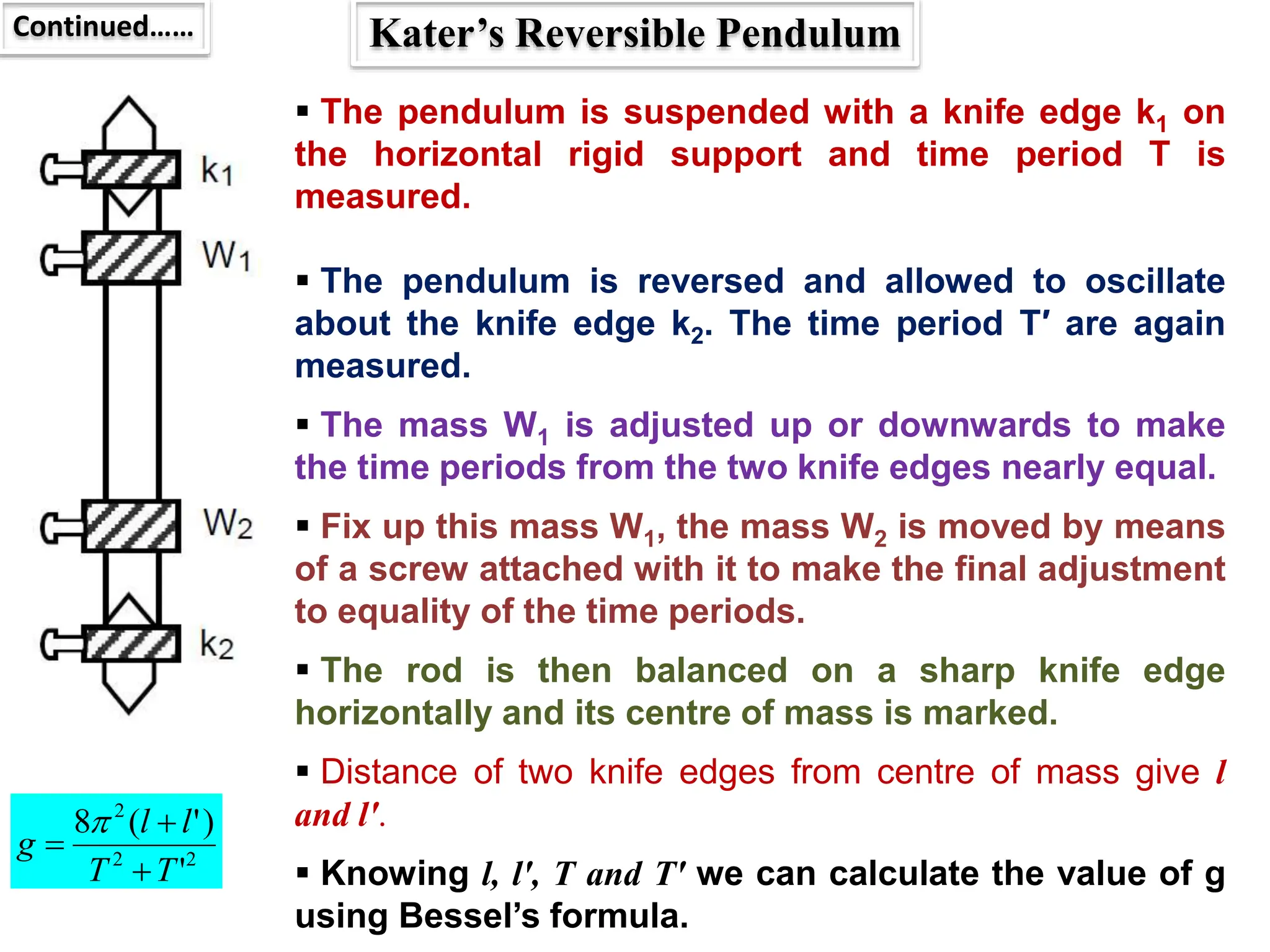
 The pendulum is suspended with a knife edge k1 on
the horizontal rigid support and time period T is
measured.
 The pendulum is reversed and allowed to oscillate
about the knife edge k2. The time period T′ are again
measured.
 The mass W1 is adjusted up or downwards to make
the time periods from the two knife edges nearly equal.
 Fix up this mass W1, the mass W2 is moved by means
of a screw attached with it to make the final adjustment
to equality of the time periods.
 The rod is then balanced on a sharp knife edge
horizontally and its centre of mass is marked.
 Distance of two knife edges from centre of mass give l
and l′.
 Knowing l, l′, T and T′ we can calculate the value of g
using Bessel’s formula.
2
2
2
'
)
'
(
8
T
T
l
l
g




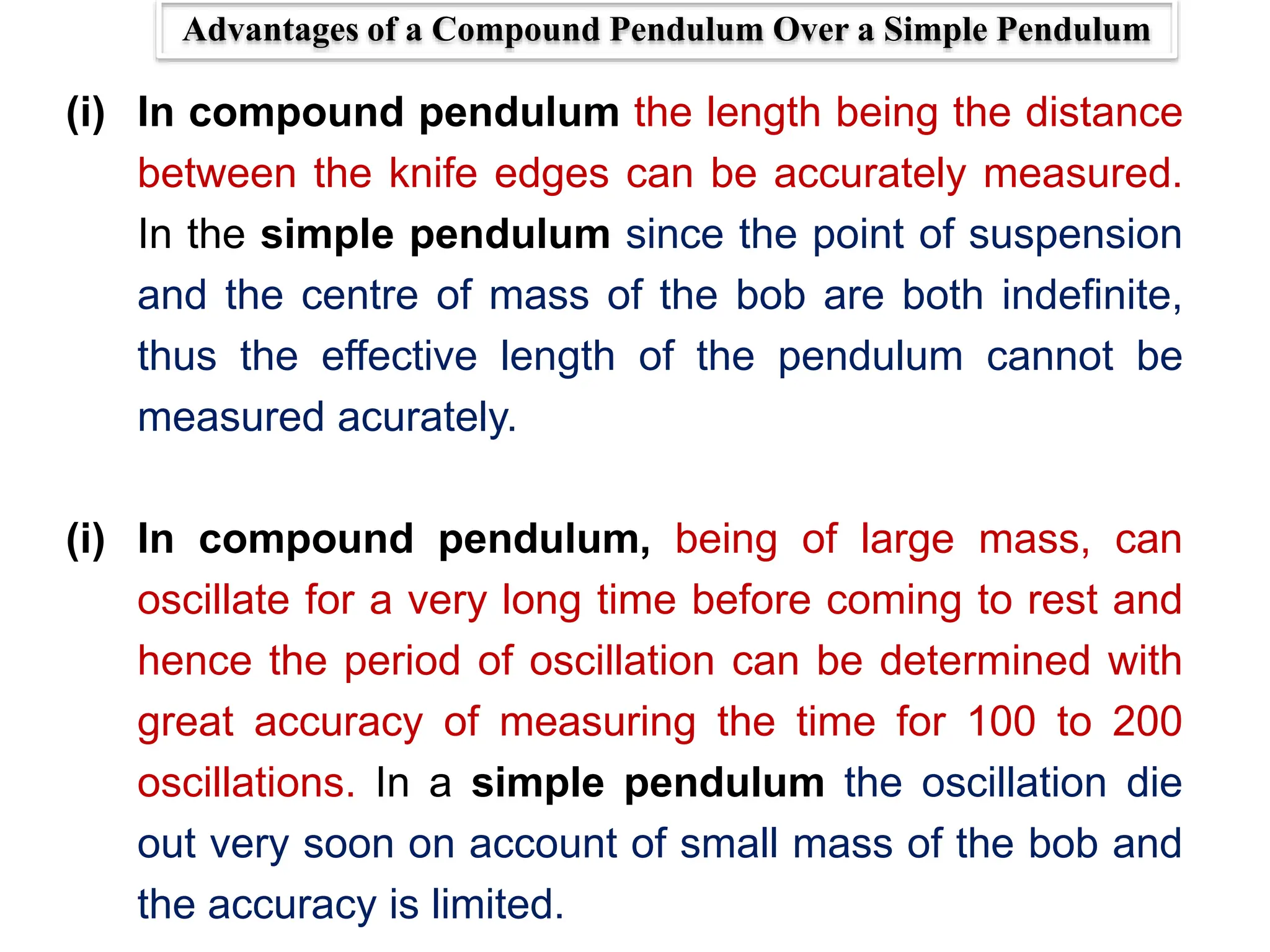
Advantages of a Compound Pendulum Over a Simple Pendulum
(i) In compound pendulum the length being the distance
between the knife edges can be accurately measured.
In the simple pendulum since the point of suspension
and the centre of mass of the bob are both indefinite,
thus the effective length of the pendulum cannot be
measured acurately.
(i) In compound pendulum, being of large mass, can
oscillate for a very long time before coming to rest and
hence the period of oscillation can be determined with
great accuracy of measuring the time for 100 to 200
oscillations. In a simple pendulum the oscillation die
out very soon on account of small mass of the bob and
the accuracy is limited.
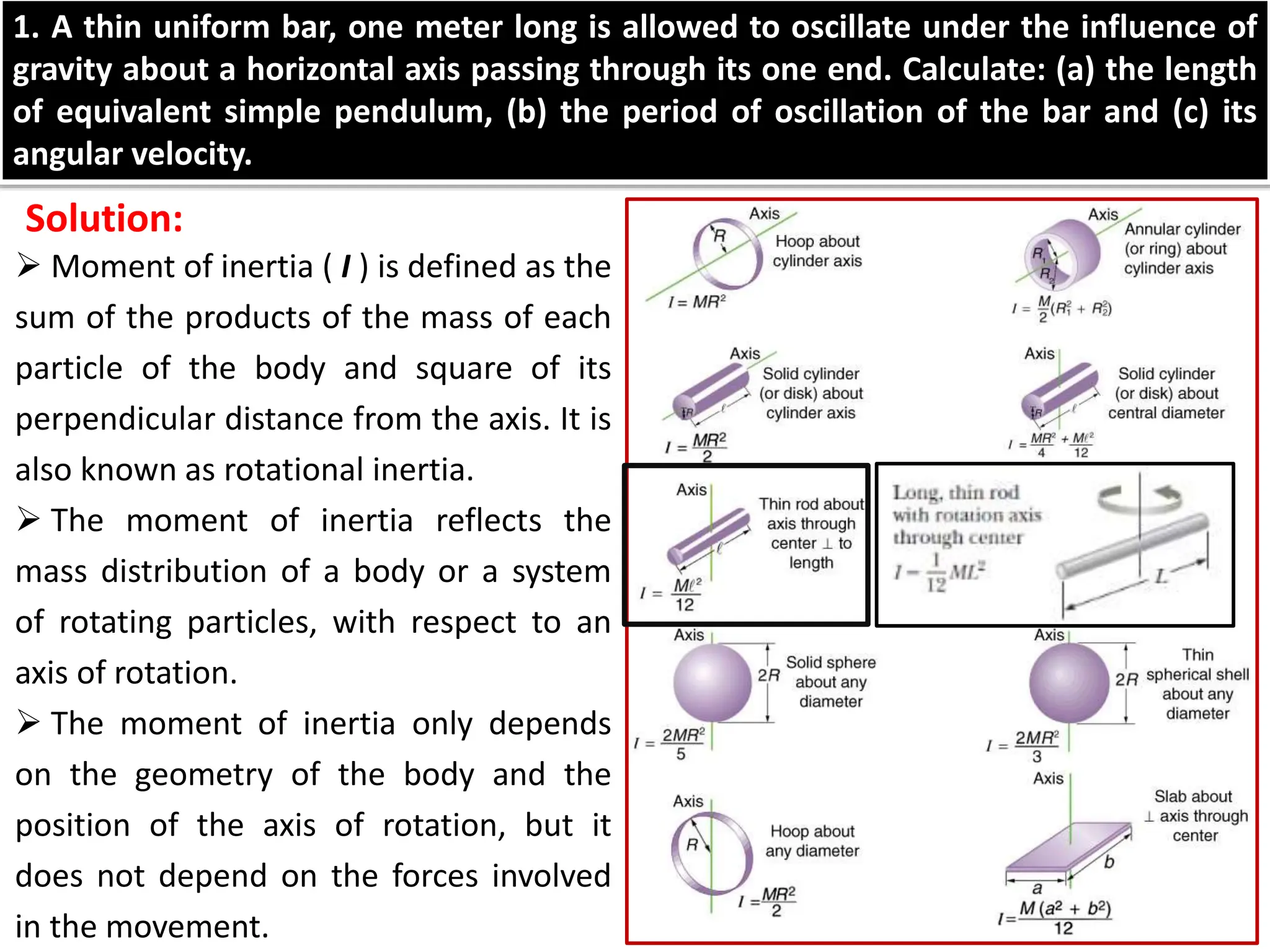
 Moment of inertia ( I ) is defined as the
sum of the products of the mass of each
particle of the body and square of its
perpendicular distance from the axis. It is
also known as rotational inertia.
 The moment of inertia reflects the
mass distribution of a body or a system
of rotating particles, with respect to an
axis of rotation.
 The moment of inertia only depends
on the geometry of the body and the
position of the axis of rotation, but it
does not depend on the forces involved
in the movement.
1. A thin uniform bar, one meter long is allowed to oscillate under the influence of
gravity about a horizontal axis passing through its one end. Calculate: (a) the length
of equivalent simple pendulum, (b) the period of oscillation of the bar and (c) its
angular velocity.
Solution:
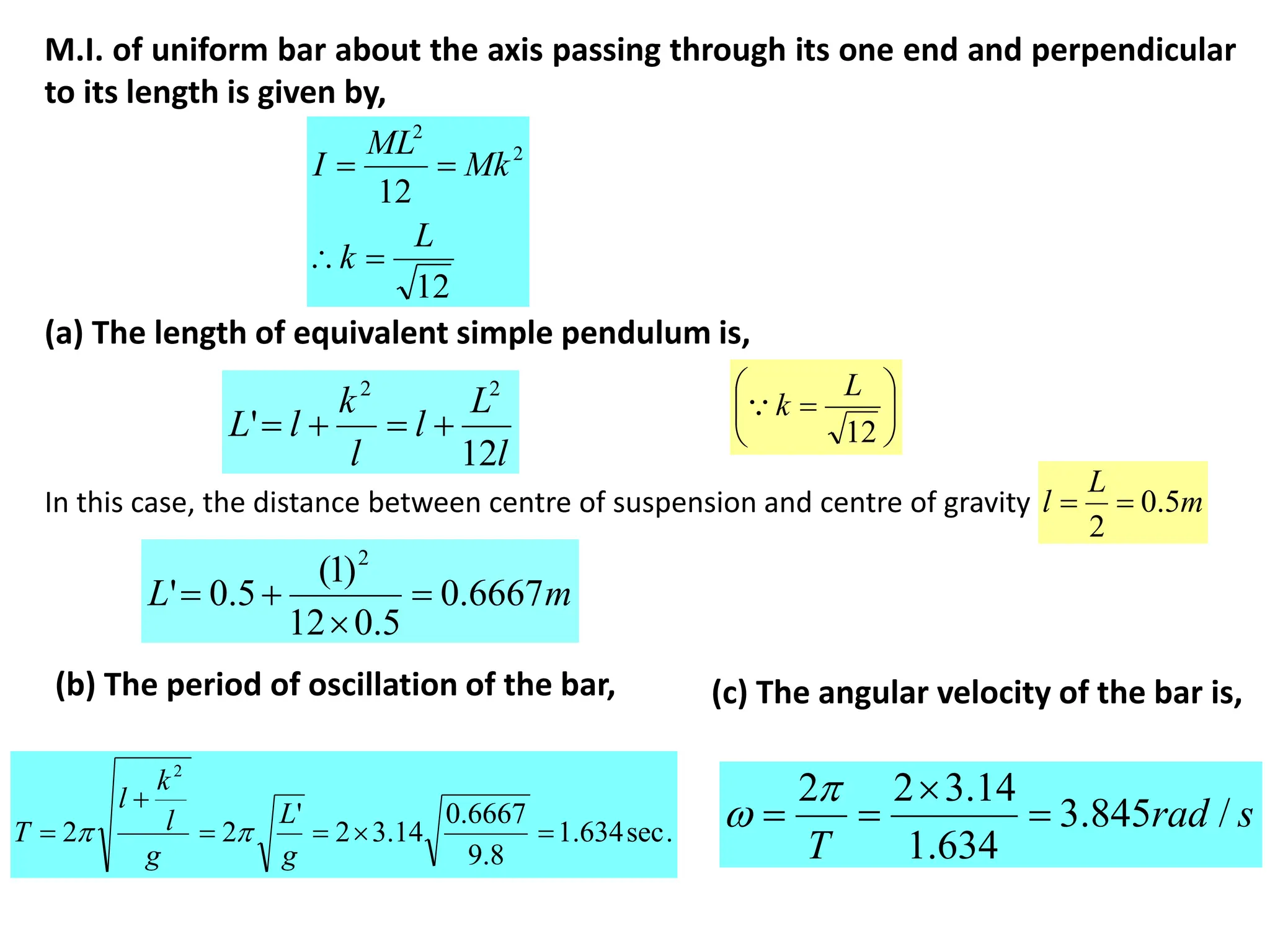
M.I. of uniform bar about the axis passing through its one end and perpendicular
to its length is given by,
12
12
2
2
L
k
Mk
ML
I




(a) The length of equivalent simple pendulum is,
l
L
l
l
k
l
L
12
'
2
2











12
L
k

In this case, the distance between centre of suspension and centre of gravity
m
L 6667
.
0
5
.
0
12
)
1
(
5
.
0
'
2




m
L
l 5
.
0
2


(b) The period of oscillation of the bar,
.
sec
634
.
1
8
.
9
6667
.
0
14
.
3
2
'
2
2
2






g
L
g
l
k
l
T 
 s
rad
T
/
845
.
3
634
.
1
14
.
3
2
2






(c) The angular velocity of the bar is,
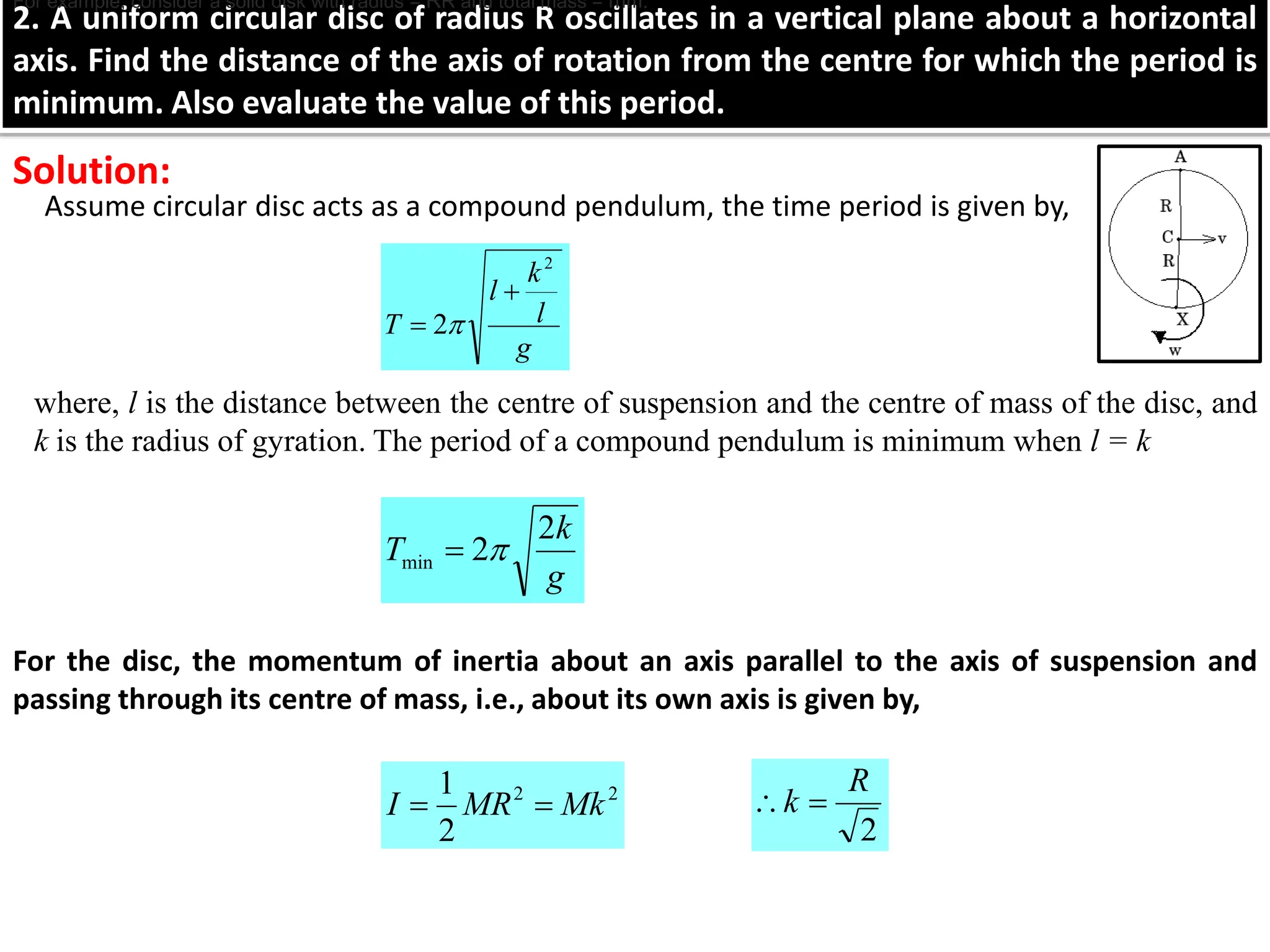
2. A uniform circular disc of radius R oscillates in a vertical plane about a horizontal
axis. Find the distance of the axis of rotation from the centre for which the period is
minimum. Also evaluate the value of this period.
Assume circular disc acts as a compound pendulum, the time period is given by,
Solution:
g
l
k
l
T
2
2

 
where, l is the distance between the centre of suspension and the centre of mass of the disc, and
k is the radius of gyration. The period of a compound pendulum is minimum when l = k
g
k
T
2
2
min 

For the disc, the momentum of inertia about an axis parallel to the axis of suspension and
passing through its centre of mass, i.e., about its own axis is given by,
2
2
2
1
Mk
MR
I 

For example, consider a solid disk with radius = RR and total mass = mm.
2
R
k 

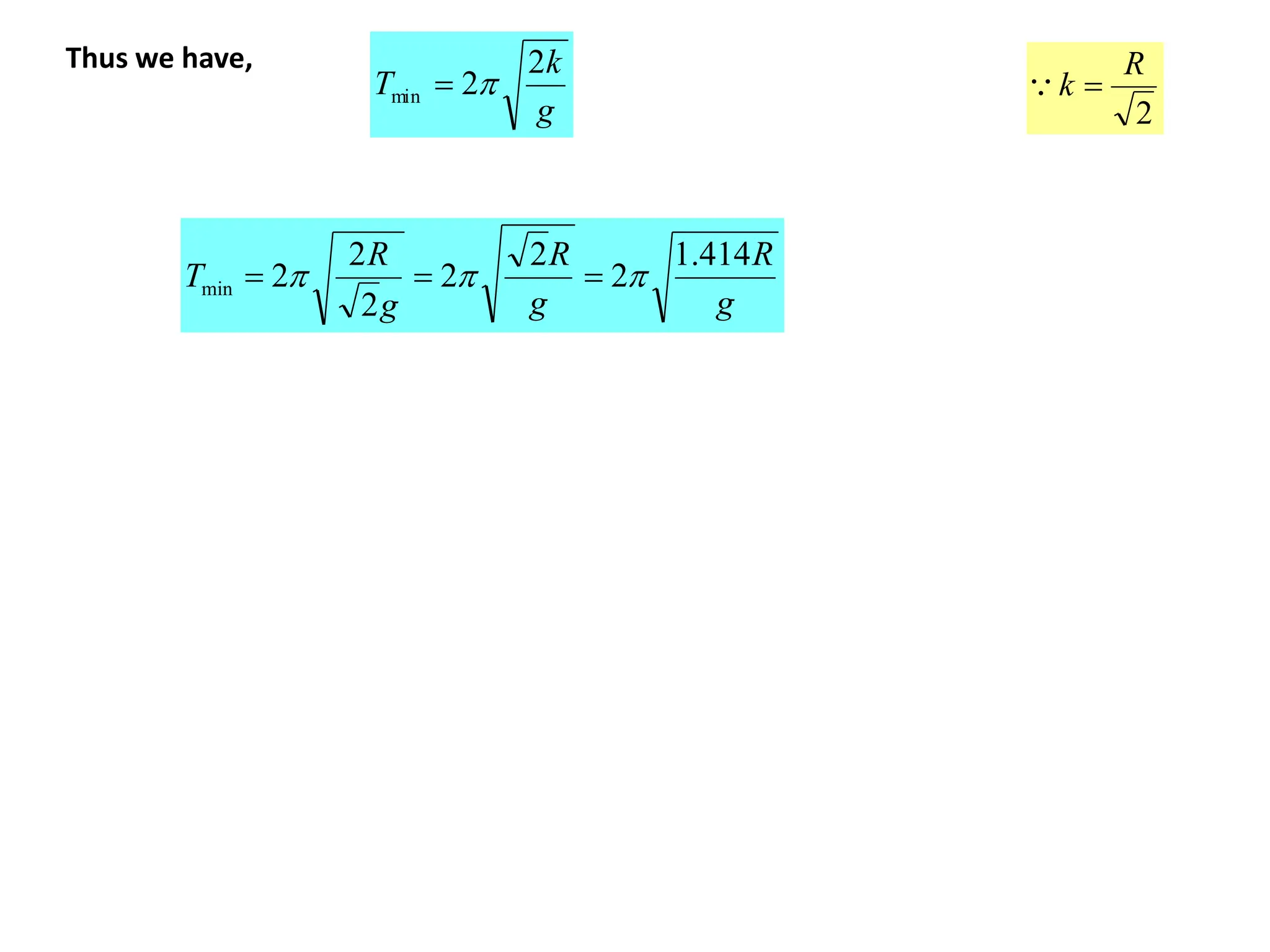
Thus we have,
g
k
T
2
2
min 

2
R
k 

g
R
g
R
g
R
T
414
.
1
2
2
2
2
2
2
min 

 


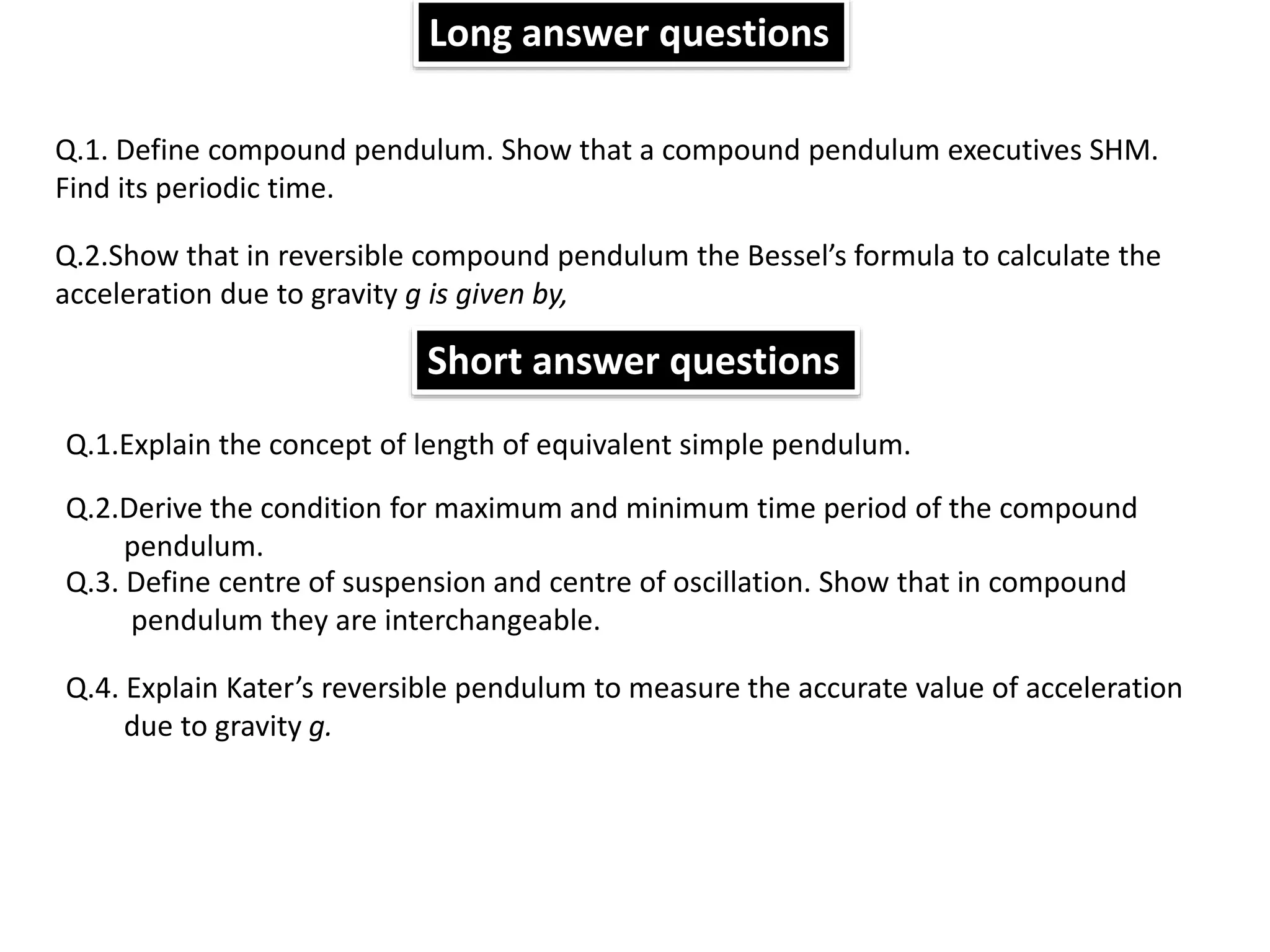
Q.1. Define compound pendulum. Show that a compound pendulum executives SHM.
Find its periodic time.
Q.1.Explain the concept of length of equivalent simple pendulum.
Q.2.Derive the condition for maximum and minimum time period of the compound
pendulum.
Q.3. Define centre of suspension and centre of oscillation. Show that in compound
pendulum they are interchangeable.
Q.2.Show that in reversible compound pendulum the Bessel’s formula to calculate the
acceleration due to gravity g is given by,
Q.4. Explain Kater’s reversible pendulum to measure the accurate value of acceleration
due to gravity g.
Long answer questions
Short answer questions

Mechanics:- Simple and Compound Pendulum

  • 1.
    Compound Pendulum # Topics a)Time period of compound pendulum b) Maximum and Minimum Time periods of a compound pendulum
  • 2.
    Simple Pendulum A pendulumis suspended body oscillating under the influence of the gravitational force acting on it. This is the most accurate method for determining of acceleration due to gravity. The simple pendulum whose period of oscillation is, g l T  2  where, g = acceleration due to gravity l = is the length of pendulum
  • 3.
    Compound Pendulum The real(or rigid body) pendulum which can be of any shape object or a rigid body capable of oscillating in a vertical plane freely about a horizontal axis passing through any point of it is called physical pendulum or compound pendulum. The moment (or torque) of a force about a turning point is the force multiplied by the perpendicular distance to the force from the turning point. Moments are measured in newton metres (Nm). Moment = F d F is the force in Newton d is the perpendicular distance Example: A 10N force acts at a perpendicular distance of 0.50m from the turning point. What is the moment of the force? Moment = F . d = 10 x 0.50 = 5.0 Nm
  • 4.
    A couple istwo equal forces which act in opposite directs on an object but not through the same point so they produce a turning effect. The moment (or torque) of a couple is calculated by multiplying the size of one of the force (F) by the perpendicular distance between the two forces (s). E.g. a steering wheel in a car; Moment of Couple = F . s
  • 5.
  • 6.
    Equate equation (1)and (2), we get This is the differential equation of angular SHM showing that the motion of the compound pendulum is simple harmonic. The time period of oscillation is given by, mgl I T T    2 2 0   ---------------------(3) ---------------------(4)
  • 7.
    Let Ig bethe moment of inertia of the rigid body about an axis parallel to the axis of suspension but passing through its centre of gravity G. Then from the parallel axis theorem, we can write, I = Ig + ml2 If k be the radius of gyration of the rigid body about an axis passing through the centre of gravity G, then Ig = mk2 . Thus we have, I = mk2 + ml2 = m(k2 + l2 ) Hence, the time period becomes, mgl l k m T ) ( 2 2 2    gl l k T ) ( 2 2 2    ---------------------(5) The moment of inertia about any axis parallel to that axis through the center of mass the moment of inertia about a parallel axis is the center of mass moment plus the moment of inertia of the entire object treated as a point mass at the center of mass.
  • 8.
    Length of EquivalentSimple Pendulum mgl l k m T ) ( 2 2 2    The time period of compound pendulum is, g l l k gl l k T     2 2 2 2 ) ( 2   Comparing this time period of a compound pendulum with the time period of an ideal simple pendulum of length L          g L T e i  2 . . l l k L   2 if we use above equation, then two time periods would be the same. This length L of a compound pendulum is known as the length of equivalent simple pendulum. If the whole mass of the compound pendulum is concentrated at a point C at a distance from the point of suspension, as shown in Fig. l l k L   2 This pendulum behave like a simple pendulum of same period.  The point C is then the centre of oscillation.
  • 9.
    Maximum and MinimumTime Periods of a Compound Pendulum gl l k T 2 2 2    The time period of compound pendulum is, Squaring on both sides, we get,           l l k g T 2 2 2 2 4           l k l g T 2 2 2 4 Differentiating the above eqn. with respect to l, we get,           2 2 2 1 4 2 l k g dl dT T  (a) If l = 0, the R.H.S. of eqn. (2) becomes infinite. Hence, ------------(1) ------------(2) The time period of the pendulum gradually increases as the point of suspension is shifted slowly towards the centre of mass. The time period of the pendulum is maximum when the axis of suspension passes through the centre of gravity of the pendulum. Hence the time period of the pendulum is minimum, when the distance between the centre of suspension and centre of gravity (c.g.) becomes equal the radius of gyration of the pendulum about the horizontal axis passing through c.g., we then have, (b) If l = k, the R.H.S. of eqn. (2) is zero. gl l k T 2 2 min 2    gl l l T 2 2 2    g l gl l T 2 2 2 2 2    
  • 10.
    Centre of suspension& centre of oscillation are mutually interchangeable The point O through which the horizontal axis of suspension passes is known as the centre of suspension. The length of equivalent simple pendulum is, l l k L   2 If the line OG is extended up to a point C, then the point C is called the centre of oscillation. Thus, OC = OG + GC l l k L   2 Let the distance of the c.g. from the centre of oscillation C = l′. Then we have, l k l 2 ' 2 ' k ll   If the pendulum is suspended about the point O, then the time period becomes, gl l k T 2 2 2    gl l ll T 2 ' 2    g l l T   ' 2 Again, when the pendulum is inverted and suspended about the point C, then the time period T′ is, 𝑇′ = 2𝜋 𝑘2 + 𝑙′2 𝑔𝑙′ 𝑇′ = 2𝜋 𝑙𝑙′ + 𝑙′2 𝑔𝑙′ g l l T ' 2 '    T T  ' -------(1) -------(2) Eqn. (1) & (2)
  • 11.
    Thus, the centreof suspension and the centre of oscillation are interchangeable. If the distance between the centre of suspension and the centre of oscillation is L and knowing the time period about either of them, we have the value of g as follows, g L T  2  2 2 4 T L g    ------------------------------------------(3)
  • 12.
    Reversible Compound Pendulum Acompound pendulum with two knife edges (i.e., the point of suspension and point of oscillation) so placed that the periods of oscillation when suspended from either is the same is called a reversible compound pendulum. The time period of the compound pendulum from one side is, gl l k T 2 2 2    squaring on both sides, gl l k T ) ( 4 2 2 2 2    ) ( 4 2 2 2 2 l k g l T    and the time period of the compound pendulum from other side is, ' ' 2 ' 2 2 gl l k T    ------------(1) ------------(2) squaring on both sides, ' ) ' ( 4 ' 2 2 2 2 gl l k T    ) ' ( 4 ' ' 2 2 2 2 l k g l T    ------------(3) ------------(4) Let us put T′ = T, and subtract eqn. (4) from eqn. (2), we get, ) ' ( 4 ) ' ( 2 2 2 2 l l g l l T    
  • 13.
    Continued…… If l≠ l′, then ) ' ( 4 ) ' ( ) ' )( ' ( 4 2 2 2 l l g l l l l l l g T         g l l T ' 2     2 2 ) ' ( 4 T l l g    or ------------(5) The distance between any two points on opposite sides of G and at unequal distances from G, the time periods about them being exactly equal, then the distance (l + l’) is equal to the length of the equivalent simple pendulum and is given by L = l + l′ Experimentally, we can measure the values of l, l′ and the time period T = T′. Hence, the acceleration due to gravity can be found using eqn. (5). ) ' ( 4 ) ' ( 2 2 2 2 l l g l l T    
  • 14.
    In actual practice,it is extremely difficult to find the positions of the axes for the time period T and T′ to be exactly equal. Continued…… According to Friedrich Wilhelm Bessel, it is found that, if the two periods are nearly equal is also sufficient. Then the time periods of the compound pendulum of both sides (after squaring) using eqns. (1) and (3) can be written as, gl l k T ) ( 4 2 2 2 2    ------------(1) ' ) ' ( 4 2 2 2 2 gl l k T    ------------(3) 2 2 2 2 4 l k glT    2 2 2 2 ' 4 ' l k glT    On subtracting, above equations, we get, 2 2 2 2 2 ' ] ' ' [ 4 l l T l lT g     2 2 2 2 2 ' ' ' 4 l l T l lT g     ------------(6) ------------(7) ) ' )( ' ( ' ' 4 2 2 2 l l l l T l lT g      ------------(8)
  • 15.
    Continued…… It canbe solved by using partial fractions as follow, ) ' ( ) ' ( 4 2 l l B l l A g      where A and B are undetermined constants. ) ' )( ' ( ) ' ( ) ' ( 4 2 l l l l l l B l l A g        ) ' )( ' ( ) ( ' ) ( 4 2 l l l l B A l B A l g        Comparing the coefficient of l and l′ of eqns. (8) and (10), we get, ------------(9) ------------(10) ) ' )( ' ( ' ' 4 2 2 2 l l l l T l lT g      ------(8) A + B = T2 and A – B = T′2 2 ' & 2 ' 2 2 2 2 T T B T T A      Substituting the values of A and B in eqn. (9), we get, ) ' ( 2 ' ) ' ( 2 ' 4 2 2 2 2 2 l l T T l l T T g        ) ' ( 2 ' ) ' ( 2 ' 4 2 2 2 2 2 l l T T l l T T g        ------------(11)
  • 16.
    Continued…… Equation (11) iscalled Bessel’s formula which is used to determine the acceleration due to gravity ‘g’ using reversible compound pendulum. ) ' ( 2 ' ) ' ( 2 ' 4 2 2 2 2 2 l l T T l l T T g        ------------(11) As T = T′, (T2 – T′2) → 0 but (l – l′) is appreciable. As the second term in the denominator of eqn. (11) is very small as compared to the first term, hence ignoring the second term. It is enough to determine the position of centre of gravity by balancing the pendulum on a horizontal knife edge and measuring l and l′. Thus, 2 2 2 ' ) ' ( 8 T T l l g     ------------(12)
  • 17.
     Kater’s ReversiblePendulum is the compound pendulum, and this is used to give an accurate value of g.  The principle is based on reversibility of centre of suspension and centre of oscillation. It is therefore called Kater’s reversible pendulum.  It consists of a metal rod of uniform cross section, a heavy cylindrical weight W1 can be  Fixed near its one end so that the centre of mass of the rod is shifted towards this end.  Two weights W1 and W2, one heavy of metal and others light of wood can be made to slide along the length of the bar and clamped at any position.  Two knife edges k1 and k2 facing each other may be adjusted near the two edges as shown in Fig. Kater’s Reversible Pendulum Kater’s Pendulum
  • 18.
    Kater’s Reversible Pendulum Continued…… The pendulum is suspended with a knife edge k1 on the horizontal rigid support and time period T is measured.  The pendulum is reversed and allowed to oscillate about the knife edge k2. The time period T′ are again measured.  The mass W1 is adjusted up or downwards to make the time periods from the two knife edges nearly equal.  Fix up this mass W1, the mass W2 is moved by means of a screw attached with it to make the final adjustment to equality of the time periods.  The rod is then balanced on a sharp knife edge horizontally and its centre of mass is marked.  Distance of two knife edges from centre of mass give l and l′.  Knowing l, l′, T and T′ we can calculate the value of g using Bessel’s formula. 2 2 2 ' ) ' ( 8 T T l l g    
  • 19.
    Advantages of aCompound Pendulum Over a Simple Pendulum (i) In compound pendulum the length being the distance between the knife edges can be accurately measured. In the simple pendulum since the point of suspension and the centre of mass of the bob are both indefinite, thus the effective length of the pendulum cannot be measured acurately. (i) In compound pendulum, being of large mass, can oscillate for a very long time before coming to rest and hence the period of oscillation can be determined with great accuracy of measuring the time for 100 to 200 oscillations. In a simple pendulum the oscillation die out very soon on account of small mass of the bob and the accuracy is limited.
  • 20.
     Moment ofinertia ( I ) is defined as the sum of the products of the mass of each particle of the body and square of its perpendicular distance from the axis. It is also known as rotational inertia.  The moment of inertia reflects the mass distribution of a body or a system of rotating particles, with respect to an axis of rotation.  The moment of inertia only depends on the geometry of the body and the position of the axis of rotation, but it does not depend on the forces involved in the movement. 1. A thin uniform bar, one meter long is allowed to oscillate under the influence of gravity about a horizontal axis passing through its one end. Calculate: (a) the length of equivalent simple pendulum, (b) the period of oscillation of the bar and (c) its angular velocity. Solution:
  • 21.
    M.I. of uniformbar about the axis passing through its one end and perpendicular to its length is given by, 12 12 2 2 L k Mk ML I     (a) The length of equivalent simple pendulum is, l L l l k l L 12 ' 2 2            12 L k  In this case, the distance between centre of suspension and centre of gravity m L 6667 . 0 5 . 0 12 ) 1 ( 5 . 0 ' 2     m L l 5 . 0 2   (b) The period of oscillation of the bar, . sec 634 . 1 8 . 9 6667 . 0 14 . 3 2 ' 2 2 2       g L g l k l T   s rad T / 845 . 3 634 . 1 14 . 3 2 2       (c) The angular velocity of the bar is,
  • 22.
    2. A uniformcircular disc of radius R oscillates in a vertical plane about a horizontal axis. Find the distance of the axis of rotation from the centre for which the period is minimum. Also evaluate the value of this period. Assume circular disc acts as a compound pendulum, the time period is given by, Solution: g l k l T 2 2    where, l is the distance between the centre of suspension and the centre of mass of the disc, and k is the radius of gyration. The period of a compound pendulum is minimum when l = k g k T 2 2 min   For the disc, the momentum of inertia about an axis parallel to the axis of suspension and passing through its centre of mass, i.e., about its own axis is given by, 2 2 2 1 Mk MR I   For example, consider a solid disk with radius = RR and total mass = mm. 2 R k  
  • 23.
    Thus we have, g k T 2 2 min  2 R k   g R g R g R T 414 . 1 2 2 2 2 2 2 min      
  • 24.
    Q.1. Define compoundpendulum. Show that a compound pendulum executives SHM. Find its periodic time. Q.1.Explain the concept of length of equivalent simple pendulum. Q.2.Derive the condition for maximum and minimum time period of the compound pendulum. Q.3. Define centre of suspension and centre of oscillation. Show that in compound pendulum they are interchangeable. Q.2.Show that in reversible compound pendulum the Bessel’s formula to calculate the acceleration due to gravity g is given by, Q.4. Explain Kater’s reversible pendulum to measure the accurate value of acceleration due to gravity g. Long answer questions Short answer questions