BAR PENDLUM
To determine
• The acceleration due to gravity “g” using bar
pendulum.
• The radius of gyration “k” of the bar about a
horizontal axis passing through the centre of gravity.
AIM :
• Bar pendulum.
• Stop Watch, etc.
APPARATUS :
A bar pendulum consists of a uniform rectangular
bar having a number of equidistant holes along its
length as shown in fig [a] . A small rod with a knife
edge can be passed through any of these holes and
the bar can be suspended with this rod as axis.The
pendulum can be made to oscillate in a vertical
plane about this axis.
DESCRIPTION :
PRINCIPLE:
The bar pendulum is a kind of compound pendulum. If ‘K’ is the radius of gyation about a horizontal axis through the C .G.
of the bar and h is the distance of the axis of suspension from the C.G. the period of oscillation.
•
• When the period [T] about the different holes is plotted against distance h we get curves of the form shown in figure
[b]. For a given value of T ,there are 4 points [ A,B,C,and D] about which the periods are the same . The length of the
corresponding equivalent simple pendulum is
The period of the pendulum is the minimum when h=k. therefore distance
if T1 AND T2 are the periods about two wholes which are at distances h1 and h2 from the C.G.
By squaring these exepression and simplifying we get
if T1 AND T2 are the periods about two wholes which are at
distances h1 and h2 from the C.G.
HHHH
PROCEDURE:
The pendulum is suspended about a horizontal axis passing through the
9th hole from the center.
The distance h of the hole from the C.G. [ie.the central hole]
is measured .the pendulum is set into oscillation [small amplitude] and the
time for 20 oscilation is measured using a stop watch.from this period T ie the
time for one oscillation is found out.
This is reapeted for the different holes on either side of the center .the
acceleration due to gravity and radius of gyration can be determined by
two methods.
[a] h-T graph :
a graph is drawn taking T along Y axis and h along x axis . Two
symmetric curves as show in figure [b] are obtained .a straight line
ABCD is drawn parallel to X axis and L=AC+BD is calculated.if T is the period
corresponding to the line ABCD,
The calculation can be repeated by drawing other lines parallel to ABCD
The distance pq between the lowest points of the two curves is found out
The value of k by direct calculation
Where L is the length and B is the breadth of the bar
[b] Two-hole method:The periods T1 and T2 about any two holes [eg,,second and eighth or
third and seventh]are determined.The value of G and K are calculated using equations [3]
and [4]
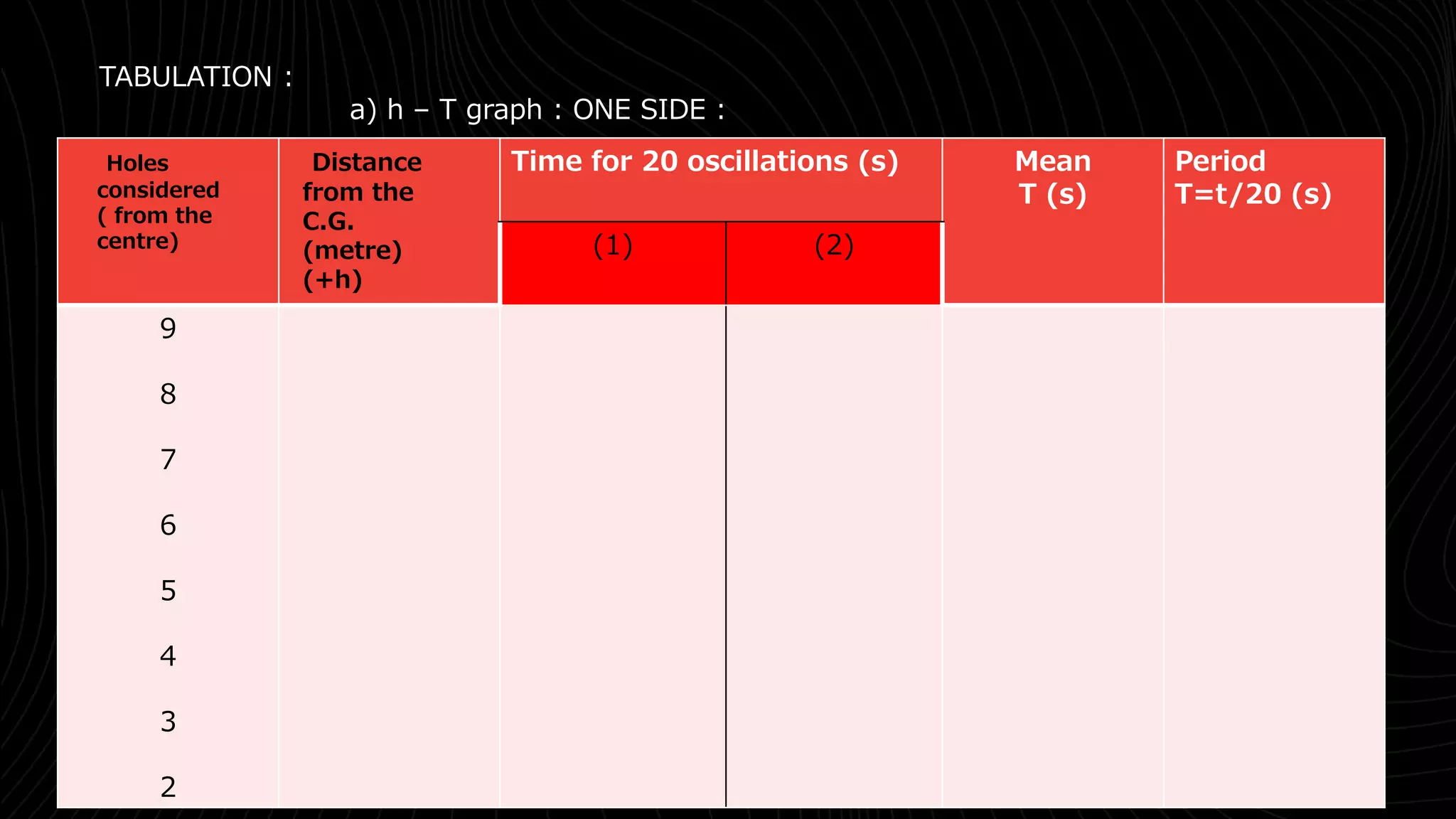
Time for 20 oscillations (s) Mean
T (s)
Period
T=t/20 (s)
(1) (2)
9
8
7
6
5
4
3
2
Holes
considered
( from the
centre)
Distance
from the
C.G.
(metre)
(+h)
TABULATION :
a) h – T graph : ONE SIDE :
Hole
considered
(from the
centre)
Distance from
the C.G.
(metre) (-h)
Time for 20
oscillation (s)
Mean t (s) Period T = t/20
(s)
(1) (2)
9
8
7
6
5
4
3
2
OTHER SIDE :
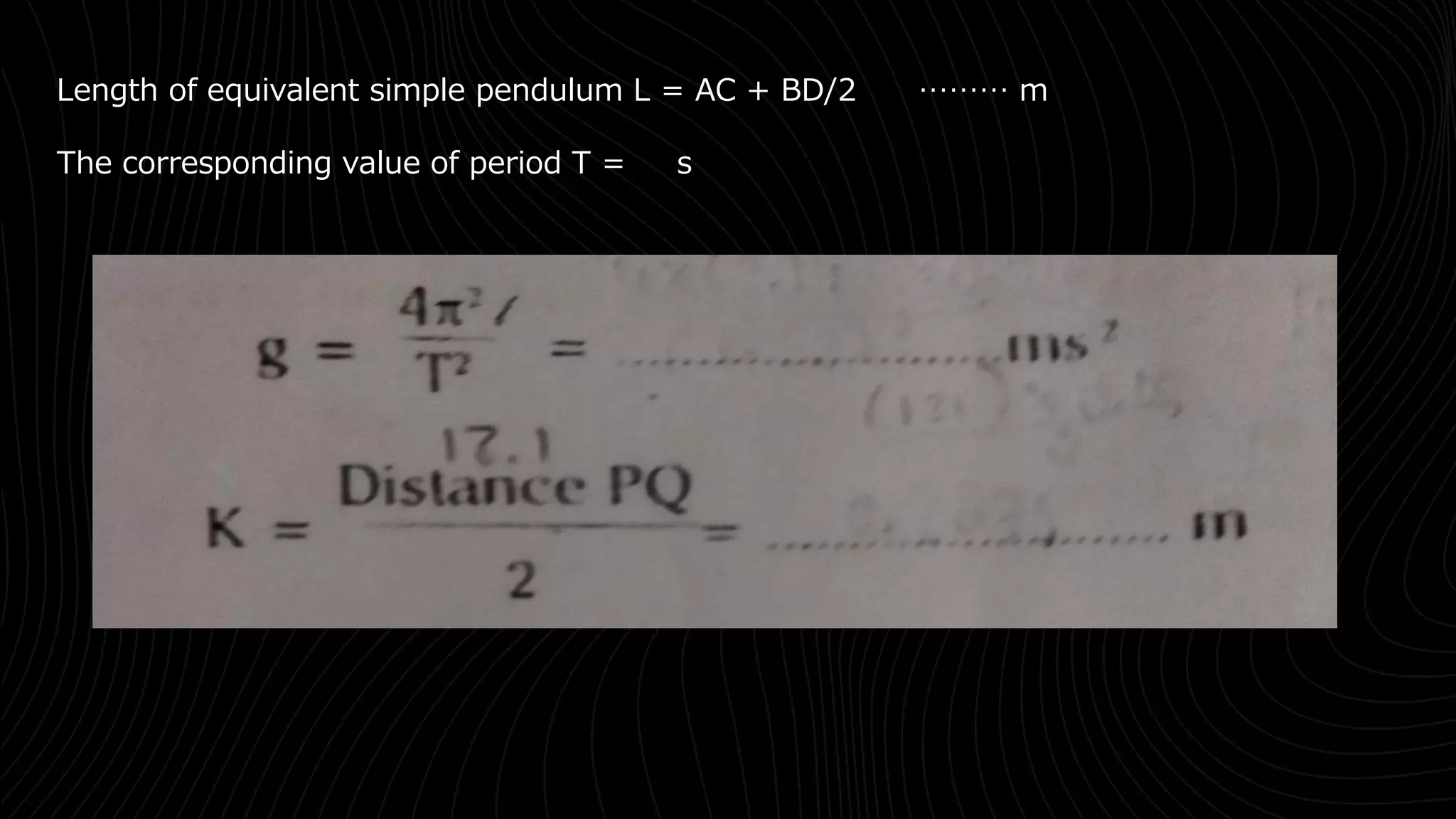
Length of equivalent simple pendulum L = AC + BD/2 ……… m
The corresponding value of period T = s
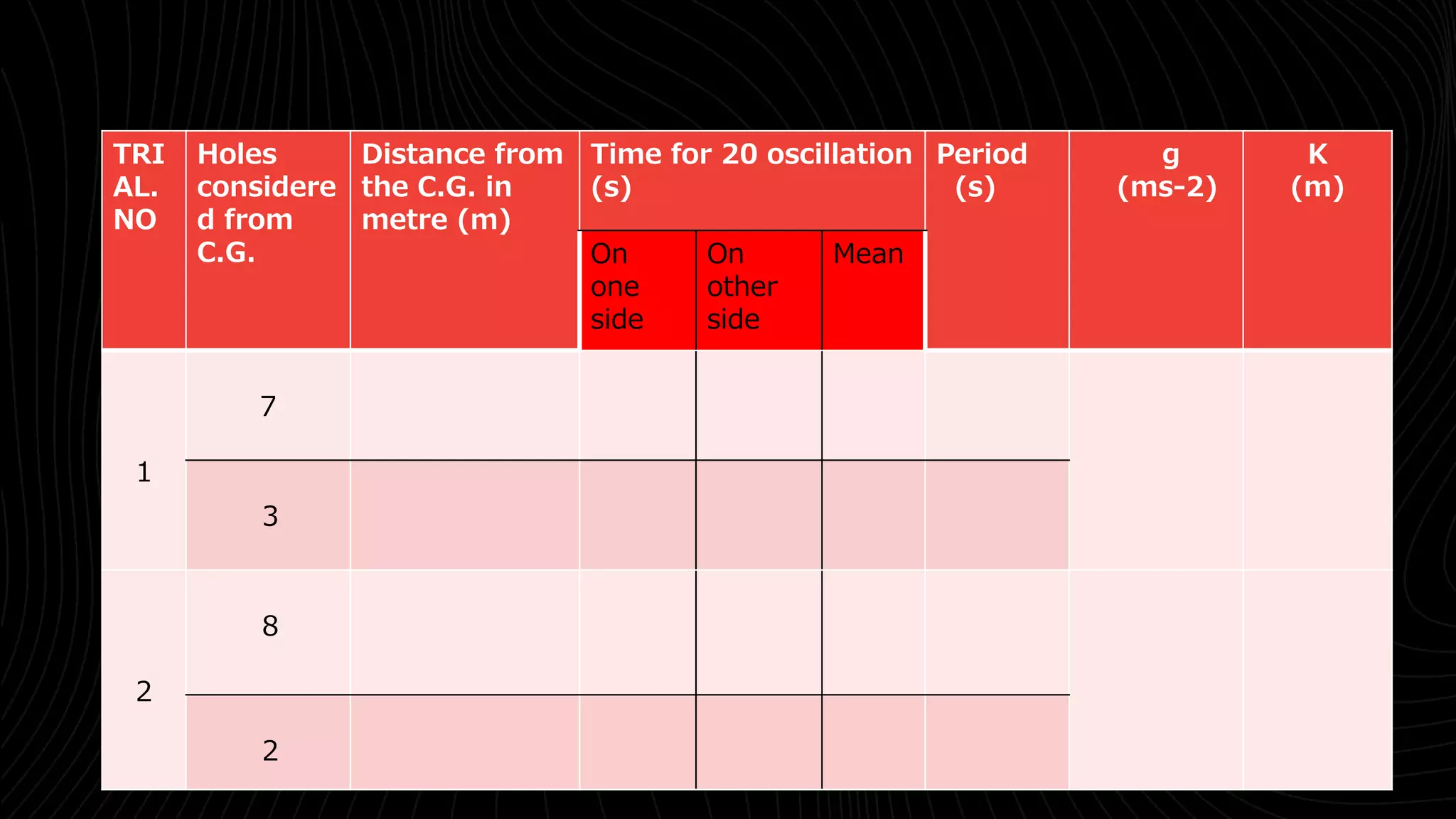
TRI
AL.
NO
Holes
considere
d from
C.G.
Distance from
the C.G. in
metre (m)
Time for 20 oscillation
(s)
Period
(s)
g
(ms-2)
K
(m)
On
one
side
On
other
side
Mean
1
7
3
2
8
2
Mean g = m.s-2
Mean K = m
= ms-2
Verification: Length of the bar L =…………………m
Breadth of the bar B =…………………m
Radius of gyration K by direct calculation =
RESULTS:
1.Acceleration due to gravity (a) by h-T graph= ________ms-2
(b) by two-hole method=_______ms-2
2. Radius of gyration of the bar about a horizontal axis passing through the C.G.
(a) by h-T graph =__________m
(b) by two-hole method =_________m
(c) by direct calculation =________m

Bar Pendulum experiment ppt.pptx

  • 1.
  • 2.
    To determine • Theacceleration due to gravity “g” using bar pendulum. • The radius of gyration “k” of the bar about a horizontal axis passing through the centre of gravity. AIM :
  • 3.
    • Bar pendulum. •Stop Watch, etc. APPARATUS :
  • 4.
    A bar pendulumconsists of a uniform rectangular bar having a number of equidistant holes along its length as shown in fig [a] . A small rod with a knife edge can be passed through any of these holes and the bar can be suspended with this rod as axis.The pendulum can be made to oscillate in a vertical plane about this axis. DESCRIPTION :
  • 5.
    PRINCIPLE: The bar pendulumis a kind of compound pendulum. If ‘K’ is the radius of gyation about a horizontal axis through the C .G. of the bar and h is the distance of the axis of suspension from the C.G. the period of oscillation. • • When the period [T] about the different holes is plotted against distance h we get curves of the form shown in figure [b]. For a given value of T ,there are 4 points [ A,B,C,and D] about which the periods are the same . The length of the corresponding equivalent simple pendulum is The period of the pendulum is the minimum when h=k. therefore distance if T1 AND T2 are the periods about two wholes which are at distances h1 and h2 from the C.G.
  • 6.
    By squaring theseexepression and simplifying we get if T1 AND T2 are the periods about two wholes which are at distances h1 and h2 from the C.G.
  • 7.
    HHHH PROCEDURE: The pendulum issuspended about a horizontal axis passing through the 9th hole from the center. The distance h of the hole from the C.G. [ie.the central hole] is measured .the pendulum is set into oscillation [small amplitude] and the time for 20 oscilation is measured using a stop watch.from this period T ie the time for one oscillation is found out. This is reapeted for the different holes on either side of the center .the acceleration due to gravity and radius of gyration can be determined by two methods. [a] h-T graph : a graph is drawn taking T along Y axis and h along x axis . Two symmetric curves as show in figure [b] are obtained .a straight line ABCD is drawn parallel to X axis and L=AC+BD is calculated.if T is the period corresponding to the line ABCD,
  • 8.
    The calculation canbe repeated by drawing other lines parallel to ABCD The distance pq between the lowest points of the two curves is found out The value of k by direct calculation Where L is the length and B is the breadth of the bar [b] Two-hole method:The periods T1 and T2 about any two holes [eg,,second and eighth or third and seventh]are determined.The value of G and K are calculated using equations [3] and [4]
  • 9.
    Time for 20oscillations (s) Mean T (s) Period T=t/20 (s) (1) (2) 9 8 7 6 5 4 3 2 Holes considered ( from the centre) Distance from the C.G. (metre) (+h) TABULATION : a) h – T graph : ONE SIDE :
  • 10.
    Hole considered (from the centre) Distance from theC.G. (metre) (-h) Time for 20 oscillation (s) Mean t (s) Period T = t/20 (s) (1) (2) 9 8 7 6 5 4 3 2 OTHER SIDE :
  • 11.
    Length of equivalentsimple pendulum L = AC + BD/2 ……… m The corresponding value of period T = s
  • 12.
    TRI AL. NO Holes considere d from C.G. Distance from theC.G. in metre (m) Time for 20 oscillation (s) Period (s) g (ms-2) K (m) On one side On other side Mean 1 7 3 2 8 2
  • 13.
    Mean g =m.s-2 Mean K = m = ms-2 Verification: Length of the bar L =…………………m Breadth of the bar B =…………………m Radius of gyration K by direct calculation =
  • 14.
    RESULTS: 1.Acceleration due togravity (a) by h-T graph= ________ms-2 (b) by two-hole method=_______ms-2 2. Radius of gyration of the bar about a horizontal axis passing through the C.G. (a) by h-T graph =__________m (b) by two-hole method =_________m (c) by direct calculation =________m