MFMcGraw-PHY
1401
Chapter 3b - Revised:
6/7/2010
1
Motion in a Plane
Chapter 3
MFMcGraw-PHY
1401
Chapter 3b - Revised:
6/7/2010
2
Motion in a Plane
• Vector Addition
• Velocity
• Acceleration
• Projectile motion
MFMcGraw-PHY
1401
Chapter 3b - Revised:
6/7/2010
3
Graphical Addition and Subtraction
of Vectors
A vector is a quantity that has both a
magnitude and a direction. Position is an
example of a vector quantity.
A scalar is a quantity with no direction. The
mass of an object is an example of a scalar
quantity.
MFMcGraw-PHY
1401
Chapter 3b - Revised:
6/7/2010
4
Notation
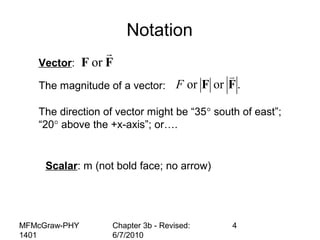
Vector: FF

or
The magnitude of a vector: .oror FF

F
Scalar: m (not bold face; no arrow)
The direction of vector might be “35° south of east”;
“20° above the +x-axis”; or….
MFMcGraw-PHY
1401
Chapter 3b - Revised:
6/7/2010
5
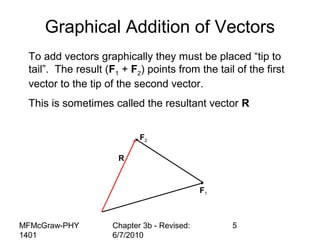
To add vectors graphically they must be placed “tip to
tail”. The result (F1 + F2) points from the tail of the first
vector to the tip of the second vector.
This is sometimes called the resultant vector R
F1
F2
R
Graphical Addition of Vectors
MFMcGraw-PHY
1401
Chapter 3b - Revised:
6/7/2010
6
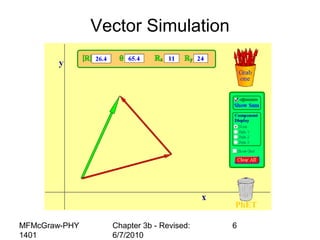
Vector Simulation
MFMcGraw-PHY
1401
Chapter 3b - Revised:
6/7/2010
7
Examples
• Trig Table
• Vector Components
• Unit Vectors
MFMcGraw-PHY
1401
Chapter 3b - Revised:
6/7/2010
8
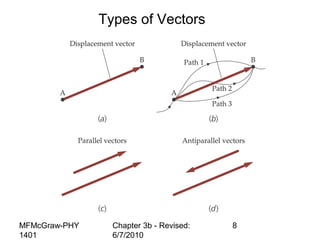
Types of Vectors
MFMcGraw-PHY
1401
Chapter 3b - Revised:
6/7/2010
9
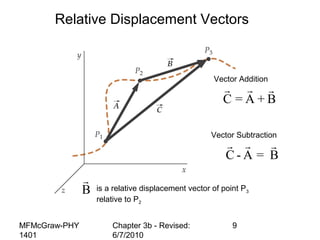
Relative Displacement Vectors
C = A + B
  
C - A = B
  
Vector Addition
Vector Subtraction
B

is a relative displacement vector of point P3
relative to P2
MFMcGraw-PHY
1401
Chapter 3b - Revised:
6/7/2010
10
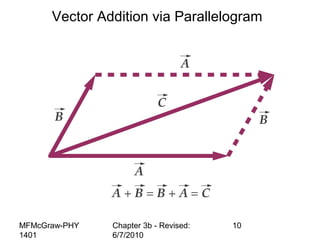
Vector Addition via Parallelogram
MFMcGraw-PHY
1401
Chapter 3b - Revised:
6/7/2010
11
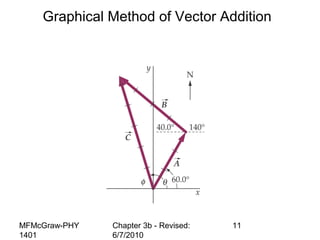
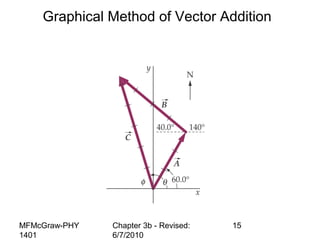
Graphical Method of Vector Addition
MFMcGraw-PHY
1401
Chapter 3b - Revised:
6/7/2010
12
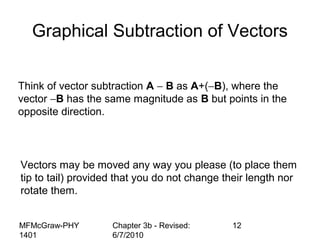
Think of vector subtraction A − B as A+(−B), where the
vector −B has the same magnitude as B but points in the
opposite direction.
Graphical Subtraction of Vectors
Vectors may be moved any way you please (to place them
tip to tail) provided that you do not change their length nor
rotate them.
MFMcGraw-PHY
1401
Chapter 3b - Revised:
6/7/2010
13
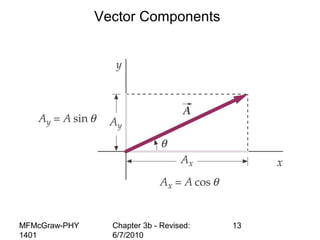
Vector Components
MFMcGraw-PHY
1401
Chapter 3b - Revised:
6/7/2010
14
Vector Components
MFMcGraw-PHY
1401
Chapter 3b - Revised:
6/7/2010
15
Graphical Method of Vector Addition
MFMcGraw-PHY
1401
Chapter 3b - Revised:
6/7/2010
16
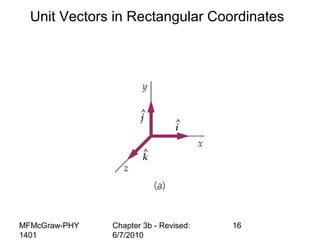
Unit Vectors in Rectangular Coordinates
MFMcGraw-PHY
1401
Chapter 3b - Revised:
6/7/2010
17
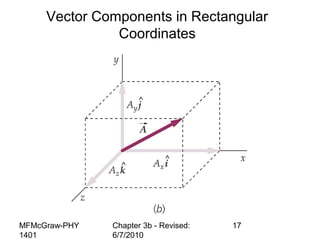
Vector Components in Rectangular
Coordinates
MFMcGraw-PHY
1401
Chapter 3b - Revised:
6/7/2010
18
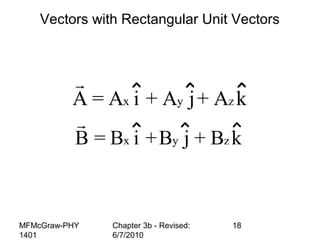
x y zA = A i + A j+ A kˆ ˆ ˆ
r
x y zB = B i +B j + B kˆ ˆ ˆ
r
Vectors with Rectangular Unit Vectors
MFMcGraw-PHY
1401
Chapter 3b - Revised:
6/7/2010
19
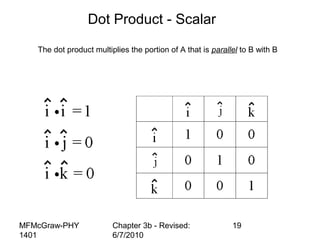
Dot Product - Scalar
The dot product multiplies the portion of A that is parallel to B with B
MFMcGraw-PHY
1401
Chapter 3b - Revised:
6/7/2010
20
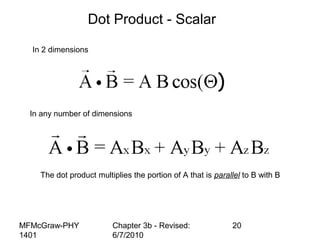
Dot Product - Scalar
The dot product multiplies the portion of A that is parallel to B with B
In 2 dimensions
In any number of dimensions
MFMcGraw-PHY
1401
Chapter 3b - Revised:
6/7/2010
21
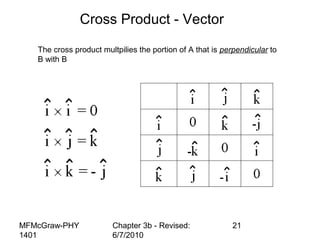
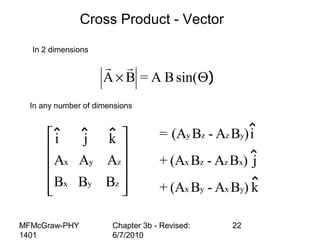
Cross Product - Vector
The cross product multpilies the portion of A that is perpendicular to
B with B
MFMcGraw-PHY
1401
Chapter 3b - Revised:
6/7/2010
22
x y z
x y z
i j k
A A A
B B B
ˆ ˆ ˆ 
 
 
 
  
y z z y
x z z x
x y x y
= (A B - A B )i
+ (A B - A B ) j
+ (A B - A B ) k
ˆ
ˆ
ˆ
A B = A Bsin( )× Θ
r r
In 2 dimensions
In any number of dimensions
Cross Product - Vector
MFMcGraw-PHY
1401
Chapter 3b - Revised:
6/7/2010
23
Velocity
MFMcGraw-PHY
1401
Chapter 3b - Revised:
6/7/2010
24
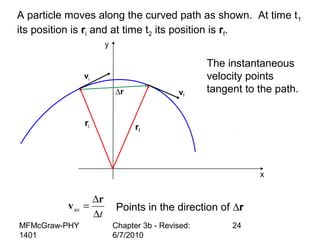
y
x
ri rf
t∆
∆
=
r
vav Points in the direction of ∆r
∆r
vi
The instantaneous
velocity points
tangent to the path.vf
A particle moves along the curved path as shown. At time t1
its position is ri and at time t2 its position is rf.
MFMcGraw-PHY
1401
Chapter 3b - Revised:
6/7/2010
25
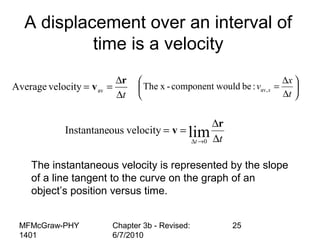
tt ∆
∆
==
→∆
r
v lim0
velocityousInstantane
The instantaneous velocity is represented by the slope
of a line tangent to the curve on the graph of an
object’s position versus time.
t∆
∆
==
r
vavvelocityAverage 





∆
∆
=
t
x
v x,av:bewouldcomponent-xThe
A displacement over an interval of
time is a velocity
MFMcGraw-PHY
1401
Chapter 3b - Revised:
6/7/2010
26
Acceleration
MFMcGraw-PHY
1401
Chapter 3b - Revised:
6/7/2010
27
y
x
vi
ri rf
vf
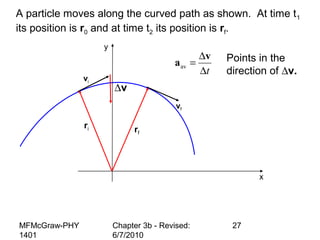
A particle moves along the curved path as shown. At time t1
its position is r0 and at time t2 its position is rf.
∆v
Points in the
direction of ∆v.t∆
∆
=
v
aav
MFMcGraw-PHY
1401
Chapter 3b - Revised:
6/7/2010
28
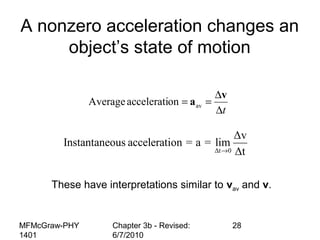
t∆
∆
==
v
aavonacceleratiAverage
A nonzero acceleration changes an
object’s state of motion
Δt 0
Δv
Instantaneous acceleration = a = lim
Δt→
These have interpretations similar to vav and v.
MFMcGraw-PHY
1401
Chapter 3b - Revised:
6/7/2010
29
Motion in a Plane with Constant
Acceleration - Projectile
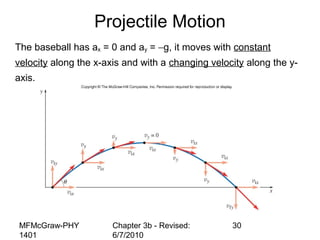
What is the motion of a struck baseball? Once it leaves the
bat (if air resistance is negligible) only the force of gravity
acts on the baseball.
Acceleration due to gravity has a constant value near the
surface of the earth. We call it g = 9.8 m/s2
Only the vertical motion is affected by gravity
MFMcGraw-PHY
1401
Chapter 3b - Revised:
6/7/2010
30
The baseball has ax = 0 and ay = −g, it moves with constant
velocity along the x-axis and with a changing velocity along the y-
axis.
Projectile Motion
MFMcGraw-PHY
1401
Chapter 3b - Revised:
6/7/2010
31
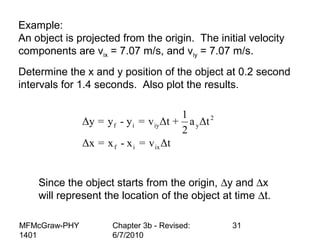
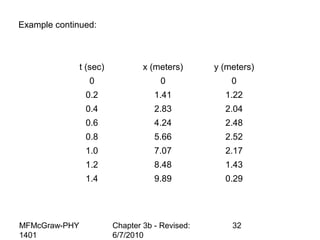
Example:
An object is projected from the origin. The initial velocity
components are vix = 7.07 m/s, and viy = 7.07 m/s.
Determine the x and y position of the object at 0.2 second
intervals for 1.4 seconds. Also plot the results.
2
f i iy y
f i ix
1
Δy = y - y = v Δt + a Δt
2
Δx = x - x = v Δt
Since the object starts from the origin, ∆y and ∆x
will represent the location of the object at time ∆t.
MFMcGraw-PHY
1401
Chapter 3b - Revised:
6/7/2010
32
t (sec) x (meters) y (meters)
0 0 0
0.2 1.41 1.22
0.4 2.83 2.04
0.6 4.24 2.48
0.8 5.66 2.52
1.0 7.07 2.17
1.2 8.48 1.43
1.4 9.89 0.29
Example continued:
MFMcGraw-PHY
1401
Chapter 3b - Revised:
6/7/2010
33
0
2
4
6
8
10
12
0 0.5 1 1.5
t (sec)
x,y(m)
This is a plot of the x position (black points) and y position
(red points) of the object as a function of time.
Example continued:
MFMcGraw-PHY
1401
Chapter 3b - Revised:
6/7/2010
34
Example continued:
0
0.5
1
1.5
2
2.5
3
0 2 4 6 8 10
x (m)
y(m)
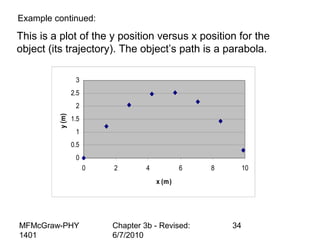
This is a plot of the y position versus x position for the
object (its trajectory). The object’s path is a parabola.
MFMcGraw-PHY
1401
Chapter 3b - Revised:
6/7/2010
35
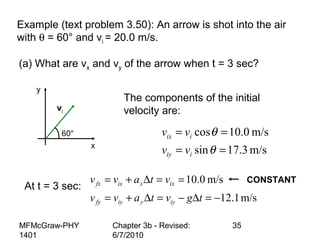
Example (text problem 3.50): An arrow is shot into the air
with θ = 60° and vi = 20.0 m/s.
(a) What are vx and vy of the arrow when t = 3 sec?
The components of the initial
velocity are:
m/s3.17sin
m/s0.10cos
==
==
θ
θ
iiy
iix
vv
vv
At t = 3 sec:
m/s1.12
m/s0.10
−=∆−=∆+=
==∆+=
tgvtavv
vtavv
iyyiyfy
ixxixfx
x
y
60°
vi
CONSTANT
MFMcGraw-PHY
1401
Chapter 3b - Revised:
6/7/2010
36
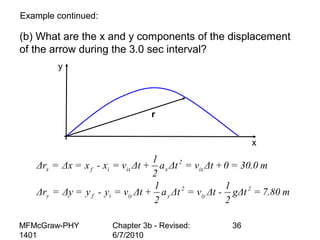
(b) What are the x and y components of the displacement
of the arrow during the 3.0 sec interval?
y
x
r
2
x f i ix x ix
2 2
y f i iy y iy
1
Δr = Δx = x - x = v Δt + a Δt = v Δt +0 = 30.0 m
2
1 1
Δr = Δy = y - y = v Δt + a Δt = v Δt - gΔt = 7.80 m
2 2
Example continued:
MFMcGraw-PHY
1401
Chapter 3b - Revised:
6/7/2010
37
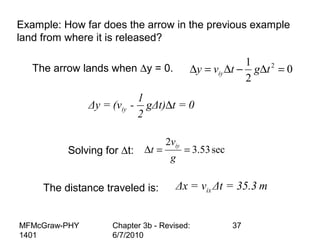
Example: How far does the arrow in the previous example
land from where it is released?
The arrow lands when ∆y = 0. 0
2
1 2
=∆−∆=∆ tgtvy iy
Solving for ∆t: sec53.3
2
==∆
g
v
t iy
The distance traveled is: ixΔx = v Δt = 35.3 m
∆iy
1
Δy = (v - gΔt) t = 0
2
MFMcGraw-PHY
1401
Chapter 3b - Revised:
6/7/2010
38
Summary
• Adding and subtracting vectors (graphical
method & component method)
• Velocity
• Acceleration
• Projectile motion (here ax = 0 and ay = −g)
MFMcGraw-PHY
1401
Chapter 3b - Revised:
6/7/2010
39
Projectiles Examples
• Problem solving strategy
• Symmetry of the motion
• Dropped from a plane
• The home run

Ch 03b motion in a plane

  • 1.
    MFMcGraw-PHY 1401 Chapter 3b -Revised: 6/7/2010 1 Motion in a Plane Chapter 3
  • 2.
    MFMcGraw-PHY 1401 Chapter 3b -Revised: 6/7/2010 2 Motion in a Plane • Vector Addition • Velocity • Acceleration • Projectile motion
  • 3.
    MFMcGraw-PHY 1401 Chapter 3b -Revised: 6/7/2010 3 Graphical Addition and Subtraction of Vectors A vector is a quantity that has both a magnitude and a direction. Position is an example of a vector quantity. A scalar is a quantity with no direction. The mass of an object is an example of a scalar quantity.
  • 4.
    MFMcGraw-PHY 1401 Chapter 3b -Revised: 6/7/2010 4 Notation Vector: FF  or The magnitude of a vector: .oror FF  F Scalar: m (not bold face; no arrow) The direction of vector might be “35° south of east”; “20° above the +x-axis”; or….
  • 5.
    MFMcGraw-PHY 1401 Chapter 3b -Revised: 6/7/2010 5 To add vectors graphically they must be placed “tip to tail”. The result (F1 + F2) points from the tail of the first vector to the tip of the second vector. This is sometimes called the resultant vector R F1 F2 R Graphical Addition of Vectors
  • 6.
    MFMcGraw-PHY 1401 Chapter 3b -Revised: 6/7/2010 6 Vector Simulation
  • 7.
    MFMcGraw-PHY 1401 Chapter 3b -Revised: 6/7/2010 7 Examples • Trig Table • Vector Components • Unit Vectors
  • 8.
    MFMcGraw-PHY 1401 Chapter 3b -Revised: 6/7/2010 8 Types of Vectors
  • 9.
    MFMcGraw-PHY 1401 Chapter 3b -Revised: 6/7/2010 9 Relative Displacement Vectors C = A + B    C - A = B    Vector Addition Vector Subtraction B  is a relative displacement vector of point P3 relative to P2
  • 10.
    MFMcGraw-PHY 1401 Chapter 3b -Revised: 6/7/2010 10 Vector Addition via Parallelogram
  • 11.
    MFMcGraw-PHY 1401 Chapter 3b -Revised: 6/7/2010 11 Graphical Method of Vector Addition
  • 12.
    MFMcGraw-PHY 1401 Chapter 3b -Revised: 6/7/2010 12 Think of vector subtraction A − B as A+(−B), where the vector −B has the same magnitude as B but points in the opposite direction. Graphical Subtraction of Vectors Vectors may be moved any way you please (to place them tip to tail) provided that you do not change their length nor rotate them.
  • 13.
    MFMcGraw-PHY 1401 Chapter 3b -Revised: 6/7/2010 13 Vector Components
  • 14.
    MFMcGraw-PHY 1401 Chapter 3b -Revised: 6/7/2010 14 Vector Components
  • 15.
    MFMcGraw-PHY 1401 Chapter 3b -Revised: 6/7/2010 15 Graphical Method of Vector Addition
  • 16.
    MFMcGraw-PHY 1401 Chapter 3b -Revised: 6/7/2010 16 Unit Vectors in Rectangular Coordinates
  • 17.
    MFMcGraw-PHY 1401 Chapter 3b -Revised: 6/7/2010 17 Vector Components in Rectangular Coordinates
  • 18.
    MFMcGraw-PHY 1401 Chapter 3b -Revised: 6/7/2010 18 x y zA = A i + A j+ A kˆ ˆ ˆ r x y zB = B i +B j + B kˆ ˆ ˆ r Vectors with Rectangular Unit Vectors
  • 19.
    MFMcGraw-PHY 1401 Chapter 3b -Revised: 6/7/2010 19 Dot Product - Scalar The dot product multiplies the portion of A that is parallel to B with B
  • 20.
    MFMcGraw-PHY 1401 Chapter 3b -Revised: 6/7/2010 20 Dot Product - Scalar The dot product multiplies the portion of A that is parallel to B with B In 2 dimensions In any number of dimensions
  • 21.
    MFMcGraw-PHY 1401 Chapter 3b -Revised: 6/7/2010 21 Cross Product - Vector The cross product multpilies the portion of A that is perpendicular to B with B
  • 22.
    MFMcGraw-PHY 1401 Chapter 3b -Revised: 6/7/2010 22 x y z x y z i j k A A A B B B ˆ ˆ ˆ           y z z y x z z x x y x y = (A B - A B )i + (A B - A B ) j + (A B - A B ) k ˆ ˆ ˆ A B = A Bsin( )× Θ r r In 2 dimensions In any number of dimensions Cross Product - Vector
  • 23.
    MFMcGraw-PHY 1401 Chapter 3b -Revised: 6/7/2010 23 Velocity
  • 24.
    MFMcGraw-PHY 1401 Chapter 3b -Revised: 6/7/2010 24 y x ri rf t∆ ∆ = r vav Points in the direction of ∆r ∆r vi The instantaneous velocity points tangent to the path.vf A particle moves along the curved path as shown. At time t1 its position is ri and at time t2 its position is rf.
  • 25.
    MFMcGraw-PHY 1401 Chapter 3b -Revised: 6/7/2010 25 tt ∆ ∆ == →∆ r v lim0 velocityousInstantane The instantaneous velocity is represented by the slope of a line tangent to the curve on the graph of an object’s position versus time. t∆ ∆ == r vavvelocityAverage       ∆ ∆ = t x v x,av:bewouldcomponent-xThe A displacement over an interval of time is a velocity
  • 26.
    MFMcGraw-PHY 1401 Chapter 3b -Revised: 6/7/2010 26 Acceleration
  • 27.
    MFMcGraw-PHY 1401 Chapter 3b -Revised: 6/7/2010 27 y x vi ri rf vf A particle moves along the curved path as shown. At time t1 its position is r0 and at time t2 its position is rf. ∆v Points in the direction of ∆v.t∆ ∆ = v aav
  • 28.
    MFMcGraw-PHY 1401 Chapter 3b -Revised: 6/7/2010 28 t∆ ∆ == v aavonacceleratiAverage A nonzero acceleration changes an object’s state of motion Δt 0 Δv Instantaneous acceleration = a = lim Δt→ These have interpretations similar to vav and v.
  • 29.
    MFMcGraw-PHY 1401 Chapter 3b -Revised: 6/7/2010 29 Motion in a Plane with Constant Acceleration - Projectile What is the motion of a struck baseball? Once it leaves the bat (if air resistance is negligible) only the force of gravity acts on the baseball. Acceleration due to gravity has a constant value near the surface of the earth. We call it g = 9.8 m/s2 Only the vertical motion is affected by gravity
  • 30.
    MFMcGraw-PHY 1401 Chapter 3b -Revised: 6/7/2010 30 The baseball has ax = 0 and ay = −g, it moves with constant velocity along the x-axis and with a changing velocity along the y- axis. Projectile Motion
  • 31.
    MFMcGraw-PHY 1401 Chapter 3b -Revised: 6/7/2010 31 Example: An object is projected from the origin. The initial velocity components are vix = 7.07 m/s, and viy = 7.07 m/s. Determine the x and y position of the object at 0.2 second intervals for 1.4 seconds. Also plot the results. 2 f i iy y f i ix 1 Δy = y - y = v Δt + a Δt 2 Δx = x - x = v Δt Since the object starts from the origin, ∆y and ∆x will represent the location of the object at time ∆t.
  • 32.
    MFMcGraw-PHY 1401 Chapter 3b -Revised: 6/7/2010 32 t (sec) x (meters) y (meters) 0 0 0 0.2 1.41 1.22 0.4 2.83 2.04 0.6 4.24 2.48 0.8 5.66 2.52 1.0 7.07 2.17 1.2 8.48 1.43 1.4 9.89 0.29 Example continued:
  • 33.
    MFMcGraw-PHY 1401 Chapter 3b -Revised: 6/7/2010 33 0 2 4 6 8 10 12 0 0.5 1 1.5 t (sec) x,y(m) This is a plot of the x position (black points) and y position (red points) of the object as a function of time. Example continued:
  • 34.
    MFMcGraw-PHY 1401 Chapter 3b -Revised: 6/7/2010 34 Example continued: 0 0.5 1 1.5 2 2.5 3 0 2 4 6 8 10 x (m) y(m) This is a plot of the y position versus x position for the object (its trajectory). The object’s path is a parabola.
  • 35.
    MFMcGraw-PHY 1401 Chapter 3b -Revised: 6/7/2010 35 Example (text problem 3.50): An arrow is shot into the air with θ = 60° and vi = 20.0 m/s. (a) What are vx and vy of the arrow when t = 3 sec? The components of the initial velocity are: m/s3.17sin m/s0.10cos == == θ θ iiy iix vv vv At t = 3 sec: m/s1.12 m/s0.10 −=∆−=∆+= ==∆+= tgvtavv vtavv iyyiyfy ixxixfx x y 60° vi CONSTANT
  • 36.
    MFMcGraw-PHY 1401 Chapter 3b -Revised: 6/7/2010 36 (b) What are the x and y components of the displacement of the arrow during the 3.0 sec interval? y x r 2 x f i ix x ix 2 2 y f i iy y iy 1 Δr = Δx = x - x = v Δt + a Δt = v Δt +0 = 30.0 m 2 1 1 Δr = Δy = y - y = v Δt + a Δt = v Δt - gΔt = 7.80 m 2 2 Example continued:
  • 37.
    MFMcGraw-PHY 1401 Chapter 3b -Revised: 6/7/2010 37 Example: How far does the arrow in the previous example land from where it is released? The arrow lands when ∆y = 0. 0 2 1 2 =∆−∆=∆ tgtvy iy Solving for ∆t: sec53.3 2 ==∆ g v t iy The distance traveled is: ixΔx = v Δt = 35.3 m ∆iy 1 Δy = (v - gΔt) t = 0 2
  • 38.
    MFMcGraw-PHY 1401 Chapter 3b -Revised: 6/7/2010 38 Summary • Adding and subtracting vectors (graphical method & component method) • Velocity • Acceleration • Projectile motion (here ax = 0 and ay = −g)
  • 39.
    MFMcGraw-PHY 1401 Chapter 3b -Revised: 6/7/2010 39 Projectiles Examples • Problem solving strategy • Symmetry of the motion • Dropped from a plane • The home run

Editor's Notes

  • #24 Could incorporate personal response system questions from the College Physics by G/R/R 2E ARIS site (www.mhhe.com/grr), Instructor Resources: CPS by eInstruction, Chapter 3, Questions 10 and 11.