BREAST CANCER
Dr.Nidhi Ahya
Assistant Professor
Cardiovascular & Respiratory PT
DVVPF’s College of Physiotherapy,
Ahmednagar 414111
Dr.Nidhi Ahya(MPT-CVRPT) 1
OBJECTIVES
• Anatomy of Breast tissue
• Breast Cancer
• Risk Factors
• Signs & Symptoms
• Cancer Grading & Stages
• Treatment
Dr.Nidhi Ahya(MPT-CVRPT) 2
STRUCTURE
 clavicle superiorly,
 the lateral border of
the latissimus muscle
laterally,
 the sternum medially
 inframammary fold
inferiorly
Dr.Nidhi Ahya(MPT-CVRPT) 3
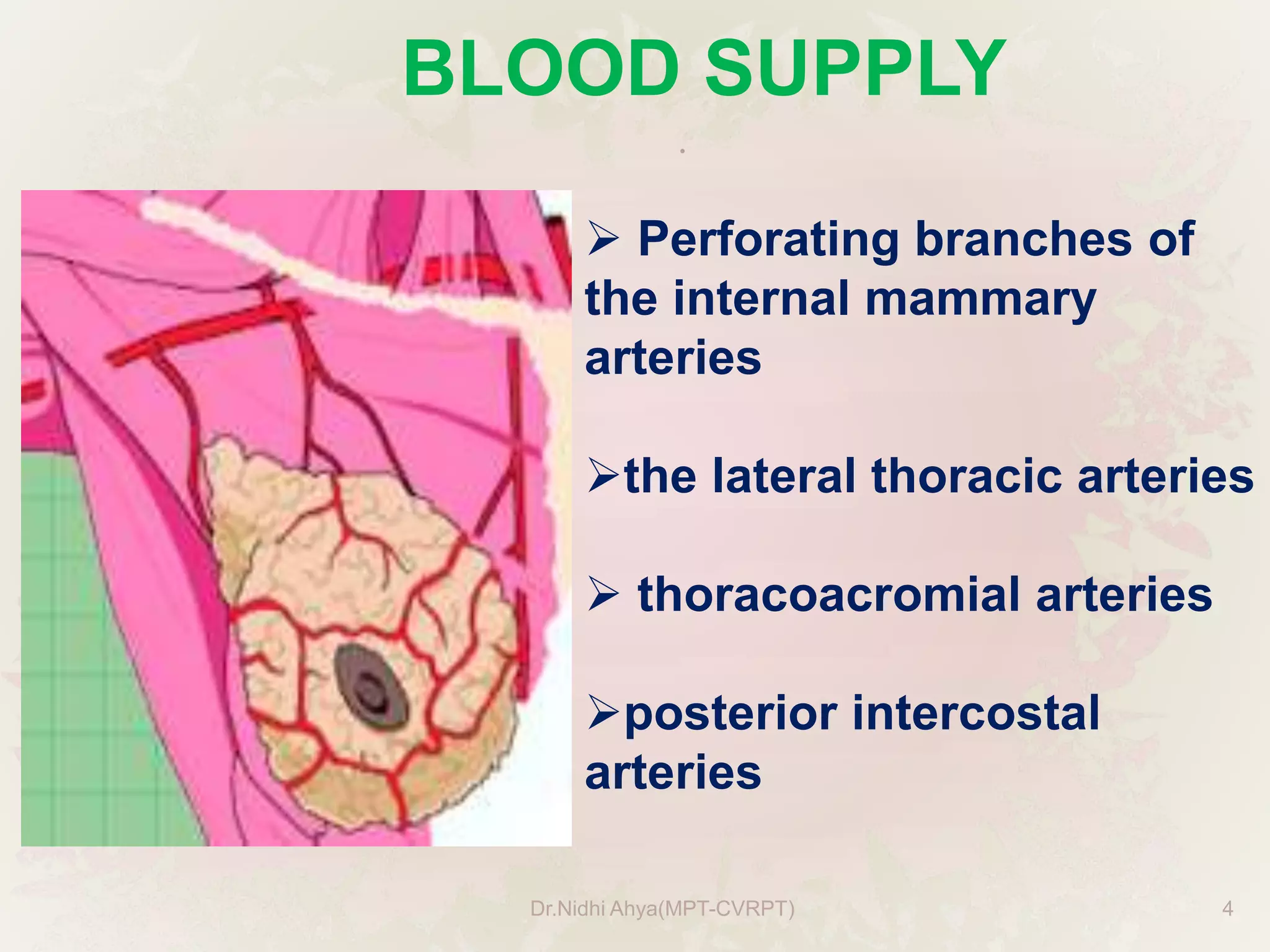
BLOOD SUPPLY
Dr.Nidhi Ahya(MPT-CVRPT) 4
 Perforating branches of
the internal mammary
arteries
the lateral thoracic arteries
 thoracoacromial arteries
posterior intercostal
arteries
LYMPH
NODES
AND
LYMPHATICS
75% -Axillary nodes
25% -internal
mammary
Carcinoma of breast
spreads mostly along
the lymphatic to the
regional lymph nodesDr.Nidhi Ahya(MPT-CVRPT) 5
MUSCULAR RELATIONS
Dr.Nidhi Ahya(MPT-CVRPT) 6
BREAST CANCER
• Abnormal mass of tissue, the growth of which
exceeds and is uncoordinated with that of the
normal tissues and persists in the same
manner after the cessation of stimuli which
evoked the change.
• Breast cancer is cancer originating in the
breast tissue.
Dr.Nidhi Ahya(MPT-CVRPT) 7
• WHO world cancer report 2009- 192370
women diagnosed with breast cancer
• About 13.7% deaths in women due to breast
cancer globally
• In India number of breast cancer cases is
1,15,000 per year and expected to rise to
2,50,000 new cases by 2015
Dr.Nidhi Ahya(MPT-CVRPT) 8
Risk factors
• Gender
• Increased age
• Family history
• Lack of child bearing or breast feeding
• Higher hormone levels
• Late age of menopause
• Alcohol
• Dense breast tissue
• Diethylstibesterol exposureDr.Nidhi Ahya(MPT-CVRPT) 9
Signs and Symptoms
• Lump in the breast
• Changes in the breast size or
shape
• Skin dimpling
• Nipple inversion
• Spontaneous discharge from
nipple
• Change in texture of the skin
• Pain Dr.Nidhi Ahya(MPT-CVRPT) 10
Types of Breast Cancer
• Non-invasive: ductal carcinoma in-situ
lobar carcinoma in-situ
Dr.Nidhi Ahya(MPT-CVRPT) 11
• Invasive : Invasive ductal carcinoma
Invasive lobar carcinoma
• Inflammatory breast cancer
• Phyllodes tumor
Dr.Nidhi Ahya(MPT-CVRPT) 12
Diagnosis
• Clinical Breast Examination
• Mammography
• Ultrasound
• MR imaging
• Fine Needle Aspiration &
Cytology ( FNAC)
• Core Biopsy
• Excisional biopsy
Dr.Nidhi Ahya(MPT-CVRPT) 13
MAMOGRAPHY
Mammography is a special
type of low-powered x-ray
technique
It gives detailed images of
the internal structure of
the breast.
High resolution
mammogram films can
demonstrate micro
calcifications smaller than
100μm
Dr.Nidhi Ahya(MPT-CVRPT) 14
ULTRASOUND IMAGING
Ultrasound is an adjunct
modality that can be used
in the assessment of a
breast cancer.
Its usefulness lies in its
ability to distinguish solid
from cystic lesions.
Dr.Nidhi Ahya(MPT-CVRPT) 15
Stages of Breast Cancer
• Staging of breast cancer done by using the
TNM classification
• The American Joint Committee on Cancer
recommends this classification
Dr.Nidhi Ahya(MPT-CVRPT) 16
Dr.Nidhi Ahya(MPT-CVRPT) 17
• Stage 0: non-invasive carcinoma or
carcinoma in situ
• Stages I and II: early
• Stage III: advanced; tumor > 2 cm across
and spread to underarm LNs or is extensive
in underarm LNs or spread to LNs near
breastbone or other tissue near breast
• Stage IV: spread beyond breast and
underarm LNs to other body parts
Dr.Nidhi Ahya(MPT-CVRPT) 18
Treatment
Dr.Nidhi Ahya(MPT-CVRPT) 19
SURGICAL
• Radical Mastectomy
• Modified Radical
Mastectomy
• Simple/Total
Mastectomy
• Breast Conserving
Surgery
CHEMOTHERAPY
• Neo-Adjunctive
Chemotherapy
• Adjunctive
Chemotherapy
• Chemotherapy for
Advanced
Metastatic Disease
RADIATION
• Intra-operative
Irradiation
• External beam
Radiotherapy
• Brachytherapy
Chemotherapy
• Treatment of cancer with one
or more cytotoxic anti-
neoplastic drugs.
• It can be either curative or
palliative
• It is often used in
conjugation with radiation
therapy or surgery
• Chemotherapeutic agents act
by killing cells that divide
rapidly- one of the main
properties of cancerous cells
Dr.Nidhi Ahya(MPT-CVRPT) 20
• Common combination of chemotherapy
regime for breast cancer patients is-
 Cyclophosphomide
 Methotraxate
 5-Flurouracil
• Drug Delivery-
Intravenous
 PVC
 CVC
 PICC
 IP
Dr.Nidhi Ahya(MPT-CVRPT) 21
• Treatment Strategies
 Induction therapy- for curative purpose as
the first line of treatment
 Neoadjunctive- chemotherapy given prior to
local treatment
 Adjunctive Chemotherapy- Given after a
local treatment or when little evidence or
suspicion about reoccurrence or subclinical
cancer is present
 Maintenance Chemotherapy- repeated low
dosage treatment given for prolong
remission
Dr.Nidhi Ahya(MPT-CVRPT) 22
Side effects of Chemotherapy:
• Immunosuppression and
myelosuppression
• Gastrointestinal distress
• Anemia
• Fatigue
• Hair loss
• Infertility
• Peripheral Neuropathy
Dr.Nidhi Ahya(MPT-CVRPT) 23
Radiation Therapy
• It involves medical use
of ionizing radiation,
used in cancer
treatment
• It can be used as a
curative, adjunctive or
palliative care
• Ionizing radiation work
by damaging the DNA
of cancerous tissues
leading to cellular
death.
Dr.Nidhi Ahya(MPT-CVRPT) 24
• Dossage is calculated in unit
Gray (Gy)
• It depends upon the type,
stage of cancer being treated
• For curative purpose typical
dose is between 60-80 Gy
For preventive or Adjunctive
purpose- 45- 60 Gy
• Treatment Methods:
 External beam radiation
therapy
 Brachytherapy
 Radioisotope therapy
Dr.Nidhi Ahya(MPT-CVRPT) 25
Dr.Nidhi Ahya(MPT-CVRPT) 26
Side effects of Radiation Therapy
• Acute-
Nausea,vomiting,damage to
epithelial cells, Lymphedma
or infertility
• Late- Fibrosis of exposed
tissue, Hair loss occur with
>30Gy and may br
permanent. May also lead to
dryness of mouth and eyes
Dr.Nidhi Ahya(MPT-CVRPT) 27
Radical Mastectomy
• Excision of
 complete breast tissue
 pectoral muscles
 axillary lymph nodes
 associated skin and
subcutaneous tissue
• Performed in case of
advanced last stage
breast cancer that has
invaded the muscle wall
under the breast tissue
Dr.Nidhi Ahya(MPT-CVRPT) 28
• Associated Post-operative Impairments:
 Incisional Pain
 Lymphedema due to removal of axillary
lymph nodes which disrupts the normal
circulation of lymph
 Weakness of horizontal adductors of the
shoulder, serratus anterior
 Postural asymmetry and dysfunction
Dr.Nidhi Ahya(MPT-CVRPT) 29
Modified Radical Mastectomy
• Excision of
 Entire breast tissue
 Fascia over the chest
muscles
 Axillary lymph nodes
• Pectoral muscles remain
intact
Dr.Nidhi Ahya(MPT-CVRPT) 30
• Benefits:
 Reduces cosmetic deformity
 Upper extremity dysfunction can be
prevented
Dr.Nidhi Ahya(MPT-CVRPT) 31
Simple/Total Mastectomy
• It involves surgical removal of entire breast
tissue, but lymphatic tissue and pectoral
muscles are preserved
• Involves a low to moderate risk of
Lymphedema due to post-operative radiation
therapy
Dr.Nidhi Ahya(MPT-CVRPT) 32
Breast Conserving Surgery
This involves –
 Lumpectomy- Surgical removal
of lump, margin of normal
tissue surrounding lump. May
include sampling or removal of
axillary lymph nodes.
 Segmental Mastectomy-
Excision of mass along with
some portion of breast tissue
 Quadrectomy – excision of
affected quadrant of the breast
tissue
Dr.Nidhi Ahya(MPT-CVRPT) 33
Breast Reconstruction
• Breast reconstruction is regarded as an integral
part of modern day breast cancer management
• Various techniques available include:
 Silicone Implants
 Lattissimus Dorsi myocutaneous flaps (LD)
 Transverse Rectus abdominus myocutaneous
flaps
( TRAM)
 Gluteal Free Flap
SUMMARY
• Anatomy of Breast tissue
• What is Breast Cancer
• Risk Factors
• Signs & Symptoms
• Cancer Grading & Stages
• Treatment
Dr.Nidhi Ahya(MPT-CVRPT) 35

Breast cancer

  • 1.
    BREAST CANCER Dr.Nidhi Ahya AssistantProfessor Cardiovascular & Respiratory PT DVVPF’s College of Physiotherapy, Ahmednagar 414111 Dr.Nidhi Ahya(MPT-CVRPT) 1
  • 2.
    OBJECTIVES • Anatomy ofBreast tissue • Breast Cancer • Risk Factors • Signs & Symptoms • Cancer Grading & Stages • Treatment Dr.Nidhi Ahya(MPT-CVRPT) 2
  • 3.
    STRUCTURE  clavicle superiorly, the lateral border of the latissimus muscle laterally,  the sternum medially  inframammary fold inferiorly Dr.Nidhi Ahya(MPT-CVRPT) 3
  • 4.
    BLOOD SUPPLY Dr.Nidhi Ahya(MPT-CVRPT)4  Perforating branches of the internal mammary arteries the lateral thoracic arteries  thoracoacromial arteries posterior intercostal arteries
  • 5.
    LYMPH NODES AND LYMPHATICS 75% -Axillary nodes 25%-internal mammary Carcinoma of breast spreads mostly along the lymphatic to the regional lymph nodesDr.Nidhi Ahya(MPT-CVRPT) 5
  • 6.
  • 7.
    BREAST CANCER • Abnormalmass of tissue, the growth of which exceeds and is uncoordinated with that of the normal tissues and persists in the same manner after the cessation of stimuli which evoked the change. • Breast cancer is cancer originating in the breast tissue. Dr.Nidhi Ahya(MPT-CVRPT) 7
  • 8.
    • WHO worldcancer report 2009- 192370 women diagnosed with breast cancer • About 13.7% deaths in women due to breast cancer globally • In India number of breast cancer cases is 1,15,000 per year and expected to rise to 2,50,000 new cases by 2015 Dr.Nidhi Ahya(MPT-CVRPT) 8
  • 9.
    Risk factors • Gender •Increased age • Family history • Lack of child bearing or breast feeding • Higher hormone levels • Late age of menopause • Alcohol • Dense breast tissue • Diethylstibesterol exposureDr.Nidhi Ahya(MPT-CVRPT) 9
  • 10.
    Signs and Symptoms •Lump in the breast • Changes in the breast size or shape • Skin dimpling • Nipple inversion • Spontaneous discharge from nipple • Change in texture of the skin • Pain Dr.Nidhi Ahya(MPT-CVRPT) 10
  • 11.
    Types of BreastCancer • Non-invasive: ductal carcinoma in-situ lobar carcinoma in-situ Dr.Nidhi Ahya(MPT-CVRPT) 11
  • 12.
    • Invasive :Invasive ductal carcinoma Invasive lobar carcinoma • Inflammatory breast cancer • Phyllodes tumor Dr.Nidhi Ahya(MPT-CVRPT) 12
  • 13.
    Diagnosis • Clinical BreastExamination • Mammography • Ultrasound • MR imaging • Fine Needle Aspiration & Cytology ( FNAC) • Core Biopsy • Excisional biopsy Dr.Nidhi Ahya(MPT-CVRPT) 13
  • 14.
    MAMOGRAPHY Mammography is aspecial type of low-powered x-ray technique It gives detailed images of the internal structure of the breast. High resolution mammogram films can demonstrate micro calcifications smaller than 100μm Dr.Nidhi Ahya(MPT-CVRPT) 14
  • 15.
    ULTRASOUND IMAGING Ultrasound isan adjunct modality that can be used in the assessment of a breast cancer. Its usefulness lies in its ability to distinguish solid from cystic lesions. Dr.Nidhi Ahya(MPT-CVRPT) 15
  • 16.
    Stages of BreastCancer • Staging of breast cancer done by using the TNM classification • The American Joint Committee on Cancer recommends this classification Dr.Nidhi Ahya(MPT-CVRPT) 16
  • 17.
  • 18.
    • Stage 0:non-invasive carcinoma or carcinoma in situ • Stages I and II: early • Stage III: advanced; tumor > 2 cm across and spread to underarm LNs or is extensive in underarm LNs or spread to LNs near breastbone or other tissue near breast • Stage IV: spread beyond breast and underarm LNs to other body parts Dr.Nidhi Ahya(MPT-CVRPT) 18
  • 19.
    Treatment Dr.Nidhi Ahya(MPT-CVRPT) 19 SURGICAL •Radical Mastectomy • Modified Radical Mastectomy • Simple/Total Mastectomy • Breast Conserving Surgery CHEMOTHERAPY • Neo-Adjunctive Chemotherapy • Adjunctive Chemotherapy • Chemotherapy for Advanced Metastatic Disease RADIATION • Intra-operative Irradiation • External beam Radiotherapy • Brachytherapy
  • 20.
    Chemotherapy • Treatment ofcancer with one or more cytotoxic anti- neoplastic drugs. • It can be either curative or palliative • It is often used in conjugation with radiation therapy or surgery • Chemotherapeutic agents act by killing cells that divide rapidly- one of the main properties of cancerous cells Dr.Nidhi Ahya(MPT-CVRPT) 20
  • 21.
    • Common combinationof chemotherapy regime for breast cancer patients is-  Cyclophosphomide  Methotraxate  5-Flurouracil • Drug Delivery- Intravenous  PVC  CVC  PICC  IP Dr.Nidhi Ahya(MPT-CVRPT) 21
  • 22.
    • Treatment Strategies Induction therapy- for curative purpose as the first line of treatment  Neoadjunctive- chemotherapy given prior to local treatment  Adjunctive Chemotherapy- Given after a local treatment or when little evidence or suspicion about reoccurrence or subclinical cancer is present  Maintenance Chemotherapy- repeated low dosage treatment given for prolong remission Dr.Nidhi Ahya(MPT-CVRPT) 22
  • 23.
    Side effects ofChemotherapy: • Immunosuppression and myelosuppression • Gastrointestinal distress • Anemia • Fatigue • Hair loss • Infertility • Peripheral Neuropathy Dr.Nidhi Ahya(MPT-CVRPT) 23
  • 24.
    Radiation Therapy • Itinvolves medical use of ionizing radiation, used in cancer treatment • It can be used as a curative, adjunctive or palliative care • Ionizing radiation work by damaging the DNA of cancerous tissues leading to cellular death. Dr.Nidhi Ahya(MPT-CVRPT) 24
  • 25.
    • Dossage iscalculated in unit Gray (Gy) • It depends upon the type, stage of cancer being treated • For curative purpose typical dose is between 60-80 Gy For preventive or Adjunctive purpose- 45- 60 Gy • Treatment Methods:  External beam radiation therapy  Brachytherapy  Radioisotope therapy Dr.Nidhi Ahya(MPT-CVRPT) 25
  • 26.
  • 27.
    Side effects ofRadiation Therapy • Acute- Nausea,vomiting,damage to epithelial cells, Lymphedma or infertility • Late- Fibrosis of exposed tissue, Hair loss occur with >30Gy and may br permanent. May also lead to dryness of mouth and eyes Dr.Nidhi Ahya(MPT-CVRPT) 27
  • 28.
    Radical Mastectomy • Excisionof  complete breast tissue  pectoral muscles  axillary lymph nodes  associated skin and subcutaneous tissue • Performed in case of advanced last stage breast cancer that has invaded the muscle wall under the breast tissue Dr.Nidhi Ahya(MPT-CVRPT) 28
  • 29.
    • Associated Post-operativeImpairments:  Incisional Pain  Lymphedema due to removal of axillary lymph nodes which disrupts the normal circulation of lymph  Weakness of horizontal adductors of the shoulder, serratus anterior  Postural asymmetry and dysfunction Dr.Nidhi Ahya(MPT-CVRPT) 29
  • 30.
    Modified Radical Mastectomy •Excision of  Entire breast tissue  Fascia over the chest muscles  Axillary lymph nodes • Pectoral muscles remain intact Dr.Nidhi Ahya(MPT-CVRPT) 30
  • 31.
    • Benefits:  Reducescosmetic deformity  Upper extremity dysfunction can be prevented Dr.Nidhi Ahya(MPT-CVRPT) 31
  • 32.
    Simple/Total Mastectomy • Itinvolves surgical removal of entire breast tissue, but lymphatic tissue and pectoral muscles are preserved • Involves a low to moderate risk of Lymphedema due to post-operative radiation therapy Dr.Nidhi Ahya(MPT-CVRPT) 32
  • 33.
    Breast Conserving Surgery Thisinvolves –  Lumpectomy- Surgical removal of lump, margin of normal tissue surrounding lump. May include sampling or removal of axillary lymph nodes.  Segmental Mastectomy- Excision of mass along with some portion of breast tissue  Quadrectomy – excision of affected quadrant of the breast tissue Dr.Nidhi Ahya(MPT-CVRPT) 33
  • 34.
    Breast Reconstruction • Breastreconstruction is regarded as an integral part of modern day breast cancer management • Various techniques available include:  Silicone Implants  Lattissimus Dorsi myocutaneous flaps (LD)  Transverse Rectus abdominus myocutaneous flaps ( TRAM)  Gluteal Free Flap
  • 35.
    SUMMARY • Anatomy ofBreast tissue • What is Breast Cancer • Risk Factors • Signs & Symptoms • Cancer Grading & Stages • Treatment Dr.Nidhi Ahya(MPT-CVRPT) 35