Outcome measures of functional capacity
Content
 Exercise testing
 Application of 6MWT
 6MWT Evidence
 Application of SWT
 ISWT Evidence
 Comparison
Exercise testing
 Role of Exercise Testing
 Assess Exercise Capacity
 Exercise Prescription
 Assess Change
Exercise Testing
Gold Standard- Symptom Limited Graded Exercise Testing (GXT)
 Laboratory based
 Incremental
 Symptom limited
 Externally paced
 Gas Exchange
Field-Based Exercise Testing
 6 Minute Walk Test
 Shuttle Walk Test
6 Minute Walk test
Background
 Developed in 1963 by Balke to evaluate functional capacity in respiratory
disease and heart failure.
 Has since been used in a variety of populations including the elderly, stroke
patients and spinal cord injuries.
 Easy to implement, little equipment needed.
6MWT
Application
 Measures the amount of distance and individual is able to walk over a
period of 6 minutes on a hard, flat surface.
 Self-paced. Resting allowed as necessary. Submaximal test.
 Measure Heart Rate and SpO2 before test and upon completion.
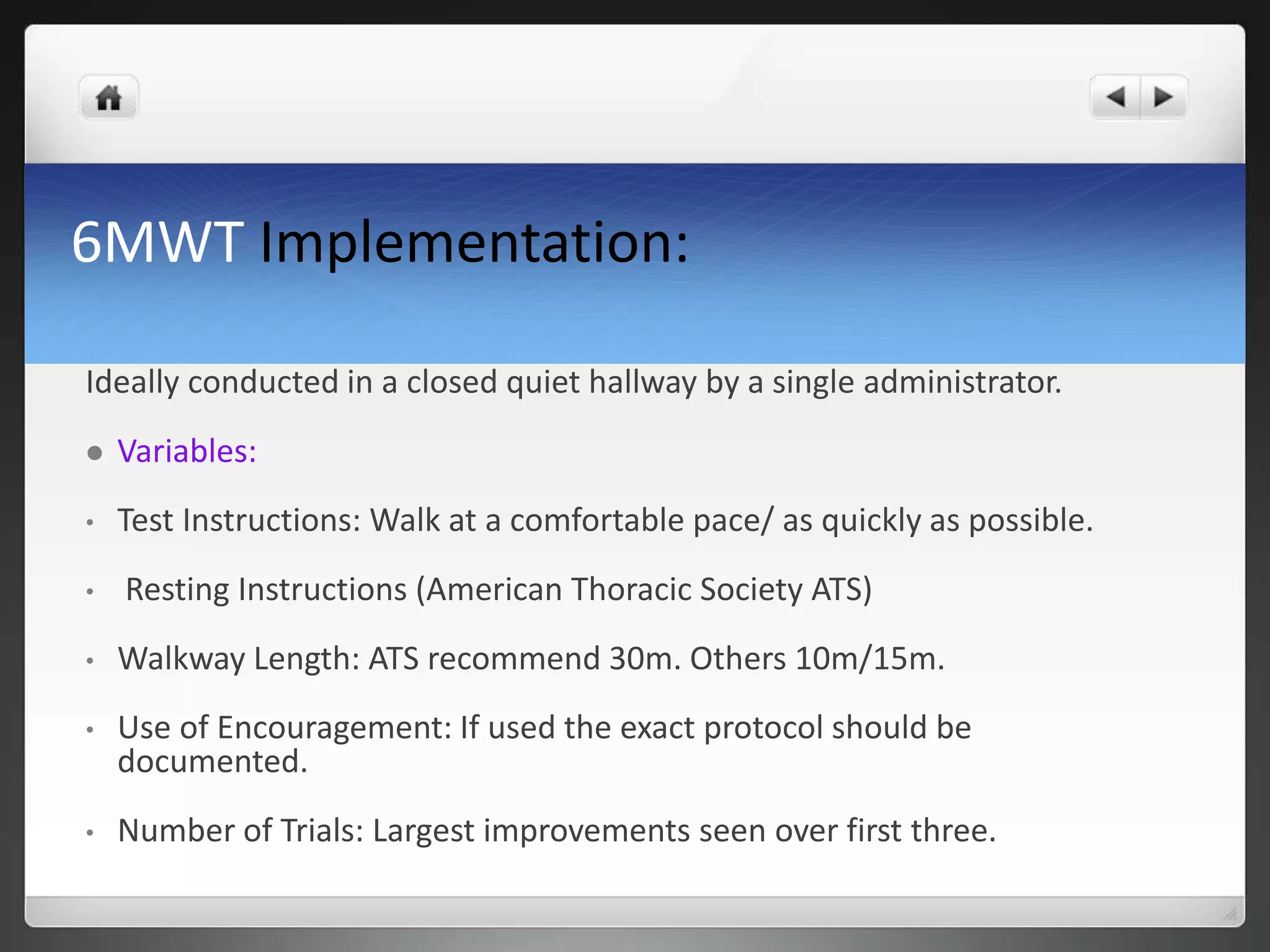
6MWT Implementation:
Ideally conducted in a closed quiet hallway by a single administrator.
 Variables:
• Test Instructions: Walk at a comfortable pace/ as quickly as possible.
• Resting Instructions (American Thoracic Society ATS)
• Walkway Length: ATS recommend 30m. Others 10m/15m.
• Use of Encouragement: If used the exact protocol should be
documented.
• Number of Trials: Largest improvements seen over first three.
6MWT
 Scoring:
 Range for healthy adults is 400m-600m
 Clinically important difference is 54m for healthy adults (Redelmeier et al,
1997)
 50m for stroke patients (Perera et al, 2006) 25m for coronary disease
(Gremeaux et al, 2011). % change of clinical significance not established.
Test Evaluation
 Validity- Does the test measure what it is said to measure?
 Reliability- If the test is repeated on the same patient by the same or
different examiners will the results be similar?
 Responsiveness- Is the test responsive to change? e.g.: following completion
of an exercise intervention.
Evidence
Systematic review in out-patient cardiac rehabilitation
 “Strong evidence suggests that the 6MWT is responsive to clinical
change following cardiac rehabilitation. Intra and inter-tester
reliability of the 6MWT and its validity in patients undergoing cardiac
rehabilitation requires further research.”
-Bellet et al,2012
6MWT Evidence
 Validity-Moderate to high relationships have been reported between the
6MWT distance and peak VO2max obtained in persons with heart failure
and COPD (Guyatt et al, 1985, Jaeschke et al 1993)
 Reliability-Different encouragements and repeated testing produce variable
results (Guyatt et al, 1984)
 Responsiveness- Studies of responsiveness have shown that improvement in
6MWT distance is related to diminished breathlessness (pacemaker
patients), improvements in QOL (elderly, cardiac pts) and changes in VO2
max (COPD)
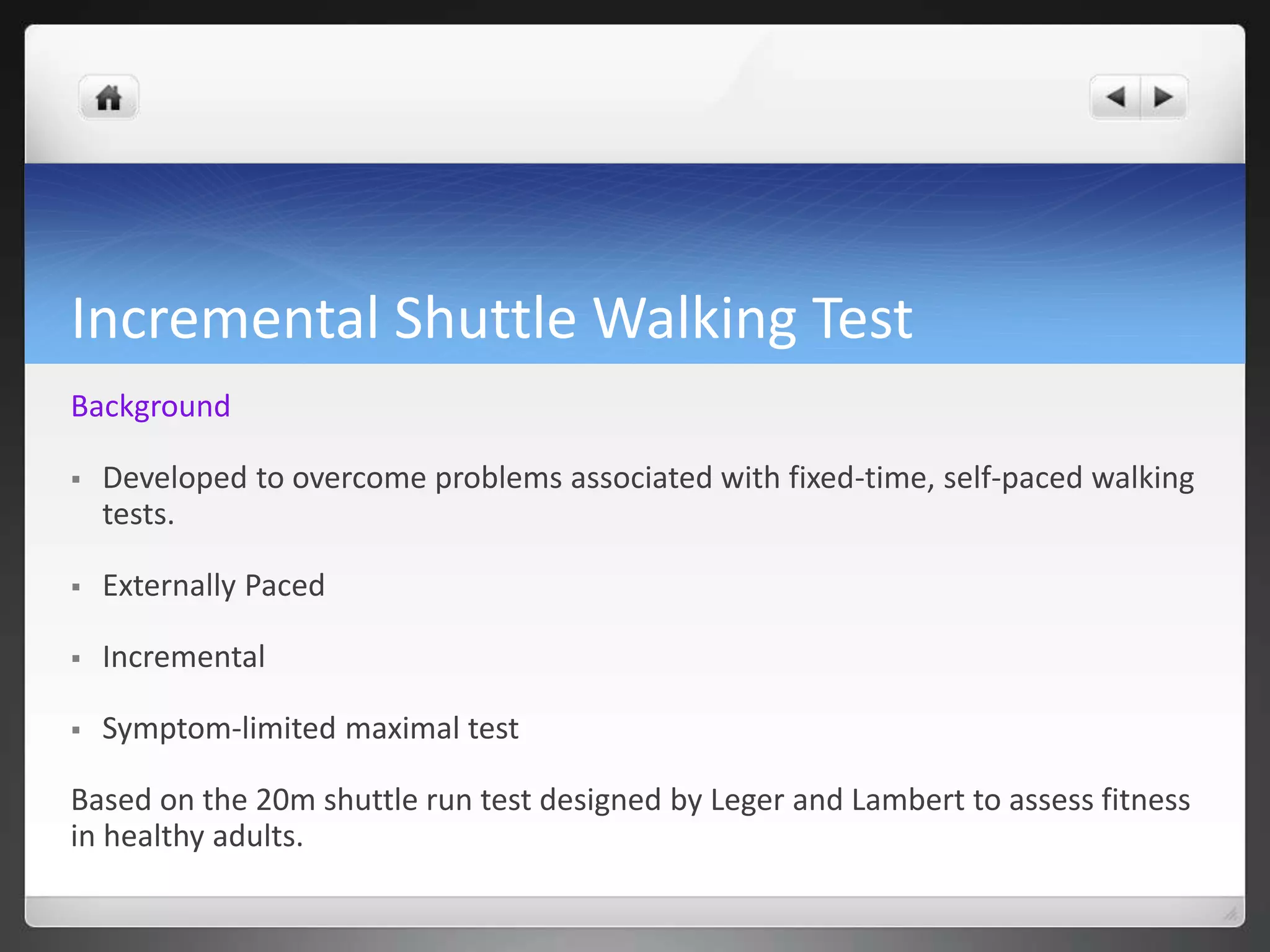
Incremental Shuttle Walking Test
Background
 Developed to overcome problems associated with fixed-time, self-paced walking
tests.
 Externally Paced
 Incremental
 Symptom-limited maximal test
Based on the 20m shuttle run test designed by Leger and Lambert to assess fitness
in healthy adults.
ISWT Implementation
 10m course marked by 2 cones set 0.5m from each end.
 Walking speed set by an audio signal on a tape/cd.
 Initial pace is 0.5m/sec. Walking speed increases by 0.17m/sec each minute of the
test, indicated by a triple beep from the tape.
 Number of shuttles increases by 1 each time the speed of walking increases.
 Test ends when the patient is exhausted or too breathless to continue or when the
patient is more than .5m from the cone when the turn signal sounds.
 Max 12 levels.HR, SpO2, BORG Dyspea scale used in coherence with the walking
test.
ISWT
Evidence
Validity
 Several studies have demonstrated a strong relationship between distance
walked on the ISWT and the directly determined VO2max, advocating the
tests validity in:
-COPD Patients (Singh et al, 2003. Turner et al, 2004. )
-Chronic Heart Failure (Morales et al, 2000. Green et al, 2001)
-Pulmonary Fibrosis (Moloney et al, 2003)
ISWT
Reproducibility
Singh et al and Green et al both reported strong test-retest reproducibility
when they compared distance walked during tests spaced 1 week apart.
Reliability
Strong as externally paced and audio cued.
6MWT Vs ISWT
 Some studies in people with COPD and CCF have demonstrated that the
6MWT overestimates disability when compared to the ISWT (Singh et al
1994, Green et al 2001, Morales et al, 2000)
 Similar distances covered. Peak HR and dyspnea greater on ISWT
 Conversely, Turner et al (2004) noted a strong correlation between heart
rate (HR), dyspnea and distances covered in the two tests and strongly
encouraged the 6MWT. This test also used encouragement.
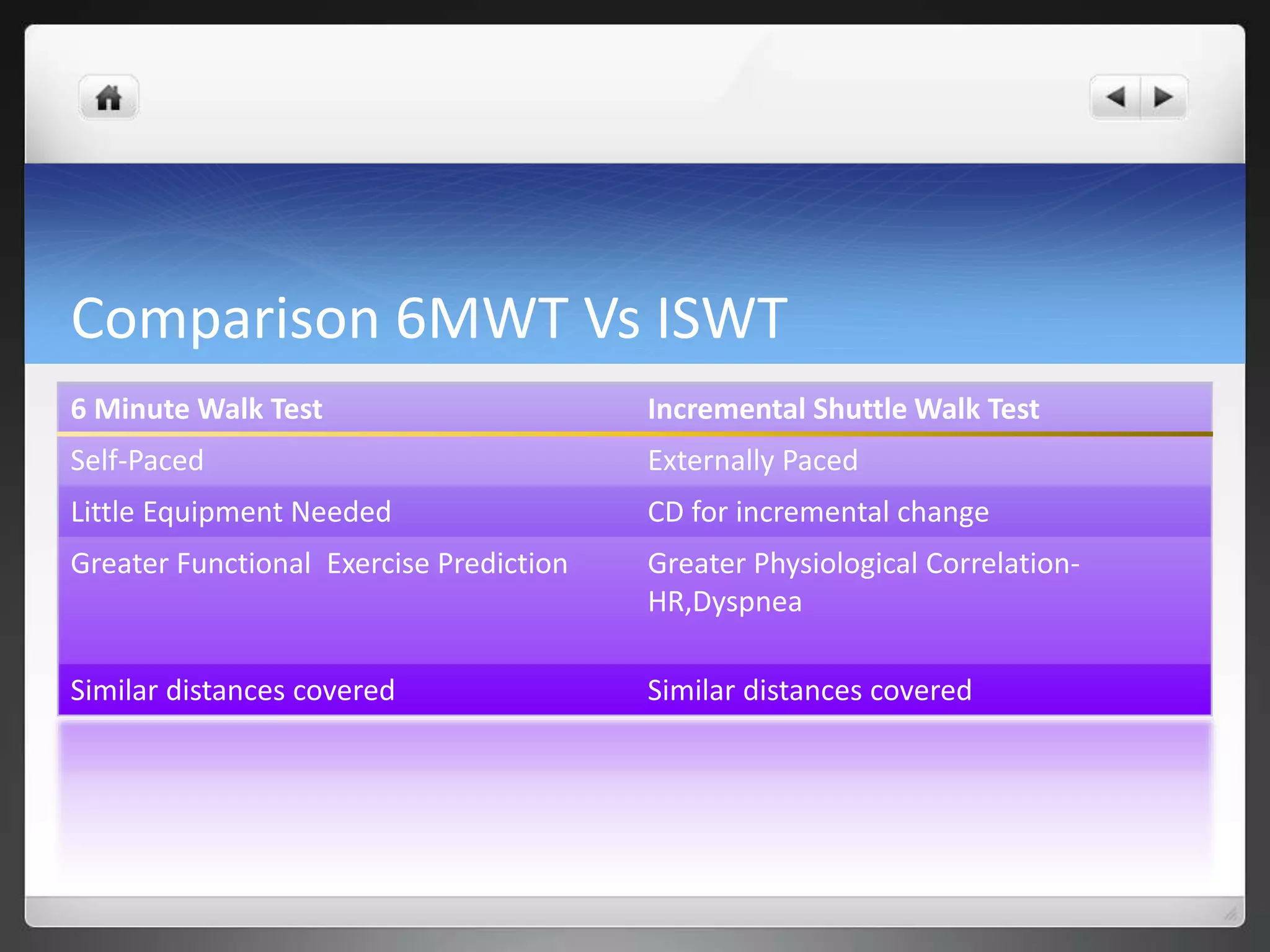
Comparison 6MWT Vs ISWT
6 Minute Walk Test Incremental Shuttle Walk Test
Self-Paced Externally Paced
Little Equipment Needed CD for incremental change
Greater Functional Exercise Prediction Greater Physiological Correlation-
HR,Dyspnea
Similar distances covered Similar distances covered
Comparison
Randomised Control Trials. ? Conflicting Evidence
 The shuttle walk test is simple and easy to implement in patients with chronic obstructive
pulmonary disease. The encouraged 6-minute walk test produced higher post-test heart
rate and greater post-test sensation of dyspnea than did the shuttle walk test. (COPD)
-Rosa et al, 2006.
 The shuttle walk test is no more responsive to change than the 6-minute walk test in older
people. It is limited by ceiling effects, and cannot be performed successfully by very frail
older people. (Elderly population)
-Witham et al, 2012.
Conclusion
 Further evidence is needed for specific patient populations to establish the
true validity in all patient sub-groups.
 Current evidence suggests both the 6MWT and Shuttle walk test are
suitable functional capacity outcome measures for cardiopulmonary
patients.
References
 Bellet et al, 2012. The 6-minute walk test in outpatient cardiac
rehabilitation: validity, reliability and responsiveness- a systematic review.
 Guyatt et al, 1985. How should we measure function in patients with chronic
heart and lung disease? J Chronic Disease.
 Jaeschke et al, 1989. Measurement of health status: Ascertaining the
minimal clinically important difference. Control clinical trials.
 Solway et al, 2001. A qualitative systematic overview of the measurement
properties of functional walk tests used in the cardiorespiratory domain.
Chest.
References
 Singh et al, 1994. Comparison of oxygen uptake during a conventional treadmill
test and the shuttle walking test in chronic airflow limitation. Eur Resp J.
 Turner SE et al, 2004. Physiologic responses to incremental and self-paced
exercise in COPD. A comparison of three tests. Chest.
 Moloney ED et al 2003. The Shuttle walk exercise test in idiopathic pulmonary
fibrosis. Resp. Med.
 Green DJ et al, 2001 A Comparison of the shuttle and 6 minute walking tests
with measured peak oxygen consumption in patients with CHF. J Sci Med Sports
 Morales et al, 2000. Shuttle versus six-minute walk test in the prediction of
outcome in chronic heart failure. Int J Cardiol.

6 mwt and shuttle

  • 1.
    Outcome measures offunctional capacity
  • 2.
    Content  Exercise testing Application of 6MWT  6MWT Evidence  Application of SWT  ISWT Evidence  Comparison
  • 3.
    Exercise testing  Roleof Exercise Testing  Assess Exercise Capacity  Exercise Prescription  Assess Change
  • 4.
    Exercise Testing Gold Standard-Symptom Limited Graded Exercise Testing (GXT)  Laboratory based  Incremental  Symptom limited  Externally paced  Gas Exchange
  • 5.
    Field-Based Exercise Testing 6 Minute Walk Test  Shuttle Walk Test
  • 6.
    6 Minute Walktest Background  Developed in 1963 by Balke to evaluate functional capacity in respiratory disease and heart failure.  Has since been used in a variety of populations including the elderly, stroke patients and spinal cord injuries.  Easy to implement, little equipment needed.
  • 7.
    6MWT Application  Measures theamount of distance and individual is able to walk over a period of 6 minutes on a hard, flat surface.  Self-paced. Resting allowed as necessary. Submaximal test.  Measure Heart Rate and SpO2 before test and upon completion.
  • 8.
    6MWT Implementation: Ideally conductedin a closed quiet hallway by a single administrator.  Variables: • Test Instructions: Walk at a comfortable pace/ as quickly as possible. • Resting Instructions (American Thoracic Society ATS) • Walkway Length: ATS recommend 30m. Others 10m/15m. • Use of Encouragement: If used the exact protocol should be documented. • Number of Trials: Largest improvements seen over first three.
  • 9.
    6MWT  Scoring:  Rangefor healthy adults is 400m-600m  Clinically important difference is 54m for healthy adults (Redelmeier et al, 1997)  50m for stroke patients (Perera et al, 2006) 25m for coronary disease (Gremeaux et al, 2011). % change of clinical significance not established.
  • 10.
    Test Evaluation  Validity-Does the test measure what it is said to measure?  Reliability- If the test is repeated on the same patient by the same or different examiners will the results be similar?  Responsiveness- Is the test responsive to change? e.g.: following completion of an exercise intervention.
  • 11.
    Evidence Systematic review inout-patient cardiac rehabilitation  “Strong evidence suggests that the 6MWT is responsive to clinical change following cardiac rehabilitation. Intra and inter-tester reliability of the 6MWT and its validity in patients undergoing cardiac rehabilitation requires further research.” -Bellet et al,2012
  • 12.
    6MWT Evidence  Validity-Moderateto high relationships have been reported between the 6MWT distance and peak VO2max obtained in persons with heart failure and COPD (Guyatt et al, 1985, Jaeschke et al 1993)  Reliability-Different encouragements and repeated testing produce variable results (Guyatt et al, 1984)  Responsiveness- Studies of responsiveness have shown that improvement in 6MWT distance is related to diminished breathlessness (pacemaker patients), improvements in QOL (elderly, cardiac pts) and changes in VO2 max (COPD)
  • 13.
    Incremental Shuttle WalkingTest Background  Developed to overcome problems associated with fixed-time, self-paced walking tests.  Externally Paced  Incremental  Symptom-limited maximal test Based on the 20m shuttle run test designed by Leger and Lambert to assess fitness in healthy adults.
  • 14.
    ISWT Implementation  10mcourse marked by 2 cones set 0.5m from each end.  Walking speed set by an audio signal on a tape/cd.  Initial pace is 0.5m/sec. Walking speed increases by 0.17m/sec each minute of the test, indicated by a triple beep from the tape.  Number of shuttles increases by 1 each time the speed of walking increases.  Test ends when the patient is exhausted or too breathless to continue or when the patient is more than .5m from the cone when the turn signal sounds.  Max 12 levels.HR, SpO2, BORG Dyspea scale used in coherence with the walking test.
  • 15.
  • 16.
    Evidence Validity  Several studieshave demonstrated a strong relationship between distance walked on the ISWT and the directly determined VO2max, advocating the tests validity in: -COPD Patients (Singh et al, 2003. Turner et al, 2004. ) -Chronic Heart Failure (Morales et al, 2000. Green et al, 2001) -Pulmonary Fibrosis (Moloney et al, 2003)
  • 17.
    ISWT Reproducibility Singh et aland Green et al both reported strong test-retest reproducibility when they compared distance walked during tests spaced 1 week apart. Reliability Strong as externally paced and audio cued.
  • 18.
    6MWT Vs ISWT Some studies in people with COPD and CCF have demonstrated that the 6MWT overestimates disability when compared to the ISWT (Singh et al 1994, Green et al 2001, Morales et al, 2000)  Similar distances covered. Peak HR and dyspnea greater on ISWT  Conversely, Turner et al (2004) noted a strong correlation between heart rate (HR), dyspnea and distances covered in the two tests and strongly encouraged the 6MWT. This test also used encouragement.
  • 19.
    Comparison 6MWT VsISWT 6 Minute Walk Test Incremental Shuttle Walk Test Self-Paced Externally Paced Little Equipment Needed CD for incremental change Greater Functional Exercise Prediction Greater Physiological Correlation- HR,Dyspnea Similar distances covered Similar distances covered
  • 20.
    Comparison Randomised Control Trials.? Conflicting Evidence  The shuttle walk test is simple and easy to implement in patients with chronic obstructive pulmonary disease. The encouraged 6-minute walk test produced higher post-test heart rate and greater post-test sensation of dyspnea than did the shuttle walk test. (COPD) -Rosa et al, 2006.  The shuttle walk test is no more responsive to change than the 6-minute walk test in older people. It is limited by ceiling effects, and cannot be performed successfully by very frail older people. (Elderly population) -Witham et al, 2012.
  • 21.
    Conclusion  Further evidenceis needed for specific patient populations to establish the true validity in all patient sub-groups.  Current evidence suggests both the 6MWT and Shuttle walk test are suitable functional capacity outcome measures for cardiopulmonary patients.
  • 22.
    References  Bellet etal, 2012. The 6-minute walk test in outpatient cardiac rehabilitation: validity, reliability and responsiveness- a systematic review.  Guyatt et al, 1985. How should we measure function in patients with chronic heart and lung disease? J Chronic Disease.  Jaeschke et al, 1989. Measurement of health status: Ascertaining the minimal clinically important difference. Control clinical trials.  Solway et al, 2001. A qualitative systematic overview of the measurement properties of functional walk tests used in the cardiorespiratory domain. Chest.
  • 23.
    References  Singh etal, 1994. Comparison of oxygen uptake during a conventional treadmill test and the shuttle walking test in chronic airflow limitation. Eur Resp J.  Turner SE et al, 2004. Physiologic responses to incremental and self-paced exercise in COPD. A comparison of three tests. Chest.  Moloney ED et al 2003. The Shuttle walk exercise test in idiopathic pulmonary fibrosis. Resp. Med.  Green DJ et al, 2001 A Comparison of the shuttle and 6 minute walking tests with measured peak oxygen consumption in patients with CHF. J Sci Med Sports  Morales et al, 2000. Shuttle versus six-minute walk test in the prediction of outcome in chronic heart failure. Int J Cardiol.