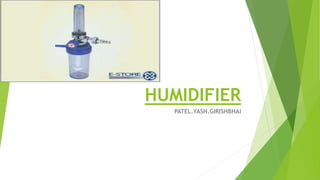
HUMIDIFIER
PATEL.YASH.GIRISHBHAI
WHAT IS HUMIDIFICATION
 It is water vapor and at time, heat added to inspired gas
of achieving near normal inspiratory condition when gas
enters the airway.
WHAT IS IT IMPORTANT
 Adequate level of humidity and heat are necessary to
ensure function of mucocillary transport system.
 During mechanical ventilation, humidification is crucial to
avoid-
1. Hypothermia
2. Atelectasis
3. Inspissation of airway secretion
4. Depressed ciliary function
WHAT IS IDEAL HUMIDIFICATION
 Inspired gas is delivered into trachea at 32-36 degree C
with content of 30-43 g/m3
 Set temp. remains constant
 Humidification and temperature remain unaffected by
large of fresh gas flows
 Device-simple to use
TYPE OF HUMIDIFIERS
 ACTIVE
 Heated humidifier
 Active source of heart and water
 PASSIVE
 Heat and moisture exchange filter (HMEF)
 Passively retains and humidity leaving trachea during
expiration and recycle during next inspiration
PASSIVE HUMIDIFIERS
 Device that collects the patients expired heart and
moisture and returns during the following inspiration
“artificial noses”
 Heat and moisture exchangers: device which uses the
principle of heat and moisture exchange only
 Hygroscopic heat moisture exchanger: HHME
 HHME-
 Most popular style of artificial nose
 Comprised of a paper or propylene to enhance moisture
conservation
INDICATION
 Most useful during short term ventilation, in pt who are
adequately hydrated
 Can be use as o2 therapy device in intubated pt.
CONTRAINDICATION
 Pt with thick, copious, or bloody secretion
 Pt with body temp < 32 degree C
 Pt with spontaneous MV > 10L/min
 It should be removed during aerosol treatment
HOT WATER HUMIDIFIER
 Water bath temp – thermostatically controlled
 Heated wire may be sited in inspiratory tubing – to
maintain gas temp. and humidity
USE
 It is placed in inspiratory tubings
 Care should be taken – inspiratory and not expiratory
tubing
 It should be lower than pt.- to void risk of water running
down tube in to pt.
 Clear tubing should be used – so water can be seen
DISADVANTAGE
 Bulky and complex
 More costly than HMEs
 Electrical hazards
 Maintenance cost- control of temp, refilling of reservoir,
cleaing and sterilization after sued
COLD WATER HUMIDIFIIER
 Simple, inexpensive
 Inefficient
 Potential source of microbiological contamination
 May cause bronchoconstriction
OTHER METHODS OF HUMIDIFICATION
 SYSTEMIC HYDRATION: regular fluid intake prevents
secretions to become tenacious
 STEAM INHALATION: inhalation of the steam is helpful if
they are encouraged to breath deeply.
Humidifier

Humidifier

  • 1.
  • 2.
    WHAT IS HUMIDIFICATION It is water vapor and at time, heat added to inspired gas of achieving near normal inspiratory condition when gas enters the airway.
  • 3.
    WHAT IS ITIMPORTANT  Adequate level of humidity and heat are necessary to ensure function of mucocillary transport system.  During mechanical ventilation, humidification is crucial to avoid- 1. Hypothermia 2. Atelectasis 3. Inspissation of airway secretion 4. Depressed ciliary function
  • 4.
    WHAT IS IDEALHUMIDIFICATION  Inspired gas is delivered into trachea at 32-36 degree C with content of 30-43 g/m3  Set temp. remains constant  Humidification and temperature remain unaffected by large of fresh gas flows  Device-simple to use
  • 5.
    TYPE OF HUMIDIFIERS ACTIVE  Heated humidifier  Active source of heart and water  PASSIVE  Heat and moisture exchange filter (HMEF)  Passively retains and humidity leaving trachea during expiration and recycle during next inspiration
  • 6.
    PASSIVE HUMIDIFIERS  Devicethat collects the patients expired heart and moisture and returns during the following inspiration “artificial noses”  Heat and moisture exchangers: device which uses the principle of heat and moisture exchange only  Hygroscopic heat moisture exchanger: HHME
  • 7.
     HHME-  Mostpopular style of artificial nose  Comprised of a paper or propylene to enhance moisture conservation
  • 10.
    INDICATION  Most usefulduring short term ventilation, in pt who are adequately hydrated  Can be use as o2 therapy device in intubated pt.
  • 11.
    CONTRAINDICATION  Pt withthick, copious, or bloody secretion  Pt with body temp < 32 degree C  Pt with spontaneous MV > 10L/min  It should be removed during aerosol treatment
  • 12.
    HOT WATER HUMIDIFIER Water bath temp – thermostatically controlled  Heated wire may be sited in inspiratory tubing – to maintain gas temp. and humidity
  • 14.
    USE  It isplaced in inspiratory tubings  Care should be taken – inspiratory and not expiratory tubing  It should be lower than pt.- to void risk of water running down tube in to pt.  Clear tubing should be used – so water can be seen
  • 15.
    DISADVANTAGE  Bulky andcomplex  More costly than HMEs  Electrical hazards  Maintenance cost- control of temp, refilling of reservoir, cleaing and sterilization after sued
  • 16.
    COLD WATER HUMIDIFIIER Simple, inexpensive  Inefficient  Potential source of microbiological contamination  May cause bronchoconstriction
  • 17.
    OTHER METHODS OFHUMIDIFICATION  SYSTEMIC HYDRATION: regular fluid intake prevents secretions to become tenacious  STEAM INHALATION: inhalation of the steam is helpful if they are encouraged to breath deeply.