the determination of the size range of
particles present in a soil, expressed as
percentage of the total dry weight.
In any soil mass, the sizes of the grains
vary greatly. To classify a soil properly,
you must know its grain-size
distribution.
Two Methods Use in Determining the Particle Size
Distribution of Soil
1. Sieve Analysis
 Use in determining particle size distribution for coarse
rained soil (For particle sizes larger than 0.075 mm in
diameter)
2. Hydrometer Analysis
 Use in obtaining the particle size distribution for fine
rained soil (For particle sizes smaller than 0.075 mm in
diameter)
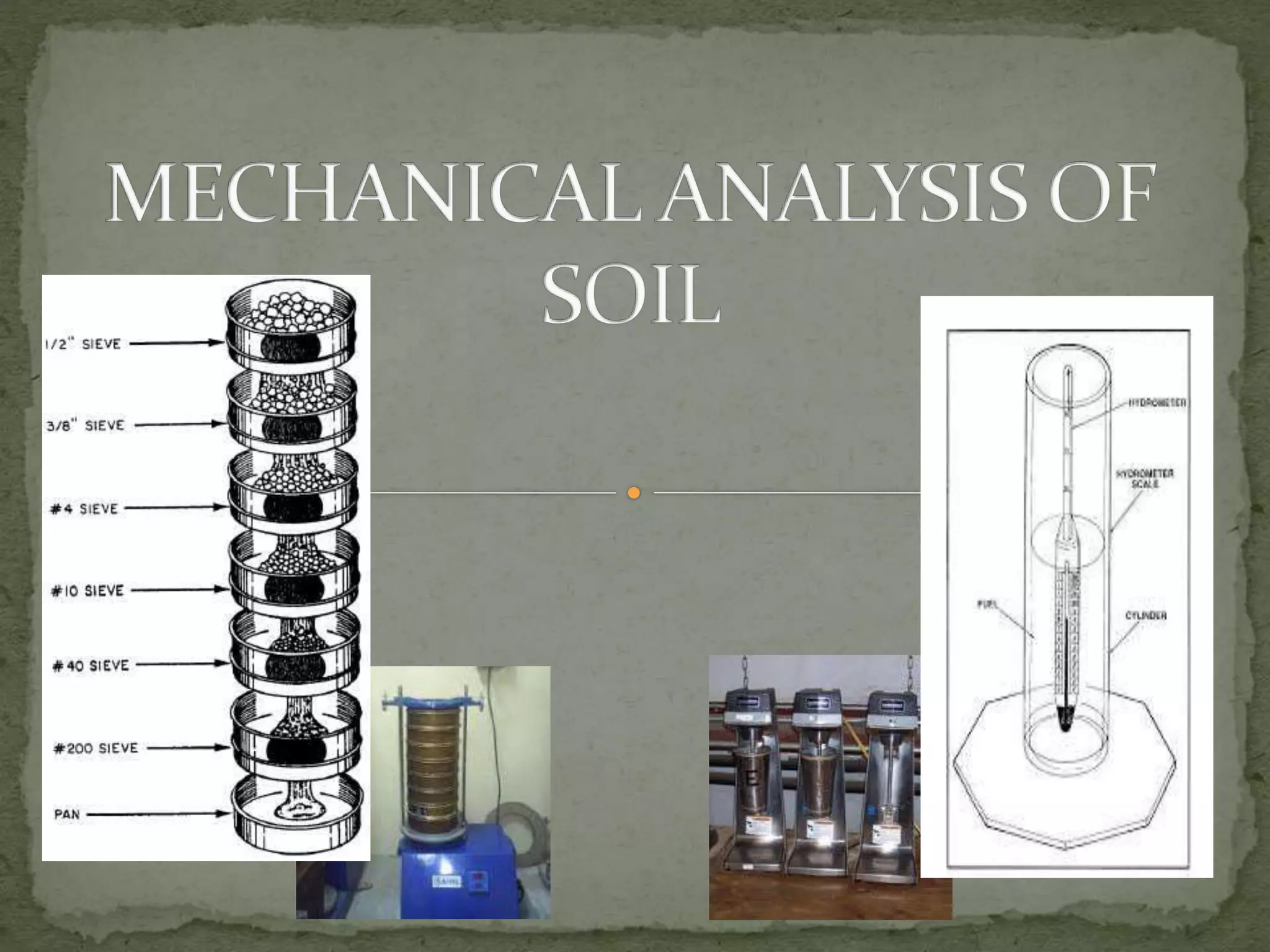
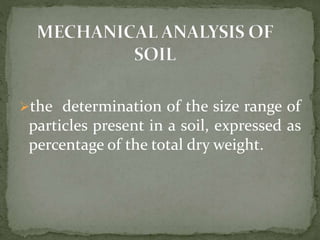
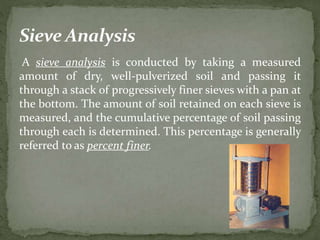
A sieve analysis is conducted by taking a measured
amount of dry, well-pulverized soil and passing it
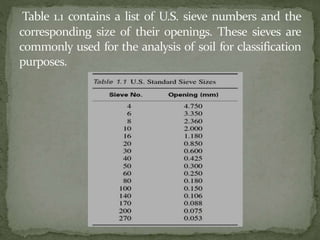
through a stack of progressively finer sieves with a pan at
the bottom. The amount of soil retained on each sieve is
measured, and the cumulative percentage of soil passing
through each is determined. This percentage is generally
referred to as percent finer.
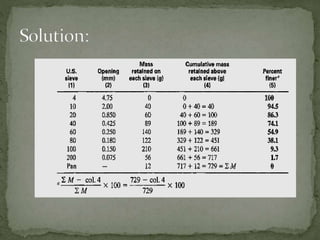
1. Oven dry the soil and then break all lumps into smaller particles .
2. The soil is then shaken through a stack of sieves with openings of decreasing
size from top to bottom.
3. After the soil is shaken, the mass of soil retained on each sieve and pan is
determined.
4. Determine the total mass of the soil : M1 + M2 + ….Mn =Ʃ M.
5. Determine the cumulative mass of soil retained above each sieve. For the ith
sieve, it is : M1 + M2 + ….Mi
6. The mass of soil passing the ith sieve is ƩM – (: M1 + M2 + ….Mi)
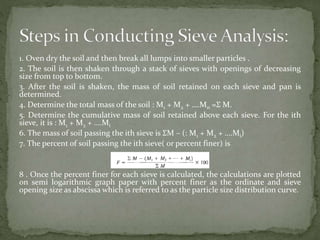
7. The percent of soil passing the ith sieve( or percent finer) is
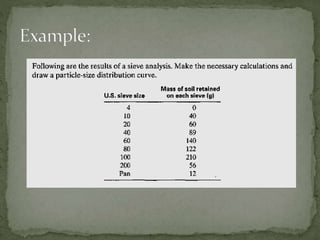
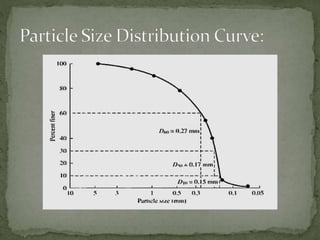
8 . Once the percent finer for each sieve is calculated, the calculations are plotted
on semi logarithmic graph paper with percent finer as the ordinate and sieve
opening size as abscissa which is referred to as the particle size distribution curve.
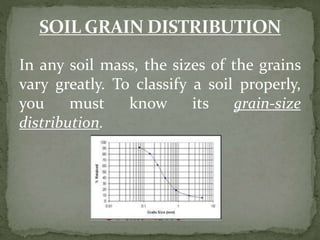
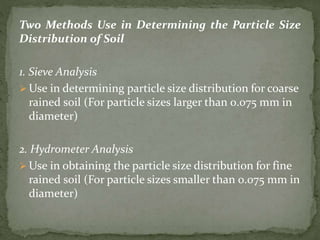
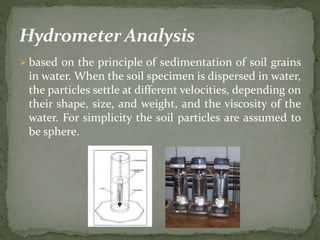
 based on the principle of sedimentation of soil grains
in water. When the soil specimen is dispersed in water,
the particles settle at different velocities, depending on
their shape, size, and weight, and the viscosity of the
water. For simplicity the soil particles are assumed to
be sphere.
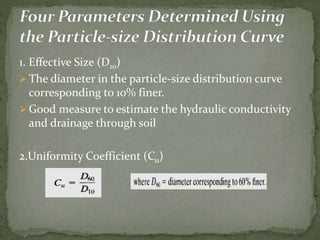
1. Effective Size (D10)
 The diameter in the particle-size distribution curve
corresponding to 10% finer.
 Good measure to estimate the hydraulic conductivity
and drainage through soil
2.Uniformity Coefficient (Cu)
3. Coefficient of Gradation( Cc)
Cc =[D30]2/[(D60)(D10)]
4. Sorting Coefficient( So)
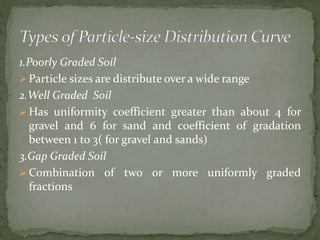
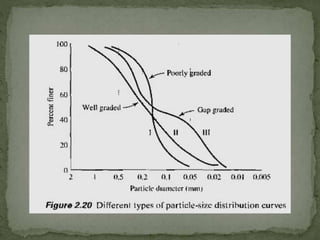
1.Poorly Graded Soil
 Particle sizes are distribute over a wide range
2.Well Graded Soil
 Has uniformity coefficient greater than about 4 for
gravel and 6 for sand and coefficient of gradation
between 1 to 3( for gravel and sands)
3.Gap Graded Soil
 Combination of two or more uniformly graded
fractions
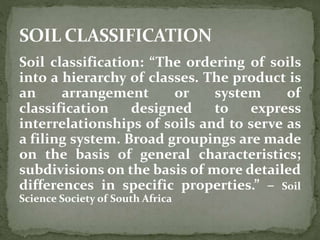
Soil classification: “The ordering of soils
into a hierarchy of classes. The product is
an arrangement or system of
classification designed to express
interrelationships of soils and to serve as
a filing system. Broad groupings are made
on the basis of general characteristics;
subdivisions on the basis of more detailed
differences in specific properties.” – Soil
Science Society of South Africa
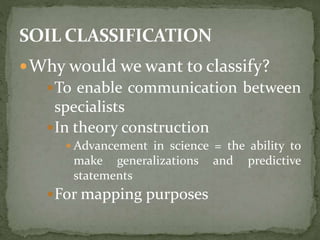
Why would we want to classify?
To enable communication between
specialists
In theory construction
 Advancement in science = the ability to
make generalizations and predictive
statements
For mapping purposes
USDA CLASIFICATION SYSTEM
AASHTO SOIL CLASSIFICATION SYSTEM
USCS

Mechanical analysis of soil

  • 2.
    the determination ofthe size range of particles present in a soil, expressed as percentage of the total dry weight.
  • 3.
    In any soilmass, the sizes of the grains vary greatly. To classify a soil properly, you must know its grain-size distribution.
  • 4.
    Two Methods Usein Determining the Particle Size Distribution of Soil 1. Sieve Analysis  Use in determining particle size distribution for coarse rained soil (For particle sizes larger than 0.075 mm in diameter) 2. Hydrometer Analysis  Use in obtaining the particle size distribution for fine rained soil (For particle sizes smaller than 0.075 mm in diameter)
  • 5.
    A sieve analysisis conducted by taking a measured amount of dry, well-pulverized soil and passing it through a stack of progressively finer sieves with a pan at the bottom. The amount of soil retained on each sieve is measured, and the cumulative percentage of soil passing through each is determined. This percentage is generally referred to as percent finer.
  • 7.
    1. Oven drythe soil and then break all lumps into smaller particles . 2. The soil is then shaken through a stack of sieves with openings of decreasing size from top to bottom. 3. After the soil is shaken, the mass of soil retained on each sieve and pan is determined. 4. Determine the total mass of the soil : M1 + M2 + ….Mn =Ʃ M. 5. Determine the cumulative mass of soil retained above each sieve. For the ith sieve, it is : M1 + M2 + ….Mi 6. The mass of soil passing the ith sieve is ƩM – (: M1 + M2 + ….Mi) 7. The percent of soil passing the ith sieve( or percent finer) is 8 . Once the percent finer for each sieve is calculated, the calculations are plotted on semi logarithmic graph paper with percent finer as the ordinate and sieve opening size as abscissa which is referred to as the particle size distribution curve.
  • 8.
     based onthe principle of sedimentation of soil grains in water. When the soil specimen is dispersed in water, the particles settle at different velocities, depending on their shape, size, and weight, and the viscosity of the water. For simplicity the soil particles are assumed to be sphere.
  • 9.
    1. Effective Size(D10)  The diameter in the particle-size distribution curve corresponding to 10% finer.  Good measure to estimate the hydraulic conductivity and drainage through soil 2.Uniformity Coefficient (Cu)
  • 10.
    3. Coefficient ofGradation( Cc) Cc =[D30]2/[(D60)(D10)] 4. Sorting Coefficient( So)
  • 11.
    1.Poorly Graded Soil Particle sizes are distribute over a wide range 2.Well Graded Soil  Has uniformity coefficient greater than about 4 for gravel and 6 for sand and coefficient of gradation between 1 to 3( for gravel and sands) 3.Gap Graded Soil  Combination of two or more uniformly graded fractions
  • 16.
    Soil classification: “Theordering of soils into a hierarchy of classes. The product is an arrangement or system of classification designed to express interrelationships of soils and to serve as a filing system. Broad groupings are made on the basis of general characteristics; subdivisions on the basis of more detailed differences in specific properties.” – Soil Science Society of South Africa
  • 17.
    Why would wewant to classify? To enable communication between specialists In theory construction  Advancement in science = the ability to make generalizations and predictive statements For mapping purposes
  • 18.
    USDA CLASIFICATION SYSTEM AASHTOSOIL CLASSIFICATION SYSTEM USCS