Geotechnical
Engineering 1
Engr. Ida P. Mandawe
CLASSIFICATION OF SOIL
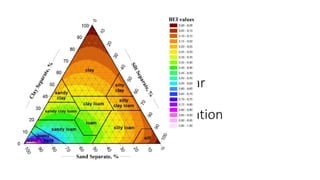
USDA
Triangular
Textural
Classification
Chart
Particle Size Distribution
 The sieves normally required are as follows:
Particle Size Distribution
 Significance:
 Engineering classification of soils.
 Selection of the most suitable soil for construction of roads,
airfields, levees, dams and other embankments.
 To predict the seepage through soil (although permeability
tests are more generally used)
 To predict the susceptibility to frost action.
 Selection of most suitable filter material.
Particle Size Distribution
 The gradation curve:
 A gradation curve is drawn by plotting the percentage finer
(%age passing) on ordinate against the particle sizes on
abscissa.
 The gradation curves indicate the type of soil, and provide very
important information related to the properties and behavior
of soil
Particle Size Distribution
 The gradation curves have great importance in civil
engineering and are extensively used for the following
purposes.
 Determination of Effective Grain (Particle) Size.
 Determination of Uniformity co-efficient.
 Determination of co-efficient of Curvature.
 Determination of percentage of different soil types in a soil
sample e.g., sand, silt, clay.
 Determination of percentage larger or finer than a given
size.
 Classification of soil.
 Design of filters.
 Concrete mix design.
Particle Size Distribution
 Well-Graded Soil:
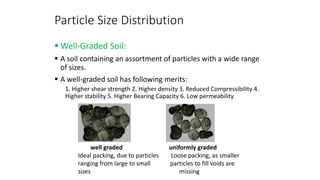
 A soil containing an assortment of particles with a wide range
of sizes.
 A well-graded soil has following merits:
1. Higher shear strength 2. Higher density 3. Reduced Compressibility 4.
Higher stability 5. Higher Bearing Capacity 6. Low permeability
well graded uniformly graded
Ideal packing, due to particles Loose packing, as smaller
ranging from large to small particles to fill voids are
sizes missing
Particle Size Distribution
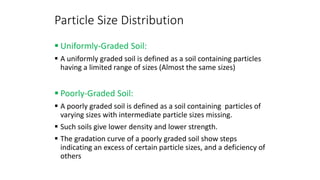
 Uniformly-Graded Soil:
 A uniformly graded soil is defined as a soil containing particles
having a limited range of sizes (Almost the same sizes)
 Poorly-Graded Soil:
 A poorly graded soil is defined as a soil containing particles of
varying sizes with intermediate particle sizes missing.
 Such soils give lower density and lower strength.
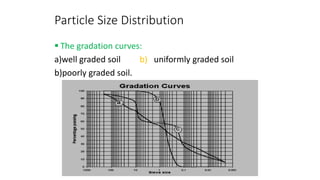
 The gradation curve of a poorly graded soil show steps
indicating an excess of certain particle sizes, and a deficiency of
others
Particle Size Distribution
 The gradation curves:
a)well graded soil b) uniformly graded soil
b)poorly graded soil.
Particle Size Distribution
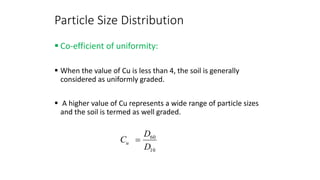
 Co-efficient of uniformity:
 When the value of Cu is less than 4, the soil is generally
considered as uniformly graded.
 A higher value of Cu represents a wide range of particle sizes
and the soil is termed as well graded.
)
32
.
1
(
10
60
D
D
Cu 
Particle Size Distribution
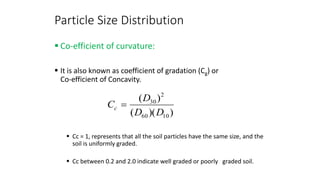
 Co-efficient of curvature:
 It is also known as coefficient of gradation (Cg) or
Co-efficient of Concavity.
 Cc = 1, represents that all the soil particles have the same size, and the
soil is uniformly graded.
 Cc between 0.2 and 2.0 indicate well graded or poorly graded soil.
)
)(
(
)
(
10
60
2
30
D
D
D
Cc 
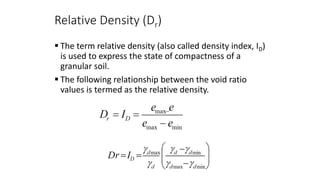
Relative Density (Dr)
 The term relative density (also called density index, ID)
is used to express the state of compactness of a
granular soil.
 The following relationship between the void ratio
values is termed as the relative density.
Relative Density (Dr)
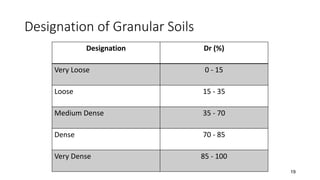
 The range of values for relative densities (Dr) and the
commonly referred state of compaction for granular
soil.
Designation of Granular Soils
Designation Dr (%)
Very Loose 0 - 15
Loose 15 - 35
Medium Dense 35 - 70
Dense 70 - 85
Very Dense 85 - 100
19
Atterberg or Consistency Limits
 The consistency of a soil means its physical state with
respect to the moisture content present that time.
 Consistency states are:
1. Solid state
2. Semi solid state
3. Plastic state
4. Liquid state.
Lesson-3-Classification-of-Soil.pptx

Lesson-3-Classification-of-Soil.pptx

  • 1.
    Geotechnical Engineering 1 Engr. IdaP. Mandawe CLASSIFICATION OF SOIL
  • 2.
  • 8.
    Particle Size Distribution The sieves normally required are as follows:
  • 9.
    Particle Size Distribution Significance:  Engineering classification of soils.  Selection of the most suitable soil for construction of roads, airfields, levees, dams and other embankments.  To predict the seepage through soil (although permeability tests are more generally used)  To predict the susceptibility to frost action.  Selection of most suitable filter material.
  • 10.
    Particle Size Distribution The gradation curve:  A gradation curve is drawn by plotting the percentage finer (%age passing) on ordinate against the particle sizes on abscissa.  The gradation curves indicate the type of soil, and provide very important information related to the properties and behavior of soil
  • 11.
    Particle Size Distribution The gradation curves have great importance in civil engineering and are extensively used for the following purposes.  Determination of Effective Grain (Particle) Size.  Determination of Uniformity co-efficient.  Determination of co-efficient of Curvature.  Determination of percentage of different soil types in a soil sample e.g., sand, silt, clay.  Determination of percentage larger or finer than a given size.  Classification of soil.  Design of filters.  Concrete mix design.
  • 12.
    Particle Size Distribution Well-Graded Soil:  A soil containing an assortment of particles with a wide range of sizes.  A well-graded soil has following merits: 1. Higher shear strength 2. Higher density 3. Reduced Compressibility 4. Higher stability 5. Higher Bearing Capacity 6. Low permeability well graded uniformly graded Ideal packing, due to particles Loose packing, as smaller ranging from large to small particles to fill voids are sizes missing
  • 13.
    Particle Size Distribution Uniformly-Graded Soil:  A uniformly graded soil is defined as a soil containing particles having a limited range of sizes (Almost the same sizes)  Poorly-Graded Soil:  A poorly graded soil is defined as a soil containing particles of varying sizes with intermediate particle sizes missing.  Such soils give lower density and lower strength.  The gradation curve of a poorly graded soil show steps indicating an excess of certain particle sizes, and a deficiency of others
  • 14.
    Particle Size Distribution The gradation curves: a)well graded soil b) uniformly graded soil b)poorly graded soil.
  • 15.
    Particle Size Distribution Co-efficient of uniformity:  When the value of Cu is less than 4, the soil is generally considered as uniformly graded.  A higher value of Cu represents a wide range of particle sizes and the soil is termed as well graded. ) 32 . 1 ( 10 60 D D Cu 
  • 16.
    Particle Size Distribution Co-efficient of curvature:  It is also known as coefficient of gradation (Cg) or Co-efficient of Concavity.  Cc = 1, represents that all the soil particles have the same size, and the soil is uniformly graded.  Cc between 0.2 and 2.0 indicate well graded or poorly graded soil. ) )( ( ) ( 10 60 2 30 D D D Cc 
  • 17.
    Relative Density (Dr) The term relative density (also called density index, ID) is used to express the state of compactness of a granular soil.  The following relationship between the void ratio values is termed as the relative density.
  • 18.
    Relative Density (Dr) The range of values for relative densities (Dr) and the commonly referred state of compaction for granular soil.
  • 19.
    Designation of GranularSoils Designation Dr (%) Very Loose 0 - 15 Loose 15 - 35 Medium Dense 35 - 70 Dense 70 - 85 Very Dense 85 - 100 19
  • 20.
    Atterberg or ConsistencyLimits  The consistency of a soil means its physical state with respect to the moisture content present that time.  Consistency states are: 1. Solid state 2. Semi solid state 3. Plastic state 4. Liquid state.