DETERMINATION OF
GRAIN SIZE DISTRIBUTION
EXPERIMENT NO 5
SOIL MECHANICS LABORATORY
CE PC 594
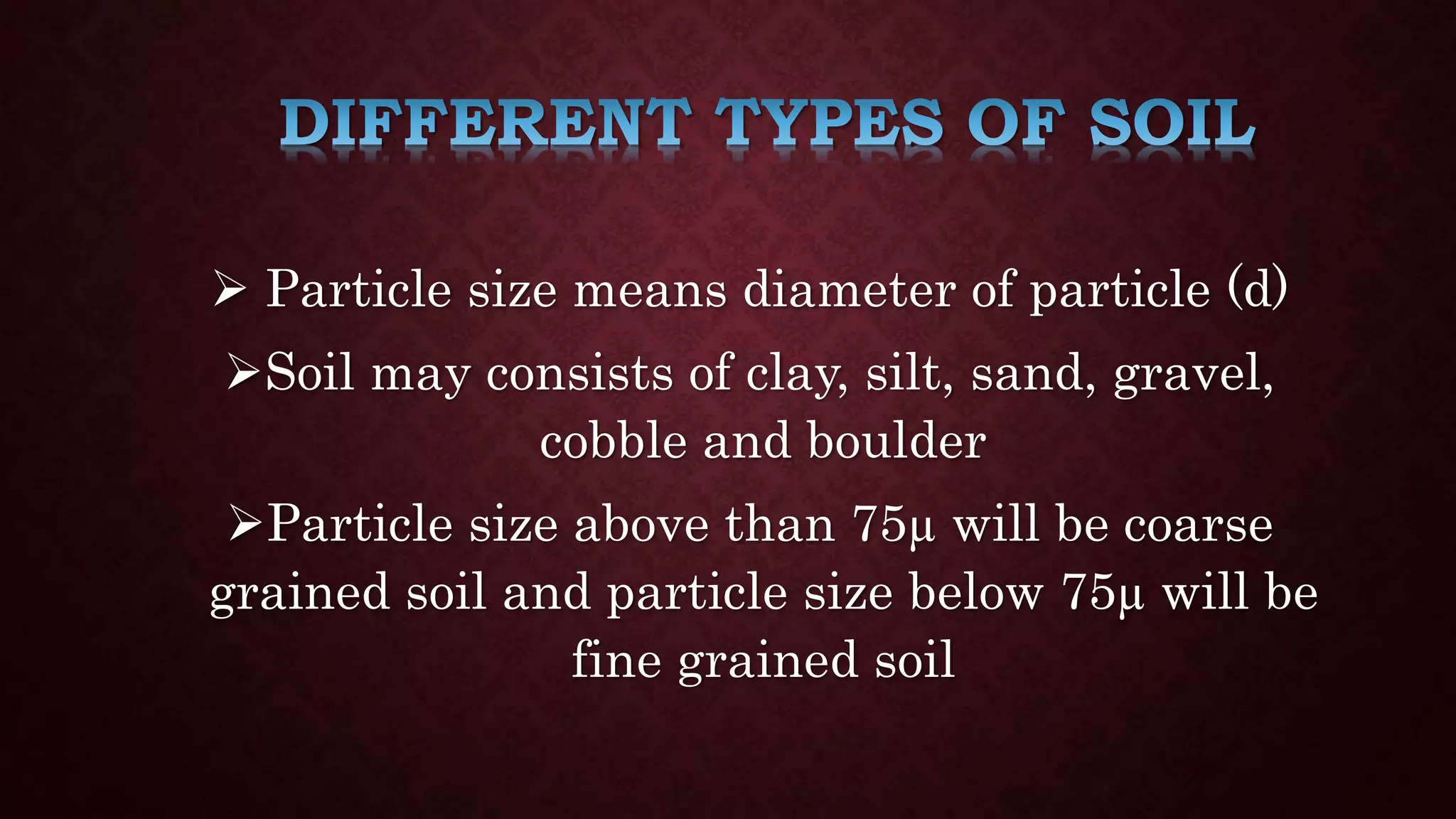
 Particle size means diameter of particle (d)
Soil may consists of clay, silt, sand, gravel,
cobble and boulder
Particle size above than 75µ will be coarse
grained soil and particle size below 75µ will be
fine grained soil
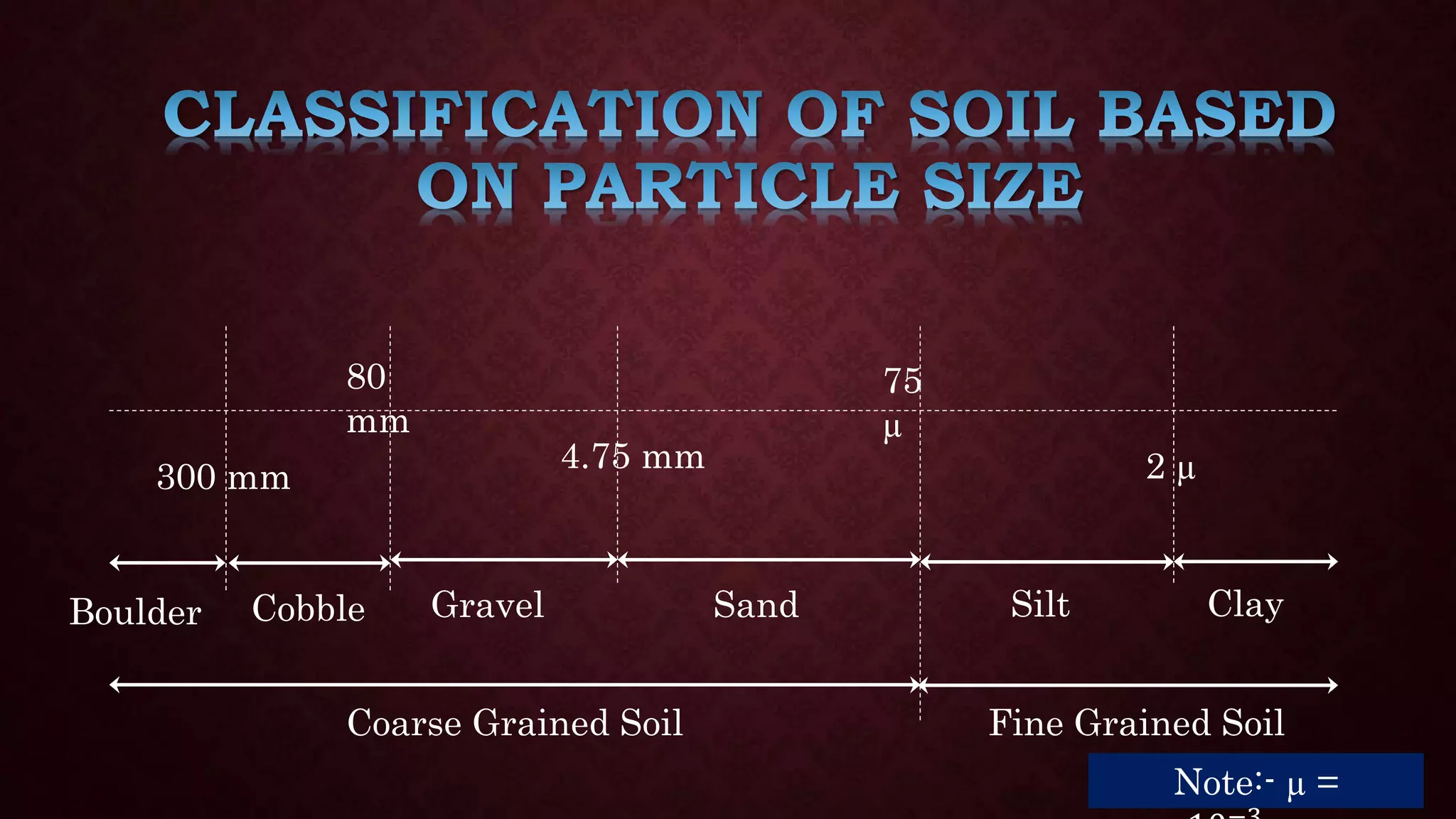
300 mm
80
mm
75
µ
4.75 mm 2 µ
Boulder Cobble Gravel Sand Silt Clay
Fine Grained Soil
Coarse Grained Soil
Note:- µ =
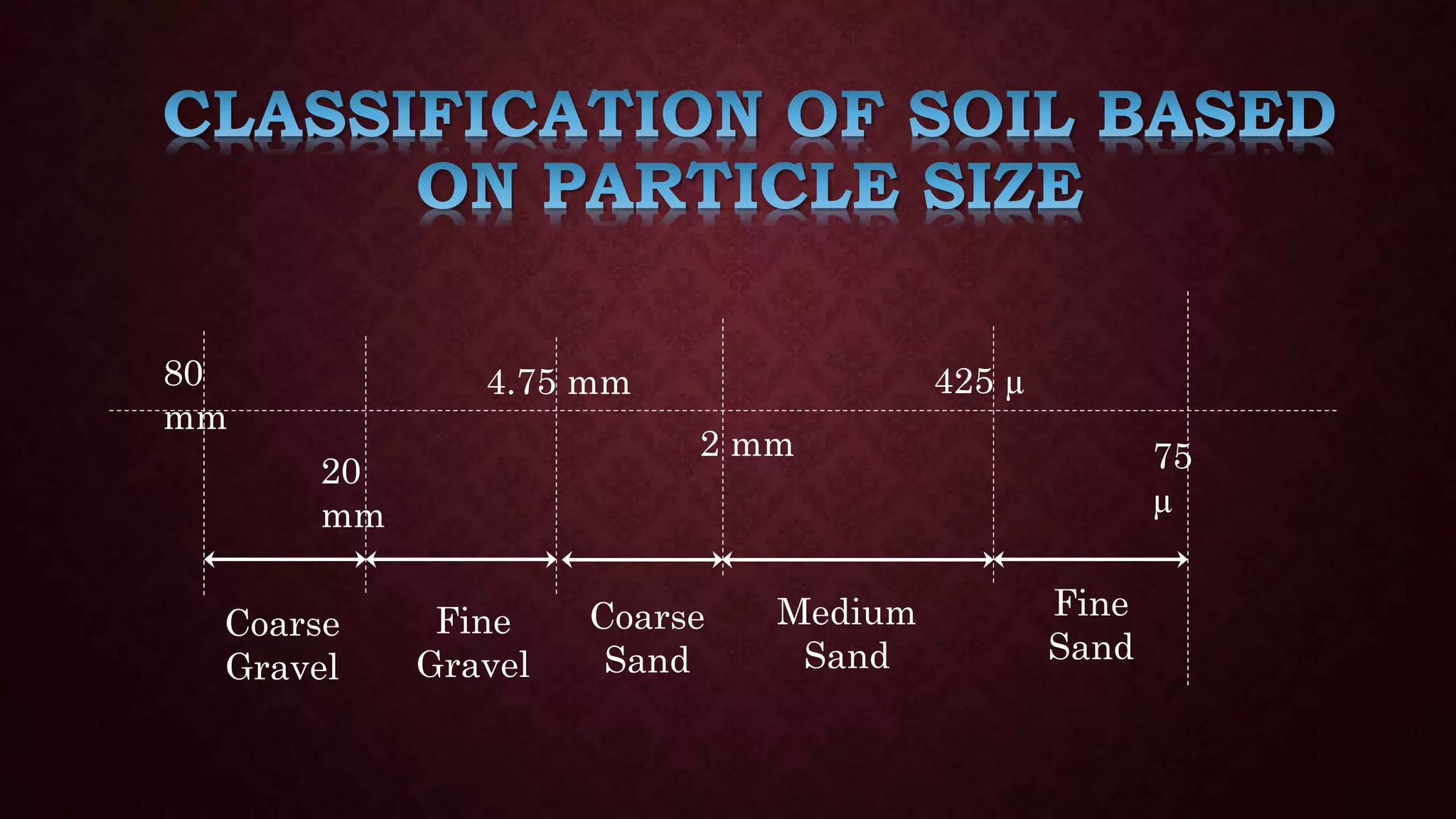
80
mm
75
µ
4.75 mm
Coarse
Gravel
Medium
Sand
20
mm
425 µ
2 mm
Fine
Gravel
Coarse
Sand
Fine
Sand
Particle size distribution will help you to evaluate
1. Type of soil
2. Gradation of soil
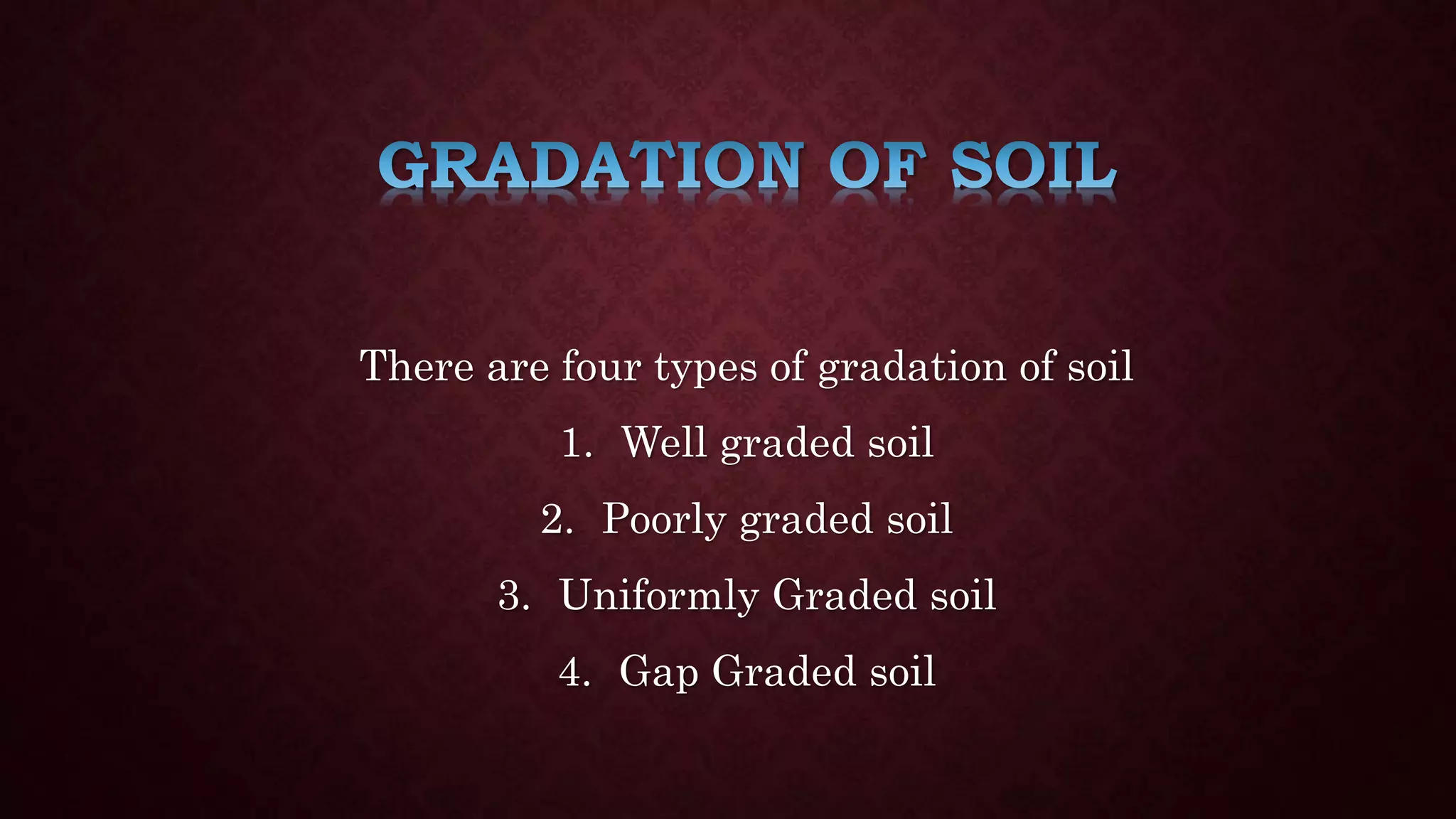
There are four types of gradation of soil
1. Well graded soil
2. Poorly graded soil
3. Uniformly Graded soil
4. Gap Graded soil
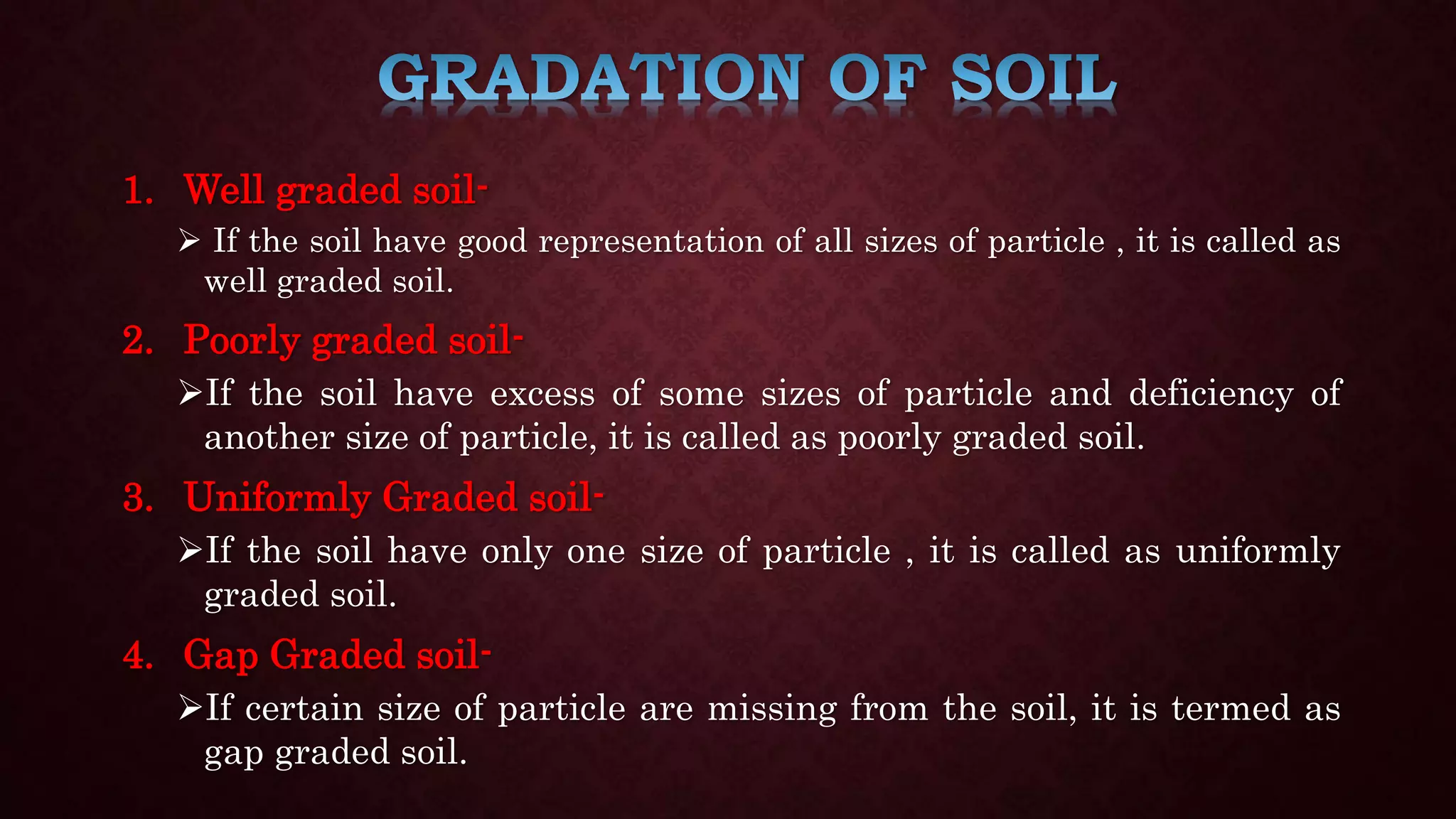
1. Well graded soil-
 If the soil have good representation of all sizes of particle , it is called as
well graded soil.
2. Poorly graded soil-
If the soil have excess of some sizes of particle and deficiency of
another size of particle, it is called as poorly graded soil.
3. Uniformly Graded soil-
If the soil have only one size of particle , it is called as uniformly
graded soil.
4. Gap Graded soil-
If certain size of particle are missing from the soil, it is termed as
gap graded soil.
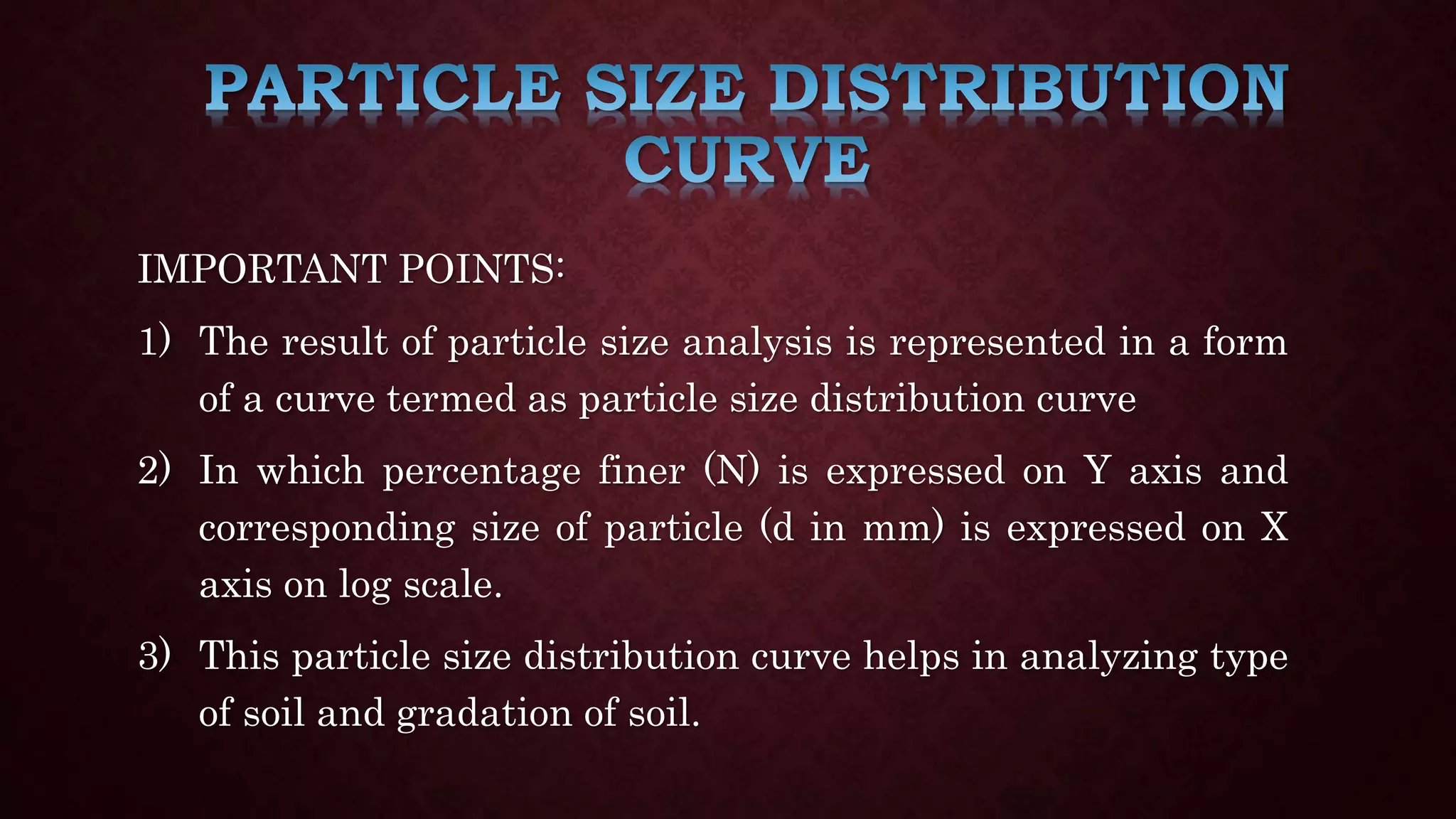
IMPORTANT POINTS:
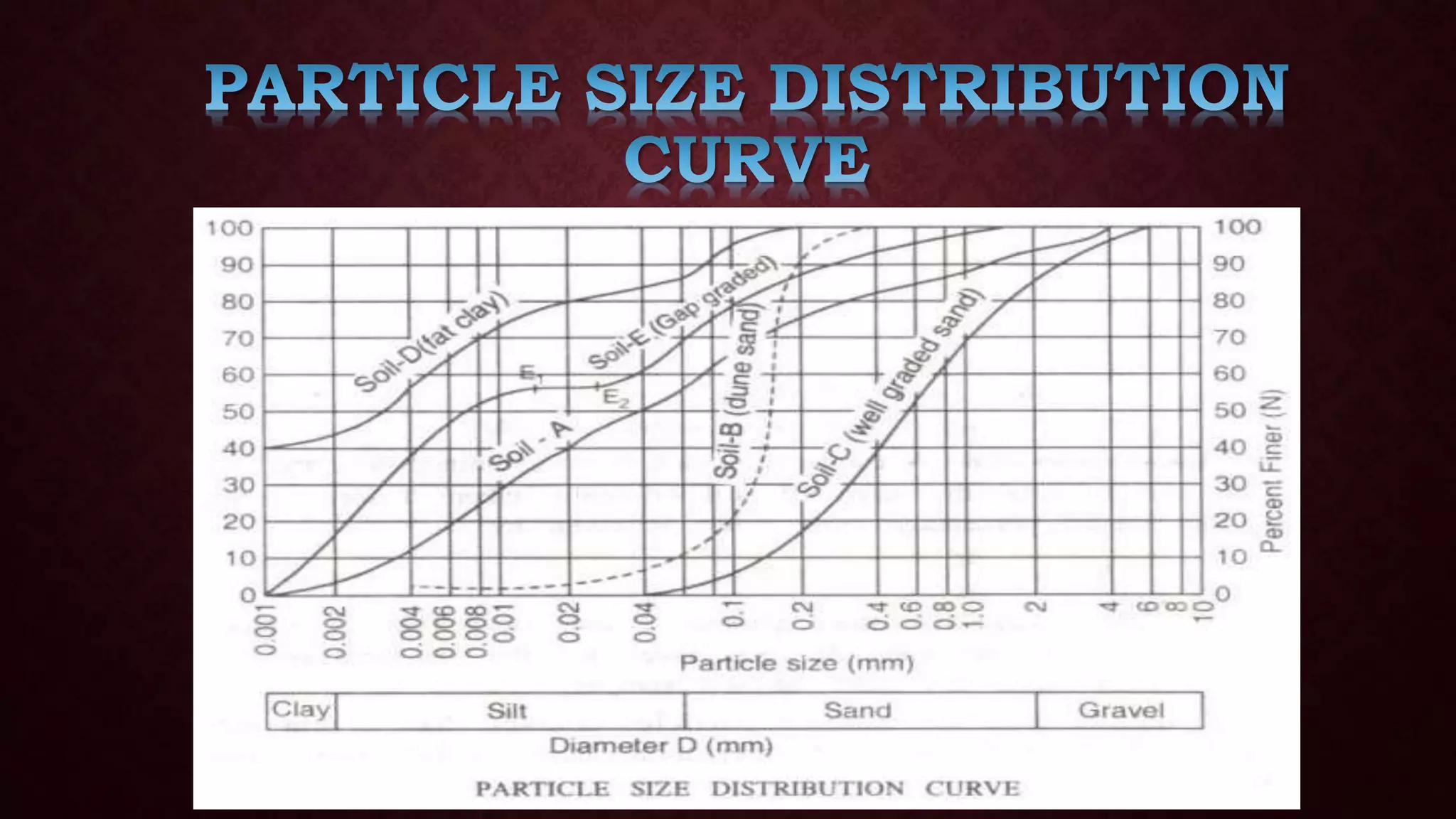
1) The result of particle size analysis is represented in a form
of a curve termed as particle size distribution curve
2) In which percentage finer (N) is expressed on Y axis and
corresponding size of particle (d in mm) is expressed on X
axis on log scale.
3) This particle size distribution curve helps in analyzing type
of soil and gradation of soil.
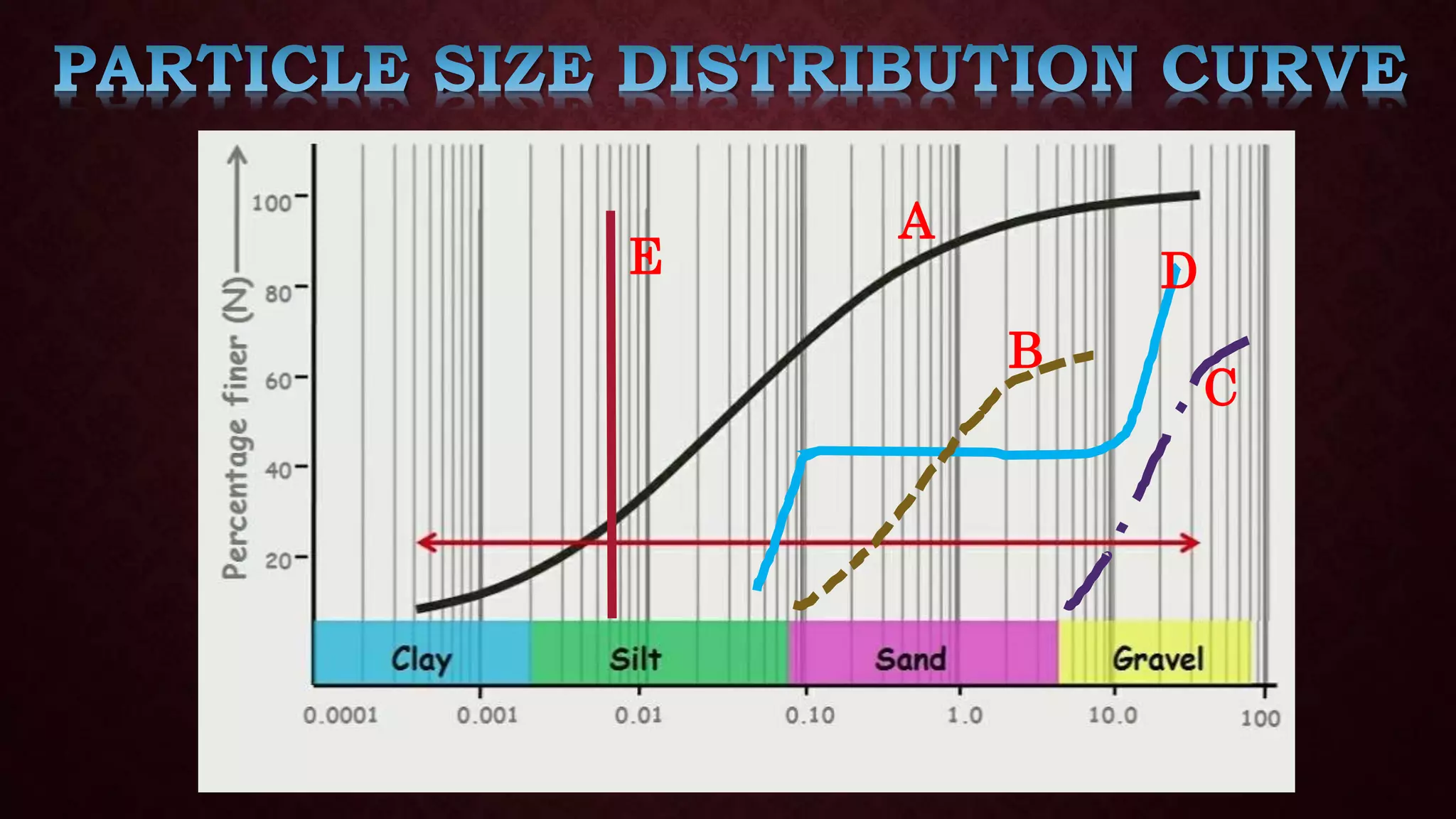
A
D
C
B
E
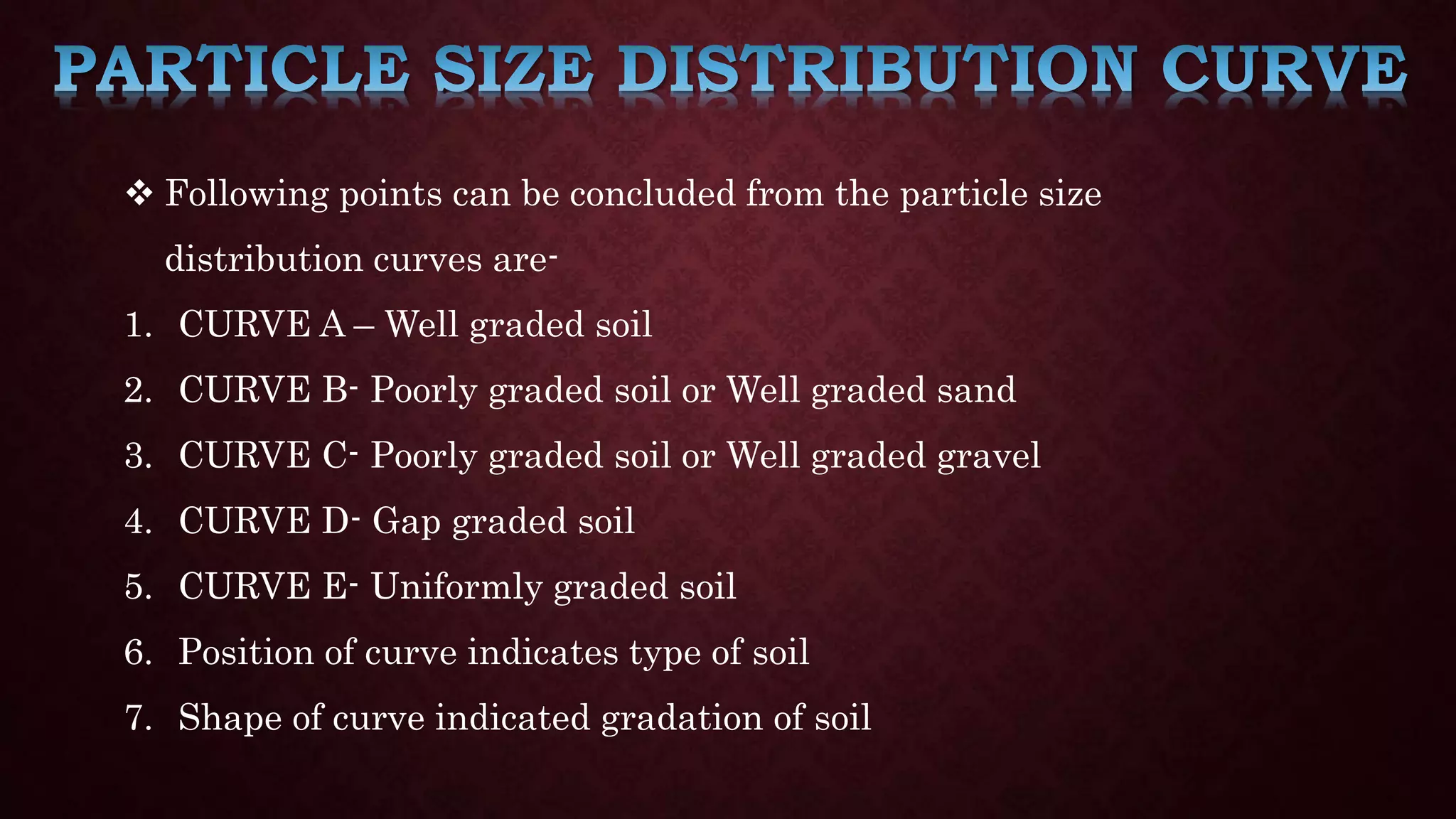
 Following points can be concluded from the particle size
distribution curves are-
1. CURVE A – Well graded soil
2. CURVE B- Poorly graded soil or Well graded sand
3. CURVE C- Poorly graded soil or Well graded gravel
4. CURVE D- Gap graded soil
5. CURVE E- Uniformly graded soil
6. Position of curve indicates type of soil
7. Shape of curve indicated gradation of soil
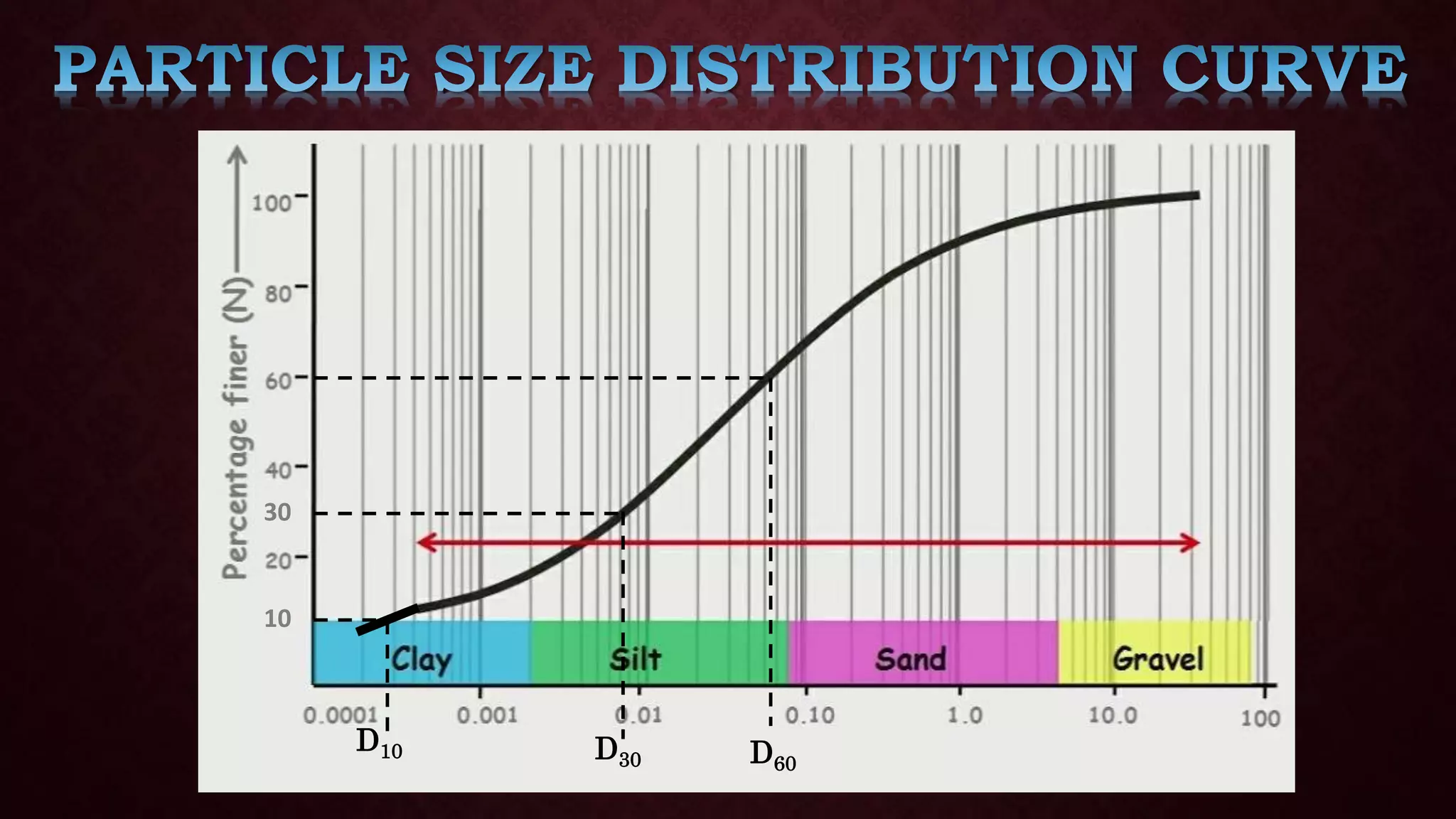
10
30
D10 D30 D60
 IMPORTANT:-
1. For coarse grain soil (sand and gravel only) certain size of particle
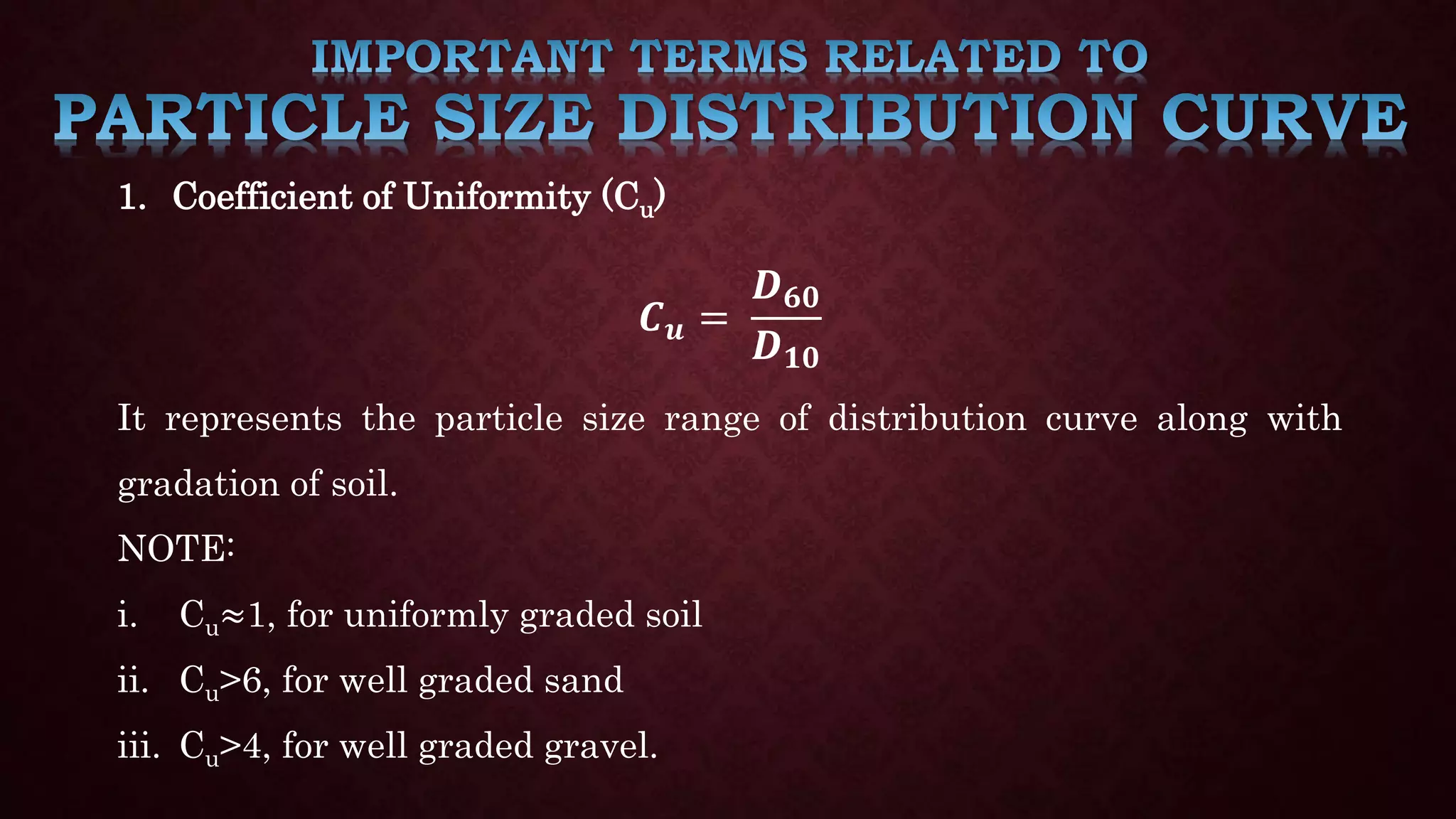
D10, D30, D60 have higher significance than other size of particle.
2. As they helps in representing the characteristics of particle size
distribution curve in terms of a parameters known as shape factors.
3. D10 is called effective size of particle
4. D10 means size of sieve in mm from which 10% are finer or 10% of
particles are finer than D mm sieve size.
1. Coefficient of Uniformity (Cu)
𝑪𝒖 =
𝑫𝟔𝟎
𝑫𝟏𝟎
It represents the particle size range of distribution curve along with
gradation of soil.
NOTE:
i. Cu≈1, for uniformly graded soil
ii. Cu>6, for well graded sand
iii. Cu>4, for well graded gravel.
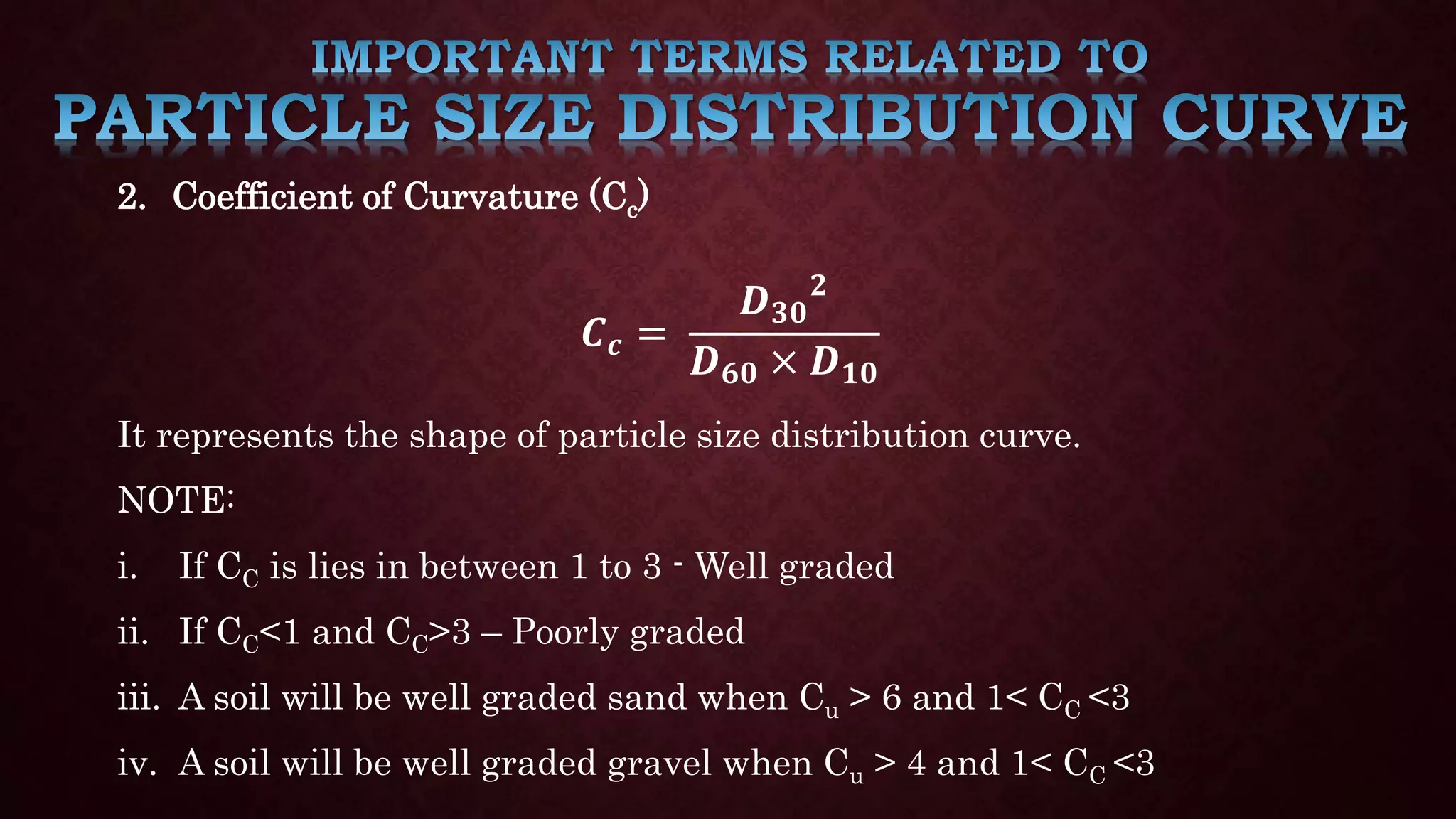
2. Coefficient of Curvature (Cc)
𝑪𝒄 =
𝑫𝟑𝟎
𝟐
𝑫𝟔𝟎 × 𝑫𝟏𝟎
It represents the shape of particle size distribution curve.
NOTE:
i. If CC is lies in between 1 to 3 - Well graded
ii. If CC<1 and CC>3 – Poorly graded
iii. A soil will be well graded sand when Cu > 6 and 1< CC <3
iv. A soil will be well graded gravel when Cu > 4 and 1< CC <3
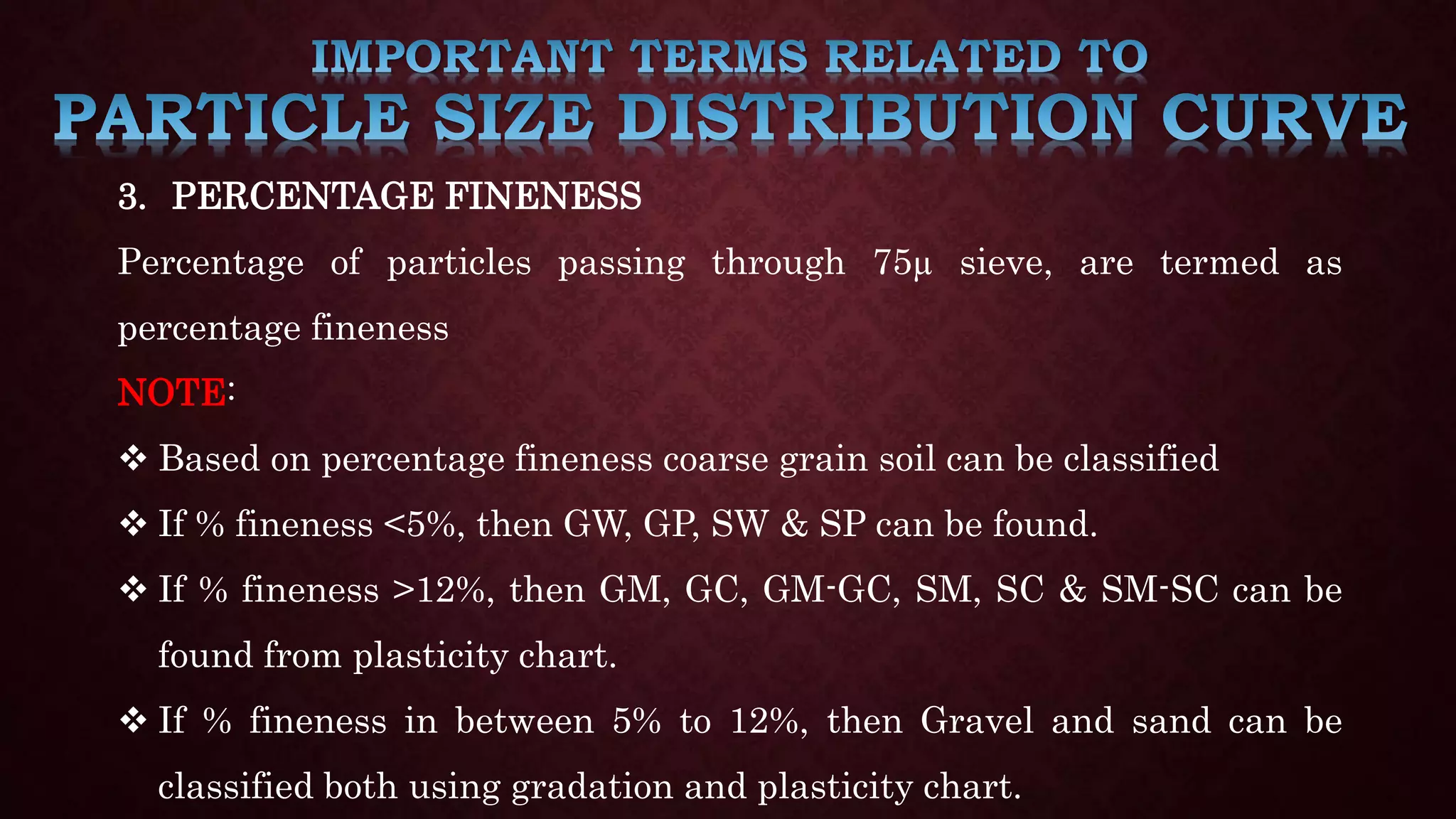
3. PERCENTAGE FINENESS
Percentage of particles passing through 75µ sieve, are termed as
percentage fineness
NOTE:
 Based on percentage fineness coarse grain soil can be classified
 If % fineness <5%, then GW, GP, SW & SP can be found.
 If % fineness >12%, then GM, GC, GM-GC, SM, SC & SM-SC can be
found from plasticity chart.
 If % fineness in between 5% to 12%, then Gravel and sand can be
classified both using gradation and plasticity chart.
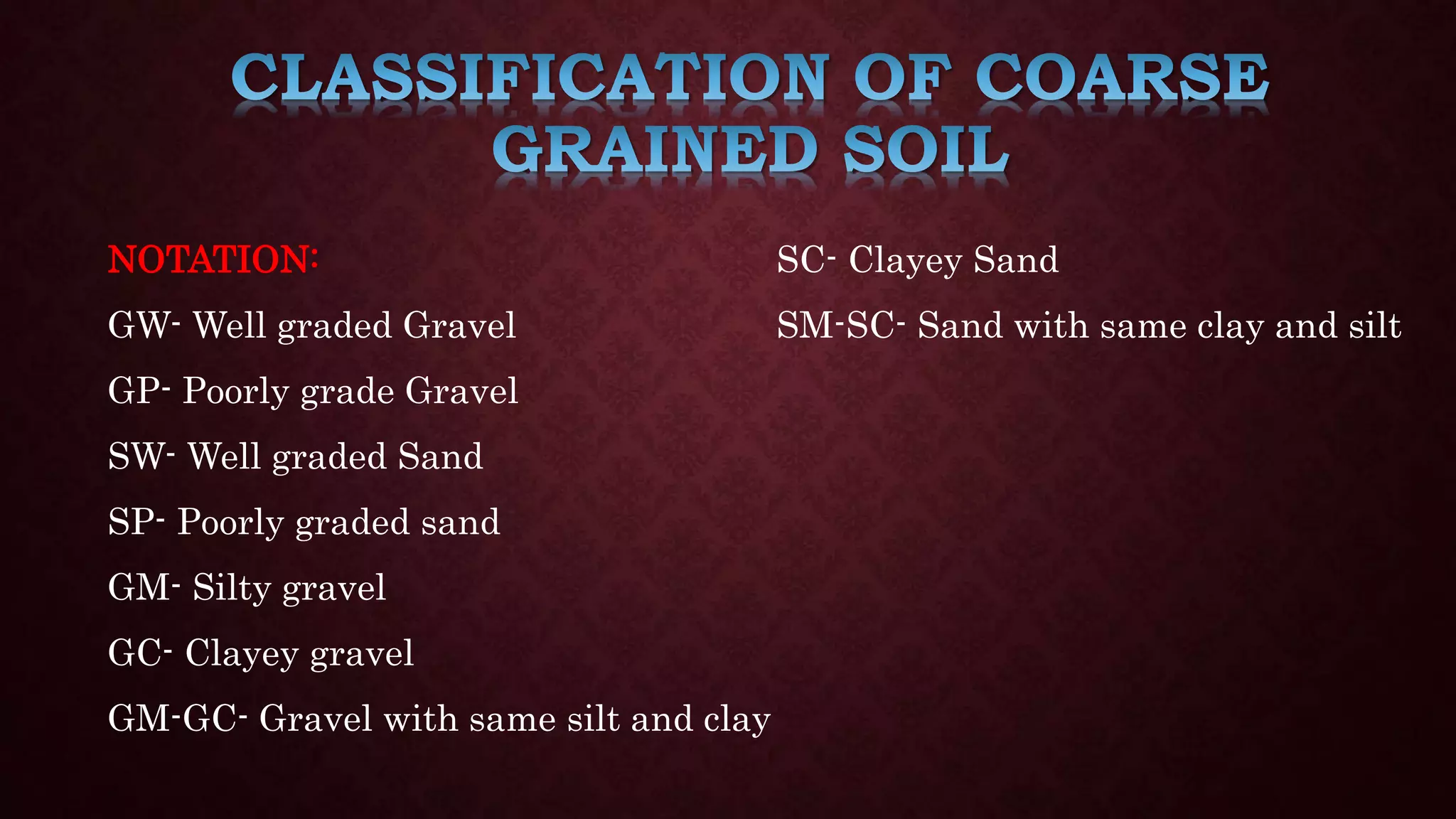
NOTATION:
GW- Well graded Gravel
GP- Poorly grade Gravel
SW- Well graded Sand
SP- Poorly graded sand
GM- Silty gravel
GC- Clayey gravel
GM-GC- Gravel with same silt and clay
SC- Clayey Sand
SM-SC- Sand with same clay and silt
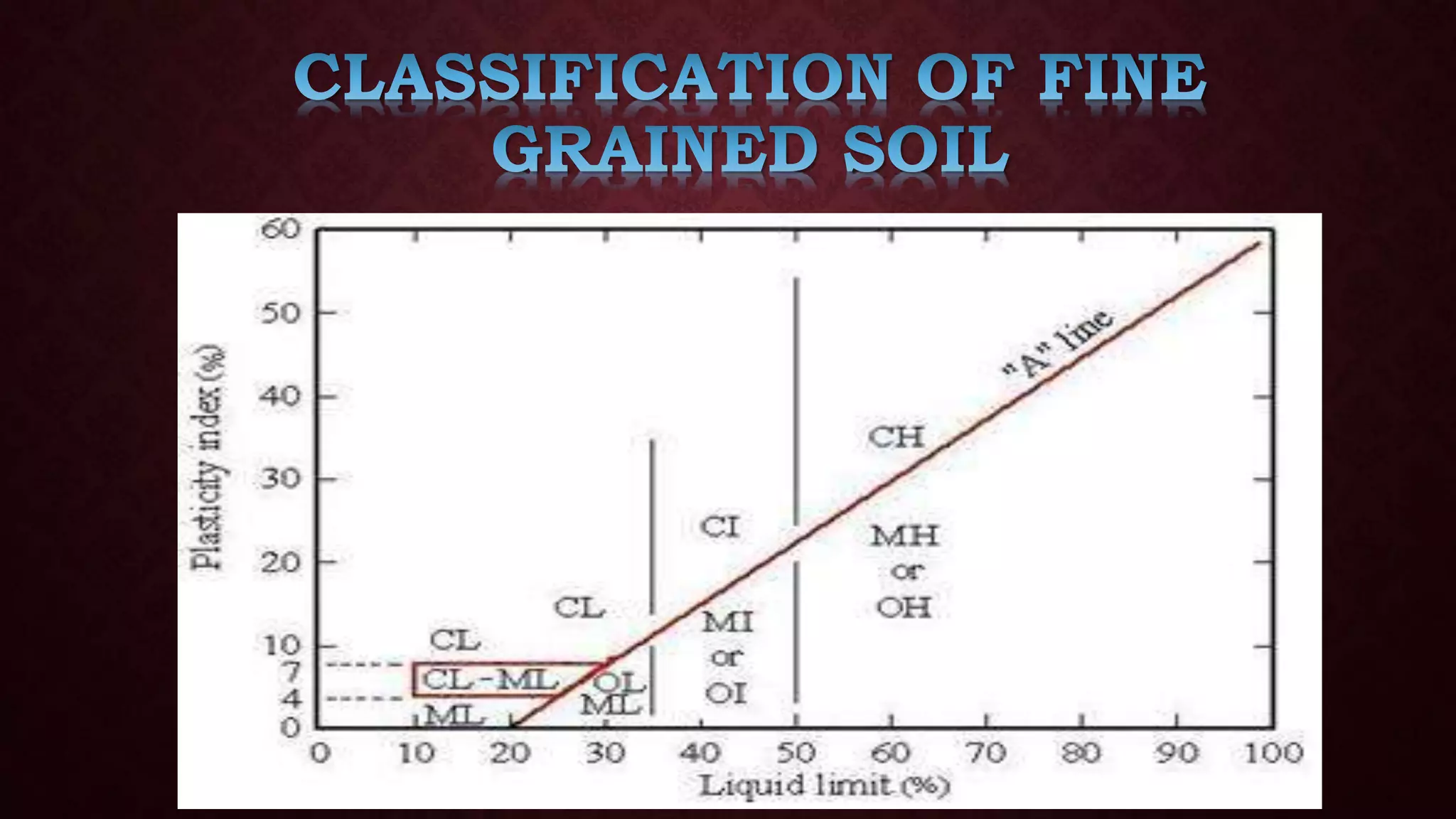
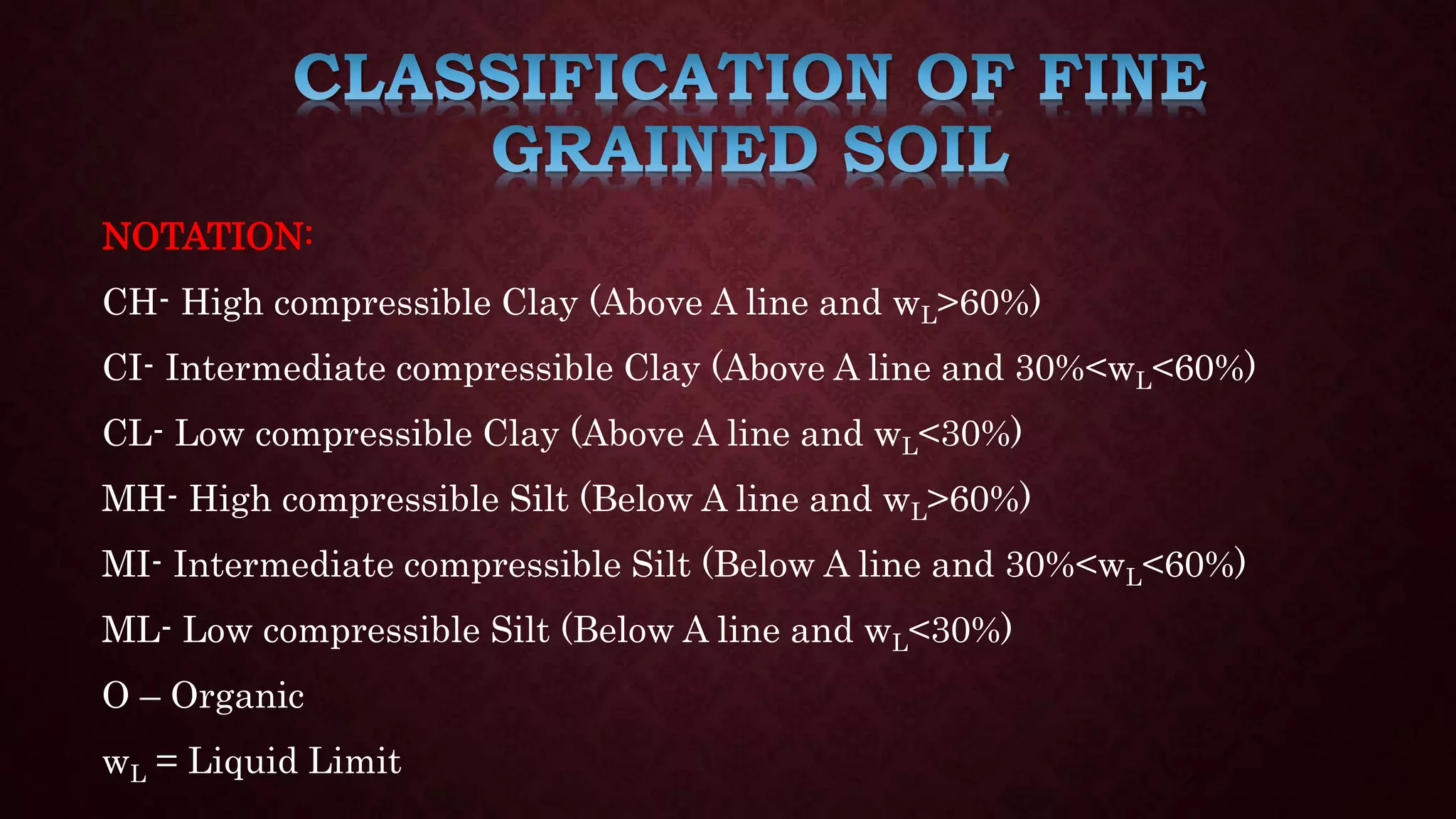
NOTATION:
CH- High compressible Clay (Above A line and wL>60%)
CI- Intermediate compressible Clay (Above A line and 30%<wL<60%)
CL- Low compressible Clay (Above A line and wL<30%)
MH- High compressible Silt (Below A line and wL>60%)
MI- Intermediate compressible Silt (Below A line and 30%<wL<60%)
ML- Low compressible Silt (Below A line and wL<30%)
O – Organic
wL = Liquid Limit
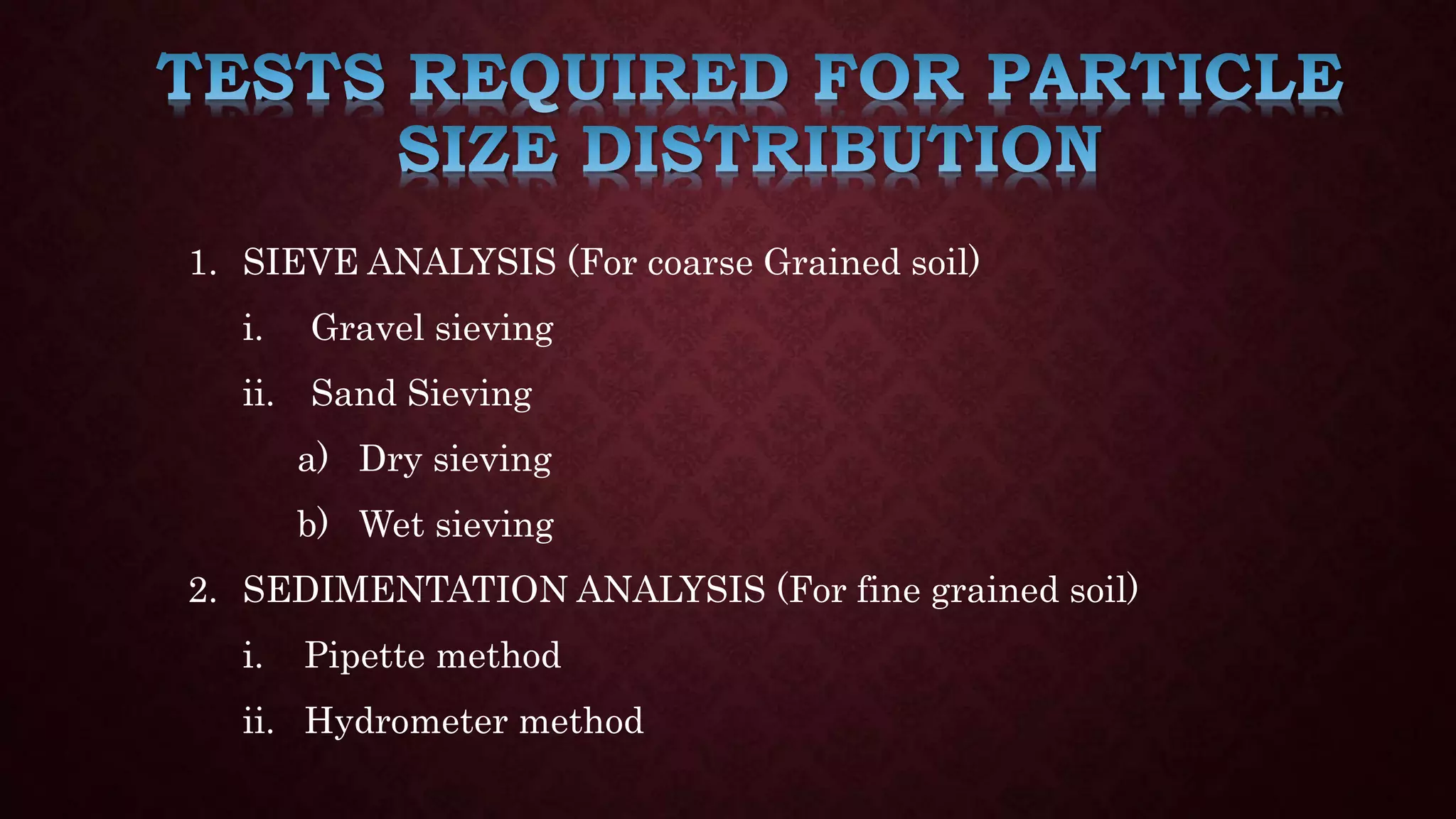
1. SIEVE ANALYSIS (For coarse Grained soil)
i. Gravel sieving
ii. Sand Sieving
a) Dry sieving
b) Wet sieving
2. SEDIMENTATION ANALYSIS (For fine grained soil)
i. Pipette method
ii. Hydrometer method
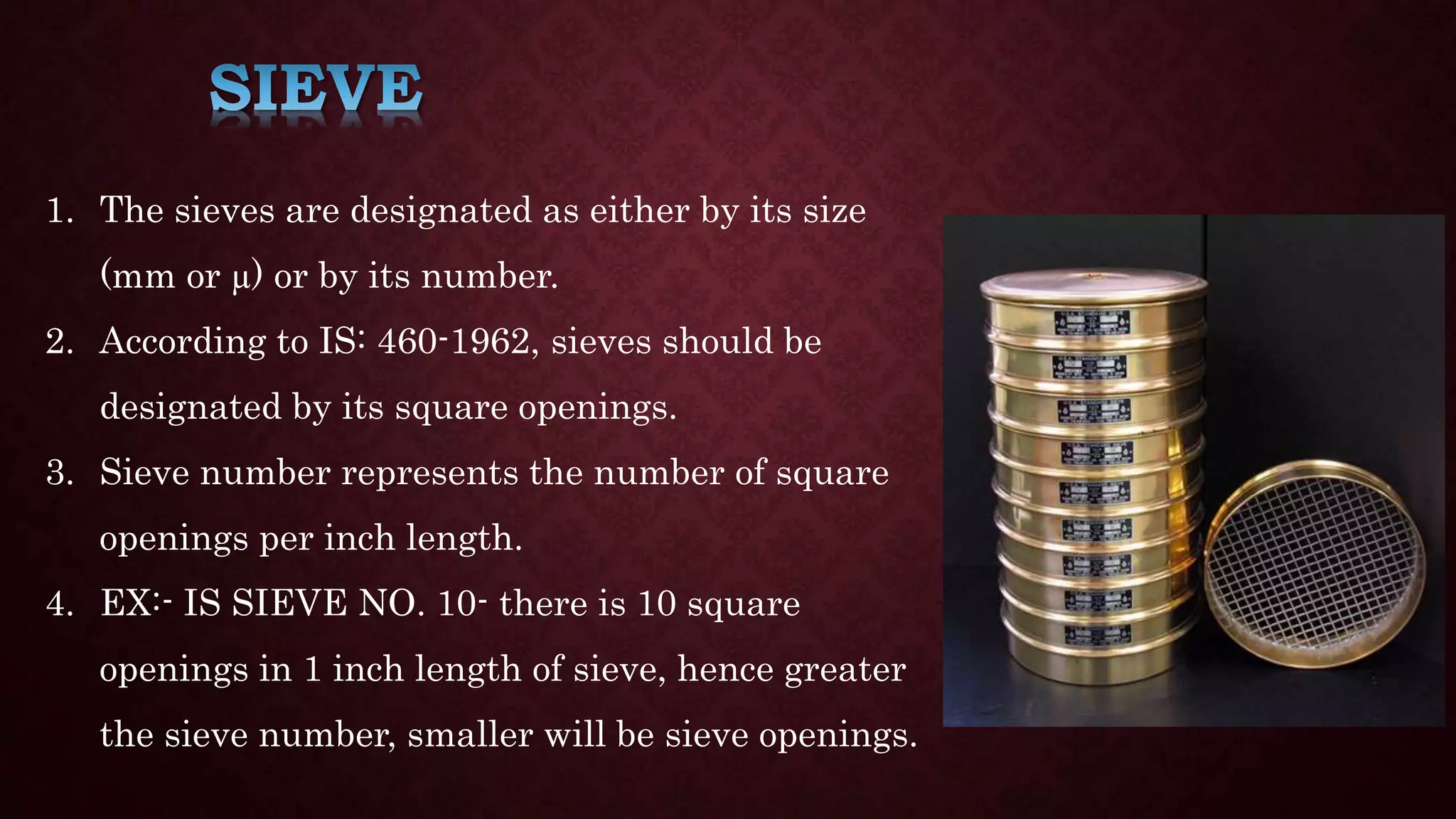
1. The sieves are designated as either by its size
(mm or µ) or by its number.
2. According to IS: 460-1962, sieves should be
designated by its square openings.
3. Sieve number represents the number of square
openings per inch length.
4. EX:- IS SIEVE NO. 10- there is 10 square
openings in 1 inch length of sieve, hence greater
the sieve number, smaller will be sieve openings.
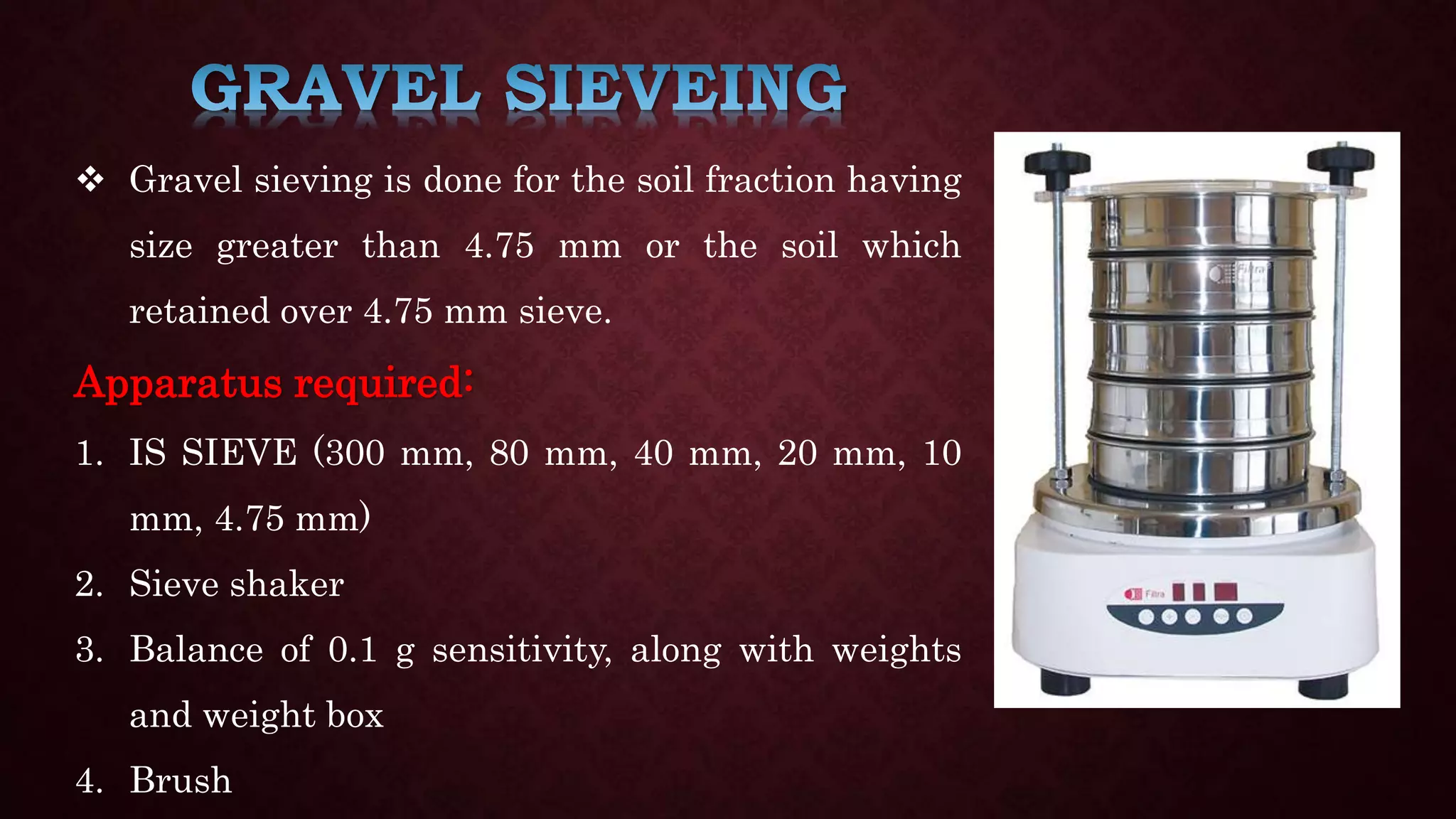
 Gravel sieving is done for the soil fraction having
size greater than 4.75 mm or the soil which
retained over 4.75 mm sieve.
Apparatus required:
1. IS SIEVE (300 mm, 80 mm, 40 mm, 20 mm, 10
mm, 4.75 mm)
2. Sieve shaker
3. Balance of 0.1 g sensitivity, along with weights
and weight box
4. Brush
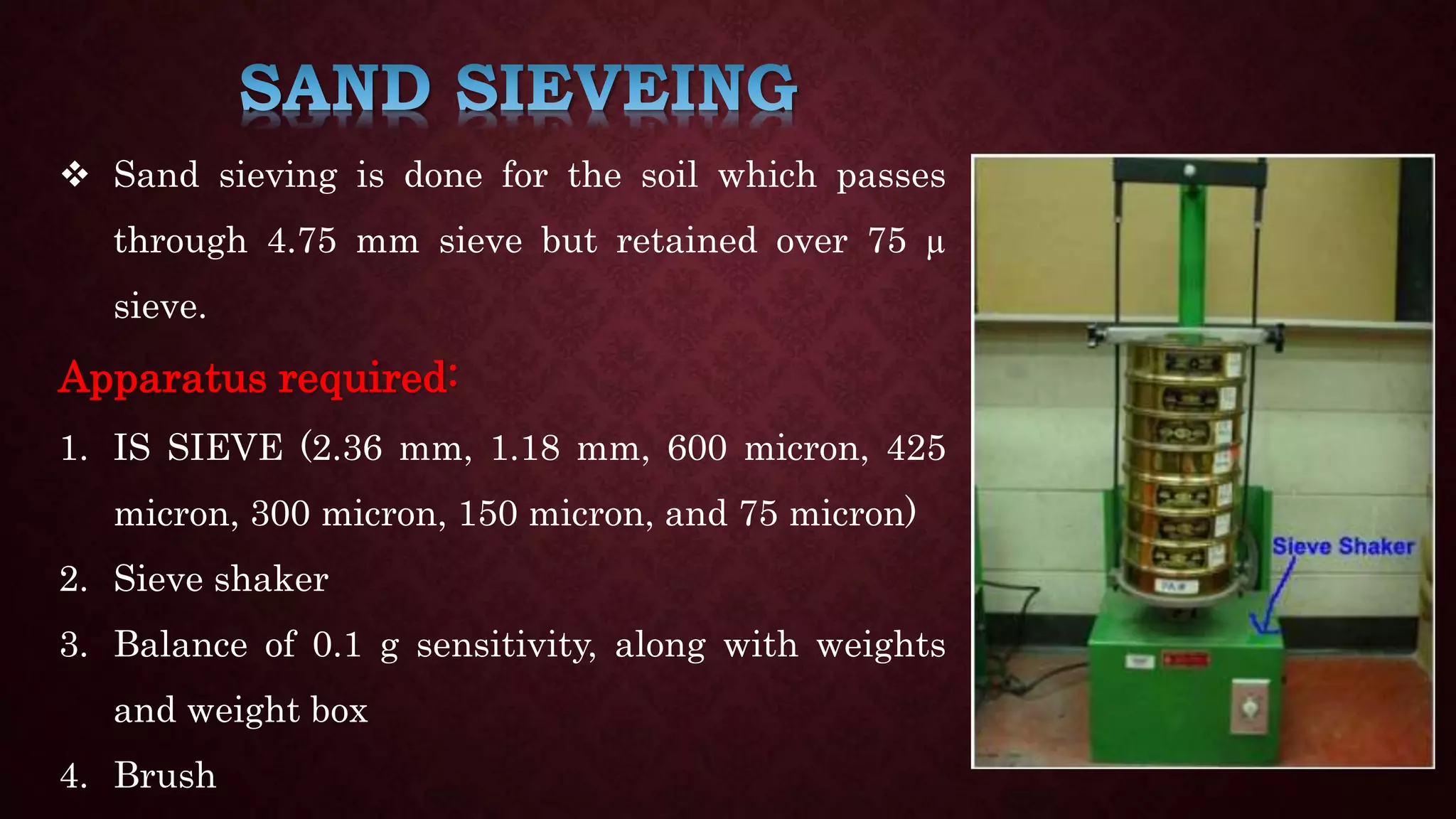
 Sand sieving is done for the soil which passes
through 4.75 mm sieve but retained over 75 µ
sieve.
Apparatus required:
1. IS SIEVE (2.36 mm, 1.18 mm, 600 micron, 425
micron, 300 micron, 150 micron, and 75 micron)
2. Sieve shaker
3. Balance of 0.1 g sensitivity, along with weights
and weight box
4. Brush
PROCEDURE:
1. Weight accurately about 200gms of oven dried soil sample.
i. If the soil has a large fraction greater than 4.75mm size, then greater
quantity of soil, that is, about 5.0 Kg should be taken.
ii. For soil containing some particle greater than 4.75 mm size, the weight
of the soil sample should be taken as 0.5 Kg to 1.0 Kg.
2. Clean the sieves and pan with brush and weigh them up to 0.1 gm accuracy
M1.
3. Arrange the first set sieves of size 300 mm, 80mm, 40mm, 20mm, 10mm,
4.75 mm and the second set sieves of sizes 2.36 mm, 1.18 mm, 600 micron,
425 micron, 150 micron, 75 micron and pan in a order from top to bottom.
PROCEDURE:
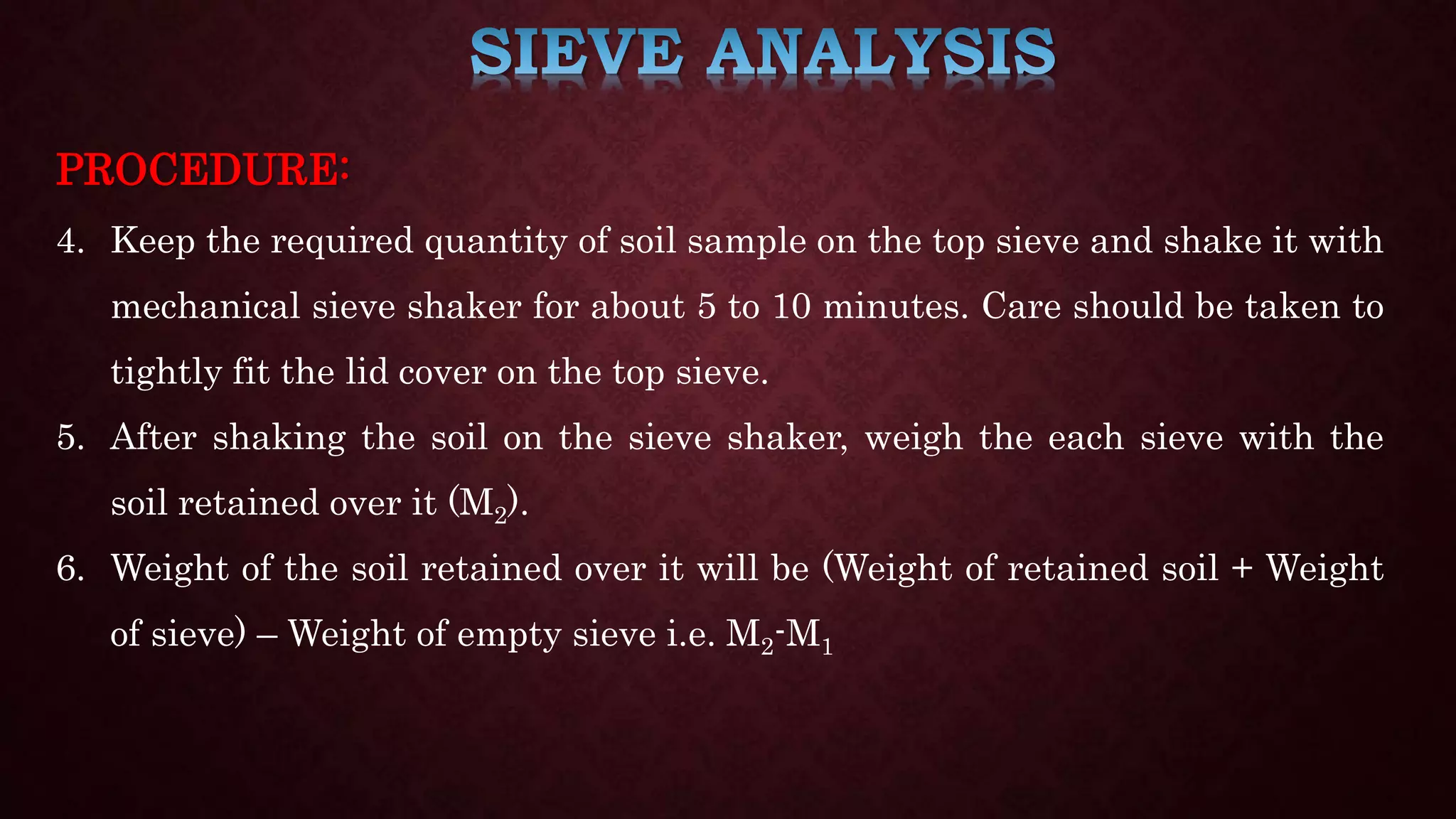
4. Keep the required quantity of soil sample on the top sieve and shake it with
mechanical sieve shaker for about 5 to 10 minutes. Care should be taken to
tightly fit the lid cover on the top sieve.
5. After shaking the soil on the sieve shaker, weigh the each sieve with the
soil retained over it (M2).
6. Weight of the soil retained over it will be (Weight of retained soil + Weight
of sieve) – Weight of empty sieve i.e. M2-M1
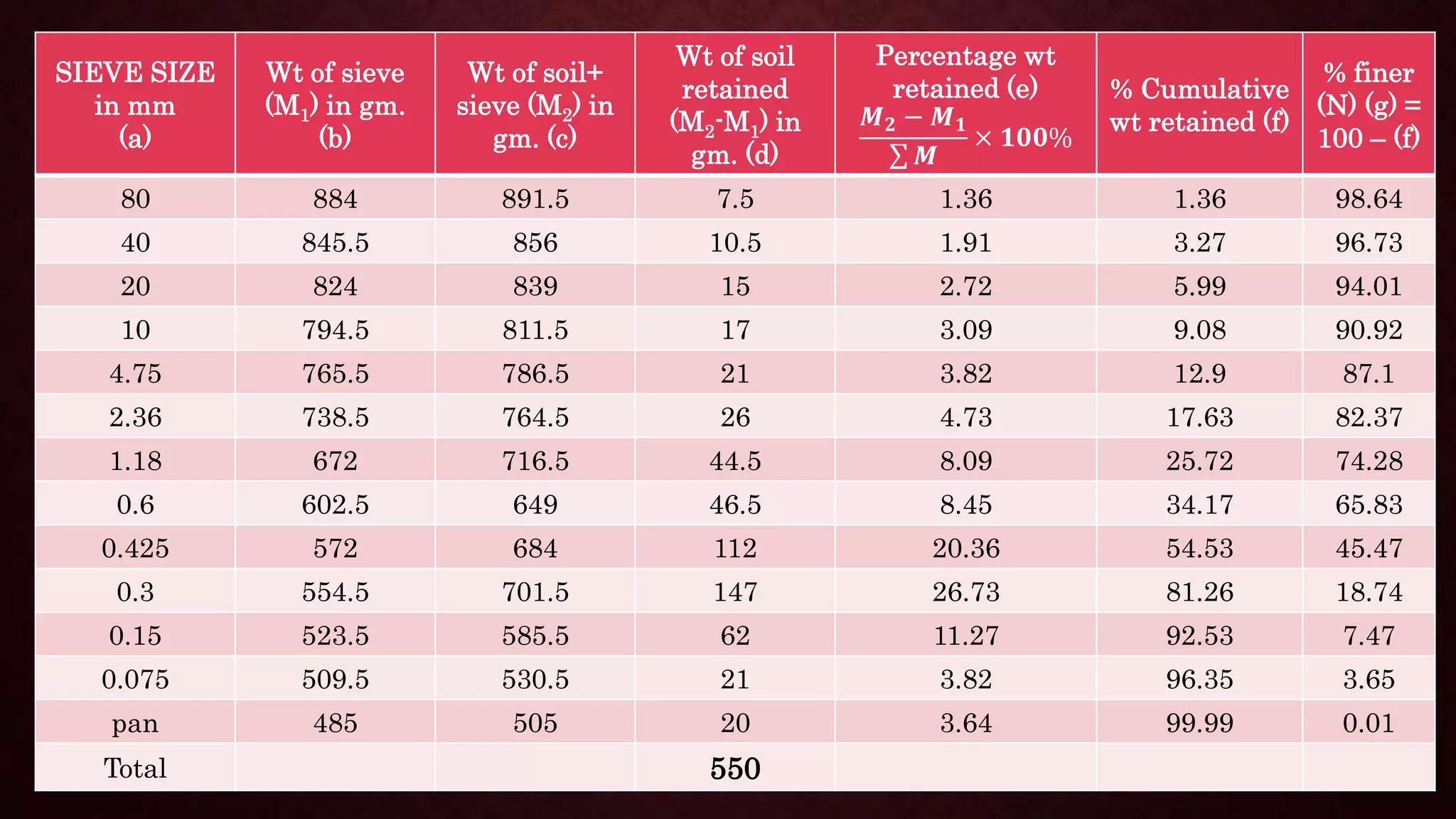
SIEVE SIZE
in mm
(a)
Wt of sieve
(M1) in gm.
(b)
Wt of soil+
sieve (M2) in
gm. (c)
Wt of soil
retained
(M2-M1) in
gm. (d)
Percentage wt
retained (e)
𝑴𝟐 − 𝑴𝟏
𝑴
× 𝟏𝟎𝟎%
% Cumulative
wt retained (f)
% finer
(N) (g) =
100 – (f)
80 884 891.5 7.5 1.36 1.36 98.64
40 845.5 856 10.5 1.91 3.27 96.73
20 824 839 15 2.72 5.99 94.01
10 794.5 811.5 17 3.09 9.08 90.92
4.75 765.5 786.5 21 3.82 12.9 87.1
2.36 738.5 764.5 26 4.73 17.63 82.37
1.18 672 716.5 44.5 8.09 25.72 74.28
0.6 602.5 649 46.5 8.45 34.17 65.83
0.425 572 684 112 20.36 54.53 45.47
0.3 554.5 701.5 147 26.73 81.26 18.74
0.15 523.5 585.5 62 11.27 92.53 7.47
0.075 509.5 530.5 21 3.82 96.35 3.65
pan 485 505 20 3.64 99.99 0.01
Total 550
 Dry sieve is performed for cohesion less soils if
percentage fineness are less than 5%.
 Wet sieve analysis is carried out if percentage fineness
are more than 5% and of cohesive nature.
 If silt and clay is present in the sand then wet sieving is
adopted in which sand are washed so that fine particles
are removed.
 In wet sieving for washing of silt and clay 2 gm sodium
hexa-metaphosphate is used in 1 liter of pure water.
 Sodium hexa-metaphosphate work as deflocculating
agent.
 Procedure is same as coarse sieving.
 During shaking the lid on the topmost sieve should be
kept tight to prevent escape of soils.
 While drying the soil, the temperature of the oven should
not be more than 105° C because higher temperature
may cause some permanent change in the 75 fraction.
Determination grain size distribution of soil

Determination grain size distribution of soil

  • 1.
    DETERMINATION OF GRAIN SIZEDISTRIBUTION EXPERIMENT NO 5 SOIL MECHANICS LABORATORY CE PC 594
  • 2.
     Particle sizemeans diameter of particle (d) Soil may consists of clay, silt, sand, gravel, cobble and boulder Particle size above than 75µ will be coarse grained soil and particle size below 75µ will be fine grained soil
  • 3.
    300 mm 80 mm 75 µ 4.75 mm2 µ Boulder Cobble Gravel Sand Silt Clay Fine Grained Soil Coarse Grained Soil Note:- µ =
  • 4.
  • 5.
    Particle size distributionwill help you to evaluate 1. Type of soil 2. Gradation of soil
  • 6.
    There are fourtypes of gradation of soil 1. Well graded soil 2. Poorly graded soil 3. Uniformly Graded soil 4. Gap Graded soil
  • 7.
    1. Well gradedsoil-  If the soil have good representation of all sizes of particle , it is called as well graded soil. 2. Poorly graded soil- If the soil have excess of some sizes of particle and deficiency of another size of particle, it is called as poorly graded soil. 3. Uniformly Graded soil- If the soil have only one size of particle , it is called as uniformly graded soil. 4. Gap Graded soil- If certain size of particle are missing from the soil, it is termed as gap graded soil.
  • 8.
    IMPORTANT POINTS: 1) Theresult of particle size analysis is represented in a form of a curve termed as particle size distribution curve 2) In which percentage finer (N) is expressed on Y axis and corresponding size of particle (d in mm) is expressed on X axis on log scale. 3) This particle size distribution curve helps in analyzing type of soil and gradation of soil.
  • 10.
  • 11.
     Following pointscan be concluded from the particle size distribution curves are- 1. CURVE A – Well graded soil 2. CURVE B- Poorly graded soil or Well graded sand 3. CURVE C- Poorly graded soil or Well graded gravel 4. CURVE D- Gap graded soil 5. CURVE E- Uniformly graded soil 6. Position of curve indicates type of soil 7. Shape of curve indicated gradation of soil
  • 12.
  • 13.
     IMPORTANT:- 1. Forcoarse grain soil (sand and gravel only) certain size of particle D10, D30, D60 have higher significance than other size of particle. 2. As they helps in representing the characteristics of particle size distribution curve in terms of a parameters known as shape factors. 3. D10 is called effective size of particle 4. D10 means size of sieve in mm from which 10% are finer or 10% of particles are finer than D mm sieve size.
  • 14.
    1. Coefficient ofUniformity (Cu) 𝑪𝒖 = 𝑫𝟔𝟎 𝑫𝟏𝟎 It represents the particle size range of distribution curve along with gradation of soil. NOTE: i. Cu≈1, for uniformly graded soil ii. Cu>6, for well graded sand iii. Cu>4, for well graded gravel.
  • 15.
    2. Coefficient ofCurvature (Cc) 𝑪𝒄 = 𝑫𝟑𝟎 𝟐 𝑫𝟔𝟎 × 𝑫𝟏𝟎 It represents the shape of particle size distribution curve. NOTE: i. If CC is lies in between 1 to 3 - Well graded ii. If CC<1 and CC>3 – Poorly graded iii. A soil will be well graded sand when Cu > 6 and 1< CC <3 iv. A soil will be well graded gravel when Cu > 4 and 1< CC <3
  • 16.
    3. PERCENTAGE FINENESS Percentageof particles passing through 75µ sieve, are termed as percentage fineness NOTE:  Based on percentage fineness coarse grain soil can be classified  If % fineness <5%, then GW, GP, SW & SP can be found.  If % fineness >12%, then GM, GC, GM-GC, SM, SC & SM-SC can be found from plasticity chart.  If % fineness in between 5% to 12%, then Gravel and sand can be classified both using gradation and plasticity chart.
  • 17.
    NOTATION: GW- Well gradedGravel GP- Poorly grade Gravel SW- Well graded Sand SP- Poorly graded sand GM- Silty gravel GC- Clayey gravel GM-GC- Gravel with same silt and clay SC- Clayey Sand SM-SC- Sand with same clay and silt
  • 19.
    NOTATION: CH- High compressibleClay (Above A line and wL>60%) CI- Intermediate compressible Clay (Above A line and 30%<wL<60%) CL- Low compressible Clay (Above A line and wL<30%) MH- High compressible Silt (Below A line and wL>60%) MI- Intermediate compressible Silt (Below A line and 30%<wL<60%) ML- Low compressible Silt (Below A line and wL<30%) O – Organic wL = Liquid Limit
  • 20.
    1. SIEVE ANALYSIS(For coarse Grained soil) i. Gravel sieving ii. Sand Sieving a) Dry sieving b) Wet sieving 2. SEDIMENTATION ANALYSIS (For fine grained soil) i. Pipette method ii. Hydrometer method
  • 21.
    1. The sievesare designated as either by its size (mm or µ) or by its number. 2. According to IS: 460-1962, sieves should be designated by its square openings. 3. Sieve number represents the number of square openings per inch length. 4. EX:- IS SIEVE NO. 10- there is 10 square openings in 1 inch length of sieve, hence greater the sieve number, smaller will be sieve openings.
  • 22.
     Gravel sievingis done for the soil fraction having size greater than 4.75 mm or the soil which retained over 4.75 mm sieve. Apparatus required: 1. IS SIEVE (300 mm, 80 mm, 40 mm, 20 mm, 10 mm, 4.75 mm) 2. Sieve shaker 3. Balance of 0.1 g sensitivity, along with weights and weight box 4. Brush
  • 23.
     Sand sievingis done for the soil which passes through 4.75 mm sieve but retained over 75 µ sieve. Apparatus required: 1. IS SIEVE (2.36 mm, 1.18 mm, 600 micron, 425 micron, 300 micron, 150 micron, and 75 micron) 2. Sieve shaker 3. Balance of 0.1 g sensitivity, along with weights and weight box 4. Brush
  • 24.
    PROCEDURE: 1. Weight accuratelyabout 200gms of oven dried soil sample. i. If the soil has a large fraction greater than 4.75mm size, then greater quantity of soil, that is, about 5.0 Kg should be taken. ii. For soil containing some particle greater than 4.75 mm size, the weight of the soil sample should be taken as 0.5 Kg to 1.0 Kg. 2. Clean the sieves and pan with brush and weigh them up to 0.1 gm accuracy M1. 3. Arrange the first set sieves of size 300 mm, 80mm, 40mm, 20mm, 10mm, 4.75 mm and the second set sieves of sizes 2.36 mm, 1.18 mm, 600 micron, 425 micron, 150 micron, 75 micron and pan in a order from top to bottom.
  • 25.
    PROCEDURE: 4. Keep therequired quantity of soil sample on the top sieve and shake it with mechanical sieve shaker for about 5 to 10 minutes. Care should be taken to tightly fit the lid cover on the top sieve. 5. After shaking the soil on the sieve shaker, weigh the each sieve with the soil retained over it (M2). 6. Weight of the soil retained over it will be (Weight of retained soil + Weight of sieve) – Weight of empty sieve i.e. M2-M1
  • 26.
    SIEVE SIZE in mm (a) Wtof sieve (M1) in gm. (b) Wt of soil+ sieve (M2) in gm. (c) Wt of soil retained (M2-M1) in gm. (d) Percentage wt retained (e) 𝑴𝟐 − 𝑴𝟏 𝑴 × 𝟏𝟎𝟎% % Cumulative wt retained (f) % finer (N) (g) = 100 – (f) 80 884 891.5 7.5 1.36 1.36 98.64 40 845.5 856 10.5 1.91 3.27 96.73 20 824 839 15 2.72 5.99 94.01 10 794.5 811.5 17 3.09 9.08 90.92 4.75 765.5 786.5 21 3.82 12.9 87.1 2.36 738.5 764.5 26 4.73 17.63 82.37 1.18 672 716.5 44.5 8.09 25.72 74.28 0.6 602.5 649 46.5 8.45 34.17 65.83 0.425 572 684 112 20.36 54.53 45.47 0.3 554.5 701.5 147 26.73 81.26 18.74 0.15 523.5 585.5 62 11.27 92.53 7.47 0.075 509.5 530.5 21 3.82 96.35 3.65 pan 485 505 20 3.64 99.99 0.01 Total 550
  • 27.
     Dry sieveis performed for cohesion less soils if percentage fineness are less than 5%.  Wet sieve analysis is carried out if percentage fineness are more than 5% and of cohesive nature.
  • 28.
     If siltand clay is present in the sand then wet sieving is adopted in which sand are washed so that fine particles are removed.  In wet sieving for washing of silt and clay 2 gm sodium hexa-metaphosphate is used in 1 liter of pure water.  Sodium hexa-metaphosphate work as deflocculating agent.  Procedure is same as coarse sieving.
  • 29.
     During shakingthe lid on the topmost sieve should be kept tight to prevent escape of soils.  While drying the soil, the temperature of the oven should not be more than 105° C because higher temperature may cause some permanent change in the 75 fraction.