Evaporation Measurement Instrument
Bhawani Shankar (14EMVCE006)
Gaurav Mewara (14EMVCE014) 1
GENERAL
Evaporation is one of the main components of the water budget. Although some
headway has been made in the estimation ofevaporation, the present state of development is
unsatisfactory. There is a need for more theoretical and experimental studies, especially for
application of the theory of turbulent diffusion to the realities of evaporation from cropped or
forested surfaces. The dependence of evaporation on soil and vegetation factors is
inadequately defined.
The sensitive methods of measurement that have been developed still have
considerable drawbacks. There is the problem that the high accuracy obtained at the
measuring point is lost in the transfer of the measured values to larger regions.
Above all, hydrology requires values of evaporation for whole catchments for use in
water balance models. Hydrological data from remote areas are lacking for establishing
global, continental and regional water balance models.
An evaporation rate meter, or evaporimeter, has been devised that shows promise of
directly measuring the rate of evaporation near the sea surface. The simplicity of the
instrument indicates that it may be of interest to oceanographers, and possibly to
meteorologists and climatologists.
Evaporation Measurement Instrument
Bhawani Shankar (14EMVCE006)
Gaurav Mewara (14EMVCE014) 2
INTRODUCTION
According to von Arx the amount of water distilled into the atmosphere from the sea
has been estimated by measuring the evaporation from pans of water on shipboard, by
meteorological measurements of the upward flux of water vapour in the air above the sea, and
by evaluating the successive terms in the steady-state heat budget for the oceans.
It appears that a simpler and more direct method of evaporation measurement is
desirable. It is believed that the evaporimeter herein described may be a helpful tool in
evaporation studies.
There are many different types of pan and tank evaporimeters in use. As
standardization and proper exposure are two important factors for the application of pan data,
WMO, through its Commission for Instruments and Methods of Observation, set up a
Working Group to examine evaporation measurement.
The Group concludes that pans are useful devices provided that the various
observations can be reduced to a standard datum (CIMO-V/Doc. 60,27. VII. 1969; Hounam,
1970). Pan evaporation values can be used for estimating the evaporation from a free water
surface, both for existing and planned storages. The value of pan network observations is
increased if they are supplemented by standard climatological observations.
Pan data corrected for vapour pressure gradients over the pan and the lake can provide
useful information for lake evaporation estimation (Subbotin, 1964; Webb, 1966). Pan
evaporimeters can serve as the basis for estimat- ing evapo-transpiration only for field
capacity conditions; they are useless for drying soil conditions.
Evaporation Measurement Instrument
Bhawani Shankar (14EMVCE006)
Gaurav Mewara (14EMVCE014) 3
What is Evaporation and How it Occurs?
Before rainfall reaches the outlet of a basin as runoff, certain demands of the
catchment such as interception, depression storage and infiltration have to be met. Besides
these, evaporation and transpiration processes transfer water to the atmosphere as water
vapour.
Evaporation from water bodies and the soil mass together with transpiration from
vegetation is called evapotranspiration (ET). That portion of Precipitation which is not
available as surface runoff is termed as “loss”.
Evaporation is a cooling process- the latent heat of vaporization (~585 cal/g of
evaporated water) must be provided by the water body.
Rate of evaporation depends on
- Vapour pressures at the water surface and the air above
- Wind speed – Incident solar radiation
- Atmospheric pressure – Quality of water
- Air and water temperatures
- Size of the water body
Evaporation Measurement Instrument
Bhawani Shankar (14EMVCE006)
Gaurav Mewara (14EMVCE014) 4
EVAPORATION PAN
Description
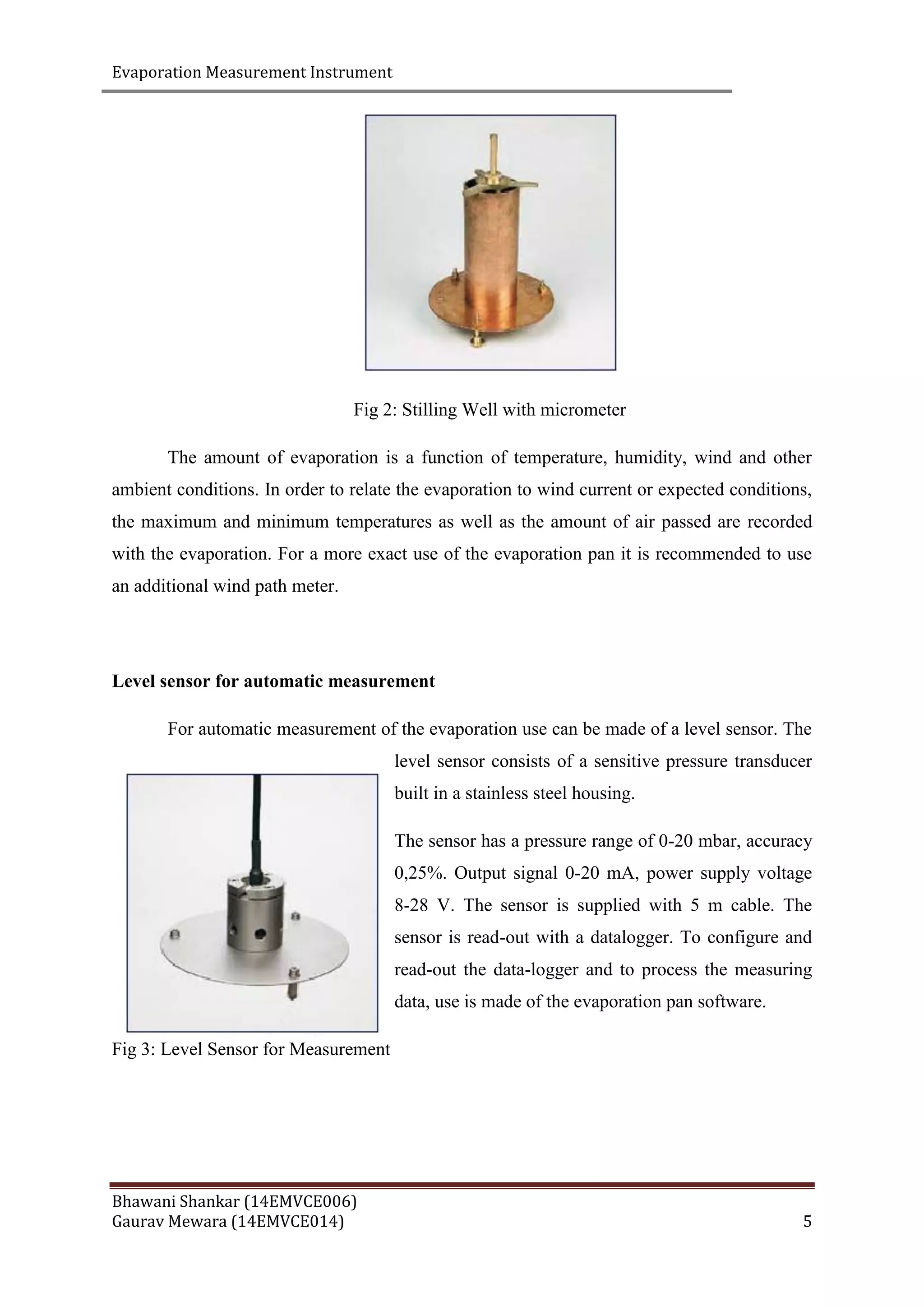
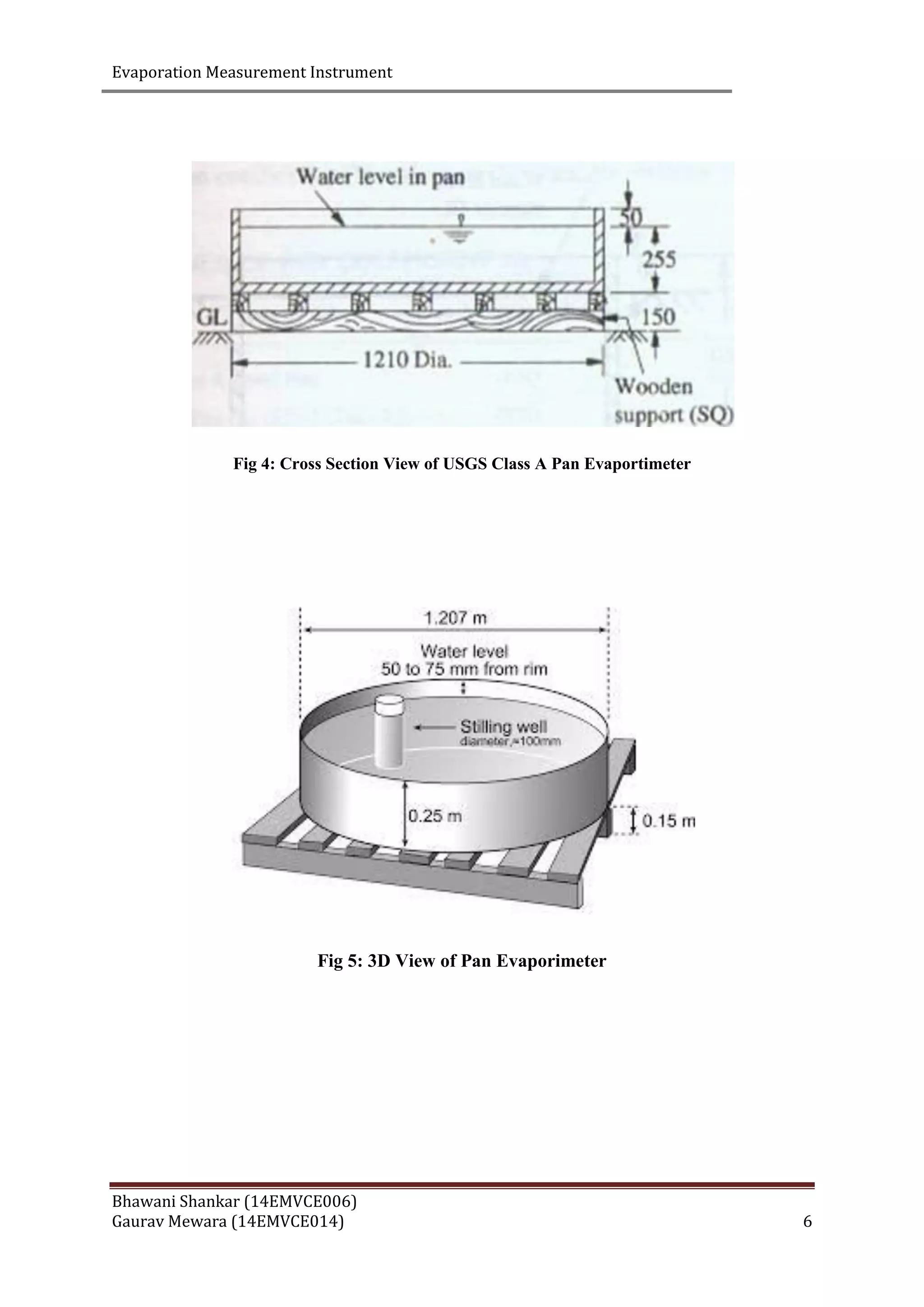
The evaporation pan of this standard set is made of stainless steel and has the
dimensions of a “class A“ evaporation pan, namely 54 mm ( 0 inches) in height and 206 mm
(47.5 inches) in diameter. The evaporation pan is installed on the wooden support, which is
set and levelled on the ground in a grassy location, away from bushes, trees and other
obstacles which obstruct a natural air flow around the pan, thus representing open water in an
open area.
Fig 1: Evaporation Pan
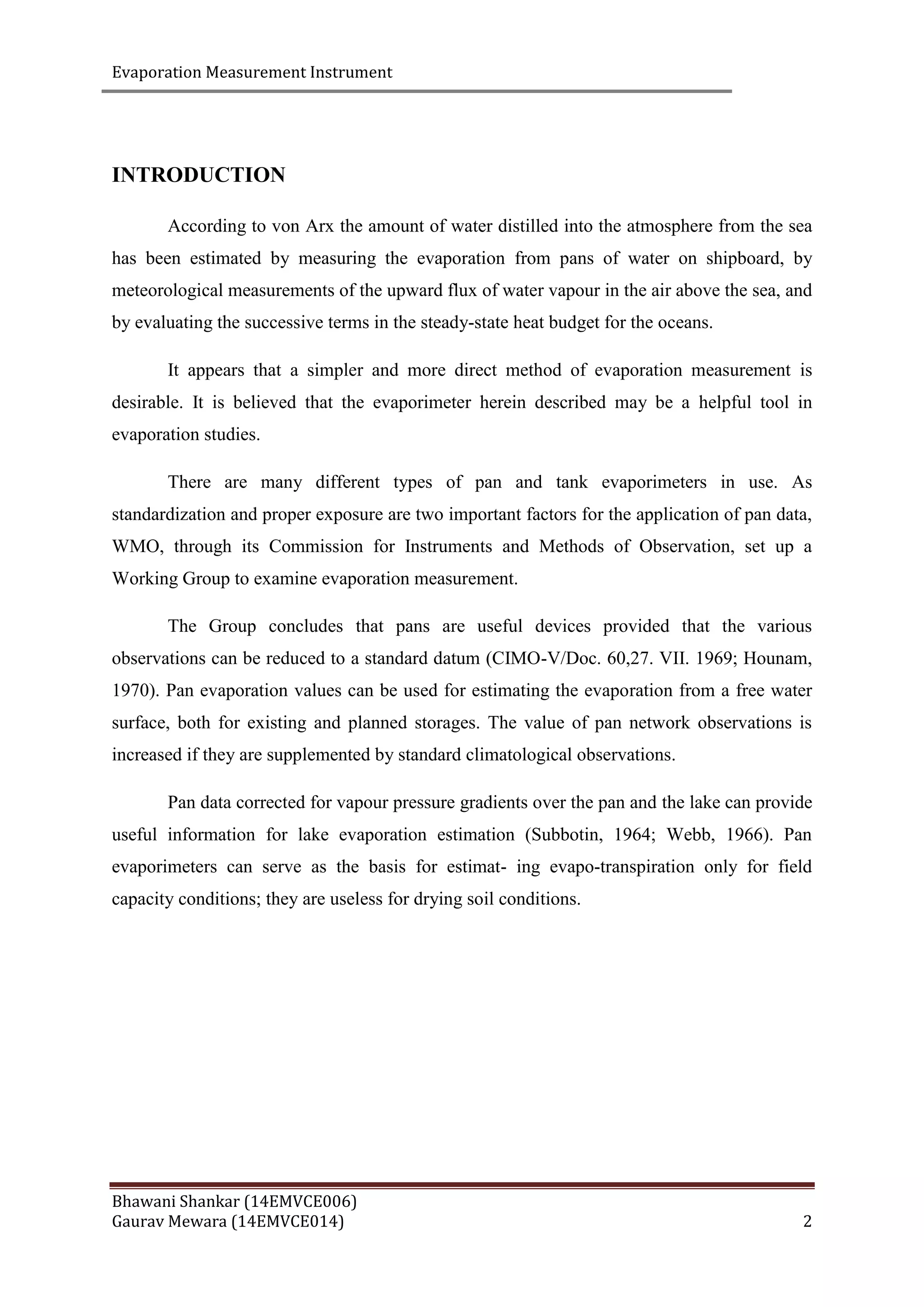
Daily the result of evaporation and precipitation is measured within the still well, by
means of a high quality evaporation micrometer with a measuring range of 00 mm and an
accuracy of 0.02 mm. This accuracy can be obtained because the still well prevents rippling
of the water surface.
Evaporation Measurement Instrument
Bhawani Shankar (14EMVCE006)
Gaurav Mewara (14EMVCE014) 5
Fig 2: Stilling Well with micrometer
The amount of evaporation is a function of temperature, humidity, wind and other
ambient conditions. In order to relate the evaporation to wind current or expected conditions,
the maximum and minimum temperatures as well as the amount of air passed are recorded
with the evaporation. For a more exact use of the evaporation pan it is recommended to use
an additional wind path meter.
Level sensor for automatic measurement
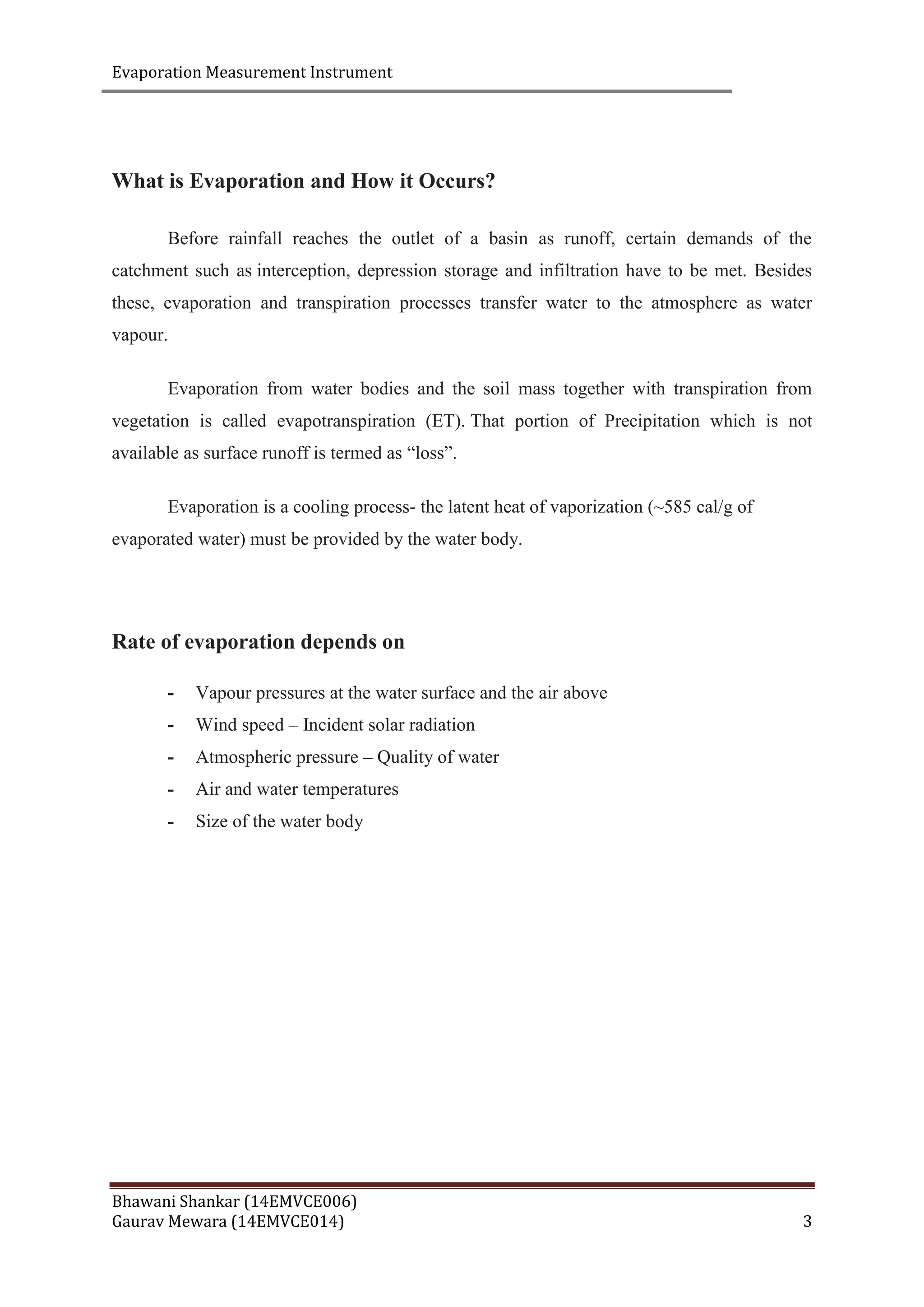
For automatic measurement of the evaporation use can be made of a level sensor. The
level sensor consists of a sensitive pressure transducer
built in a stainless steel housing.
The sensor has a pressure range of 0-20 mbar, accuracy
0,25%. Output signal 0-20 mA, power supply voltage
8-28 V. The sensor is supplied with 5 m cable. The
sensor is read-out with a datalogger. To configure and
read-out the data-logger and to process the measuring
data, use is made of the evaporation pan software.
Fig 3: Level Sensor for Measurement
Evaporation Measurement Instrument
Bhawani Shankar (14EMVCE006)
Gaurav Mewara (14EMVCE014) 6
Fig 4: Cross Section View of USGS Class A Pan Evaportimeter
Fig 5: 3D View of Pan Evaporimeter
Evaporation Measurement Instrument
Bhawani Shankar (14EMVCE006)
Gaurav Mewara (14EMVCE014) 7
Measuring principle
An evaporation pan provides a measurement of the combined effect of temperature,
humidity, wind speed and sunshine on the reference crop evapo-transpiration ETo.
The principle of the evaporation pan is the following:
• The pan is installed in the field.
• The pan is filled with a known quantity of water (the surface area of the pan is known
and the water depth is measured)
• The water is allowed to evaporate during a certain period of time (usually 24 hours).
For example, each morning at 7 o’clock a measurement is taken. The rainfall, if any,
is measured simultaneously.
• After 24 hours, the remaining quantity of water (i.e. water depth) is measured
• The amount of evaporation per time unit (the difference between the two measured
water depths) is calculated; this is the pan evaporation: E pan (in mm/24 hours)
• The E pan is multiplied by a pan coefficient, K pan, to obtain the ETo.
Formula: ETo = K pan × E pan
with:
ETo : reference crop evapotranspiration
K pan : pan coefficient
E pan : pan evaporation
If the water depth in the pan drops too much (due to lack of rain), water is added and
the water depth is measured before and after the water is added. If the water level rises too
much (due to rain) water is taken out of the pan and the water depths before and after are
measured.
Evaporation Measurement Instrument
Bhawani Shankar (14EMVCE006)
Gaurav Mewara (14EMVCE014) 8
Determination of K pan
When using the evaporation pan to estimate the ETo, in fact, a comparison is made
between the evaporation from the water surface in the pan and the evapo-transpiration of the
standard grass. Of course the water in the pan and the grass do not react in exactly the same
way to the climate. Therefore a special coefficient is used (K pan) to relate one to the other.
The pan coefficient, K pan, depends on:
• The type of pan used
• The pan environment: if the pan is placed in a fallow or cropped area
• The climate: the humidity and wind-speed
For the Class A evaporation pan, the K pan varies between 0.35 and 0.85. Average K pan =
0.70.
• The K pan is high if:
o The pan is placed in a fallow.
o The humidity is high (i.e. humid).
o The wind-speed is low.
• The K pan is low if:
o Area the pan is placed in a cropped area.
o The humidity is low (i.e. dry).
o The wind-speed is high.
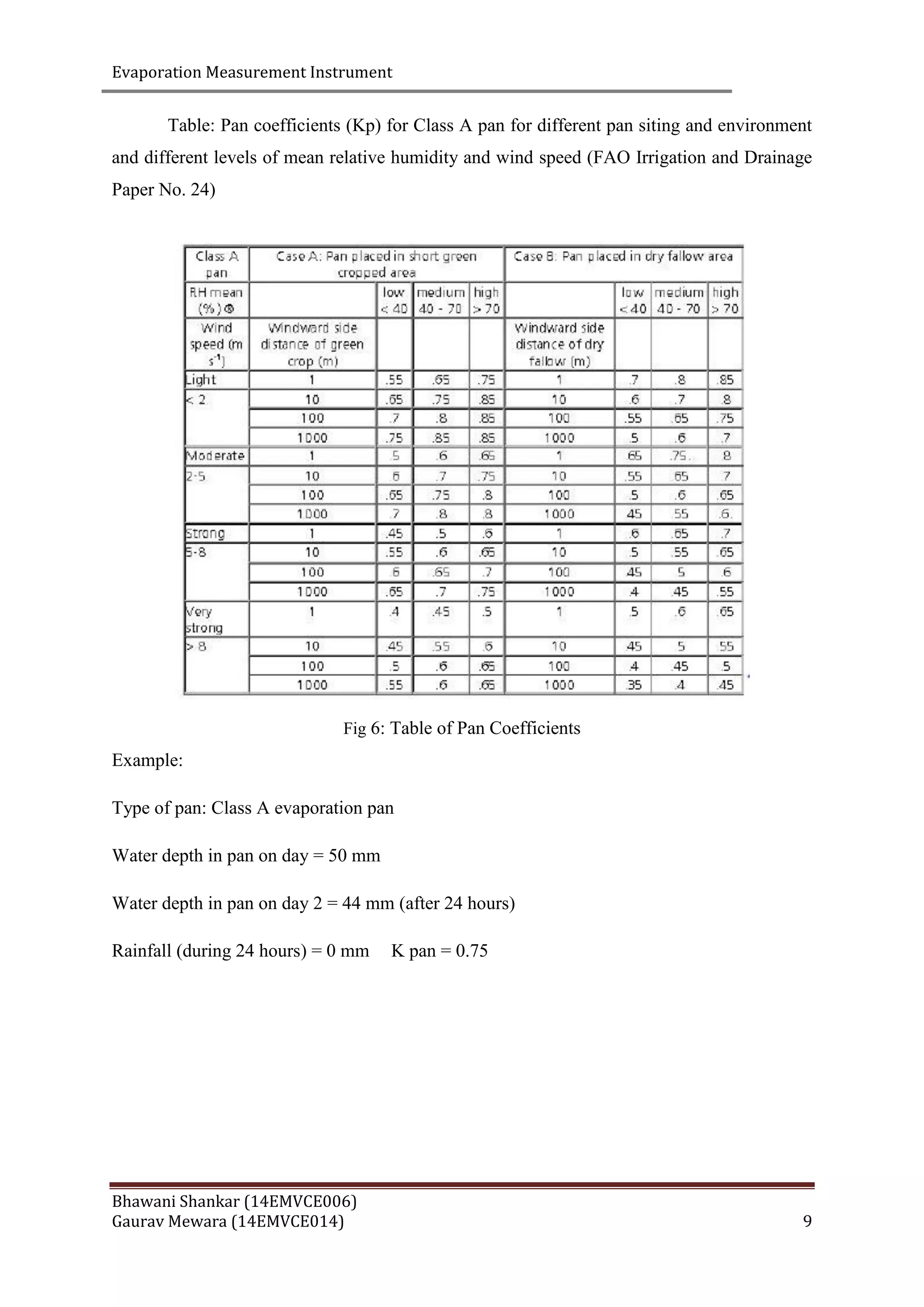
If the pan factor is not known the average value could be used. If more accuracy is
required, the pan factors can be taken grom the table below (for class A pan only).
Evaporation Measurement Instrument
Bhawani Shankar (14EMVCE006)
Gaurav Mewara (14EMVCE014) 9
Table: Pan coefficients (Kp) for Class A pan for different pan siting and environment
and different levels of mean relative humidity and wind speed (FAO Irrigation and Drainage
Paper No. 24)
Fig 6: Table of Pan Coefficients
Example:
Type of pan: Class A evaporation pan
Water depth in pan on day = 50 mm
Water depth in pan on day 2 = 44 mm (after 24 hours)
Rainfall (during 24 hours) = 0 mm K pan = 0.75
Evaporation Measurement Instrument
Bhawani Shankar (14EMVCE006)
Gaurav Mewara (14EMVCE014) 10
Formula:
ETo = K pan × E pan
Calculation: E pan = 50 - 44 = 6 mm/day
ETo = 0.75 × 6 =4.5 mm/day
Evaporation Stations
WMO recommends the following values of minimum density of evaporimeters
- Arid Zones – 1 station for every 30,000 sq.km
- Humid Temperate Zones – 1 station for every 50,000 sq.km
- Cold regions – 1 station for every 1,00,000 sq.km
Evaporation Measurement Instrument
Bhawani Shankar (14EMVCE006)
Gaurav Mewara (14EMVCE014) 11
Decreasing Trend of Pan Evaporation
Over the last 50 or so years, pan evaporation has been carefully monitored. For
decades, pan evaporation measurements were not analyzed critically for long term trends. But
in the 1990s scientists reported that the rate of evaporation was falling.
According to data the downward trend had been observed all over the world except in
a few places where it has increased.
It is currently theorized that all other things being equal, as the global climate warms
evaporation would increase proportionately and as result, the hydrological cycle in its most
general sense is bound to accelerate.
The downward trend of pan evaporation has since also been linked to a phenomenon
called global dimming. In 2005 Wild et al. and Pinker et al found that “dimming” trend had
reversed since about 1990.
Other theories suggest that measurements have not taken the local environment into
account. Since the local moisture level has increased in the local terrain, less water
evaporates from the pan. This leads to false measurements and must be compensated for in
the data analysis. Models accounting for additional local terrain moisture match global
estimates.
Evaporation Measurement Instrument
Bhawani Shankar (14EMVCE006)
Gaurav Mewara (14EMVCE014) 12
Lake Evaporation vs. Pan Evaporation
Pan evaporation is used to estimate the evaporation from lakes. There is a correlation
between lake evaporation and pan evaporation. Evaporation from a natural body of water is
usually at a lower rate because the body of water does not have metal sides that get hot with
the sun, and while light penetration in a pan is essentially uniform, light penetration in natural
bodies of water will decrease as depth increases. Most textbooks suggest multiplying the pan
evaporation by 0.75 to correct for this.
Relationship to Hydrological Cycle
It is generally agreed that the evaporation from pans has been decreasing for the past
half century over many regions of the Earth. However, the significance of this negative trend,
as regards terrestrial evaporation, is still somewhat controversial, and its implications for the
global hydrologic cycle remain unclear.
The controversy stems from the alternative views that these evaporative changes
resulted, either from global radioactive dimming, or from the complementary relationship
between pan and terrestrial evaporation. Actually, these factors are not mutually exclusive but
act concurrently.
Evaporation Pan Management
Evaporation pans should be kept free of algae or other organic growths because such
growths will affect evaporation rates. Small concentrations (5-10 ppm) of copper sulfate
(Caution, large concentrations may cause the pan to rust) or chlorine can be used to prevent
organic growths.
Evaporation Measurement Instrument
Bhawani Shankar (14EMVCE006)
Gaurav Mewara (14EMVCE014) 13
Rust spots should be repaired when they occur, and repaired spots must be painted the
same color as the pan.
A darker color will tend to heat up faster and increase evaporation rates. Oil or grease
of any type must not be used in pans because such products will tend to float and prevent
evaporation.
Evaporation pans must be kept fenced to prevent animals from drinking from them.
Their use by birds as water sources should also be discouraged.
The amount of water in an evaporation pan will affect how fast it gains or losses heat.
Thus, water levels in evaporation pans must always be maintained between 2 and 3 inches
from the top of the pan. This provides a 7 to 8 inch depth of water in the standard 10-inch
deep pan.
To facilitate measurements, make marks inside the pan at 2 and 3 inches below the
top of the pan. Manage pan water depths by filling the pan to the top mark (2 inches from the
top of the pan) to initiate readings, then allow evaporation to deplete water from the pan over
several days.
Refill the pan when the water level drops to near the 3-inch mark. Following this
procedure, the pan might be refilled every 3 or 4 days during high ET months, but only
weekly or less frequently during low ET months.
Because rainfall is collected in an evaporation pan, rainfall depth will be measured by
changes in pan water levels. After large rainfall events, the pan water level may need to be
reduced to near the 2-inch mark.
Evaporation Measurement Instrument
Bhawani Shankar (14EMVCE006)
Gaurav Mewara (14EMVCE014) 14
Measuring Pan Water Levels
Water levels in an evaporation pan can be most accurately measured using a stilling
well with a hook gauge and micrometer. The stilling well provides a fixed reference point for
accurate measurements even if the pan is not perfectly level. The hook gauge and micrometer
permit depths to be measured to the nearest 0.001 inches, which is much greater accuracy
than required for irrigation scheduling.
Accuracies sufficient for irrigation scheduling can be obtained using a finely-
graduated ruler or meter stick. However, the water depth measurement must always be made
at the same location, and care must be taken to assure that the ruler is held vertically when
measurements are made.
Because evaporation pans are not refilled daily, errors made in daily depth
measurements will compensate over several days. Measurement errors will be most serious
for crops which are irrigated very frequently (daily or more often), but even so, sufficient
accuracies can often be obtained using rulers if care is taken in their use.
For ease of interpretation, evaporation measurements should be made at about the
same time each day. Normally, early morning or late evening measurements are most
convenient. Early morning measurements permit yesterday's ET to be estimated and today's
irrigations to be scheduled. Late evening measurements can be used to estimate today's ET
for irrigations to be scheduled tonight or early tomorrow morning.
Evaporation Measurement Instrument
Bhawani Shankar (14EMVCE006)
Gaurav Mewara (14EMVCE014) 15
Maintenance
The pan should be cleaned at least once a year. After cleaning and every month an
algaecide should be added at the same rate as for swimming pools. If an algaecide is not
added then the pan should be emptied and cleaned monthly.
If the maintenance or siting of the pan or the construction of the pan is not standard,
then there will be a different relationship between evaporation and plant water use, but this
difference is not critical if the differences are small and consistent.
Variations from month to month like algae growth, unmown grass or reading at very
irregular intervals are far worse than a consistent difference.
For example we suggest that if the grass cannot be kept green and mown then the area
around the pan should be kept bare with a herbicide.
It should be recognised here that non-standard evaporation pans can still be very
useful for irrigation scheduling.
They must, however, be evaluated on their own. Published irrigation replacement
factors will be less accurate than for a standard evaporation pan.
We recommend that if a non standard evaporation pan is used for irrigation
scheduling then soil moisture and plant performance must be monitored to determine
appropriate irrigation replacements from evaporation.
Evaporation Measurement Instrument
Bhawani Shankar (14EMVCE006)
Gaurav Mewara (14EMVCE014) 16
Irrigation Scheduling with NWS Evaporation Pans
The NWS Standard Evaporation Pan can be used to schedule irrigations by following
an accounting (bookkeeping) procedure. In brief, the evaporation pan can be used to estimate
daily rates of water use, and thus the amount of water required to replenish the soil water
content by irrigation.
If Kc values and the amount of water stored in the effective root zone of the crop are
known, daily crop ET rates can be calculated and subtracted from the soil water storage until
a critical soil-water depletion level is obtained.
At that point, an irrigation would be scheduled to replenish the soil-water content.
Thus, the evaporation pan would be used to determine both the timing of irrigation events and
the amount of water that has been depleted.
Also, if rainfall occurs, amounts must be measured and entered into the book keeping
procedure to account for all water inputs to the soil.
Evaporation Measurement Instrument
Bhawani Shankar (14EMVCE006)
Gaurav Mewara (14EMVCE014) 17
Procedure:
• The pan rests on a carefully leveled, wooden base and is often enclosed by a chain
link fence to prevent animals drinking from it.
• Evaporation is measured daily as the depth of water (in inches) evaporates from the
pan.
• The measurement day begins with the pan filled to exactly two inches (5 cm) from the
pan top.
• Evaporation readings are recorded in prospective table.
• At the end of 24 hours, the amount of water to refill the pan to exactly two inches
from its top is measured if want.
• The most common and obvious error is in daily rainfall events of >55mm (203mm
rain gauge) where the Class A Evaporation pan will likely overflow.
• The less obvious, and therefore more concerning, is the influence of heavy or intense
rainfall causing spuriously high daily evaporation totals without obvious over flow.
Evaporation Measurement Instrument
Bhawani Shankar (14EMVCE006)
Gaurav Mewara (14EMVCE014) 18
Project Readings
-: Measurements of Pan Evaporimeter
Location : - Pali, Rajasthan
Starting Date : - 25 Apr. 2018
Ending Date : - 29 Apr. 2018
Following Data are recorded for Evaporation Calculation
Day
Elapsed
Time
(days)
Usable
Soil-Water
(inches)
Pan
Evap.
(Inches)
Kpan
Calculated
ETo
(inches)
1 1 0.80 0.17 0.75 0.127
2 2 0.63 0.19 0.75 0.142
3 3 0.44 0.18 0.75 0.135
4 4 0.26 0.18 0.75 0.135
Evaporation Measurement Instrument
Bhawani Shankar (14EMVCE006)
Gaurav Mewara (14EMVCE014) 19
Using Formula
ETo = K pan X Evaporation Pan
Evapo-transpiration (ETo)
As:
ETo = 0.75 * 0.80 = 0.127
All respective ETo will be calculated and evaporation for different location can be
found out.
• Many researchers and irrigation schedulers have shown that evaporation pans can be
used to accurately schedule irrigations.
• An accounting (bookkeeping) procedure for the management of soil-water content is
required to make effective use of evaporation pans.
• Pans must be properly constructed, located, and managed for accurate use in ET
estimation and irrigation scheduling.
• All evaporation pans must be calibrated for their specific application. This is done by
using pan coefficients and crop water use coefficients.
• Refinement of calibration is obtained by field experience.
Evaporation Measurement Instrument
Bhawani Shankar (14EMVCE006)
Gaurav Mewara (14EMVCE014) 20
CONCLUSION
• An evaporation pan (University of Hawaii , or U. H. pan ) has been developed with a
water level that remains at a constant level during both rainy and non rainy period s.
Records are obtained from reading a gage on the outside of a water supply tank
holding 1 to 2 months' supply. A continuo us evaporation record can be obtained by
using a float recorder on the supply tank.
• The record obtained with the U.H . pan during non rainy periods is the same as that
obtained by a U.S. Weather Bureau Class A (W.B.) pan, which has been
recommended as the international standard for pan -evaporation measurement. During
rainy periods, the U. H. pan records approximately 6 percent lower evaporation than
the W .B. pan. This difference can be largely accounted for from findings that under
Hawaii an conditions a pan intercepts some 5 percent less rain than a rain gage.
• Differences in amounts of rainfall intercepted by a pan and a rain gage may vary
according to the circumstances under which the rain falls. Findings in Hawaii may not
necessarily apply elsewhere. However, under Hawaii an conditions the U.H . pan
records evaporation more accurately than the W .B. pan during rainy conditions.
• An error is introduced in evaporation measurement by the V.H . pan during rainy
periods, generally not exceeding I percent. A correction can readily be applied .
• The V.H. pan can be used more conveniently than the W.N. pan for routine
evaporation measurements, but one y expect, with normal care , to lose one record on
I day in a year due to interference by dirt with the level-control mechanism.
• Inaccurate records may possibly be obtained when winds of over 40 miles per hour
prevail.
• But for the reservation mentioned under, the V.H . pan can be installed in isolated
areas where only weekly attendance is possible.
• The cost of manufacture of the U.H. pan is approximately 112 times that of the W .B.
pan.
Evaporation Measurement Instrument
Bhawani Shankar (14EMVCE006)
Gaurav Mewara (14EMVCE014) 21
References
• https://web.archive.org/web/20070326160426/http://www.engineering.usu.edu/uwrl/a
tlas/ch3/ch3overview.html
• "Irrigation Scheduling with Evaporation Pans". Archived from the original on 2007-
02-25.
• http://www.crh.noaa.gov/gid/Local_Information/coop/evapStations/#sec1
• https://en.wikipedia.org/wiki/Pan_evaporation
• http://agriculture.vic.gov.au/agriculture/farm-management/soil-and-
water/irrigation/construction-of-an-evaporation-pan-for-irrigation-scheduling

Evaporation pan meter

  • 1.
    Evaporation Measurement Instrument BhawaniShankar (14EMVCE006) Gaurav Mewara (14EMVCE014) 1 GENERAL Evaporation is one of the main components of the water budget. Although some headway has been made in the estimation ofevaporation, the present state of development is unsatisfactory. There is a need for more theoretical and experimental studies, especially for application of the theory of turbulent diffusion to the realities of evaporation from cropped or forested surfaces. The dependence of evaporation on soil and vegetation factors is inadequately defined. The sensitive methods of measurement that have been developed still have considerable drawbacks. There is the problem that the high accuracy obtained at the measuring point is lost in the transfer of the measured values to larger regions. Above all, hydrology requires values of evaporation for whole catchments for use in water balance models. Hydrological data from remote areas are lacking for establishing global, continental and regional water balance models. An evaporation rate meter, or evaporimeter, has been devised that shows promise of directly measuring the rate of evaporation near the sea surface. The simplicity of the instrument indicates that it may be of interest to oceanographers, and possibly to meteorologists and climatologists.
  • 2.
    Evaporation Measurement Instrument BhawaniShankar (14EMVCE006) Gaurav Mewara (14EMVCE014) 2 INTRODUCTION According to von Arx the amount of water distilled into the atmosphere from the sea has been estimated by measuring the evaporation from pans of water on shipboard, by meteorological measurements of the upward flux of water vapour in the air above the sea, and by evaluating the successive terms in the steady-state heat budget for the oceans. It appears that a simpler and more direct method of evaporation measurement is desirable. It is believed that the evaporimeter herein described may be a helpful tool in evaporation studies. There are many different types of pan and tank evaporimeters in use. As standardization and proper exposure are two important factors for the application of pan data, WMO, through its Commission for Instruments and Methods of Observation, set up a Working Group to examine evaporation measurement. The Group concludes that pans are useful devices provided that the various observations can be reduced to a standard datum (CIMO-V/Doc. 60,27. VII. 1969; Hounam, 1970). Pan evaporation values can be used for estimating the evaporation from a free water surface, both for existing and planned storages. The value of pan network observations is increased if they are supplemented by standard climatological observations. Pan data corrected for vapour pressure gradients over the pan and the lake can provide useful information for lake evaporation estimation (Subbotin, 1964; Webb, 1966). Pan evaporimeters can serve as the basis for estimat- ing evapo-transpiration only for field capacity conditions; they are useless for drying soil conditions.
  • 3.
    Evaporation Measurement Instrument BhawaniShankar (14EMVCE006) Gaurav Mewara (14EMVCE014) 3 What is Evaporation and How it Occurs? Before rainfall reaches the outlet of a basin as runoff, certain demands of the catchment such as interception, depression storage and infiltration have to be met. Besides these, evaporation and transpiration processes transfer water to the atmosphere as water vapour. Evaporation from water bodies and the soil mass together with transpiration from vegetation is called evapotranspiration (ET). That portion of Precipitation which is not available as surface runoff is termed as “loss”. Evaporation is a cooling process- the latent heat of vaporization (~585 cal/g of evaporated water) must be provided by the water body. Rate of evaporation depends on - Vapour pressures at the water surface and the air above - Wind speed – Incident solar radiation - Atmospheric pressure – Quality of water - Air and water temperatures - Size of the water body
  • 4.
    Evaporation Measurement Instrument BhawaniShankar (14EMVCE006) Gaurav Mewara (14EMVCE014) 4 EVAPORATION PAN Description The evaporation pan of this standard set is made of stainless steel and has the dimensions of a “class A“ evaporation pan, namely 54 mm ( 0 inches) in height and 206 mm (47.5 inches) in diameter. The evaporation pan is installed on the wooden support, which is set and levelled on the ground in a grassy location, away from bushes, trees and other obstacles which obstruct a natural air flow around the pan, thus representing open water in an open area. Fig 1: Evaporation Pan Daily the result of evaporation and precipitation is measured within the still well, by means of a high quality evaporation micrometer with a measuring range of 00 mm and an accuracy of 0.02 mm. This accuracy can be obtained because the still well prevents rippling of the water surface.
  • 5.
    Evaporation Measurement Instrument BhawaniShankar (14EMVCE006) Gaurav Mewara (14EMVCE014) 5 Fig 2: Stilling Well with micrometer The amount of evaporation is a function of temperature, humidity, wind and other ambient conditions. In order to relate the evaporation to wind current or expected conditions, the maximum and minimum temperatures as well as the amount of air passed are recorded with the evaporation. For a more exact use of the evaporation pan it is recommended to use an additional wind path meter. Level sensor for automatic measurement For automatic measurement of the evaporation use can be made of a level sensor. The level sensor consists of a sensitive pressure transducer built in a stainless steel housing. The sensor has a pressure range of 0-20 mbar, accuracy 0,25%. Output signal 0-20 mA, power supply voltage 8-28 V. The sensor is supplied with 5 m cable. The sensor is read-out with a datalogger. To configure and read-out the data-logger and to process the measuring data, use is made of the evaporation pan software. Fig 3: Level Sensor for Measurement
  • 6.
    Evaporation Measurement Instrument BhawaniShankar (14EMVCE006) Gaurav Mewara (14EMVCE014) 6 Fig 4: Cross Section View of USGS Class A Pan Evaportimeter Fig 5: 3D View of Pan Evaporimeter
  • 7.
    Evaporation Measurement Instrument BhawaniShankar (14EMVCE006) Gaurav Mewara (14EMVCE014) 7 Measuring principle An evaporation pan provides a measurement of the combined effect of temperature, humidity, wind speed and sunshine on the reference crop evapo-transpiration ETo. The principle of the evaporation pan is the following: • The pan is installed in the field. • The pan is filled with a known quantity of water (the surface area of the pan is known and the water depth is measured) • The water is allowed to evaporate during a certain period of time (usually 24 hours). For example, each morning at 7 o’clock a measurement is taken. The rainfall, if any, is measured simultaneously. • After 24 hours, the remaining quantity of water (i.e. water depth) is measured • The amount of evaporation per time unit (the difference between the two measured water depths) is calculated; this is the pan evaporation: E pan (in mm/24 hours) • The E pan is multiplied by a pan coefficient, K pan, to obtain the ETo. Formula: ETo = K pan × E pan with: ETo : reference crop evapotranspiration K pan : pan coefficient E pan : pan evaporation If the water depth in the pan drops too much (due to lack of rain), water is added and the water depth is measured before and after the water is added. If the water level rises too much (due to rain) water is taken out of the pan and the water depths before and after are measured.
  • 8.
    Evaporation Measurement Instrument BhawaniShankar (14EMVCE006) Gaurav Mewara (14EMVCE014) 8 Determination of K pan When using the evaporation pan to estimate the ETo, in fact, a comparison is made between the evaporation from the water surface in the pan and the evapo-transpiration of the standard grass. Of course the water in the pan and the grass do not react in exactly the same way to the climate. Therefore a special coefficient is used (K pan) to relate one to the other. The pan coefficient, K pan, depends on: • The type of pan used • The pan environment: if the pan is placed in a fallow or cropped area • The climate: the humidity and wind-speed For the Class A evaporation pan, the K pan varies between 0.35 and 0.85. Average K pan = 0.70. • The K pan is high if: o The pan is placed in a fallow. o The humidity is high (i.e. humid). o The wind-speed is low. • The K pan is low if: o Area the pan is placed in a cropped area. o The humidity is low (i.e. dry). o The wind-speed is high. If the pan factor is not known the average value could be used. If more accuracy is required, the pan factors can be taken grom the table below (for class A pan only).
  • 9.
    Evaporation Measurement Instrument BhawaniShankar (14EMVCE006) Gaurav Mewara (14EMVCE014) 9 Table: Pan coefficients (Kp) for Class A pan for different pan siting and environment and different levels of mean relative humidity and wind speed (FAO Irrigation and Drainage Paper No. 24) Fig 6: Table of Pan Coefficients Example: Type of pan: Class A evaporation pan Water depth in pan on day = 50 mm Water depth in pan on day 2 = 44 mm (after 24 hours) Rainfall (during 24 hours) = 0 mm K pan = 0.75
  • 10.
    Evaporation Measurement Instrument BhawaniShankar (14EMVCE006) Gaurav Mewara (14EMVCE014) 10 Formula: ETo = K pan × E pan Calculation: E pan = 50 - 44 = 6 mm/day ETo = 0.75 × 6 =4.5 mm/day Evaporation Stations WMO recommends the following values of minimum density of evaporimeters - Arid Zones – 1 station for every 30,000 sq.km - Humid Temperate Zones – 1 station for every 50,000 sq.km - Cold regions – 1 station for every 1,00,000 sq.km
  • 11.
    Evaporation Measurement Instrument BhawaniShankar (14EMVCE006) Gaurav Mewara (14EMVCE014) 11 Decreasing Trend of Pan Evaporation Over the last 50 or so years, pan evaporation has been carefully monitored. For decades, pan evaporation measurements were not analyzed critically for long term trends. But in the 1990s scientists reported that the rate of evaporation was falling. According to data the downward trend had been observed all over the world except in a few places where it has increased. It is currently theorized that all other things being equal, as the global climate warms evaporation would increase proportionately and as result, the hydrological cycle in its most general sense is bound to accelerate. The downward trend of pan evaporation has since also been linked to a phenomenon called global dimming. In 2005 Wild et al. and Pinker et al found that “dimming” trend had reversed since about 1990. Other theories suggest that measurements have not taken the local environment into account. Since the local moisture level has increased in the local terrain, less water evaporates from the pan. This leads to false measurements and must be compensated for in the data analysis. Models accounting for additional local terrain moisture match global estimates.
  • 12.
    Evaporation Measurement Instrument BhawaniShankar (14EMVCE006) Gaurav Mewara (14EMVCE014) 12 Lake Evaporation vs. Pan Evaporation Pan evaporation is used to estimate the evaporation from lakes. There is a correlation between lake evaporation and pan evaporation. Evaporation from a natural body of water is usually at a lower rate because the body of water does not have metal sides that get hot with the sun, and while light penetration in a pan is essentially uniform, light penetration in natural bodies of water will decrease as depth increases. Most textbooks suggest multiplying the pan evaporation by 0.75 to correct for this. Relationship to Hydrological Cycle It is generally agreed that the evaporation from pans has been decreasing for the past half century over many regions of the Earth. However, the significance of this negative trend, as regards terrestrial evaporation, is still somewhat controversial, and its implications for the global hydrologic cycle remain unclear. The controversy stems from the alternative views that these evaporative changes resulted, either from global radioactive dimming, or from the complementary relationship between pan and terrestrial evaporation. Actually, these factors are not mutually exclusive but act concurrently. Evaporation Pan Management Evaporation pans should be kept free of algae or other organic growths because such growths will affect evaporation rates. Small concentrations (5-10 ppm) of copper sulfate (Caution, large concentrations may cause the pan to rust) or chlorine can be used to prevent organic growths.
  • 13.
    Evaporation Measurement Instrument BhawaniShankar (14EMVCE006) Gaurav Mewara (14EMVCE014) 13 Rust spots should be repaired when they occur, and repaired spots must be painted the same color as the pan. A darker color will tend to heat up faster and increase evaporation rates. Oil or grease of any type must not be used in pans because such products will tend to float and prevent evaporation. Evaporation pans must be kept fenced to prevent animals from drinking from them. Their use by birds as water sources should also be discouraged. The amount of water in an evaporation pan will affect how fast it gains or losses heat. Thus, water levels in evaporation pans must always be maintained between 2 and 3 inches from the top of the pan. This provides a 7 to 8 inch depth of water in the standard 10-inch deep pan. To facilitate measurements, make marks inside the pan at 2 and 3 inches below the top of the pan. Manage pan water depths by filling the pan to the top mark (2 inches from the top of the pan) to initiate readings, then allow evaporation to deplete water from the pan over several days. Refill the pan when the water level drops to near the 3-inch mark. Following this procedure, the pan might be refilled every 3 or 4 days during high ET months, but only weekly or less frequently during low ET months. Because rainfall is collected in an evaporation pan, rainfall depth will be measured by changes in pan water levels. After large rainfall events, the pan water level may need to be reduced to near the 2-inch mark.
  • 14.
    Evaporation Measurement Instrument BhawaniShankar (14EMVCE006) Gaurav Mewara (14EMVCE014) 14 Measuring Pan Water Levels Water levels in an evaporation pan can be most accurately measured using a stilling well with a hook gauge and micrometer. The stilling well provides a fixed reference point for accurate measurements even if the pan is not perfectly level. The hook gauge and micrometer permit depths to be measured to the nearest 0.001 inches, which is much greater accuracy than required for irrigation scheduling. Accuracies sufficient for irrigation scheduling can be obtained using a finely- graduated ruler or meter stick. However, the water depth measurement must always be made at the same location, and care must be taken to assure that the ruler is held vertically when measurements are made. Because evaporation pans are not refilled daily, errors made in daily depth measurements will compensate over several days. Measurement errors will be most serious for crops which are irrigated very frequently (daily or more often), but even so, sufficient accuracies can often be obtained using rulers if care is taken in their use. For ease of interpretation, evaporation measurements should be made at about the same time each day. Normally, early morning or late evening measurements are most convenient. Early morning measurements permit yesterday's ET to be estimated and today's irrigations to be scheduled. Late evening measurements can be used to estimate today's ET for irrigations to be scheduled tonight or early tomorrow morning.
  • 15.
    Evaporation Measurement Instrument BhawaniShankar (14EMVCE006) Gaurav Mewara (14EMVCE014) 15 Maintenance The pan should be cleaned at least once a year. After cleaning and every month an algaecide should be added at the same rate as for swimming pools. If an algaecide is not added then the pan should be emptied and cleaned monthly. If the maintenance or siting of the pan or the construction of the pan is not standard, then there will be a different relationship between evaporation and plant water use, but this difference is not critical if the differences are small and consistent. Variations from month to month like algae growth, unmown grass or reading at very irregular intervals are far worse than a consistent difference. For example we suggest that if the grass cannot be kept green and mown then the area around the pan should be kept bare with a herbicide. It should be recognised here that non-standard evaporation pans can still be very useful for irrigation scheduling. They must, however, be evaluated on their own. Published irrigation replacement factors will be less accurate than for a standard evaporation pan. We recommend that if a non standard evaporation pan is used for irrigation scheduling then soil moisture and plant performance must be monitored to determine appropriate irrigation replacements from evaporation.
  • 16.
    Evaporation Measurement Instrument BhawaniShankar (14EMVCE006) Gaurav Mewara (14EMVCE014) 16 Irrigation Scheduling with NWS Evaporation Pans The NWS Standard Evaporation Pan can be used to schedule irrigations by following an accounting (bookkeeping) procedure. In brief, the evaporation pan can be used to estimate daily rates of water use, and thus the amount of water required to replenish the soil water content by irrigation. If Kc values and the amount of water stored in the effective root zone of the crop are known, daily crop ET rates can be calculated and subtracted from the soil water storage until a critical soil-water depletion level is obtained. At that point, an irrigation would be scheduled to replenish the soil-water content. Thus, the evaporation pan would be used to determine both the timing of irrigation events and the amount of water that has been depleted. Also, if rainfall occurs, amounts must be measured and entered into the book keeping procedure to account for all water inputs to the soil.
  • 17.
    Evaporation Measurement Instrument BhawaniShankar (14EMVCE006) Gaurav Mewara (14EMVCE014) 17 Procedure: • The pan rests on a carefully leveled, wooden base and is often enclosed by a chain link fence to prevent animals drinking from it. • Evaporation is measured daily as the depth of water (in inches) evaporates from the pan. • The measurement day begins with the pan filled to exactly two inches (5 cm) from the pan top. • Evaporation readings are recorded in prospective table. • At the end of 24 hours, the amount of water to refill the pan to exactly two inches from its top is measured if want. • The most common and obvious error is in daily rainfall events of >55mm (203mm rain gauge) where the Class A Evaporation pan will likely overflow. • The less obvious, and therefore more concerning, is the influence of heavy or intense rainfall causing spuriously high daily evaporation totals without obvious over flow.
  • 18.
    Evaporation Measurement Instrument BhawaniShankar (14EMVCE006) Gaurav Mewara (14EMVCE014) 18 Project Readings -: Measurements of Pan Evaporimeter Location : - Pali, Rajasthan Starting Date : - 25 Apr. 2018 Ending Date : - 29 Apr. 2018 Following Data are recorded for Evaporation Calculation Day Elapsed Time (days) Usable Soil-Water (inches) Pan Evap. (Inches) Kpan Calculated ETo (inches) 1 1 0.80 0.17 0.75 0.127 2 2 0.63 0.19 0.75 0.142 3 3 0.44 0.18 0.75 0.135 4 4 0.26 0.18 0.75 0.135
  • 19.
    Evaporation Measurement Instrument BhawaniShankar (14EMVCE006) Gaurav Mewara (14EMVCE014) 19 Using Formula ETo = K pan X Evaporation Pan Evapo-transpiration (ETo) As: ETo = 0.75 * 0.80 = 0.127 All respective ETo will be calculated and evaporation for different location can be found out. • Many researchers and irrigation schedulers have shown that evaporation pans can be used to accurately schedule irrigations. • An accounting (bookkeeping) procedure for the management of soil-water content is required to make effective use of evaporation pans. • Pans must be properly constructed, located, and managed for accurate use in ET estimation and irrigation scheduling. • All evaporation pans must be calibrated for their specific application. This is done by using pan coefficients and crop water use coefficients. • Refinement of calibration is obtained by field experience.
  • 20.
    Evaporation Measurement Instrument BhawaniShankar (14EMVCE006) Gaurav Mewara (14EMVCE014) 20 CONCLUSION • An evaporation pan (University of Hawaii , or U. H. pan ) has been developed with a water level that remains at a constant level during both rainy and non rainy period s. Records are obtained from reading a gage on the outside of a water supply tank holding 1 to 2 months' supply. A continuo us evaporation record can be obtained by using a float recorder on the supply tank. • The record obtained with the U.H . pan during non rainy periods is the same as that obtained by a U.S. Weather Bureau Class A (W.B.) pan, which has been recommended as the international standard for pan -evaporation measurement. During rainy periods, the U. H. pan records approximately 6 percent lower evaporation than the W .B. pan. This difference can be largely accounted for from findings that under Hawaii an conditions a pan intercepts some 5 percent less rain than a rain gage. • Differences in amounts of rainfall intercepted by a pan and a rain gage may vary according to the circumstances under which the rain falls. Findings in Hawaii may not necessarily apply elsewhere. However, under Hawaii an conditions the U.H . pan records evaporation more accurately than the W .B. pan during rainy conditions. • An error is introduced in evaporation measurement by the V.H . pan during rainy periods, generally not exceeding I percent. A correction can readily be applied . • The V.H. pan can be used more conveniently than the W.N. pan for routine evaporation measurements, but one y expect, with normal care , to lose one record on I day in a year due to interference by dirt with the level-control mechanism. • Inaccurate records may possibly be obtained when winds of over 40 miles per hour prevail. • But for the reservation mentioned under, the V.H . pan can be installed in isolated areas where only weekly attendance is possible. • The cost of manufacture of the U.H. pan is approximately 112 times that of the W .B. pan.
  • 21.
    Evaporation Measurement Instrument BhawaniShankar (14EMVCE006) Gaurav Mewara (14EMVCE014) 21 References • https://web.archive.org/web/20070326160426/http://www.engineering.usu.edu/uwrl/a tlas/ch3/ch3overview.html • "Irrigation Scheduling with Evaporation Pans". Archived from the original on 2007- 02-25. • http://www.crh.noaa.gov/gid/Local_Information/coop/evapStations/#sec1 • https://en.wikipedia.org/wiki/Pan_evaporation • http://agriculture.vic.gov.au/agriculture/farm-management/soil-and- water/irrigation/construction-of-an-evaporation-pan-for-irrigation-scheduling