SIEVE TEST
Uji Ayakan
Mektan Kuliah 2
Out Line Slide
• 1.Engineering consideration of soil particles
• 2.Sieve test
• 3.Hydrometer test
• 4.Particle distribution
• 5.Shape of soil particles
Definitions for SOIL
• Engineering definitions:
Civil Engineering:
• Soil is the earth material that can be disaggregated in water
by gentle agitation.
Construction:
• Soil is material that can be removed by conventional means
without blasting. similar to the definition of regolith in
geological terms.
Agronomy definition:
• Soil consists of the thin layers of the earth’s crust formed by
surface weathering that are able to support plant life.
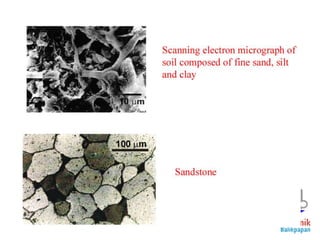
Soil particles
• The description of the grain size distribution of
soil particles according to their texture (particle
size, shape, and gradation).
Major textural classes include:
– gravel (>2 mm);
– sand (0.1 – 2 mm);
– silt (0.01 – 0.1 mm);
– clay (< 0.01 mm).
• Furthermore, gravel and sand can be roughly
classified as coarse textured soils, wile silt and
claycan be classified as fine textures soils.
• For engineering purposes, soils can also be
divided into cohesive and non-cohesive soils.
Non-cohesive means the soil has no shear
strength if no confinement. Cohesive soil contains
clay minerals and posses plasticity.
• In engineering practice, plasticity is defined as the
ability to be rolled into thin thread before
breaking into pieces. Clay is cohesive and plastic.
For example, mud sticking on shoes in a rainy day
when one walk in a field. Sand is non-cohesive
and non-plastic.
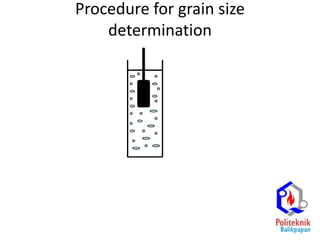
Procedure for grain size
determination
• Sieving - used for particles > 75 µm
• Hydrometer test - used for smaller particles
(f< 75 µm)
– Analysis based on Stoke’s Law, velocity
proportional to diameter
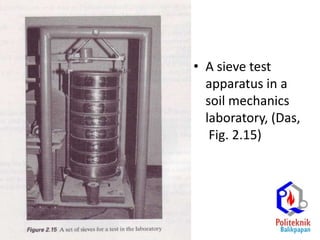
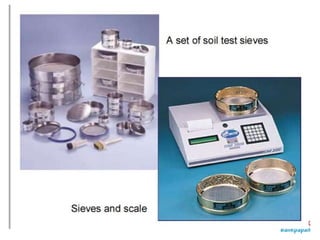
• A sieve test
apparatus in a
soil mechanics
laboratory, (Das,
Fig. 2.15)
Sieve Test
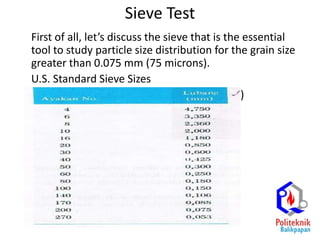
First of all, let’s discuss the sieve that is the essential
tool to study particle size distribution for the grain size
greater than 0.075 mm (75 microns).
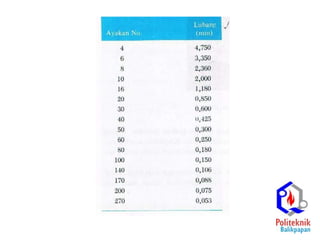
U.S. Standard Sieve Sizes
sieve # Sieve opening (mm)
4 4.75
10 2.00
20 0.850
40 0.425
60 0.250
100 0.150
200 0.074
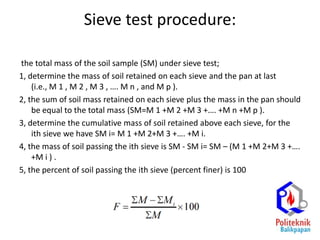
Sieve test procedure:
the total mass of the soil sample (SM) under sieve test;
1, determine the mass of soil retained on each sieve and the pan at last
(i.e., M 1 , M 2 , M 3 , …. M n , and M p ).
2, the sum of soil mass retained on each sieve plus the mass in the pan should
be equal to the total mass (SM=M 1 +M 2 +M 3 +…. +M n +M p ).
3, determine the cumulative mass of soil retained above each sieve, for the
ith sieve we have SM i= M 1 +M 2+M 3 +…. +M i.
4, the mass of soil passing the ith sieve is SM - SM i= SM – (M 1 +M 2+M 3 +….
+M i ) .
5, the percent of soil passing the ith sieve (percent finer) is 100
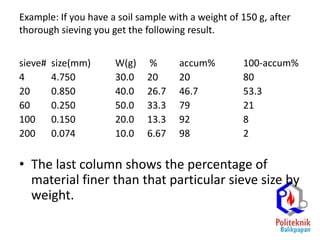
Example: If you have a soil sample with a weight of 150 g, after
thorough sieving you get the following result.
sieve# size(mm) W(g) % accum% 100-accum%
4 4.750 30.0 20 20 80
20 0.850 40.0 26.7 46.7 53.3
60 0.250 50.0 33.3 79 21
100 0.150 20.0 13.3 92 8
200 0.074 10.0 6.67 98 2
• The last column shows the percentage of
material finer than that particular sieve size by
weight.
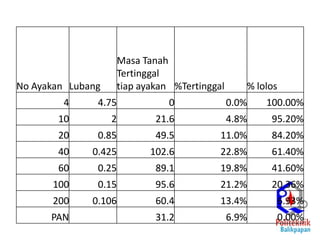
No Ayakan Lubang
Masa Tanah
Tertinggal
tiap ayakan %Tertinggal % lolos
4 4.75 0 0.0% 100.00%
10 2 21.6 4.8% 95.20%
20 0.85 49.5 11.0% 84.20%
40 0.425 102.6 22.8% 61.40%
60 0.25 89.1 19.8% 41.60%
100 0.15 95.6 21.2% 20.36%
200 0.106 60.4 13.4% 6.93%
PAN 31.2 6.9% 0.00%
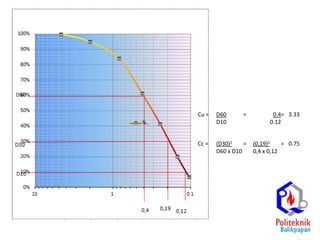
Cu = D60 = 0.4= 3.33
D10 0.12
Cc = (D30)2 = (0,19)2 = 0.75
D60 x D10 0,4 x 0,12
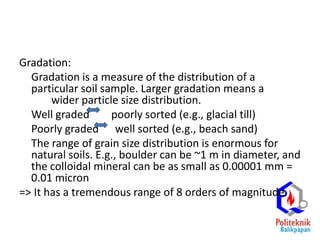
Gradation:
Gradation is a measure of the distribution of a
particular soil sample. Larger gradation means a
wider particle size distribution.
Well graded poorly sorted (e.g., glacial till)
Poorly graded well sorted (e.g., beach sand)
The range of grain size distribution is enormous for
natural soils. E.g., boulder can be ~1 m in diameter, and
the colloidal mineral can be as small as 0.00001 mm =
0.01 micron
=> It has a tremendous range of 8 orders of magnitude.
Fine-grained soil
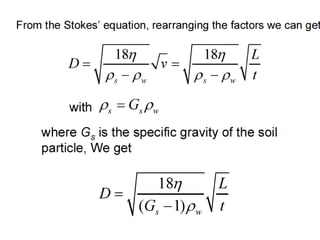
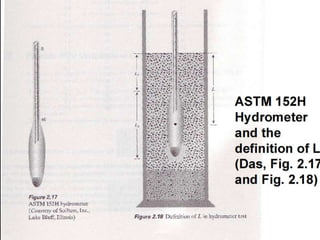
The hydrometer test uses Stokes equation (for the velocity of a free
falling sphere in suspension) to determine grain size distribution
smaller than #200 sieve.
The grain size distributions of soils are commonly determined by
sieve (smallest being #200) and hydrometer procedures. In the
hydrometer analysis the soil smaller than #200 sieve is placed in
suspension and by use of Stokes' equation for the velocity of a free
falling sphere the equivalent particle size and percent of soilin
suspension are computed.
For soils with both fine and coarse grained materials a combined
analysis is made using both the sieve and hydrometer procedures.
Procedure for grain size
determination
Procedure for grain size
determination
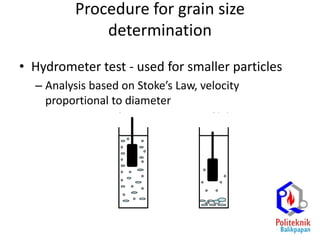
• Hydrometer test - used for smaller particles
– Analysis based on Stoke’s Law, velocity
proportional to diameter
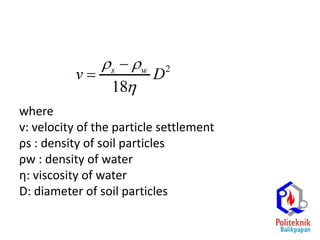
Stokes Law
• A sphere falling freely through a liquid of
infinite extent will accelerate rapidly to a
certain maximum velocity and will continue at
that velocity as long as conditions remain the
same.
• The relationship of the terminal velocity to the
physical properties of the sphere and the
liquid are expressed by Stokes' Equation as
shown in the following page.
where
v: velocity of the particle settlement
ρs : density of soil particles
ρw : density of water
η: viscosity of water
D: diameter of soil particles
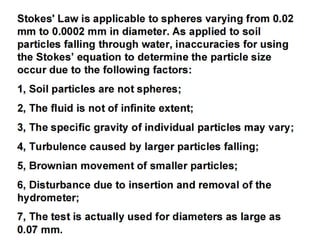
However, by proper sample and laboratory
technique all except Item 1 (soil particles are not
always spherical) in the 7 factors can be
controlled or minimized so that the resulting
inaccuracies can be ignored in normal testing.
The shape of soil particles will vary from cubes to
flakes with each of the shapes between these
limits having different influence. Nevertheless,
the results of the hydrometer analysis are valid if
they are considered equivalent grain diameter
rather than actual grain diameter.
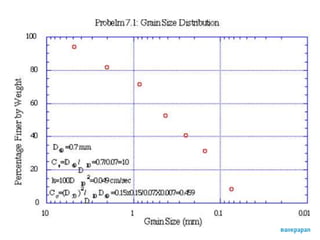
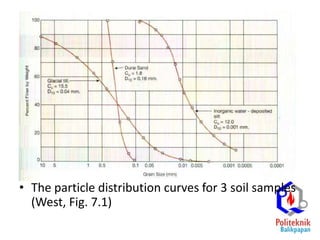
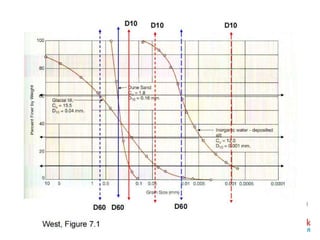
• The particle distribution curves for 3 soil samples
(West, Fig. 7.1)
Latihan
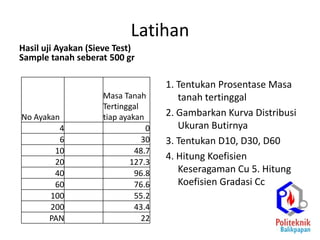
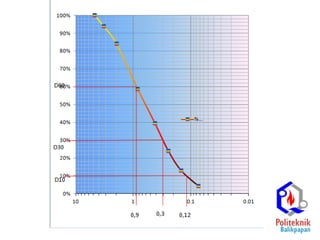
Hasil uji Ayakan (Sieve Test)
Sample tanah seberat 500 gr
No Ayakan Lubang
Masa Tanah
Tertinggal
tiap ayakan
4 4.75 0
6 3.35 30
10 2 48.7
20 0.85 127.3
40 0.425 96.8
60 0.25 76.6
100 0.15 55.2
200 0.075 43.4
PAN 22
1. Tentukan Prosentase Masa
tanah tertinggal
2. Gambarkan Kurva Distribusi
Ukuran Butirnya
3. Tentukan D10, D30, D60
4. Hitung Koefisien
Keseragaman Cu 5. Hitung
Koefisien Gradasi Cc
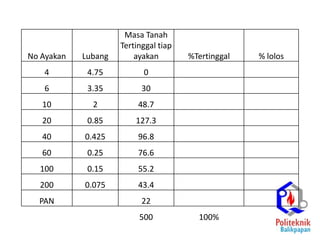
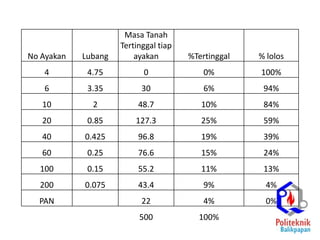
No Ayakan Lubang
Masa Tanah
Tertinggal tiap
ayakan %Tertinggal % lolos
4 4.75 0 0% 100%
6 3.35 30 6% 94%
10 2 48.7 10% 84%
20 0.85 127.3 25% 59%
40 0.425 96.8 19% 39%
60 0.25 76.6 15% 24%
100 0.15 55.2 11% 13%
200 0.075 43.4 9% 4%
PAN 22 4% 0%
500 100%
No Ayakan Lubang
Masa Tanah
Tertinggal tiap
ayakan %Tertinggal % lolos
4 4.75 0 0% 100%
6 3.35 30 6% 94%
10 2 48.7 10% 84%
20 0.85 127.3 25% 59%
40 0.425 96.8 19% 39%
60 0.25 76.6 15% 24%
100 0.15 55.2 11% 13%
200 0.075 43.4 9% 4%
PAN 22 4% 0%
500 100%
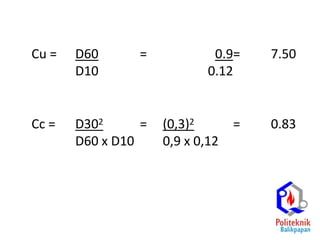
Cu = D60 = 0.9= 7.50
D10 0.12
Cc = D302 = (0,3)2 = 0.83
D60 x D10 0,9 x 0,12
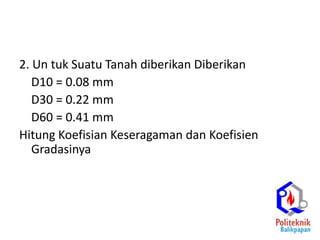
2. Un tuk Suatu Tanah diberikan Diberikan
D10 = 0.08 mm
D30 = 0.22 mm
D60 = 0.41 mm
Hitung Koefisian Keseragaman dan Koefisien
Gradasinya
Cu= 5.13
Cc = 1.48
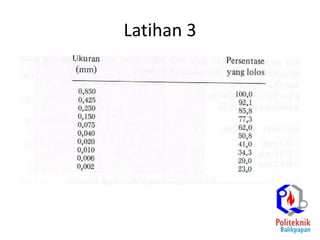
Latihan 3

Mekanika Tanah - Sieve Analysis

  • 1.
  • 2.
    Out Line Slide •1.Engineering consideration of soil particles • 2.Sieve test • 3.Hydrometer test • 4.Particle distribution • 5.Shape of soil particles
  • 3.
    Definitions for SOIL •Engineering definitions: Civil Engineering: • Soil is the earth material that can be disaggregated in water by gentle agitation. Construction: • Soil is material that can be removed by conventional means without blasting. similar to the definition of regolith in geological terms. Agronomy definition: • Soil consists of the thin layers of the earth’s crust formed by surface weathering that are able to support plant life.
  • 4.
    Soil particles • Thedescription of the grain size distribution of soil particles according to their texture (particle size, shape, and gradation). Major textural classes include: – gravel (>2 mm); – sand (0.1 – 2 mm); – silt (0.01 – 0.1 mm); – clay (< 0.01 mm). • Furthermore, gravel and sand can be roughly classified as coarse textured soils, wile silt and claycan be classified as fine textures soils.
  • 5.
    • For engineeringpurposes, soils can also be divided into cohesive and non-cohesive soils. Non-cohesive means the soil has no shear strength if no confinement. Cohesive soil contains clay minerals and posses plasticity. • In engineering practice, plasticity is defined as the ability to be rolled into thin thread before breaking into pieces. Clay is cohesive and plastic. For example, mud sticking on shoes in a rainy day when one walk in a field. Sand is non-cohesive and non-plastic.
  • 6.
    Procedure for grainsize determination • Sieving - used for particles > 75 µm • Hydrometer test - used for smaller particles (f< 75 µm) – Analysis based on Stoke’s Law, velocity proportional to diameter
  • 7.
    • A sievetest apparatus in a soil mechanics laboratory, (Das, Fig. 2.15)
  • 9.
    Sieve Test First ofall, let’s discuss the sieve that is the essential tool to study particle size distribution for the grain size greater than 0.075 mm (75 microns). U.S. Standard Sieve Sizes sieve # Sieve opening (mm) 4 4.75 10 2.00 20 0.850 40 0.425 60 0.250 100 0.150 200 0.074
  • 10.
    Sieve test procedure: thetotal mass of the soil sample (SM) under sieve test; 1, determine the mass of soil retained on each sieve and the pan at last (i.e., M 1 , M 2 , M 3 , …. M n , and M p ). 2, the sum of soil mass retained on each sieve plus the mass in the pan should be equal to the total mass (SM=M 1 +M 2 +M 3 +…. +M n +M p ). 3, determine the cumulative mass of soil retained above each sieve, for the ith sieve we have SM i= M 1 +M 2+M 3 +…. +M i. 4, the mass of soil passing the ith sieve is SM - SM i= SM – (M 1 +M 2+M 3 +…. +M i ) . 5, the percent of soil passing the ith sieve (percent finer) is 100
  • 11.
    Example: If youhave a soil sample with a weight of 150 g, after thorough sieving you get the following result. sieve# size(mm) W(g) % accum% 100-accum% 4 4.750 30.0 20 20 80 20 0.850 40.0 26.7 46.7 53.3 60 0.250 50.0 33.3 79 21 100 0.150 20.0 13.3 92 8 200 0.074 10.0 6.67 98 2 • The last column shows the percentage of material finer than that particular sieve size by weight.
  • 13.
    No Ayakan Lubang MasaTanah Tertinggal tiap ayakan %Tertinggal % lolos 4 4.75 0 0.0% 100.00% 10 2 21.6 4.8% 95.20% 20 0.85 49.5 11.0% 84.20% 40 0.425 102.6 22.8% 61.40% 60 0.25 89.1 19.8% 41.60% 100 0.15 95.6 21.2% 20.36% 200 0.106 60.4 13.4% 6.93% PAN 31.2 6.9% 0.00%
  • 14.
    Cu = D60= 0.4= 3.33 D10 0.12 Cc = (D30)2 = (0,19)2 = 0.75 D60 x D10 0,4 x 0,12
  • 15.
    Gradation: Gradation is ameasure of the distribution of a particular soil sample. Larger gradation means a wider particle size distribution. Well graded poorly sorted (e.g., glacial till) Poorly graded well sorted (e.g., beach sand) The range of grain size distribution is enormous for natural soils. E.g., boulder can be ~1 m in diameter, and the colloidal mineral can be as small as 0.00001 mm = 0.01 micron => It has a tremendous range of 8 orders of magnitude.
  • 16.
    Fine-grained soil The hydrometertest uses Stokes equation (for the velocity of a free falling sphere in suspension) to determine grain size distribution smaller than #200 sieve. The grain size distributions of soils are commonly determined by sieve (smallest being #200) and hydrometer procedures. In the hydrometer analysis the soil smaller than #200 sieve is placed in suspension and by use of Stokes' equation for the velocity of a free falling sphere the equivalent particle size and percent of soilin suspension are computed. For soils with both fine and coarse grained materials a combined analysis is made using both the sieve and hydrometer procedures.
  • 17.
    Procedure for grainsize determination
  • 18.
    Procedure for grainsize determination • Hydrometer test - used for smaller particles – Analysis based on Stoke’s Law, velocity proportional to diameter
  • 19.
    Stokes Law • Asphere falling freely through a liquid of infinite extent will accelerate rapidly to a certain maximum velocity and will continue at that velocity as long as conditions remain the same. • The relationship of the terminal velocity to the physical properties of the sphere and the liquid are expressed by Stokes' Equation as shown in the following page.
  • 20.
    where v: velocity ofthe particle settlement ρs : density of soil particles ρw : density of water η: viscosity of water D: diameter of soil particles
  • 27.
    However, by propersample and laboratory technique all except Item 1 (soil particles are not always spherical) in the 7 factors can be controlled or minimized so that the resulting inaccuracies can be ignored in normal testing. The shape of soil particles will vary from cubes to flakes with each of the shapes between these limits having different influence. Nevertheless, the results of the hydrometer analysis are valid if they are considered equivalent grain diameter rather than actual grain diameter.
  • 28.
    • The particledistribution curves for 3 soil samples (West, Fig. 7.1)
  • 33.
    Latihan Hasil uji Ayakan(Sieve Test) Sample tanah seberat 500 gr No Ayakan Lubang Masa Tanah Tertinggal tiap ayakan 4 4.75 0 6 3.35 30 10 2 48.7 20 0.85 127.3 40 0.425 96.8 60 0.25 76.6 100 0.15 55.2 200 0.075 43.4 PAN 22 1. Tentukan Prosentase Masa tanah tertinggal 2. Gambarkan Kurva Distribusi Ukuran Butirnya 3. Tentukan D10, D30, D60 4. Hitung Koefisien Keseragaman Cu 5. Hitung Koefisien Gradasi Cc
  • 35.
    No Ayakan Lubang MasaTanah Tertinggal tiap ayakan %Tertinggal % lolos 4 4.75 0 0% 100% 6 3.35 30 6% 94% 10 2 48.7 10% 84% 20 0.85 127.3 25% 59% 40 0.425 96.8 19% 39% 60 0.25 76.6 15% 24% 100 0.15 55.2 11% 13% 200 0.075 43.4 9% 4% PAN 22 4% 0% 500 100%
  • 37.
    No Ayakan Lubang MasaTanah Tertinggal tiap ayakan %Tertinggal % lolos 4 4.75 0 0% 100% 6 3.35 30 6% 94% 10 2 48.7 10% 84% 20 0.85 127.3 25% 59% 40 0.425 96.8 19% 39% 60 0.25 76.6 15% 24% 100 0.15 55.2 11% 13% 200 0.075 43.4 9% 4% PAN 22 4% 0% 500 100%
  • 39.
    Cu = D60= 0.9= 7.50 D10 0.12 Cc = D302 = (0,3)2 = 0.83 D60 x D10 0,9 x 0,12
  • 40.
    2. Un tukSuatu Tanah diberikan Diberikan D10 = 0.08 mm D30 = 0.22 mm D60 = 0.41 mm Hitung Koefisian Keseragaman dan Koefisien Gradasinya Cu= 5.13 Cc = 1.48
  • 41.