Descriptive Statistics
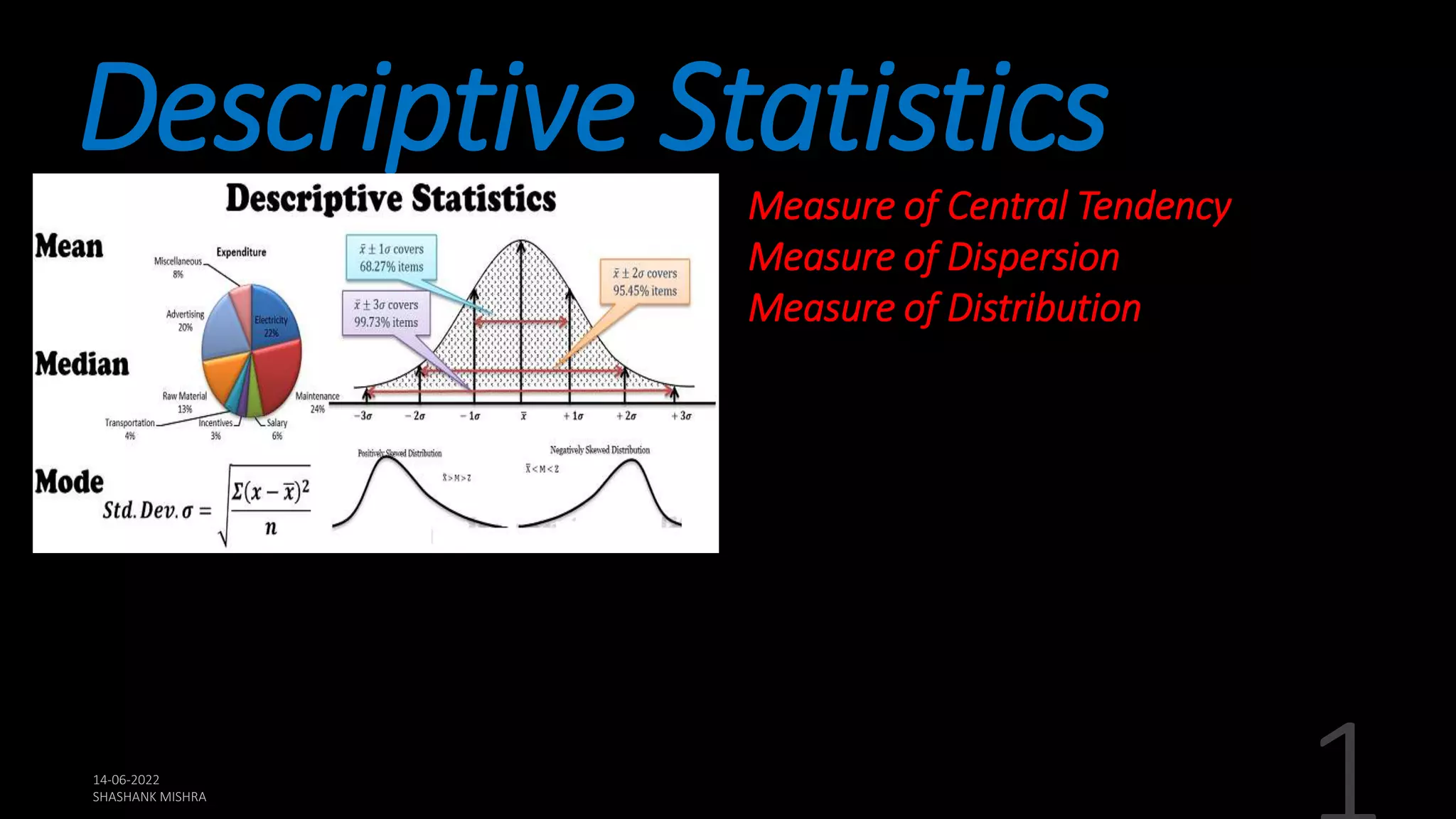
Measure of Central Tendency
Measure of Dispersion
Measure of Distribution
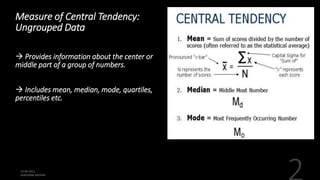
Measure of Central Tendency:
Ungrouped Data
 Provides information about the center or
middle part of a group of numbers.
 Includes mean, median, mode, quartiles,
percentiles etc.
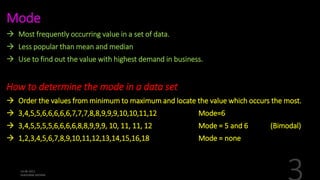
Mode
 Most frequently occurring value in a set of data.
 Less popular than mean and median
 Use to find out the value with highest demand in business.
How to determine the mode in a data set
 Order the values from minimum to maximum and locate the value which occurs the most.
 3,4,5,5,6,6,6,6,6,7,7,7,8,8,9,9,9,10,10,11,12 Mode=6
 3,4,5,5,5,5,6,6,6,6,8,8,9,9,9, 10, 11, 11, 12 Mode = 5 and 6 (Bimodal)
 1,2,3,4,5,6,7,8,9,10,11,12,13,14,15,16,18 Mode = none
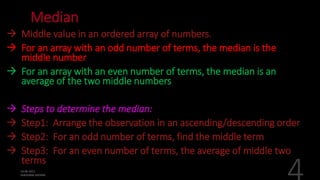
Median
 Middle value in an ordered array of numbers.
 For an array with an odd number of terms, the median is the
middle number
 For an array with an even number of terms, the median is an
average of the two middle numbers
 Steps to determine the median:
 Step1: Arrange the observation in an ascending/descending order
 Step2: For an odd number of terms, find the middle term
 Step3: For an even number of terms, the average of middle two
terms
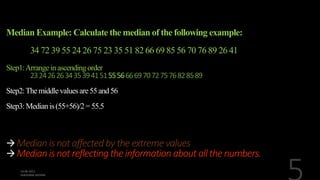
Median Example: Calculate the median of the following example:
34 72 39 55 24 26 75 23 35 51 82 66 69 85 56 70 76 89 26 41
Step1:Arrange inascendingorder
2324262634353941515556666970727576828589
Step2:Themiddlevaluesare55and56
Step3:Medianis(55+56)/2= 55.5
Median is not affected by theextreme values
Median is not reflecting theinformation about all the numbers.
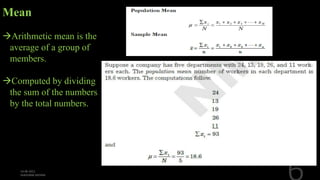
Mean
Arithmetic mean is the
average of a group of
members.
Computed by dividing
the sum of the numbers
by the total numbers.
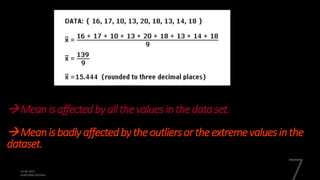
Meanisaffectedbyallthevaluesinthedataset.
Meanisbadlyaffectedbytheoutliersortheextremevaluesinthe
dataset.
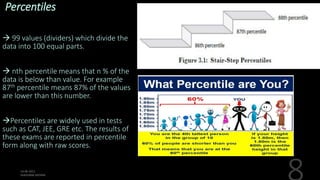
Percentiles
 99 values (dividers) which divide the
data into 100 equal parts.
 nth percentile means that n % of the
data is below than value. For example
87th percentile means 87% of the values
are lower than this number.
Percentiles are widely used in tests
such as CAT, JEE, GRE etc. The results of
these exams are reported in percentile
form along with raw scores.
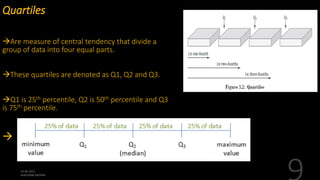
Quartiles
Are measure of central tendency that divide a
group of data into four equal parts.
These quartiles are denoted as Q1, Q2 and Q3.
Q1 is 25th percentile, Q2 is 50th percentile and Q3
is 75th percentile.

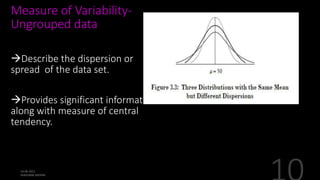
Measure of Variability-
Ungrouped data
Describe the dispersion or
spread of the data set.
Provides significant information
along with measure of central
tendency.
Range and Interquartile range
Range is the difference between the largest value of a data set and the smallest value of the
data set.
Easy to compute
Not considered as a good measure as it considers the extreme values of the dataset.
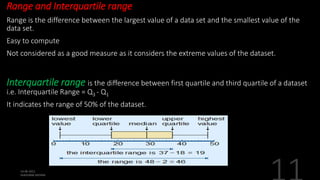
Interquartile range is the difference between first quartile and third quartile of a dataset
i.e. Interquartile Range = Q3 - Q1
It indicates the range of 50% of the dataset.
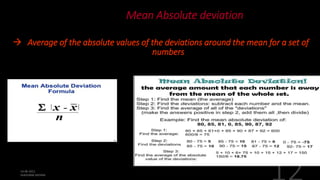
Mean Absolute deviation
 Average of the absolute values of the deviations around the mean for a set of
numbers
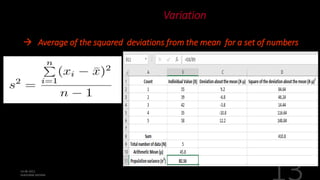
Variation
 Average of the squared deviations from the mean for a set of numbers
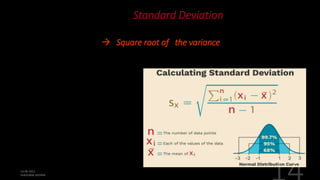
Standard Deviation
 Square root of the variance
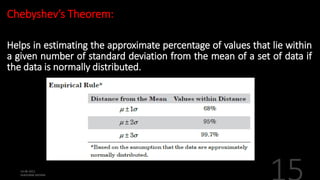
Chebyshev’s Theorem:
Helps in estimating the approximate percentage of values that lie within
a given number of standard deviation from the mean of a set of data if
the data is normally distributed.
Chebyshev’s theorem
statesthatatleast1–1/k2valueswillfallwithin+standarddeviationofthe
meanregardlessoftheshapeofthedistribution
Assuming the average weight of 56 kg and standard deviation of 10 kg.
Estimate that how much proportion of the population lie within the
range of mean + 2 * SD
a. If the distribution is normal.
b. If the distribution is not normal.
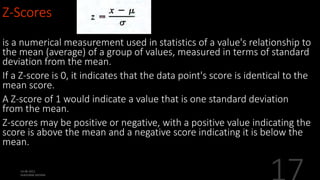
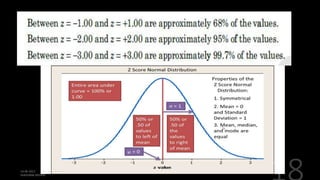
Z-Scores
is a numerical measurement used in statistics of a value's relationship to
the mean (average) of a group of values, measured in terms of standard
deviation from the mean.
If a Z-score is 0, it indicates that the data point's score is identical to the
mean score.
A Z-score of 1 would indicate a value that is one standard deviation
from the mean.
Z-scores may be positive or negative, with a positive value indicating the
score is above the mean and a negative score indicating it is below the
mean.
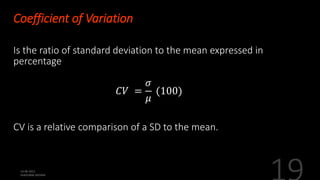
Coefficient of Variation
Is the ratio of standard deviation to the mean expressed in
percentage
𝐶𝑉 =
𝜎
𝜇
(100)
CV is a relative comparison of a SD to the mean.
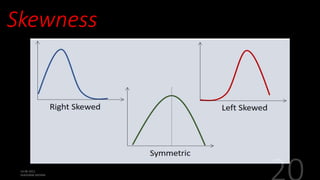
Skewness
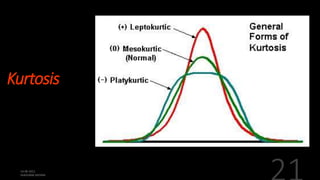
Kurtosis
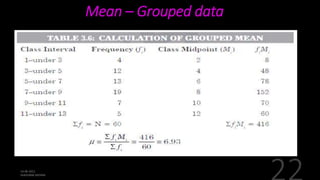
Mean – Grouped data
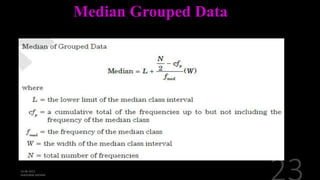
Median Grouped Data
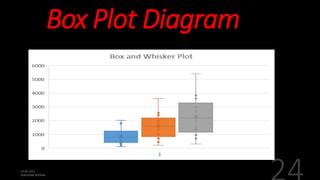
Box Plot Diagram
Thankyou

Descriptive Statistics.pptx

  • 1.
    Descriptive Statistics Measure ofCentral Tendency Measure of Dispersion Measure of Distribution
  • 2.
    Measure of CentralTendency: Ungrouped Data  Provides information about the center or middle part of a group of numbers.  Includes mean, median, mode, quartiles, percentiles etc.
  • 3.
    Mode  Most frequentlyoccurring value in a set of data.  Less popular than mean and median  Use to find out the value with highest demand in business. How to determine the mode in a data set  Order the values from minimum to maximum and locate the value which occurs the most.  3,4,5,5,6,6,6,6,6,7,7,7,8,8,9,9,9,10,10,11,12 Mode=6  3,4,5,5,5,5,6,6,6,6,8,8,9,9,9, 10, 11, 11, 12 Mode = 5 and 6 (Bimodal)  1,2,3,4,5,6,7,8,9,10,11,12,13,14,15,16,18 Mode = none
  • 4.
    Median  Middle valuein an ordered array of numbers.  For an array with an odd number of terms, the median is the middle number  For an array with an even number of terms, the median is an average of the two middle numbers  Steps to determine the median:  Step1: Arrange the observation in an ascending/descending order  Step2: For an odd number of terms, find the middle term  Step3: For an even number of terms, the average of middle two terms
  • 5.
    Median Example: Calculatethe median of the following example: 34 72 39 55 24 26 75 23 35 51 82 66 69 85 56 70 76 89 26 41 Step1:Arrange inascendingorder 2324262634353941515556666970727576828589 Step2:Themiddlevaluesare55and56 Step3:Medianis(55+56)/2= 55.5 Median is not affected by theextreme values Median is not reflecting theinformation about all the numbers.
  • 6.
    Mean Arithmetic mean isthe average of a group of members. Computed by dividing the sum of the numbers by the total numbers.
  • 7.
  • 8.
    Percentiles  99 values(dividers) which divide the data into 100 equal parts.  nth percentile means that n % of the data is below than value. For example 87th percentile means 87% of the values are lower than this number. Percentiles are widely used in tests such as CAT, JEE, GRE etc. The results of these exams are reported in percentile form along with raw scores.
  • 9.
    Quartiles Are measure ofcentral tendency that divide a group of data into four equal parts. These quartiles are denoted as Q1, Q2 and Q3. Q1 is 25th percentile, Q2 is 50th percentile and Q3 is 75th percentile. 
  • 10.
    Measure of Variability- Ungroupeddata Describe the dispersion or spread of the data set. Provides significant information along with measure of central tendency.
  • 11.
    Range and Interquartilerange Range is the difference between the largest value of a data set and the smallest value of the data set. Easy to compute Not considered as a good measure as it considers the extreme values of the dataset. Interquartile range is the difference between first quartile and third quartile of a dataset i.e. Interquartile Range = Q3 - Q1 It indicates the range of 50% of the dataset.
  • 12.
    Mean Absolute deviation Average of the absolute values of the deviations around the mean for a set of numbers
  • 13.
    Variation  Average ofthe squared deviations from the mean for a set of numbers
  • 14.
    Standard Deviation  Squareroot of the variance
  • 15.
    Chebyshev’s Theorem: Helps inestimating the approximate percentage of values that lie within a given number of standard deviation from the mean of a set of data if the data is normally distributed.
  • 16.
    Chebyshev’s theorem statesthatatleast1–1/k2valueswillfallwithin+standarddeviationofthe meanregardlessoftheshapeofthedistribution Assuming theaverage weight of 56 kg and standard deviation of 10 kg. Estimate that how much proportion of the population lie within the range of mean + 2 * SD a. If the distribution is normal. b. If the distribution is not normal.
  • 17.
    Z-Scores is a numericalmeasurement used in statistics of a value's relationship to the mean (average) of a group of values, measured in terms of standard deviation from the mean. If a Z-score is 0, it indicates that the data point's score is identical to the mean score. A Z-score of 1 would indicate a value that is one standard deviation from the mean. Z-scores may be positive or negative, with a positive value indicating the score is above the mean and a negative score indicating it is below the mean.
  • 19.
    Coefficient of Variation Isthe ratio of standard deviation to the mean expressed in percentage 𝐶𝑉 = 𝜎 𝜇 (100) CV is a relative comparison of a SD to the mean.
  • 20.
  • 21.
  • 22.
  • 23.
  • 24.
  • 25.