Measures of Dispersion
Measures of variation measure
the variation present among the
values of a data set, so measures
of variation are measures of
spread of values in the data.
1
2
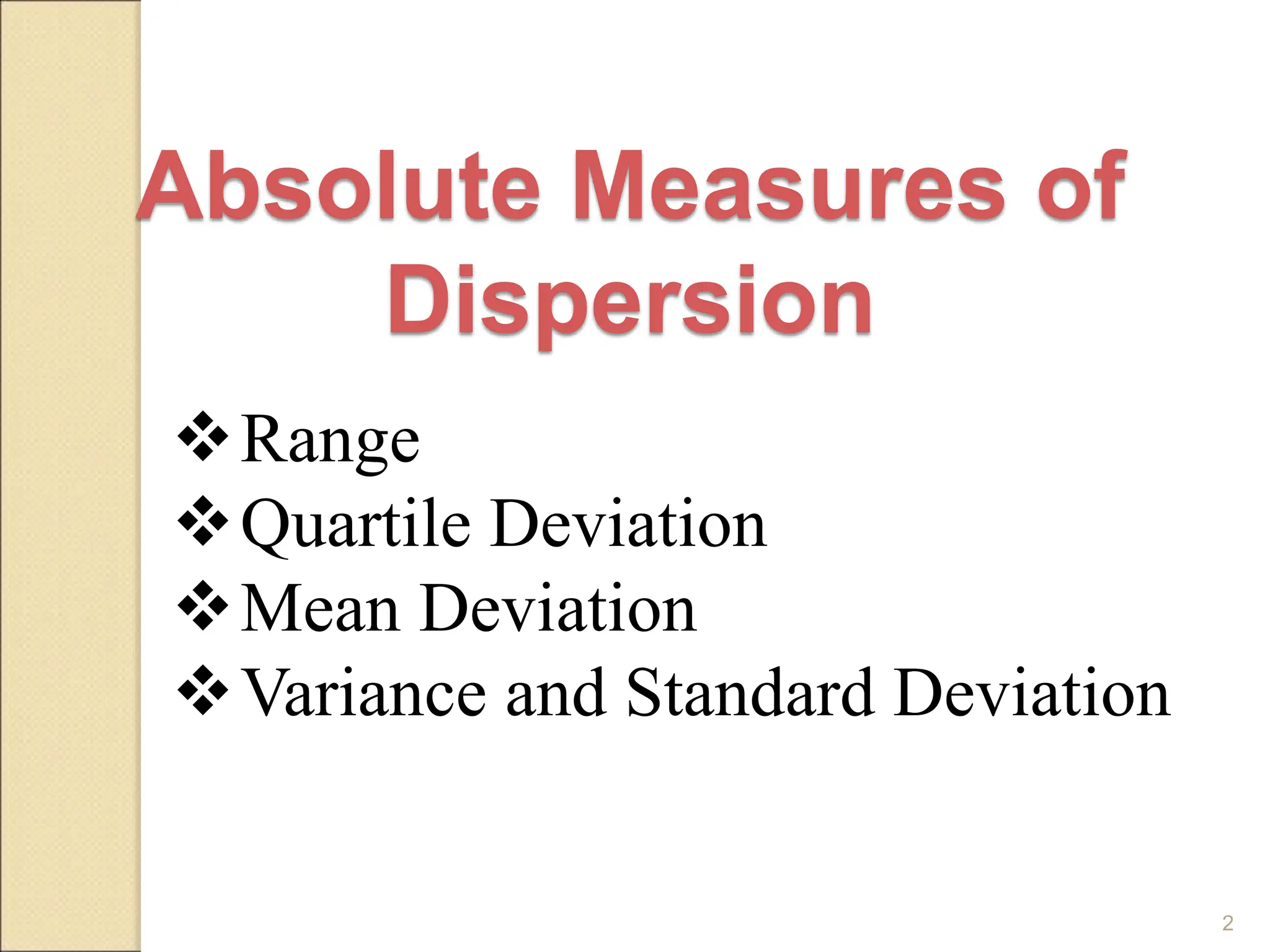
Absolute Measures of
Dispersion
Range
Quartile Deviation
Mean Deviation
Variance and Standard Deviation
Range
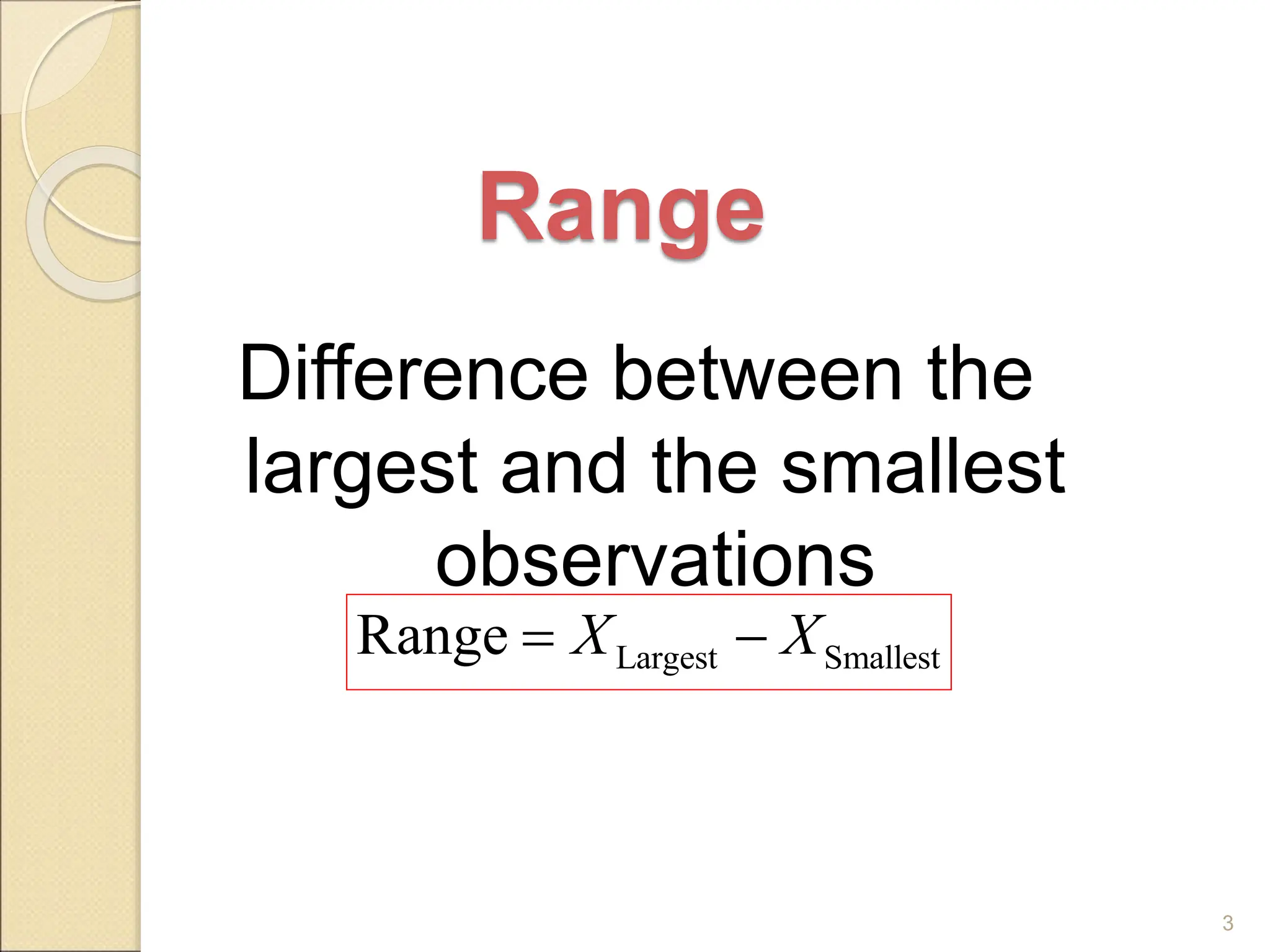
Difference between the
largest and the smallest
observations
3
Largest Smallest
Range X X
 
Disadvantages of the Range
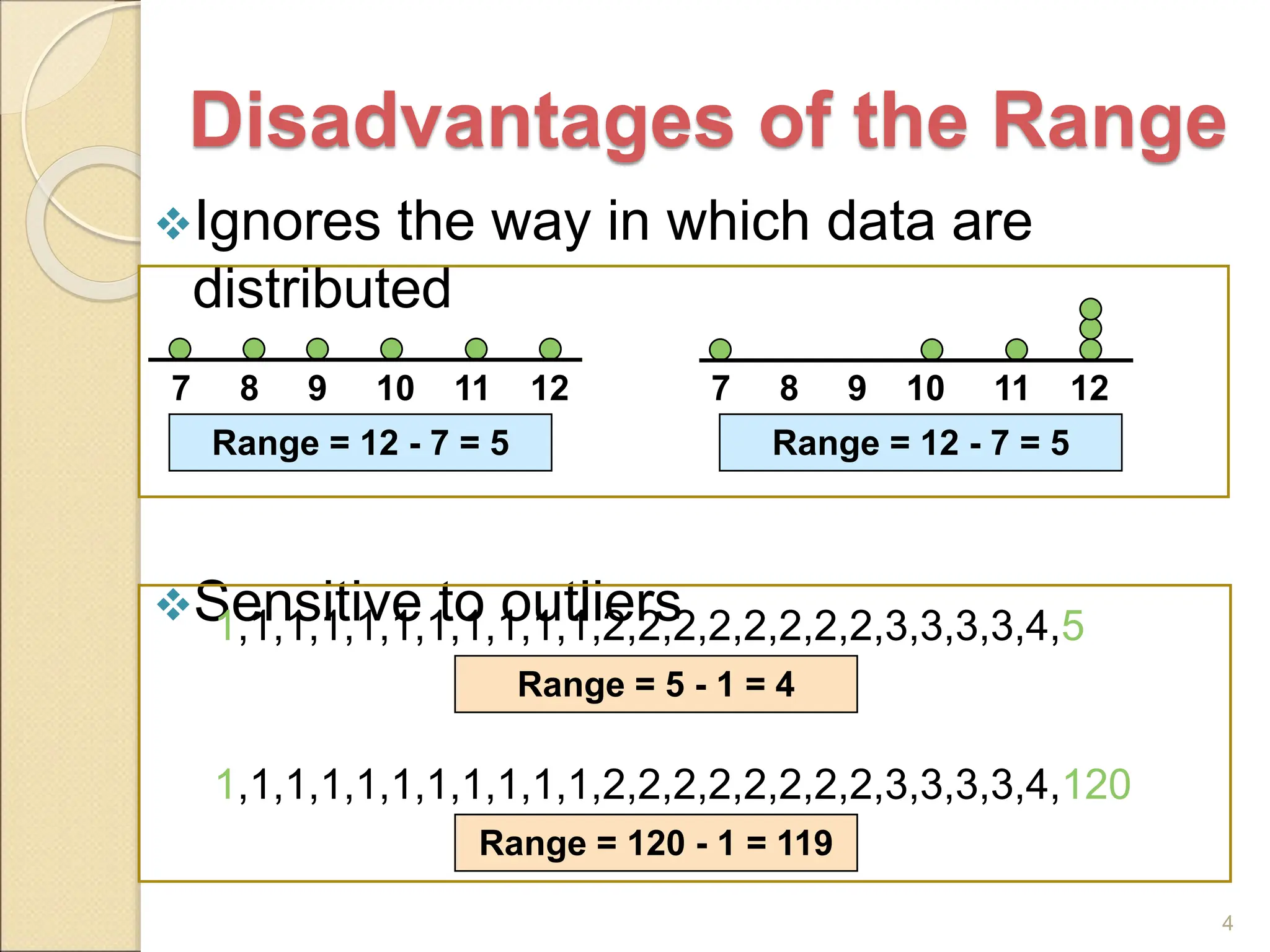
Ignores the way in which data are
distributed
Sensitive to outliers
4
7 8 9 10 11 12
Range = 12 - 7 = 5
7 8 9 10 11 12
Range = 12 - 7 = 5
1,1,1,1,1,1,1,1,1,1,1,2,2,2,2,2,2,2,2,3,3,3,3,4,5
1,1,1,1,1,1,1,1,1,1,1,2,2,2,2,2,2,2,2,3,3,3,3,4,120
Range = 5 - 1 = 4
Range = 120 - 1 = 119
Variance
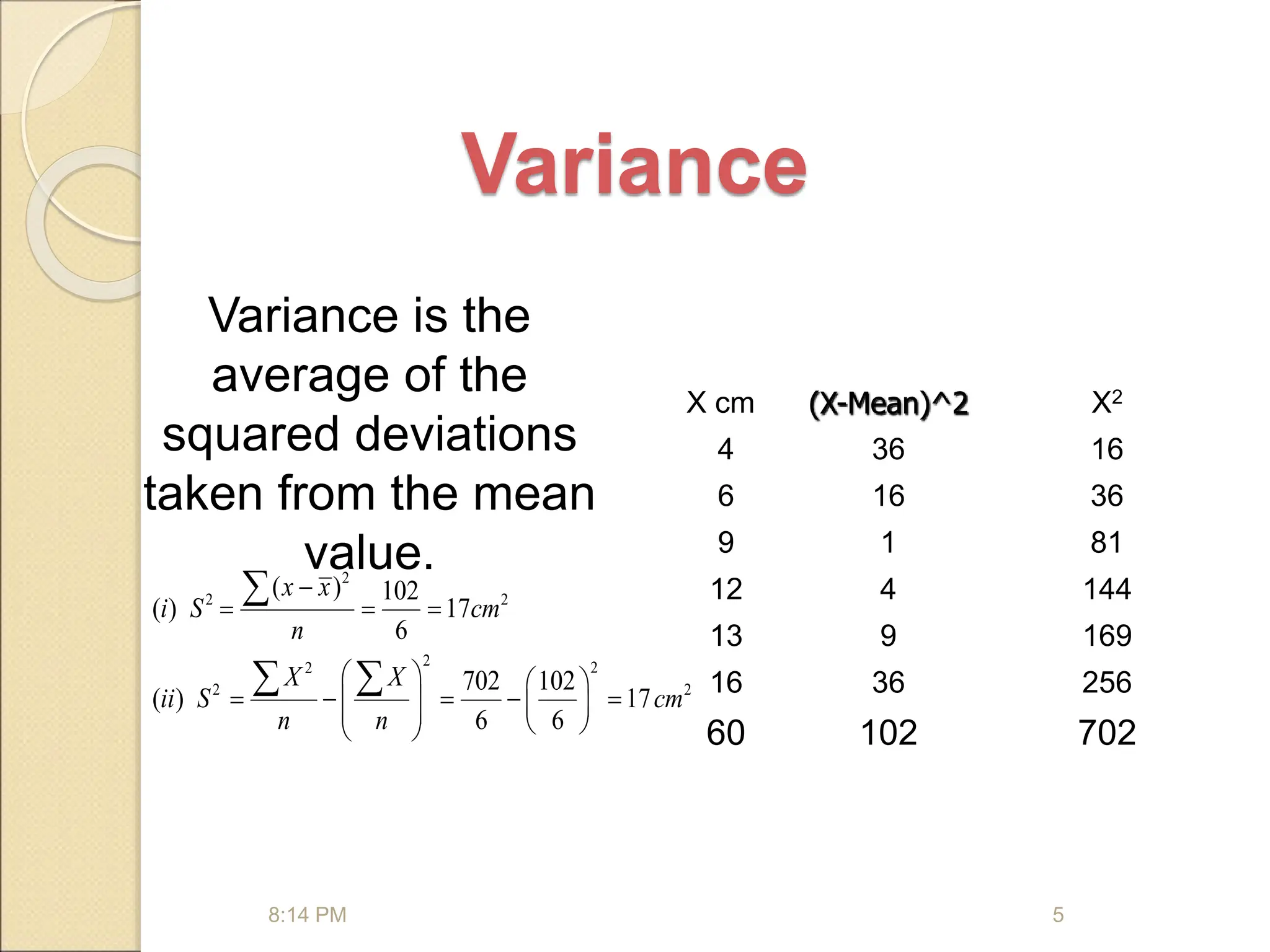
Variance is the
average of the
squared deviations
taken from the mean
value.
2
2 2
2 2
2
2 2
( ) 102
( ) 17
6
702 102
( ) 17
6 6
x x
i S cm
n
X X
ii S cm
n n

  
   
    
   
   
 

 
8:14 PM 5
X cm (X-Mean)^2 X2
4 36 16
6 16 36
9 1 81
12 4 144
13 9 169
16 36 256
60 102 702
Standard Deviation
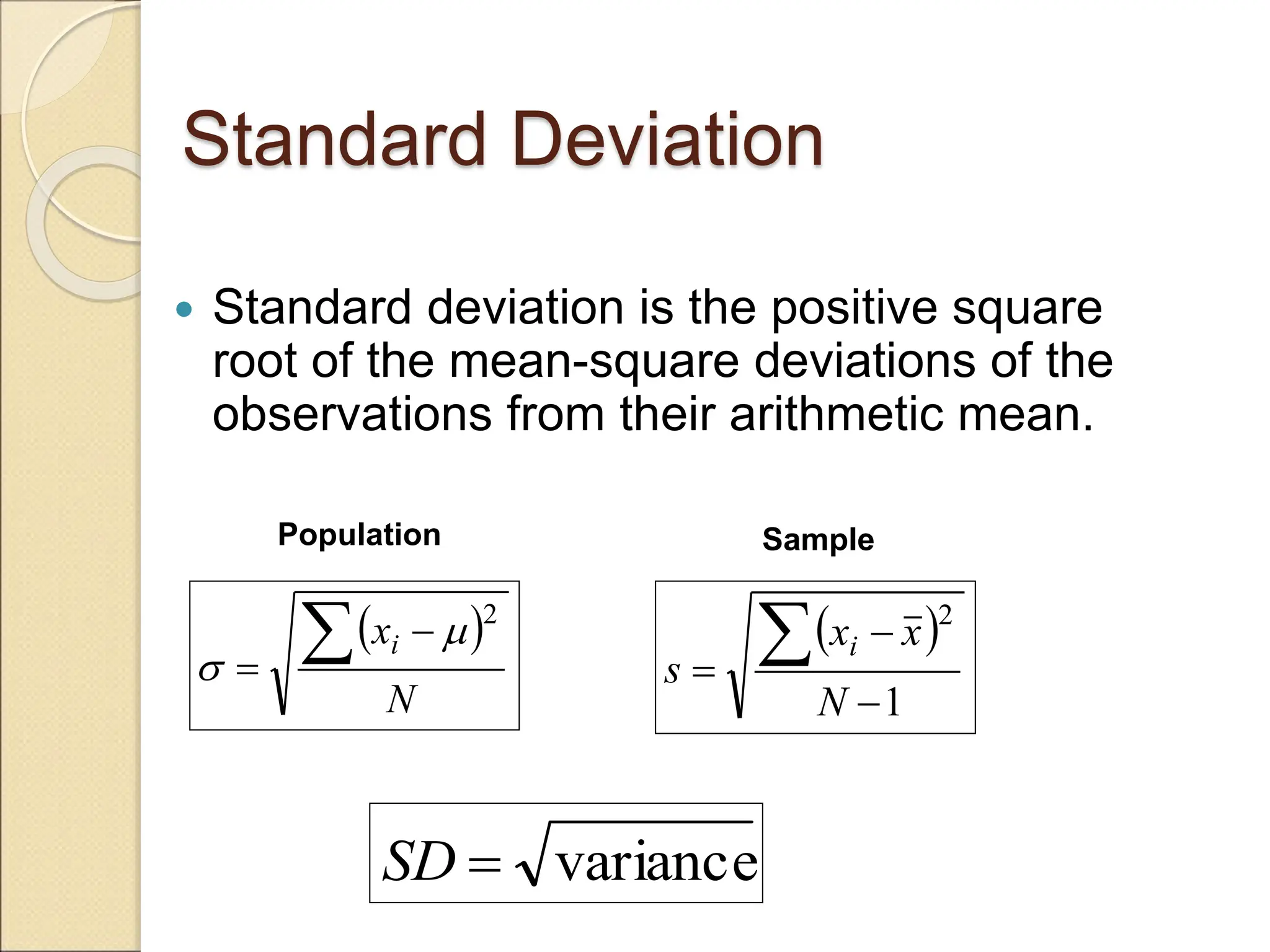
 Standard deviation is the positive square
root of the mean-square deviations of the
observations from their arithmetic mean.
variance

SD
 
1
2




N
x
x
s
i
 
N
xi
 

2


Population Sample
Standard Deviation for Group
Data
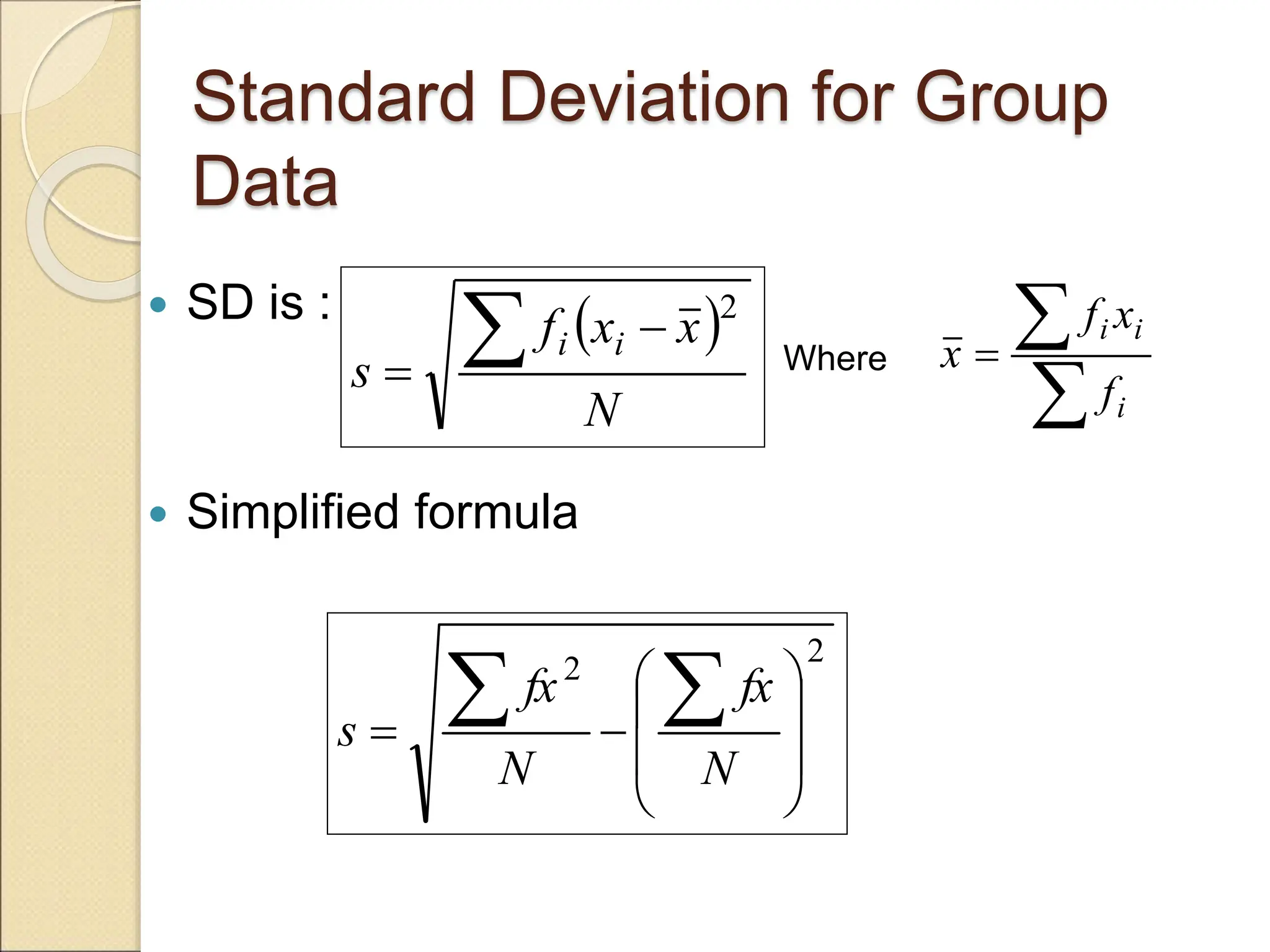
 SD is :
 Simplified formula
2
2












N
fx
N
fx
s
 
N
x
x
f
s
i
i
 

2



i
i
i
f
x
f
x
Where
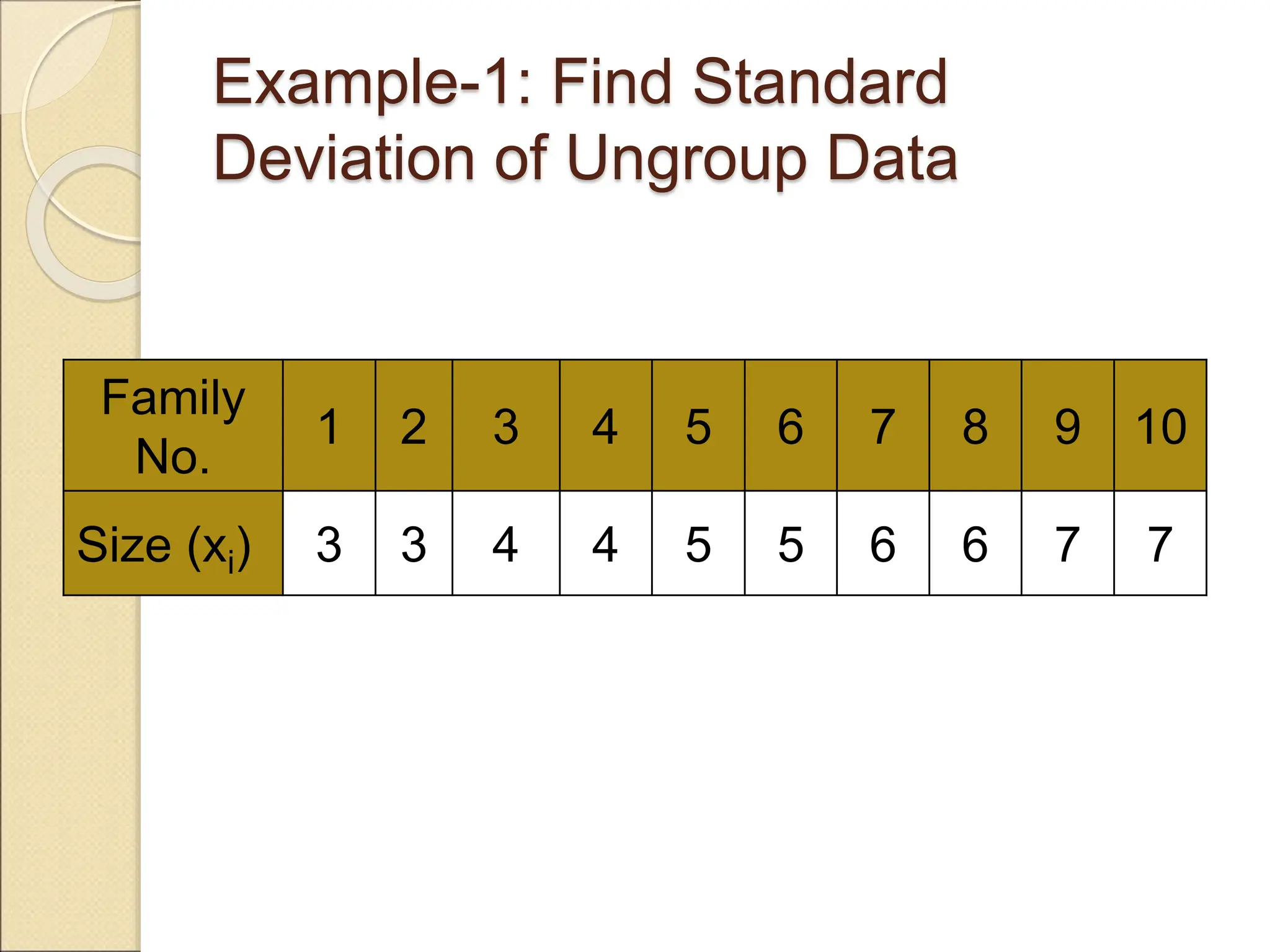
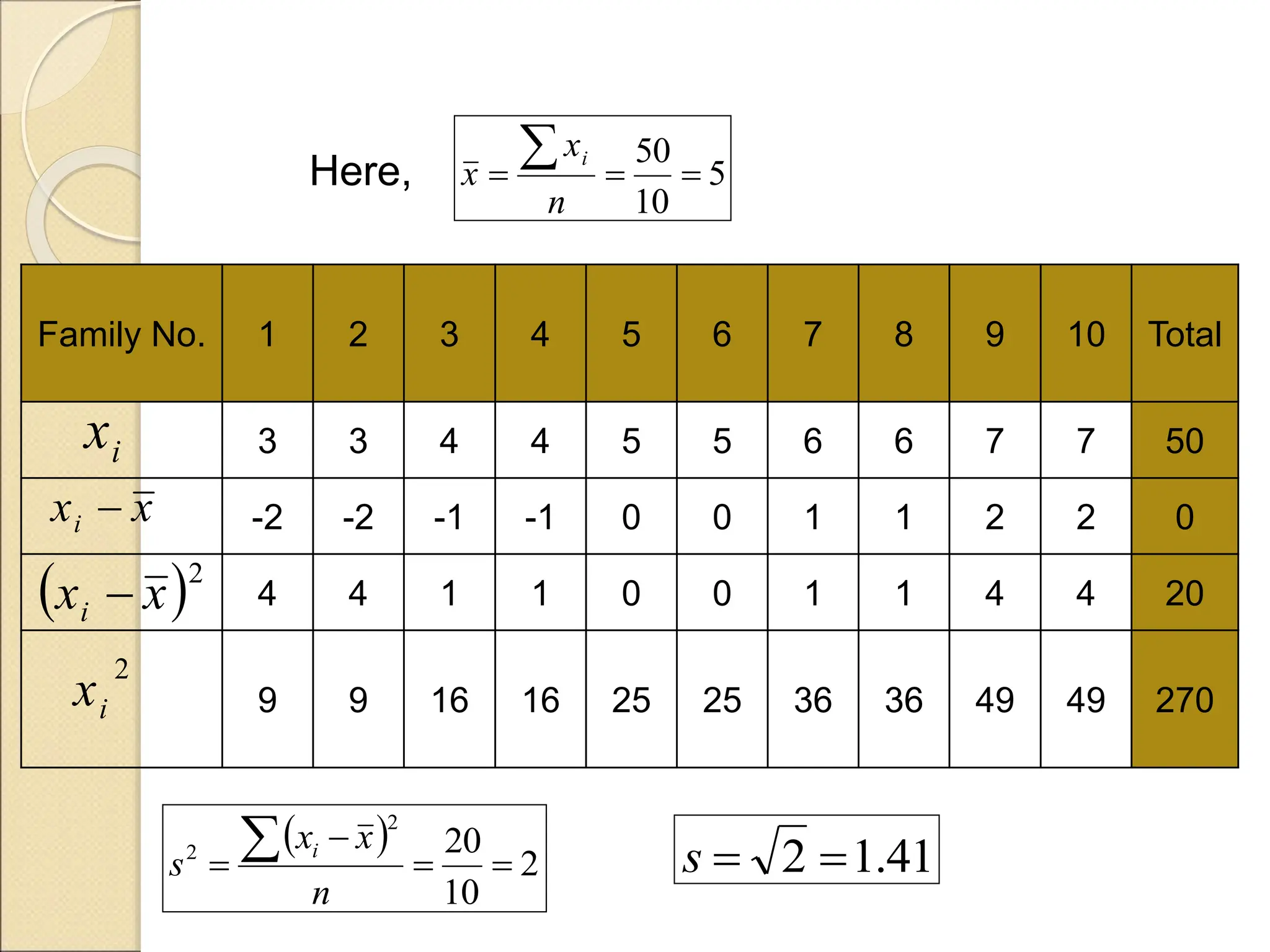
Example-1: Find Standard
Deviation of Ungroup Data
Family
No.
1 2 3 4 5 6 7 8 9 10
Size (xi) 3 3 4 4 5 5 6 6 7 7
i
x
x
xi 
 2
x
xi 
2
i
x
Family No. 1 2 3 4 5 6 7 8 9 10 Total
3 3 4 4 5 5 6 6 7 7 50
-2 -2 -1 -1 0 0 1 1 2 2 0
4 4 1 1 0 0 1 1 4 4 20
9 9 16 16 25 25 36 36 49 49 270
5
10
50




n
x
x
i
 
2
10
20
2
2





n
x
x
s i
41
.
1
2 

s
Here,
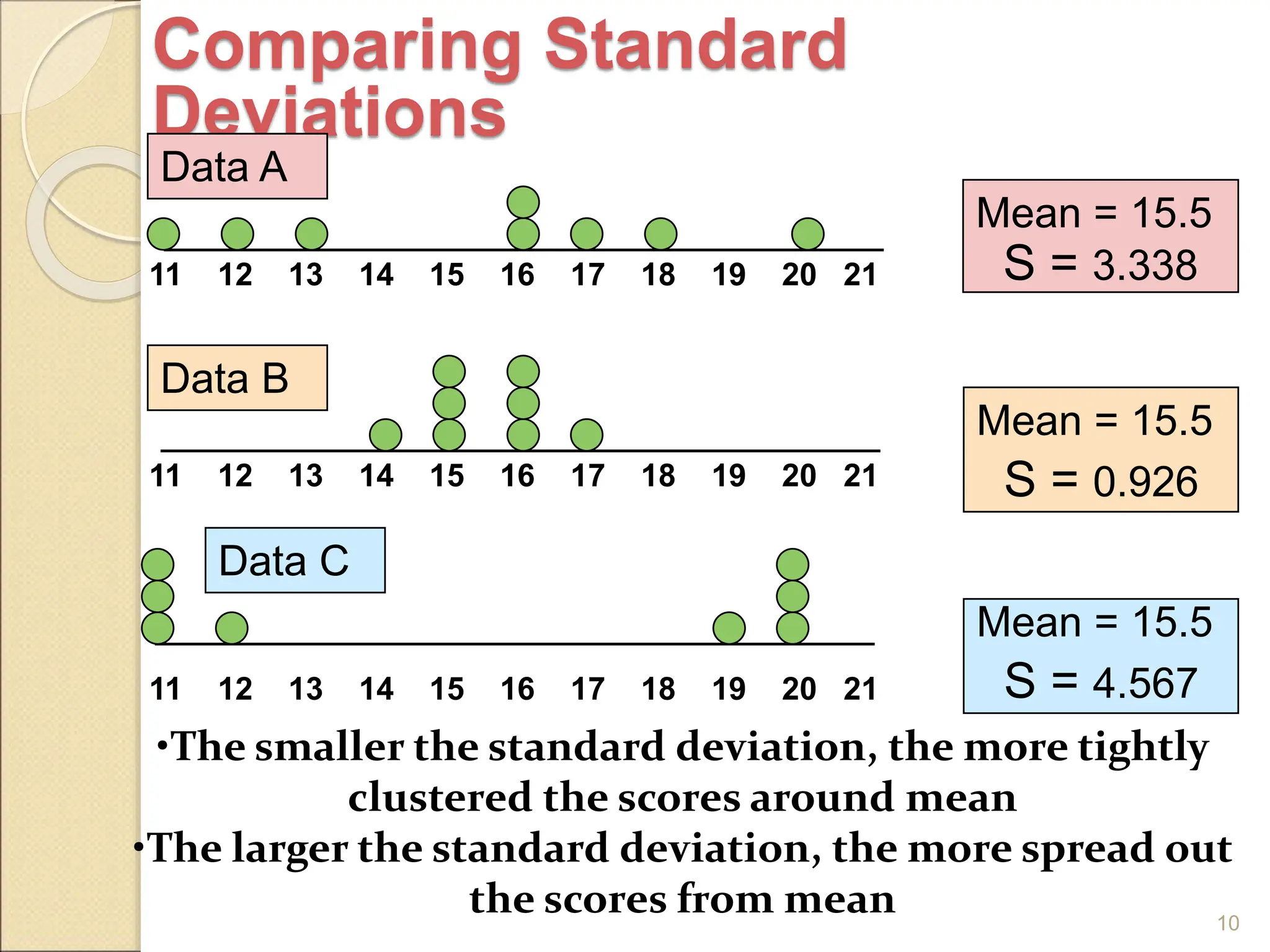
Comparing Standard
Deviations
10
Mean = 15.5
S = 3.338
11 12 13 14 15 16 17 18 19 20 21
Data A
11 12 13 14 15 16 17 18 19 20 21
Mean = 15.5
S = 4.567
Data C
•The smaller the standard deviation, the more tightly
clustered the scores around mean
•The larger the standard deviation, the more spread out
the scores from mean
11 12 13 14 15 16 17 18 19 20 21
Data B
Mean = 15.5
S = 0.926
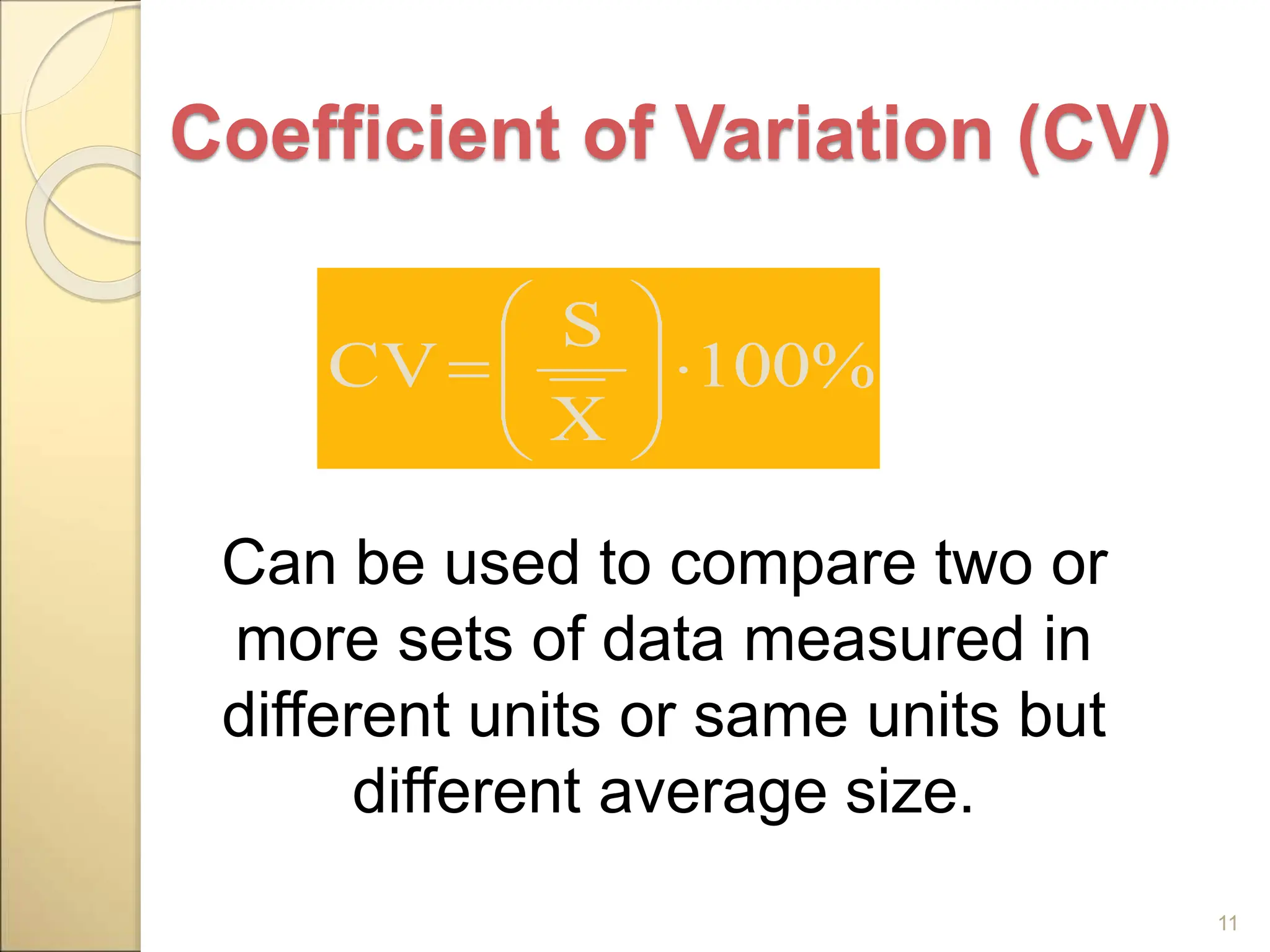
Coefficient of Variation (CV)
Can be used to compare two or
more sets of data measured in
different units or same units but
different average size.
11
100%
X
S
CV 









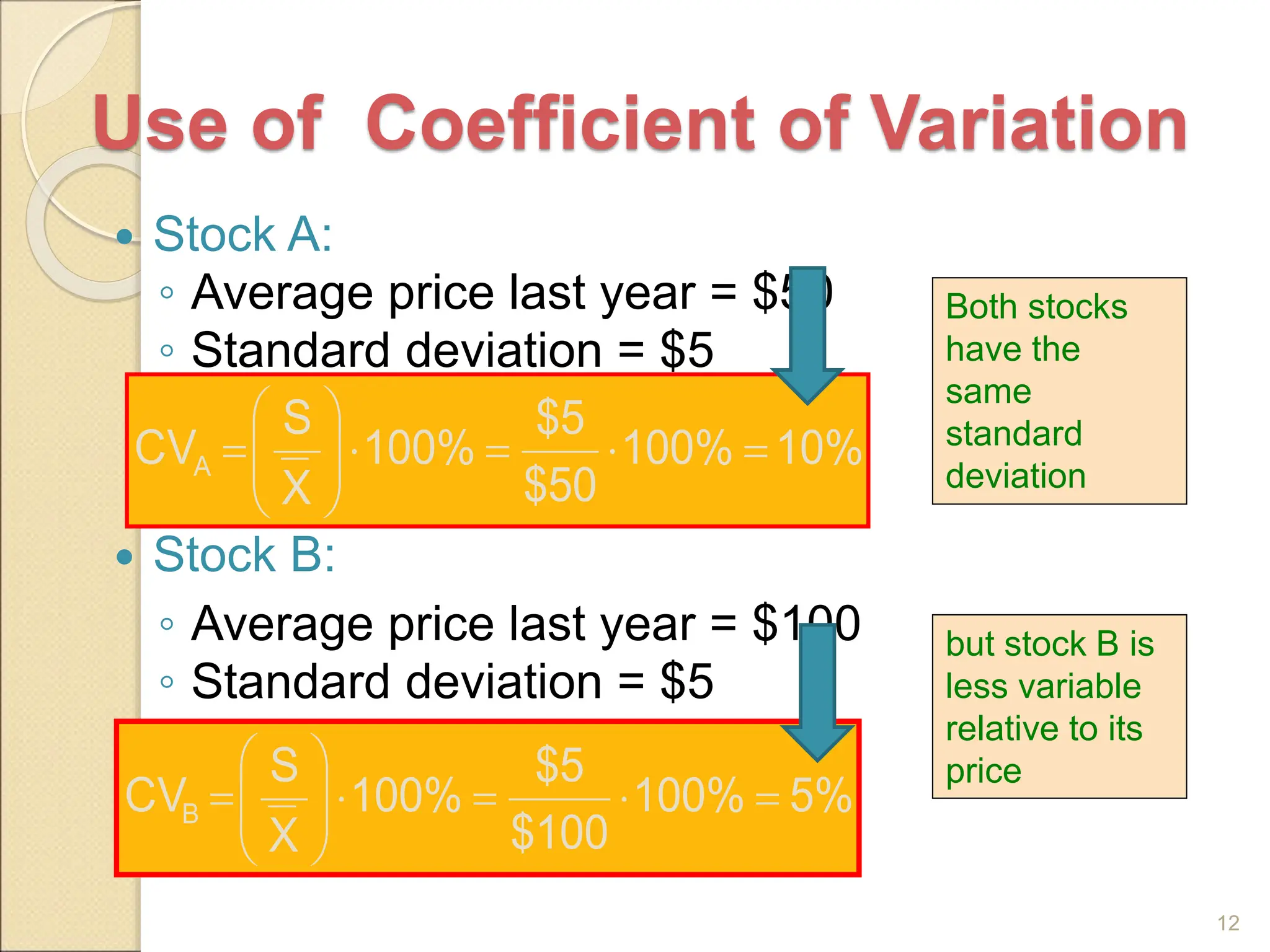
Use of Coefficient of Variation
 Stock A:
◦ Average price last year = $50
◦ Standard deviation = $5
 Stock B:
◦ Average price last year = $100
◦ Standard deviation = $5
12
but stock B is
less variable
relative to its
price
10%
100%
$50
$5
100%
X
S
CVA 












5%
100%
$100
$5
100%
X
S
CVB 












Both stocks
have the
same
standard
deviation
values
of
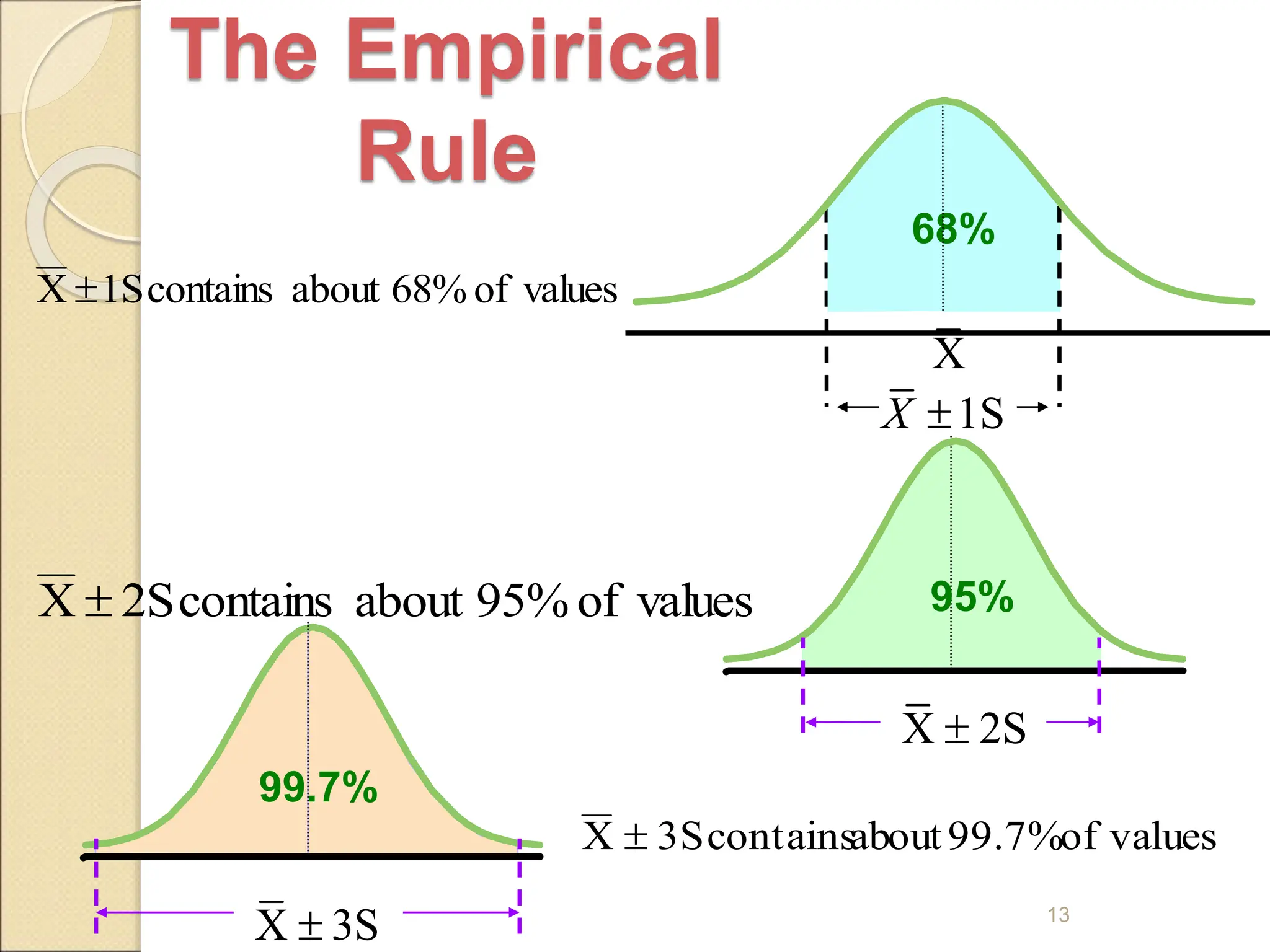
68%
about
contains
1S
X 
values
of
99.7%
about
contains
3S
X 
13
The Empirical
Rule
X
68%
1S
X 
values
of
95%
about
contains
2S
X  95%
X 2S

X 3S

99.7%
14
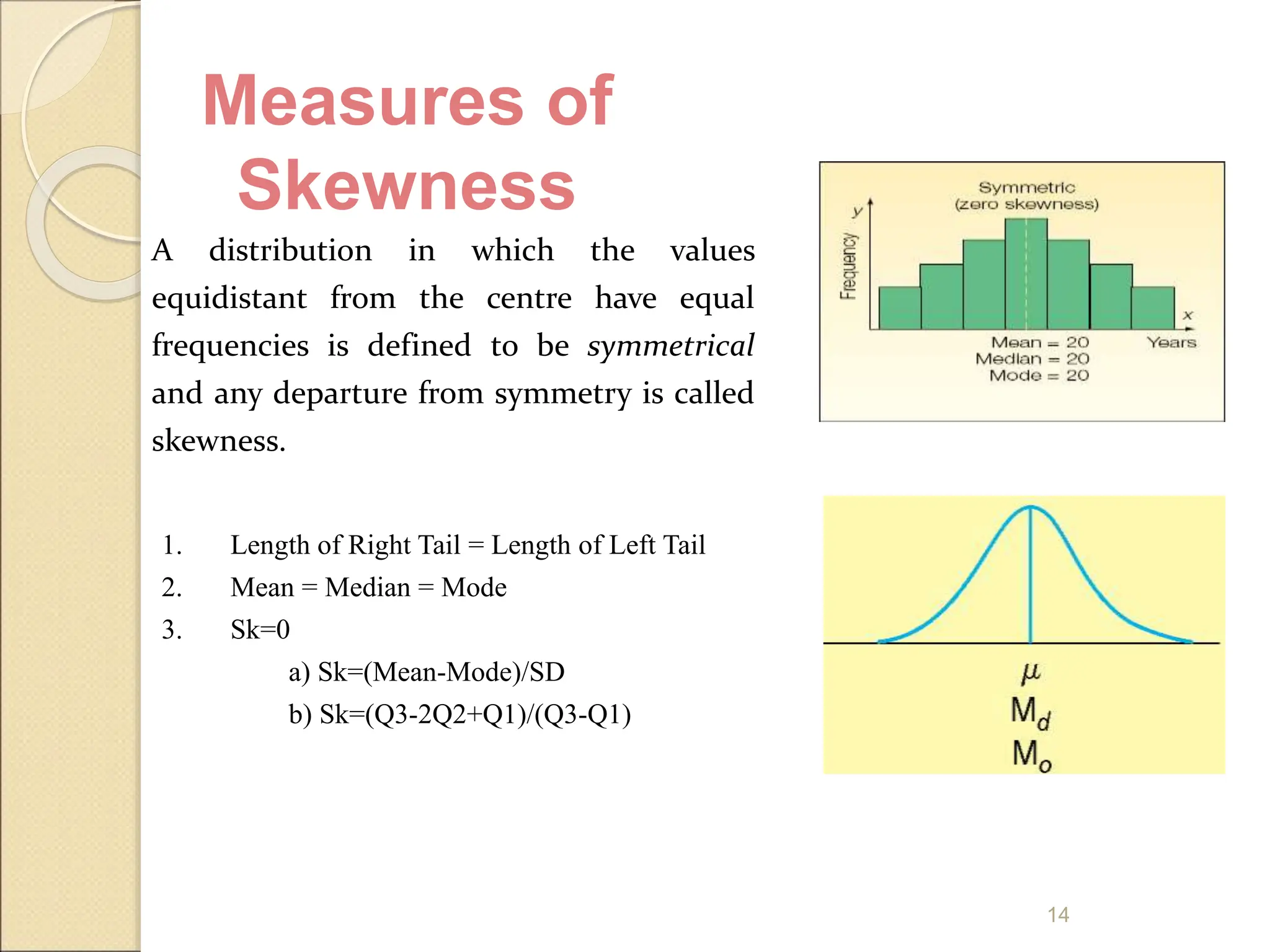
A distribution in which the values
equidistant from the centre have equal
frequencies is defined to be symmetrical
and any departure from symmetry is called
skewness.
1. Length of Right Tail = Length of Left Tail
2. Mean = Median = Mode
3. Sk=0
a) Sk=(Mean-Mode)/SD
b) Sk=(Q3-2Q2+Q1)/(Q3-Q1)
Measures of
Skewness
15
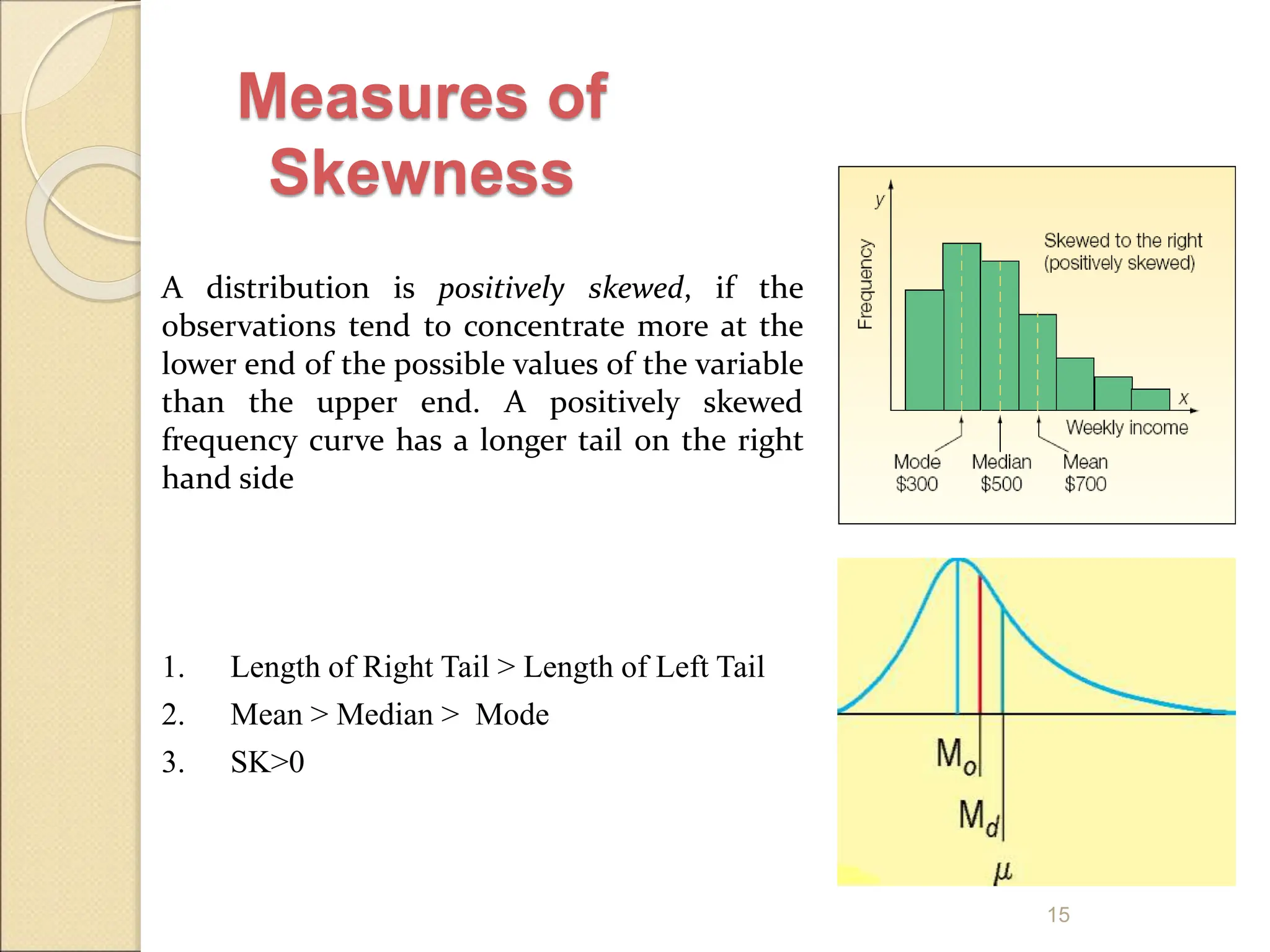
A distribution is positively skewed, if the
observations tend to concentrate more at the
lower end of the possible values of the variable
than the upper end. A positively skewed
frequency curve has a longer tail on the right
hand side
1. Length of Right Tail > Length of Left Tail
2. Mean > Median > Mode
3. SK>0
Measures of
Skewness
16
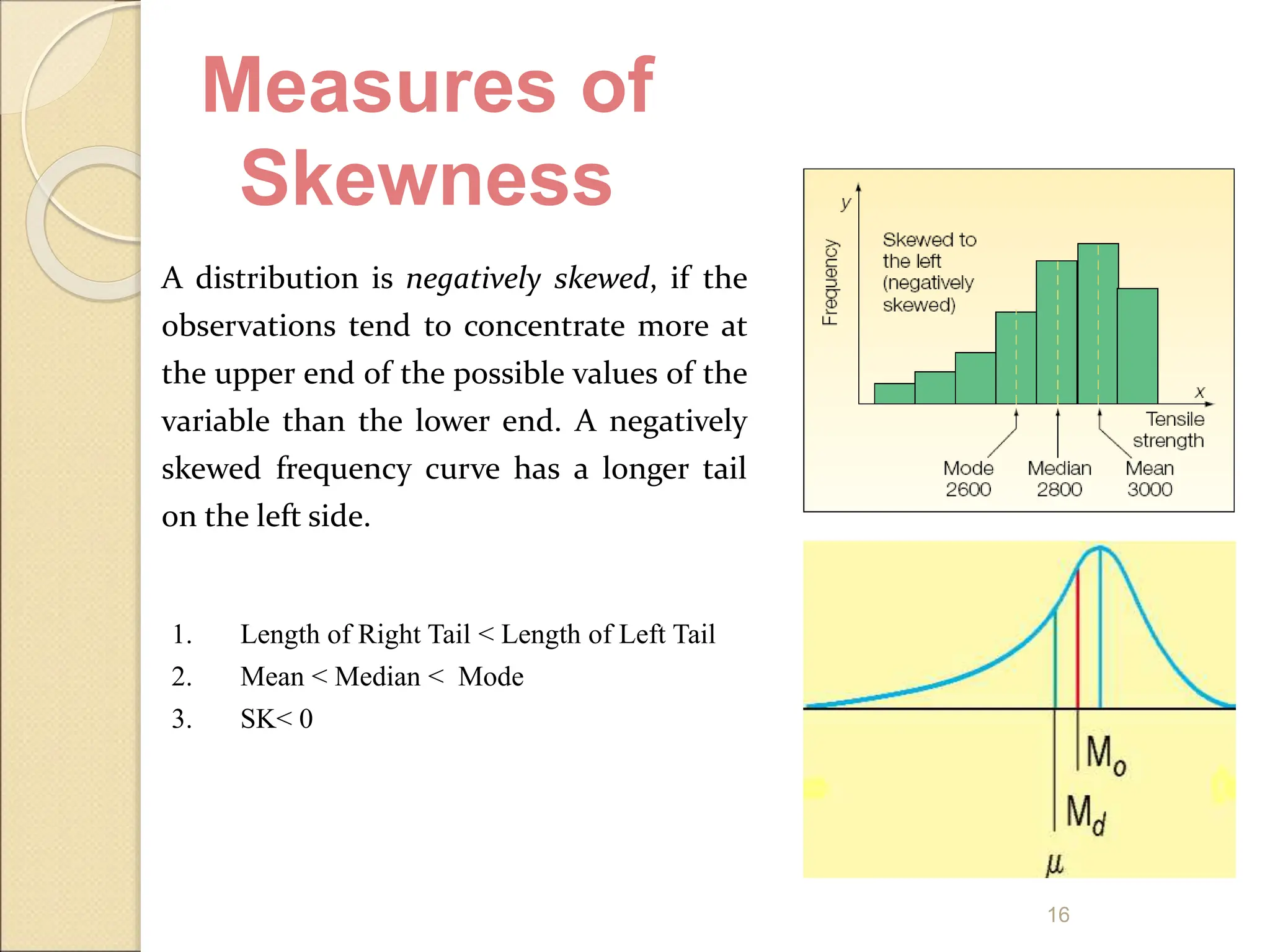
A distribution is negatively skewed, if the
observations tend to concentrate more at
the upper end of the possible values of the
variable than the lower end. A negatively
skewed frequency curve has a longer tail
on the left side.
1. Length of Right Tail < Length of Left Tail
2. Mean < Median < Mode
3. SK< 0
Measures of
Skewness
17
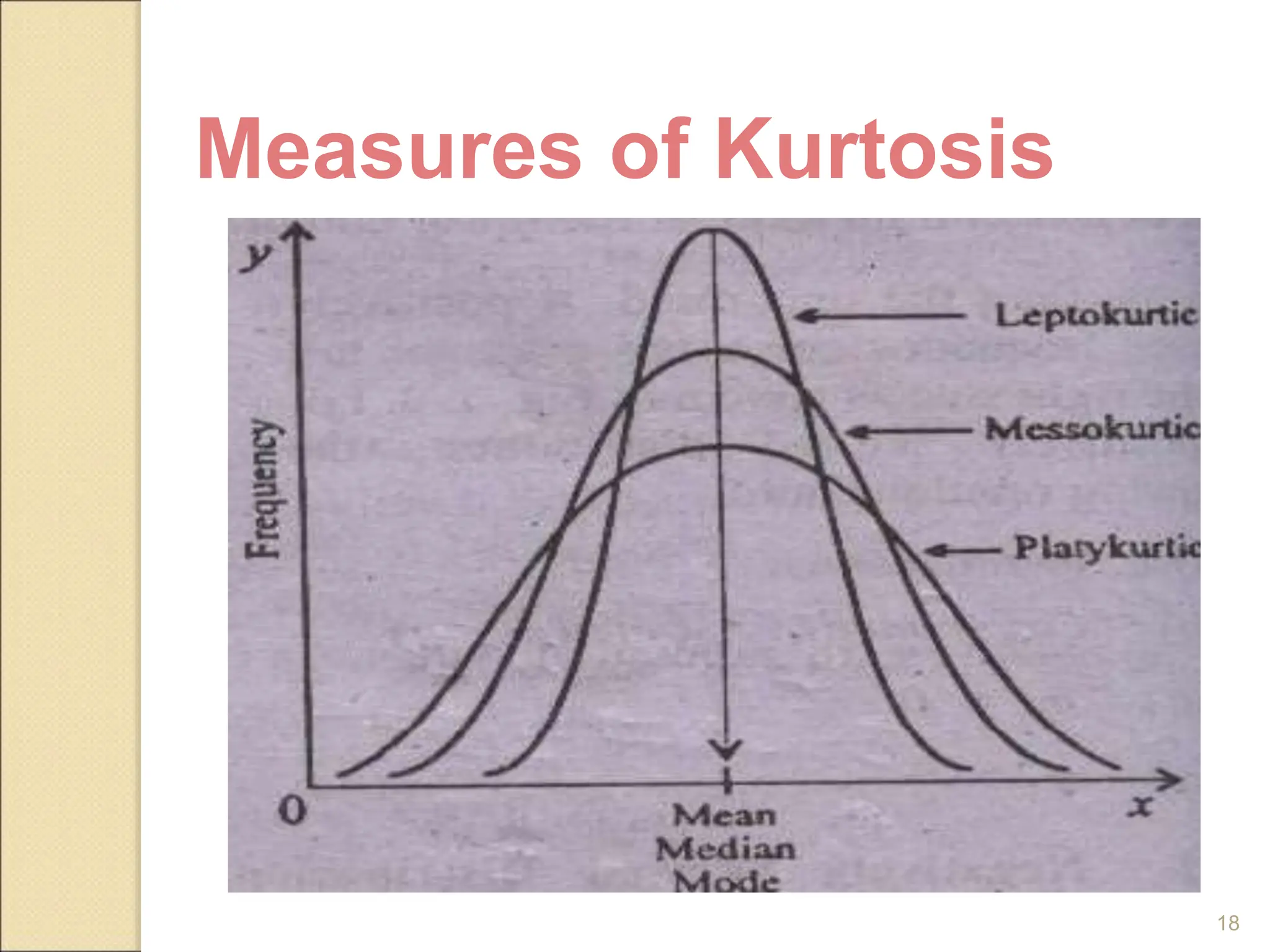
The Kurtosis is the degree of peakedness or flatness of a
unimodal (single humped) distribution,
• When the values of a variable are highly concentrated
around the mode, the peak of the curve becomes relatively
high; the curve is Leptokurtic.
• When the values of a variable have low concentration
around the mode, the peak of the curve becomes relatively
flat;curve is Platykurtic.
• A curve, which is neither very peaked nor very flat-toped,
it is taken as a basis for comparison, is called
Mesokurtic/Normal.
Measures of Kurtosis
18
Measures of Kurtosis

250380111-Measures-of-Dispersion-ppt.ppt

  • 1.
    Measures of Dispersion Measuresof variation measure the variation present among the values of a data set, so measures of variation are measures of spread of values in the data. 1
  • 2.
    2 Absolute Measures of Dispersion Range QuartileDeviation Mean Deviation Variance and Standard Deviation
  • 3.
    Range Difference between the largestand the smallest observations 3 Largest Smallest Range X X  
  • 4.
    Disadvantages of theRange Ignores the way in which data are distributed Sensitive to outliers 4 7 8 9 10 11 12 Range = 12 - 7 = 5 7 8 9 10 11 12 Range = 12 - 7 = 5 1,1,1,1,1,1,1,1,1,1,1,2,2,2,2,2,2,2,2,3,3,3,3,4,5 1,1,1,1,1,1,1,1,1,1,1,2,2,2,2,2,2,2,2,3,3,3,3,4,120 Range = 5 - 1 = 4 Range = 120 - 1 = 119
  • 5.
    Variance Variance is the averageof the squared deviations taken from the mean value. 2 2 2 2 2 2 2 2 ( ) 102 ( ) 17 6 702 102 ( ) 17 6 6 x x i S cm n X X ii S cm n n                           8:14 PM 5 X cm (X-Mean)^2 X2 4 36 16 6 16 36 9 1 81 12 4 144 13 9 169 16 36 256 60 102 702
  • 6.
    Standard Deviation  Standarddeviation is the positive square root of the mean-square deviations of the observations from their arithmetic mean. variance  SD   1 2     N x x s i   N xi    2   Population Sample
  • 7.
    Standard Deviation forGroup Data  SD is :  Simplified formula 2 2             N fx N fx s   N x x f s i i    2    i i i f x f x Where
  • 8.
    Example-1: Find Standard Deviationof Ungroup Data Family No. 1 2 3 4 5 6 7 8 9 10 Size (xi) 3 3 4 4 5 5 6 6 7 7
  • 9.
    i x x xi   2 x xi 2 i x Family No. 1 2 3 4 5 6 7 8 9 10 Total 3 3 4 4 5 5 6 6 7 7 50 -2 -2 -1 -1 0 0 1 1 2 2 0 4 4 1 1 0 0 1 1 4 4 20 9 9 16 16 25 25 36 36 49 49 270 5 10 50     n x x i   2 10 20 2 2      n x x s i 41 . 1 2   s Here,
  • 10.
    Comparing Standard Deviations 10 Mean =15.5 S = 3.338 11 12 13 14 15 16 17 18 19 20 21 Data A 11 12 13 14 15 16 17 18 19 20 21 Mean = 15.5 S = 4.567 Data C •The smaller the standard deviation, the more tightly clustered the scores around mean •The larger the standard deviation, the more spread out the scores from mean 11 12 13 14 15 16 17 18 19 20 21 Data B Mean = 15.5 S = 0.926
  • 11.
    Coefficient of Variation(CV) Can be used to compare two or more sets of data measured in different units or same units but different average size. 11 100% X S CV          
  • 12.
    Use of Coefficientof Variation  Stock A: ◦ Average price last year = $50 ◦ Standard deviation = $5  Stock B: ◦ Average price last year = $100 ◦ Standard deviation = $5 12 but stock B is less variable relative to its price 10% 100% $50 $5 100% X S CVA              5% 100% $100 $5 100% X S CVB              Both stocks have the same standard deviation
  • 13.
    values of 68% about contains 1S X  values of 99.7% about contains 3S X  13 TheEmpirical Rule X 68% 1S X  values of 95% about contains 2S X  95% X 2S  X 3S  99.7%
  • 14.
    14 A distribution inwhich the values equidistant from the centre have equal frequencies is defined to be symmetrical and any departure from symmetry is called skewness. 1. Length of Right Tail = Length of Left Tail 2. Mean = Median = Mode 3. Sk=0 a) Sk=(Mean-Mode)/SD b) Sk=(Q3-2Q2+Q1)/(Q3-Q1) Measures of Skewness
  • 15.
    15 A distribution ispositively skewed, if the observations tend to concentrate more at the lower end of the possible values of the variable than the upper end. A positively skewed frequency curve has a longer tail on the right hand side 1. Length of Right Tail > Length of Left Tail 2. Mean > Median > Mode 3. SK>0 Measures of Skewness
  • 16.
    16 A distribution isnegatively skewed, if the observations tend to concentrate more at the upper end of the possible values of the variable than the lower end. A negatively skewed frequency curve has a longer tail on the left side. 1. Length of Right Tail < Length of Left Tail 2. Mean < Median < Mode 3. SK< 0 Measures of Skewness
  • 17.
    17 The Kurtosis isthe degree of peakedness or flatness of a unimodal (single humped) distribution, • When the values of a variable are highly concentrated around the mode, the peak of the curve becomes relatively high; the curve is Leptokurtic. • When the values of a variable have low concentration around the mode, the peak of the curve becomes relatively flat;curve is Platykurtic. • A curve, which is neither very peaked nor very flat-toped, it is taken as a basis for comparison, is called Mesokurtic/Normal. Measures of Kurtosis
  • 18.