Hypertext and History
Prof. Alvarado
MDST 3703
1 October 2013
Business
• Quizzes due before class on Thursday
Review: Text
• We began by looking at texts as isolated units
– stories, folktales, myths, dramas, etc.
• We showed how texts have been modeled
digitally, e.g. by OHCO, XML, TEI, HTML
• We also saw that the individual text is not
simple
– It has levels: Structure, Content, and Style
– It has overlapping structures
Review: Hypertext
• Last week, we saw that when viewed from the
perspective of the library, this model breaks
down
• Texts appear more as intersections in a
network of lexia rather than as stand-alone
objects
• The idea of hypertext decomposes the unitary
text as a temporary formation within a
universe of possibilities (the Library)
This week, we move from modeling
the text to the text as model
Text as a model of history
How are history and text related?
Historians tells stories
Stories, according to Aristotle,
describe action
What kind of action?
[The Action of Heroes]
So, histories tells stories about
people
They are also written from different
perspectives and motivations
What are some kinds of
perspectives?
[Great man theory]
The Great Man theory of history
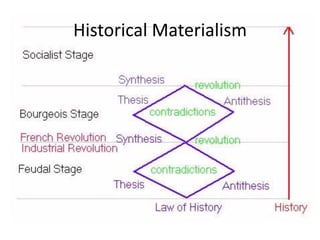
Historical Materialism
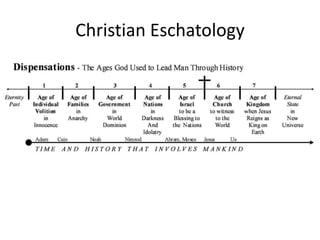
Christian Eschatology
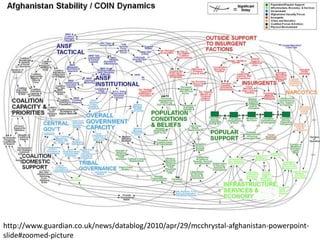
It’s Complicated
http://www.guardian.co.uk/news/datablog/2010/apr/29/mcchrystal-afghanistan-powerpoint-
slide#zoomed-picture
Are these kinds of history told in
the same way?
Is there a connection between
medium and message?
Let’s take art as an example
[Napoleon]
Picasso’s Guernica (1937)
[Guernica]
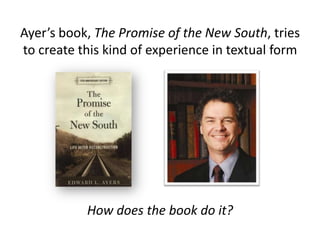
Ayer’s book, The Promise of the New South, tries
to create this kind of experience in textual form
How does the book do it?
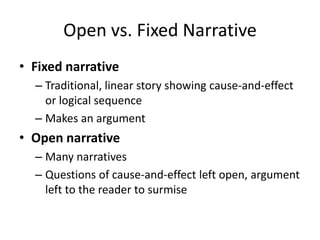
Open vs. Fixed Narrative
• Fixed narrative
– Traditional, linear story showing cause-and-effect
or logical sequence
– Makes an argument
• Open narrative
– Many narratives
– Questions of cause-and-effect left open, argument
left to the reader to surmise
[Quote]
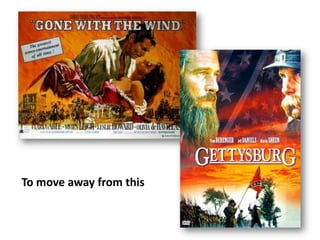
To move away from this
What from this course does this
opposition remind you of?
The problem of overlap
Competing narratives are like
overlapping structures
OHCO : Fixed Narrative
::
Structure : Content
What media form does Ayers
develop after Promise?
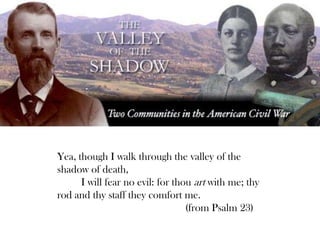
Yea, though I walk through the valley of the
shadow of death,
I will fear no evil: for thou art with me; thy
rod and thy staff they comfort me.
(from Psalm 23)
The Valley of the Shadow
moves beyond Promise
toward open narrative model
The database as radical hypertext
Back story: IATH
• Institute for Advanced Technology in the
Humanities
http://www.iath.virginia.edu
• Established in 1992
• Funded by IBM
• VOS one of two founding projects
• A demonstration project for IBM; pitched as "as a
research library in a box, enabling students at
places without a large archive to do the same
kind of research as a professional historian."
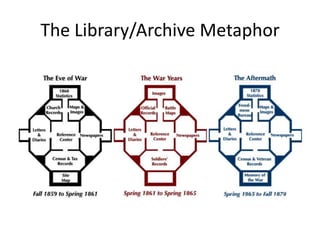
The Library/Archive Metaphor
What does the site contain?
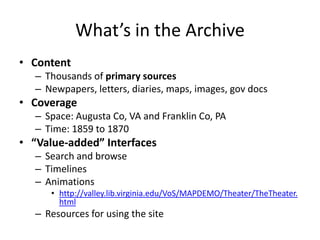
What’s in the Archive
• Content
– Thousands of primary sources
– Newpapers, letters, diaries, maps, images, gov docs
• Coverage
– Space: Augusta Co, VA and Franklin Co, PA
– Time: 1859 to 1870
• “Value-added” Interfaces
– Search and browse
– Timelines
– Animations
• http://valley.lib.virginia.edu/VoS/MAPDEMO/Theater/TheTheater.
html
– Resources for using the site
How hypertextual is the site?
How is “associative indexing”
handled?
(Associative indexing described by Bush as
function of Memex)
Site Structure
• Organized hierarchically
• Terminal nodes (lexia) not connected laterally
• No cross-site searching
• Minimal narrative
Does the site fulfill the goals of
open narrative?
No, Ayers put too much faith in
the database to produce the
desired effects
The Differences Slavery Made
An experimental form of
historical publication created in
response to criticisms of VOTS
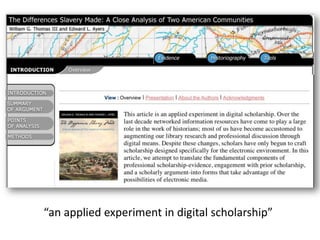
“an applied experiment in digital scholarship”
What is the specific problem that
TDSM tries to solve?
What was the experiment about?
To give full access to the
scholarly argument
and its evidence
And to relate the two
How were these
problems addressed by
Differences?
Technology
• XML is used to organize content
– The is is made from one big XML file, 24,000 lines long
– XML used to markup sources and argument
• XSL is used to transform content
– We are not learning XSL, but it is similar to CSS but
more powerful
• GIS is used for map data
– Geographic Information Systems
– Allows maps to display statistical data
Devices used by TDSM
• Narrative overlay (the Argument)
• References provided links to lexia
(Historiography and Evidence)
• Conventions for making citations
• Content divided into broad groups, reflecting
the craft of history
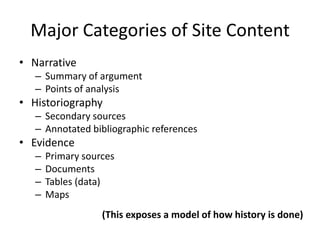
Major Categories of Site Content
• Narrative
– Summary of argument
– Points of analysis
• Historiography
– Secondary sources
– Annotated bibliographic references
• Evidence
– Primary sources
– Documents
– Tables (data)
– Maps
(This exposes a model of how history is done)
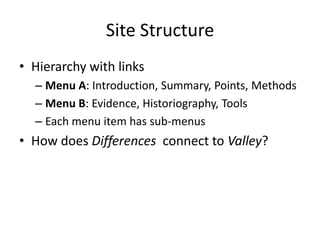
Site Structure
• Hierarchy with links
– Menu A: Introduction, Summary, Points, Methods
– Menu B: Evidence, Historiography, Tools
– Each menu item has sub-menus
• How does Differences connect to Valley?
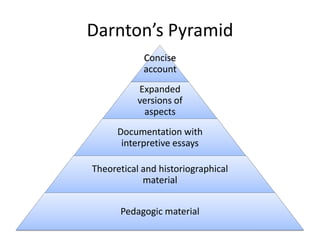
Darnton’s Pyramid
Concise
account
Expanded
versions of
aspects
Documentation with
interpretive essays
Theoretical and historiographical
material
Pedagogic material
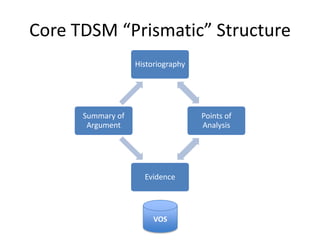
Core TDSM “Prismatic” Structure
Historiography
Points of
Analysis
Evidence
Summary of
Argument
VOS
How hypertextual is the site?
How is “associative indexing”
handled?
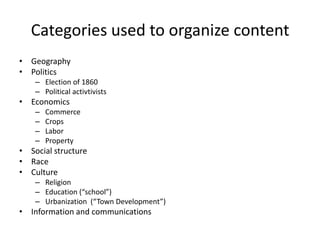
Categories used to organize content
• Geography
• Politics
– Election of 1860
– Political activtivists
• Economics
– Commerce
– Crops
– Labor
– Property
• Social structure
• Race
• Culture
– Religion
– Education (“school”)
– Urbanization (“Town Development”)
• Information and communications
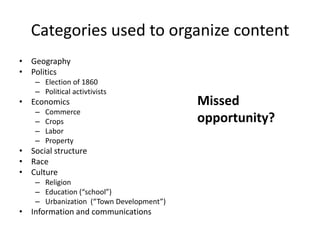
Categories used to organize content
• Geography
• Politics
– Election of 1860
– Political activtivists
• Economics
– Commerce
– Crops
– Labor
– Property
• Social structure
• Race
• Culture
– Religion
– Education (“school”)
– Urbanization (“Town Development”)
• Information and communications
Missed
opportunity?
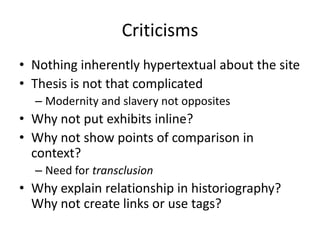
Criticisms
• Nothing inherently hypertextual about the site
• Thesis is not that complicated
– Modernity and slavery not opposites
• Why not put exhibits inline?
• Why not show points of comparison in
context?
– Need for transclusion
• Why explain relationship in historiography?
Why not create links or use tags?
Criticism
• Worst of both worlds
– Neither random access nor rich narrative
– Exploits neither the potentials of a real library or a
digital library
• Document-centric
– Subject matter remains buried in the documents
• It’s strength is in the integrity of the materials
• But criticized for being difficult to use
• Is it scholarship?
Themes
• The site exposes the process of history as a
form of storytelling
• We move from narrative to database to hyper-
narrative
• How would you improve the site?

Mdst3703 2013-10-01-hypertext-and-history

  • 1.
    Hypertext and History Prof.Alvarado MDST 3703 1 October 2013
  • 2.
    Business • Quizzes duebefore class on Thursday
  • 3.
    Review: Text • Webegan by looking at texts as isolated units – stories, folktales, myths, dramas, etc. • We showed how texts have been modeled digitally, e.g. by OHCO, XML, TEI, HTML • We also saw that the individual text is not simple – It has levels: Structure, Content, and Style – It has overlapping structures
  • 4.
    Review: Hypertext • Lastweek, we saw that when viewed from the perspective of the library, this model breaks down • Texts appear more as intersections in a network of lexia rather than as stand-alone objects • The idea of hypertext decomposes the unitary text as a temporary formation within a universe of possibilities (the Library)
  • 5.
    This week, wemove from modeling the text to the text as model Text as a model of history How are history and text related?
  • 6.
    Historians tells stories Stories,according to Aristotle, describe action What kind of action?
  • 7.
  • 8.
    So, histories tellsstories about people They are also written from different perspectives and motivations What are some kinds of perspectives?
  • 9.
    [Great man theory] TheGreat Man theory of history
  • 10.
  • 11.
  • 12.
  • 13.
    Are these kindsof history told in the same way?
  • 14.
    Is there aconnection between medium and message? Let’s take art as an example
  • 15.
  • 16.
  • 17.
    Ayer’s book, ThePromise of the New South, tries to create this kind of experience in textual form How does the book do it?
  • 18.
    Open vs. FixedNarrative • Fixed narrative – Traditional, linear story showing cause-and-effect or logical sequence – Makes an argument • Open narrative – Many narratives – Questions of cause-and-effect left open, argument left to the reader to surmise
  • 19.
  • 20.
    To move awayfrom this
  • 21.
    What from thiscourse does this opposition remind you of?
  • 22.
    The problem ofoverlap Competing narratives are like overlapping structures OHCO : Fixed Narrative :: Structure : Content
  • 23.
    What media formdoes Ayers develop after Promise?
  • 24.
    Yea, though Iwalk through the valley of the shadow of death, I will fear no evil: for thou art with me; thy rod and thy staff they comfort me. (from Psalm 23)
  • 25.
    The Valley ofthe Shadow moves beyond Promise toward open narrative model The database as radical hypertext
  • 26.
    Back story: IATH •Institute for Advanced Technology in the Humanities http://www.iath.virginia.edu • Established in 1992 • Funded by IBM • VOS one of two founding projects • A demonstration project for IBM; pitched as "as a research library in a box, enabling students at places without a large archive to do the same kind of research as a professional historian."
  • 27.
  • 28.
    What does thesite contain?
  • 29.
    What’s in theArchive • Content – Thousands of primary sources – Newpapers, letters, diaries, maps, images, gov docs • Coverage – Space: Augusta Co, VA and Franklin Co, PA – Time: 1859 to 1870 • “Value-added” Interfaces – Search and browse – Timelines – Animations • http://valley.lib.virginia.edu/VoS/MAPDEMO/Theater/TheTheater. html – Resources for using the site
  • 30.
    How hypertextual isthe site? How is “associative indexing” handled? (Associative indexing described by Bush as function of Memex)
  • 31.
    Site Structure • Organizedhierarchically • Terminal nodes (lexia) not connected laterally • No cross-site searching • Minimal narrative
  • 32.
    Does the sitefulfill the goals of open narrative?
  • 33.
    No, Ayers puttoo much faith in the database to produce the desired effects
  • 35.
    The Differences SlaveryMade An experimental form of historical publication created in response to criticisms of VOTS
  • 36.
    “an applied experimentin digital scholarship”
  • 37.
    What is thespecific problem that TDSM tries to solve? What was the experiment about?
  • 38.
    To give fullaccess to the scholarly argument and its evidence And to relate the two
  • 39.
    How were these problemsaddressed by Differences?
  • 40.
    Technology • XML isused to organize content – The is is made from one big XML file, 24,000 lines long – XML used to markup sources and argument • XSL is used to transform content – We are not learning XSL, but it is similar to CSS but more powerful • GIS is used for map data – Geographic Information Systems – Allows maps to display statistical data
  • 41.
    Devices used byTDSM • Narrative overlay (the Argument) • References provided links to lexia (Historiography and Evidence) • Conventions for making citations • Content divided into broad groups, reflecting the craft of history
  • 42.
    Major Categories ofSite Content • Narrative – Summary of argument – Points of analysis • Historiography – Secondary sources – Annotated bibliographic references • Evidence – Primary sources – Documents – Tables (data) – Maps (This exposes a model of how history is done)
  • 43.
    Site Structure • Hierarchywith links – Menu A: Introduction, Summary, Points, Methods – Menu B: Evidence, Historiography, Tools – Each menu item has sub-menus • How does Differences connect to Valley?
  • 44.
    Darnton’s Pyramid Concise account Expanded versions of aspects Documentationwith interpretive essays Theoretical and historiographical material Pedagogic material
  • 45.
    Core TDSM “Prismatic”Structure Historiography Points of Analysis Evidence Summary of Argument VOS
  • 46.
    How hypertextual isthe site? How is “associative indexing” handled?
  • 47.
    Categories used toorganize content • Geography • Politics – Election of 1860 – Political activtivists • Economics – Commerce – Crops – Labor – Property • Social structure • Race • Culture – Religion – Education (“school”) – Urbanization (“Town Development”) • Information and communications
  • 48.
    Categories used toorganize content • Geography • Politics – Election of 1860 – Political activtivists • Economics – Commerce – Crops – Labor – Property • Social structure • Race • Culture – Religion – Education (“school”) – Urbanization (“Town Development”) • Information and communications Missed opportunity?
  • 49.
    Criticisms • Nothing inherentlyhypertextual about the site • Thesis is not that complicated – Modernity and slavery not opposites • Why not put exhibits inline? • Why not show points of comparison in context? – Need for transclusion • Why explain relationship in historiography? Why not create links or use tags?
  • 50.
    Criticism • Worst ofboth worlds – Neither random access nor rich narrative – Exploits neither the potentials of a real library or a digital library • Document-centric – Subject matter remains buried in the documents • It’s strength is in the integrity of the materials • But criticized for being difficult to use • Is it scholarship?
  • 51.
    Themes • The siteexposes the process of history as a form of storytelling • We move from narrative to database to hyper- narrative • How would you improve the site?

Editor's Notes

  • #8 Ceasar outside of Rome … Crossing the Rubicon
  • #10 Ceasar outside of Rome … Crossing the Rubicon
  • #13 http://www.guardian.co.uk/news/datablog/2010/apr/29/mcchrystal-afghanistan-powerpoint-slide#zoomed-picture
  • #16 Compare Guernica image to this …
  • #17 Here’s a way to think about post moderminsm. See http://www.youtube.com/watch?v=VF8dm9sK8as&feature=youtu.be&t=5m Or http://www.youtube.com/watch?v=VF8dm9sK8as&feature=youtu.be&t=8m30s
  • #25 http://valley.lib.virginia.edu/VoS/choosepart.html
  • #37 http://www2.vcdh.virginia.edu/AHR/