Thematic Research Collections
Prof. Alvarado
MDST 3703
8 October 2013
Business
• Quizzes being graded—hopefully back by
Studio
Review
• Ayer’s essay, “The Differences Slavery Made,”
was an attempt to create a new kind of
scholarly writing
• I think it does not meet that goal, but it moves
us along the path
• Today, we explore other attempts to create a
new kind of scholarly writing
To understand these other attempts,
we need to understand the
“problem” they are addressing
Review
• Traditionally, historians represent history by
means of narratives with footnotes and figures
• But such “fixed” narratives are not adequate to
capture the complexity of history
• Also, with networked digital media, we can go
beyond footnotes and figures and incorporate
whole resources
• But replacing the traditional text is very hard to
do
Why is it so hard to create new
forms of historical (and scholarly)
writing?
One reason is that we are not
simply replacing a way of writing –
we are replacing an entire social
system of organizing information
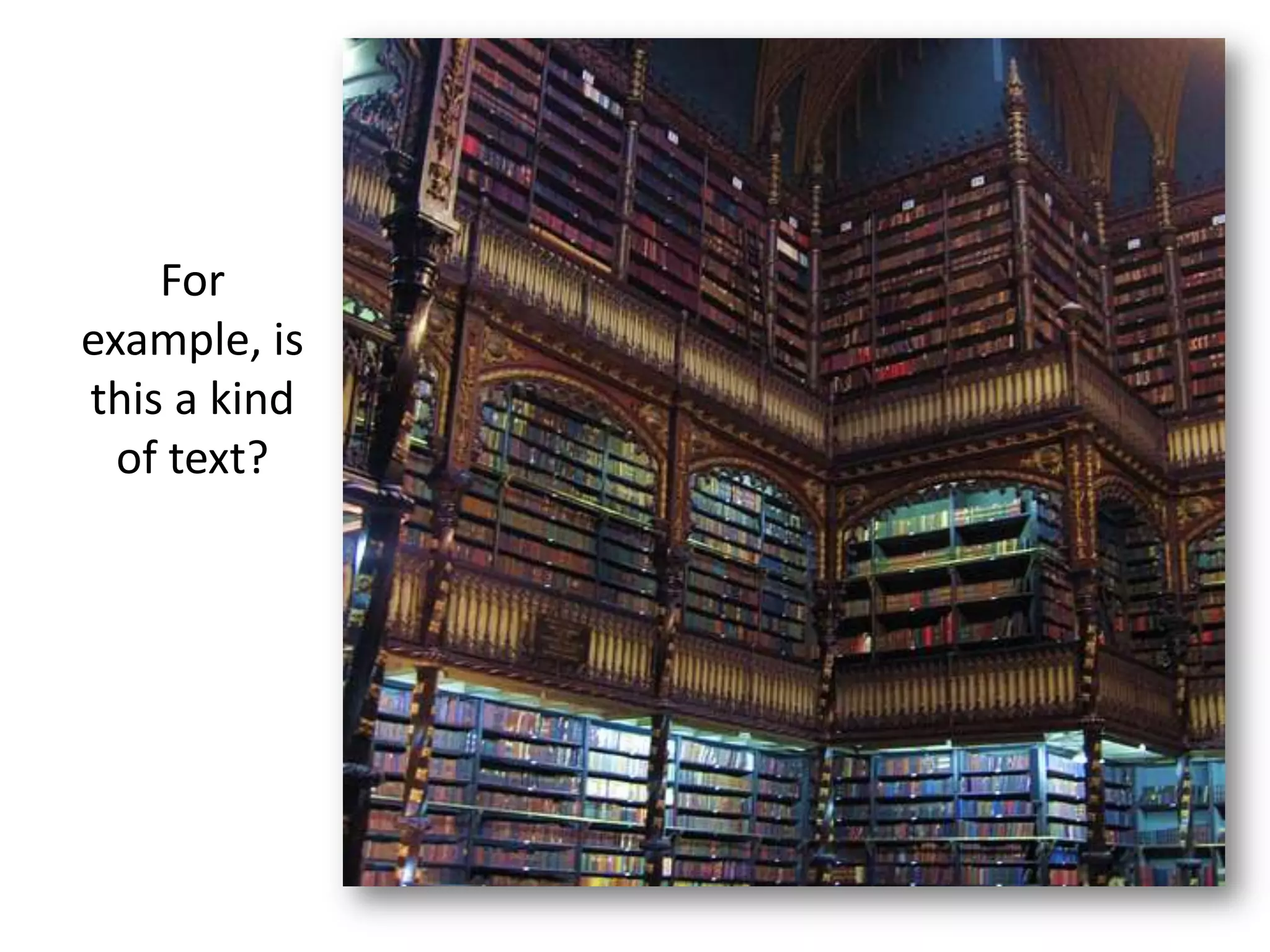
For
example, is
this a kind
of text?
What about this?
[Library of Babel]
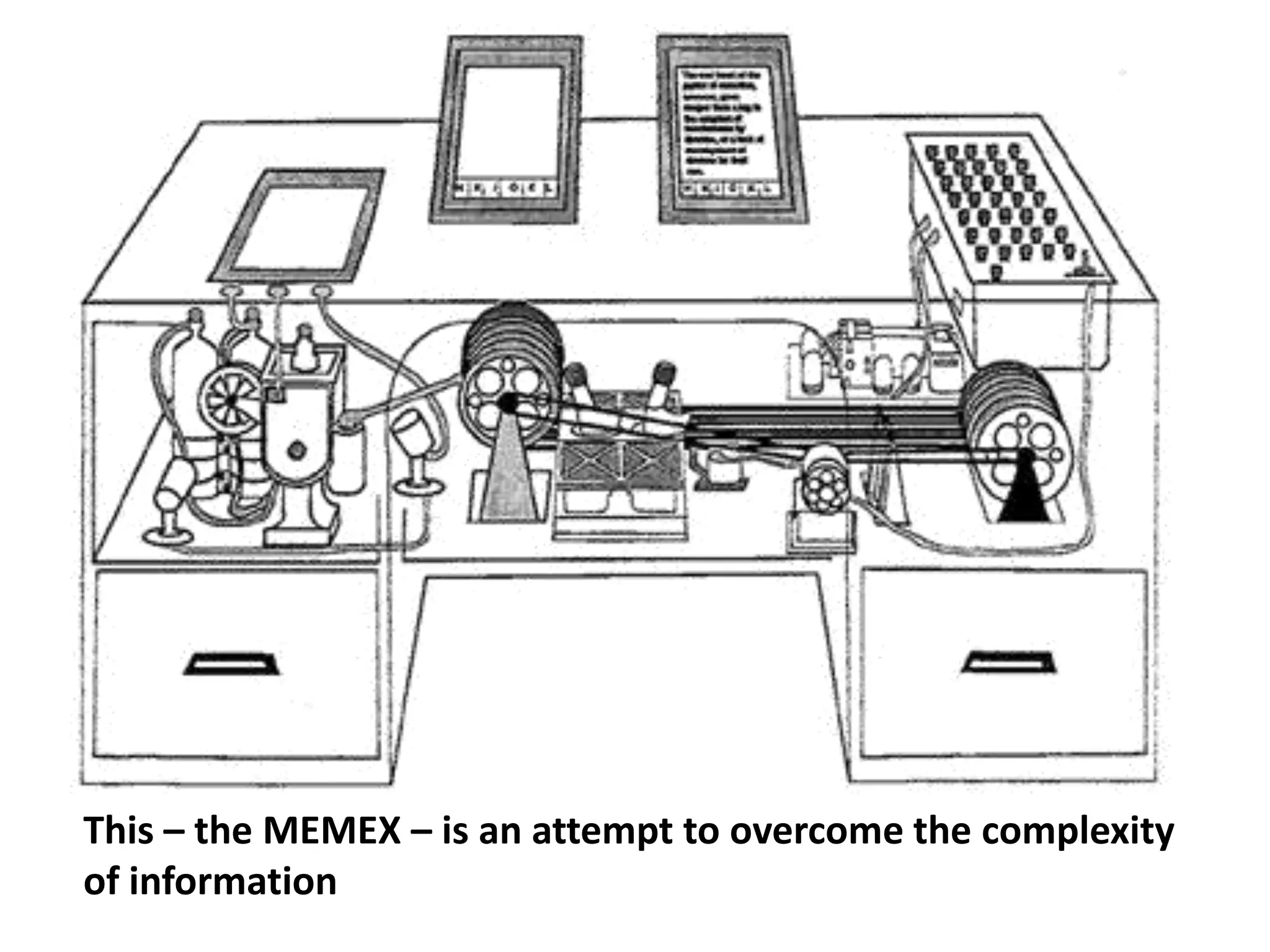
This – the MEMEX – is an attempt to overcome the complexity
of information
Is this a portable library
or a book?
[Talmud]
Libraries and books are not
distinct—they form a single
informational system based on
print technology
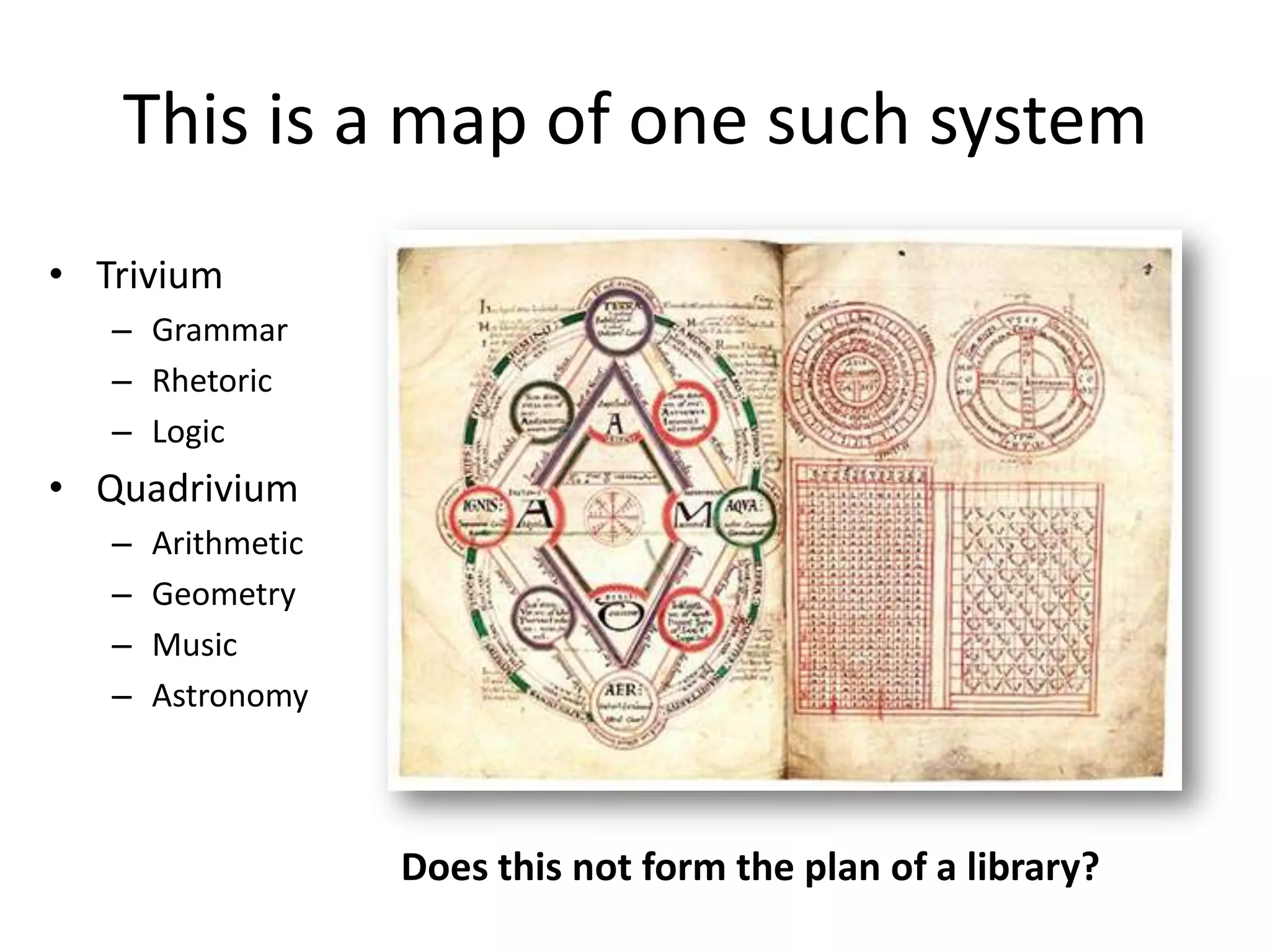
This is a map of one such system
• Trivium
– Grammar
– Rhetoric
– Logic
• Quadrivium
– Arithmetic
– Geometry
– Music
– Astronomy
Does this not form the plan of a library?
[Berners-Lee’s diagram]
This is another system, introduced by digital media
So, hypertext blurs the distinction
between documents and libraries
It opens up a docuverse, a vast
intertext within which a text is a
node
The library is one big document
Every document is a little library
This is what McGann means by
“Radiant Textuality”
We move from books and libraries to
hypertexts and networks
This fact that books are nodes in a
network makes them flexible, open,
unfinished
These properties open up new
“critical opportunities”
Criticism = Scholarship
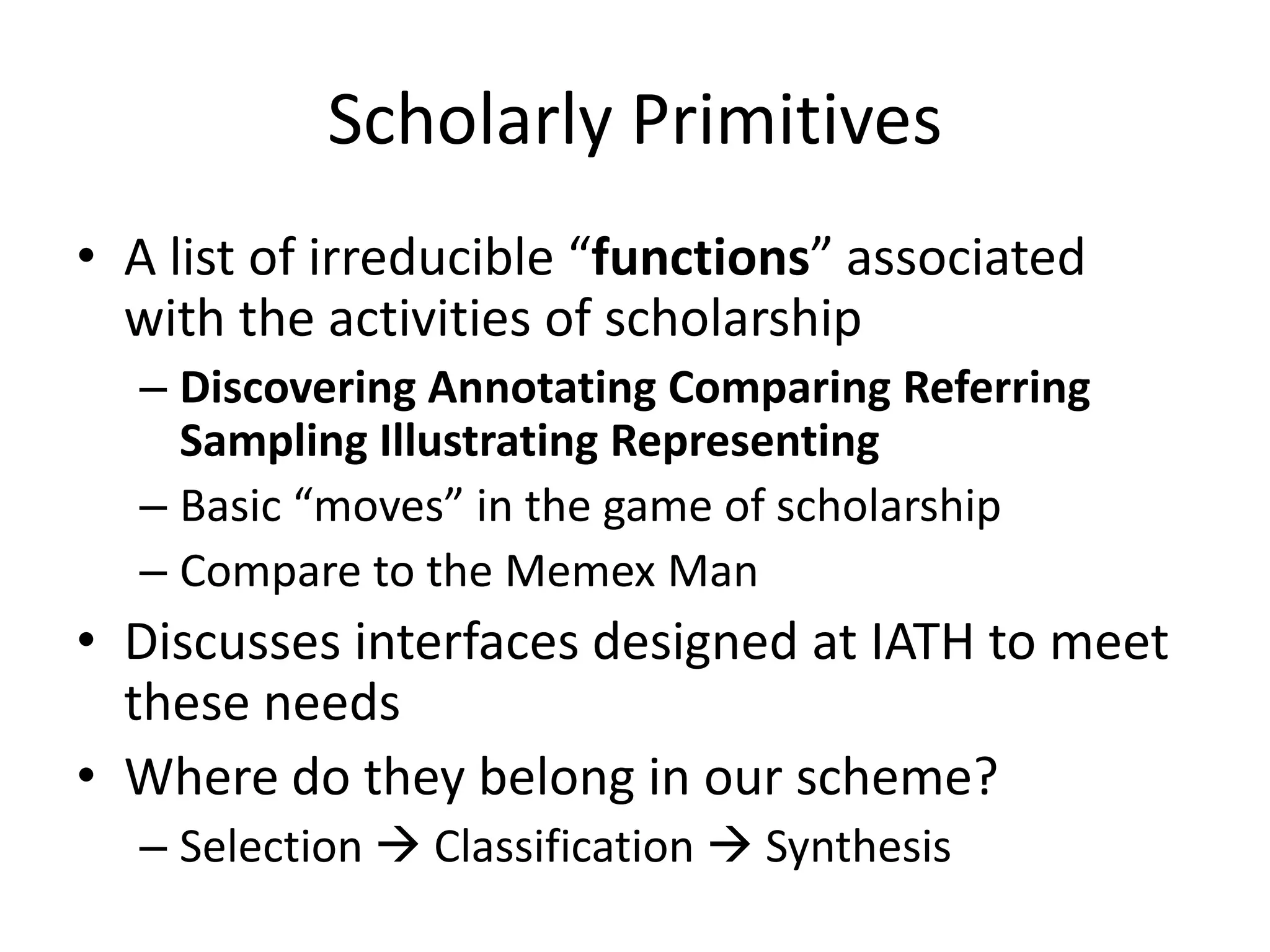
Scholarly Primitives
• A list of irreducible “functions” associated
with the activities of scholarship
– Discovering Annotating Comparing Referring
Sampling Illustrating Representing
– Basic “moves” in the game of scholarship
– Compare to the Memex Man
• Discusses interfaces designed at IATH to meet
these needs
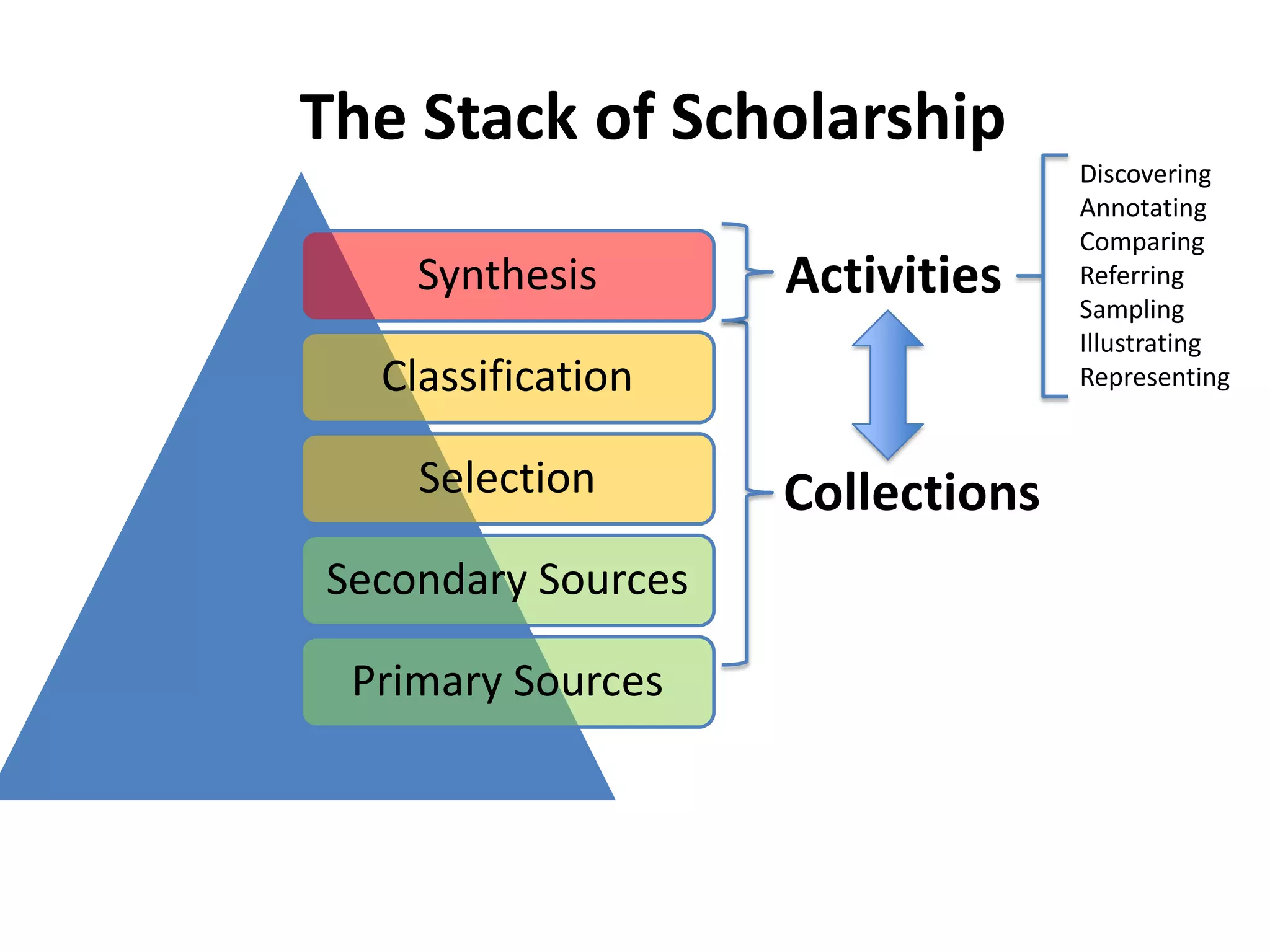
• Where do they belong in our scheme?
– Selection  Classification  Synthesis
Synthesis
Classification
Selection
Secondary Sources
Primary Sources
Collections
Activities
The Stack of Scholarship
Discovering
Annotating
Comparing
Referring
Sampling
Illustrating
Representing
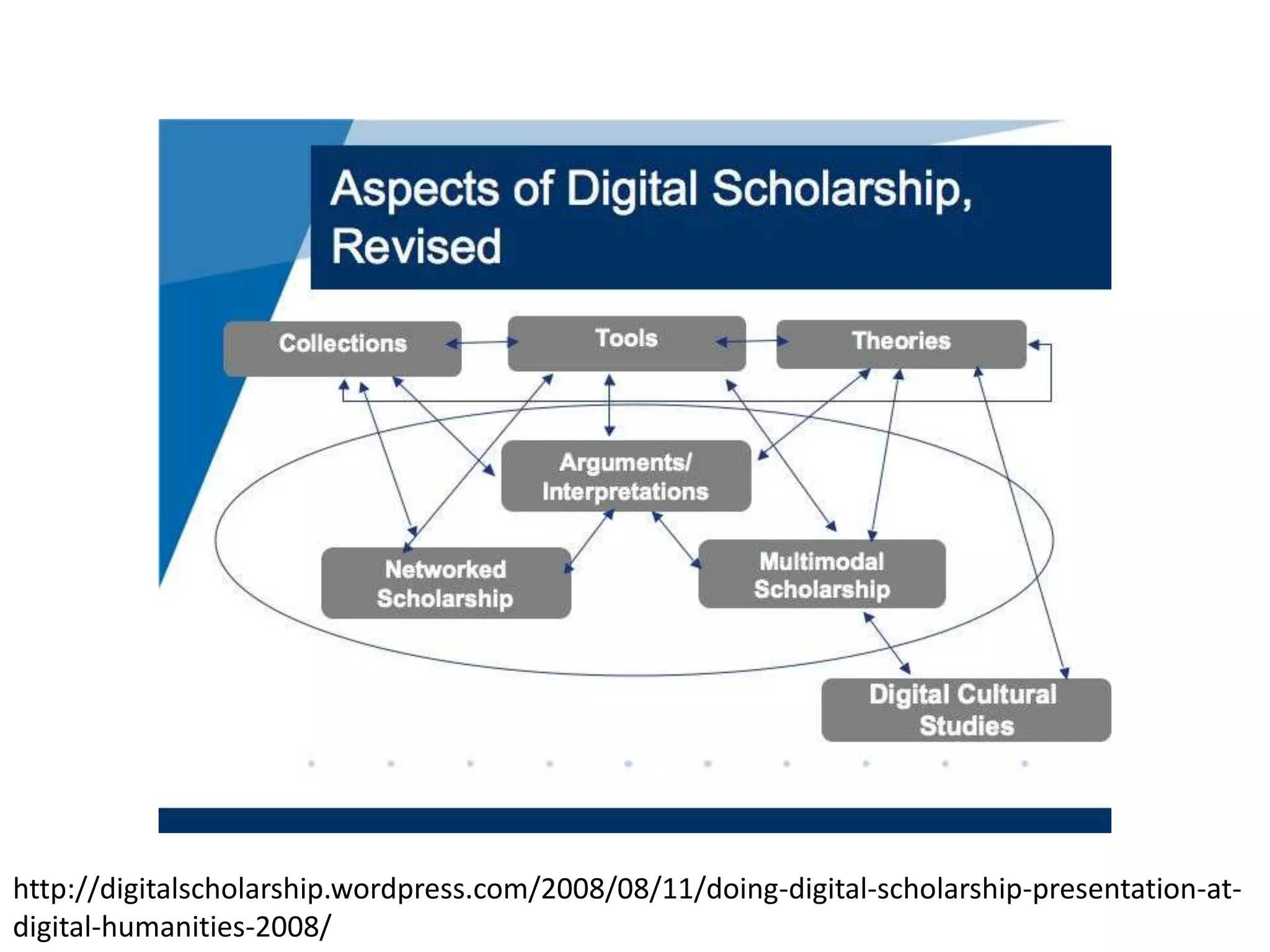
http://digitalscholarship.wordpress.com/2008/08/11/doing-digital-scholarship-presentation-at-
digital-humanities-2008/
So, even though the
informational system has
changed, we have similar goals
We still want to do scholarship—
research, discovery,
interpretation
The goal then is to replace the
system of books and libraries—
“the laboratory of the humanities”
—with something else
What “genre” of hypertext has
emerged since the early 1990s, with
works like the Valley of the Shadow?
Thematic Research Collections
What is a thematic research
collection?
How exactly is it different from a
traditional library?
TRCs overcome the problem that
libraries scatter content
They consolidate content
Features of the TRC
• electronic
• heterogeneous datatypes
• extensive but thematically coherent
• structured but open-ended
• research oriented
• authored or multi-authored
• interdisciplinary
• collections of digital primary resources
Convergences and Effects
• They coincide with the move away from
theory and toward historicism (McGann)
• They produce a renewed focus on the
materiality of text
• They achieve “contextual mass”
• They force collaboration and inter-
disciplinarity
• They become laboratories for research
Contextual Mass
Instead of building large collections, “digital
research libraries should be systematically
collecting sources and developing tools that
work together to provide a supportive context
for the research process.”
Contextual mass
=
Connectivity among parts to
support scholarly primitives
Let’s look at some examples and see
how they stack up
Do they achieve contextual mass?
Do they support the scholarly
primitives?
The Rosetti Archive
The Rossetti Archive
• One of two original IATH projects
• Focused on the works the Pre-Raphaelite poet
and painter Dante Gabriel Rossetti (1828–
1882)
– Art history and literary criticism
• Innovations
– Improved search (cross-site)
– Bread crumbs
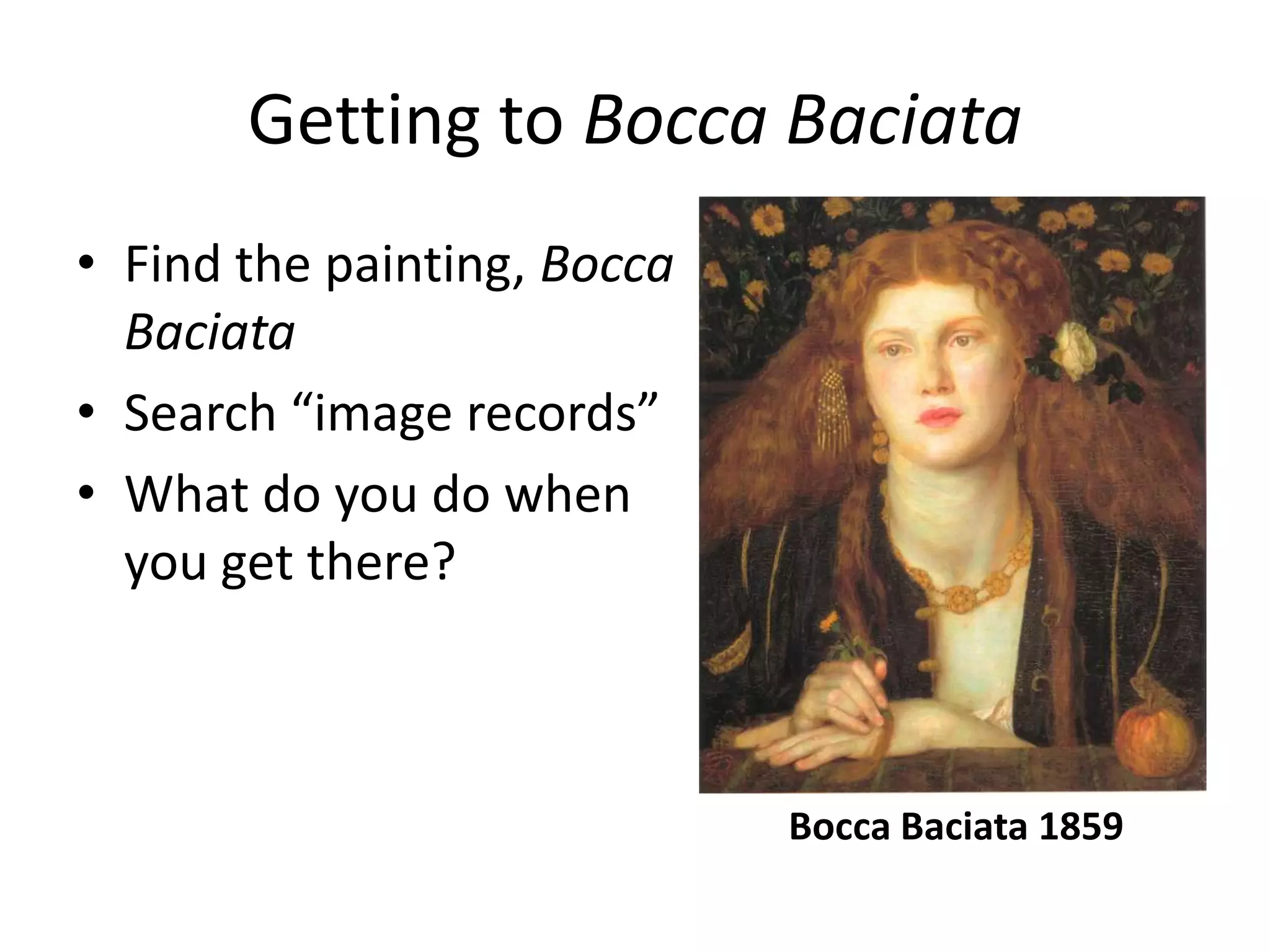
Getting to Bocca Baciata
• Find the painting, Bocca
Baciata
• Search “image records”
• What do you do when
you get there?
Bocca Baciata 1859
Questions
• How is the collection organized?
• How connected are things?
• How does the site support scholarly activity?
Answers
• How is the site organized?
– The site is organized as a traditional database
– Search, List, Display
– Not much different than a library
• How connected are things?
– Not really – texts and images remain separate
– Easy to find things if you know what you are
looking for
• Does it support scholarly activity?
The Blake Archive
• Example of networked fellows at IATH
– Morris Eaves, University of Rochester
– Robert Essick, University of California, Riverside
– Joseph Viscomi, University of North Carolina at
Chapel Hill
• Known for
– Image fidelity
– Image search (iconographic classification)
Getting to Tyger
• Find illustrations of “Tyger”
• What do you do or find when you get there?
• How is the site structured?
Questions
• How is the collection organized?
• How connected are things?
• How does the site support scholarly activity?
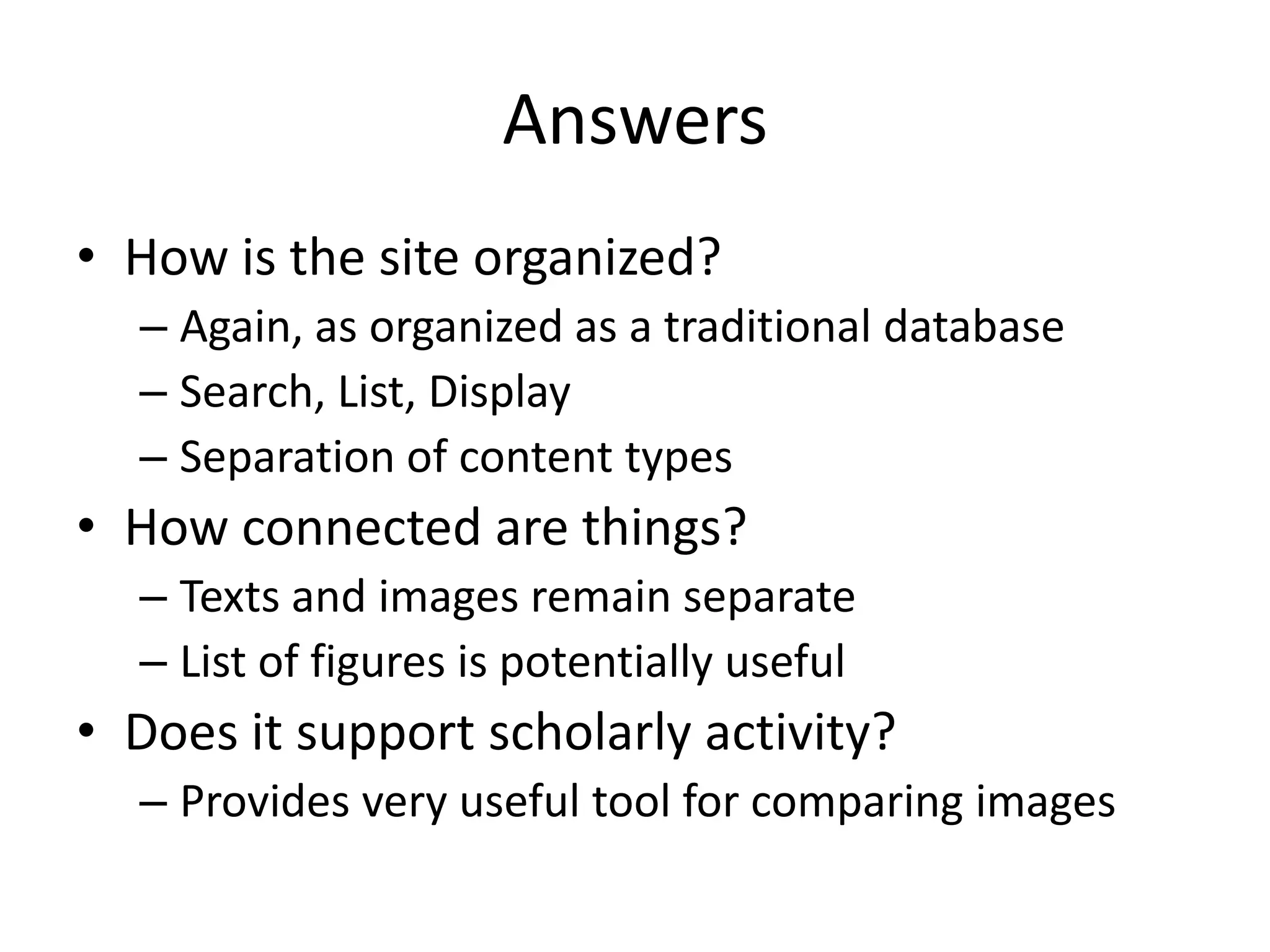
Answers
• How is the site organized?
– Again, as organized as a traditional database
– Search, List, Display
– Separation of content types
• How connected are things?
– Texts and images remain separate
– List of figures is potentially useful
• Does it support scholarly activity?
– Provides very useful tool for comparing images
Other Sites
• World of Dante
• Tibetan Himalayan Library
• A House Divided
• History of African Americans in Medicine
Some General Observations
• Most TRCs are organized on the metaphor of
the library
– Organized by medium
– Search works if you know what you are looking for
– Getting to an item finishes the process
• Some introduce other devices
– Ontologies, maps, etc.
• Still a lot of room for development!
Structure of TDSM
• Geography
• Politics
– Election of 1860
– Political activtivists
• Economics
– Commerce
– Crops
– Labor
– Property
• Social structure
• Race
• Culture
– Religion
– Education (“school”)
– Urbanization (“Town Development”)
• Information and communications
Historiography
Points of
Analysis
Evidence
Summary of
Argument
VOS
Categories

Mdst3703 2013-10-08-thematic-research-collections

  • 1.
    Thematic Research Collections Prof.Alvarado MDST 3703 8 October 2013
  • 2.
    Business • Quizzes beinggraded—hopefully back by Studio
  • 3.
    Review • Ayer’s essay,“The Differences Slavery Made,” was an attempt to create a new kind of scholarly writing • I think it does not meet that goal, but it moves us along the path • Today, we explore other attempts to create a new kind of scholarly writing
  • 4.
    To understand theseother attempts, we need to understand the “problem” they are addressing
  • 5.
    Review • Traditionally, historiansrepresent history by means of narratives with footnotes and figures • But such “fixed” narratives are not adequate to capture the complexity of history • Also, with networked digital media, we can go beyond footnotes and figures and incorporate whole resources • But replacing the traditional text is very hard to do
  • 6.
    Why is itso hard to create new forms of historical (and scholarly) writing?
  • 7.
    One reason isthat we are not simply replacing a way of writing – we are replacing an entire social system of organizing information
  • 8.
  • 9.
  • 10.
  • 11.
    This – theMEMEX – is an attempt to overcome the complexity of information
  • 12.
    Is this aportable library or a book? [Talmud]
  • 13.
    Libraries and booksare not distinct—they form a single informational system based on print technology
  • 14.
    This is amap of one such system • Trivium – Grammar – Rhetoric – Logic • Quadrivium – Arithmetic – Geometry – Music – Astronomy Does this not form the plan of a library?
  • 15.
    [Berners-Lee’s diagram] This isanother system, introduced by digital media
  • 16.
    So, hypertext blursthe distinction between documents and libraries It opens up a docuverse, a vast intertext within which a text is a node The library is one big document Every document is a little library
  • 17.
    This is whatMcGann means by “Radiant Textuality” We move from books and libraries to hypertexts and networks
  • 19.
    This fact thatbooks are nodes in a network makes them flexible, open, unfinished These properties open up new “critical opportunities”
  • 20.
  • 21.
    Scholarly Primitives • Alist of irreducible “functions” associated with the activities of scholarship – Discovering Annotating Comparing Referring Sampling Illustrating Representing – Basic “moves” in the game of scholarship – Compare to the Memex Man • Discusses interfaces designed at IATH to meet these needs • Where do they belong in our scheme? – Selection  Classification  Synthesis
  • 22.
    Synthesis Classification Selection Secondary Sources Primary Sources Collections Activities TheStack of Scholarship Discovering Annotating Comparing Referring Sampling Illustrating Representing
  • 23.
  • 24.
    So, even thoughthe informational system has changed, we have similar goals We still want to do scholarship— research, discovery, interpretation
  • 25.
    The goal thenis to replace the system of books and libraries— “the laboratory of the humanities” —with something else What “genre” of hypertext has emerged since the early 1990s, with works like the Valley of the Shadow?
  • 26.
  • 27.
    What is athematic research collection? How exactly is it different from a traditional library?
  • 28.
    TRCs overcome theproblem that libraries scatter content They consolidate content
  • 29.
    Features of theTRC • electronic • heterogeneous datatypes • extensive but thematically coherent • structured but open-ended • research oriented • authored or multi-authored • interdisciplinary • collections of digital primary resources
  • 30.
    Convergences and Effects •They coincide with the move away from theory and toward historicism (McGann) • They produce a renewed focus on the materiality of text • They achieve “contextual mass” • They force collaboration and inter- disciplinarity • They become laboratories for research
  • 31.
    Contextual Mass Instead ofbuilding large collections, “digital research libraries should be systematically collecting sources and developing tools that work together to provide a supportive context for the research process.”
  • 32.
    Contextual mass = Connectivity amongparts to support scholarly primitives
  • 33.
    Let’s look atsome examples and see how they stack up Do they achieve contextual mass? Do they support the scholarly primitives?
  • 34.
  • 35.
    The Rossetti Archive •One of two original IATH projects • Focused on the works the Pre-Raphaelite poet and painter Dante Gabriel Rossetti (1828– 1882) – Art history and literary criticism • Innovations – Improved search (cross-site) – Bread crumbs
  • 36.
    Getting to BoccaBaciata • Find the painting, Bocca Baciata • Search “image records” • What do you do when you get there? Bocca Baciata 1859
  • 37.
    Questions • How isthe collection organized? • How connected are things? • How does the site support scholarly activity?
  • 38.
    Answers • How isthe site organized? – The site is organized as a traditional database – Search, List, Display – Not much different than a library • How connected are things? – Not really – texts and images remain separate – Easy to find things if you know what you are looking for • Does it support scholarly activity?
  • 40.
    The Blake Archive •Example of networked fellows at IATH – Morris Eaves, University of Rochester – Robert Essick, University of California, Riverside – Joseph Viscomi, University of North Carolina at Chapel Hill • Known for – Image fidelity – Image search (iconographic classification)
  • 41.
    Getting to Tyger •Find illustrations of “Tyger” • What do you do or find when you get there? • How is the site structured?
  • 42.
    Questions • How isthe collection organized? • How connected are things? • How does the site support scholarly activity?
  • 43.
    Answers • How isthe site organized? – Again, as organized as a traditional database – Search, List, Display – Separation of content types • How connected are things? – Texts and images remain separate – List of figures is potentially useful • Does it support scholarly activity? – Provides very useful tool for comparing images
  • 44.
    Other Sites • Worldof Dante • Tibetan Himalayan Library • A House Divided • History of African Americans in Medicine
  • 45.
    Some General Observations •Most TRCs are organized on the metaphor of the library – Organized by medium – Search works if you know what you are looking for – Getting to an item finishes the process • Some introduce other devices – Ontologies, maps, etc. • Still a lot of room for development!
  • 46.
    Structure of TDSM •Geography • Politics – Election of 1860 – Political activtivists • Economics – Commerce – Crops – Labor – Property • Social structure • Race • Culture – Religion – Education (“school”) – Urbanization (“Town Development”) • Information and communications Historiography Points of Analysis Evidence Summary of Argument VOS Categories

Editor's Notes

  • #9 Real GabinetePortugues De Leitura Rio De Janeiro
  • #11 Borges’ Library of BabelThe search for the catalog …The library of nature …
  • #13 Doesn’t this look like a library in a book?
  • #19 Map of the Internet, circa 2003http://blyon.com/blyon-cdn/opte/maps/static/1069524880.LGL.2D.700x700.pnghttp://www.opte.org/maps/