Building a
Collaboration
for Digital
Publishing
HARRIETT GREEN
UNIVERSITY OF ILLINOIS AT URBANA-CHAMPAIGN
ASALH, SEPTEMBER 25, 2015
Print and the digital in
scholarship
“While in the past we might have thought of the
scholarly record as consisting primarily of text-based
materials like journals and monographs, today the
cohort of materials over which the scholarly record
can potentially extend has expanded dramatically,
to include research data sets, computer models,
interactive programs, complex visualizations, lab
notebooks, and a host of other materials.”
OCLC, The Evolving Scholarly Record
What is Scholarly
Communications?
“The system through which research and other
scholarly writings are created, evaluated for quality,
disseminated to the scholarly community, and
preserved for future use. The system includes both
formal means of communication, such as
publication in peer-reviewed journals, and informal
channels, such as electronic listservs.”
Association for College and Research Libraries
Digital publishing:
What Is It?
Use of multi-media tools and digital technologies to
publish content in digital form
Elizabeth Povinelli,
“Digital Futures,”
Vectors Journal (2011)
http://vectorsjournal.or
g/issues/6/povinelli/07/
Digital Publishing:
Background
 Emergence of the Internet  possibility for open,
accessible scholarly literature
 Early initiatives: ArXiV, BioMed Central, PubMed
Science
 Budapest Open Access Initiative, 2002
 Berlin Declaration of Open Access, 2003
Open Access
“The old tradition is the willingness of scientists and
scholars to publish the fruits of their research in
scholarly journals without payment, for the sake of
inquiry and knowledge. The new technology is the
internet. The public good they make possible is the
world-wide electronic distribution of the peer-
reviewed journal literature and completely free and
unrestricted access to it by all scientists, scholars,
teachers, students, and other curious minds.”
Budapest Open Access Initiative
Open Access and the
Humanities
“Open-access scholarship has the potential to reach
a broad spectrum of potentially interested publics.
We in the humanities often resist opening our work to
these publics, however, fearing the consequences of
such openness….
The problem, of course, is that the more we close our
work away from the public and the more we refuse
to engage in dialogue across the boundaries of the
academy, the more we undermine that public’s
willingness to fund our research and our institutions.”
Kathleen Fitzpatrick (2013)
Why consider digital
publishing?
“Increasing the discoverability of scholarly work on
the web, making it available to a broader
readership, is a good thing, not just for the individual
scholar but for the entirety of the field in which he or
she works.”
Kathleen Fitzpatrick (2013)
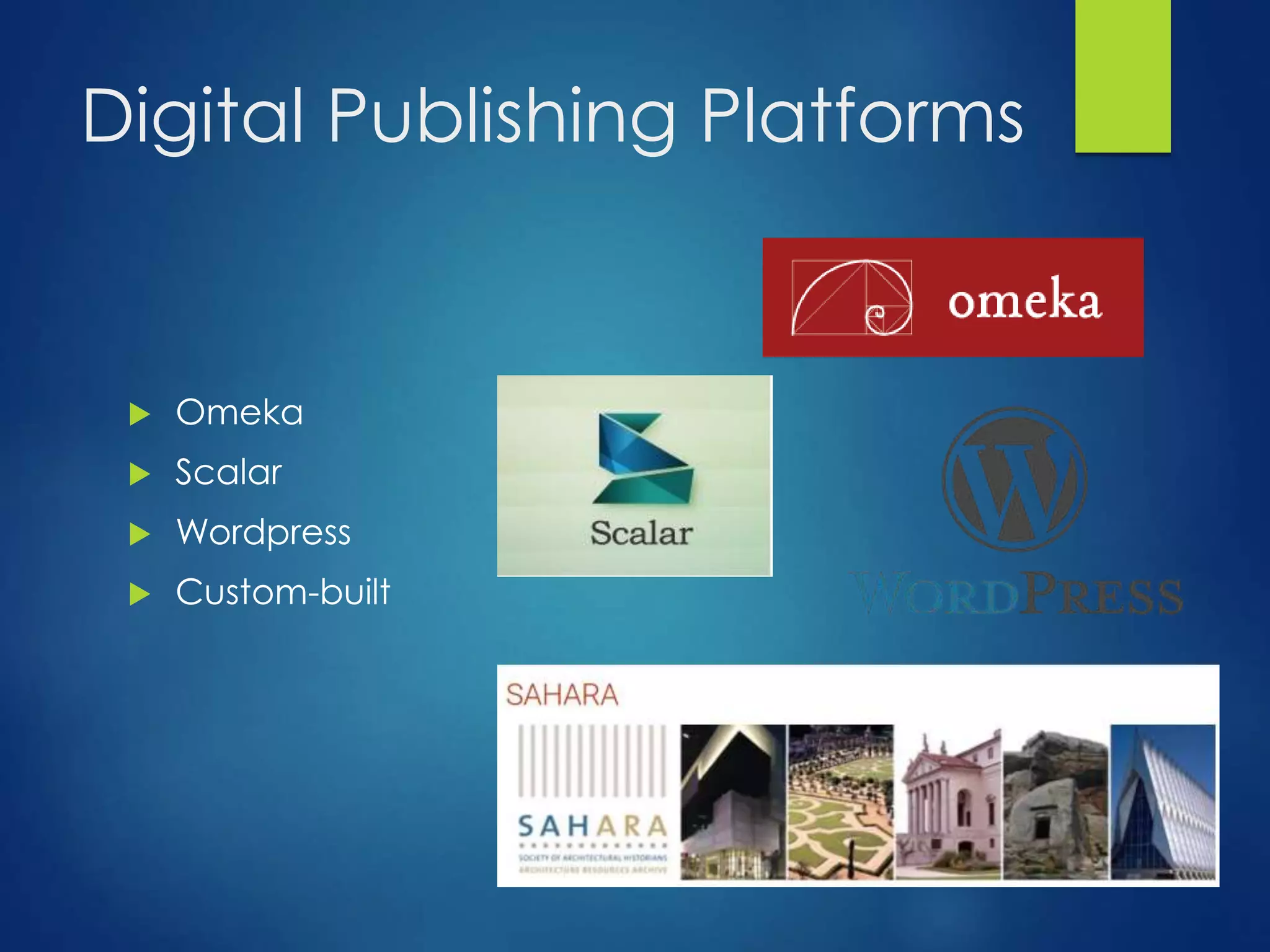
Digital Publishing Platforms
 Omeka
 Scalar
 Wordpress
 Custom-built
Open Access Publications
PLoS One
https://www.plos.org/
Digital Humanities Quarterly
http://www.digitalhumanities.org/dhq/
Institutional Repositories
 Electronic theses and dissertations (ETDs)
 Student and faculty publications
 “Gray Literature” (e.g., conference proceedings,
white papers, reports)
 Datasets
https://www.ideals.illinois.edu/
http://figshare.com/
https://commons.mla.org/
Digital Publishing:
What do you need?
Expertise
Technology
Buy-In
Expertise
Librarians in:
 Digital Humanities/Digital Scholarship
 Scholarly Communications
 Digital Curation
 And many more!
Digital Scholarship Centers
 Scholarly Commons
 Media Commons
 Educational Technology Centers
Scholarly Commons
University of Illinois Library
“The Scholarly Commons is a technology enriched
space for faculty, researchers, and graduate
students to pursue research and receive expert
copyright, data, digital humanities, digitization,
scholarly communications, and usability consultation
services.”
http://www.library.illinois.edu/sc
14
Who Is in the Scholarly
Commons?
Experts and Librarians in:
 Data services
 Scholarly publishing and copyright
 Geographic Information Systems (GIS)
 Digital Humanities
 Instructional services
 Web usability lab
15
Campus Partnerships
• Graduate College
• Survey Research Lab
• Center for Innovation in Teaching and Learning
• Institute for Computing in Humanities, Arts, and
Social Sciences (I-CHASS)
• Research Data Services
• Illinois Program for Research in the Humanities
16
Technology and
Infrastructure
 What are your goals for digital
publishing?
 What kind of technology support is
available to you?
 What kind of functionality and features
do you want?
Many Options…
Buy In
Why should faculty and students care
about digital publishing and open
access?
 Broad Promotion of scholarship
 Higher impact
 Public access to research (esp.
federally funded)
Impact:
Research Publications
McKenzie Wark, “Totality for Kids,” Vectors Journal
http://vectors.usc.edu/
Impact: Student Research
http://project500.omeka.net/
https://ugresearchjournals.illinois.edu/index.php/ujlc
Impact: Networks of
Scholarship
Credits: http://www.wellesley.edu/sites/default/files/altmetrics-ris.png
The Future of Scholarly
Publishing in the Digital
Age
 Build collaborations: cross-disciplinary, multi-
institutional, and international
 Develop skills and expertise in new areas of digital
media and publishing
 Envision potential new audiences and publics
Citations
 Budapest Open Access Initiative (2002),
http://budapestopenaccessinitiative.org/
 Kathleen Fitzpatrick, “Giving it away: Sharing and
the future of scholarly communication,” Journal of
Scholarly Publishing 43 (2012): 347-362.
http://dx.doi.org/10.3138/jsp.43.4.347
 History 364, “Project 500”
http://project500.omeka.net
 Elizabeth Povinelli, “Digital Futures,” Vectors
Journal (2011)
http://vectorsjournal.org/issues/6/povinelli/07/
 McKenzie Wark, “Totality for Kids,” Vectors Journal
(2013), http://vectorsjournal.org/issues/7/totality/
THANK YOU!
Harriett Green
English and Digital Humanities Librarian
University of Illinois at Urbana-Champaign
green19@illinois.edu
Twitter: @greenharr

Building a Collaboration for Digital Publishing

  • 1.
    Building a Collaboration for Digital Publishing HARRIETTGREEN UNIVERSITY OF ILLINOIS AT URBANA-CHAMPAIGN ASALH, SEPTEMBER 25, 2015
  • 2.
    Print and thedigital in scholarship “While in the past we might have thought of the scholarly record as consisting primarily of text-based materials like journals and monographs, today the cohort of materials over which the scholarly record can potentially extend has expanded dramatically, to include research data sets, computer models, interactive programs, complex visualizations, lab notebooks, and a host of other materials.” OCLC, The Evolving Scholarly Record
  • 3.
    What is Scholarly Communications? “Thesystem through which research and other scholarly writings are created, evaluated for quality, disseminated to the scholarly community, and preserved for future use. The system includes both formal means of communication, such as publication in peer-reviewed journals, and informal channels, such as electronic listservs.” Association for College and Research Libraries
  • 4.
    Digital publishing: What IsIt? Use of multi-media tools and digital technologies to publish content in digital form Elizabeth Povinelli, “Digital Futures,” Vectors Journal (2011) http://vectorsjournal.or g/issues/6/povinelli/07/
  • 5.
    Digital Publishing: Background  Emergenceof the Internet  possibility for open, accessible scholarly literature  Early initiatives: ArXiV, BioMed Central, PubMed Science  Budapest Open Access Initiative, 2002  Berlin Declaration of Open Access, 2003
  • 6.
    Open Access “The oldtradition is the willingness of scientists and scholars to publish the fruits of their research in scholarly journals without payment, for the sake of inquiry and knowledge. The new technology is the internet. The public good they make possible is the world-wide electronic distribution of the peer- reviewed journal literature and completely free and unrestricted access to it by all scientists, scholars, teachers, students, and other curious minds.” Budapest Open Access Initiative
  • 7.
    Open Access andthe Humanities “Open-access scholarship has the potential to reach a broad spectrum of potentially interested publics. We in the humanities often resist opening our work to these publics, however, fearing the consequences of such openness…. The problem, of course, is that the more we close our work away from the public and the more we refuse to engage in dialogue across the boundaries of the academy, the more we undermine that public’s willingness to fund our research and our institutions.” Kathleen Fitzpatrick (2013)
  • 8.
    Why consider digital publishing? “Increasingthe discoverability of scholarly work on the web, making it available to a broader readership, is a good thing, not just for the individual scholar but for the entirety of the field in which he or she works.” Kathleen Fitzpatrick (2013)
  • 9.
    Digital Publishing Platforms Omeka  Scalar  Wordpress  Custom-built
  • 10.
    Open Access Publications PLoSOne https://www.plos.org/ Digital Humanities Quarterly http://www.digitalhumanities.org/dhq/
  • 11.
    Institutional Repositories  Electronictheses and dissertations (ETDs)  Student and faculty publications  “Gray Literature” (e.g., conference proceedings, white papers, reports)  Datasets https://www.ideals.illinois.edu/ http://figshare.com/ https://commons.mla.org/
  • 12.
    Digital Publishing: What doyou need? Expertise Technology Buy-In
  • 13.
    Expertise Librarians in:  DigitalHumanities/Digital Scholarship  Scholarly Communications  Digital Curation  And many more! Digital Scholarship Centers  Scholarly Commons  Media Commons  Educational Technology Centers
  • 14.
    Scholarly Commons University ofIllinois Library “The Scholarly Commons is a technology enriched space for faculty, researchers, and graduate students to pursue research and receive expert copyright, data, digital humanities, digitization, scholarly communications, and usability consultation services.” http://www.library.illinois.edu/sc 14
  • 15.
    Who Is inthe Scholarly Commons? Experts and Librarians in:  Data services  Scholarly publishing and copyright  Geographic Information Systems (GIS)  Digital Humanities  Instructional services  Web usability lab 15
  • 16.
    Campus Partnerships • GraduateCollege • Survey Research Lab • Center for Innovation in Teaching and Learning • Institute for Computing in Humanities, Arts, and Social Sciences (I-CHASS) • Research Data Services • Illinois Program for Research in the Humanities 16
  • 17.
    Technology and Infrastructure  Whatare your goals for digital publishing?  What kind of technology support is available to you?  What kind of functionality and features do you want?
  • 18.
  • 19.
    Buy In Why shouldfaculty and students care about digital publishing and open access?  Broad Promotion of scholarship  Higher impact  Public access to research (esp. federally funded)
  • 20.
    Impact: Research Publications McKenzie Wark,“Totality for Kids,” Vectors Journal http://vectors.usc.edu/
  • 21.
  • 22.
    Impact: Networks of Scholarship Credits:http://www.wellesley.edu/sites/default/files/altmetrics-ris.png
  • 23.
    The Future ofScholarly Publishing in the Digital Age  Build collaborations: cross-disciplinary, multi- institutional, and international  Develop skills and expertise in new areas of digital media and publishing  Envision potential new audiences and publics
  • 24.
    Citations  Budapest OpenAccess Initiative (2002), http://budapestopenaccessinitiative.org/  Kathleen Fitzpatrick, “Giving it away: Sharing and the future of scholarly communication,” Journal of Scholarly Publishing 43 (2012): 347-362. http://dx.doi.org/10.3138/jsp.43.4.347  History 364, “Project 500” http://project500.omeka.net  Elizabeth Povinelli, “Digital Futures,” Vectors Journal (2011) http://vectorsjournal.org/issues/6/povinelli/07/  McKenzie Wark, “Totality for Kids,” Vectors Journal (2013), http://vectorsjournal.org/issues/7/totality/
  • 25.
    THANK YOU! Harriett Green Englishand Digital Humanities Librarian University of Illinois at Urbana-Champaign green19@illinois.edu Twitter: @greenharr