Knowledge engineering
and the Web
Guus Schreiber
VU University Amsterdam
Computer Science, Network Institute
Overview of this talk
•  Web data representation
– a meta view
•  Knowledge for the Web: categories
– key sources, alignment, conversion
•  Using knowledge: visualization and
search
My journey
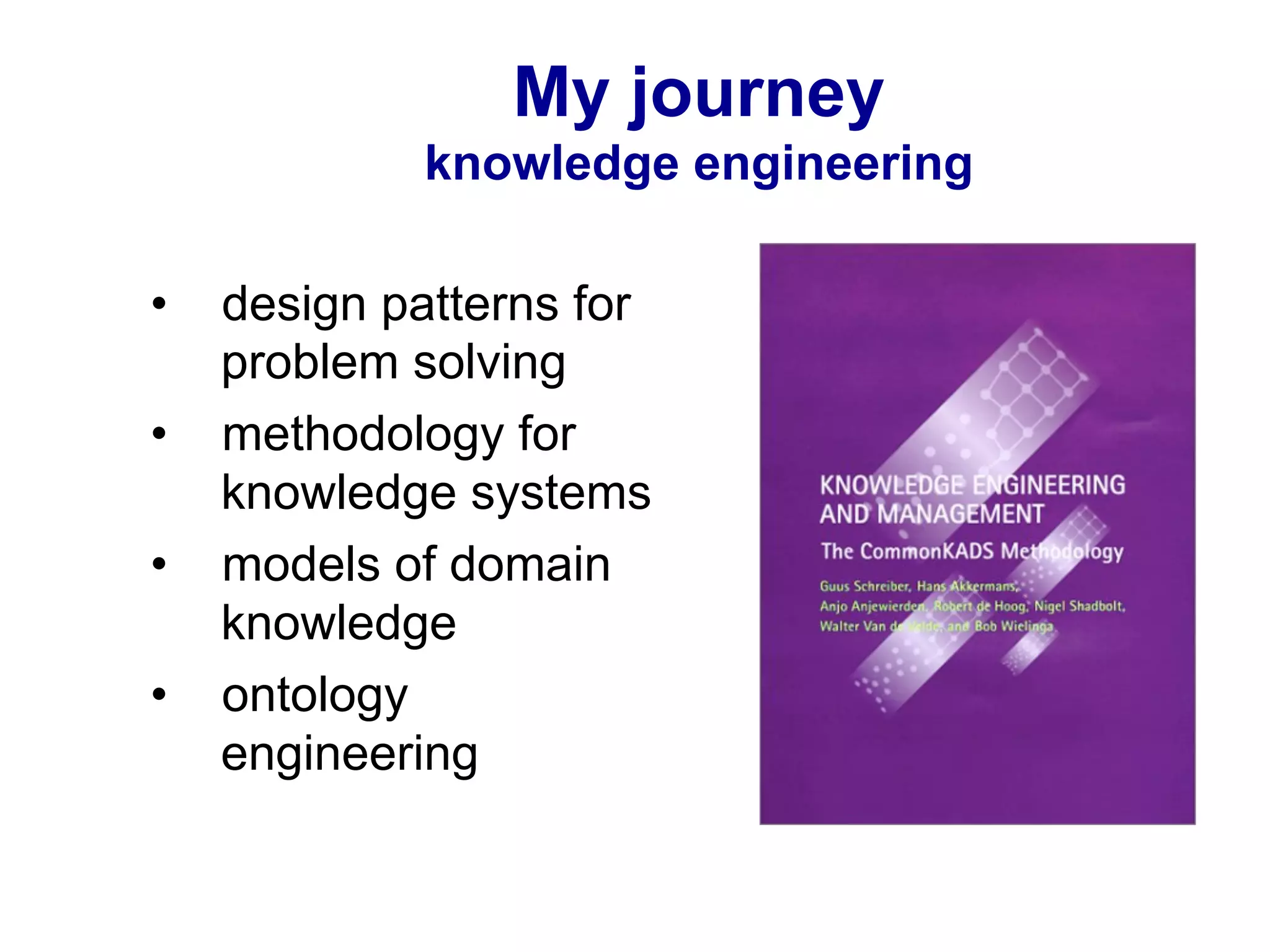
knowledge engineering
•  design patterns for
problem solving
•  methodology for
knowledge systems
•  models of domain
knowledge
•  ontology
engineering
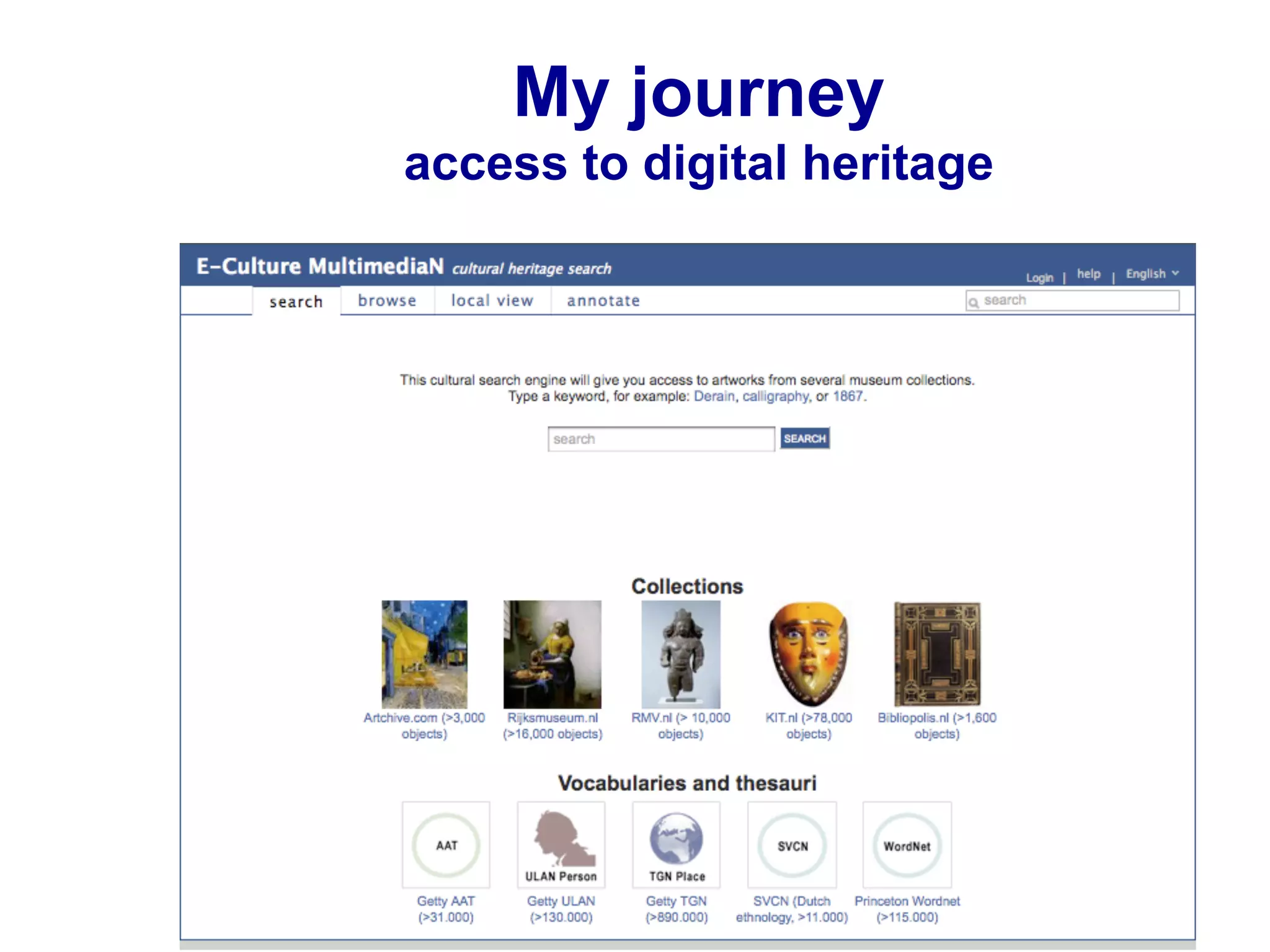
My journey
access to digital heritage
My journey
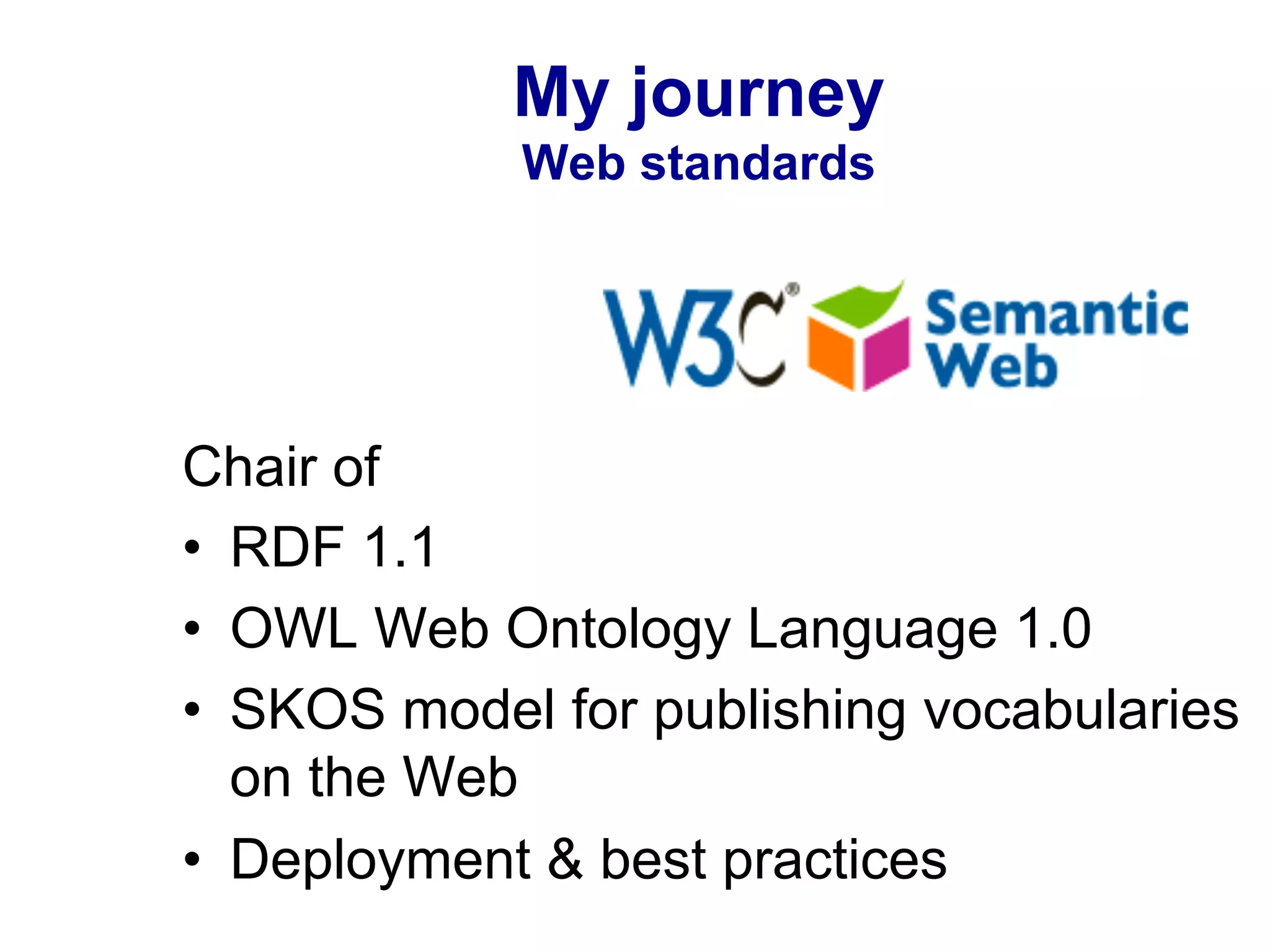
Web standards
Chair of
•  RDF 1.1
•  OWL Web Ontology Language 1.0
•  SKOS model for publishing vocabularies
on the Web
•  Deployment & best practices
A few words about
Web standardization
•  Key success factor!
•  Consensus process actually works
– Some of the time at least
•  Public review
– Taking every comment seriously
•  The danger of over-designing
– Principle of minimal commitment
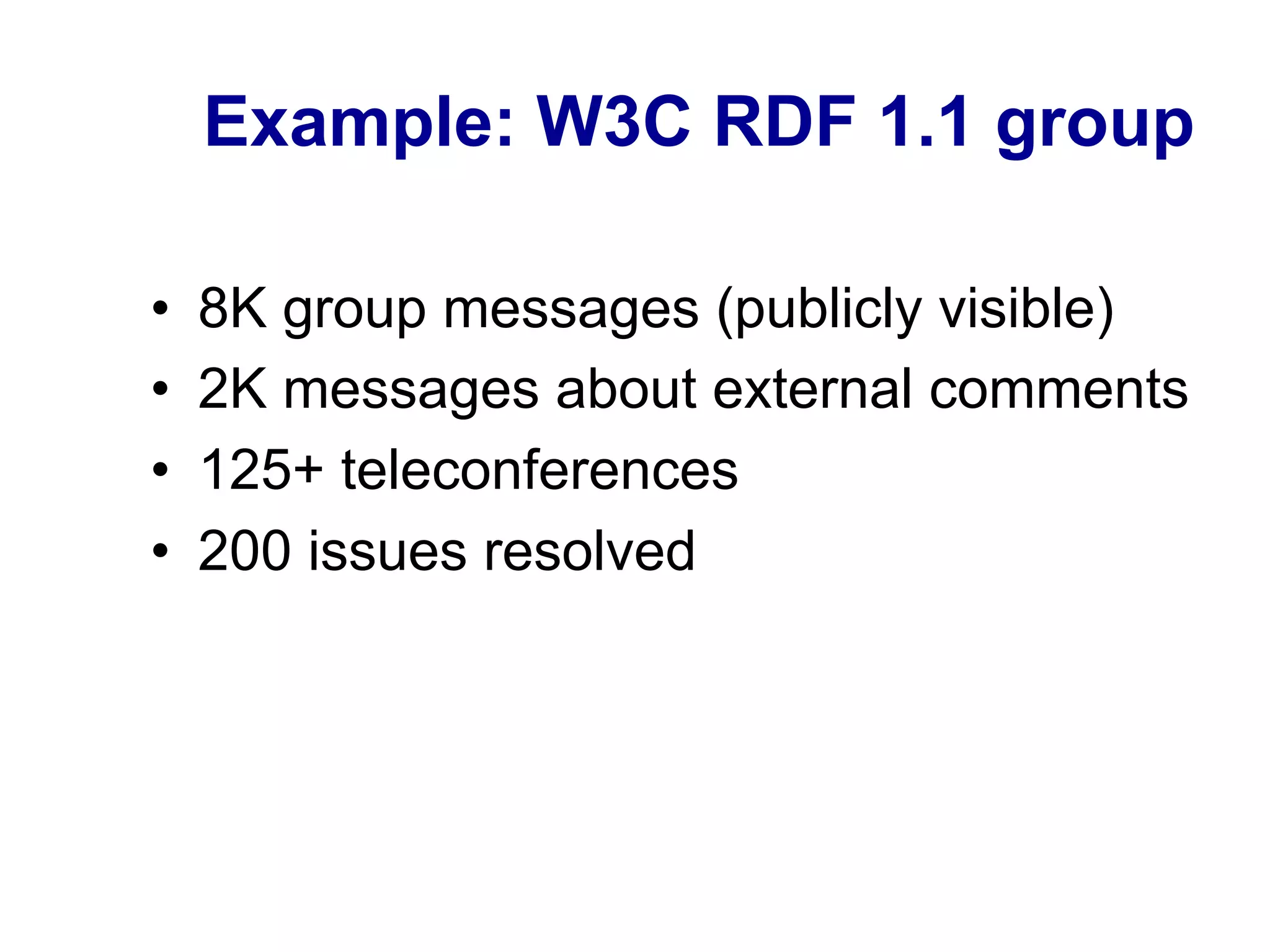
Example: W3C RDF 1.1 group
•  8K group messages (publicly visible)
•  2K messages about external comments
•  125+ teleconferences
•  200 issues resolved
WEB DATA REPRESENTATION
Caution
•  Representation languages are there for
you
•  And not the other way around ….
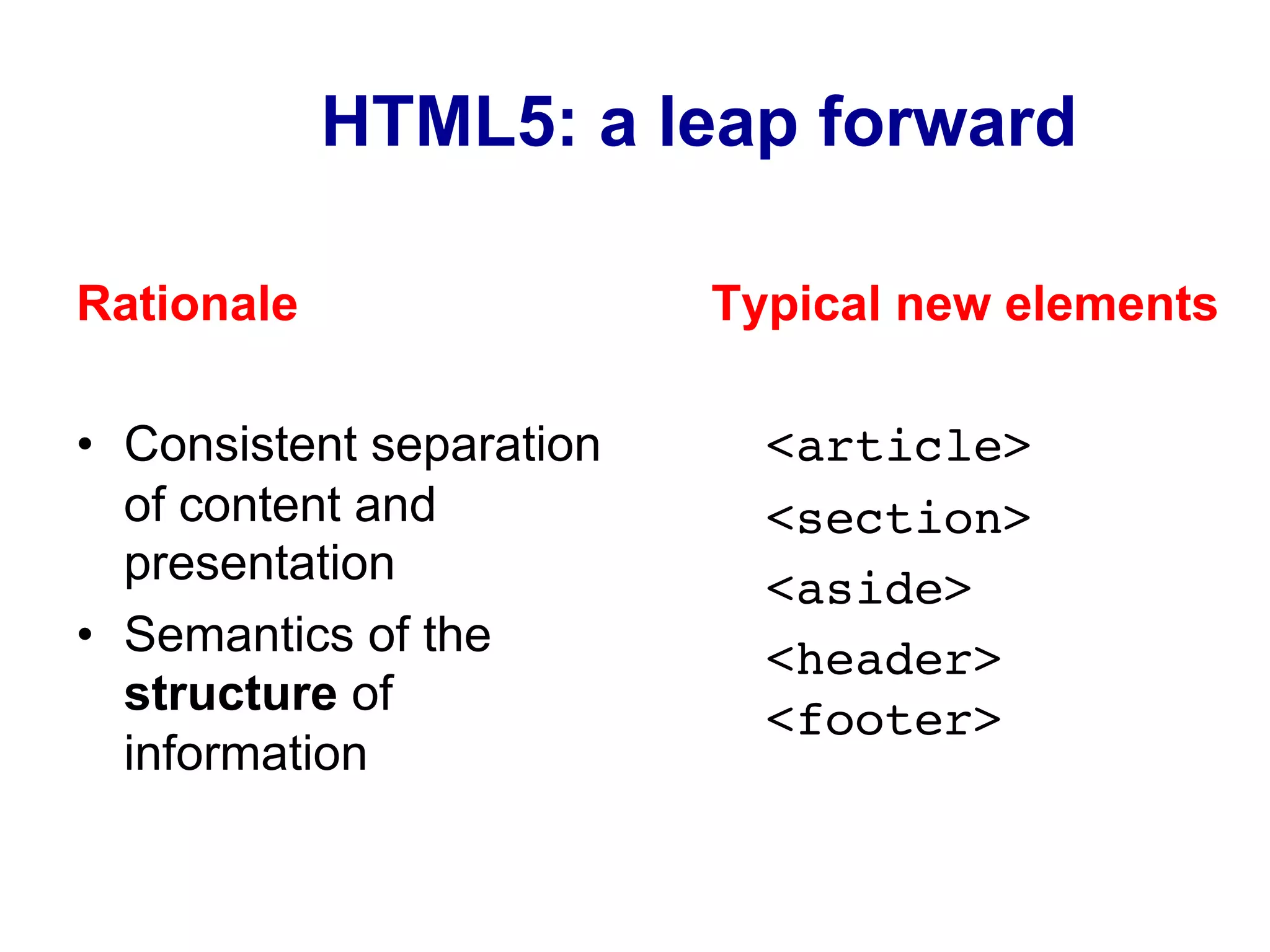
HTML5: a leap forward
Rationale
•  Consistent separation
of content and
presentation
•  Semantics of the
structure of
information
Typical new elements
<article>!
<section>!
<aside>!
<header>
<footer>!
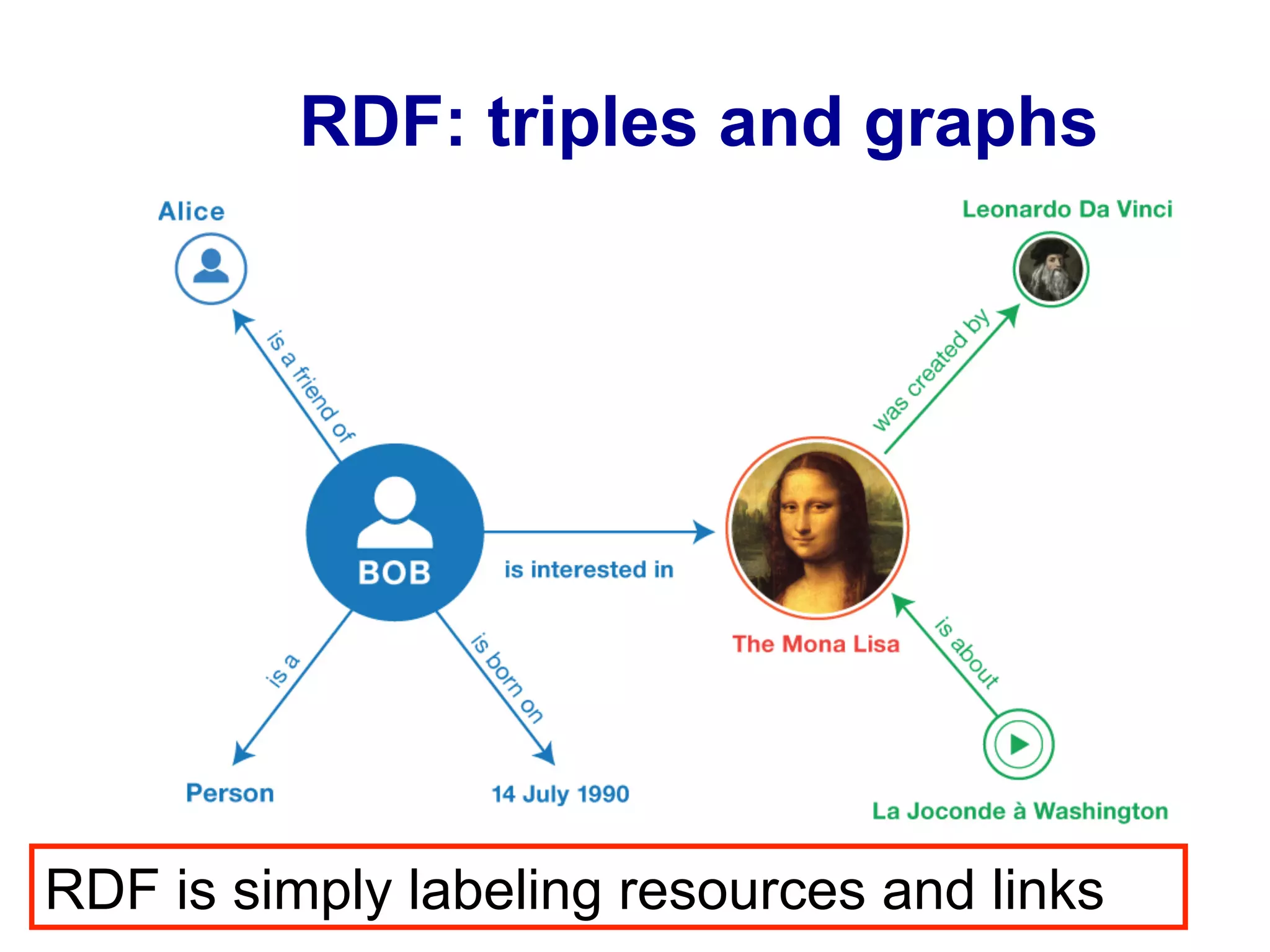
RDF: triples and graphs
RDF is simply labeling resources and links
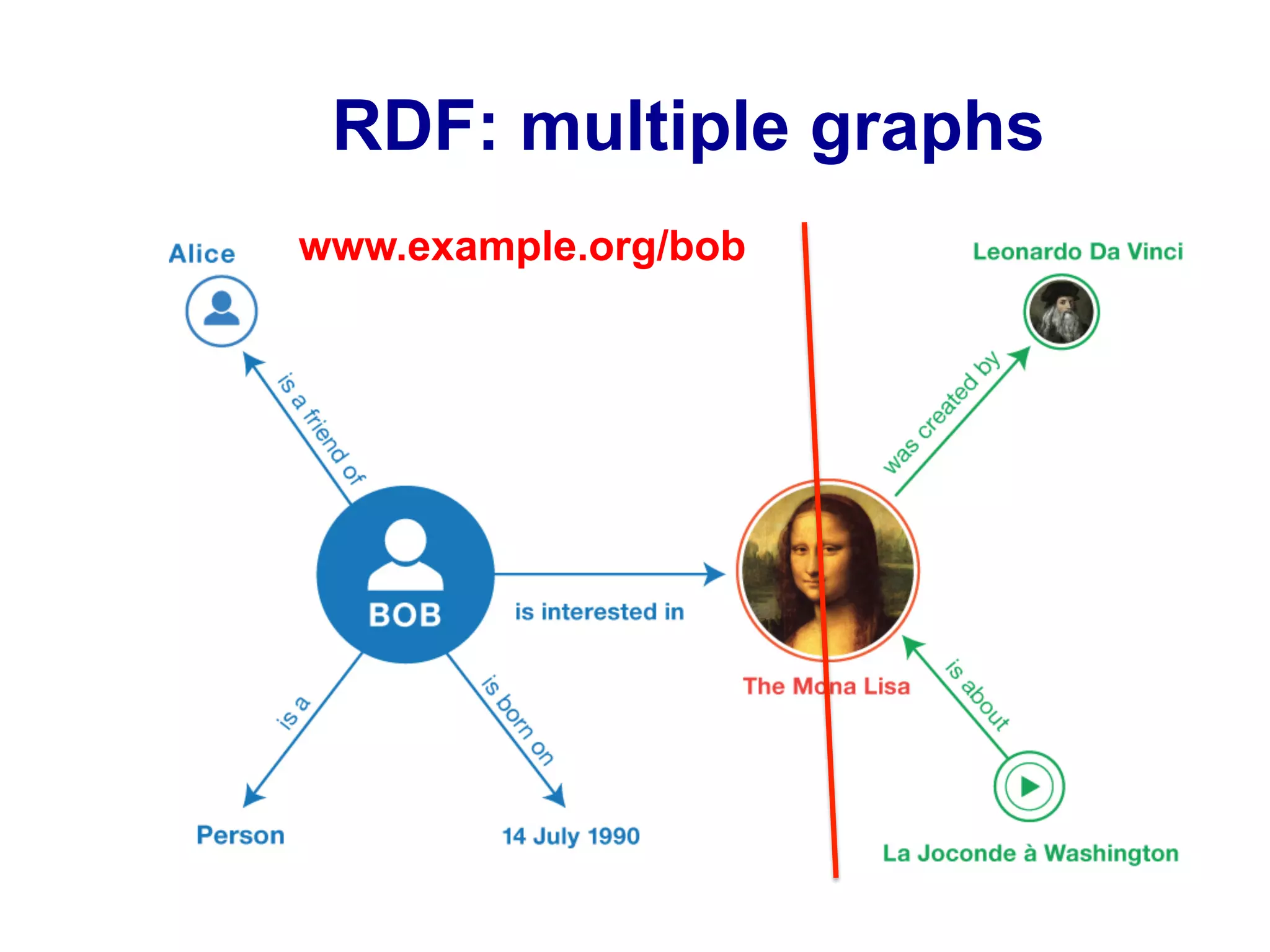
RDF: multiple graphs
www.example.org/bob
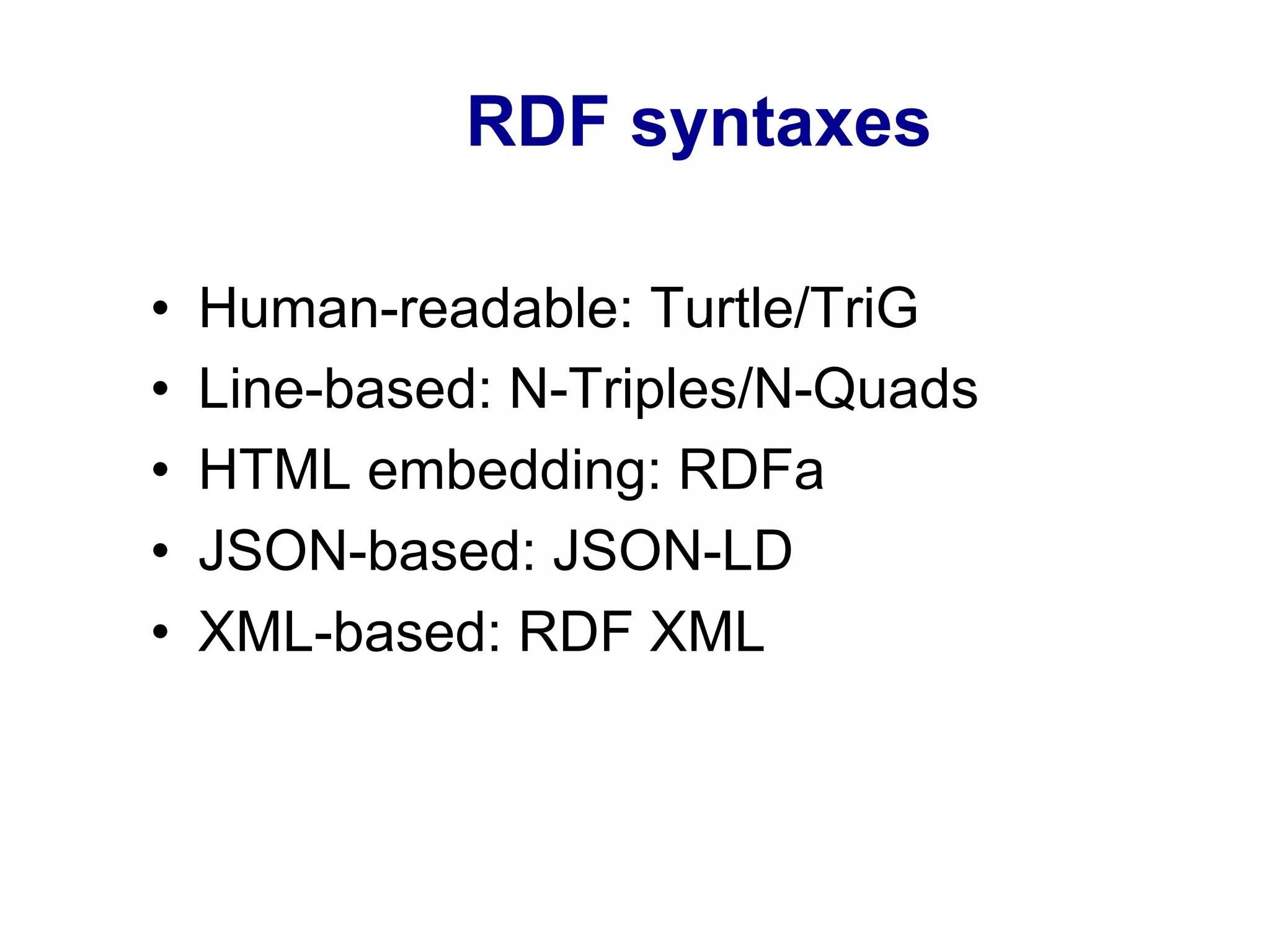
RDF syntaxes
•  Human-readable: Turtle/TriG
•  Line-based: N-Triples/N-Quads
•  HTML embedding: RDFa
•  JSON-based: JSON-LD
•  XML-based: RDF XML
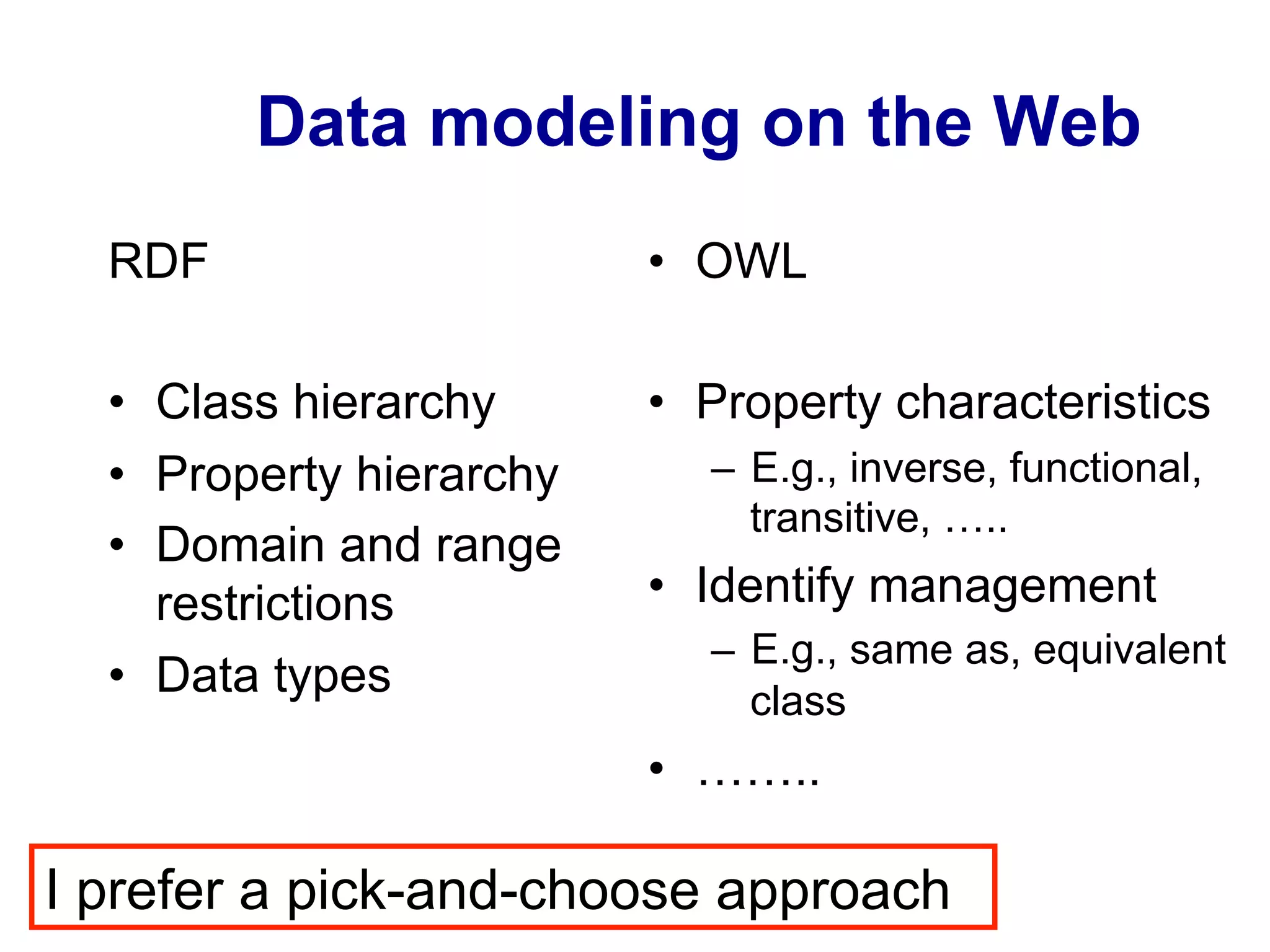
Data modeling on the Web
RDF
•  Class hierarchy
•  Property hierarchy
•  Domain and range
restrictions
•  Data types
•  OWL
•  Property characteristics
–  E.g., inverse, functional,
transitive, …..
•  Identify management
–  E.g., same as, equivalent
class
•  ……..
I prefer a pick-and-choose approach
Writing in an ontology language
does not make it an ontology!
•  Ontology is vehicle for sharing
•  Papers about your own idiosyncratic
“university ontology” should be rejected
at conferences
•  The quality of an ontology does not
depend on the number of, for example,
OWL constructs used
Rationale
•  A vocabulary represents
distilled knowledge of a
community
•  Typically product of a
consensus process over
longer period of time
Use
•  200+ vocabularies
published
•  E.g.: Library of
Congress Subject
Headings
•  Mainly in library field
SKOS: making existing
vocabularies Web accessible
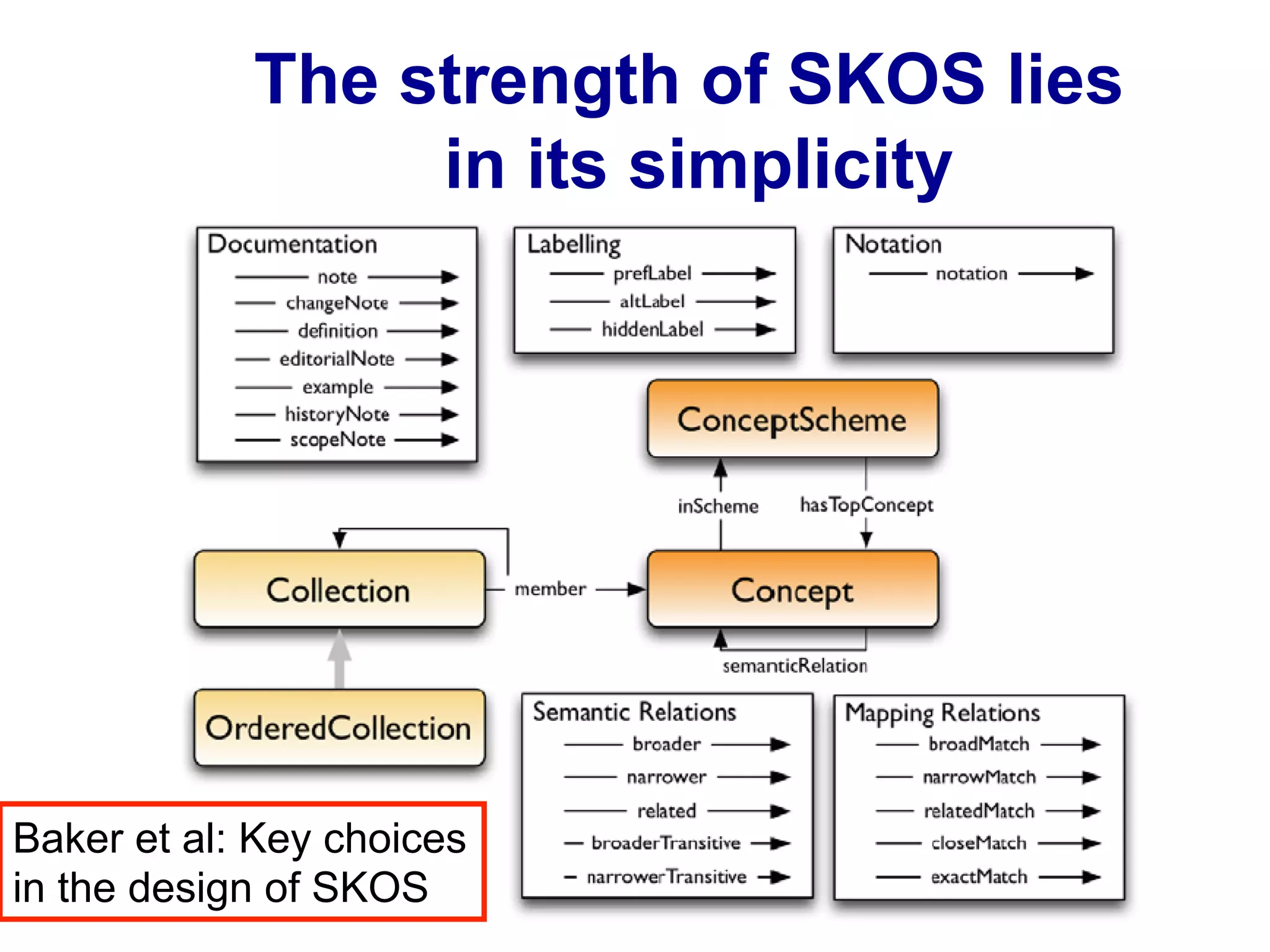
The strength of SKOS lies
in its simplicity
Baker et al: Key choices
in the design of SKOS
Beware of ontological over-
commitment
•  We have the understandable tendency
to use semantic modeling constructs
whenever we can
•  Better is to limit any Web model to the
absolute minimum
KNOWLEDGE ON THE WEB:
CATEGORIES
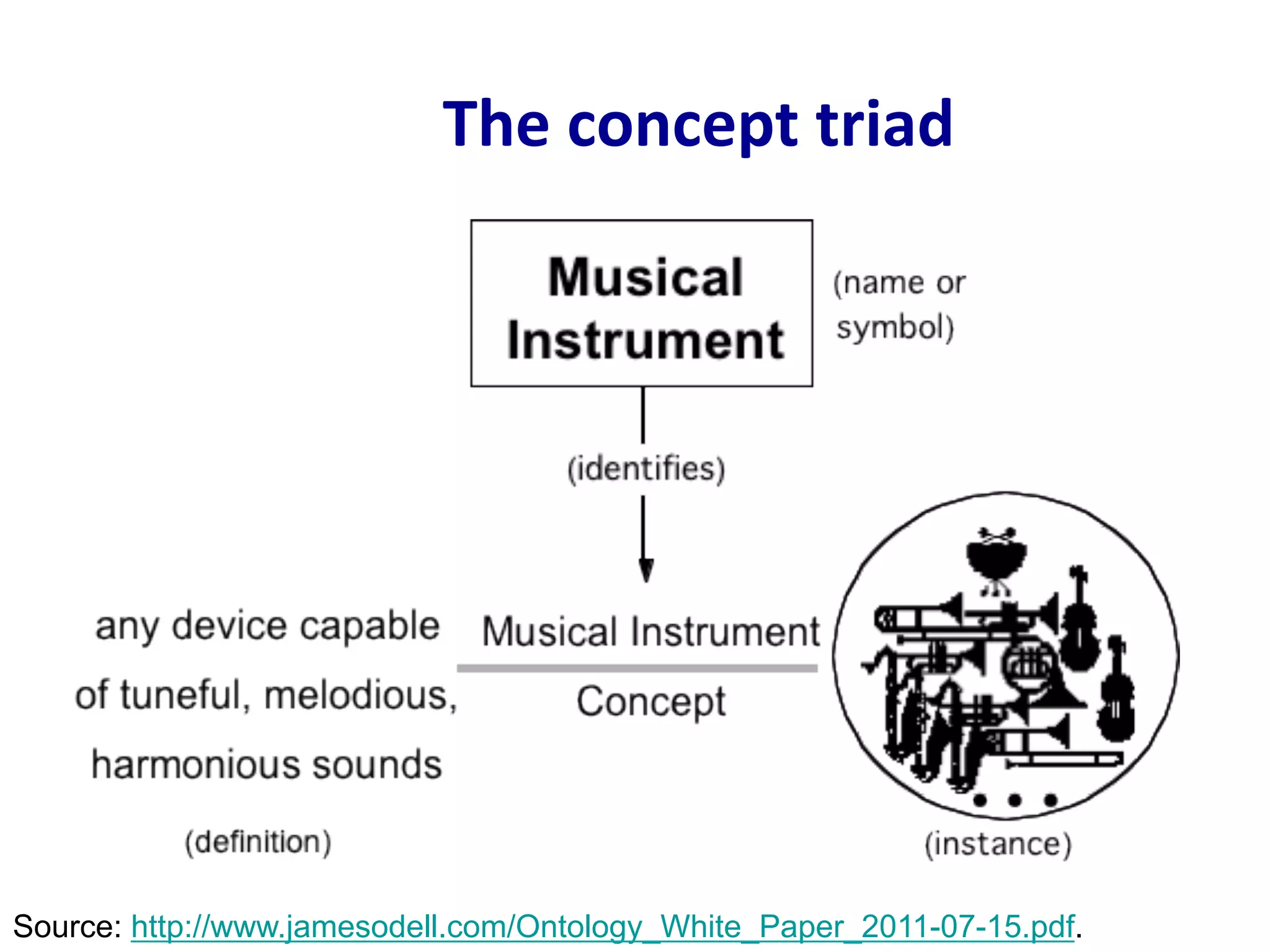
The	
  concept	
  triad
	
  
Source: http://www.jamesodell.com/Ontology_White_Paper_2011-07-15.pdf.
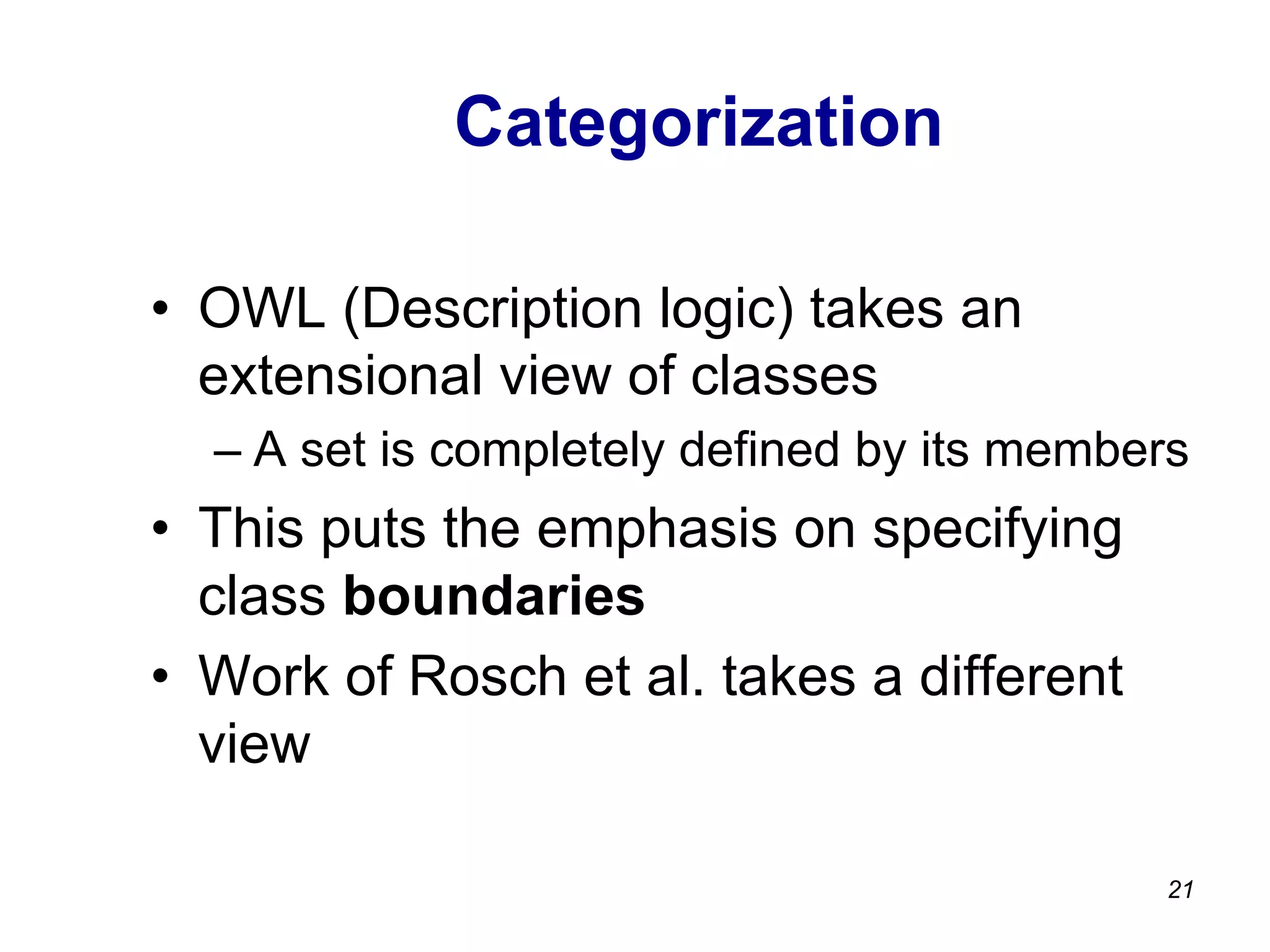
Categorization
•  OWL (Description logic) takes an
extensional view of classes
– A set is completely defined by its members
•  This puts the emphasis on specifying
class boundaries
•  Work of Rosch et al. takes a different
view
21
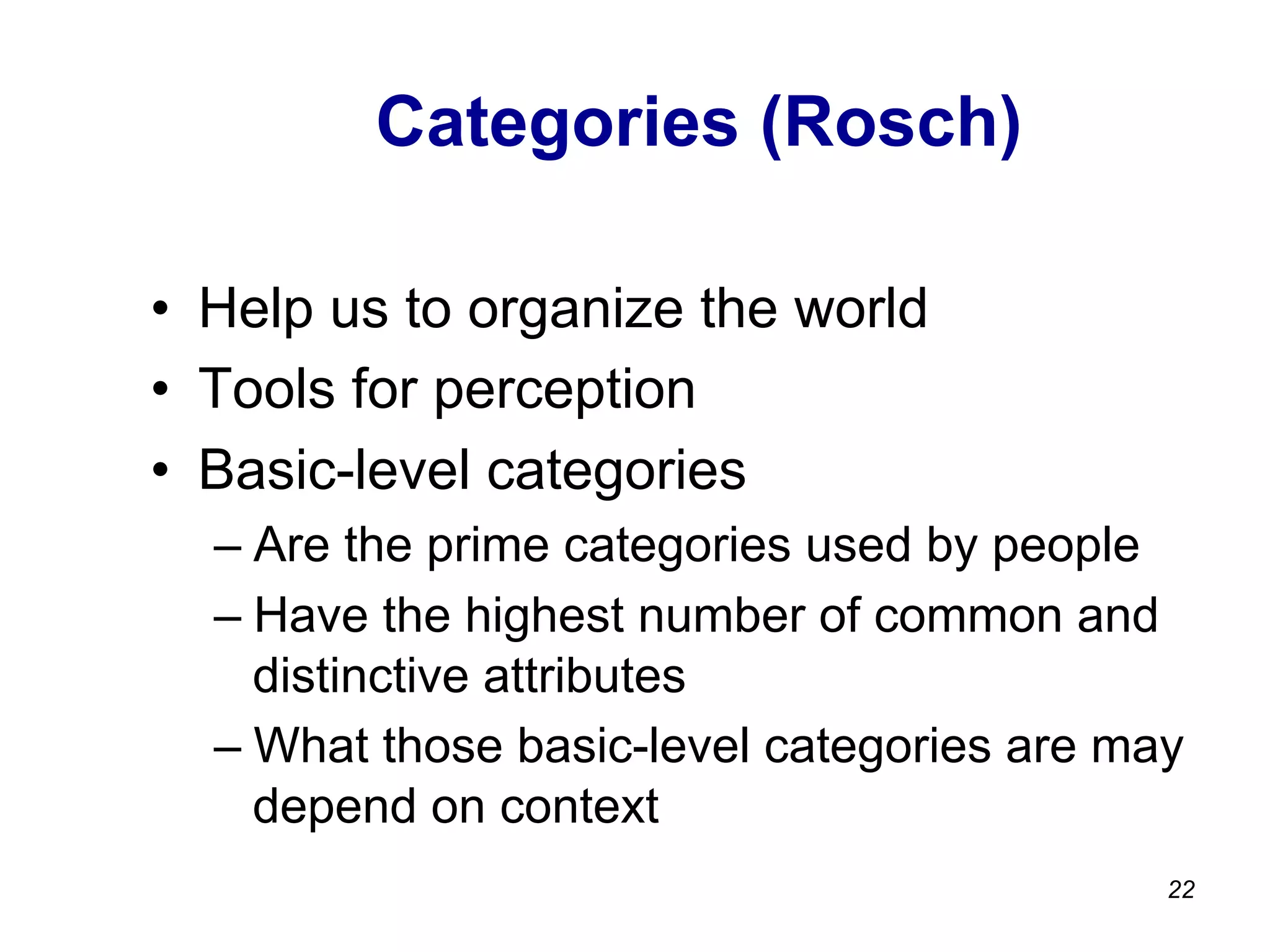
Categories (Rosch)
•  Help us to organize the world
•  Tools for perception
•  Basic-level categories
– Are the prime categories used by people
– Have the highest number of common and
distinctive attributes
– What those basic-level categories are may
depend on context
22
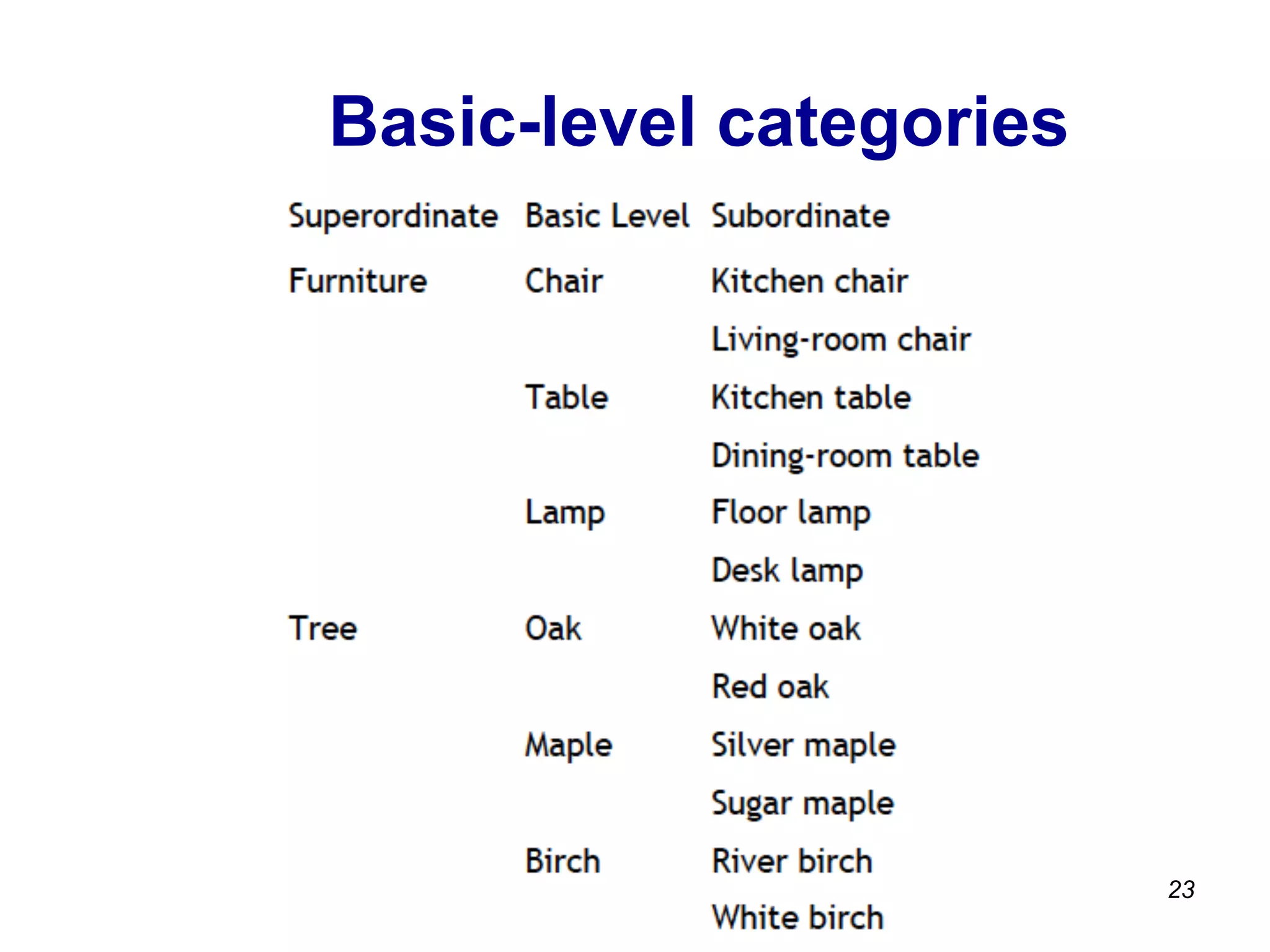
Basic-level categories
23
24
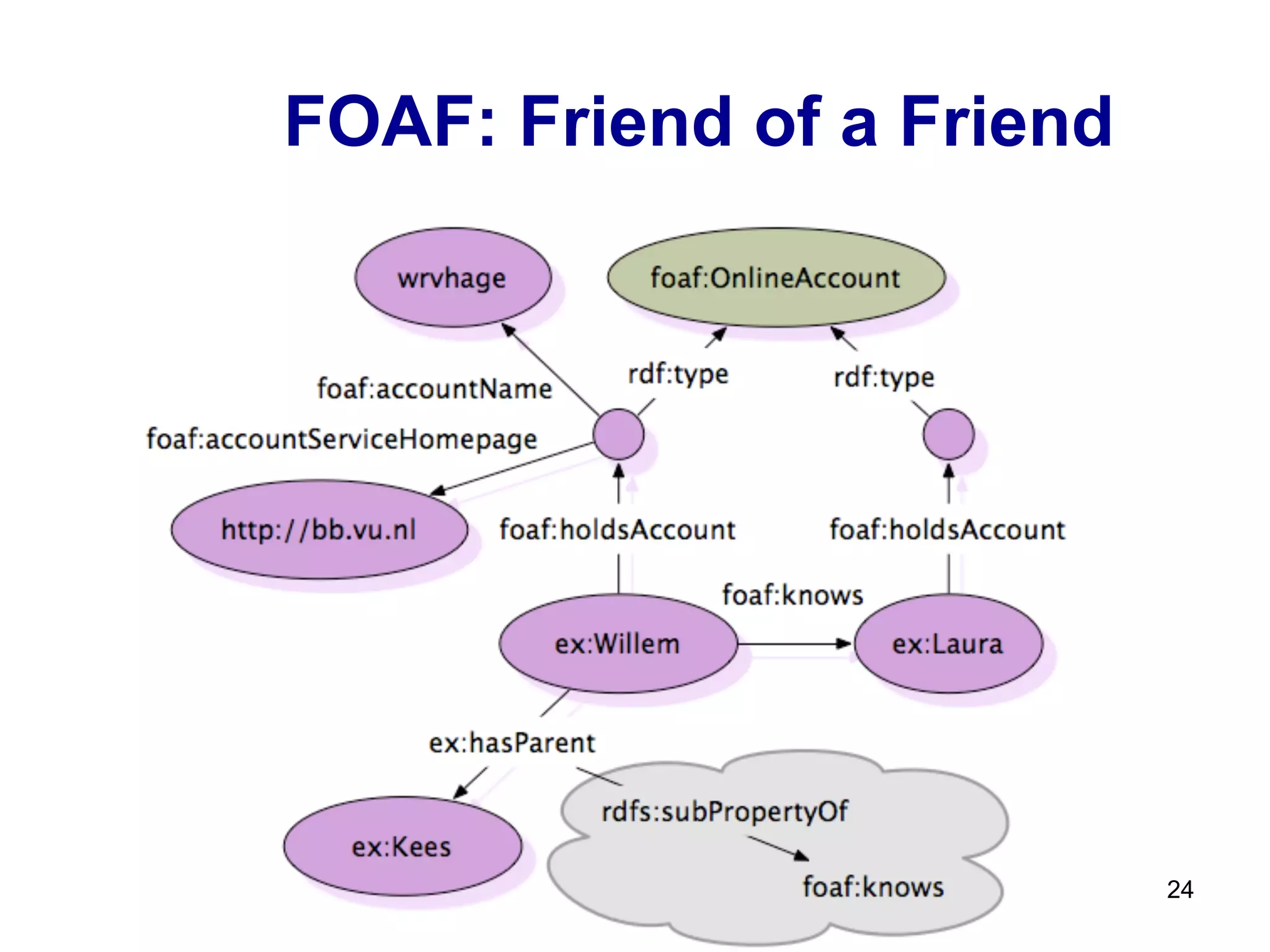
FOAF: Friend of a Friend
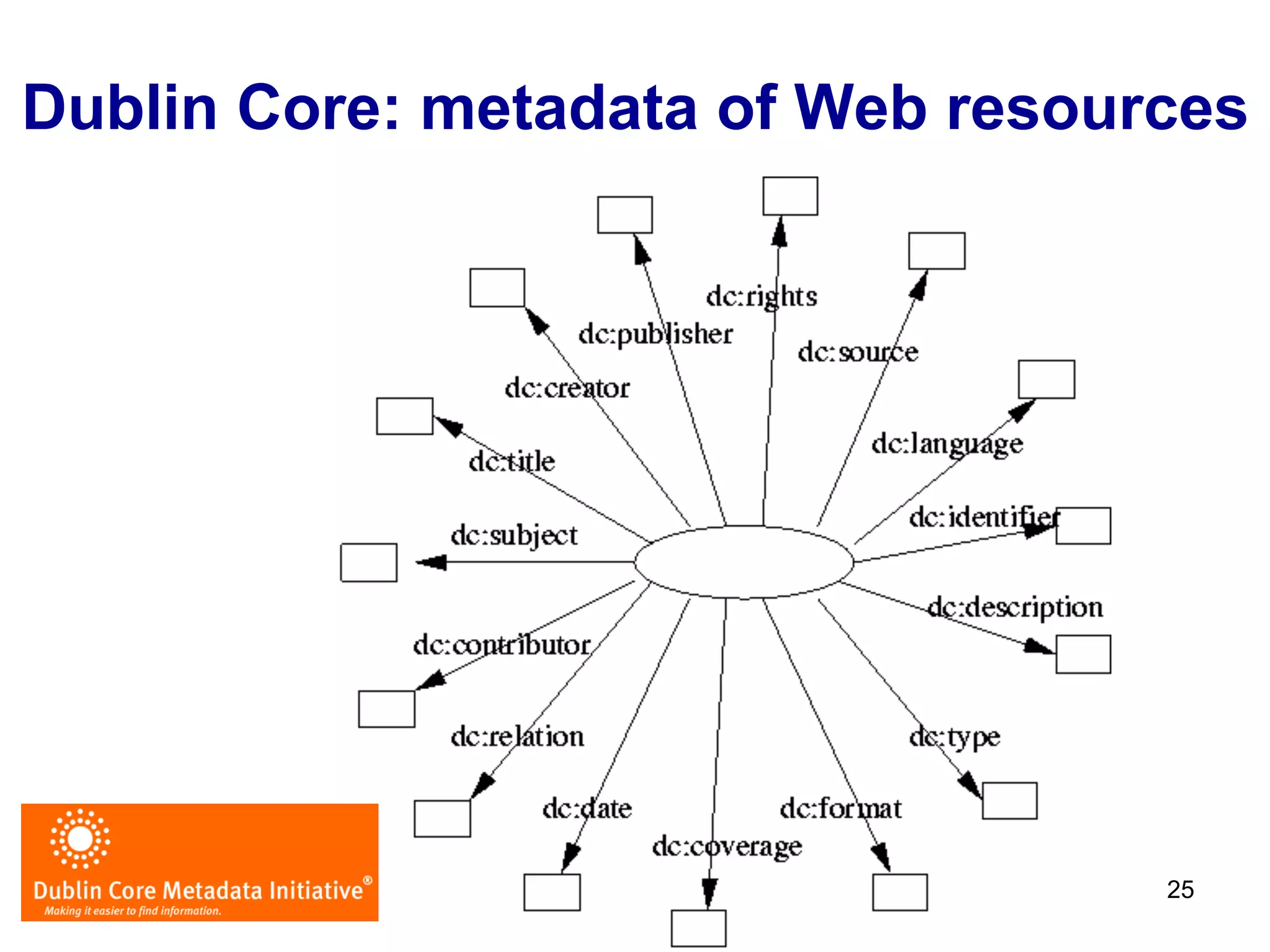
25
Dublin Core: metadata of Web resources
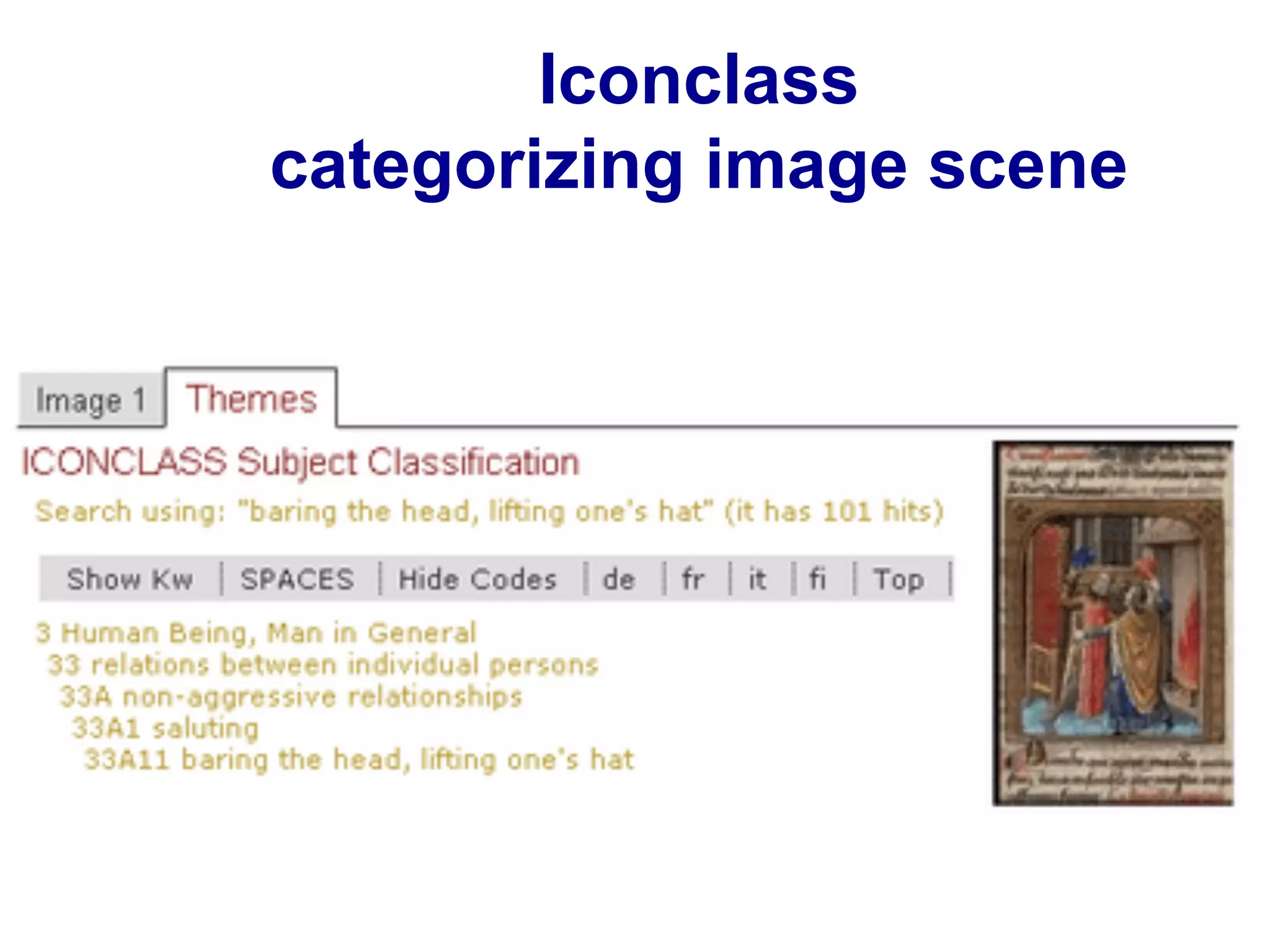
Iconclass
categorizing image scene
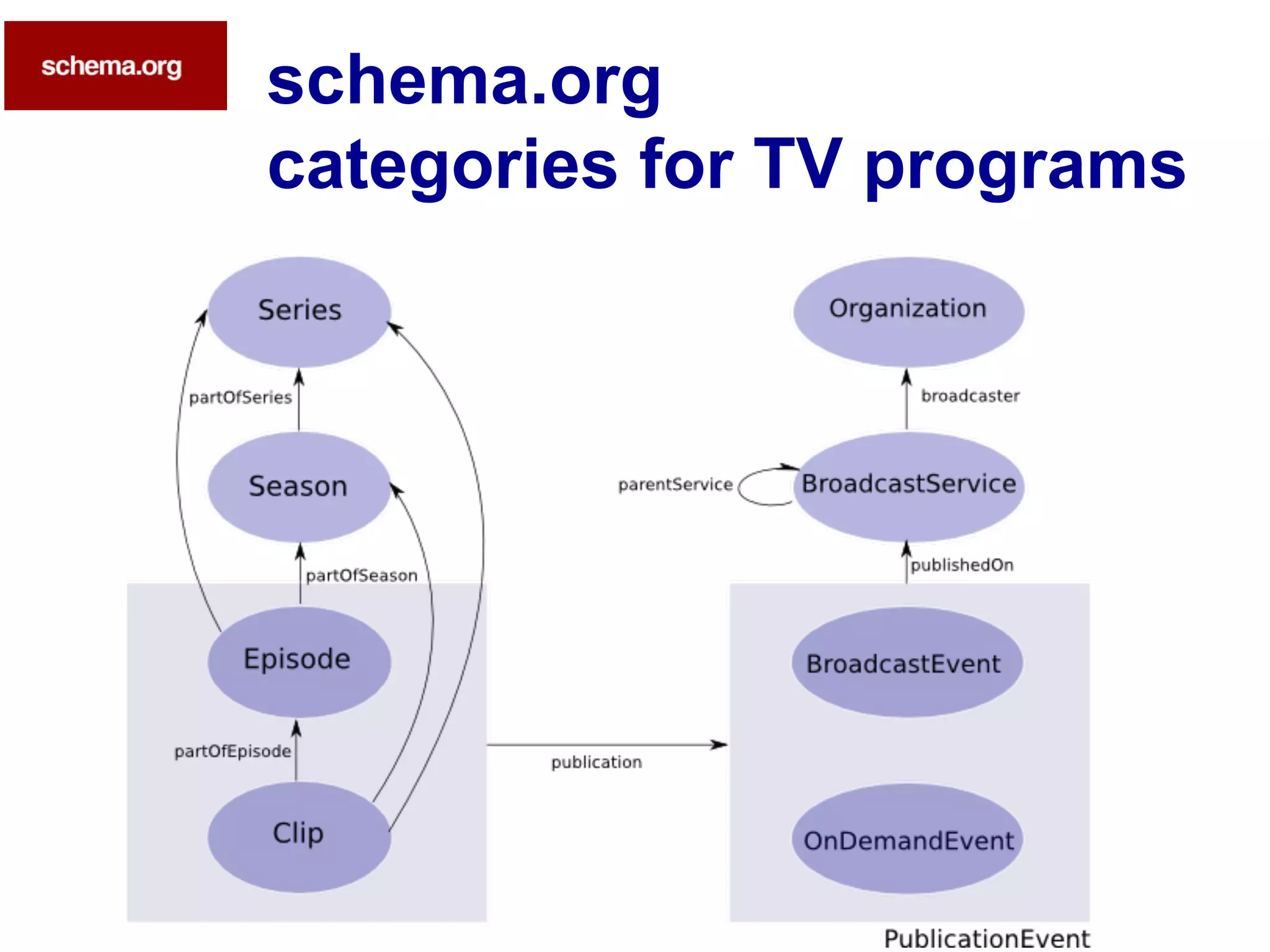
schema.org
categories for TV programs
schema.org issues
•  Top-down versus bottom-up
•  Ownership and control
•  Who can update/extend?
•  Does use for general search bias the
vocabulary?
The myth of a unified
vocabulary
•  In large virtual collections there are always
multiple vocabularies
–  In multiple languages
•  Every vocabulary has its own perspective
–  You can’t just merge them
•  But you can use vocabularies jointly by
defining a limited set of links
–  “Vocabulary alignment”
Category alignment vs.
identity disambiguation
•  Alignment concerns finding links
between (similar) categories, which
typically have no identity in the real world
•  Identity disambiguation is finding out
whether two or more IDs point to the
same object in the real world (e.g.,
person, building, ship)
•  The distinction is more subtle that “class
versus instance”
Alignment techniques
•  Syntax: comparison of characters of the terms
–  Measures of syntactic distance
–  Language processing
•  E.g. Tokenization, single/plural,
•  Relate to lexical resource
–  Relate terms to place in WordNet hierarchy
•  Taxonomy comparison
–  Look for common parents/children in taxonomy
•  Instance based mapping
–  Two classes are similar if their instances are similar.
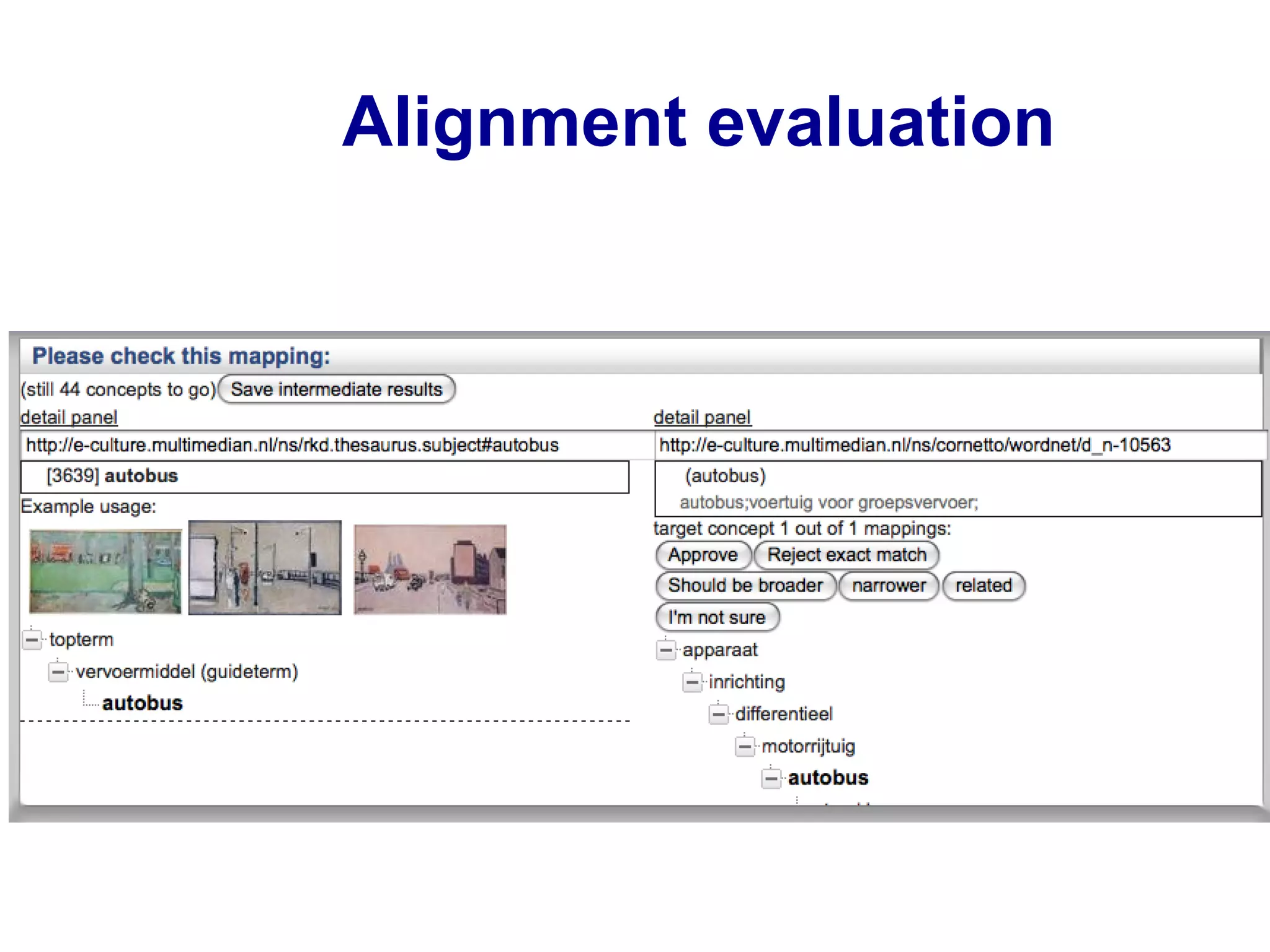
Alignment evaluation
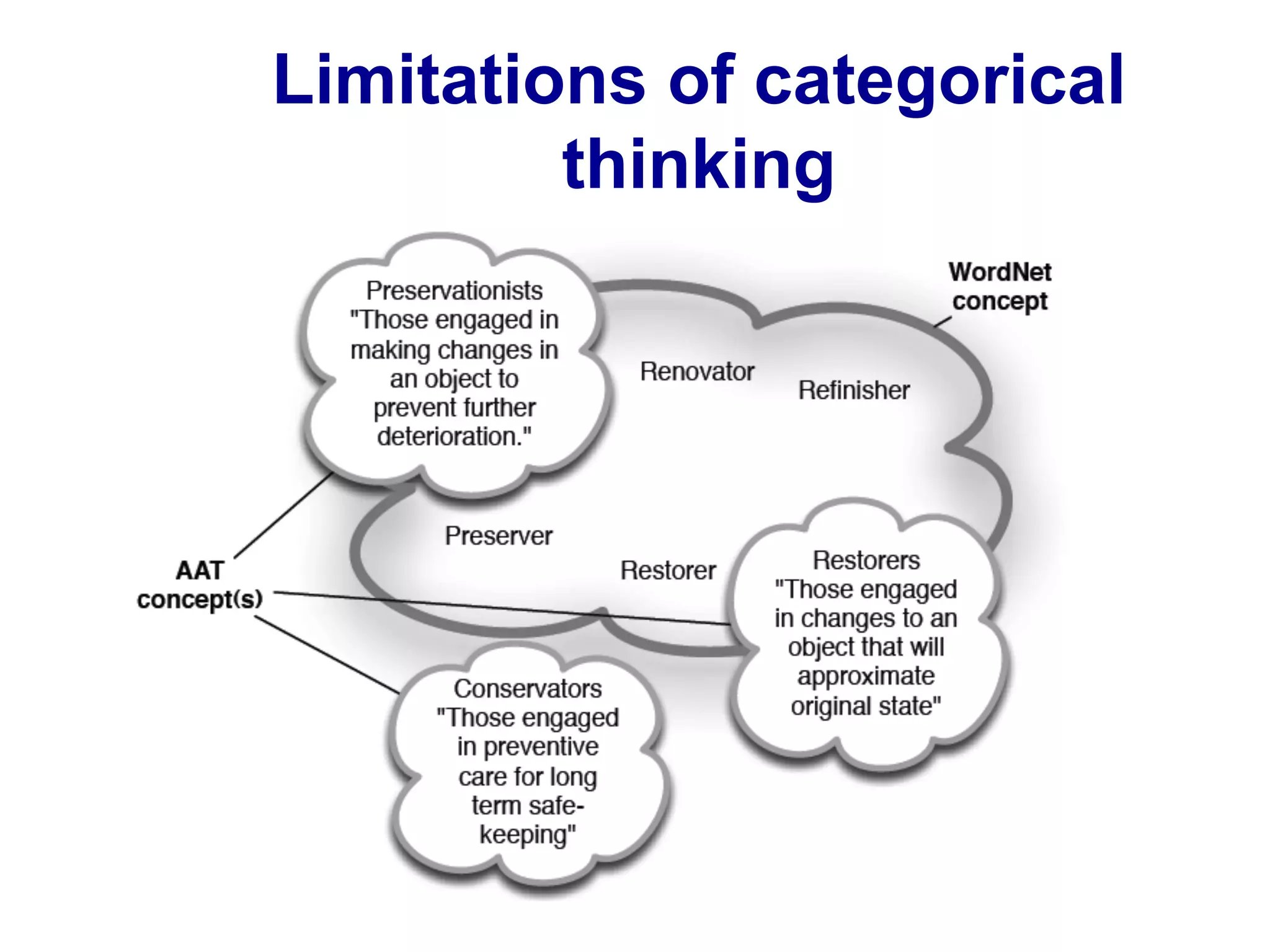
Limitations of categorical
thinking
Be modest! Don’t recreate,
but enrich and align
•  Knowledge engineers should refrain
from developing their own idiosyncratic
ontologies
•  Instead, they should make the available
rich vocabularies, thesauri and
databases available in an interoperable
(web) format
•  Techniques: learning, alignment
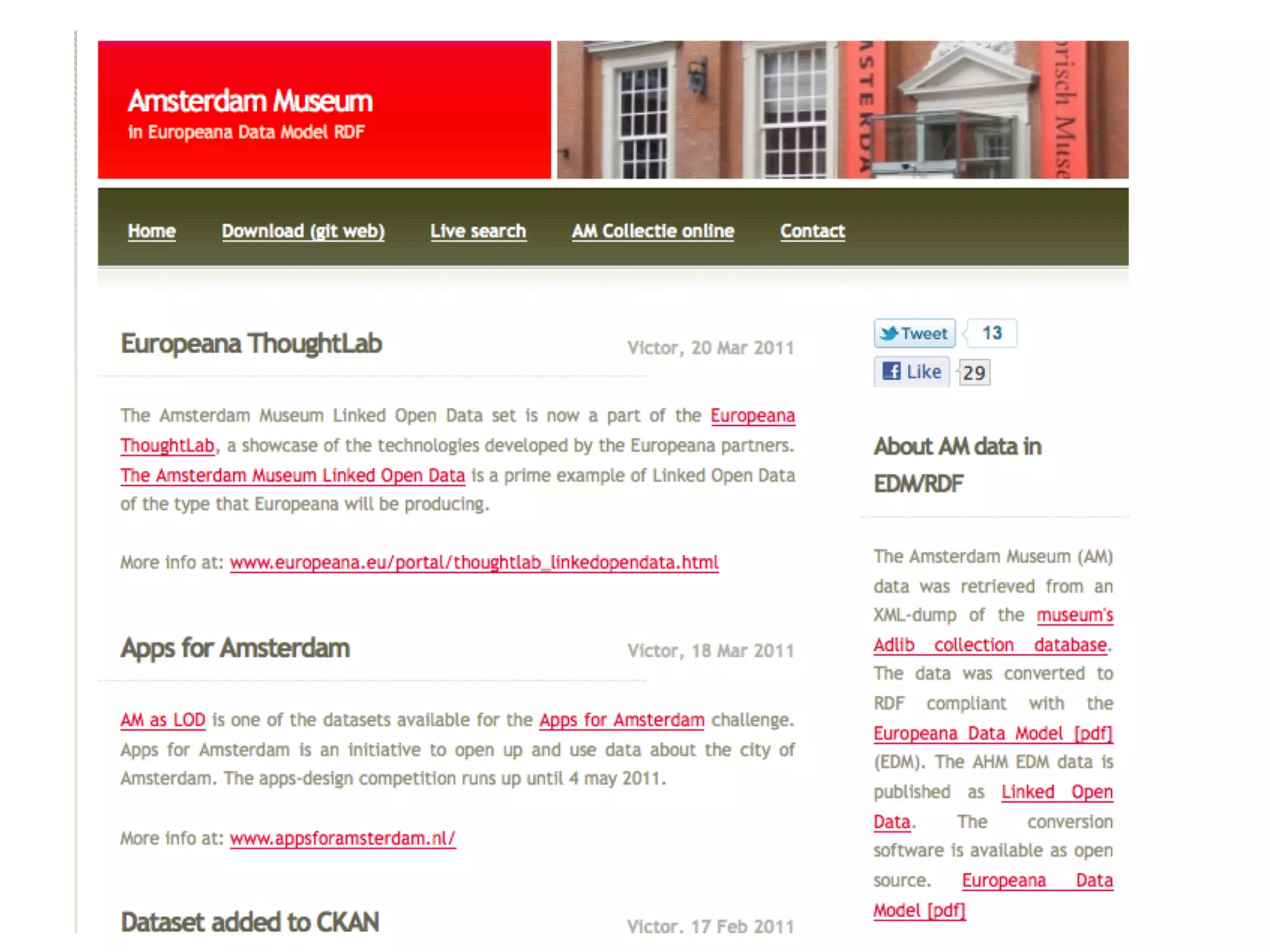
35	
  
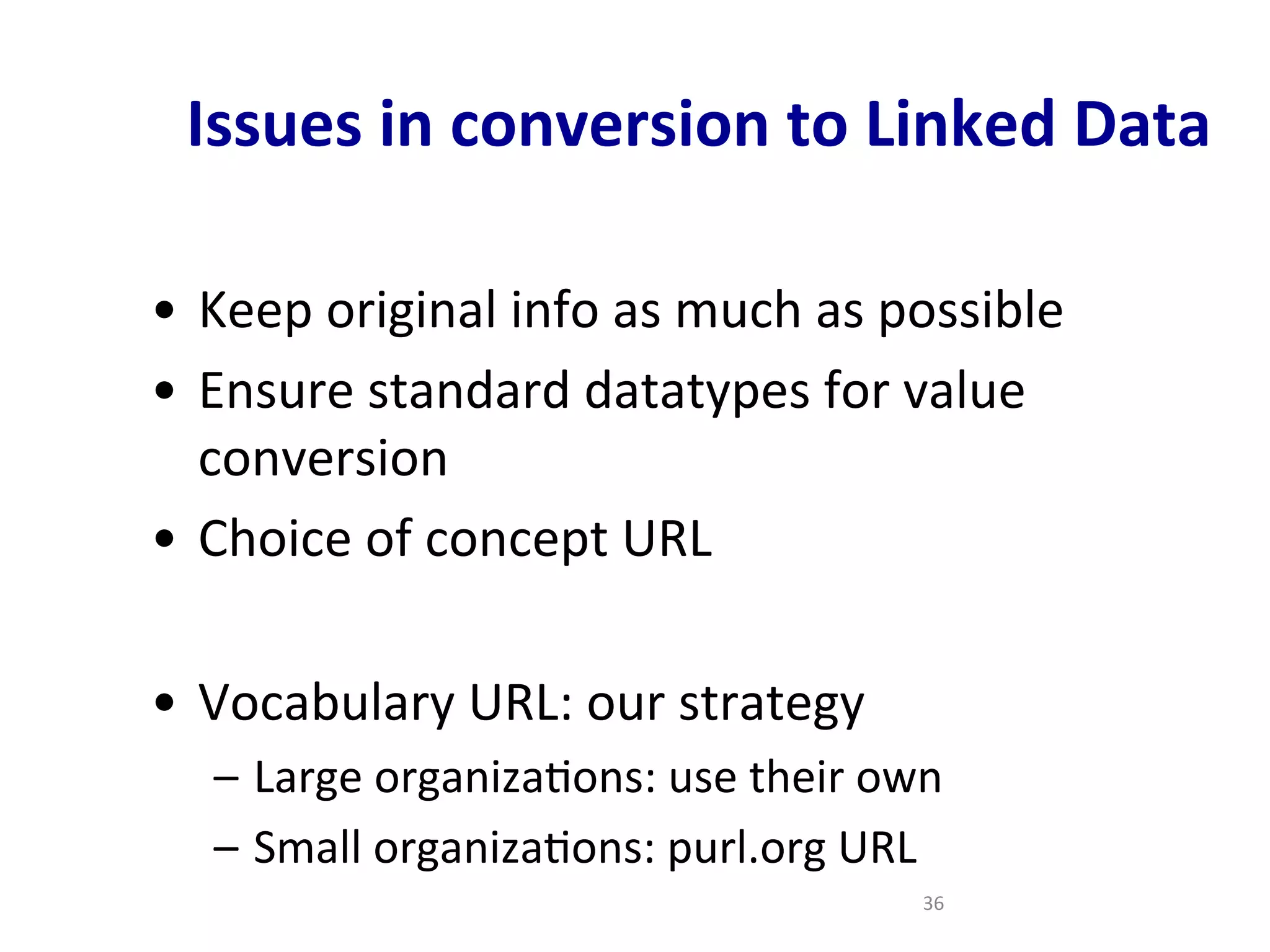
Issues	
  in	
  conversion	
  to	
  Linked	
  Data	
  
•  Keep	
  original	
  info	
  as	
  much	
  as	
  possible	
  
•  Ensure	
  standard	
  datatypes	
  for	
  value	
  
conversion	
  
•  Choice	
  of	
  concept	
  URL	
  
•  Vocabulary	
  URL:	
  our	
  strategy	
  
–  Large	
  organizaCons:	
  use	
  their	
  own	
  
–  Small	
  organizaCons:	
  purl.org	
  URL	
  	
  
36	
  
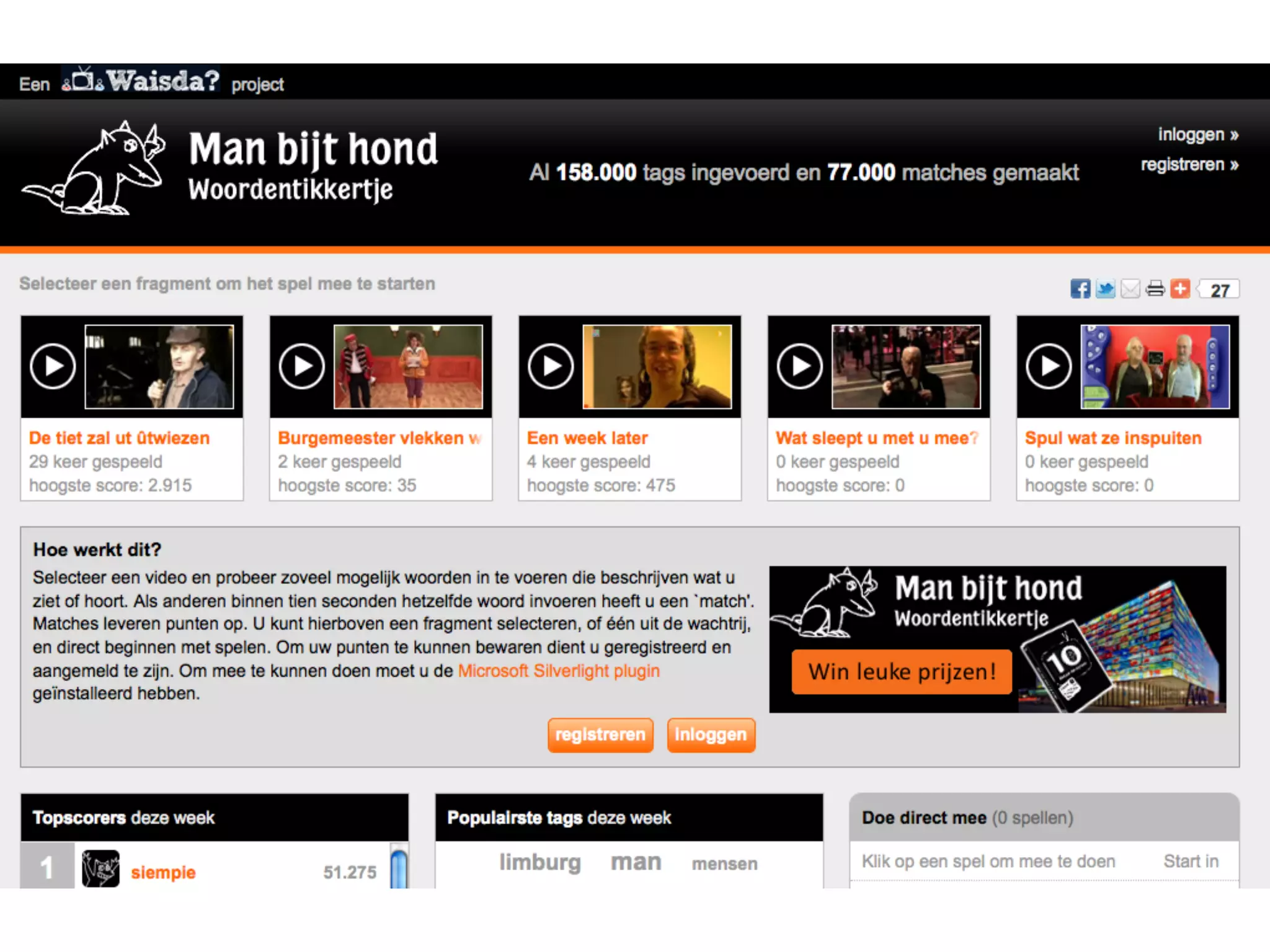
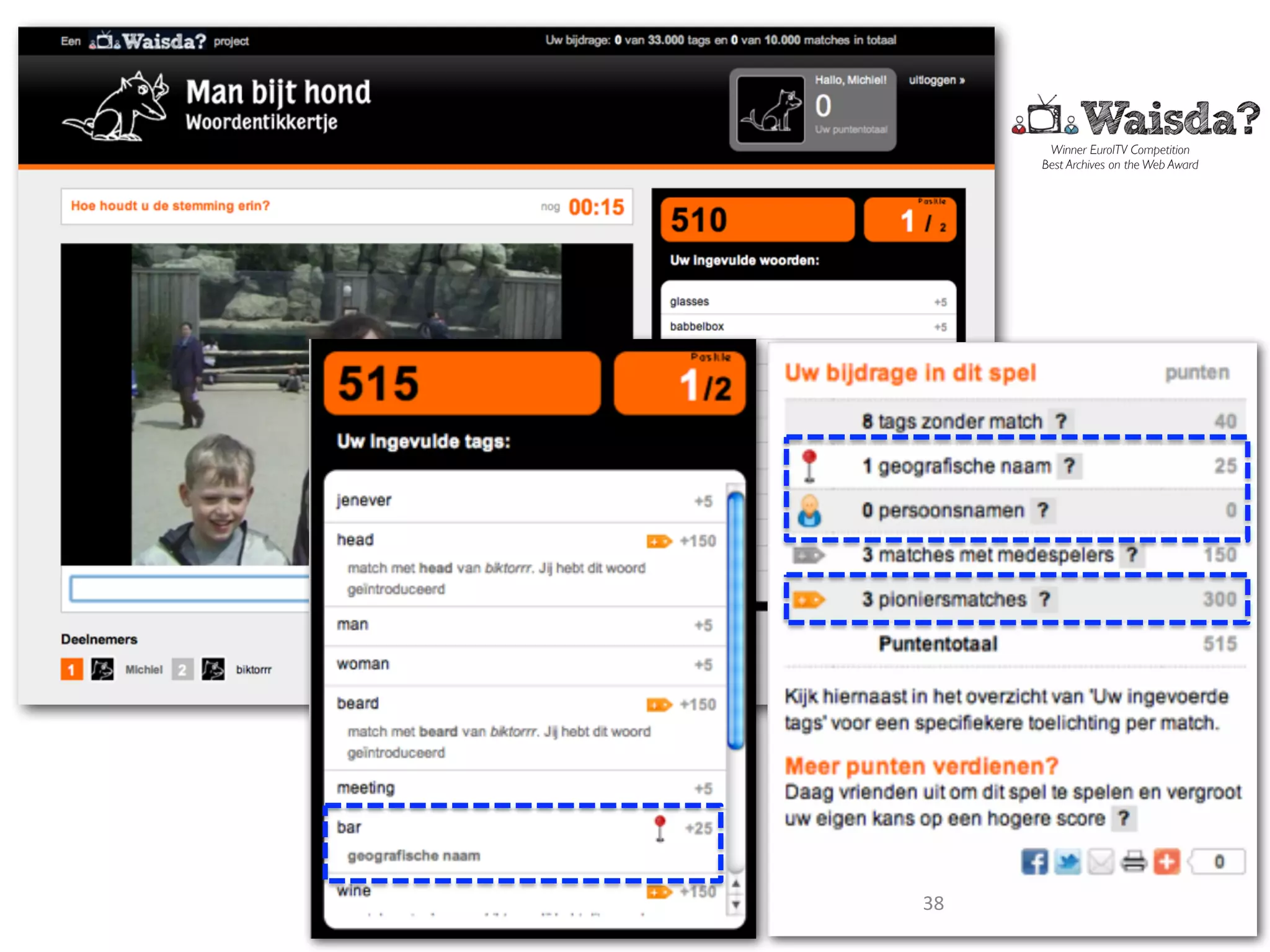
Winner EuroITV Competition
Best Archives on the Web Award
http://waisda.nl
38	
  
http://waisda.nl
http://www.prestoprime.org/
@waisda
Improve video search for (1) fragment
retrieval & (2) within video navigation
by using crowdsourcing for (1) including
time-based annotations & (2) bridging the
vocabulary gap of searcher & cataloguer
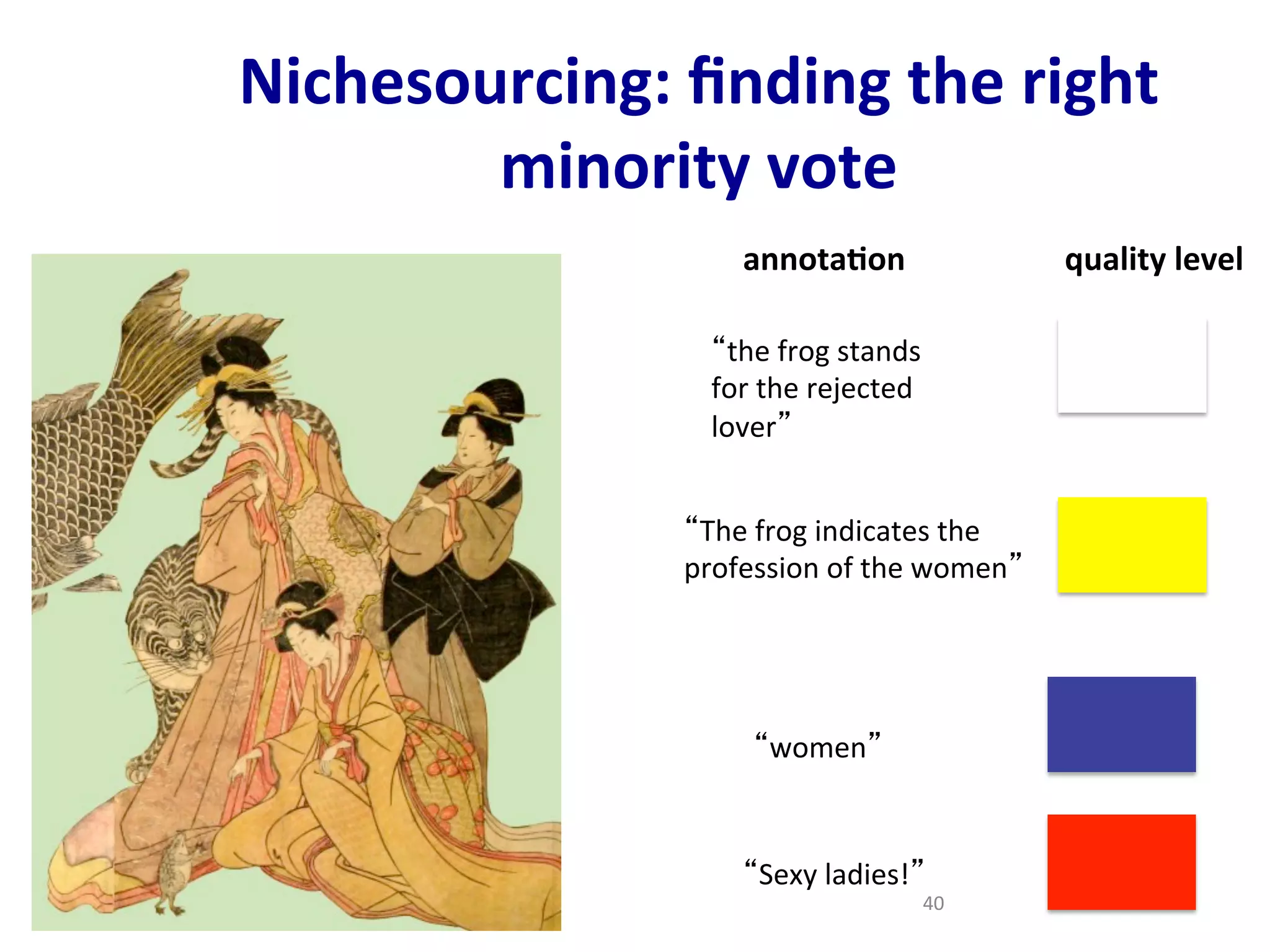
Nichesourcing:	
  finding	
  the	
  right	
  
minority	
  vote	
  
“the	
  frog	
  stands	
  
for	
  the	
  rejected	
  
lover”	
  
“The	
  frog	
  indicates	
  the	
  	
  
profession	
  of	
  the	
  women”	
  
“Sexy	
  ladies!”	
  
annota;on	


  quality	
  level	
  
40	
  
“women”	
  
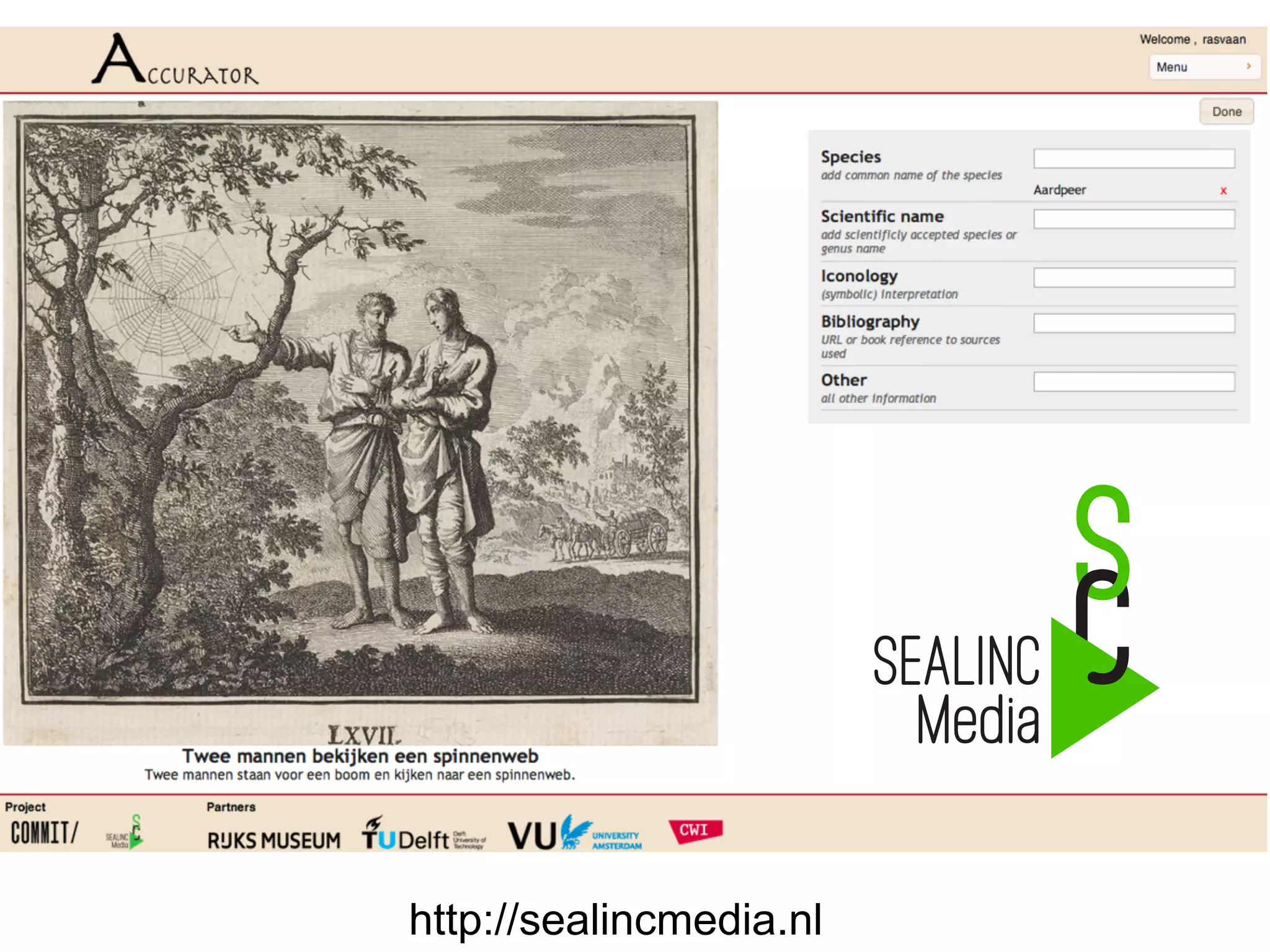
http://sealincmedia.nl
USING KNOWLEDGE:
VISUALIZATION AND SEARCH
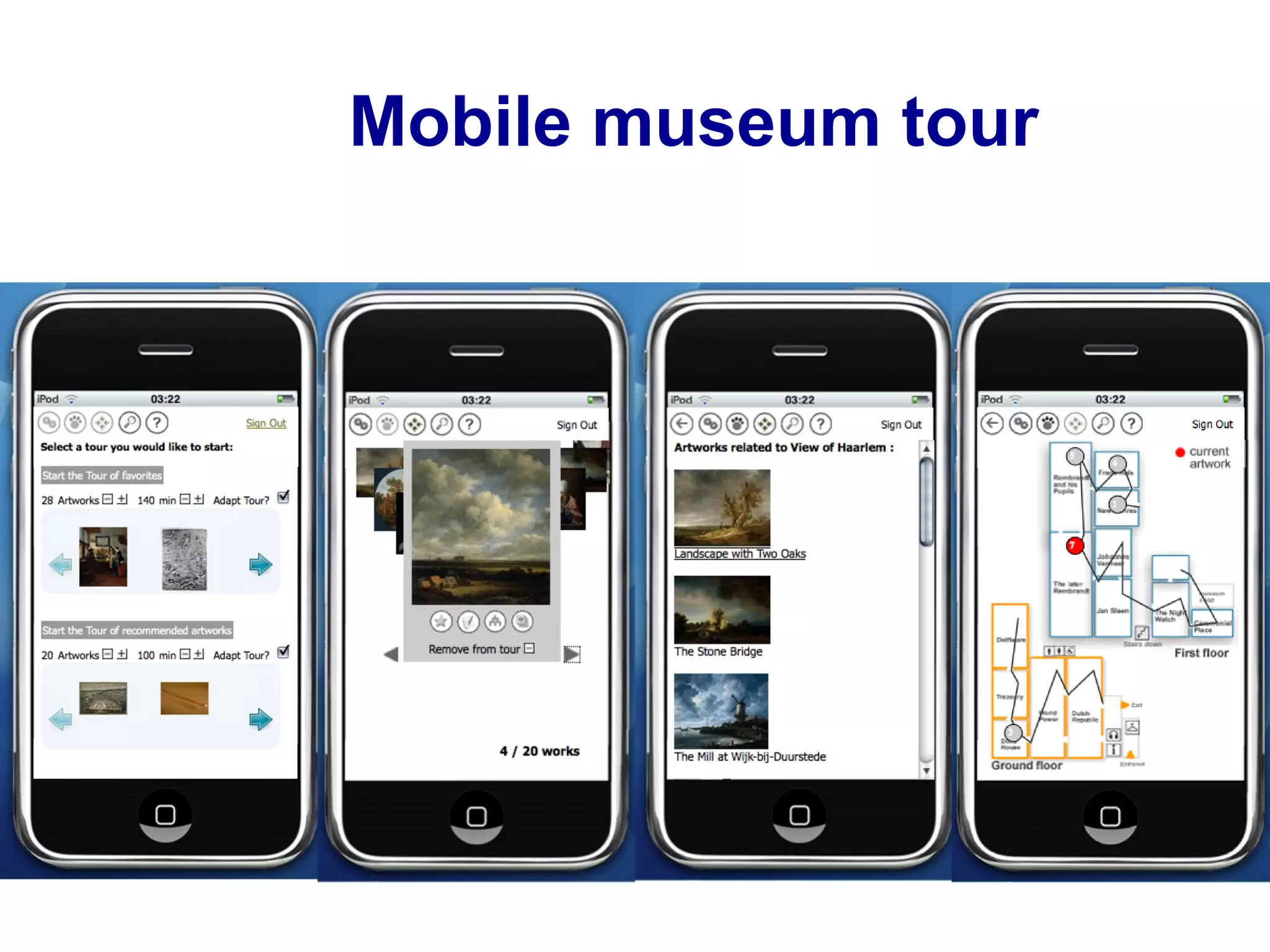
Mobile museum tour
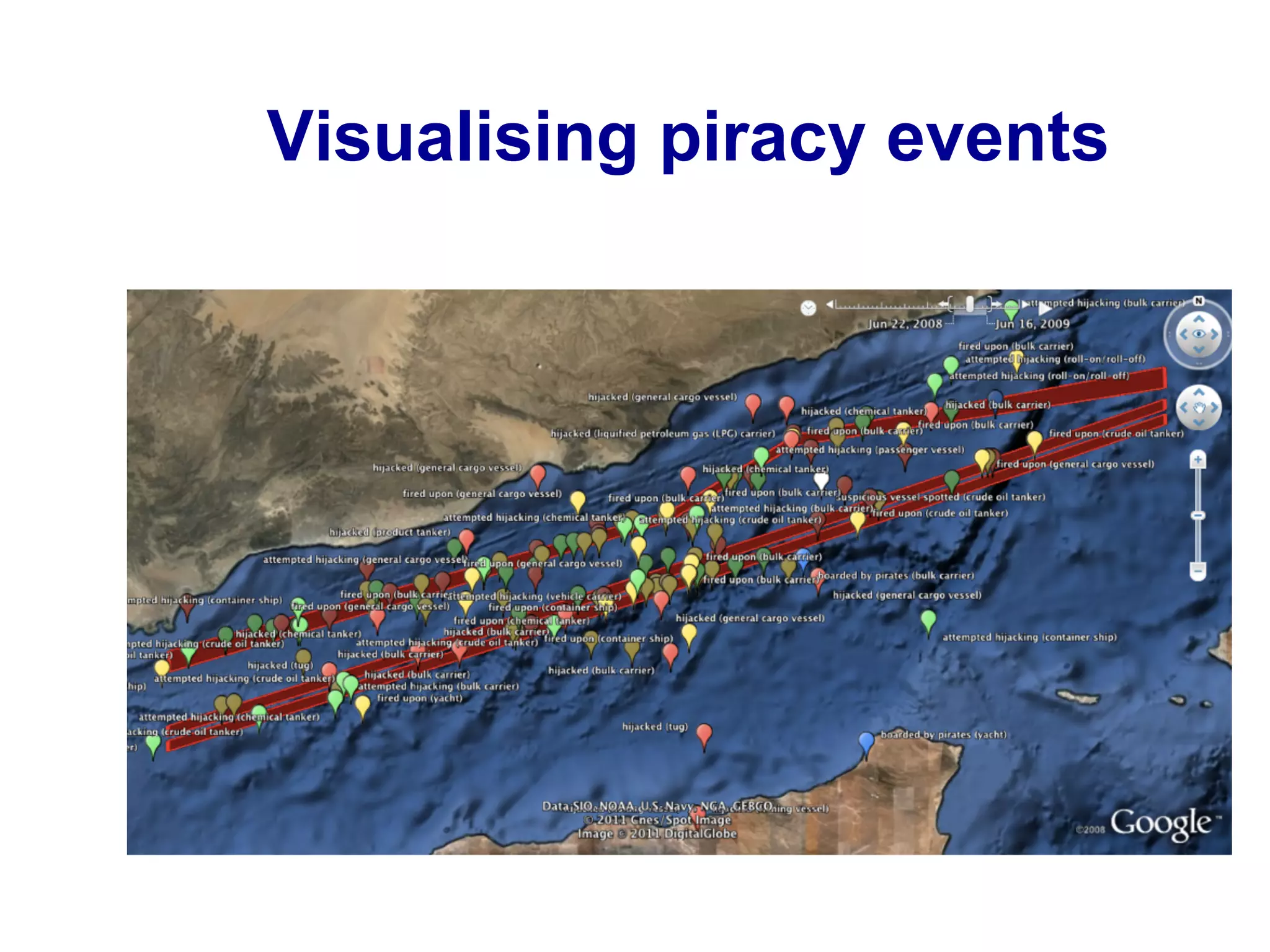
Visualising piracy events
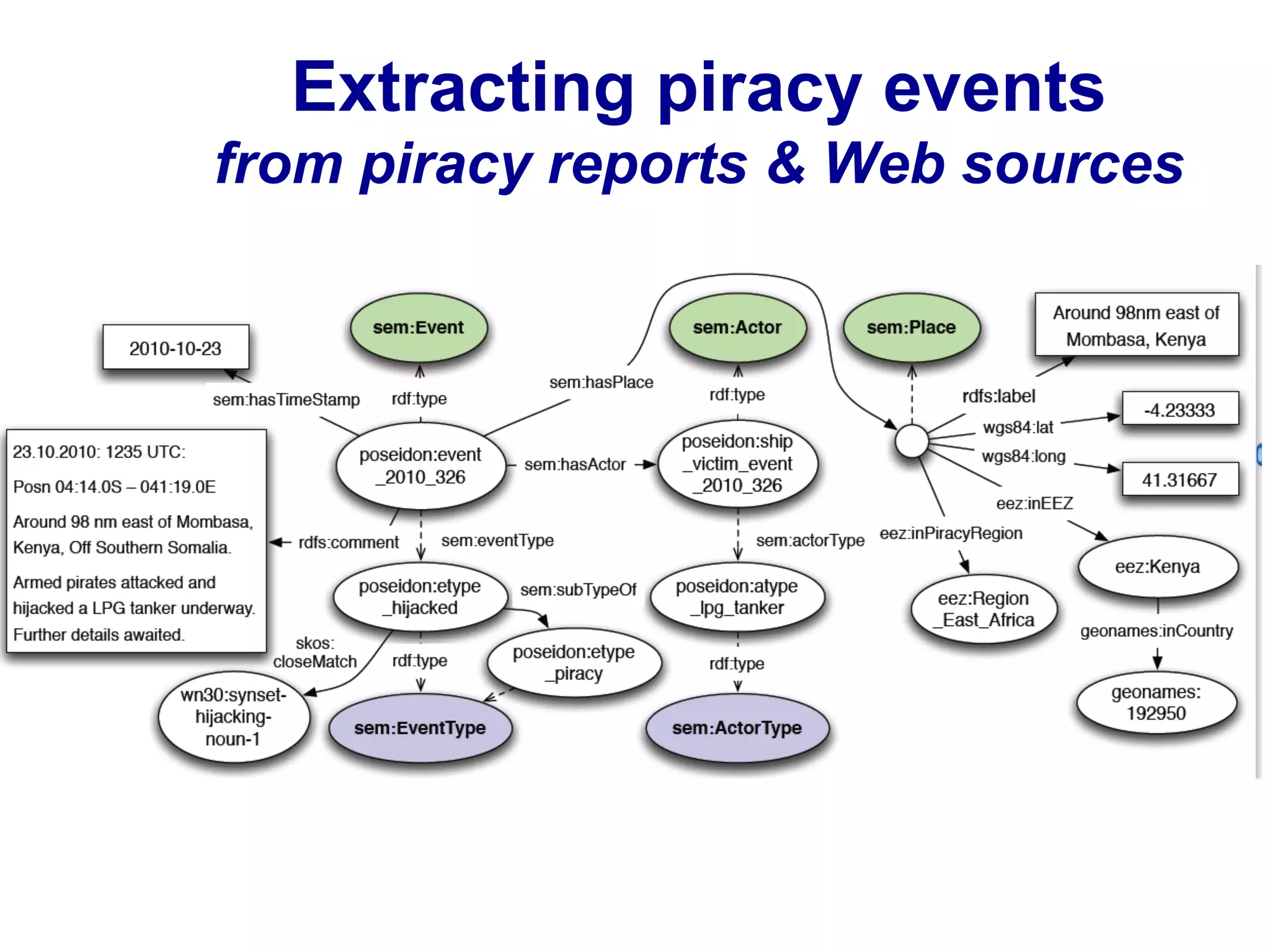
Extracting piracy events
from piracy reports & Web sources
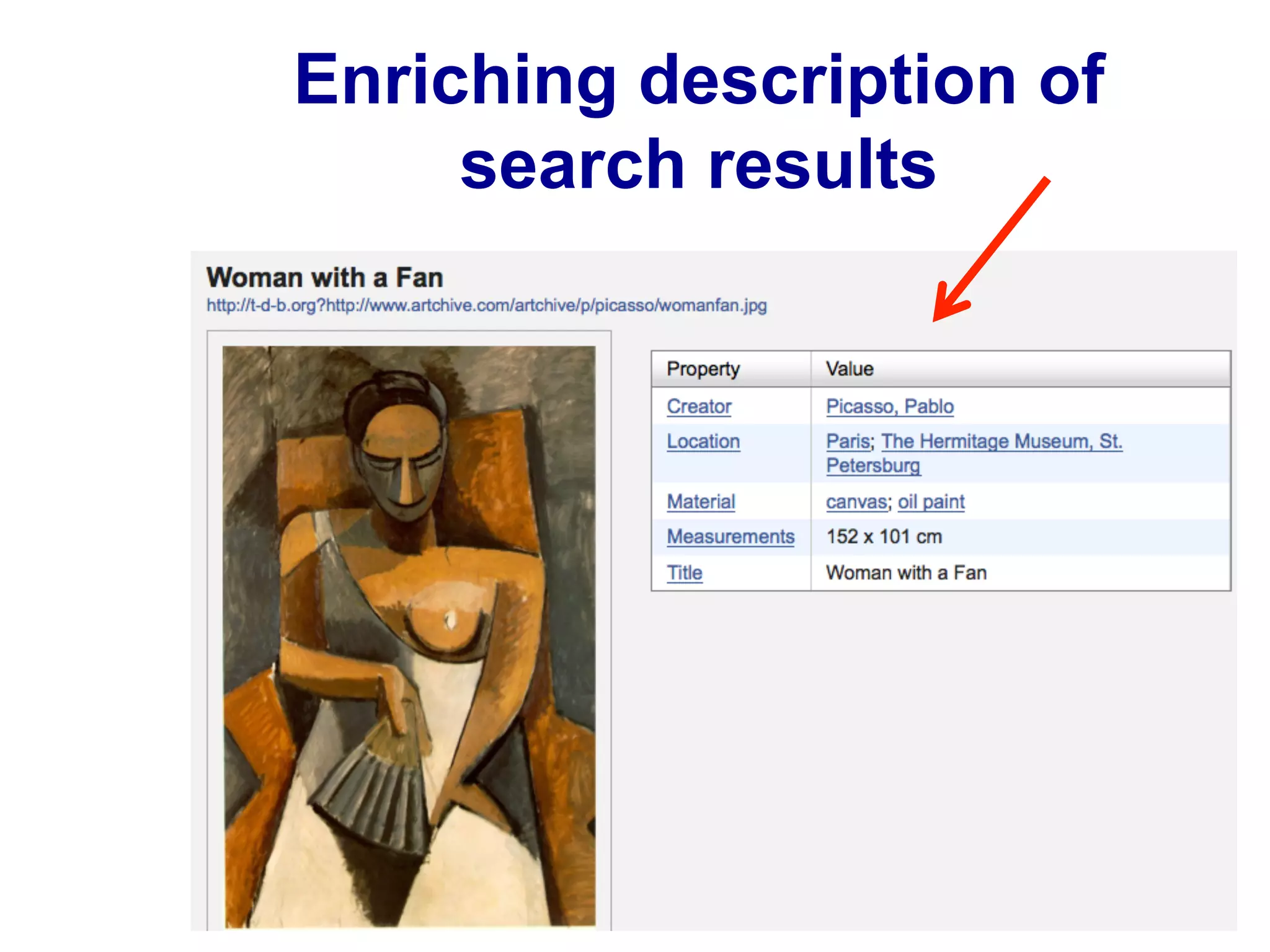
Enriching description of
search results
Sample graph search algorithm
From search term (literal) to art work
•  Find resources with matching label
•  Find path from resource to art work
– Cost of each step (step when above cost
threshold)
– Special treatment of semantics: sameAs,
inverseOf, transitive, ….
•  Cluster results based on path similarities
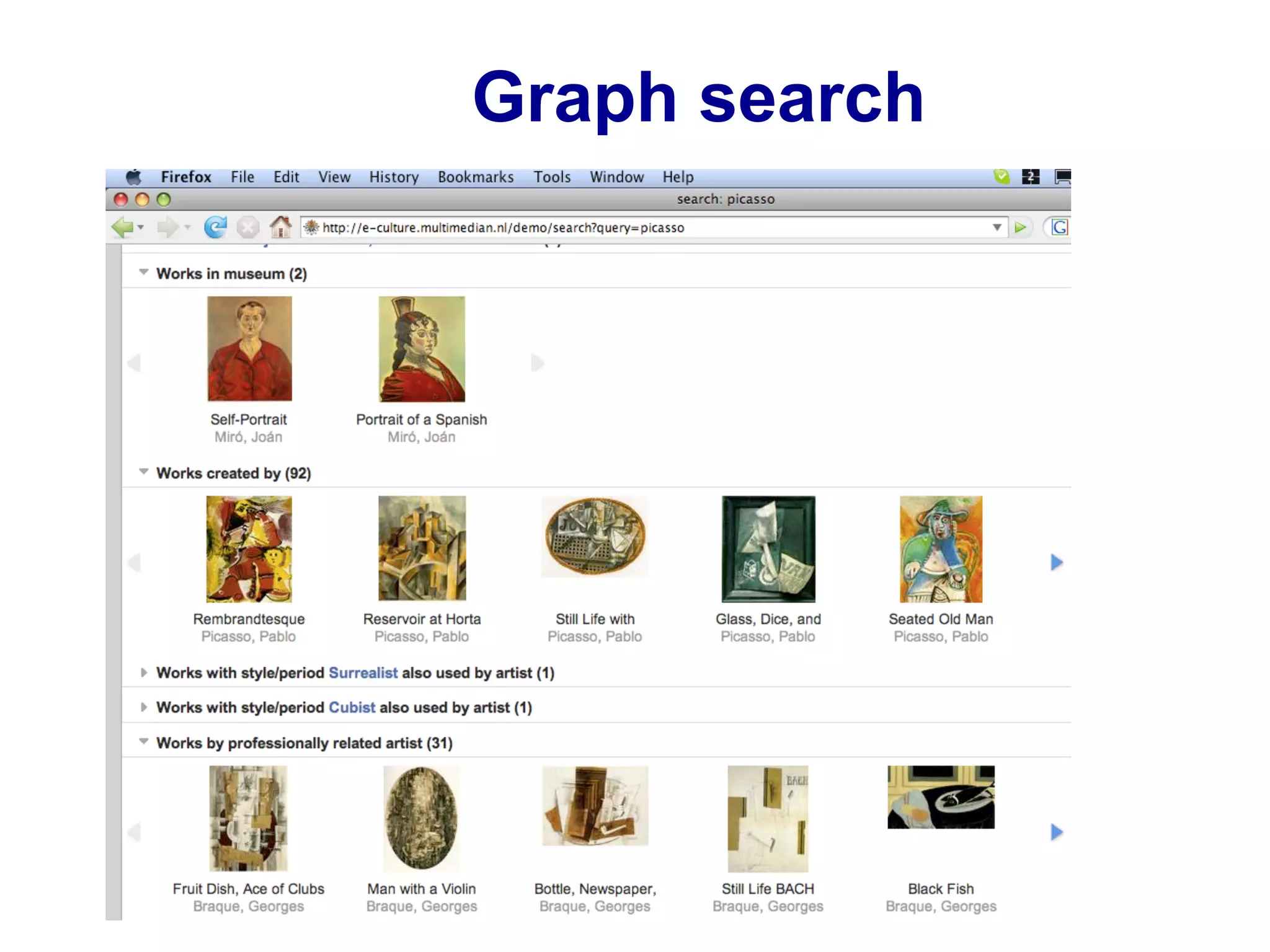
Graph search
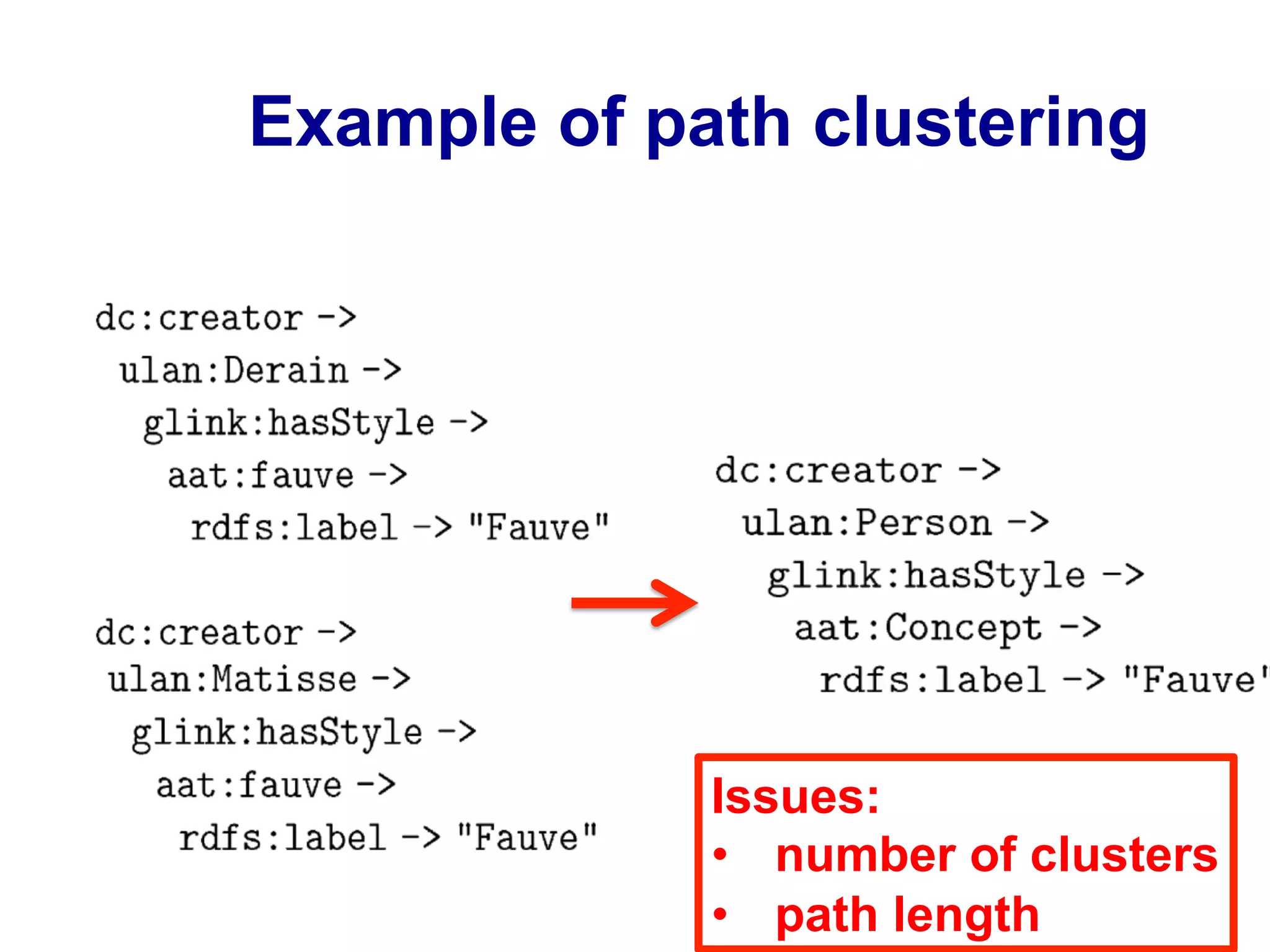
Example of path clustering
Issues:
•  number of clusters
•  path length
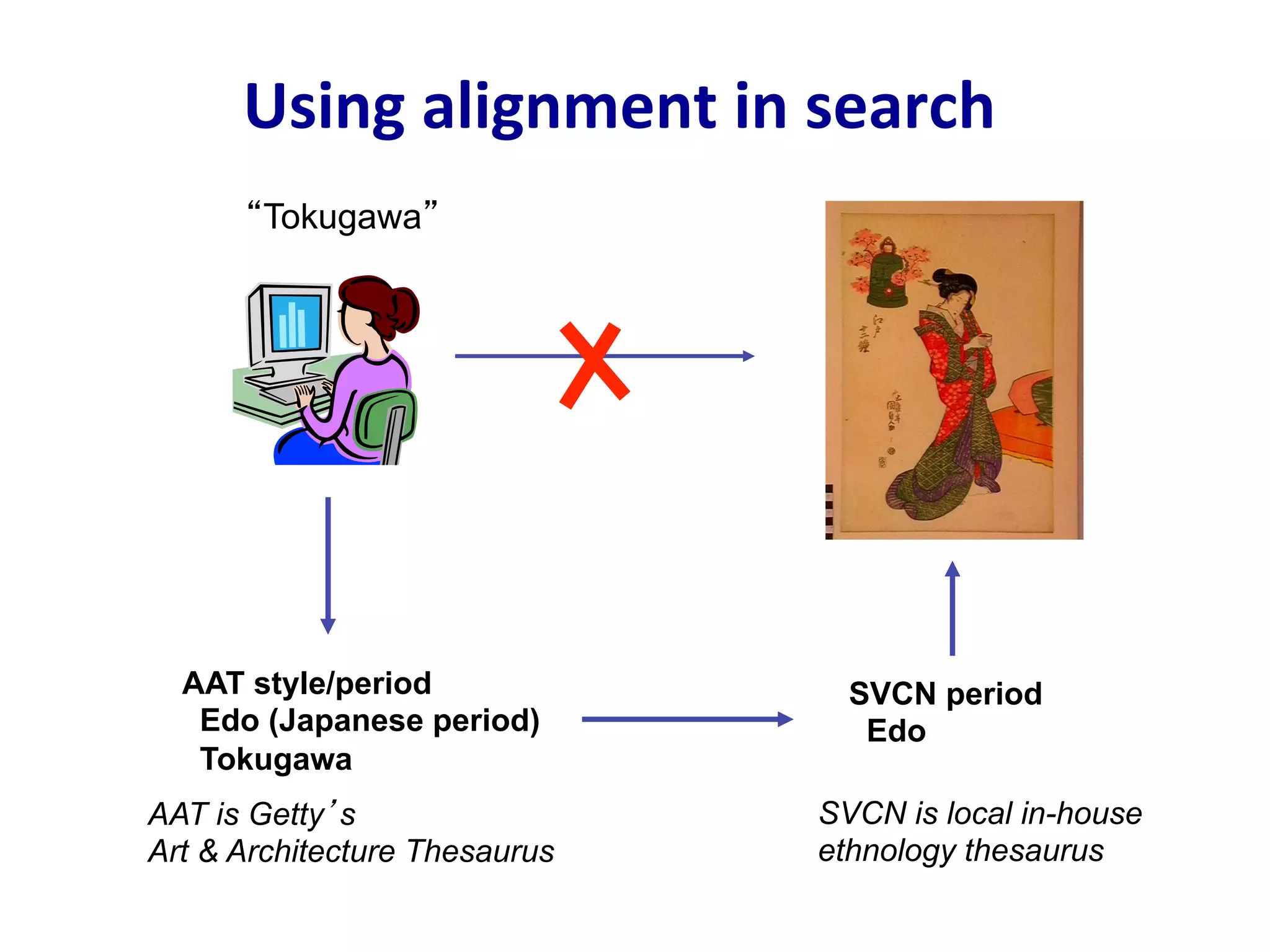
Using	
  alignment	
  in	
  search	
  
“Tokugawa”
SVCN period
Edo
SVCN is local in-house
ethnology thesaurus
AAT style/period
Edo (Japanese period)
Tokugawa
AAT is Getty’s
Art & Architecture Thesaurus
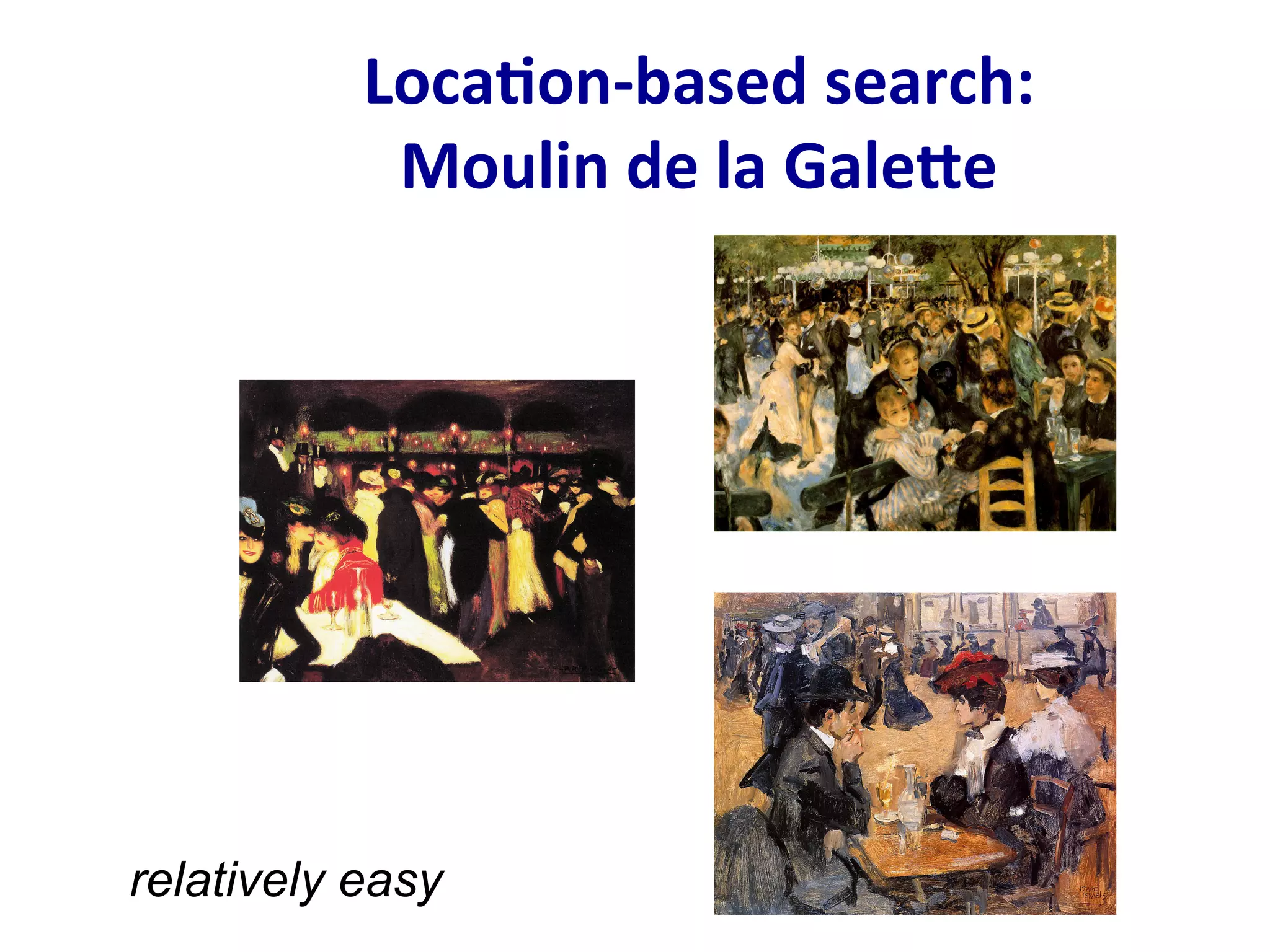
Loca;on-­‐based	
  search:	
  
Moulin	
  de	
  la	
  GaleCe	
  
relatively easy
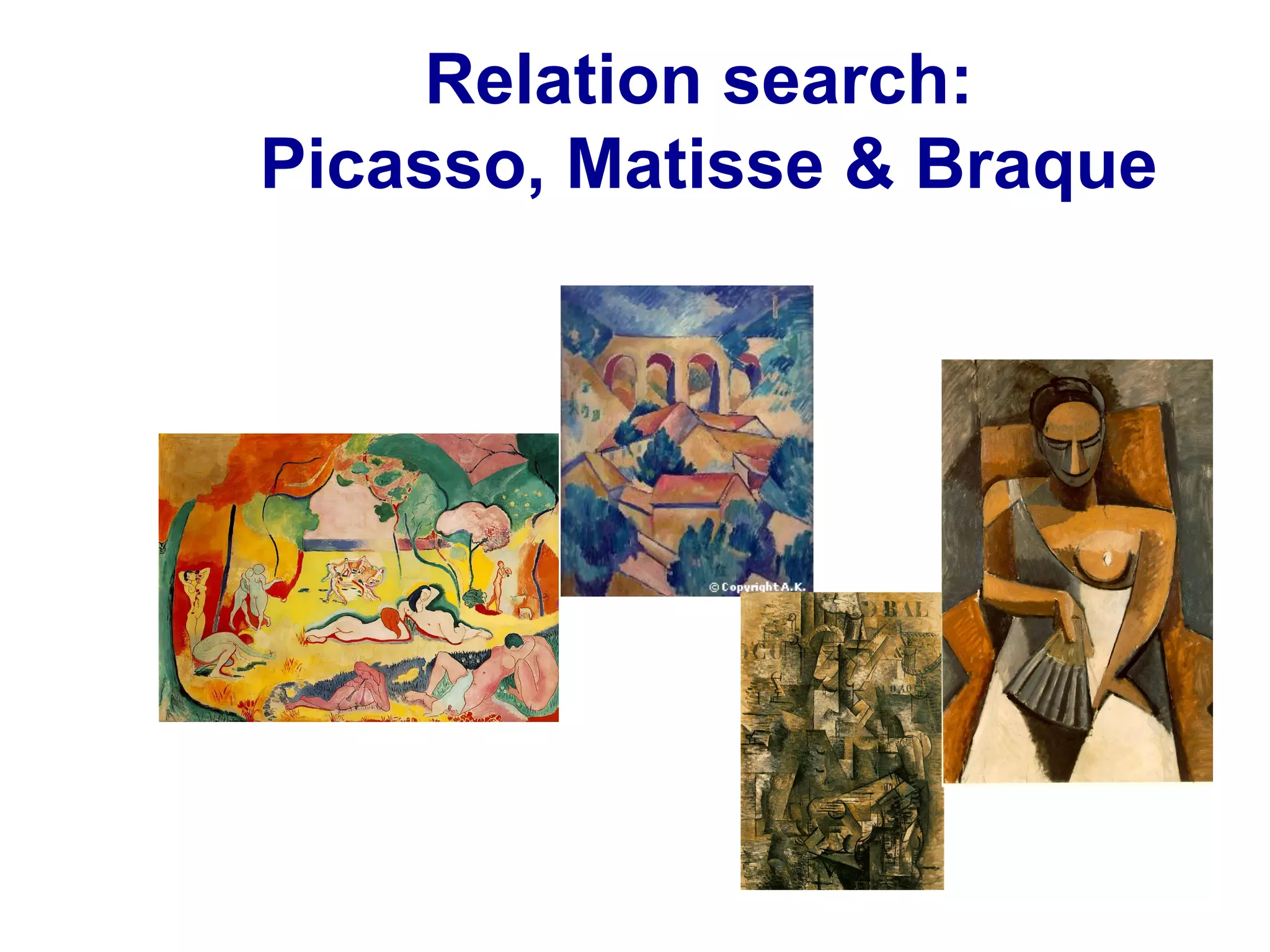
Relation search:
Picasso, Matisse & Braque
Acknowledgements
•  Long list of people
•  Projects: COMMIT, Agora, PrestoPrime,
EuropeanaConnect, Poseidon,
BiographyNet, Multimedian E-Culture

Fri schreiber key_knowledge engineering

  • 1.
    Knowledge engineering and theWeb Guus Schreiber VU University Amsterdam Computer Science, Network Institute
  • 2.
    Overview of thistalk •  Web data representation – a meta view •  Knowledge for the Web: categories – key sources, alignment, conversion •  Using knowledge: visualization and search
  • 3.
    My journey knowledge engineering • design patterns for problem solving •  methodology for knowledge systems •  models of domain knowledge •  ontology engineering
  • 4.
    My journey access todigital heritage
  • 5.
    My journey Web standards Chairof •  RDF 1.1 •  OWL Web Ontology Language 1.0 •  SKOS model for publishing vocabularies on the Web •  Deployment & best practices
  • 6.
    A few wordsabout Web standardization •  Key success factor! •  Consensus process actually works – Some of the time at least •  Public review – Taking every comment seriously •  The danger of over-designing – Principle of minimal commitment
  • 7.
    Example: W3C RDF1.1 group •  8K group messages (publicly visible) •  2K messages about external comments •  125+ teleconferences •  200 issues resolved
  • 8.
  • 9.
    Caution •  Representation languagesare there for you •  And not the other way around ….
  • 10.
    HTML5: a leapforward Rationale •  Consistent separation of content and presentation •  Semantics of the structure of information Typical new elements <article>! <section>! <aside>! <header> <footer>!
  • 11.
    RDF: triples andgraphs RDF is simply labeling resources and links
  • 12.
  • 13.
    RDF syntaxes •  Human-readable:Turtle/TriG •  Line-based: N-Triples/N-Quads •  HTML embedding: RDFa •  JSON-based: JSON-LD •  XML-based: RDF XML
  • 14.
    Data modeling onthe Web RDF •  Class hierarchy •  Property hierarchy •  Domain and range restrictions •  Data types •  OWL •  Property characteristics –  E.g., inverse, functional, transitive, ….. •  Identify management –  E.g., same as, equivalent class •  …….. I prefer a pick-and-choose approach
  • 15.
    Writing in anontology language does not make it an ontology! •  Ontology is vehicle for sharing •  Papers about your own idiosyncratic “university ontology” should be rejected at conferences •  The quality of an ontology does not depend on the number of, for example, OWL constructs used
  • 16.
    Rationale •  A vocabularyrepresents distilled knowledge of a community •  Typically product of a consensus process over longer period of time Use •  200+ vocabularies published •  E.g.: Library of Congress Subject Headings •  Mainly in library field SKOS: making existing vocabularies Web accessible
  • 17.
    The strength ofSKOS lies in its simplicity Baker et al: Key choices in the design of SKOS
  • 18.
    Beware of ontologicalover- commitment •  We have the understandable tendency to use semantic modeling constructs whenever we can •  Better is to limit any Web model to the absolute minimum
  • 19.
    KNOWLEDGE ON THEWEB: CATEGORIES
  • 20.
    The  concept  triad   Source: http://www.jamesodell.com/Ontology_White_Paper_2011-07-15.pdf.
  • 21.
    Categorization •  OWL (Descriptionlogic) takes an extensional view of classes – A set is completely defined by its members •  This puts the emphasis on specifying class boundaries •  Work of Rosch et al. takes a different view 21
  • 22.
    Categories (Rosch) •  Helpus to organize the world •  Tools for perception •  Basic-level categories – Are the prime categories used by people – Have the highest number of common and distinctive attributes – What those basic-level categories are may depend on context 22
  • 23.
  • 24.
  • 25.
    25 Dublin Core: metadataof Web resources
  • 26.
  • 27.
  • 28.
    schema.org issues •  Top-downversus bottom-up •  Ownership and control •  Who can update/extend? •  Does use for general search bias the vocabulary?
  • 29.
    The myth ofa unified vocabulary •  In large virtual collections there are always multiple vocabularies –  In multiple languages •  Every vocabulary has its own perspective –  You can’t just merge them •  But you can use vocabularies jointly by defining a limited set of links –  “Vocabulary alignment”
  • 30.
    Category alignment vs. identitydisambiguation •  Alignment concerns finding links between (similar) categories, which typically have no identity in the real world •  Identity disambiguation is finding out whether two or more IDs point to the same object in the real world (e.g., person, building, ship) •  The distinction is more subtle that “class versus instance”
  • 31.
    Alignment techniques •  Syntax:comparison of characters of the terms –  Measures of syntactic distance –  Language processing •  E.g. Tokenization, single/plural, •  Relate to lexical resource –  Relate terms to place in WordNet hierarchy •  Taxonomy comparison –  Look for common parents/children in taxonomy •  Instance based mapping –  Two classes are similar if their instances are similar.
  • 32.
  • 33.
  • 34.
    Be modest! Don’trecreate, but enrich and align •  Knowledge engineers should refrain from developing their own idiosyncratic ontologies •  Instead, they should make the available rich vocabularies, thesauri and databases available in an interoperable (web) format •  Techniques: learning, alignment
  • 35.
  • 36.
    Issues  in  conversion  to  Linked  Data   •  Keep  original  info  as  much  as  possible   •  Ensure  standard  datatypes  for  value   conversion   •  Choice  of  concept  URL   •  Vocabulary  URL:  our  strategy   –  Large  organizaCons:  use  their  own   –  Small  organizaCons:  purl.org  URL     36  
  • 38.
    Winner EuroITV Competition BestArchives on the Web Award http://waisda.nl 38  
  • 39.
    http://waisda.nl http://www.prestoprime.org/ @waisda Improve video searchfor (1) fragment retrieval & (2) within video navigation by using crowdsourcing for (1) including time-based annotations & (2) bridging the vocabulary gap of searcher & cataloguer
  • 40.
    Nichesourcing:  finding  the  right   minority  vote   “the  frog  stands   for  the  rejected   lover”   “The  frog  indicates  the     profession  of  the  women”   “Sexy  ladies!”   annota;on                                        quality  level   40   “women”  
  • 41.
  • 42.
  • 43.
  • 44.
  • 45.
    Extracting piracy events frompiracy reports & Web sources
  • 46.
  • 47.
    Sample graph searchalgorithm From search term (literal) to art work •  Find resources with matching label •  Find path from resource to art work – Cost of each step (step when above cost threshold) – Special treatment of semantics: sameAs, inverseOf, transitive, …. •  Cluster results based on path similarities
  • 48.
  • 49.
    Example of pathclustering Issues: •  number of clusters •  path length
  • 50.
    Using  alignment  in  search   “Tokugawa” SVCN period Edo SVCN is local in-house ethnology thesaurus AAT style/period Edo (Japanese period) Tokugawa AAT is Getty’s Art & Architecture Thesaurus
  • 51.
    Loca;on-­‐based  search:   Moulin  de  la  GaleCe   relatively easy
  • 52.
  • 54.
    Acknowledgements •  Long listof people •  Projects: COMMIT, Agora, PrestoPrime, EuropeanaConnect, Poseidon, BiographyNet, Multimedian E-Culture