Web Science:
The Digital Heritage Case
Guus Schreiber
Informatics Dept., Web & Media
VU University Amsterdam
21st
century computer-science
landscape
• Nowadays small (student) projects are
achieving more than large multi-year
multi-person projects 10 years ago
• Data storage and computing power are
no longer an omnipresent problem
• Globalization of data and service
availability
• Data and applications are moving to the
Web
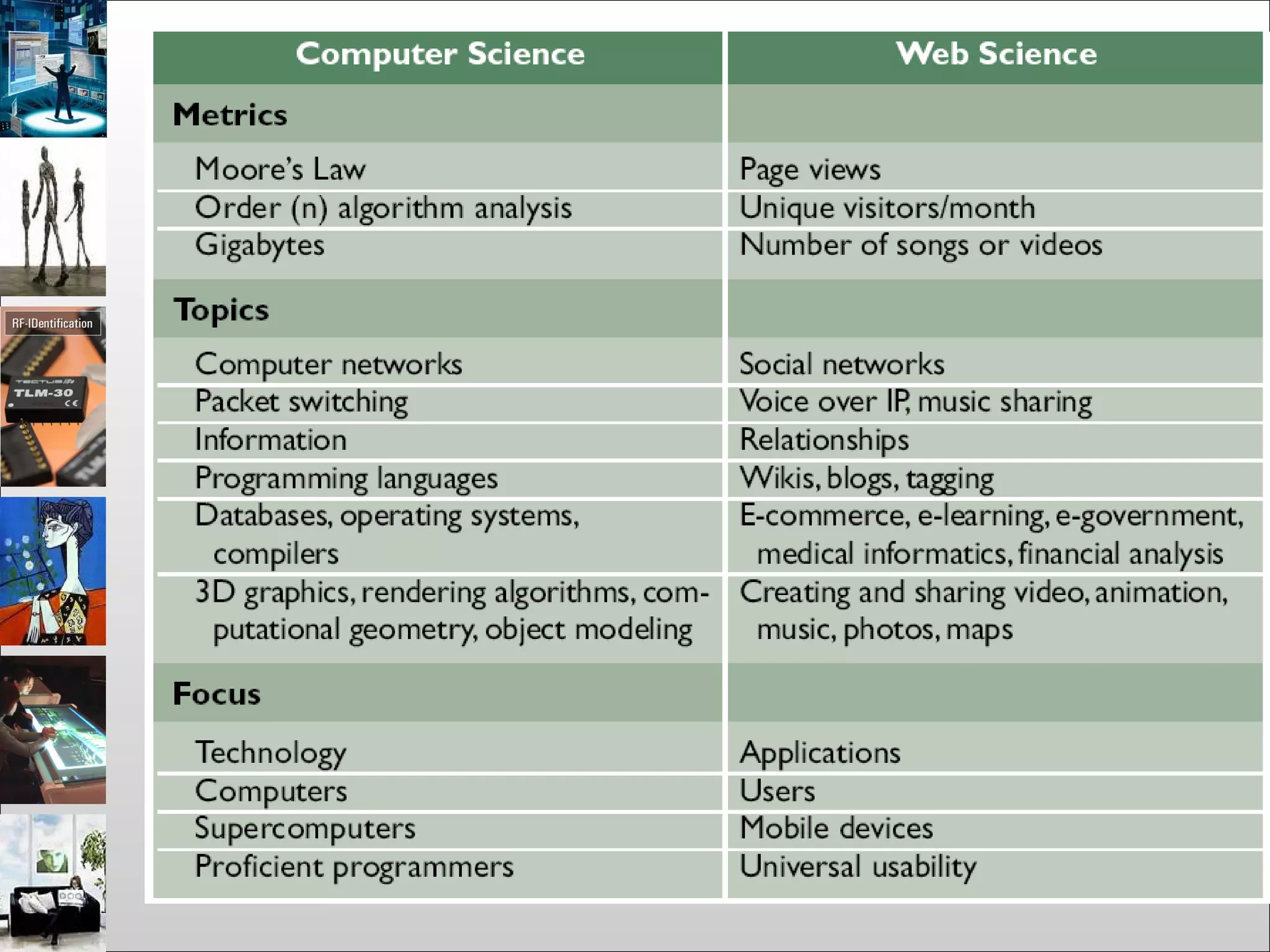
Web science
• Web science is not computer science
transported to the Web
• Web science is socially embedded
• Broad scope of research issues: trust,
reputation, security, governance, social
networks, economic models
• “Shift from studying chips to studying
clicks”
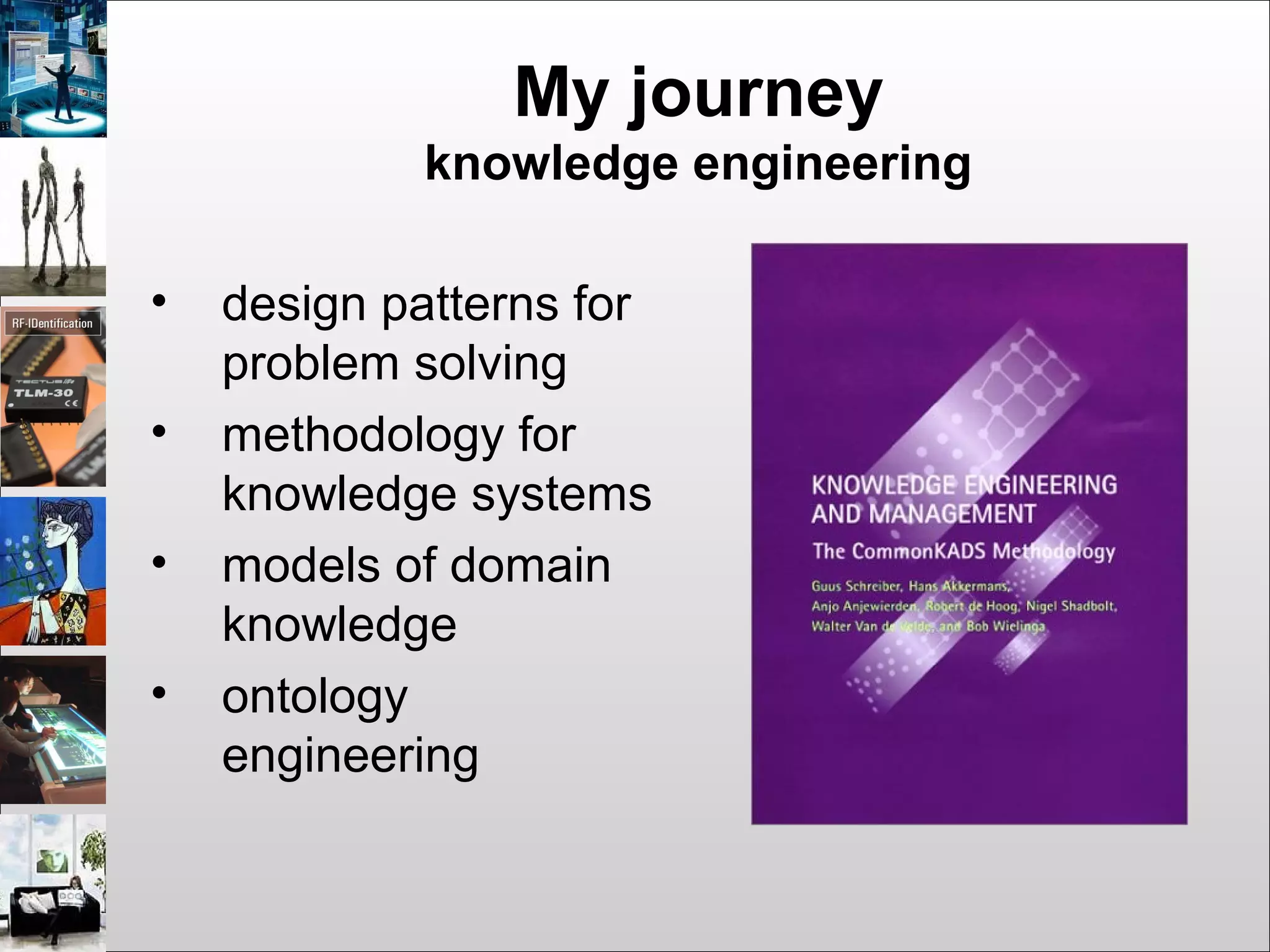
My journey
knowledge engineering
• design patterns for
problem solving
• methodology for
knowledge systems
• models of domain
knowledge
• ontology
engineering
My journey
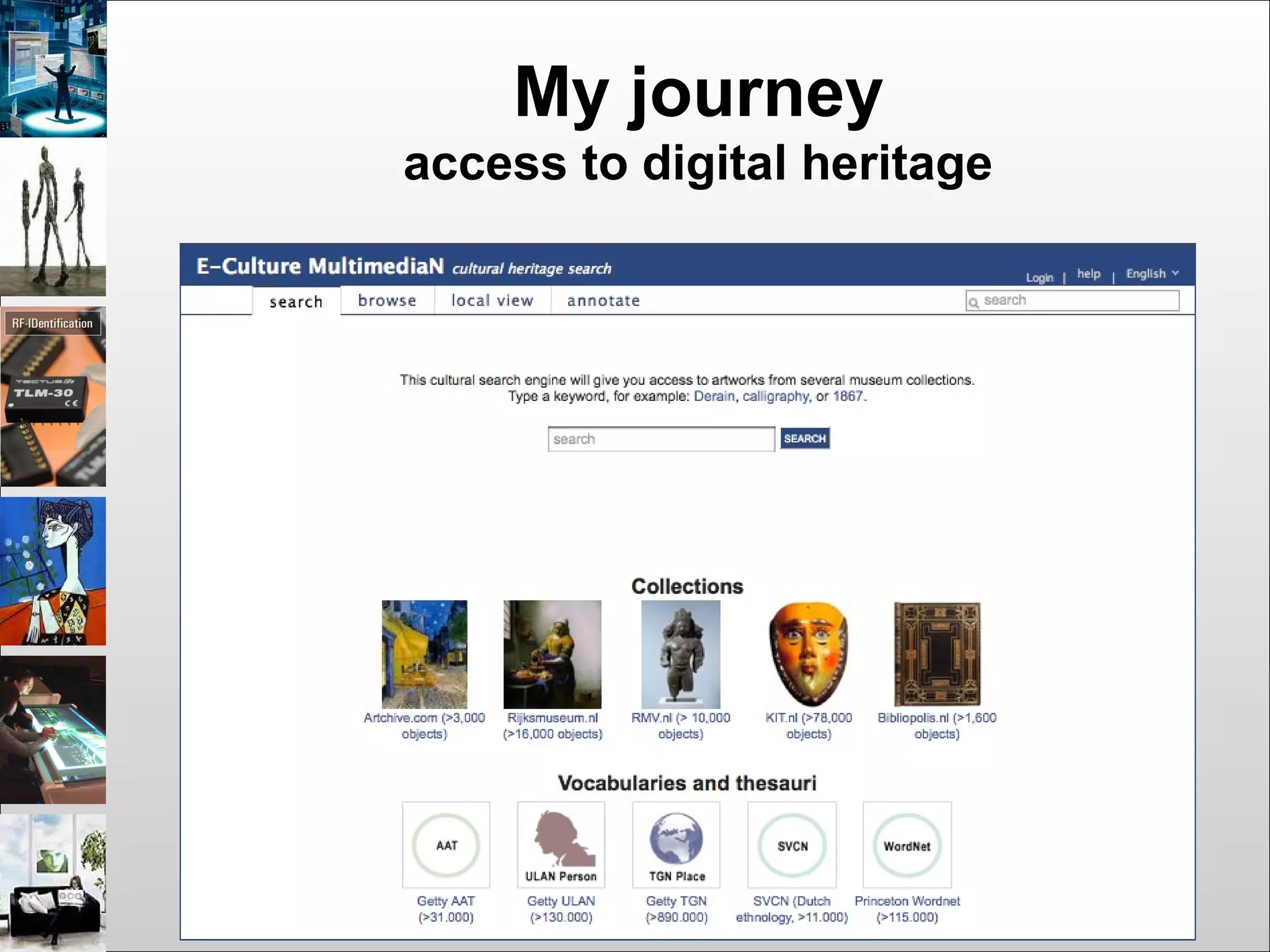
access to digital heritage
My journey
Web standards
• OWL Web Ontology Language
• SKOS model for publishing vocabularies
on the Web
A definition of Web science
“Web science is the study of
(i) the social behavior in the Web at the
personal, organizational and societal
level,
(ii) the Web technology that enables this
behavior, and
(iii) the interactions between
technology and behavior”
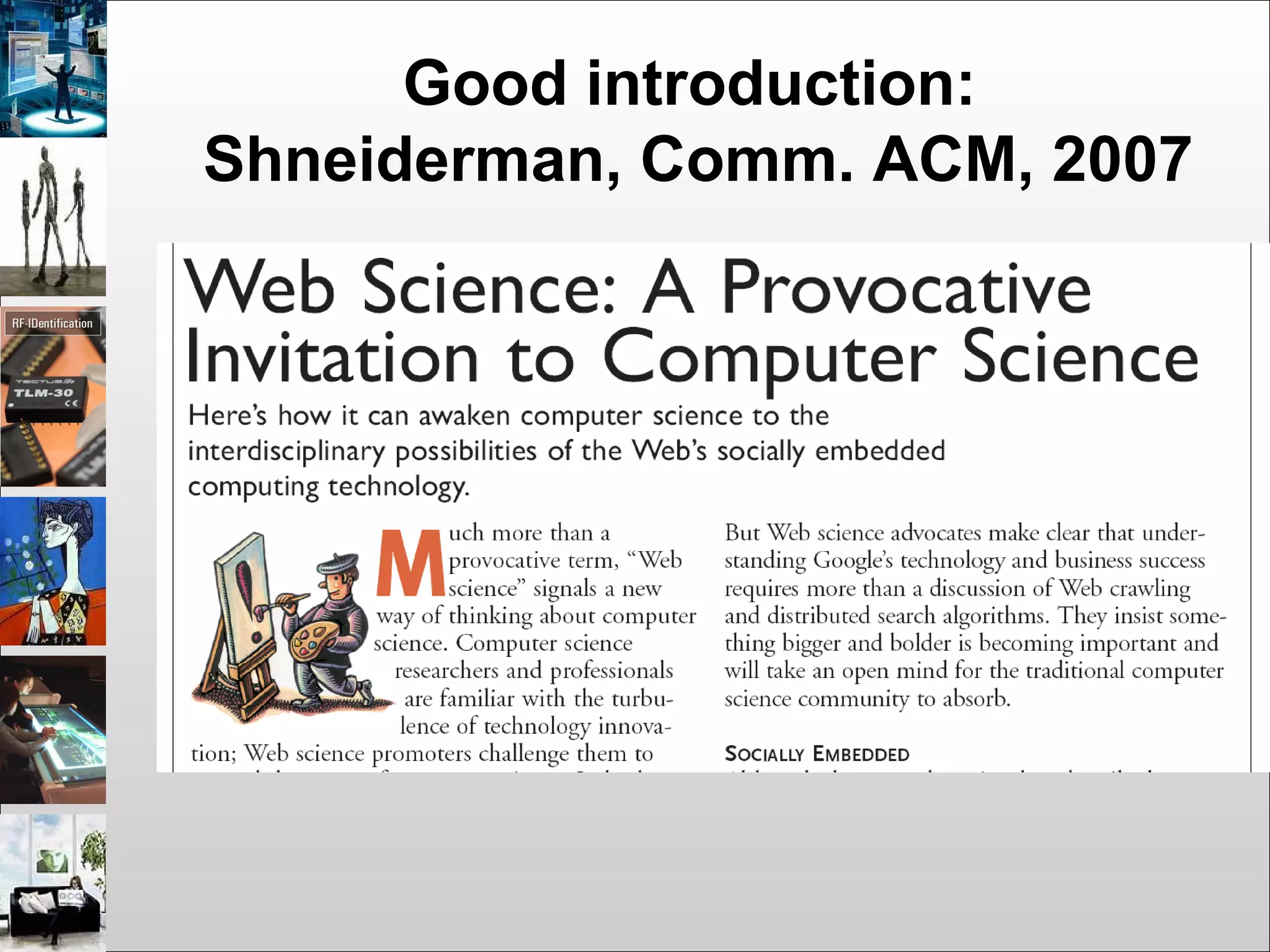
Good introduction:
Shneiderman, Comm. ACM, 2007
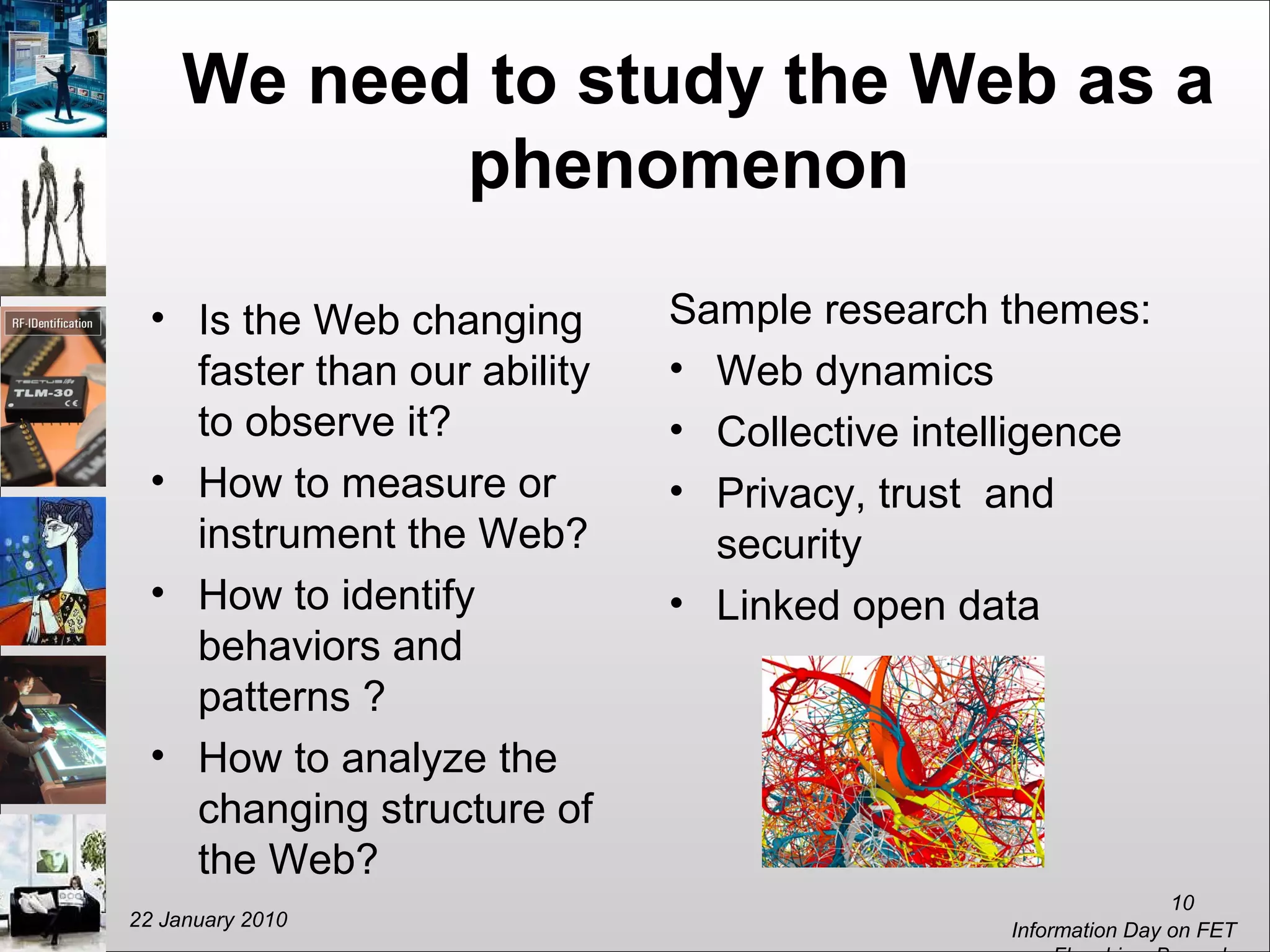
We need to study the Web as a
phenomenon
• Is the Web changing
faster than our ability
to observe it?
• How to measure or
instrument the Web?
• How to identify
behaviors and
patterns ?
• How to analyze the
changing structure of
the Web?
Sample research themes:
• Web dynamics
• Collective intelligence
• Privacy, trust and
security
• Linked open data
22 January 2010
Information Day on FET
10
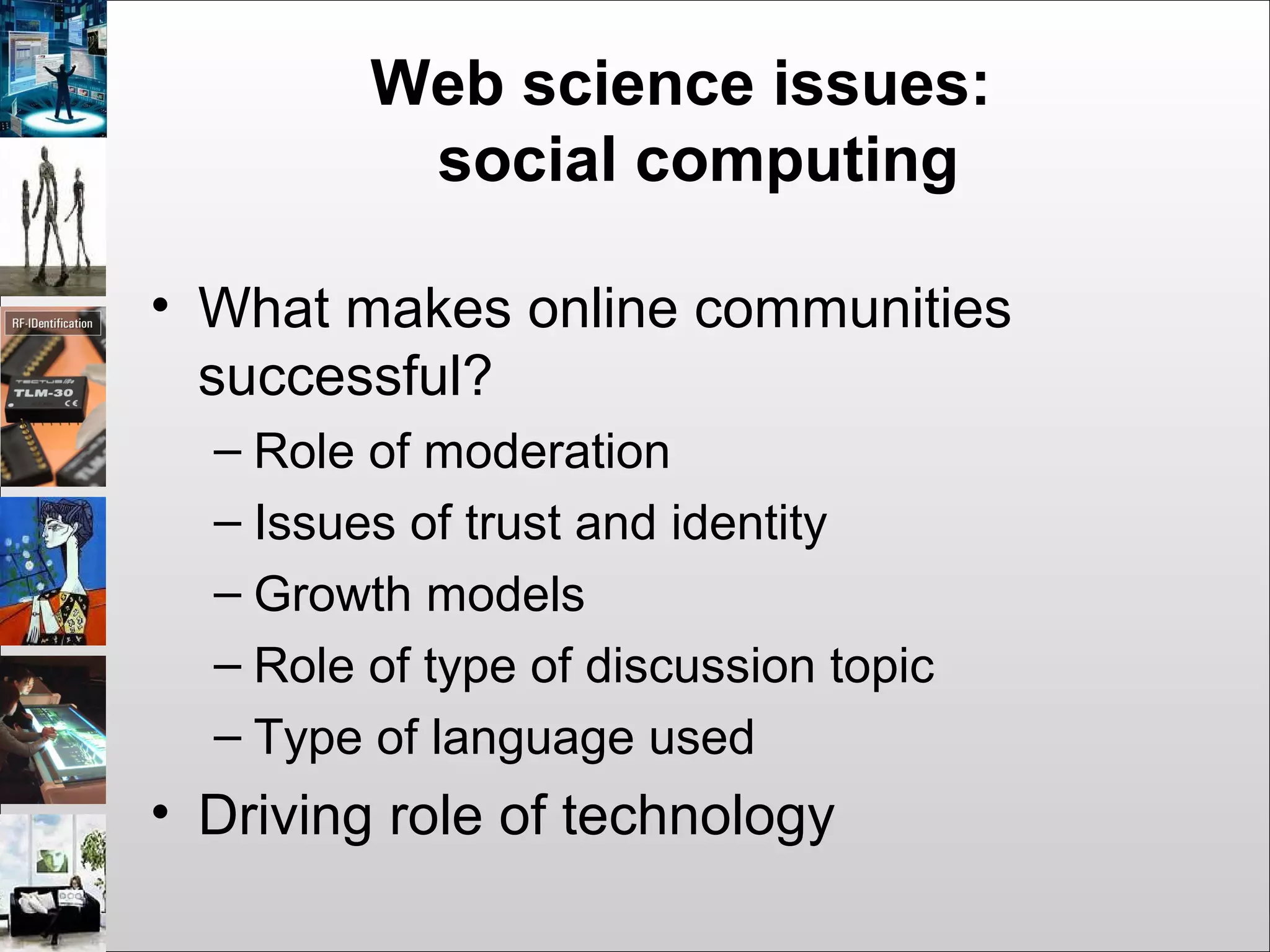
Web science issues:
social computing
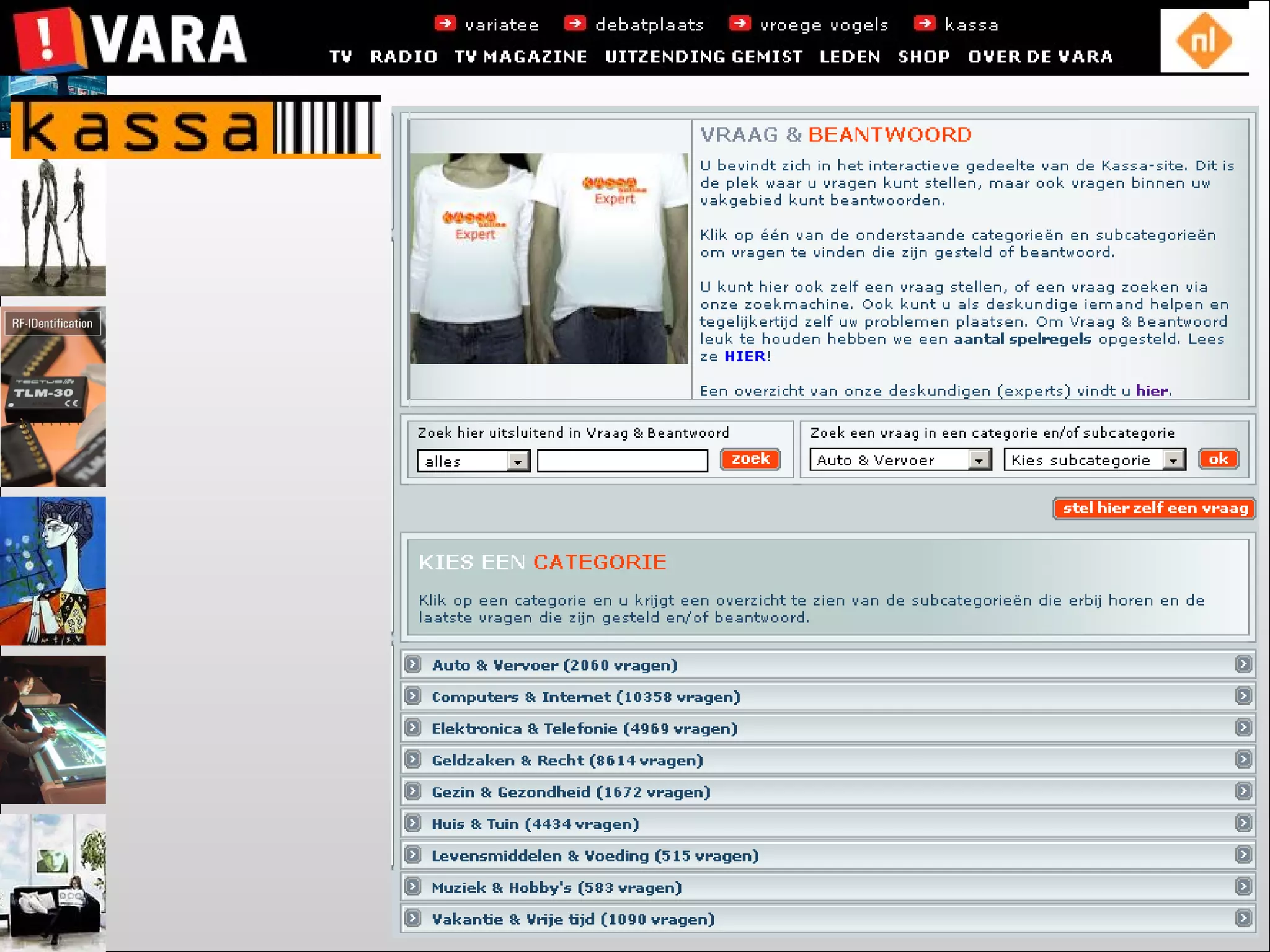
• What makes online communities
successful?
– Role of moderation
– Issues of trust and identity
– Growth models
– Role of type of discussion topic
– Type of language used
• Driving role of technology
Web science issues:
psychology and pedagogy
• Effect of chat/email on:
– Mental development of children
– Forming of relationships
– Changes in cultural preferences
• Distance learning
• Distance psychotherapy
Web science issues:
privacy
• Control over personal data
– Video’s and pictures of you
• Identity theft
• Who is allowed to store what?
• What do you accept as a user?
Web science issues:
legal problems
• Lack of “location”
– Which law to apply?
• Copyright
– New types of licenses required
– See for example Creative Commons
• Data aggregation: what can
Google/Facebook/… do with our data?
Web science issues:
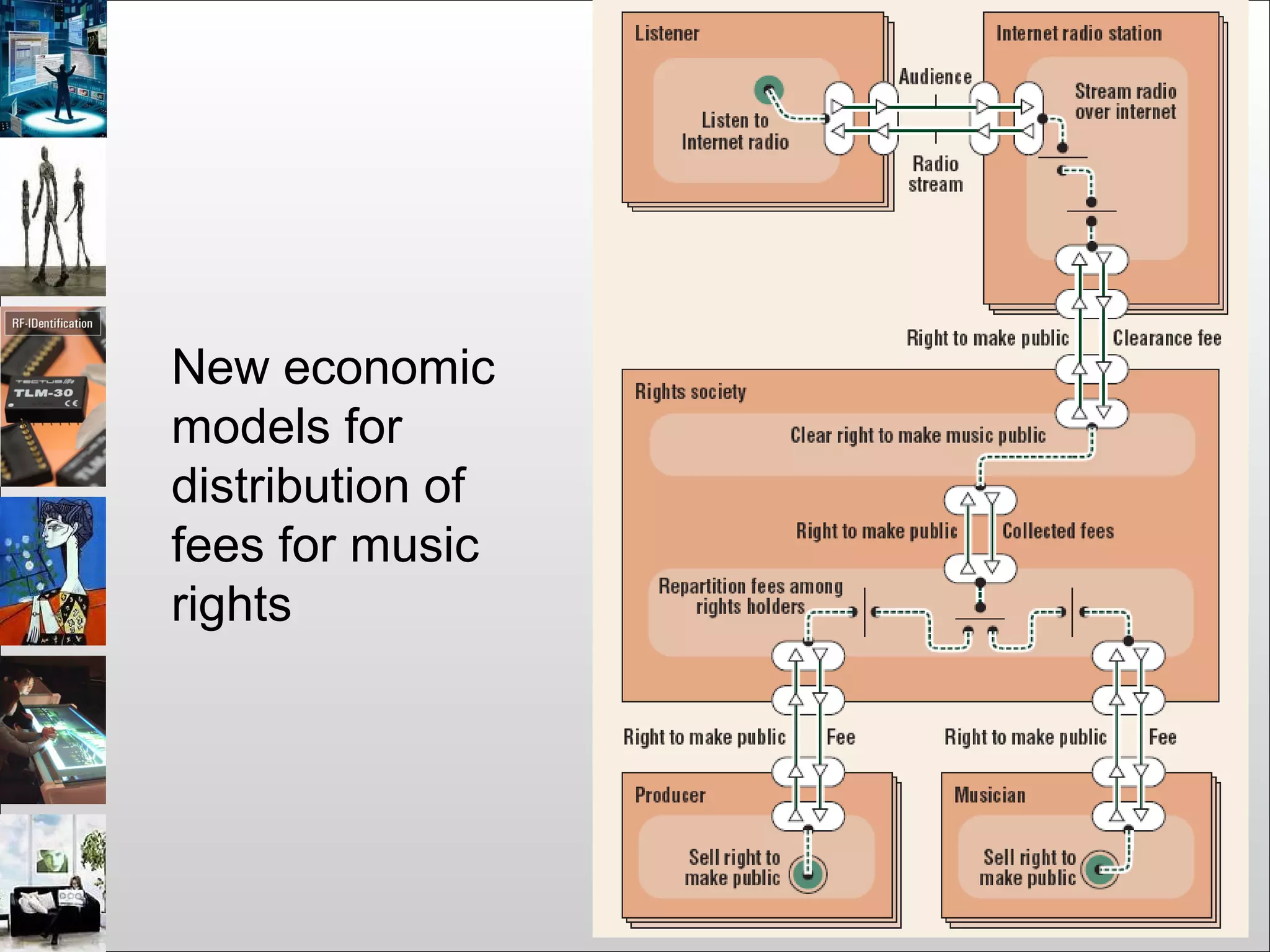
new economic models
• Micro payments for mail messages?!
• Downloading material with copyright
– What is the price of a song?
• Global personalized services replace
shops
– E.g., Web services for items now in
museum shops
New economic
models for
distribution of
fees for music
rights
Web science issues:
universal access
• Ideals: access for all!
• Limited Web access in particular
countries
• Spreading of hate
• Quality of material gathered on a global
scale
– Wikipedia
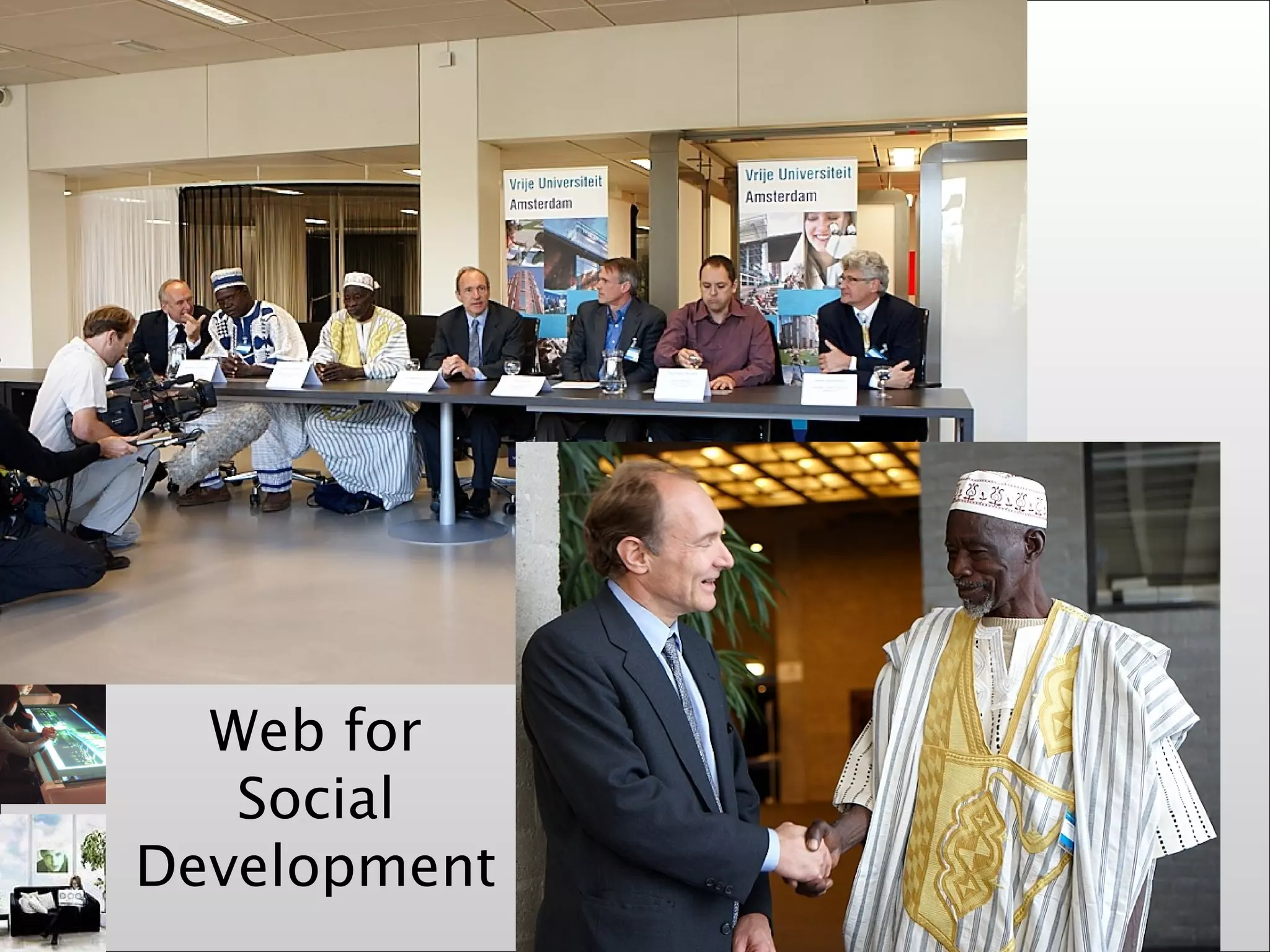
Web for
Social
Development
19
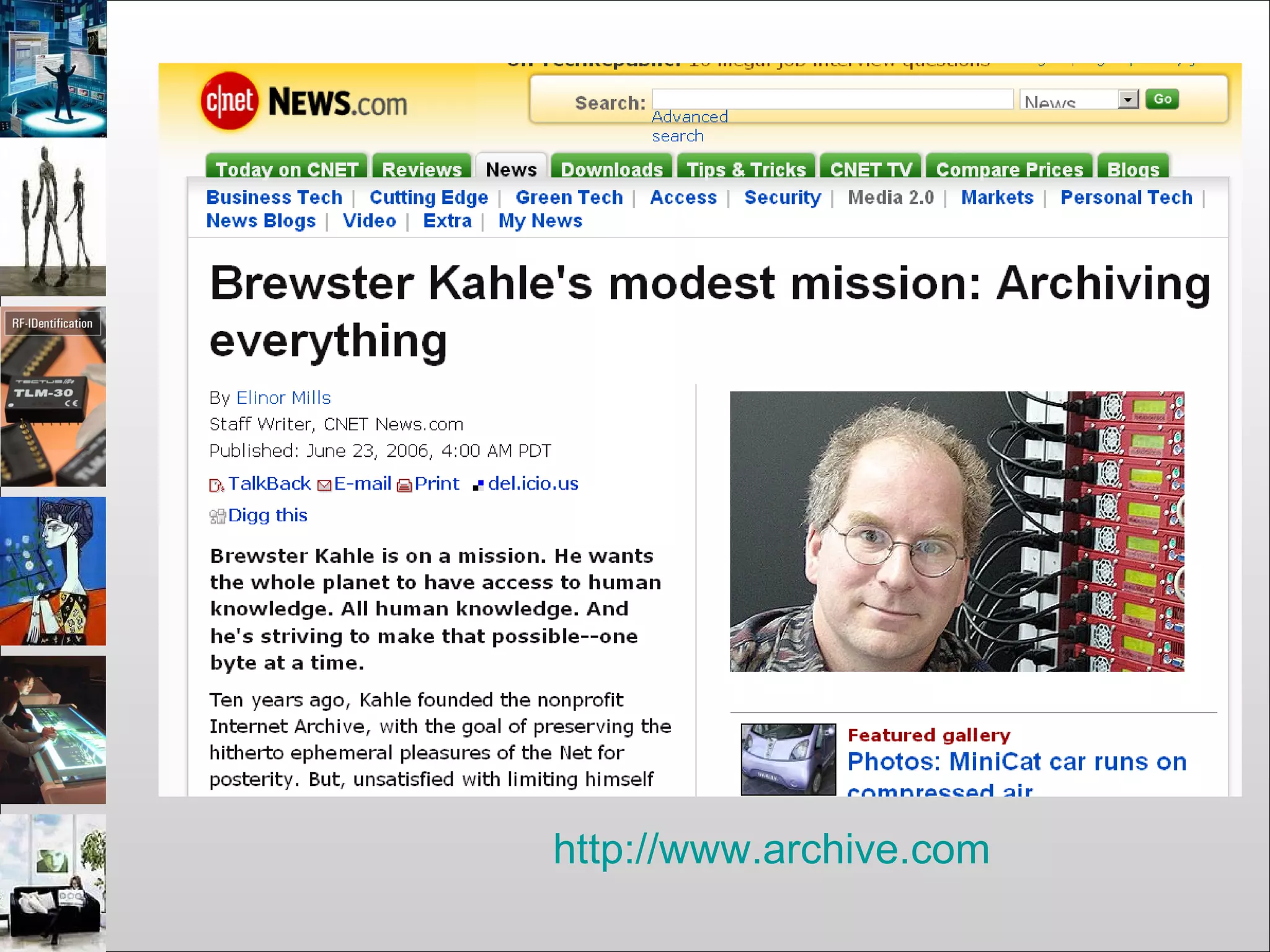
http://www.archive.com
THE DIGITAL-HERITAGE
CASE
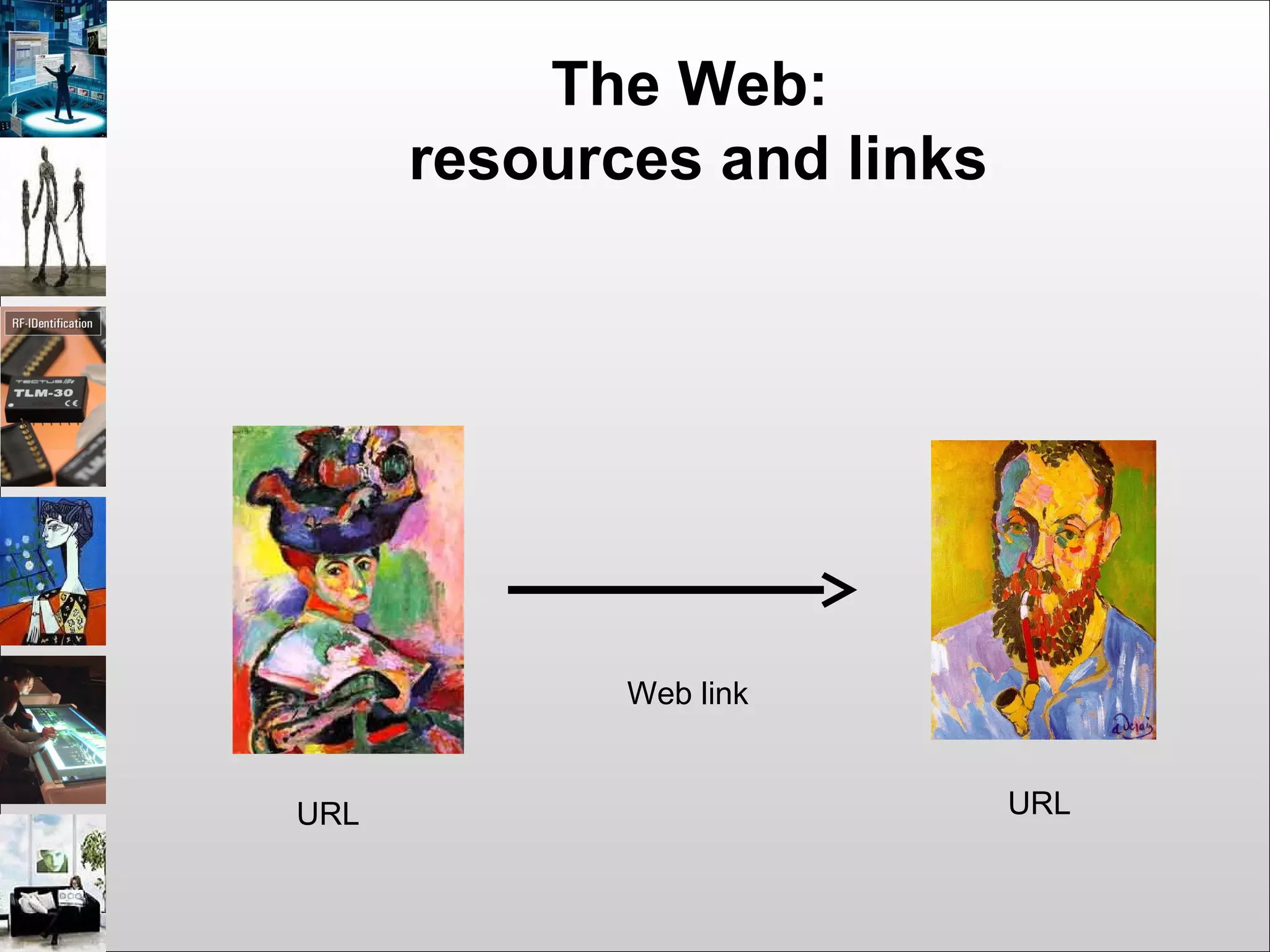
The Web:
resources and links
URL URL
Web link
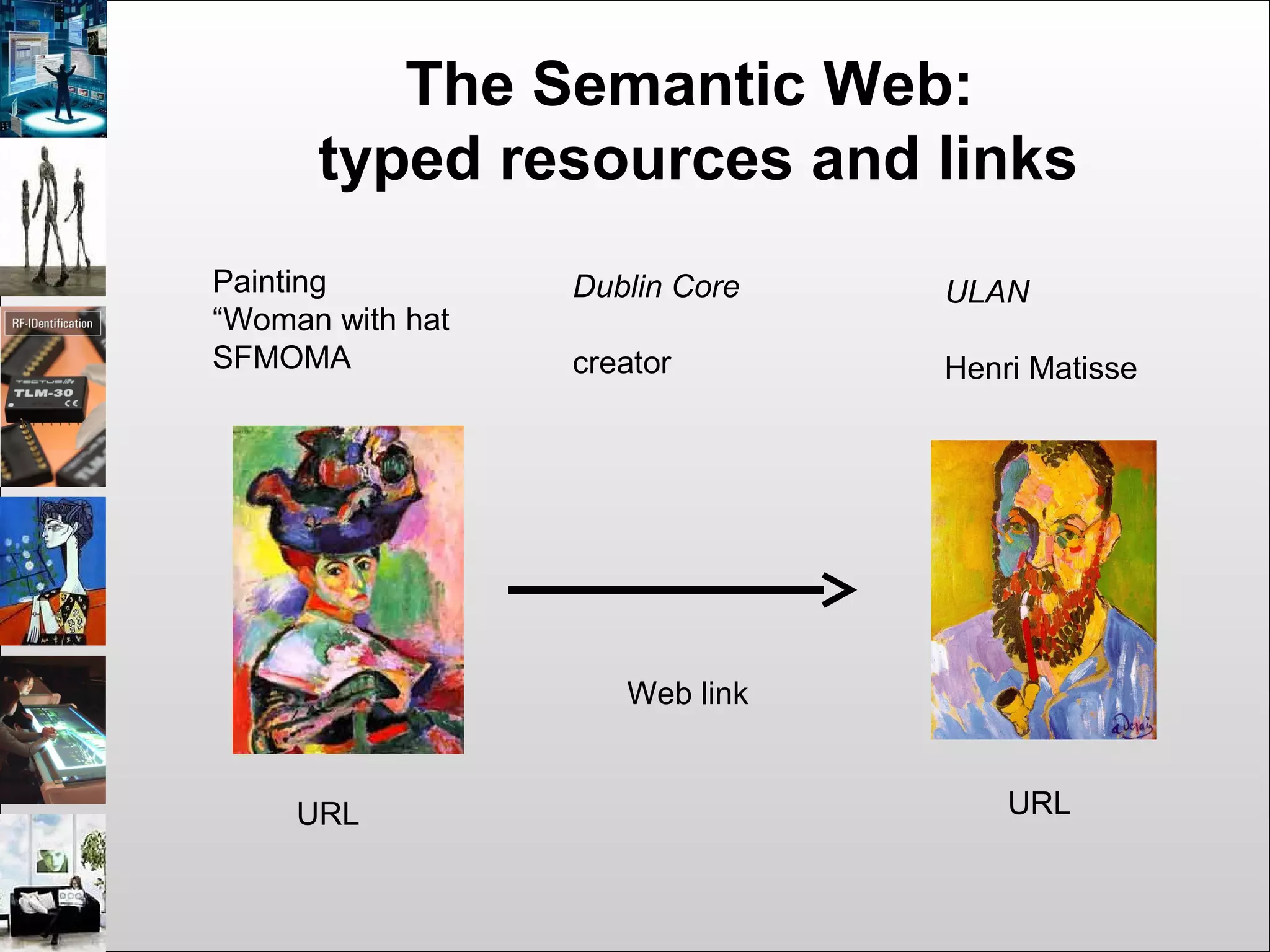
The Semantic Web:
typed resources and links
URL URL
Web link
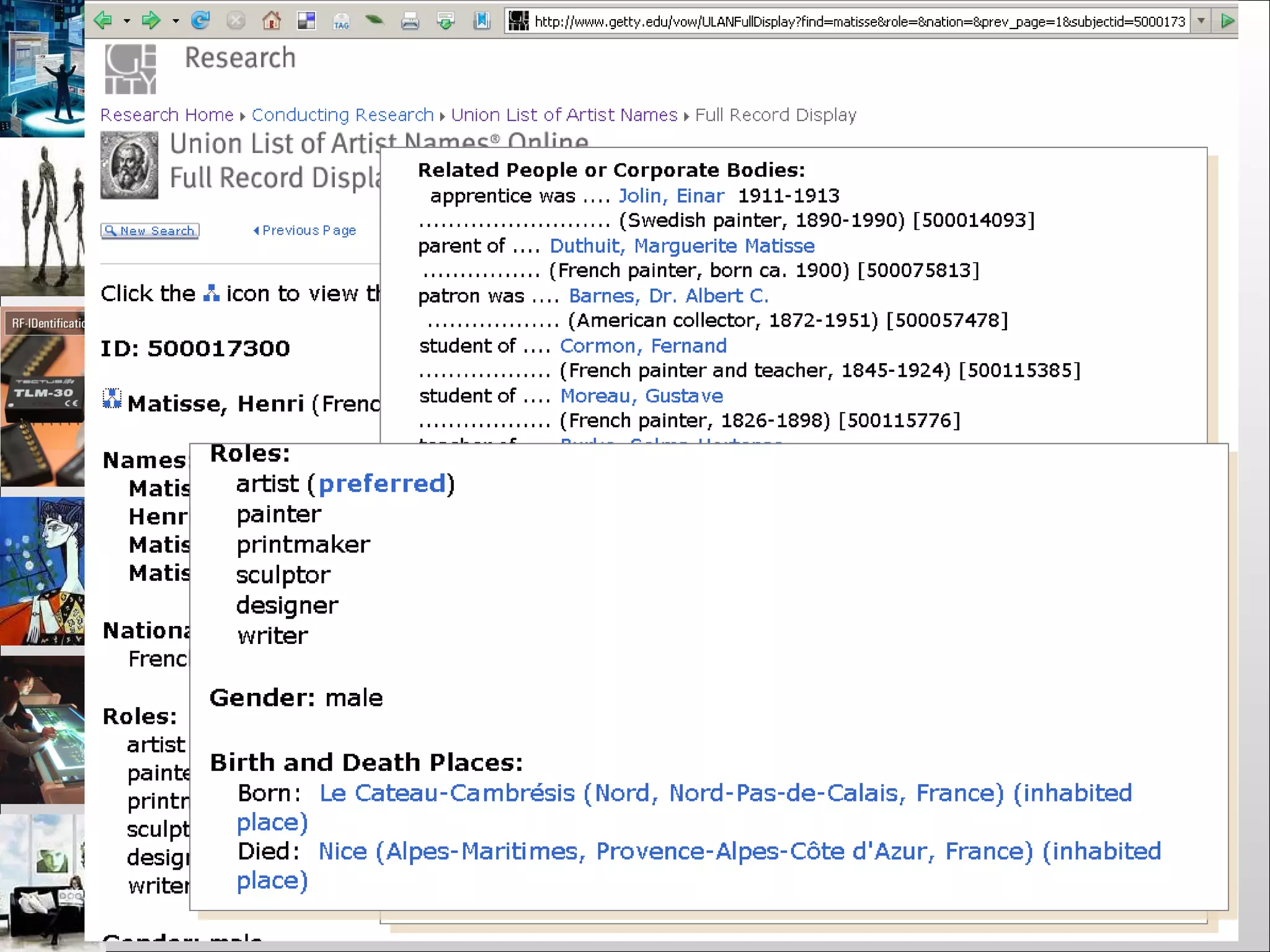
ULAN
Henri Matisse
Dublin Core
creator
Painting
“Woman with hat
SFMOMA
The myth of a unified vocabulary
• In large virtual collections there are always multiple
vocabularies
– In multiple languages
• Every vocabulary has its own perspective
– You can’t just merge them
• But you can use vocabularies jointly by defining a
limited set of links
– “Vocabulary alignment”
• It is surprising what you can do with just a few links
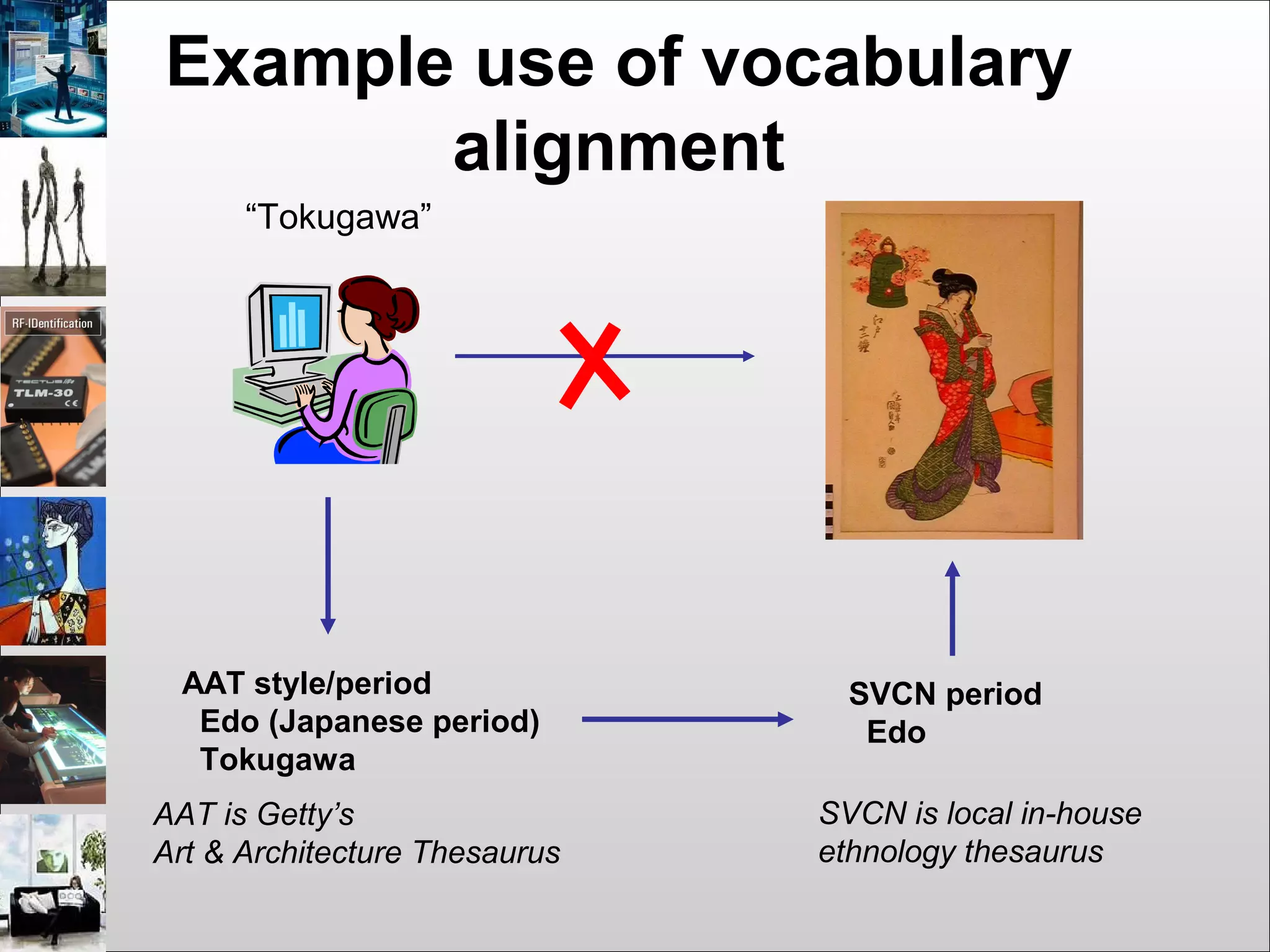
Example use of vocabulary
alignment
“Tokugawa”
SVCN period
Edo
SVCN is local in-house
ethnology thesaurus
AAT style/period
Edo (Japanese period)
Tokugawa
AAT is Getty’s
Art & Architecture Thesaurus
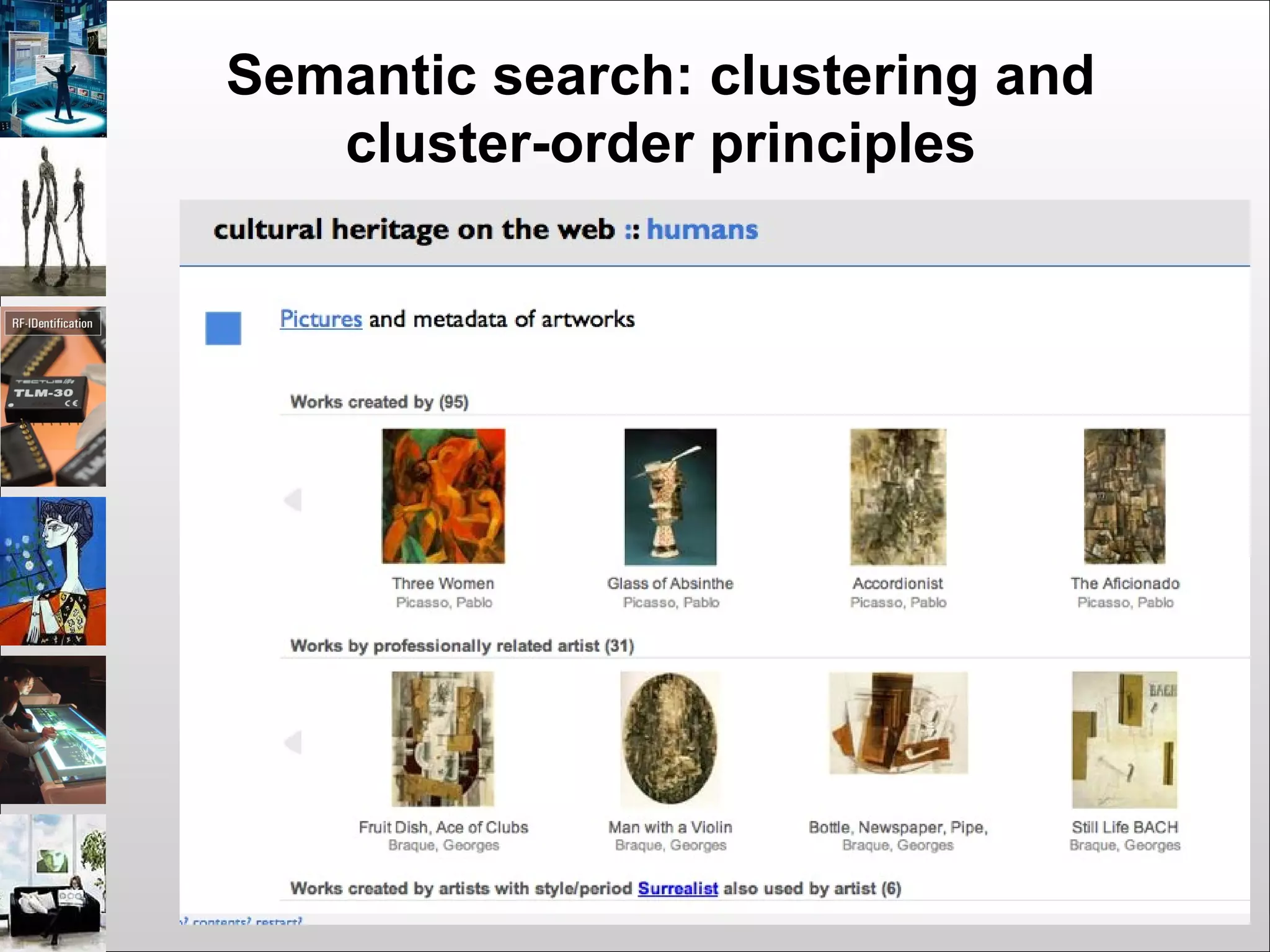
Semantic search: clustering and
cluster-order principles
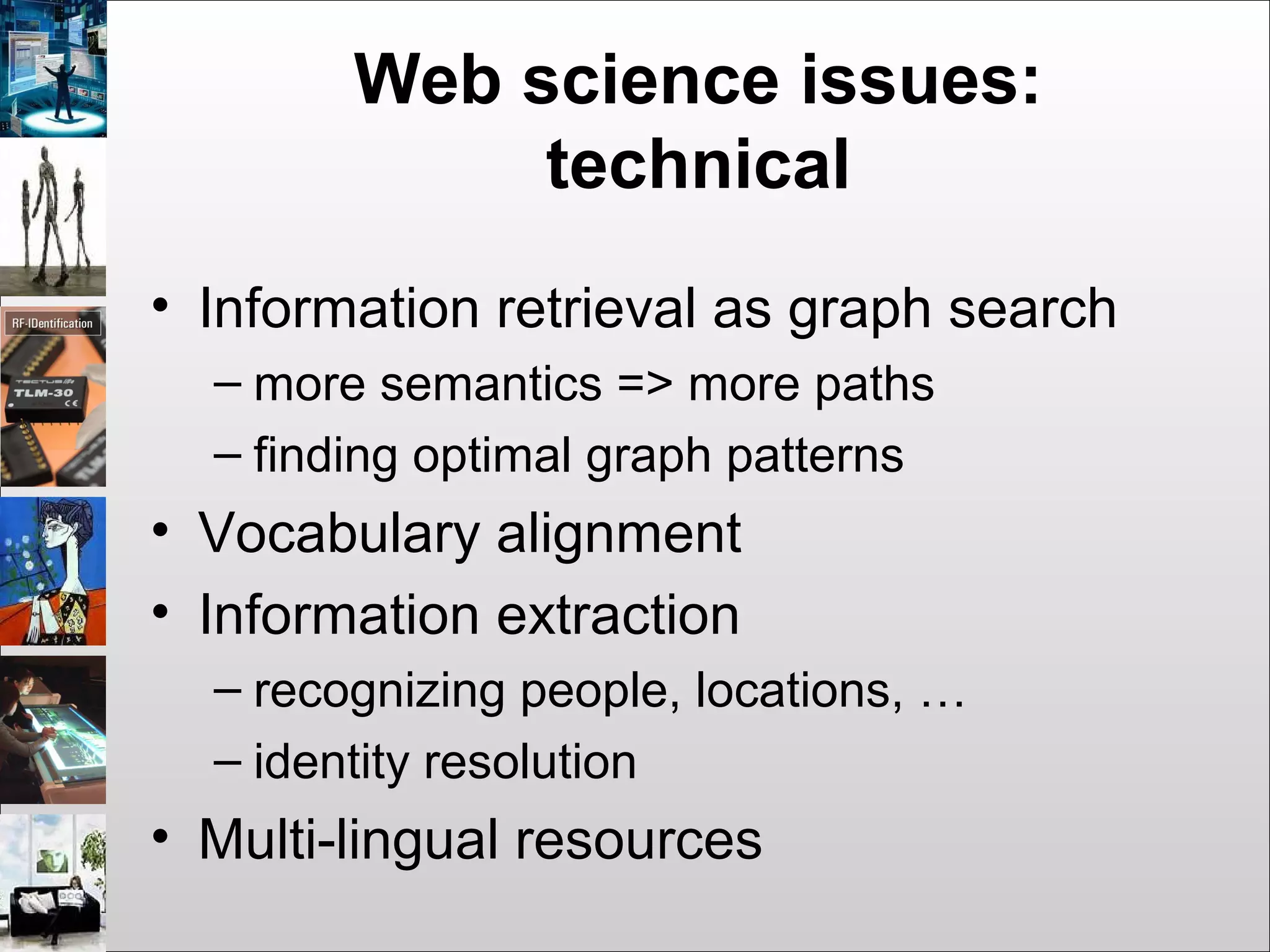
Web science issues:
technical
• Information retrieval as graph search
– more semantics => more paths
– finding optimal graph patterns
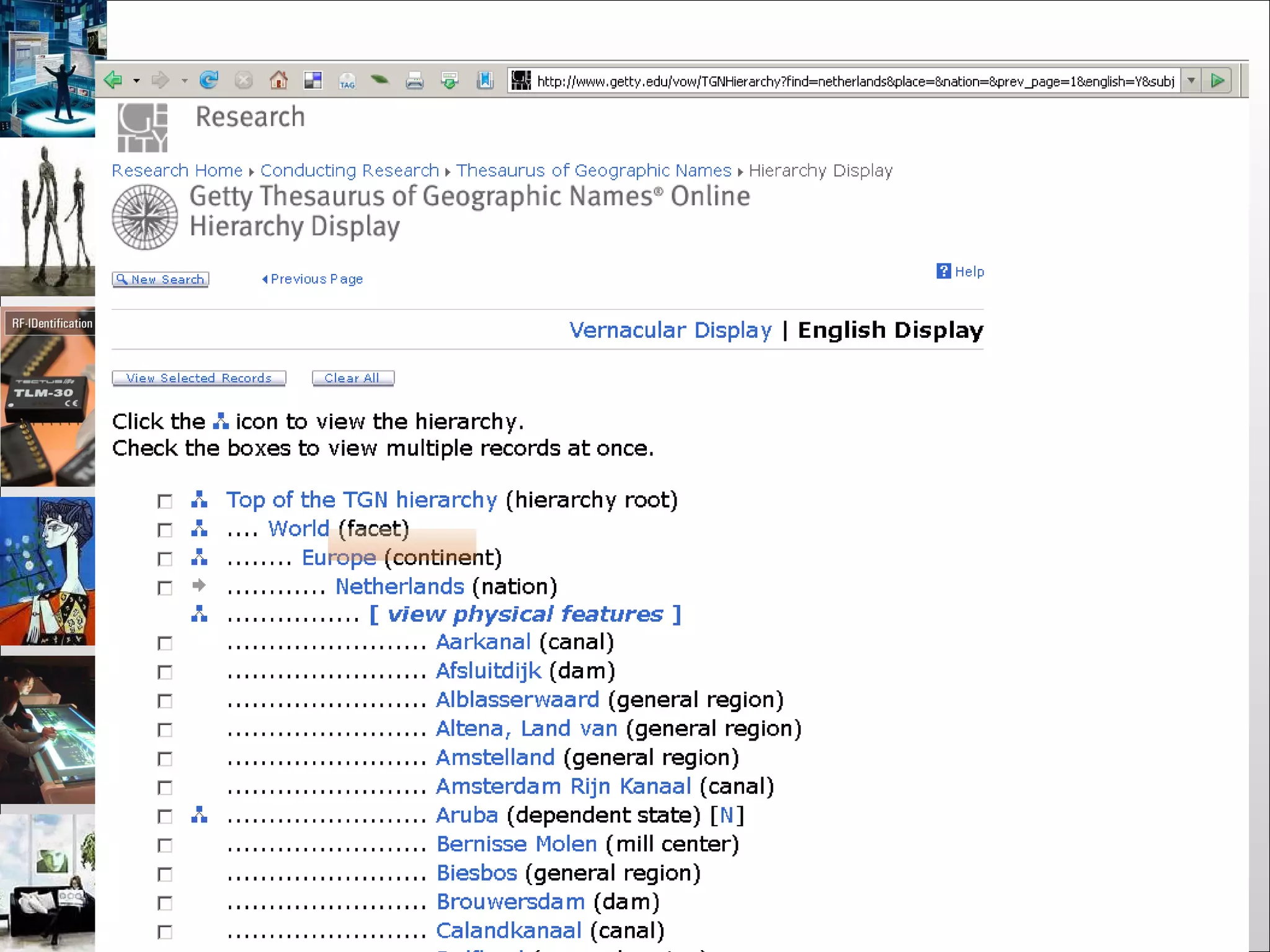
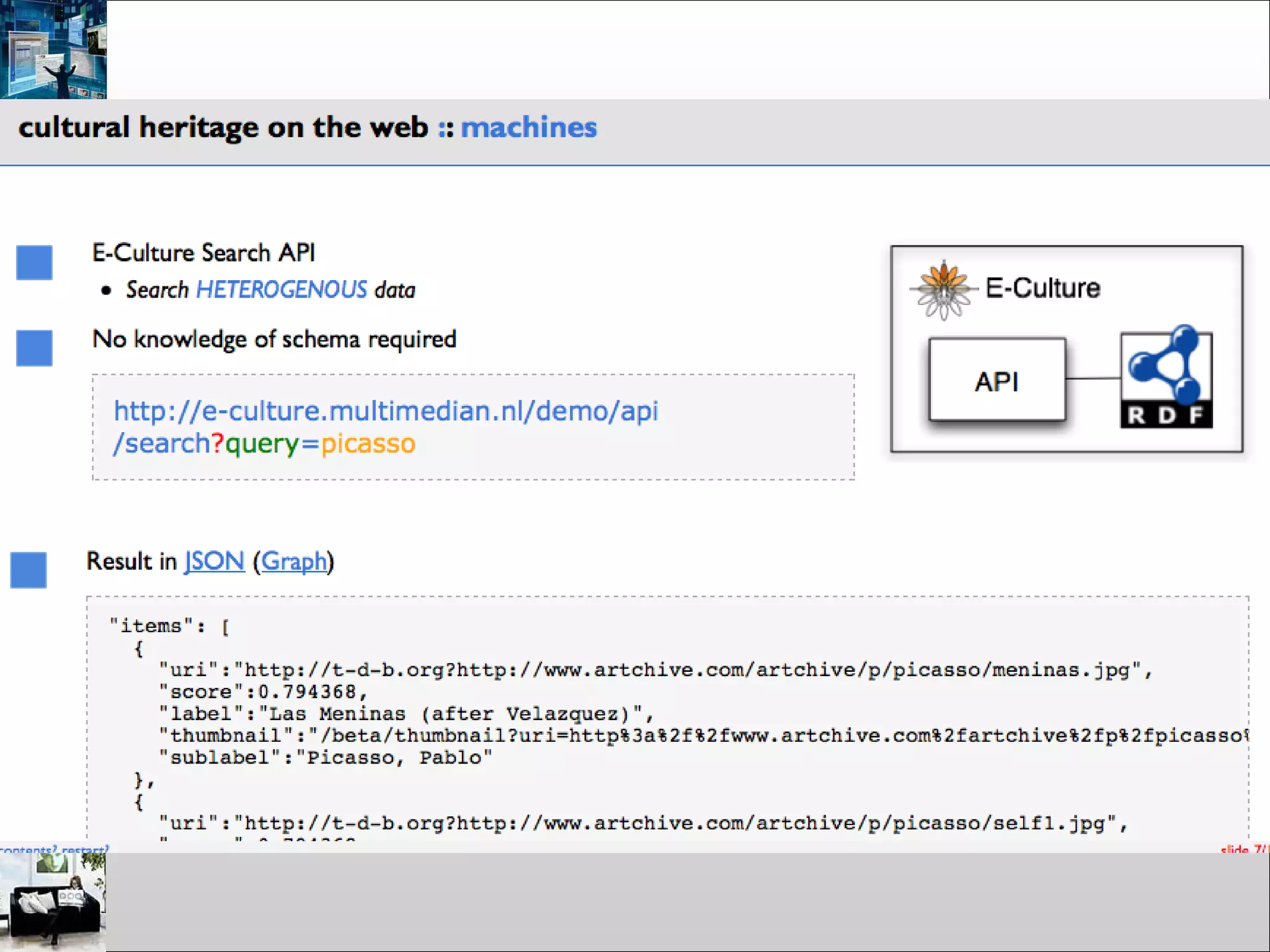
• Vocabulary alignment
• Information extraction
– recognizing people, locations, …
– identity resolution
• Multi-lingual resources
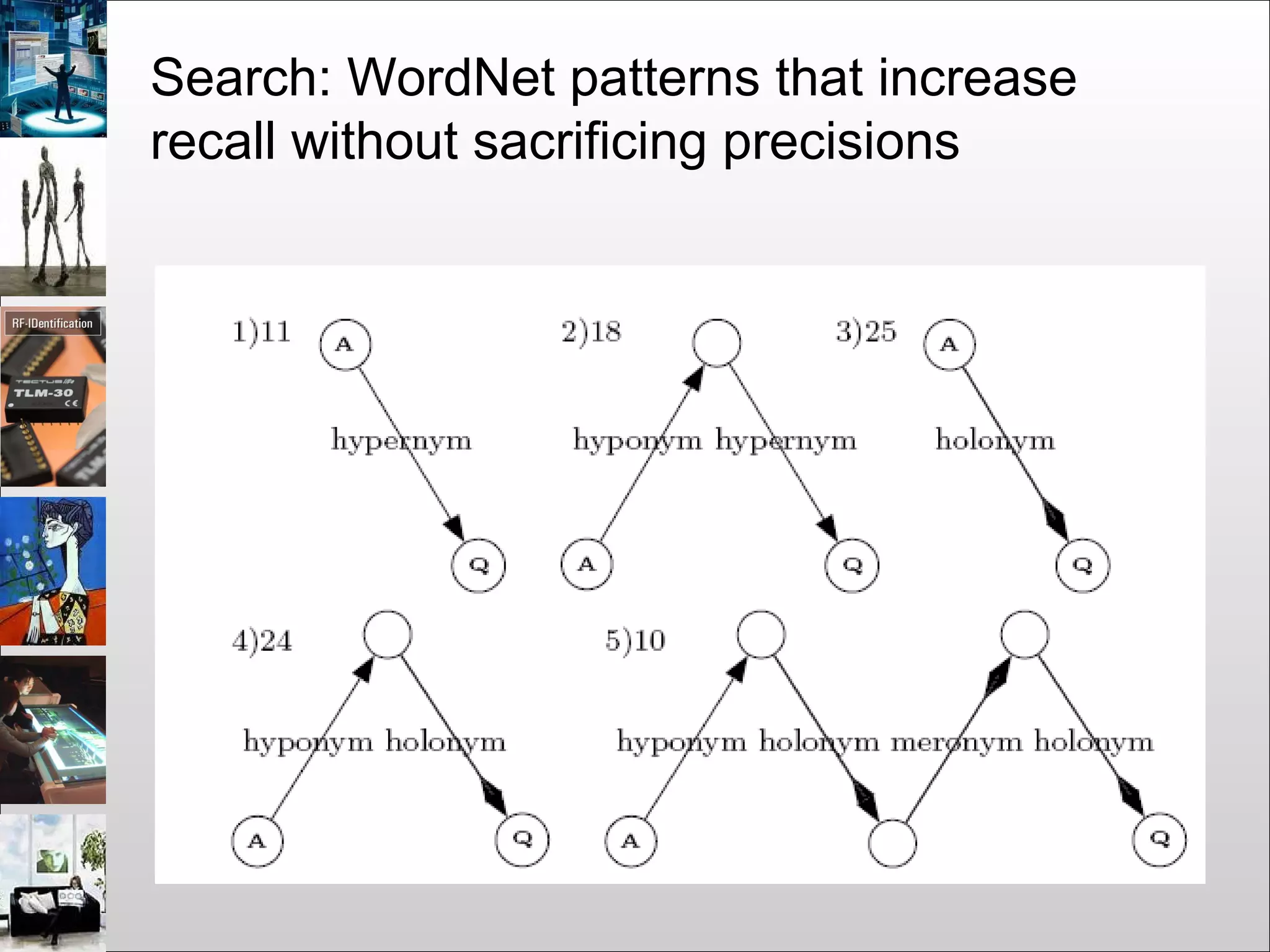
Search: WordNet patterns that increase
recall without sacrificing precisions
Web science issues:
economic
• Cultural heritage organizations find it
difficult to “give away” their data
– concerns for quality
• Re-orientation: Web is not derivative of
physical presence; they should stand
side-by-side
• Universal access: everyone should be
able to enjoy the Rijksmuseum
Amsterdam
Web science issues:
economic
• Primary access free
• Secondary services cost money
– virtual museum shop can offer much larger
collection
– access to high-resolution images
– tourist services on mobile devices
Web science issues:
legal
• Europeana.eu faces enormous rights
issues, in particular wrt recent works
• New licensing frameworks:
– Creative Commons
– Open Data Commons
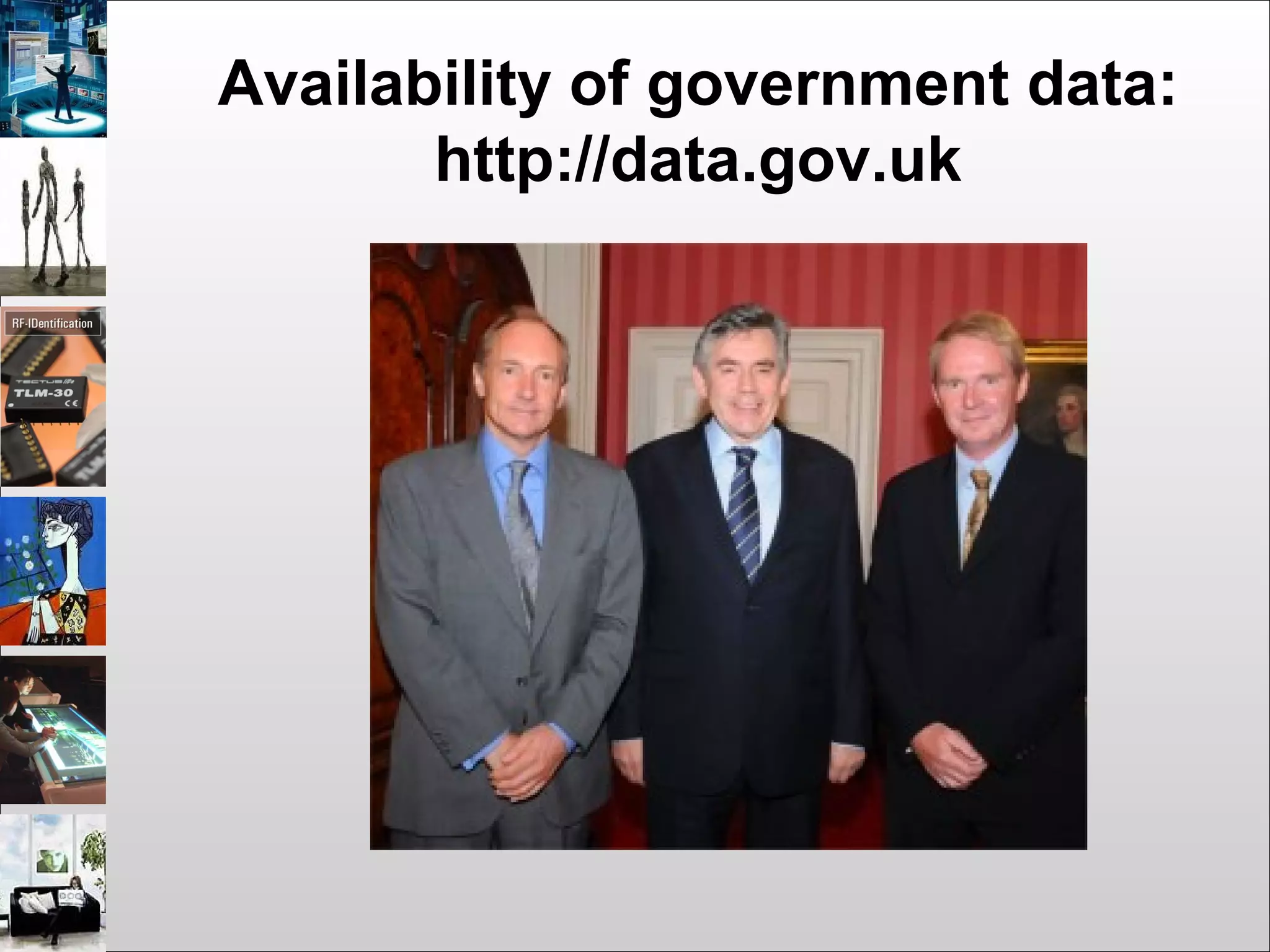
Availability of government data:
http://data.gov.uk
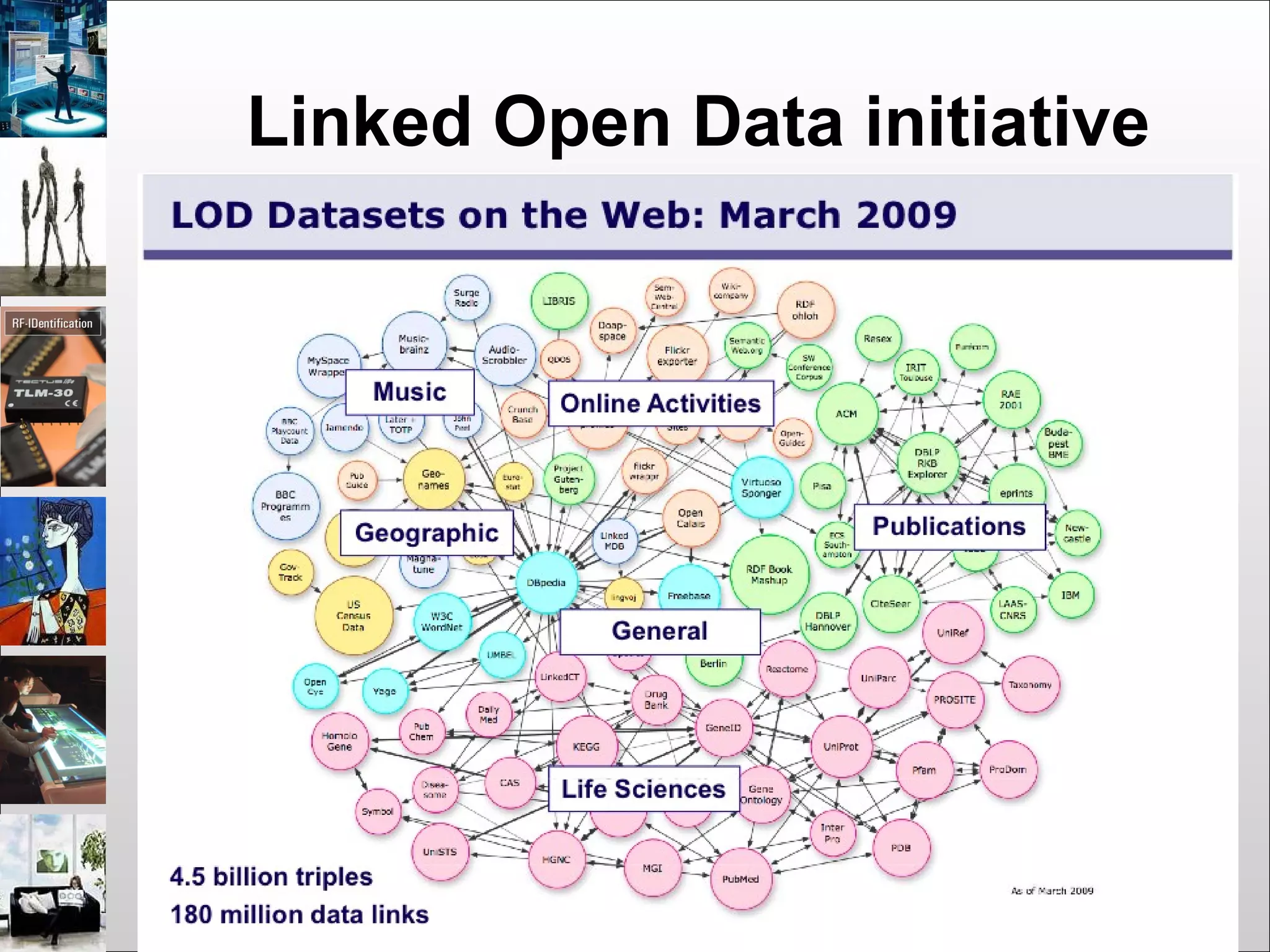
Linked Open Data initiative
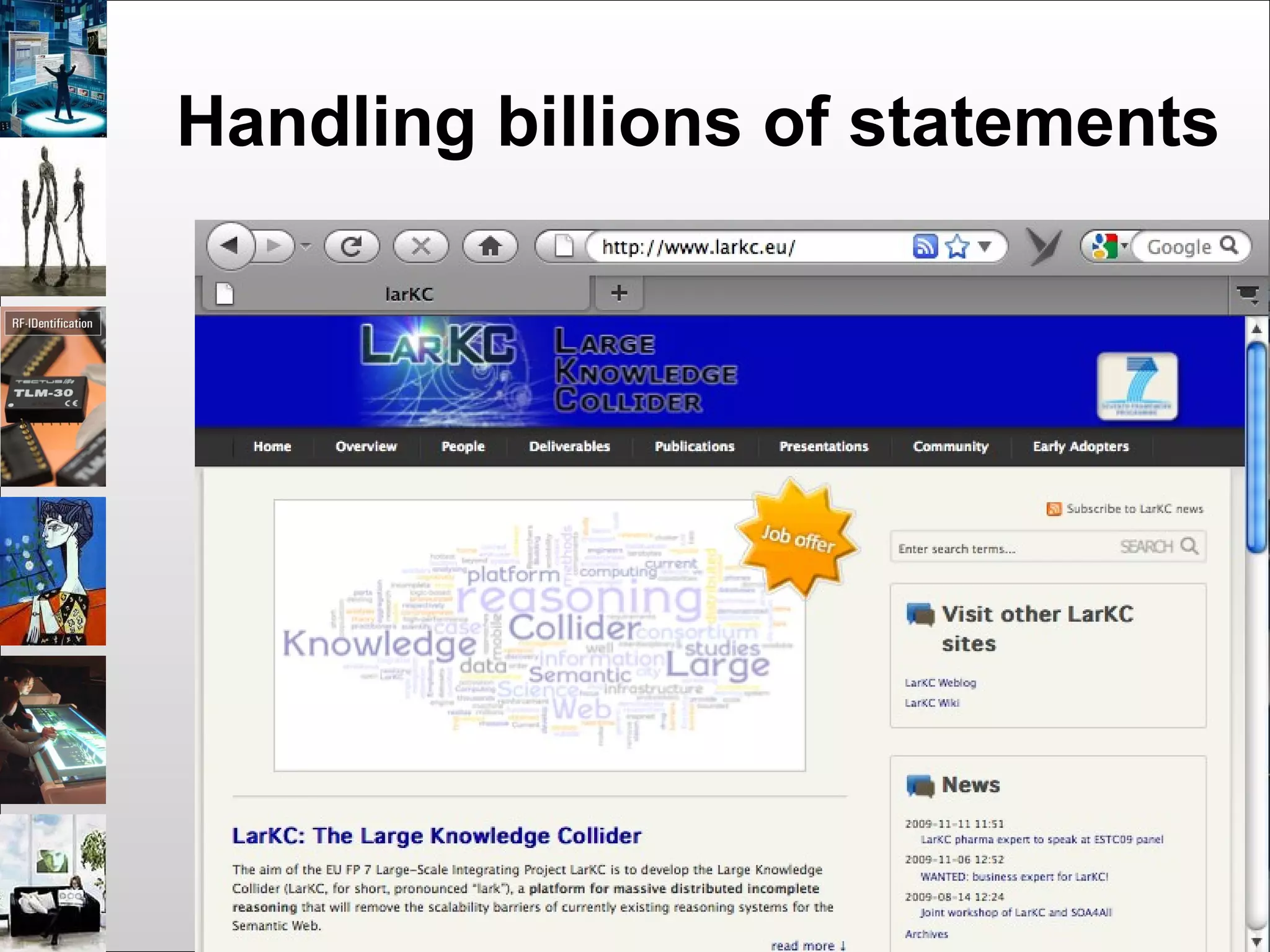
Handling billions of statements
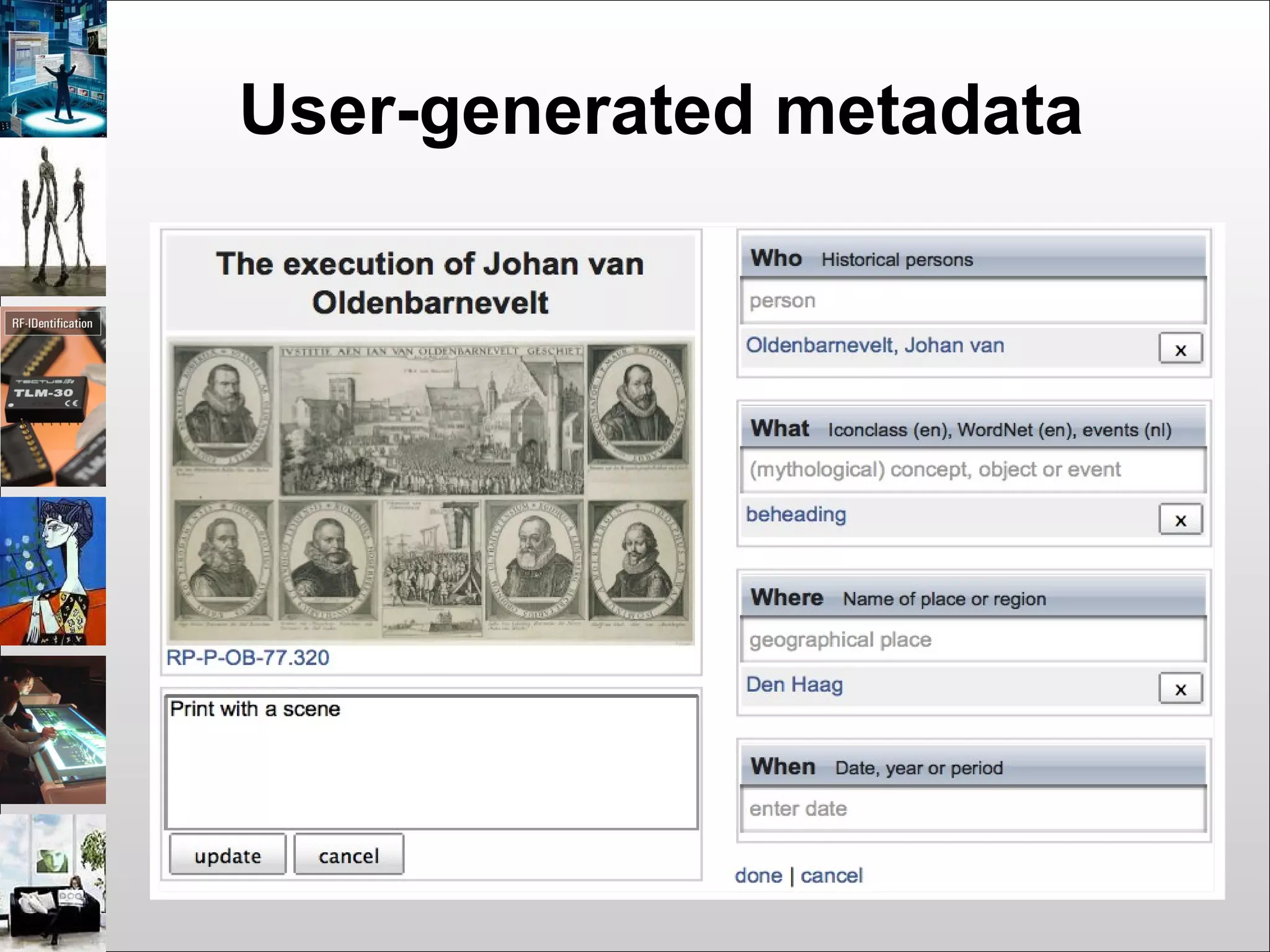
User-generated metadata
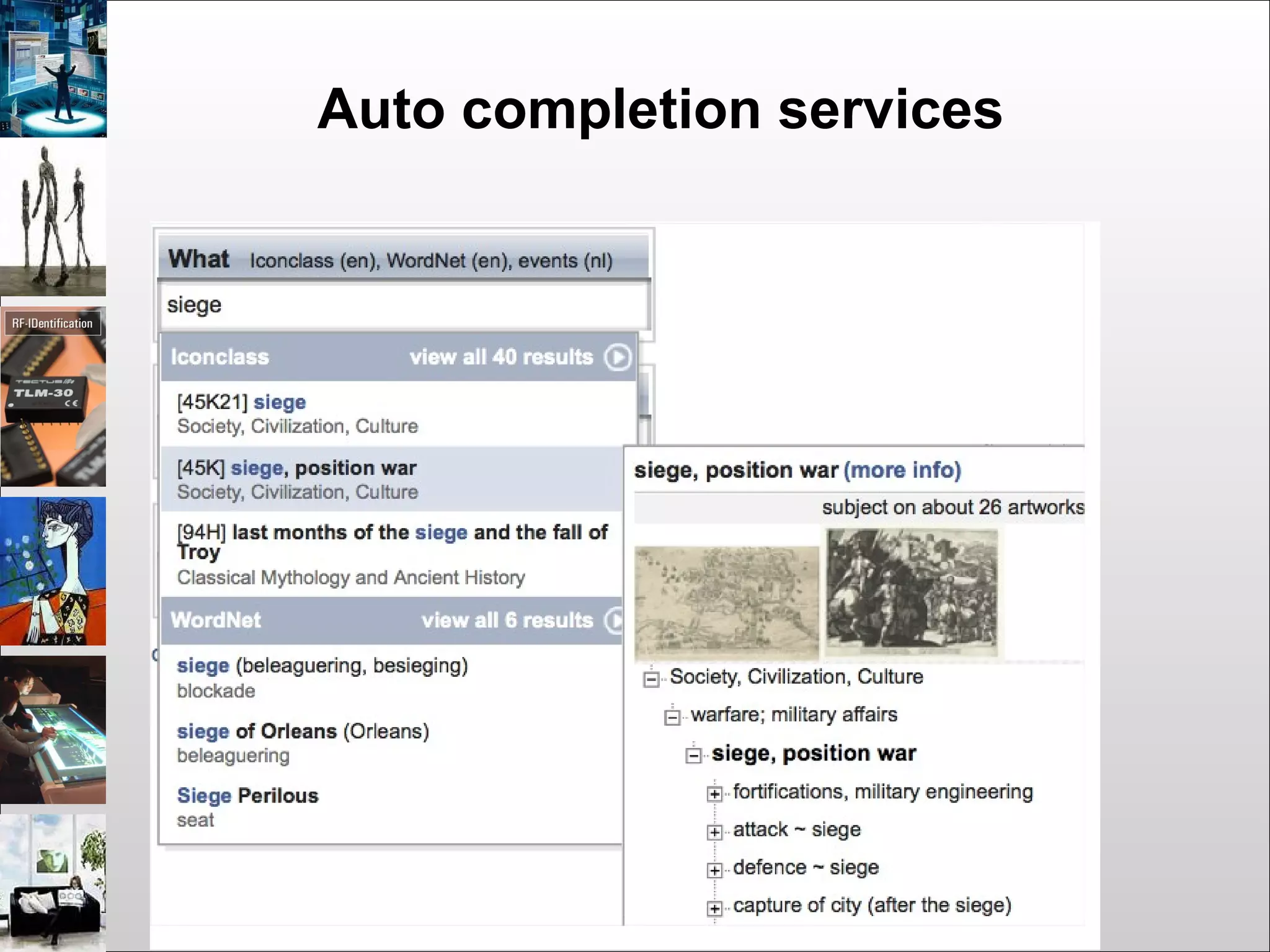
Auto completion services
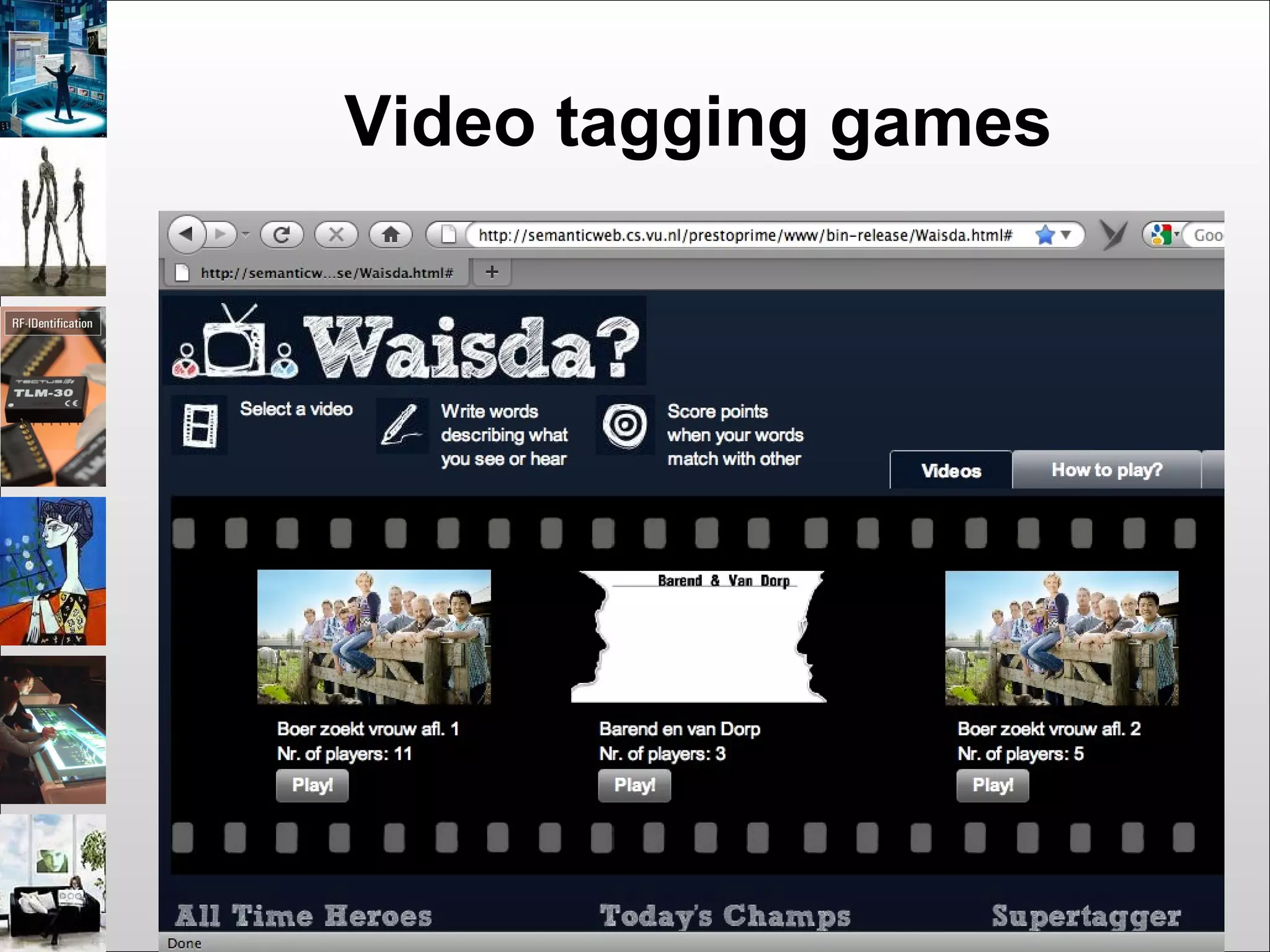
Video tagging games
Web science issues
• CH organizations need outside help to
annotate their objects
• Tension between in-house conservation-
biased metadata and user view
– who, what, where, when
• How can we derive trust levels?
• Auto completion is a difficult technical
issue in case of many vocabularies
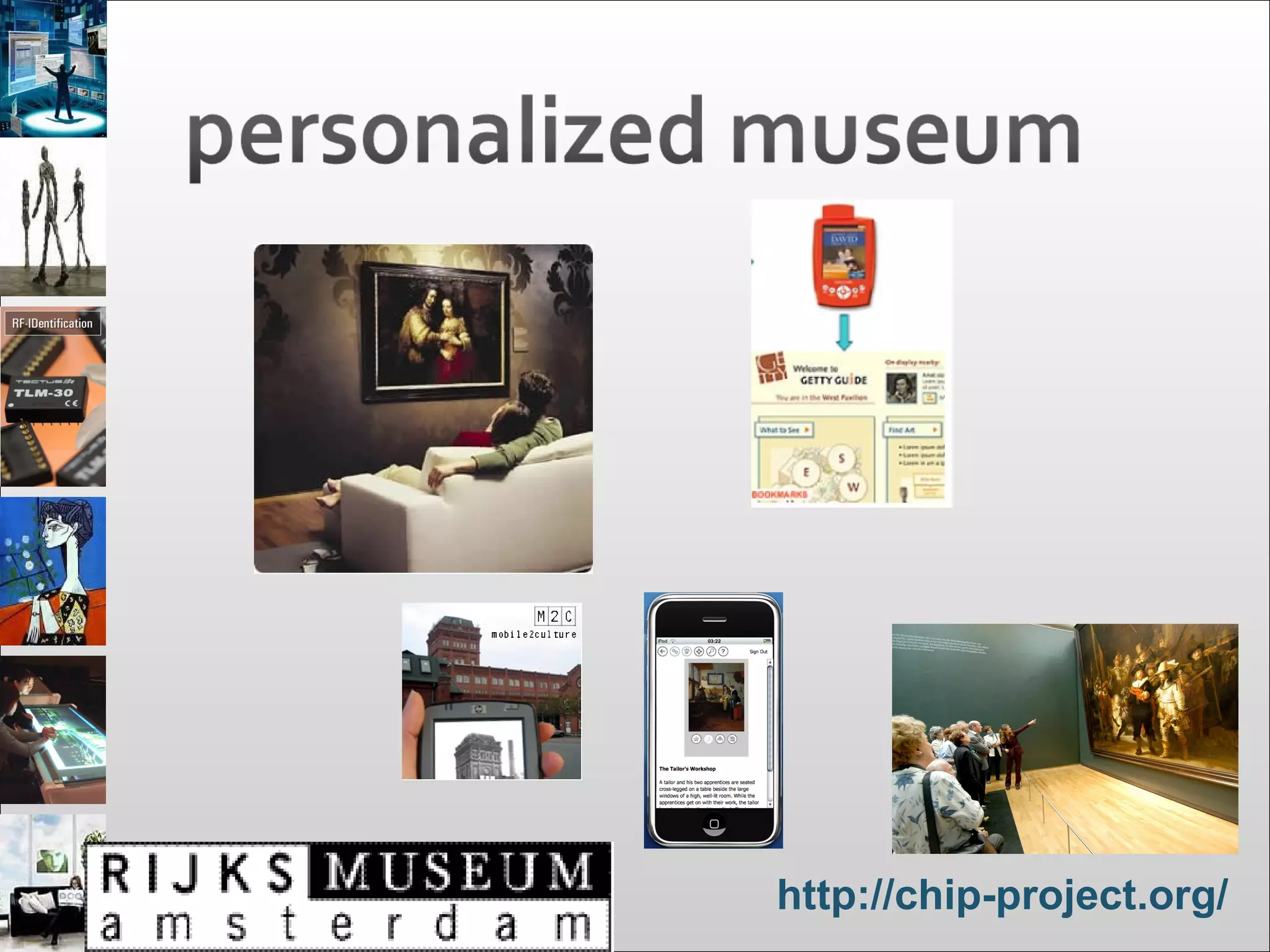
http://chip-project.org/
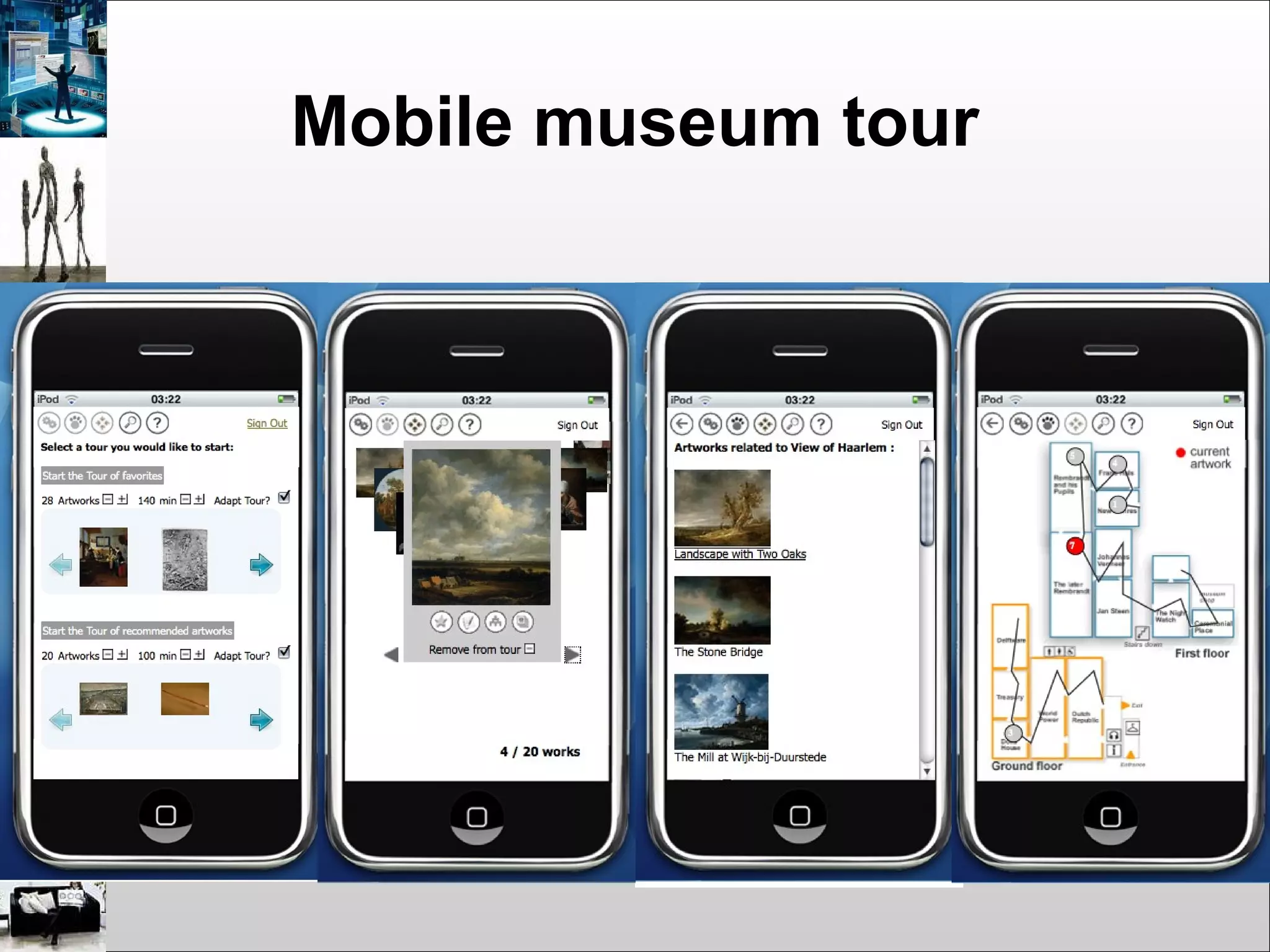
Mobile museum tour
Web science issues
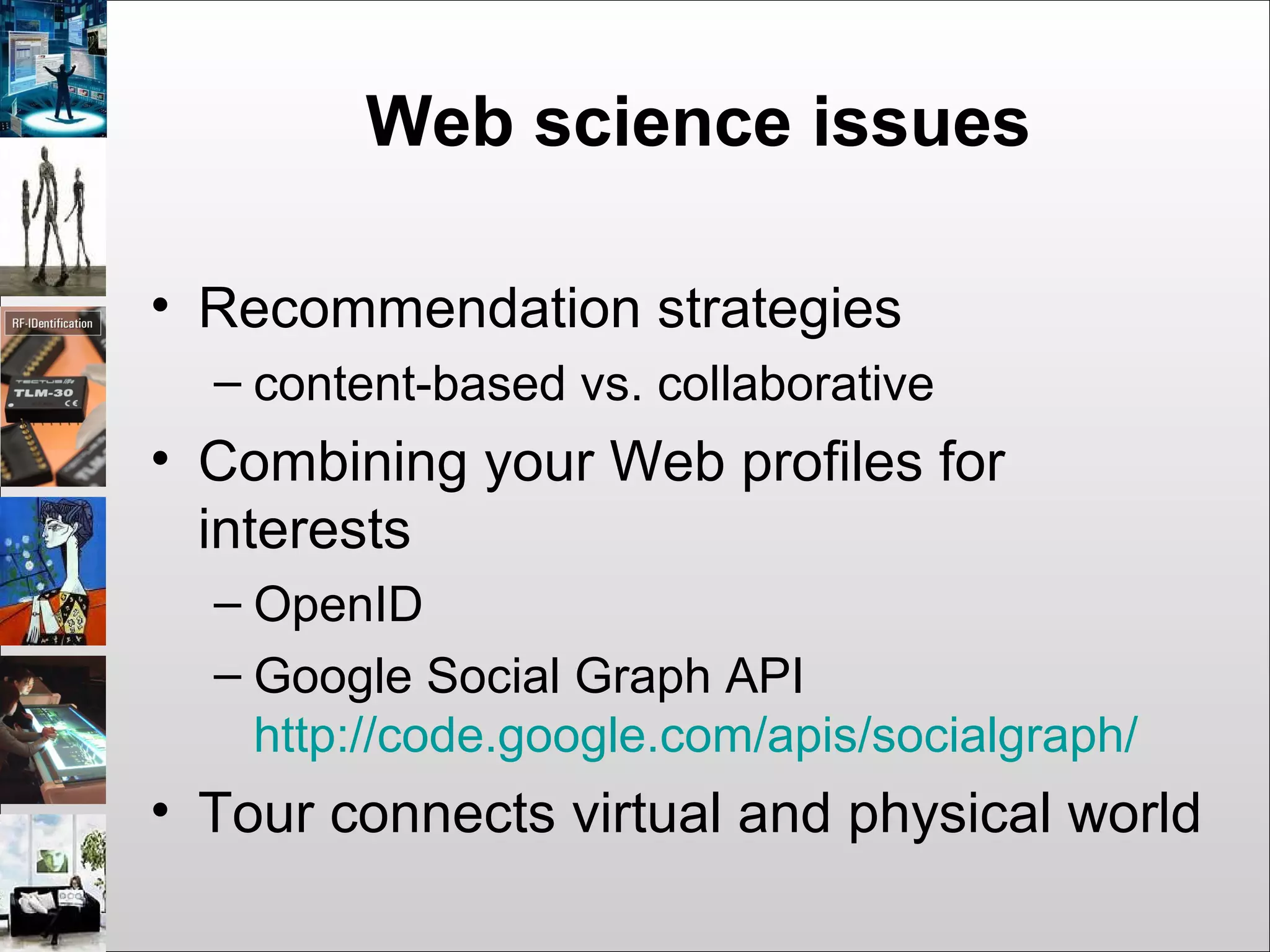
• Recommendation strategies
– content-based vs. collaborative
• Combining your Web profiles for
interests
– OpenID
– Google Social Graph API
http://code.google.com/apis/socialgraph/
• Tour connects virtual and physical world
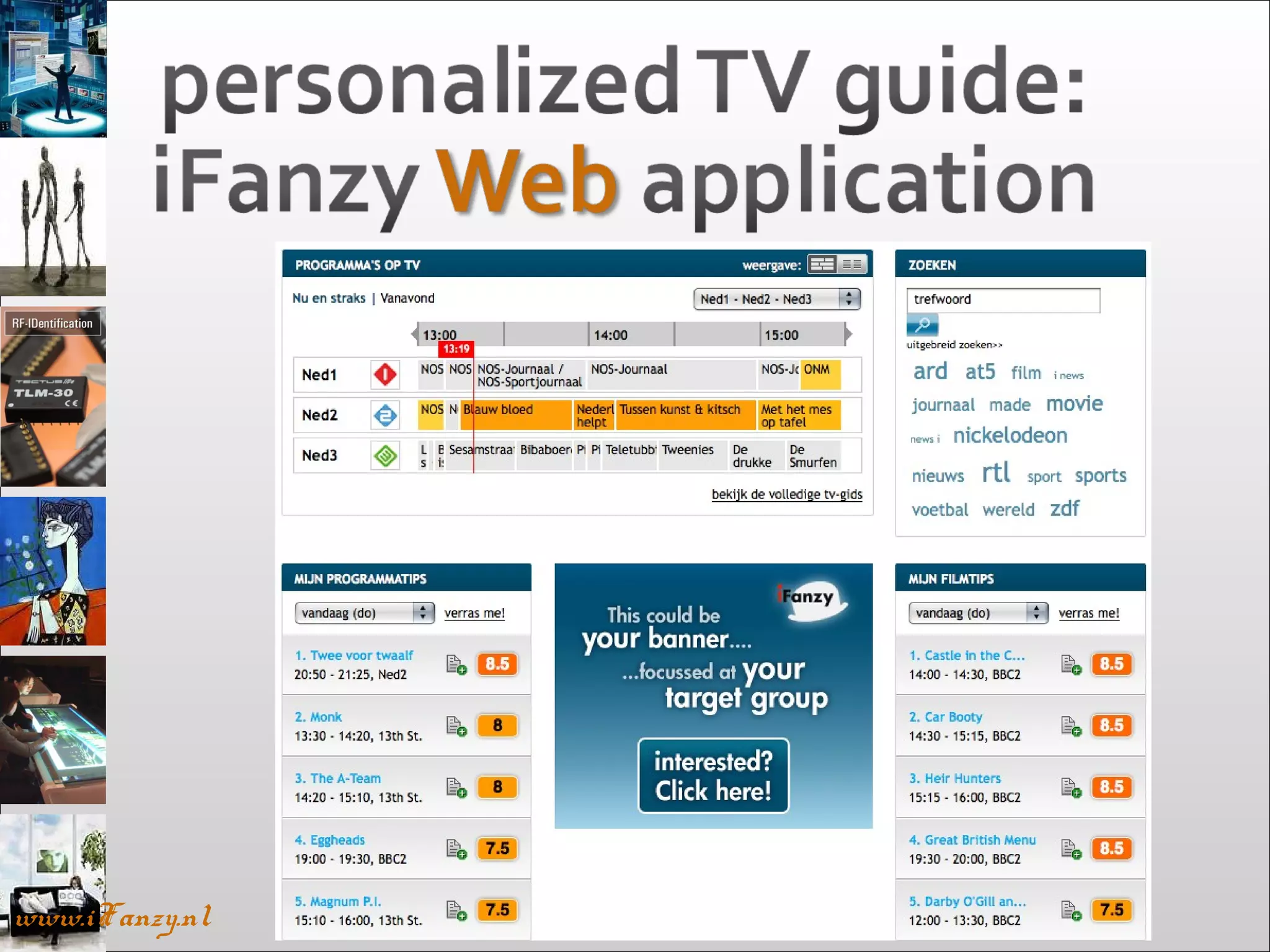
www.iFanzy.nl
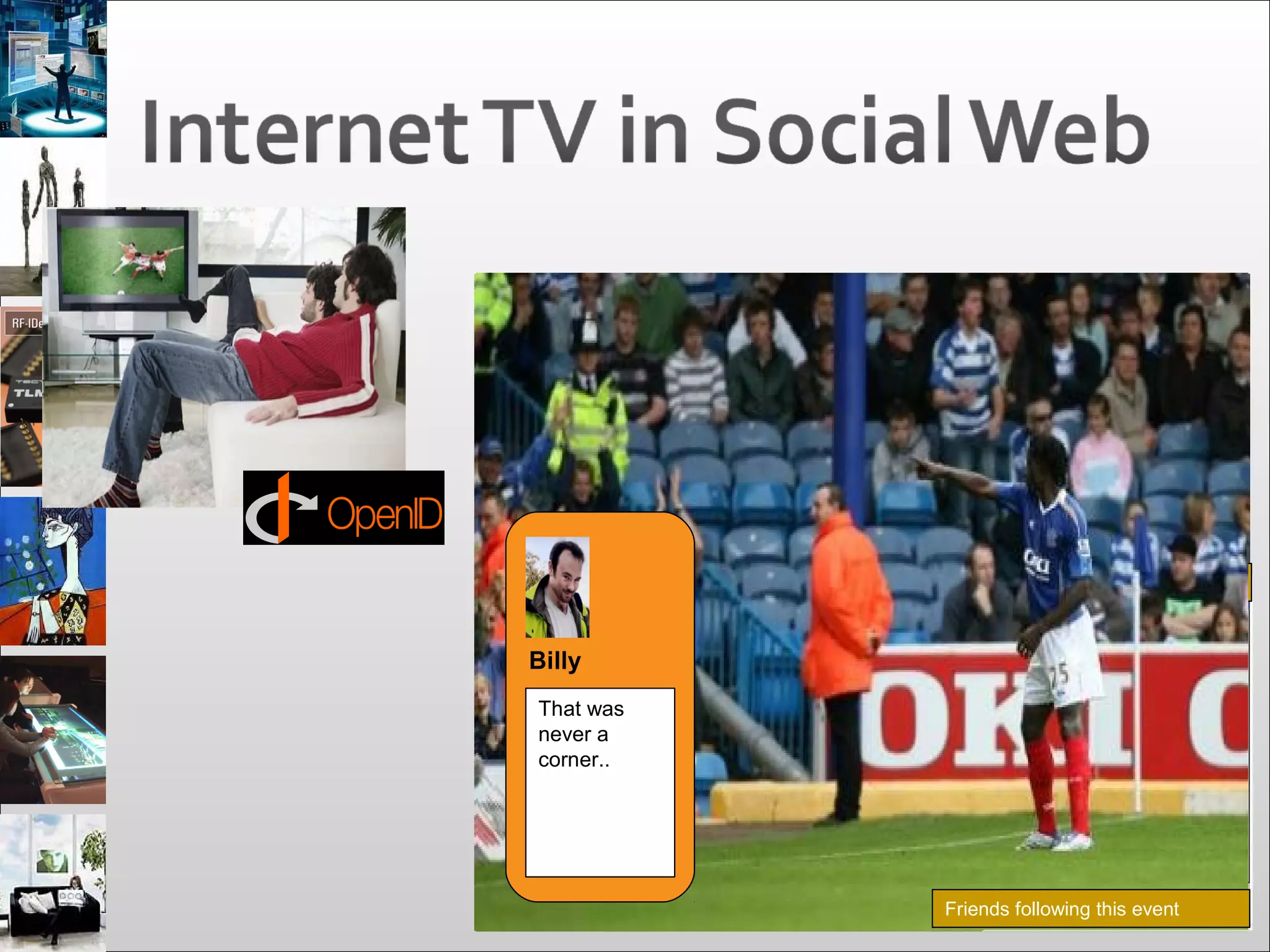
Friends following this event
Friends following this eventFriends following this event
That was
never a
corner..
Billy
Friends following this event
Web science issues
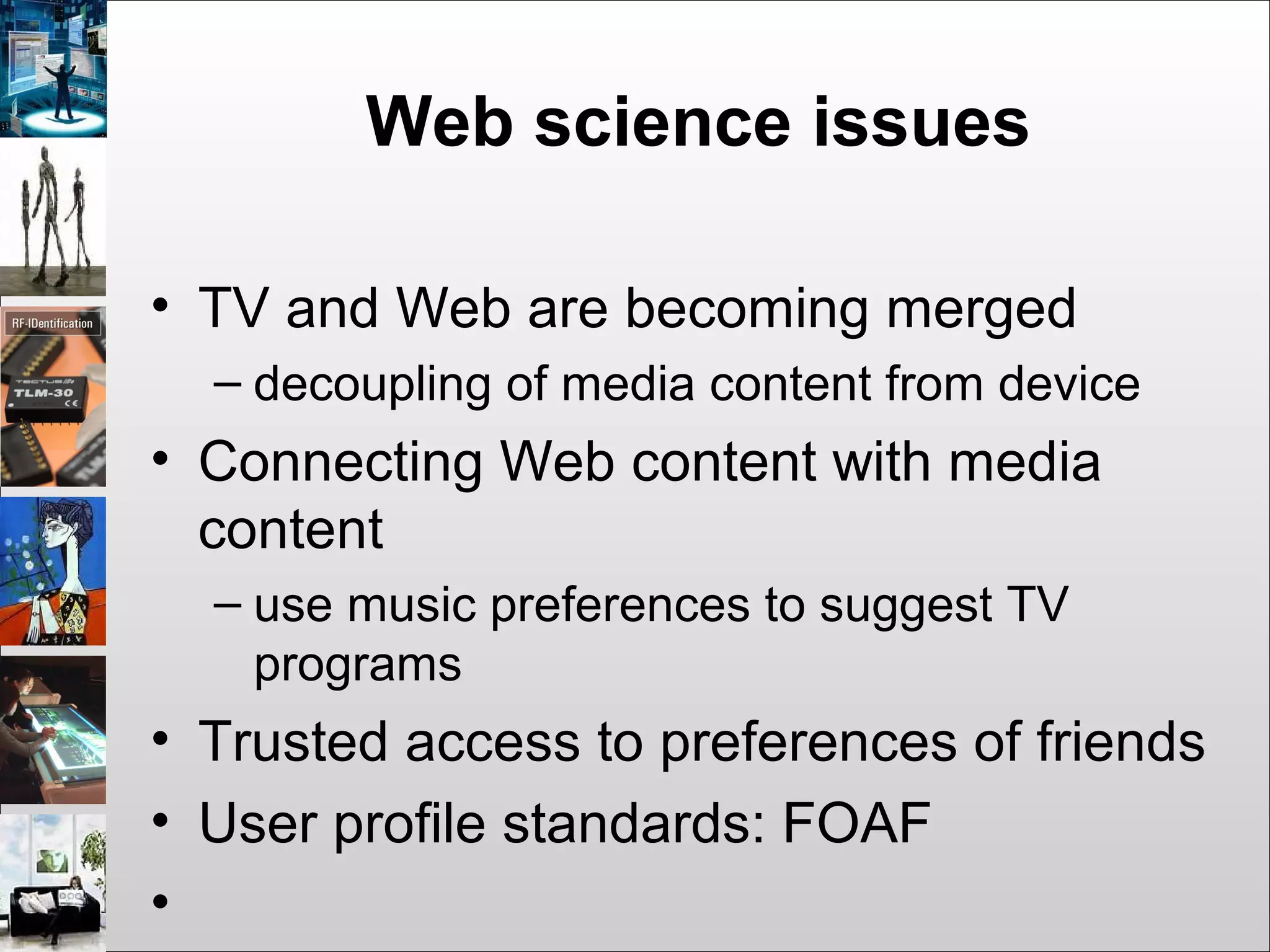
• TV and Web are becoming merged
– decoupling of media content from device
• Connecting Web content with media
content
– use music preferences to suggest TV
programs
• Trusted access to preferences of friends
• User profile standards: FOAF
•
VU University
Amsterdam
Department of Informatics49
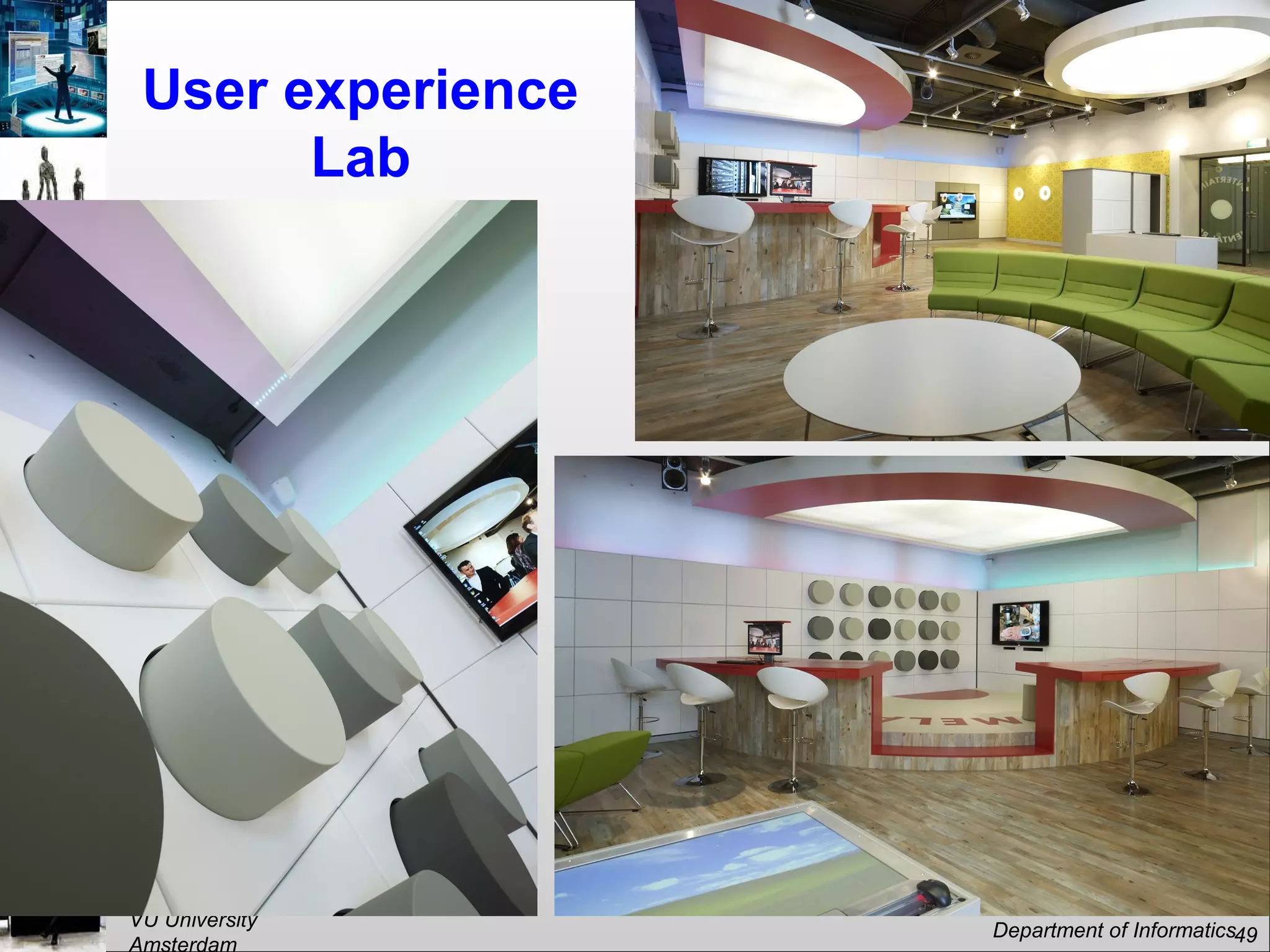
User experience
Lab
Some things I learned
Principles of knowledge
engineering on the Web
Principle 1: Be modest!
allow for multiple views and realities
Principle 2: Think large!
cf. Doug Lenat
Principle 3: Don't recreate but enrich and
align!
Principle 4: : Beware of ontological
over-commitment!
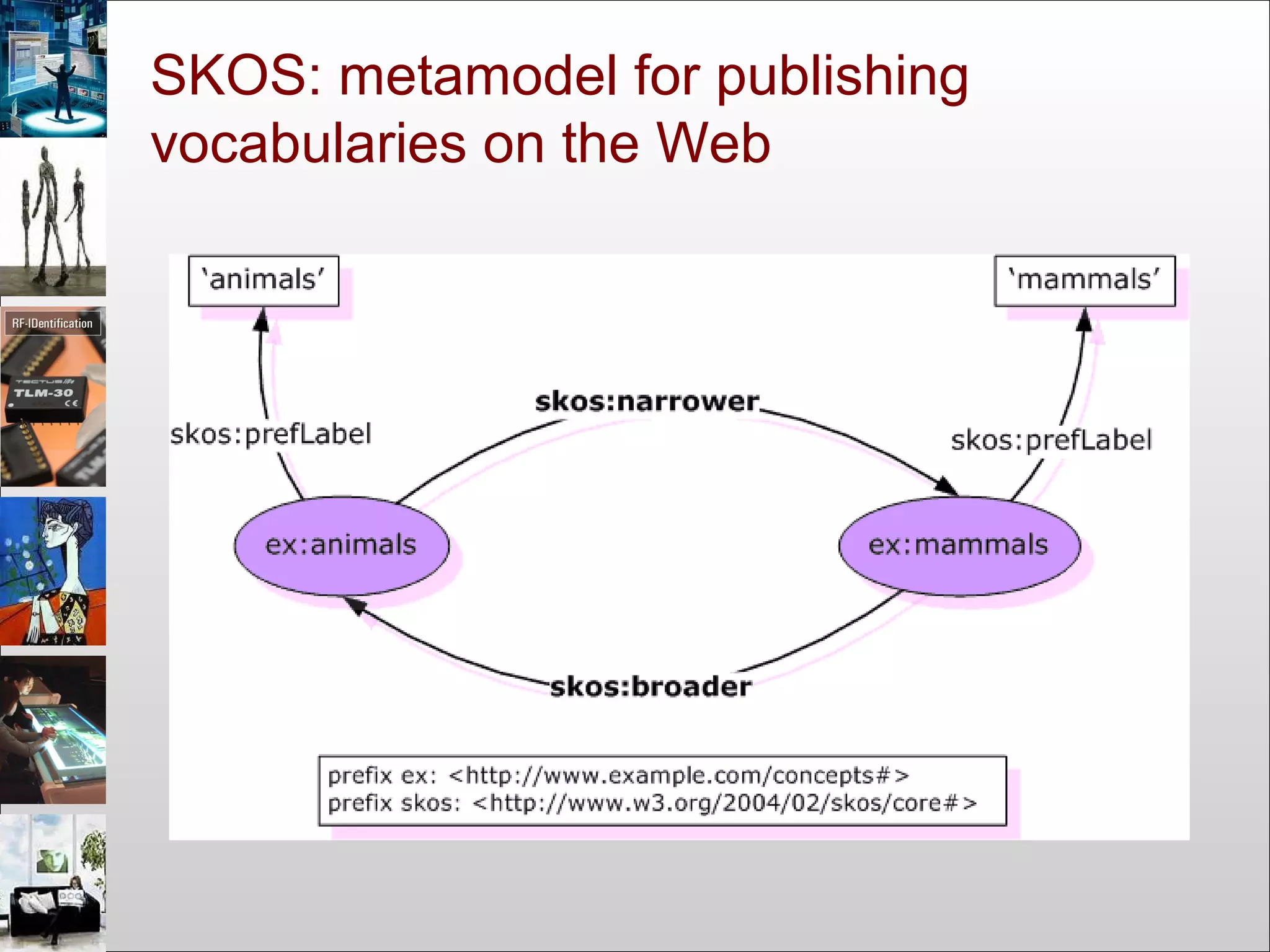
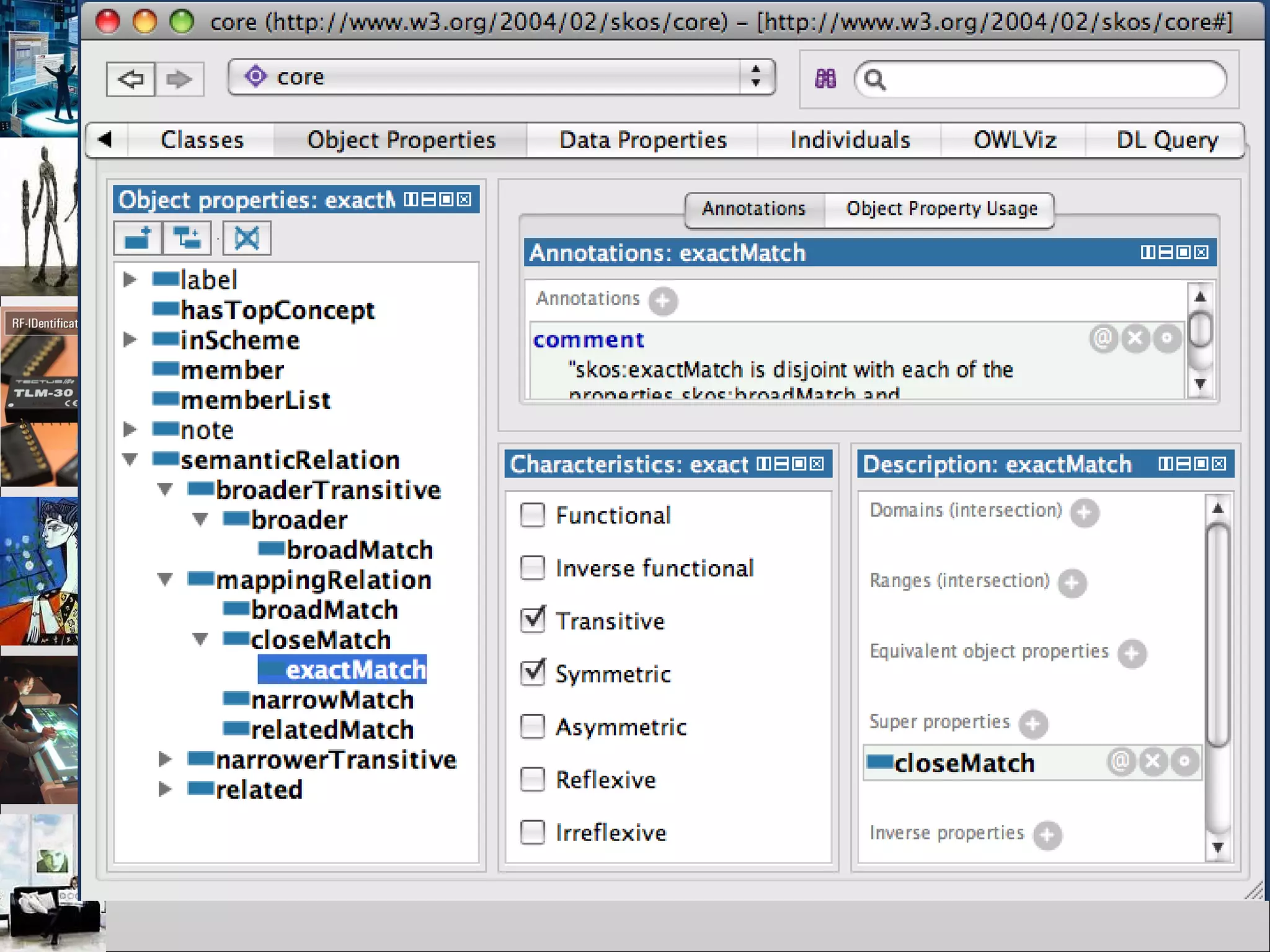
SKOS: metamodel for publishing
vocabularies on the Web
Issues in specification of
SKOS semantics
• SKOS should cover a large range of
“vocabularies”, “thesauri”,
“terminologies”, “classification
schemes”, etc.
• Therefore: objective was to define the
minimal semantics
• Leave hooks for specializations
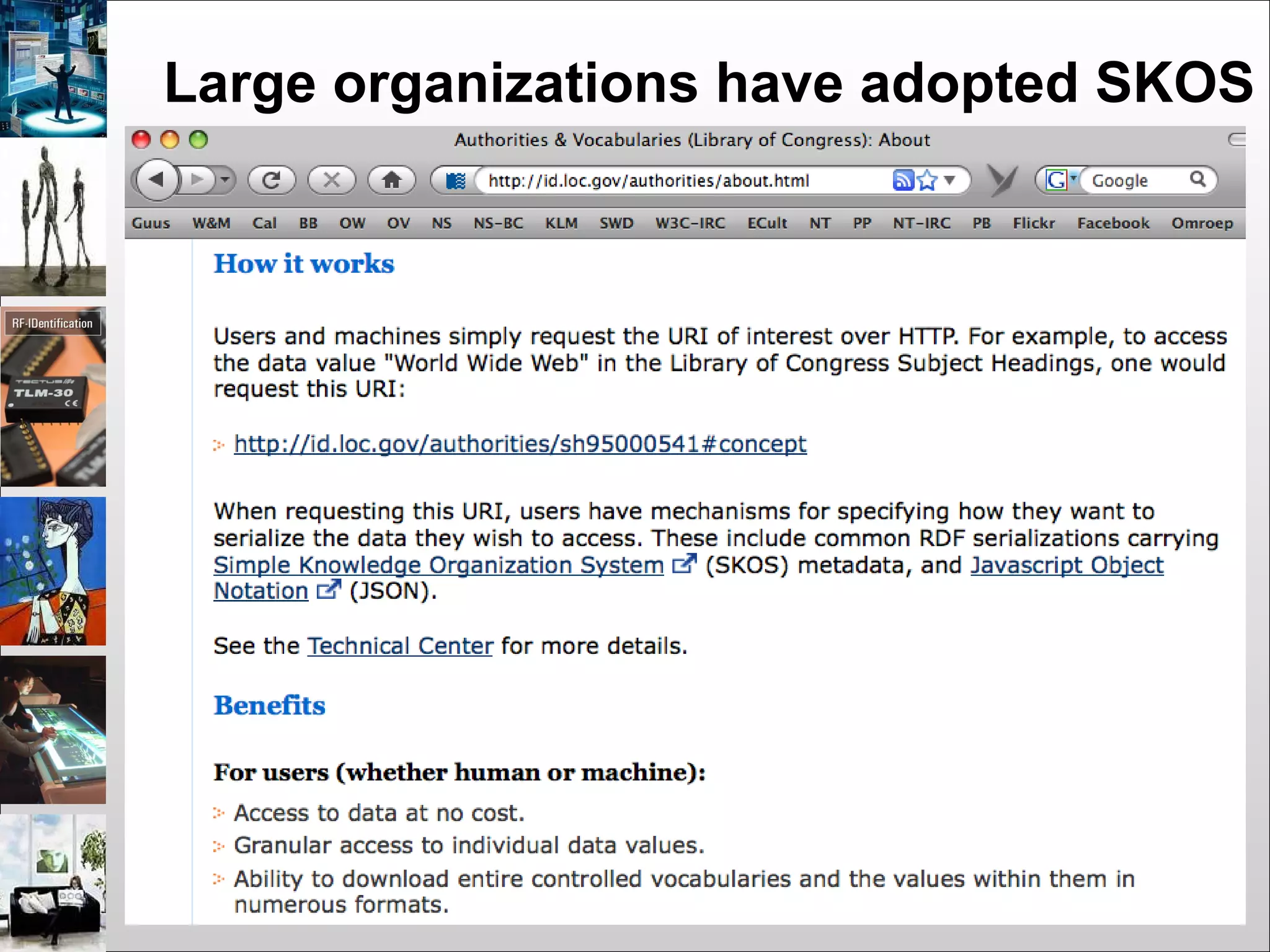
Large organizations have adopted SKOS
Web science education
Typical curriculum topics
• Web technology
• Web communication
• Web society
• Web data
http://wiki.websciencetrust.org/w/Curriculum_
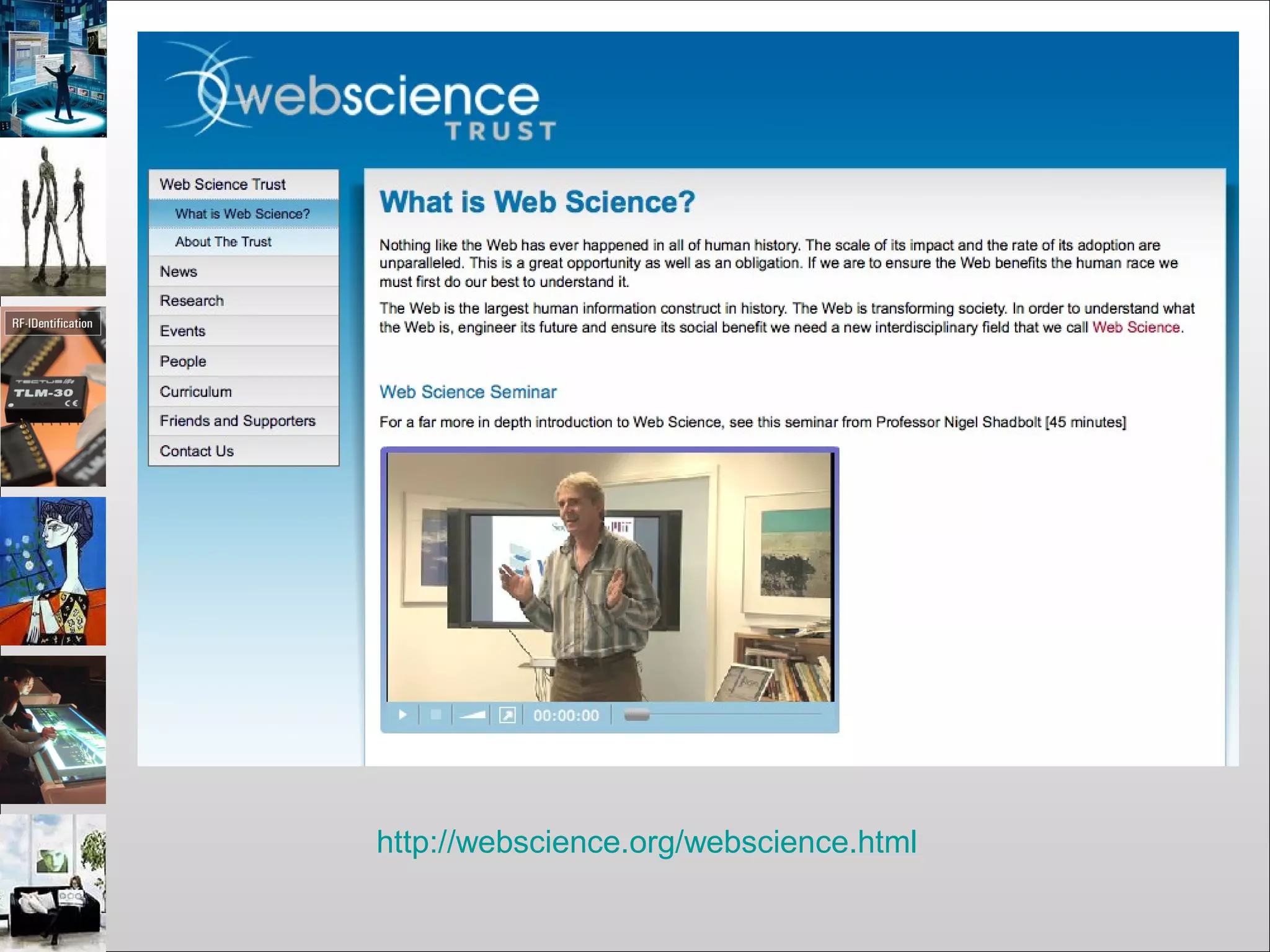
http://webscience.org/webscience.html
Take home message
• Web science is much more than
computer science for the Web
• Web science is strongly interdisciplinary
• Computer science is an important
enabler for Web developments
Thank you!
• This talk represents work of many
people, in particular colleagues at the
VU and in the Web Science Trust. Lora
Aroyo, Nigel Shadbolt, Jacco van
Ossenbruggen and Michiel Hildebrand
provided slides

Web Science: the digital heritage case

  • 1.
    Web Science: The DigitalHeritage Case Guus Schreiber Informatics Dept., Web & Media VU University Amsterdam
  • 2.
    21st century computer-science landscape • Nowadayssmall (student) projects are achieving more than large multi-year multi-person projects 10 years ago • Data storage and computing power are no longer an omnipresent problem • Globalization of data and service availability • Data and applications are moving to the Web
  • 3.
    Web science • Webscience is not computer science transported to the Web • Web science is socially embedded • Broad scope of research issues: trust, reputation, security, governance, social networks, economic models • “Shift from studying chips to studying clicks”
  • 4.
    My journey knowledge engineering •design patterns for problem solving • methodology for knowledge systems • models of domain knowledge • ontology engineering
  • 5.
    My journey access todigital heritage
  • 6.
    My journey Web standards •OWL Web Ontology Language • SKOS model for publishing vocabularies on the Web
  • 7.
    A definition ofWeb science “Web science is the study of (i) the social behavior in the Web at the personal, organizational and societal level, (ii) the Web technology that enables this behavior, and (iii) the interactions between technology and behavior”
  • 8.
  • 10.
    We need tostudy the Web as a phenomenon • Is the Web changing faster than our ability to observe it? • How to measure or instrument the Web? • How to identify behaviors and patterns ? • How to analyze the changing structure of the Web? Sample research themes: • Web dynamics • Collective intelligence • Privacy, trust and security • Linked open data 22 January 2010 Information Day on FET 10
  • 11.
    Web science issues: socialcomputing • What makes online communities successful? – Role of moderation – Issues of trust and identity – Growth models – Role of type of discussion topic – Type of language used • Driving role of technology
  • 13.
    Web science issues: psychologyand pedagogy • Effect of chat/email on: – Mental development of children – Forming of relationships – Changes in cultural preferences • Distance learning • Distance psychotherapy
  • 14.
    Web science issues: privacy •Control over personal data – Video’s and pictures of you • Identity theft • Who is allowed to store what? • What do you accept as a user?
  • 15.
    Web science issues: legalproblems • Lack of “location” – Which law to apply? • Copyright – New types of licenses required – See for example Creative Commons • Data aggregation: what can Google/Facebook/… do with our data?
  • 16.
    Web science issues: neweconomic models • Micro payments for mail messages?! • Downloading material with copyright – What is the price of a song? • Global personalized services replace shops – E.g., Web services for items now in museum shops
  • 17.
    New economic models for distributionof fees for music rights
  • 18.
    Web science issues: universalaccess • Ideals: access for all! • Limited Web access in particular countries • Spreading of hate • Quality of material gathered on a global scale – Wikipedia
  • 19.
  • 20.
  • 21.
  • 23.
    The Web: resources andlinks URL URL Web link
  • 24.
    The Semantic Web: typedresources and links URL URL Web link ULAN Henri Matisse Dublin Core creator Painting “Woman with hat SFMOMA
  • 27.
    The myth ofa unified vocabulary • In large virtual collections there are always multiple vocabularies – In multiple languages • Every vocabulary has its own perspective – You can’t just merge them • But you can use vocabularies jointly by defining a limited set of links – “Vocabulary alignment” • It is surprising what you can do with just a few links
  • 28.
    Example use ofvocabulary alignment “Tokugawa” SVCN period Edo SVCN is local in-house ethnology thesaurus AAT style/period Edo (Japanese period) Tokugawa AAT is Getty’s Art & Architecture Thesaurus
  • 29.
    Semantic search: clusteringand cluster-order principles
  • 31.
    Web science issues: technical •Information retrieval as graph search – more semantics => more paths – finding optimal graph patterns • Vocabulary alignment • Information extraction – recognizing people, locations, … – identity resolution • Multi-lingual resources
  • 32.
    Search: WordNet patternsthat increase recall without sacrificing precisions
  • 33.
    Web science issues: economic •Cultural heritage organizations find it difficult to “give away” their data – concerns for quality • Re-orientation: Web is not derivative of physical presence; they should stand side-by-side • Universal access: everyone should be able to enjoy the Rijksmuseum Amsterdam
  • 34.
    Web science issues: economic •Primary access free • Secondary services cost money – virtual museum shop can offer much larger collection – access to high-resolution images – tourist services on mobile devices
  • 35.
    Web science issues: legal •Europeana.eu faces enormous rights issues, in particular wrt recent works • New licensing frameworks: – Creative Commons – Open Data Commons
  • 36.
    Availability of governmentdata: http://data.gov.uk
  • 37.
    Linked Open Datainitiative
  • 38.
  • 39.
  • 40.
  • 41.
  • 42.
    Web science issues •CH organizations need outside help to annotate their objects • Tension between in-house conservation- biased metadata and user view – who, what, where, when • How can we derive trust levels? • Auto completion is a difficult technical issue in case of many vocabularies
  • 43.
  • 44.
  • 45.
    Web science issues •Recommendation strategies – content-based vs. collaborative • Combining your Web profiles for interests – OpenID – Google Social Graph API http://code.google.com/apis/socialgraph/ • Tour connects virtual and physical world
  • 46.
  • 47.
    Friends following thisevent Friends following this event Friends following this eventFriends following this event That was never a corner.. Billy Friends following this event
  • 48.
    Web science issues •TV and Web are becoming merged – decoupling of media content from device • Connecting Web content with media content – use music preferences to suggest TV programs • Trusted access to preferences of friends • User profile standards: FOAF •
  • 49.
    VU University Amsterdam Department ofInformatics49 User experience Lab
  • 50.
  • 51.
    Principles of knowledge engineeringon the Web Principle 1: Be modest! allow for multiple views and realities Principle 2: Think large! cf. Doug Lenat Principle 3: Don't recreate but enrich and align! Principle 4: : Beware of ontological over-commitment!
  • 52.
    SKOS: metamodel forpublishing vocabularies on the Web
  • 53.
    Issues in specificationof SKOS semantics • SKOS should cover a large range of “vocabularies”, “thesauri”, “terminologies”, “classification schemes”, etc. • Therefore: objective was to define the minimal semantics • Leave hooks for specializations
  • 55.
  • 56.
    Web science education Typicalcurriculum topics • Web technology • Web communication • Web society • Web data http://wiki.websciencetrust.org/w/Curriculum_
  • 57.
  • 59.
    Take home message •Web science is much more than computer science for the Web • Web science is strongly interdisciplinary • Computer science is an important enabler for Web developments
  • 60.
    Thank you! • Thistalk represents work of many people, in particular colleagues at the VU and in the Web Science Trust. Lora Aroyo, Nigel Shadbolt, Jacco van Ossenbruggen and Michiel Hildebrand provided slides