User Engagement with Digital
Archives: A Case Study of
Emblematica Online
Harriett Green
University of Illinois at Urbana-
Champaign
ACRL 2015 Conference
March 27, 2015
Today’s talk
• Digital collections and User Engagement
• Overview of Emblematica Online
• Results of usability study of Emblematica
• What are the future implications for
humanities scholarship with digital
collections?
@greenharr green19@illinois.edu
User Assessment
Why user studies of digital
archives?
• Build digital collections strategically and
sustainably for increased use among
library patrons
• Correlate content and functionalities to
researchers’ needs
• Ensure Return On Investment
@greenharr green19@illinois.edu
User Assessment is Necessary
“While a greater reliance and dependency on digital
resources is inevitable, the quality of the data and their
organization and accessibility in service to teaching and
scholarship are major concerns.
“Without the guiding voice of scholars, the tremendous
effort now being devoted to digitizing our cultural heritage
could in fact impede, not facilitate, future research.”
—Charles Henry, The Idea of Order: Transforming
Research Collections for 21st Century Scholarship
@greenharr green19@illinois.edu
Digital Collections and Humanities
Scholars
• Brockman Palmer, et al., Scholarly Work in
the Humanities and the Evolving Information
Environment (CLIR Pub 104)
• Our Cultural Commonwealth: The Report of
the ACLS Commission on Cyberinfrastructure
in the Humanities and Social Sciences
• Log Analysis of Internet Resources in the Arts
and Humanities Project (LAIRAH)
• Ithaka S+R, Supporting the Changing
Research Practices of… - Art Historians,
Historians@greenharr green19@illinois.edu
Emblematica Online
Emblematica Online
• Provides single point of access to
digitized emblem books from libraries
in U.S., Germany, Netherlands, UK
• Funded by a NEH/DFG Bilateral
Digital Humanities grant (2008) and
NEH Humanities Collections and
Reference Resources grant (2013)
http://emblematica.library.illinois.edu
@greenharr green19@illinois.edu
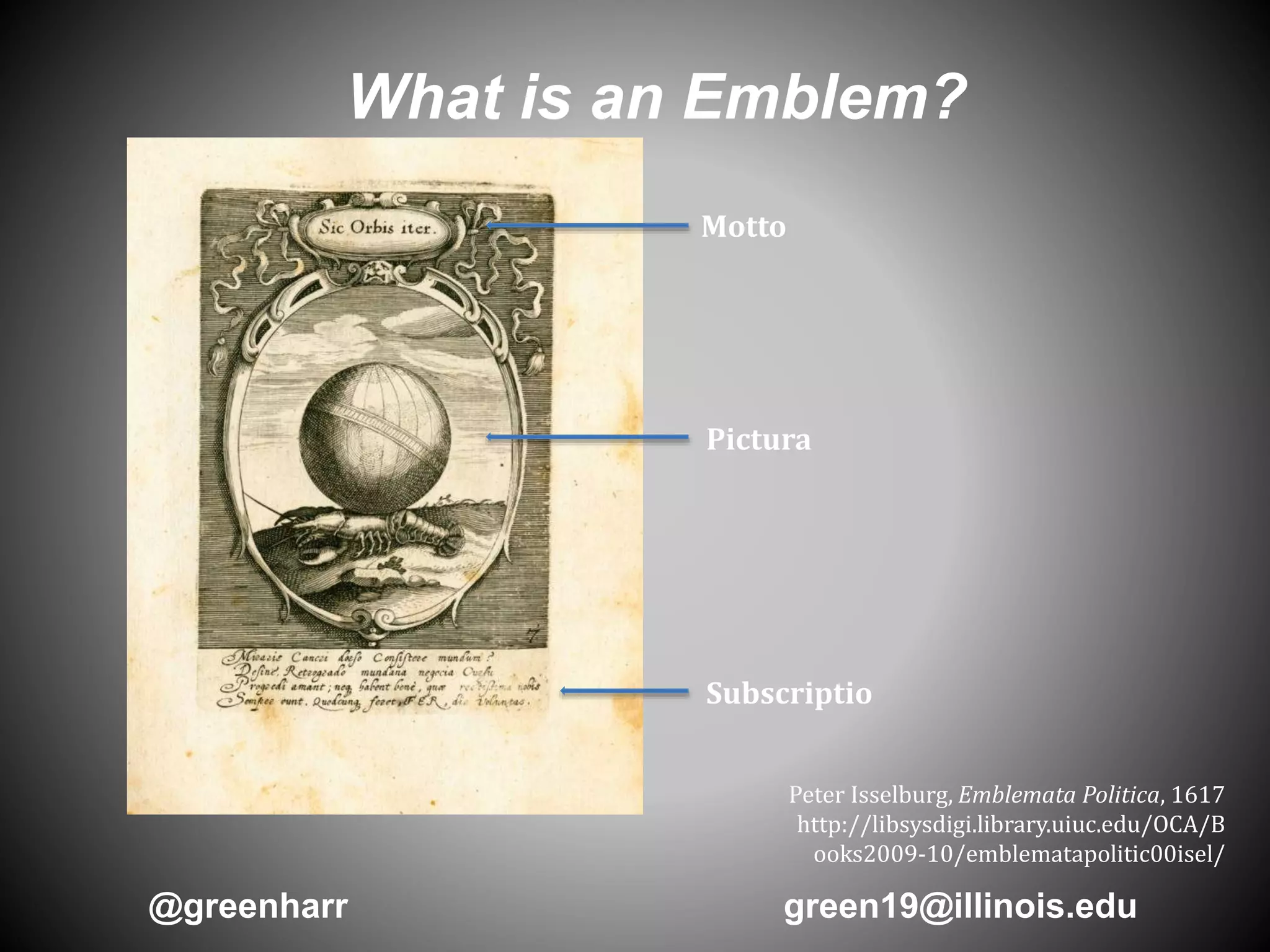
What is an Emblem?
Motto
Pictura
Subscriptio
Peter Isselburg, Emblemata Politica, 1617
http://libsysdigi.library.uiuc.edu/OCA/B
ooks2009-10/emblematapolitic00isel/
@greenharr green19@illinois.edu
What’s in Emblematica?
• Nearly 1400 emblem books
• 23,420 individual emblems
• Books digitized from the collections of the
University of Illinois at Urbana-Champaign,
HAB Wolfenbüttel, University of Utrecht,
University of Glasgow, Duke University
and the Getty Institute
@greenharr green19@illinois.edu
Usability Study
Goals of Study
• Gain further insights into research
practices of humanities scholars
• Learn about behaviors of researchers
working with Emblematica Online and
similar specialized digital archives
• Gather input to assess the new
functionalities added to Emblematica
Online, and determine future
functionalities
@greenharr green19@illinois.edu
User Assessment Study
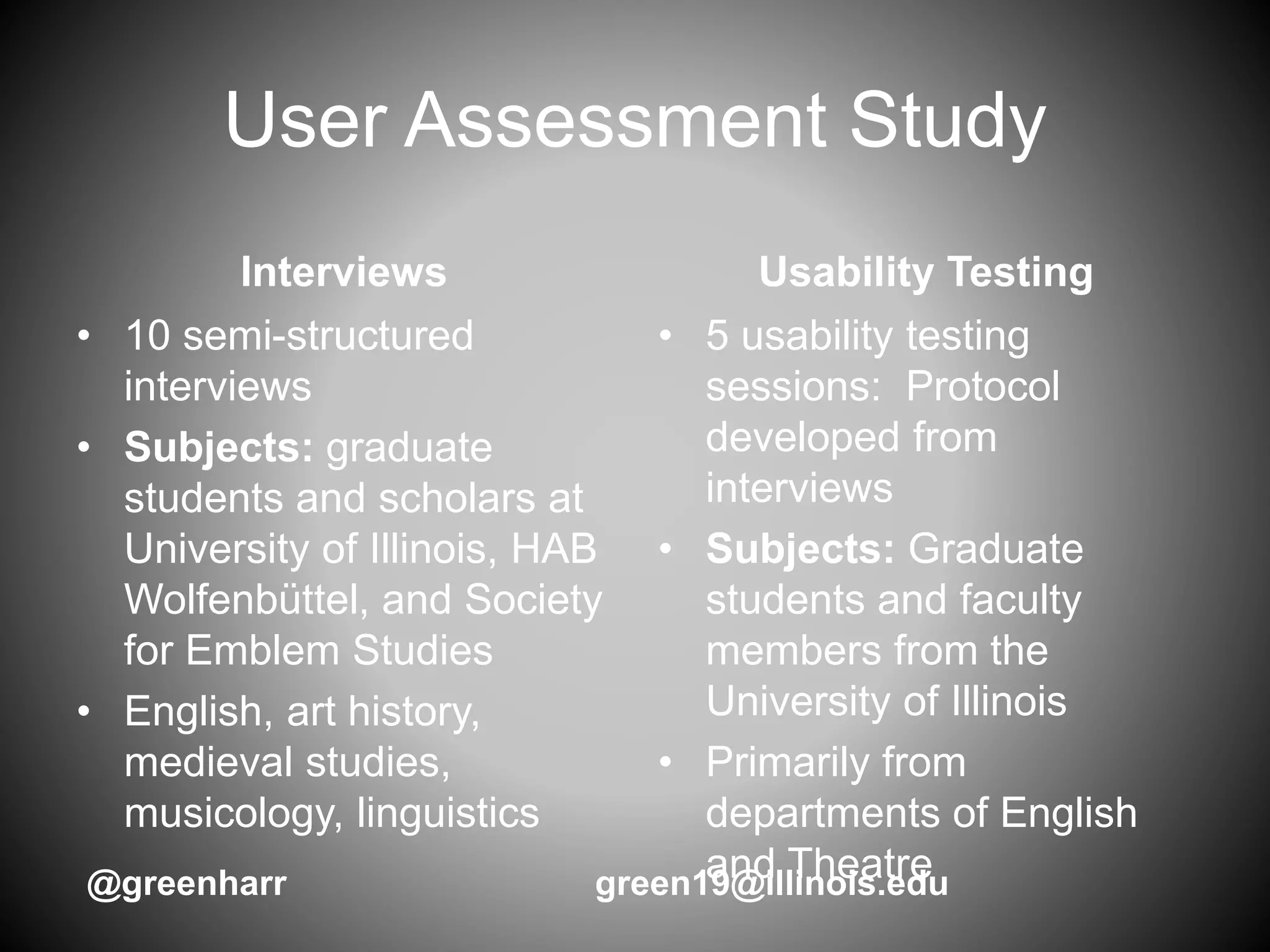
Interviews
• 10 semi-structured
interviews
• Subjects: graduate
students and scholars at
University of Illinois, HAB
Wolfenbüttel, and Society
for Emblem Studies
• English, art history,
medieval studies,
musicology, linguistics
Usability Testing
• 5 usability testing
sessions: Protocol
developed from
interviews
• Subjects: Graduate
students and faculty
members from the
University of Illinois
• Primarily from
departments of English
and Theatre@greenharr green19@illinois.edu
Teaching
• Emblems as an Illustrative tool for artistic
styles and cultural mores
• A unit on emblems for a graduate seminar
on history of the animal and early modern
culture“Spenser has an emblematic style in his
poetry…. I think if students could be directed
from those kind of moments in the poetry to
emblem culture, other emblems of charity,
other emblems of holiness, I think that could be
a great tool.” —Faculty
@greenharr green19@illinois.edu
Discovery of Content
• To look up specific emblems
• To search for emblems on themes
• Expand interdisciplinary research via new
sources of content such as emblems
“[Emblematica Online] could help students
and researchers get across multi-lingual
barriers because it is a multi-lingual tradition
and visual tradition. It can also help pioneer
searches that begin as visual and verbal
searches.” —Faculty@greenharr green19@illinois.edu
Research
• Digitized emblem books enable access to
archives normally requiring expensive
travel around the world
• Enhance skills in early modern languages,
incorporate visual culture and theory
“I look at archival sources, account books,
buildings, architectural treatises, musical
treatises, but this is another sphere, another
realm so to speak that could be used to gather
more information.” —Faculty@greenharr green19@illinois.edu
Scholarly Communications and
Impact
• Expand the use of emblems in research
across multiple disciplines
• Increase the impact and prominence of
scholarship in emblem studies
@greenharr green19@illinois.edu
“I would return to the point of [Emblematica Online] not
being bound by a single national tradition or a single
library collection. I think that, in and of itself, may allow
people to draw on a broader range of sources than they
otherwise would. That can show itself in the scholarship
that gets produced on the topic.”—Faculty
Usability Testing Issues
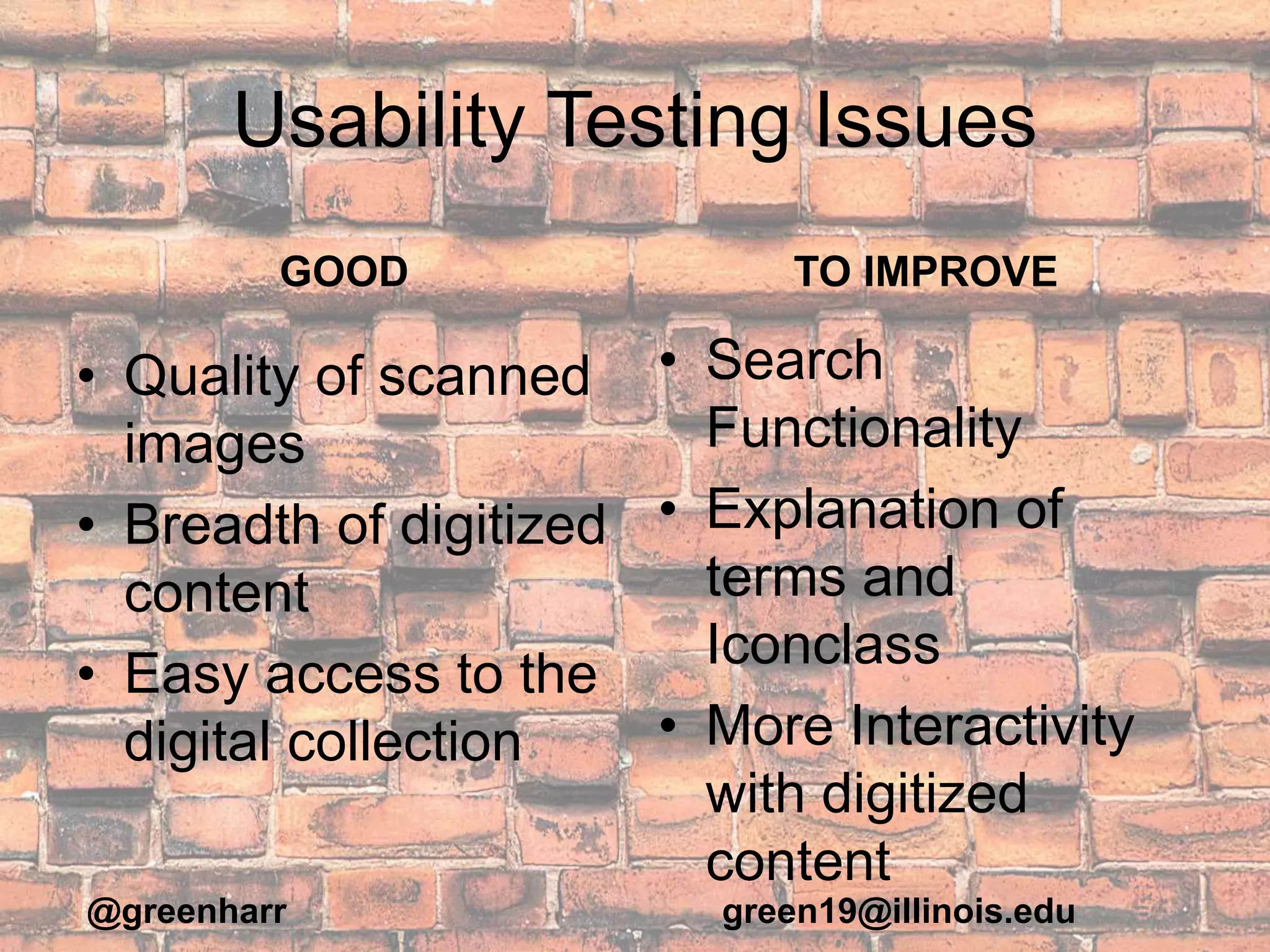
GOOD
• Quality of scanned
images
• Breadth of digitized
content
• Easy access to the
digital collection
TO IMPROVE
• Search
Functionality
• Explanation of
terms and
Iconclass
• More Interactivity
with digitized
content
@greenharr green19@illinois.edu
Functionalities to Add
• Bibliographic information on editions and
multiple volumes
• Annotation tool
• Improve search interface with more search
filter and faceting
• Include background information that
provides more of a historical context for
the works
@greenharr green19@illinois.edu
Future Impact of Digital Collections
on Humanities Scholarship?
• Potential to advance Interdisciplinarity in
humanities scholarship
• Need for user engagement
• How does the digital and print complement
each other?
@greenharr green19@illinois.edu
“When we zoomed in, that was just beautiful, and that you
can see hand markings and other pencil markings that
would be on there…. For me as a researcher, that matters
and I loved the quality of that.”
—Graduate Student
Photo Credits
• “Tun und Lassen, ist groß der Massen,” from Vortrefflich-Hoch-
Adeliches Controfeé,
http://hdl.handle.net/10111/EmblemRegistry:E001002
• “Measuring Time,” by aussiegall, on Flickr,
https://www.flickr.com/photos/aussiegall/286709039
• brick detail by Grant MacDonald, on Flickr,
https://www.flickr.com/photos/grantmac/2578109298
• "classroom” by Lauren Manning, on Flickr,
https://www.flickr.com/photos/laurenmanning/2318943806
• "More Bildsten notebooks” by Jonas Lowgren, on Flickr,
https://www.flickr.com/photos/jonas_lowgren/7406596056
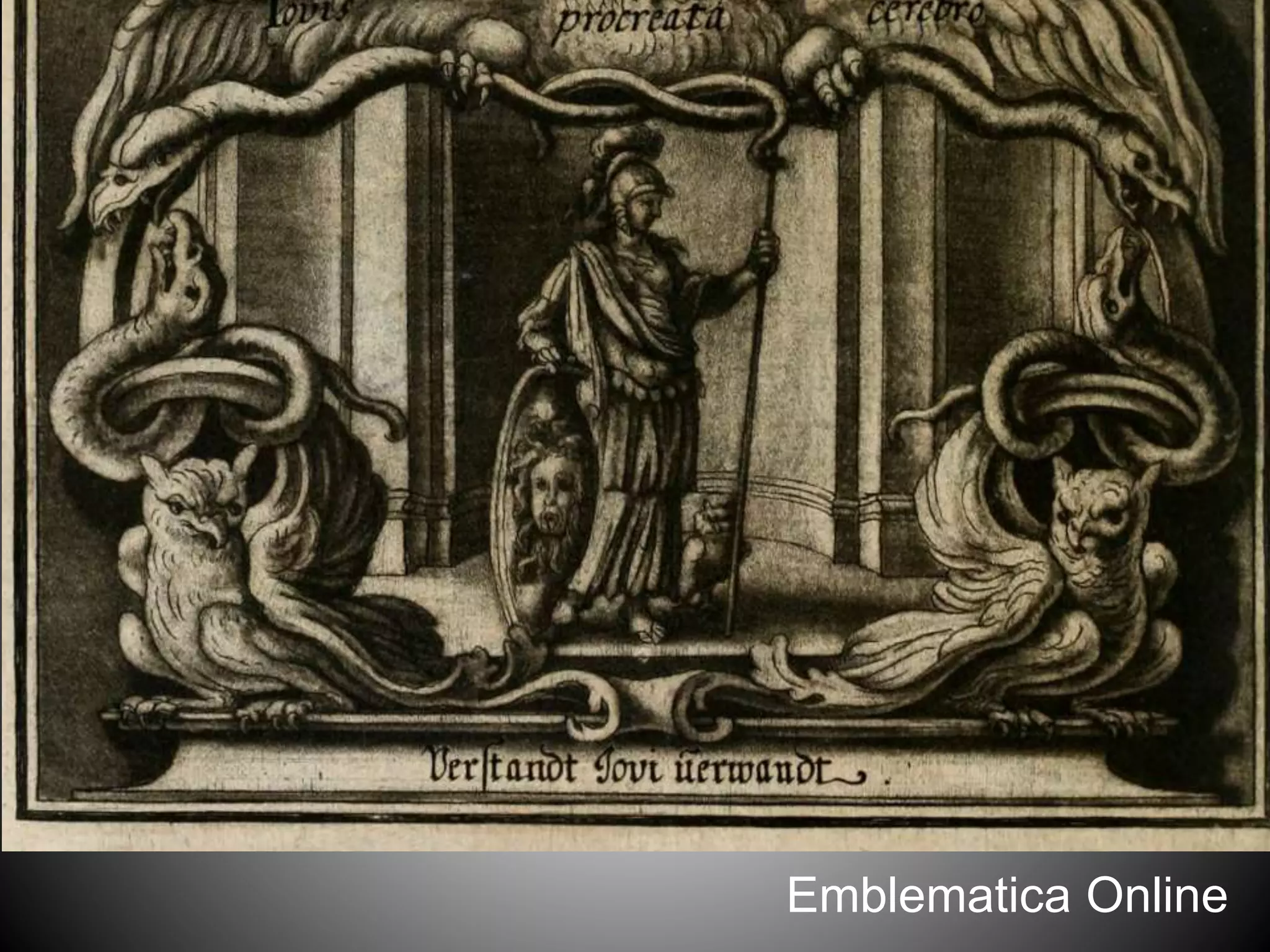
• "Verstandt Jovi verwandt," from Vortrefflich-hoch-adeliches
Controfeâe, das ist, Vollkommene...
http://hdl.handle.net/10111/EmblemRegistry:E000996
• "Paris: telescope on Eiffel Tower // Teleskop auf dem Eiffelturm” by
brongaeh, on Flickr,
https://www.flickr.com/photos/brongaeh/9933790456
• "Tunnel of black” by Shemsu.Hor, on Flickr,
https://www.flickr.com/photos/shemsu_hor/14814306629
Thank you!
Harriett Green
English and Digital Humanities Librarian
University of Illinois at Urbana-Champaign
green19@illinois.edu
Twitter: @greenharr

User Engagement with Digital Archives: A Case Study of Emblematica Online

  • 1.
    User Engagement withDigital Archives: A Case Study of Emblematica Online Harriett Green University of Illinois at Urbana- Champaign ACRL 2015 Conference March 27, 2015
  • 2.
    Today’s talk • Digitalcollections and User Engagement • Overview of Emblematica Online • Results of usability study of Emblematica • What are the future implications for humanities scholarship with digital collections? @greenharr green19@illinois.edu
  • 3.
  • 4.
    Why user studiesof digital archives? • Build digital collections strategically and sustainably for increased use among library patrons • Correlate content and functionalities to researchers’ needs • Ensure Return On Investment @greenharr green19@illinois.edu
  • 5.
    User Assessment isNecessary “While a greater reliance and dependency on digital resources is inevitable, the quality of the data and their organization and accessibility in service to teaching and scholarship are major concerns. “Without the guiding voice of scholars, the tremendous effort now being devoted to digitizing our cultural heritage could in fact impede, not facilitate, future research.” —Charles Henry, The Idea of Order: Transforming Research Collections for 21st Century Scholarship @greenharr green19@illinois.edu
  • 6.
    Digital Collections andHumanities Scholars • Brockman Palmer, et al., Scholarly Work in the Humanities and the Evolving Information Environment (CLIR Pub 104) • Our Cultural Commonwealth: The Report of the ACLS Commission on Cyberinfrastructure in the Humanities and Social Sciences • Log Analysis of Internet Resources in the Arts and Humanities Project (LAIRAH) • Ithaka S+R, Supporting the Changing Research Practices of… - Art Historians, Historians@greenharr green19@illinois.edu
  • 7.
  • 8.
    Emblematica Online • Providessingle point of access to digitized emblem books from libraries in U.S., Germany, Netherlands, UK • Funded by a NEH/DFG Bilateral Digital Humanities grant (2008) and NEH Humanities Collections and Reference Resources grant (2013) http://emblematica.library.illinois.edu @greenharr green19@illinois.edu
  • 9.
    What is anEmblem? Motto Pictura Subscriptio Peter Isselburg, Emblemata Politica, 1617 http://libsysdigi.library.uiuc.edu/OCA/B ooks2009-10/emblematapolitic00isel/ @greenharr green19@illinois.edu
  • 10.
    What’s in Emblematica? •Nearly 1400 emblem books • 23,420 individual emblems • Books digitized from the collections of the University of Illinois at Urbana-Champaign, HAB Wolfenbüttel, University of Utrecht, University of Glasgow, Duke University and the Getty Institute @greenharr green19@illinois.edu
  • 11.
  • 12.
    Goals of Study •Gain further insights into research practices of humanities scholars • Learn about behaviors of researchers working with Emblematica Online and similar specialized digital archives • Gather input to assess the new functionalities added to Emblematica Online, and determine future functionalities @greenharr green19@illinois.edu
  • 13.
    User Assessment Study Interviews •10 semi-structured interviews • Subjects: graduate students and scholars at University of Illinois, HAB Wolfenbüttel, and Society for Emblem Studies • English, art history, medieval studies, musicology, linguistics Usability Testing • 5 usability testing sessions: Protocol developed from interviews • Subjects: Graduate students and faculty members from the University of Illinois • Primarily from departments of English and Theatre@greenharr green19@illinois.edu
  • 14.
    Teaching • Emblems asan Illustrative tool for artistic styles and cultural mores • A unit on emblems for a graduate seminar on history of the animal and early modern culture“Spenser has an emblematic style in his poetry…. I think if students could be directed from those kind of moments in the poetry to emblem culture, other emblems of charity, other emblems of holiness, I think that could be a great tool.” —Faculty @greenharr green19@illinois.edu
  • 15.
    Discovery of Content •To look up specific emblems • To search for emblems on themes • Expand interdisciplinary research via new sources of content such as emblems “[Emblematica Online] could help students and researchers get across multi-lingual barriers because it is a multi-lingual tradition and visual tradition. It can also help pioneer searches that begin as visual and verbal searches.” —Faculty@greenharr green19@illinois.edu
  • 16.
    Research • Digitized emblembooks enable access to archives normally requiring expensive travel around the world • Enhance skills in early modern languages, incorporate visual culture and theory “I look at archival sources, account books, buildings, architectural treatises, musical treatises, but this is another sphere, another realm so to speak that could be used to gather more information.” —Faculty@greenharr green19@illinois.edu
  • 17.
    Scholarly Communications and Impact •Expand the use of emblems in research across multiple disciplines • Increase the impact and prominence of scholarship in emblem studies @greenharr green19@illinois.edu “I would return to the point of [Emblematica Online] not being bound by a single national tradition or a single library collection. I think that, in and of itself, may allow people to draw on a broader range of sources than they otherwise would. That can show itself in the scholarship that gets produced on the topic.”—Faculty
  • 18.
    Usability Testing Issues GOOD •Quality of scanned images • Breadth of digitized content • Easy access to the digital collection TO IMPROVE • Search Functionality • Explanation of terms and Iconclass • More Interactivity with digitized content @greenharr green19@illinois.edu
  • 19.
    Functionalities to Add •Bibliographic information on editions and multiple volumes • Annotation tool • Improve search interface with more search filter and faceting • Include background information that provides more of a historical context for the works @greenharr green19@illinois.edu
  • 20.
    Future Impact ofDigital Collections on Humanities Scholarship? • Potential to advance Interdisciplinarity in humanities scholarship • Need for user engagement • How does the digital and print complement each other? @greenharr green19@illinois.edu “When we zoomed in, that was just beautiful, and that you can see hand markings and other pencil markings that would be on there…. For me as a researcher, that matters and I loved the quality of that.” —Graduate Student
  • 21.
    Photo Credits • “Tunund Lassen, ist groß der Massen,” from Vortrefflich-Hoch- Adeliches Controfeé, http://hdl.handle.net/10111/EmblemRegistry:E001002 • “Measuring Time,” by aussiegall, on Flickr, https://www.flickr.com/photos/aussiegall/286709039 • brick detail by Grant MacDonald, on Flickr, https://www.flickr.com/photos/grantmac/2578109298 • "classroom” by Lauren Manning, on Flickr, https://www.flickr.com/photos/laurenmanning/2318943806 • "More Bildsten notebooks” by Jonas Lowgren, on Flickr, https://www.flickr.com/photos/jonas_lowgren/7406596056 • "Verstandt Jovi verwandt," from Vortrefflich-hoch-adeliches Controfeâe, das ist, Vollkommene... http://hdl.handle.net/10111/EmblemRegistry:E000996 • "Paris: telescope on Eiffel Tower // Teleskop auf dem Eiffelturm” by brongaeh, on Flickr, https://www.flickr.com/photos/brongaeh/9933790456 • "Tunnel of black” by Shemsu.Hor, on Flickr, https://www.flickr.com/photos/shemsu_hor/14814306629
  • 22.
    Thank you! Harriett Green Englishand Digital Humanities Librarian University of Illinois at Urbana-Champaign green19@illinois.edu Twitter: @greenharr

Editor's Notes

  • #2 Hello, my name is Harriett Green and today I will speak briefly about my work with the digital project Emblematica Online and my investigations into user engagement of this tool.
  • #4 But as we’re finding out more and more, it’s not enough to just create a digital collection or tool and expect users to flock to it. User engagement and assessment is key to making our innovative tools and resources actually be useful to the scholarly communities we’re trying to reach and improve our work in ways that facilitate the integration of these digital resources into scholarly research practices.
  • #8 I will now give an overview of the project: Emblematica Online
  • #9  These emblem books are contained in special collections around the world, and for a long time, the only way to find about them was this seminal but flawed bibliography by two emblem scholars. But now a number of these emblem books have been digitized to varying extents, and Emblematica Online seeks to bring these disparate collection together via a single online portal that we call the Open Emblem Portal. The project has received two NEH awards, the most recent from the NEH’s Humanities Collections and Reference Resource program. In this latest stage of Emblematica Online project, we’re working to expand the content from the digital collections of Illinois and Herzog August Bibliothek Wolfenbüttel, our original German partner, to now include digital collections from the University of Glasgow, Duke University, Utrecht, and the Getty Institute. The project also consists of work to enhance the metadata, improve the search interface, and add features such as an Annotation tool. But another critical part of this is user engagement: Emblematica Online was built as a collaboration of scholars, technologists, and librarians, and has reached an advanced stage of development and growing scholarly adoption. Yet its functionalities are still experimental, and we still are very much exploring how it provides effective access to the digitized emblems and volumes. Thus in this newest phase of the project, we examine how scholars actually use Emblematica in research and teaching. Because as we’re finding out more and more, it’s not enough to just create a digital collection or tool and expect users to flock to it. User engagement and assessment is key to making our innovative tools and resources actually be useful to the scholarly communities we’re trying to reach and improve our work in ways that facilitate the integration of these digital resources into scholarly research practices.
  • #10 What is an emblem: It’s a genre of early modern printed works emerging primarily from the 16th and 18th centuries: It comes in the form ofa tri-partite document consisting of a “motto”, which fairly self-explanatory; a pictura, or a heavily symbolic image, such as this emblem that depicts a lobster trotting with a globe on its back; and a longer “subscripto,” which is the accompanying text or an extended annotation. This is in Latin and while the subscriptio isn’t translated, the motto is “Sic orbis iter” which approximates to something like, “So the world progresses.” When you juxtapose that saying with this picture, it’s fairly cryptic and that’s the heart of why these emblem books are studied: Scholars from across disciplines study these emblem books for their rich integration of visual symbols and texts, and what they can reveal about culture, history, and intellectual thought of the period. These emblem books are contained in special collections around the world, and for a long time, the only way to find about them was this seminal but flawed bibliography by two emblem scholars.
  • #23 Thank you and I welcome any questions afterward.