Inside Plato’s Cave
Prof. Alvarado
MDST 3703
3 September 2013
Business
• For off-grounds access to Home Directory
– Use VPN (“UVa Anywhere”)
• http://its.virginia.edu/vpn/
– Or the Hive
• http://its.virginia.edu/hive
• Requires installing VMWare
• Create a virtual Windows desktop for Mac users
• For studio
– Classroom OK
– Bring laptops with power
Business
• Regarding Comments
– Deadline is 5, but turn in anyway if late
– There is some wiggle room, but the risk you take
after 5 is that there is no guarantee I will read it
• Reading formats
– I often provide multiple formats for the same text
– When possible, I will provide readings in EPUB
format
Review
“Programming is about choices and constraints,
and about how you choose to model some
select slice of the world around you in the
formal environment of a computer. This idea of
modeling is vital, and what I think was missing
from those early undergraduate courses I took.
If only someone had told me I wasn't learning to
manage a hardware store, I was learning to build
models.”
Kirshenbaum, “Hello Worlds”
What did we model in studio?
So, computers are media for the
representation of “worlds”
Programming is more about
creating models than it is about
“computation” per se
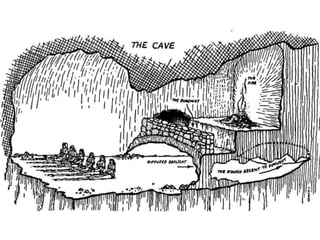
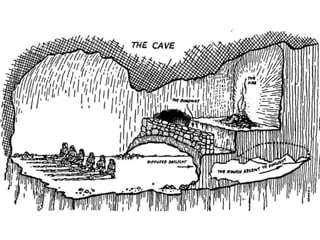
―Behold! human beings living in an underground
den, which has a mouth open towards the light
and reaching all along the den; here they have
been from their childhood, and have their legs and
necks chained so that they cannot move, and can
only see before them, being prevented by the
chains from turning round their heads. Above and
behind them a fire is blazing at a distance, and
between the fire and the prisoners there is a
raised way; and you will see, if you look, a low wall
built along the way, like the screen which
marionette players have in front of them, over
which they show the puppets.‖
Plato, The Republic, Book VII, Paragraph 1
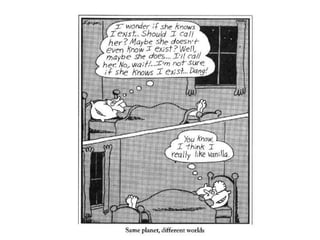
What does this remind you of?
Plato’s cave is a metaphor of the unknown and
ignorance.
Plato’s cave illustrates that reality is personal and contextual.

The nature of any person’s reality is such that it is
fabricated in their own head from electronic signals
relaying information gathered from imperfect sensory
equipment.
The freed prisoner’s emergence from the dark into the
light reminds me of myself leaving a small rural town for
UVa.
Plato’s cave ultimately seems to be about the effects of education,
specifically higher education, in our lives and society.
Plato’s cave reminds me of how people sometimes react to new
developments in technology.
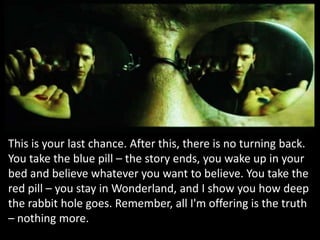
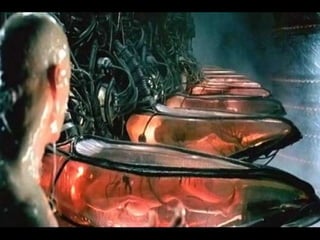
But what does the image of the
cave itself remind you of?
What does the apparatus
remind you of?
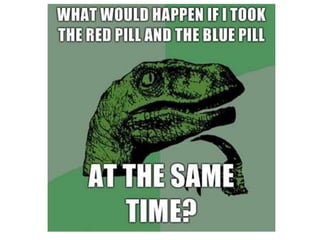
This is your last chance. After this, there is no turning back.
You take the blue pill – the story ends, you wake up in your
bed and believe whatever you want to believe. You take the
red pill – you stay in Wonderland, and I show you how deep
the rabbit hole goes. Remember, all I'm offering is the truth
– nothing more.
If the cave is an allegory, what do
the parts map onto?
Shadows, Fire, Puppets
Slaves, Puppeteers
The Sun, above ground …
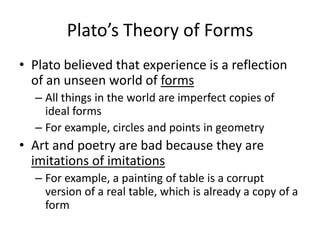
Plato’s Theory of Forms
• Plato believed that experience is a reflection
of an unseen world of forms
– All things in the world are imperfect copies of
ideal forms
– For example, circles and points in geometry
• Art and poetry are bad because they are
imitations of imitations
– For example, a painting of table is a corrupt
version of a real table, which is already a copy of a
form
“Beds, then, are of three kinds, and
there are three artists who
superintend them: God, the maker
of the bed, and the painter.”
Plato, The Republic, Book X
The model of knowledge for Plato
appears to have been geometry
Instead of poets and artists, the good
society should have mathematicians
and philosophers
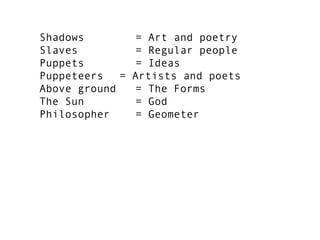
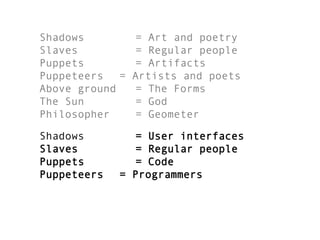
Shadows = Art and poetry
Slaves = Regular people
Puppets = Ideas
Puppeteers = Artists and poets
Above ground = The Forms
The Sun = God
Philosopher = Geometer
Shadows = Art and poetry
Slaves = Regular people
Puppets = Artifacts
Puppeteers = Artists and poets
Above ground = The Forms
The Sun = God
Philosopher = Geometer
Shadows = User interfaces
Slaves = Regular people
Puppets = Code
Puppeteers = Programmers
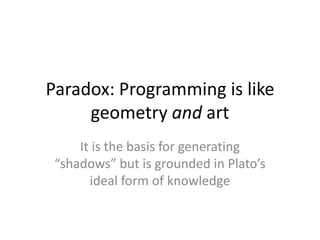
Paradox: Programming is like
geometry and art
It is the basis for generating
“shadows” but is grounded in Plato’s
ideal form of knowledge
Enter Aristotle
Aristotle’s Poetics
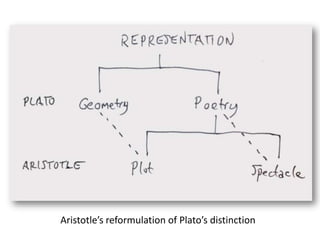
• A response to Plato’s challenge at the end of
The Republic for someone to defend poetry
• “Poetry” includes the arts of imitation
• Aristotle argues that all knowledge is based on
imitation (even geometry)
• The Poetics shows how and what drama
imitates
The Poetics can be read as the
first essay in media studies
It situates drama within the entire field
of “modes of imitation” and defines
them by medium, object, and manner
A key move in the text is to
define poetry not as text that
rhymes but text that imitates
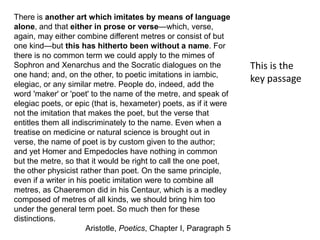
There is another art which imitates by means of language
alone, and that either in prose or verse—which, verse,
again, may either combine different metres or consist of but
one kind—but this has hitherto been without a name. For
there is no common term we could apply to the mimes of
Sophron and Xenarchus and the Socratic dialogues on the
one hand; and, on the other, to poetic imitations in iambic,
elegiac, or any similar metre. People do, indeed, add the
word 'maker' or 'poet' to the name of the metre, and speak of
elegiac poets, or epic (that is, hexameter) poets, as if it were
not the imitation that makes the poet, but the verse that
entitles them all indiscriminately to the name. Even when a
treatise on medicine or natural science is brought out in
verse, the name of poet is by custom given to the author;
and yet Homer and Empedocles have nothing in common
but the metre, so that it would be right to call the one poet,
the other physicist rather than poet. On the same principle,
even if a writer in his poetic imitation were to combine all
metres, as Chaeremon did in his Centaur, which is a medley
composed of metres of all kinds, we should bring him too
under the general term poet. So much then for these
distinctions.
Aristotle, Poetics, Chapter I, Paragraph 5
This is the
key passage
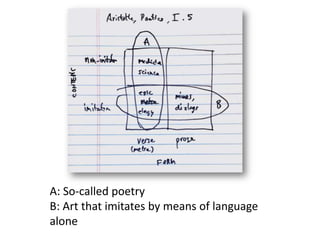
A: So-called poetry
B: Art that imitates by means of language
alone
Focus of the Poetics
• Aristotle is concerned to explain tragedy
– Part of a larger work that included comedy, now
lost (and the basis for the book, The Name of the
Rose)
• Aristotle always locates his subject in a
hierarchy (“the order of nature”)
– Imitation  “Art without a name”  Drama 
Tragedy
• Tragedy was a high form of art for the Greeks
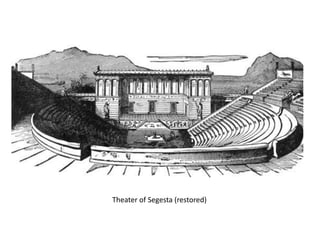
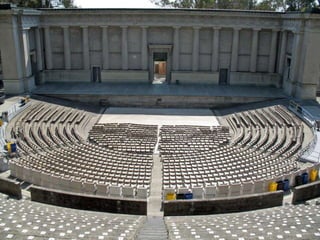
Theater of Segesta (restored)
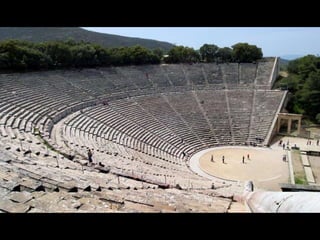
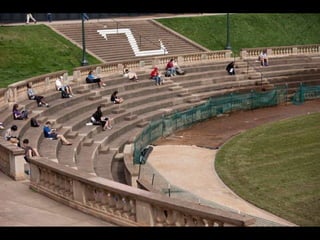
What do these images remind
you of?
(Which we just discussed)
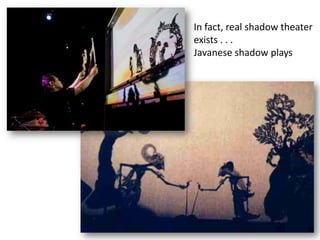
In fact, real shadow theater
exists . . .
Javanese shadow plays
So what, then, does drama
imitate?
i.e. what is really going on in the
Cave?
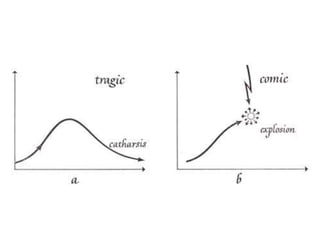
Tragedy . . . is an imitation of an action that is
serious, complete, and of a certain magnitude;
in language embellished with each kind of
artistic ornament, the several kinds being found
in separate parts of the play; in the form of
action, not of narrative; through pity and fear
effecting the proper purgation of these
emotions.
Aristotle, Poetics, Chapter VI, Paragraph 2
What is action?
“Action” is for Aristotle the way
people behave, the way events
unfold in life
It is closely tied to the concepts of
“probability” and “possibility”
These terms refer to the cultural
logic that governs social life
What are the parts of a tragedy?
What are the devices used to
represent action?
Aristotle Identifies 7 Elements
1. Plot – the sequence of events
2. Character – the people and their natures
3. Thought – the ideas expressed in the drama
4. Diction – the language used
5. Song – the accompanying music
6. Spectacle – the set, stage craft, special effects
What is least important?
Spectacle
What does Aristotle consider to be
the most important part of tragedy?
Plot is the “soul of tragedy”
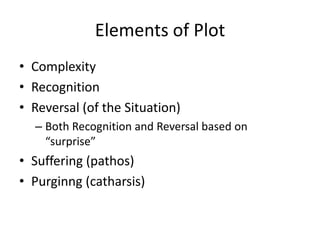
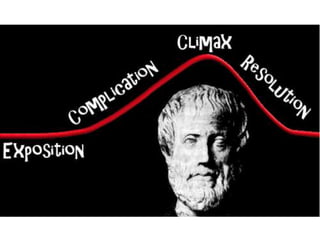
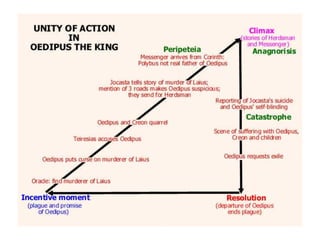
What are the parts of plot?
Elements of Plot
• Complexity
• Recognition
• Reversal (of the Situation)
– Both Recognition and Reversal based on
“surprise”
• Suffering (pathos)
• Purginng (catharsis)
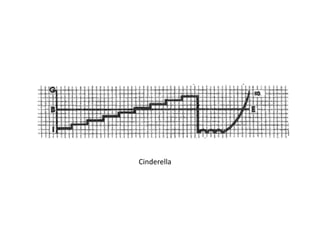
Cinderella
Aristotle’s reformulation of Plato’s distinction
Where does code fit in?
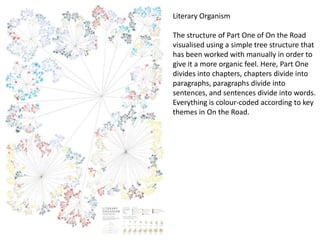
Literary Organism
The structure of Part One of On the Road
visualised using a simple tree structure that
has been worked with manually in order to
give it a more organic feel. Here, Part One
divides into chapters, chapters divide into
paragraphs, paragraphs divide into
sentences, and sentences divide into words.
Everything is colour-coded according to key
themes in On the Road.

Mdst3703 2013-09-03-plato2

  • 1.
    Inside Plato’s Cave Prof.Alvarado MDST 3703 3 September 2013
  • 2.
    Business • For off-groundsaccess to Home Directory – Use VPN (“UVa Anywhere”) • http://its.virginia.edu/vpn/ – Or the Hive • http://its.virginia.edu/hive • Requires installing VMWare • Create a virtual Windows desktop for Mac users • For studio – Classroom OK – Bring laptops with power
  • 3.
    Business • Regarding Comments –Deadline is 5, but turn in anyway if late – There is some wiggle room, but the risk you take after 5 is that there is no guarantee I will read it • Reading formats – I often provide multiple formats for the same text – When possible, I will provide readings in EPUB format
  • 4.
  • 5.
    “Programming is aboutchoices and constraints, and about how you choose to model some select slice of the world around you in the formal environment of a computer. This idea of modeling is vital, and what I think was missing from those early undergraduate courses I took. If only someone had told me I wasn't learning to manage a hardware store, I was learning to build models.” Kirshenbaum, “Hello Worlds” What did we model in studio?
  • 6.
    So, computers aremedia for the representation of “worlds” Programming is more about creating models than it is about “computation” per se
  • 9.
    ―Behold! human beingsliving in an underground den, which has a mouth open towards the light and reaching all along the den; here they have been from their childhood, and have their legs and necks chained so that they cannot move, and can only see before them, being prevented by the chains from turning round their heads. Above and behind them a fire is blazing at a distance, and between the fire and the prisoners there is a raised way; and you will see, if you look, a low wall built along the way, like the screen which marionette players have in front of them, over which they show the puppets.‖ Plato, The Republic, Book VII, Paragraph 1 What does this remind you of?
  • 10.
    Plato’s cave isa metaphor of the unknown and ignorance. Plato’s cave illustrates that reality is personal and contextual. The nature of any person’s reality is such that it is fabricated in their own head from electronic signals relaying information gathered from imperfect sensory equipment. The freed prisoner’s emergence from the dark into the light reminds me of myself leaving a small rural town for UVa. Plato’s cave ultimately seems to be about the effects of education, specifically higher education, in our lives and society. Plato’s cave reminds me of how people sometimes react to new developments in technology.
  • 11.
    But what doesthe image of the cave itself remind you of? What does the apparatus remind you of?
  • 15.
    This is yourlast chance. After this, there is no turning back. You take the blue pill – the story ends, you wake up in your bed and believe whatever you want to believe. You take the red pill – you stay in Wonderland, and I show you how deep the rabbit hole goes. Remember, all I'm offering is the truth – nothing more.
  • 17.
    If the caveis an allegory, what do the parts map onto? Shadows, Fire, Puppets Slaves, Puppeteers The Sun, above ground …
  • 18.
    Plato’s Theory ofForms • Plato believed that experience is a reflection of an unseen world of forms – All things in the world are imperfect copies of ideal forms – For example, circles and points in geometry • Art and poetry are bad because they are imitations of imitations – For example, a painting of table is a corrupt version of a real table, which is already a copy of a form
  • 19.
    “Beds, then, areof three kinds, and there are three artists who superintend them: God, the maker of the bed, and the painter.” Plato, The Republic, Book X
  • 20.
    The model ofknowledge for Plato appears to have been geometry Instead of poets and artists, the good society should have mathematicians and philosophers
  • 21.
    Shadows = Artand poetry Slaves = Regular people Puppets = Ideas Puppeteers = Artists and poets Above ground = The Forms The Sun = God Philosopher = Geometer
  • 22.
    Shadows = Artand poetry Slaves = Regular people Puppets = Artifacts Puppeteers = Artists and poets Above ground = The Forms The Sun = God Philosopher = Geometer Shadows = User interfaces Slaves = Regular people Puppets = Code Puppeteers = Programmers
  • 23.
    Paradox: Programming islike geometry and art It is the basis for generating “shadows” but is grounded in Plato’s ideal form of knowledge
  • 25.
  • 29.
    Aristotle’s Poetics • Aresponse to Plato’s challenge at the end of The Republic for someone to defend poetry • “Poetry” includes the arts of imitation • Aristotle argues that all knowledge is based on imitation (even geometry) • The Poetics shows how and what drama imitates
  • 30.
    The Poetics canbe read as the first essay in media studies It situates drama within the entire field of “modes of imitation” and defines them by medium, object, and manner
  • 31.
    A key movein the text is to define poetry not as text that rhymes but text that imitates
  • 32.
    There is anotherart which imitates by means of language alone, and that either in prose or verse—which, verse, again, may either combine different metres or consist of but one kind—but this has hitherto been without a name. For there is no common term we could apply to the mimes of Sophron and Xenarchus and the Socratic dialogues on the one hand; and, on the other, to poetic imitations in iambic, elegiac, or any similar metre. People do, indeed, add the word 'maker' or 'poet' to the name of the metre, and speak of elegiac poets, or epic (that is, hexameter) poets, as if it were not the imitation that makes the poet, but the verse that entitles them all indiscriminately to the name. Even when a treatise on medicine or natural science is brought out in verse, the name of poet is by custom given to the author; and yet Homer and Empedocles have nothing in common but the metre, so that it would be right to call the one poet, the other physicist rather than poet. On the same principle, even if a writer in his poetic imitation were to combine all metres, as Chaeremon did in his Centaur, which is a medley composed of metres of all kinds, we should bring him too under the general term poet. So much then for these distinctions. Aristotle, Poetics, Chapter I, Paragraph 5 This is the key passage
  • 33.
    A: So-called poetry B:Art that imitates by means of language alone
  • 34.
    Focus of thePoetics • Aristotle is concerned to explain tragedy – Part of a larger work that included comedy, now lost (and the basis for the book, The Name of the Rose) • Aristotle always locates his subject in a hierarchy (“the order of nature”) – Imitation  “Art without a name”  Drama  Tragedy • Tragedy was a high form of art for the Greeks
  • 37.
  • 39.
    What do theseimages remind you of? (Which we just discussed)
  • 41.
    In fact, realshadow theater exists . . . Javanese shadow plays
  • 42.
    So what, then,does drama imitate? i.e. what is really going on in the Cave?
  • 43.
    Tragedy . .. is an imitation of an action that is serious, complete, and of a certain magnitude; in language embellished with each kind of artistic ornament, the several kinds being found in separate parts of the play; in the form of action, not of narrative; through pity and fear effecting the proper purgation of these emotions. Aristotle, Poetics, Chapter VI, Paragraph 2
  • 44.
  • 45.
    “Action” is forAristotle the way people behave, the way events unfold in life It is closely tied to the concepts of “probability” and “possibility” These terms refer to the cultural logic that governs social life
  • 46.
    What are theparts of a tragedy? What are the devices used to represent action?
  • 47.
    Aristotle Identifies 7Elements 1. Plot – the sequence of events 2. Character – the people and their natures 3. Thought – the ideas expressed in the drama 4. Diction – the language used 5. Song – the accompanying music 6. Spectacle – the set, stage craft, special effects
  • 48.
    What is leastimportant?
  • 49.
  • 50.
    What does Aristotleconsider to be the most important part of tragedy?
  • 51.
    Plot is the“soul of tragedy”
  • 52.
    What are theparts of plot?
  • 53.
    Elements of Plot •Complexity • Recognition • Reversal (of the Situation) – Both Recognition and Reversal based on “surprise” • Suffering (pathos) • Purginng (catharsis)
  • 57.
  • 58.
    Aristotle’s reformulation ofPlato’s distinction
  • 59.
  • 60.
    Literary Organism The structureof Part One of On the Road visualised using a simple tree structure that has been worked with manually in order to give it a more organic feel. Here, Part One divides into chapters, chapters divide into paragraphs, paragraphs divide into sentences, and sentences divide into words. Everything is colour-coded according to key themes in On the Road.

Editor's Notes

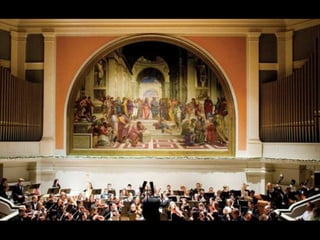
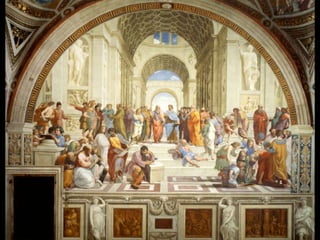
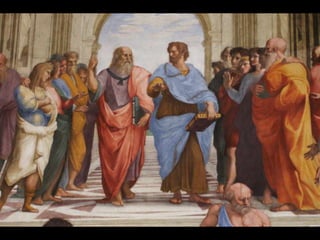
  • #28 The School of Athens, or Scuola di Atene in Italian, is one of the most famous frescoes by the Italian Renaissance artist Raphael. It was painted between 1509 and 1511 as a part of Raphael's commission to decorate with frescoes the rooms now known as the Stanze di Raffaello, in the Apostolic Palace in the Vatican. The Stanza dellaSegnatura was the first of the rooms to be decorated, and The School of Athens the second painting to be finished there, after La Disputa, on the opposite wall. The picture has long been seen as "Raphael's masterpiece and the perfect embodiment of the classical spirit of the High Renaissance.”https://en.wikipedia.org/wiki/The_School_of_Athens
  • #37 UVA
  • #39 Berkeley
  • #46 DWELL ON THIS – GIVE EXAMPLES FROM LITERATURE …
  • #57 http://www.brainpickings.org/index.php/2013/05/20/arthur-koestler-creativity-bisociation/?utm_source=buffer&utm_campaign=Buffer&utm_content=bufferd8014&utm_medium=twitter
  • #58 http://www.lonegunman.co.uk/2011/06/16/vonnegut-narrative-arcs-and-why-we-love-drama/
  • #61 http://www.itsbeenreal.co.uk/index.php?/wwwords/literary-organism/