From Data Structures to Databases

          Prof. Alvarado
            MDST 3703
         5 February 2013
Business
• Quiz 1
  – To be posted this evening
  – Due Thursday evening
  – Covers content before Databases
  – End-of-week reflections still due
• Blogging
  – Please remember to be timely
• Safari Resources
  – If you can‟t access, try going through the
    Library page
Review
• Building as knowing
  – Ramsay‟s point in “On Building”
• DH as cultural reverse engineering
  – Finding the rules in the patterns
  – Texts and images are the patterns in
    question
• Reverse engineering is like building
  – Same process in reverse (deconstruction)
  – Also requires building other things – like
    databases to store stuff
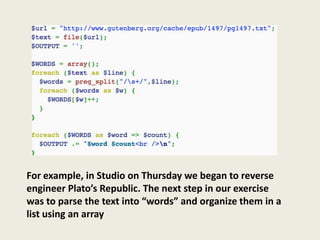
For example, in Studio on Thursday we began to reverse
engineer Plato’s Republic. The next step in our exercise
was to parse the text into “words” and organize them in a
list using an array
By the way, were we actually
      grabbing words?
Not really – we were find substrings,
 letter patterns that could also exist
     within words (e.g. “cavern”)

   Also, these patterns did not match
synonyms or pronouns (e.g. “this”) that
stand for the same thing as the word in
                question

This is the difference between SYNTAX
            and SEMANTICS
Syntax = sequences of signs
    Semantics = meanings of signs

Semantics is much harder for computers
         to grasp than syntax

  In fact, some think that semantics is
beyond the capacity of any computer …
Getting back to PHP
We can use arrays to model the text. So,
within a FOREACH loop iterating through
the lines of a text and parsing each line for
“words,” we could do the following:

  $words[$word]++;
  $words[] = $word;
  $lines[$lineNumber][] = $word;


Each method suggests a different model
More about PHP Arrays
• Arrays can be added to like so:
  $myArray[] = $newItem;
• Arrays can also use strings instead of
  number as indices, e.g.
  $myArray[3] = „foo‟;
  $myArray[„person‟] = „Bob‟;
• Array items may also point to arrays,
  creating multidimensional arrays
  $myArray[„person‟] = array();
  $myArray[„person‟][„Bob‟] = $something;
Arrays with string indices are called
    “associative arrays” in PHP

Arrays of arrays can be used to create
 data structures like trees and grids
Read Chapter 5 of PHP: The
Good Parts to learn more
about arrays (see link in
Resources on the course blog)

Also, the PHP manual is always
a good place to look
http://php.net/manual/en/language.types.array.php
Arrays as Data Structures
• PHP arrays can be used to create data
  structures to model things, like texts, e.g.
  $words[$word]++;
  $words[] = $word;
  $lines[$lineNumber][] = $word;
• These three create the following
  1. A simple list of word types (and their
     counts)
  2. A list of each word in order (position and
     word)
  3. A grid of line numbers and words
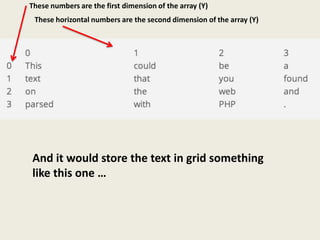
Here is an example of how we would create
the third kind of data structure. This would
store a grid of words.
These numbers are the first dimension of the array (Y)
 These horizontal numbers are the second dimension of the array (Y)


And it would store the text in grid something
like this one …
In this model, a text is a grid of words,
    each with an X and Y coordinate

Is this the only way to represent a text?

        Is it the most accurate?
Texts can also be represented as trees
Document Elements and Structures

Play                 – Heading
  – Act +              • Return Address
       • Scene +       • Date
          – Line +     • Recipient Info
                          – Name
Book                      – Title
  – Chapter +             – Address
       • Verse +     – Content
                       • Salutation
                       • Paragraph +
                       • Closing

Letter
XML is designed to represent text
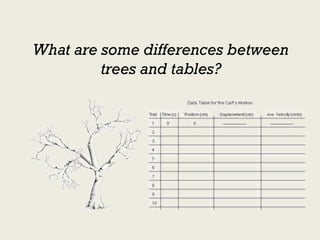
What are some differences between
         trees and tables?
Tables are more rigid
  Trees allow for indefinite depth

 But tables are easier to manipulate

In any case, tables and trees are two
major kinds of data structure that you
         will encounter …
Speaking of trees …
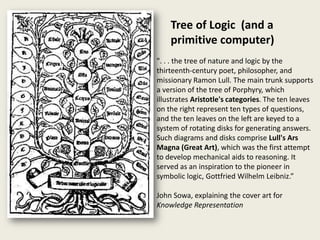
what is this?
Tree of Logic (and a
    primitive computer)
". . . the tree of nature and logic by the
thirteenth-century poet, philosopher, and
missionary Ramon Lull. The main trunk supports
a version of the tree of Porphyry, which
illustrates Aristotle's categories. The ten leaves
on the right represent ten types of questions,
and the ten leaves on the left are keyed to a
system of rotating disks for generating answers.
Such diagrams and disks comprise Lull's Ars
Magna (Great Art), which was the first attempt
to develop mechanical aids to reasoning. It
served as an inspiration to the pioneer in
symbolic logic, Gottfried Wilhelm Leibniz.”

John Sowa, explaining the cover art for
Knowledge Representation
What is this tree an example of?
The tree is a “knowledge
  representation” (KR)
A KR is a model that comprises
1. A set of categories (aka Ontology)
  Names and relationships between names
2. A set of inference rules (aka Logic)
  A method of traversing names and relations
3. A medium for computation
  A medium for producing inferences
4. A language for expressing these things
  Such as a programming or markup language
Ontologies are systems of
categories rooted in world
views
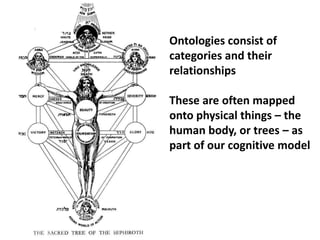
Ontologies consist of
categories and their
relationships

These are often mapped
onto physical things – the
human body, or trees – as
part of our cognitive model
The tree as body as society among the Umeda of New Guinea
Logic is a name for the systematic
unpacking ontologies in discourse …
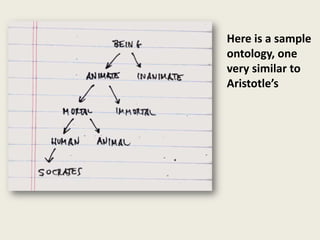
Here is a sample
ontology, one
very similar to
Aristotle’s
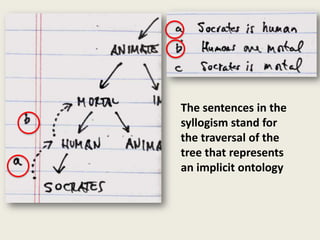
And this is a syllogism, the basic unit of
reasoning in classical logic

            How is it related to the tree?
The sentences in the
syllogism stand for
the traversal of the
tree that represents
an implicit ontology
Reasoning always implies an ontology

   Ontologies are often unexpressed

Ontologies often conflict with each other

(Digital) Humanists excavate or reverse
       engineer these ontologies
Now, a KR for a computer has to be
      an operationalized KR

How would we express a syllogism
           in PHP?
One way is to convert
the tree into an array
But, given such an array, how can we find out if
                  Socrates is mortal?

         How do we find if the following is set:
0           1           2           3              4
We’d have to some some complicated nested looping to
find the answer …
So, PHP gives us tools to create an
  ontology, but not a way to reason
        efficiently with them

To create more effective KRs, we need
      the services of a database
A database is a “a system that allows for
  the efficient storage and retrieval of
              information”

  But beyond this, it also allows us to
       “represent knowledge”

Given Unsworth‟s definition, how must it
              do this?
Databases provide a language to define
  ontologies (schema) and to “unpack”
these ontologies – via a query language
    that lets us efficiently search and
     retrieve data organized schema
In this course, we are going to use a
relational database to store and access
               information

 Relational databases use a language
             known as SQL

(pronounced S-Q-L, although some say
             “sequel”)
SQL
• SQL stands for “Structured Query
  Language”
  – NOT invented by Microsoft
• Invented in the 1970s and
  commercialized in the 1980s
  – Probably responsible for new business
    models like JIT inventories
• Built on Codd‟s relational model (1970)
  – Implements set theory and formal logic
  – Around the time of SGML
SQL
• A language used by relational databases
  – Oracle, SQL Server, Access, etc.
MySQL
• A very fast, simplified, and easy to use
  relational database
• A client/server app
  – Runs on the internet
  – Not a desktop app like Access
• Created by Monty Widenius in the mid
  1990s
  – Open Source
  – A Finn living in Sweden
  – Same time as PHP
• Powered the Web 2.0 revolution
phpMyAdmin
• A PHP interface to MySQL
• Relatively easy to use
  – No need to know SQL
• Great to manage databases that your PHP
  programs will use
• Today you will get started using UVA‟s
  free MySQL server
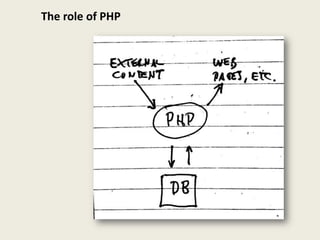
The role of PHP

Mdst3705 2013-02-05-databases

  • 1.
    From Data Structuresto Databases Prof. Alvarado MDST 3703 5 February 2013
  • 2.
    Business • Quiz 1 – To be posted this evening – Due Thursday evening – Covers content before Databases – End-of-week reflections still due • Blogging – Please remember to be timely • Safari Resources – If you can‟t access, try going through the Library page
  • 3.
    Review • Building asknowing – Ramsay‟s point in “On Building” • DH as cultural reverse engineering – Finding the rules in the patterns – Texts and images are the patterns in question • Reverse engineering is like building – Same process in reverse (deconstruction) – Also requires building other things – like databases to store stuff
  • 4.
    For example, inStudio on Thursday we began to reverse engineer Plato’s Republic. The next step in our exercise was to parse the text into “words” and organize them in a list using an array
  • 5.
    By the way,were we actually grabbing words?
  • 6.
    Not really –we were find substrings, letter patterns that could also exist within words (e.g. “cavern”) Also, these patterns did not match synonyms or pronouns (e.g. “this”) that stand for the same thing as the word in question This is the difference between SYNTAX and SEMANTICS
  • 7.
    Syntax = sequencesof signs Semantics = meanings of signs Semantics is much harder for computers to grasp than syntax In fact, some think that semantics is beyond the capacity of any computer …
  • 8.
    Getting back toPHP We can use arrays to model the text. So, within a FOREACH loop iterating through the lines of a text and parsing each line for “words,” we could do the following: $words[$word]++; $words[] = $word; $lines[$lineNumber][] = $word; Each method suggests a different model
  • 9.
    More about PHPArrays • Arrays can be added to like so: $myArray[] = $newItem; • Arrays can also use strings instead of number as indices, e.g. $myArray[3] = „foo‟; $myArray[„person‟] = „Bob‟; • Array items may also point to arrays, creating multidimensional arrays $myArray[„person‟] = array(); $myArray[„person‟][„Bob‟] = $something;
  • 10.
    Arrays with stringindices are called “associative arrays” in PHP Arrays of arrays can be used to create data structures like trees and grids
  • 11.
    Read Chapter 5of PHP: The Good Parts to learn more about arrays (see link in Resources on the course blog) Also, the PHP manual is always a good place to look http://php.net/manual/en/language.types.array.php
  • 12.
    Arrays as DataStructures • PHP arrays can be used to create data structures to model things, like texts, e.g. $words[$word]++; $words[] = $word; $lines[$lineNumber][] = $word; • These three create the following 1. A simple list of word types (and their counts) 2. A list of each word in order (position and word) 3. A grid of line numbers and words
  • 13.
    Here is anexample of how we would create the third kind of data structure. This would store a grid of words.
  • 14.
    These numbers arethe first dimension of the array (Y) These horizontal numbers are the second dimension of the array (Y) And it would store the text in grid something like this one …
  • 15.
    In this model,a text is a grid of words, each with an X and Y coordinate Is this the only way to represent a text? Is it the most accurate?
  • 16.
    Texts can alsobe represented as trees
  • 17.
    Document Elements andStructures Play – Heading – Act + • Return Address • Scene + • Date – Line + • Recipient Info – Name Book – Title – Chapter + – Address • Verse + – Content • Salutation • Paragraph + • Closing Letter
  • 18.
    XML is designedto represent text
  • 19.
    What are somedifferences between trees and tables?
  • 20.
    Tables are morerigid Trees allow for indefinite depth But tables are easier to manipulate In any case, tables and trees are two major kinds of data structure that you will encounter …
  • 21.
    Speaking of trees… what is this?
  • 22.
    Tree of Logic(and a primitive computer) ". . . the tree of nature and logic by the thirteenth-century poet, philosopher, and missionary Ramon Lull. The main trunk supports a version of the tree of Porphyry, which illustrates Aristotle's categories. The ten leaves on the right represent ten types of questions, and the ten leaves on the left are keyed to a system of rotating disks for generating answers. Such diagrams and disks comprise Lull's Ars Magna (Great Art), which was the first attempt to develop mechanical aids to reasoning. It served as an inspiration to the pioneer in symbolic logic, Gottfried Wilhelm Leibniz.” John Sowa, explaining the cover art for Knowledge Representation
  • 25.
    What is thistree an example of?
  • 26.
    The tree isa “knowledge representation” (KR)
  • 27.
    A KR isa model that comprises 1. A set of categories (aka Ontology) Names and relationships between names 2. A set of inference rules (aka Logic) A method of traversing names and relations 3. A medium for computation A medium for producing inferences 4. A language for expressing these things Such as a programming or markup language
  • 28.
    Ontologies are systemsof categories rooted in world views
  • 29.
    Ontologies consist of categoriesand their relationships These are often mapped onto physical things – the human body, or trees – as part of our cognitive model
  • 30.
    The tree asbody as society among the Umeda of New Guinea
  • 31.
    Logic is aname for the systematic unpacking ontologies in discourse …
  • 32.
    Here is asample ontology, one very similar to Aristotle’s
  • 33.
    And this isa syllogism, the basic unit of reasoning in classical logic How is it related to the tree?
  • 34.
    The sentences inthe syllogism stand for the traversal of the tree that represents an implicit ontology
  • 35.
    Reasoning always impliesan ontology Ontologies are often unexpressed Ontologies often conflict with each other (Digital) Humanists excavate or reverse engineer these ontologies
  • 36.
    Now, a KRfor a computer has to be an operationalized KR How would we express a syllogism in PHP?
  • 37.
    One way isto convert the tree into an array
  • 38.
    But, given suchan array, how can we find out if Socrates is mortal? How do we find if the following is set: 0 1 2 3 4
  • 39.
    We’d have tosome some complicated nested looping to find the answer …
  • 40.
    So, PHP givesus tools to create an ontology, but not a way to reason efficiently with them To create more effective KRs, we need the services of a database
  • 41.
    A database isa “a system that allows for the efficient storage and retrieval of information” But beyond this, it also allows us to “represent knowledge” Given Unsworth‟s definition, how must it do this?
  • 42.
    Databases provide alanguage to define ontologies (schema) and to “unpack” these ontologies – via a query language that lets us efficiently search and retrieve data organized schema
  • 43.
    In this course,we are going to use a relational database to store and access information Relational databases use a language known as SQL (pronounced S-Q-L, although some say “sequel”)
  • 44.
    SQL • SQL standsfor “Structured Query Language” – NOT invented by Microsoft • Invented in the 1970s and commercialized in the 1980s – Probably responsible for new business models like JIT inventories • Built on Codd‟s relational model (1970) – Implements set theory and formal logic – Around the time of SGML
  • 45.
    SQL • A languageused by relational databases – Oracle, SQL Server, Access, etc.
  • 46.
    MySQL • A veryfast, simplified, and easy to use relational database • A client/server app – Runs on the internet – Not a desktop app like Access • Created by Monty Widenius in the mid 1990s – Open Source – A Finn living in Sweden – Same time as PHP • Powered the Web 2.0 revolution
  • 47.
    phpMyAdmin • A PHPinterface to MySQL • Relatively easy to use – No need to know SQL • Great to manage databases that your PHP programs will use • Today you will get started using UVA‟s free MySQL server
  • 48.

Editor's Notes

  • #17 (theoretically)
  • #22 Let’s look at another tree
  • #23 Let’s look at another tree