>>> Back to index
Market Potential for Small Scale LNG Distribution
and Use in Asia
IN Information Day / Norshipping
6th June 2013 Oslo
Egil Rensvik
Science & Technology Counsellor
Royal Norwegian Embassy Singapore
Innovation Norway - South & SouthEast Asia
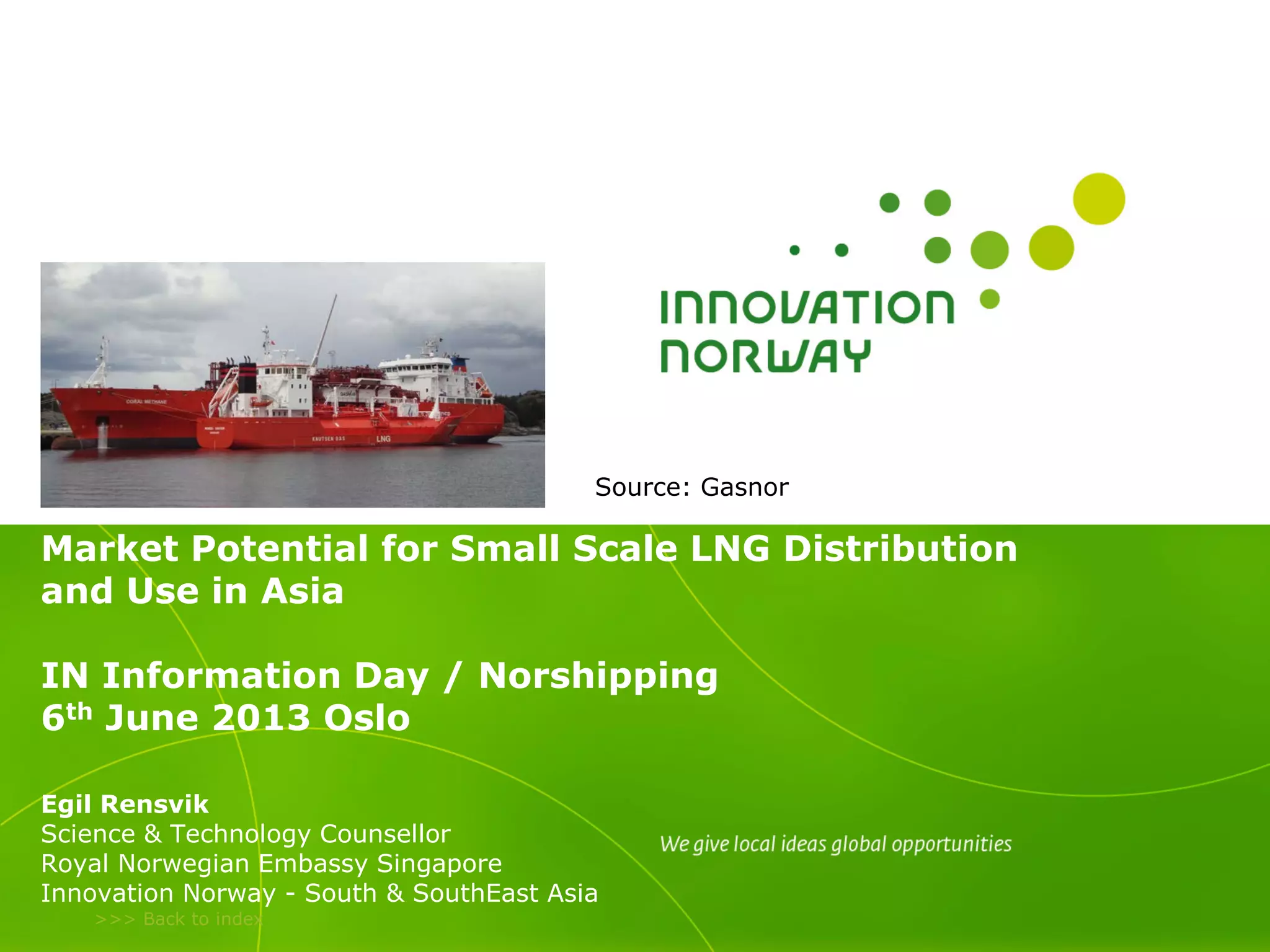
Source: Gasnor
>>> Back to index>>> Back to index
Asia
2
India
Vietnam
Indonesia
Singapore
UAE
South
Korea
China
Japan
Thailand
Malaysia
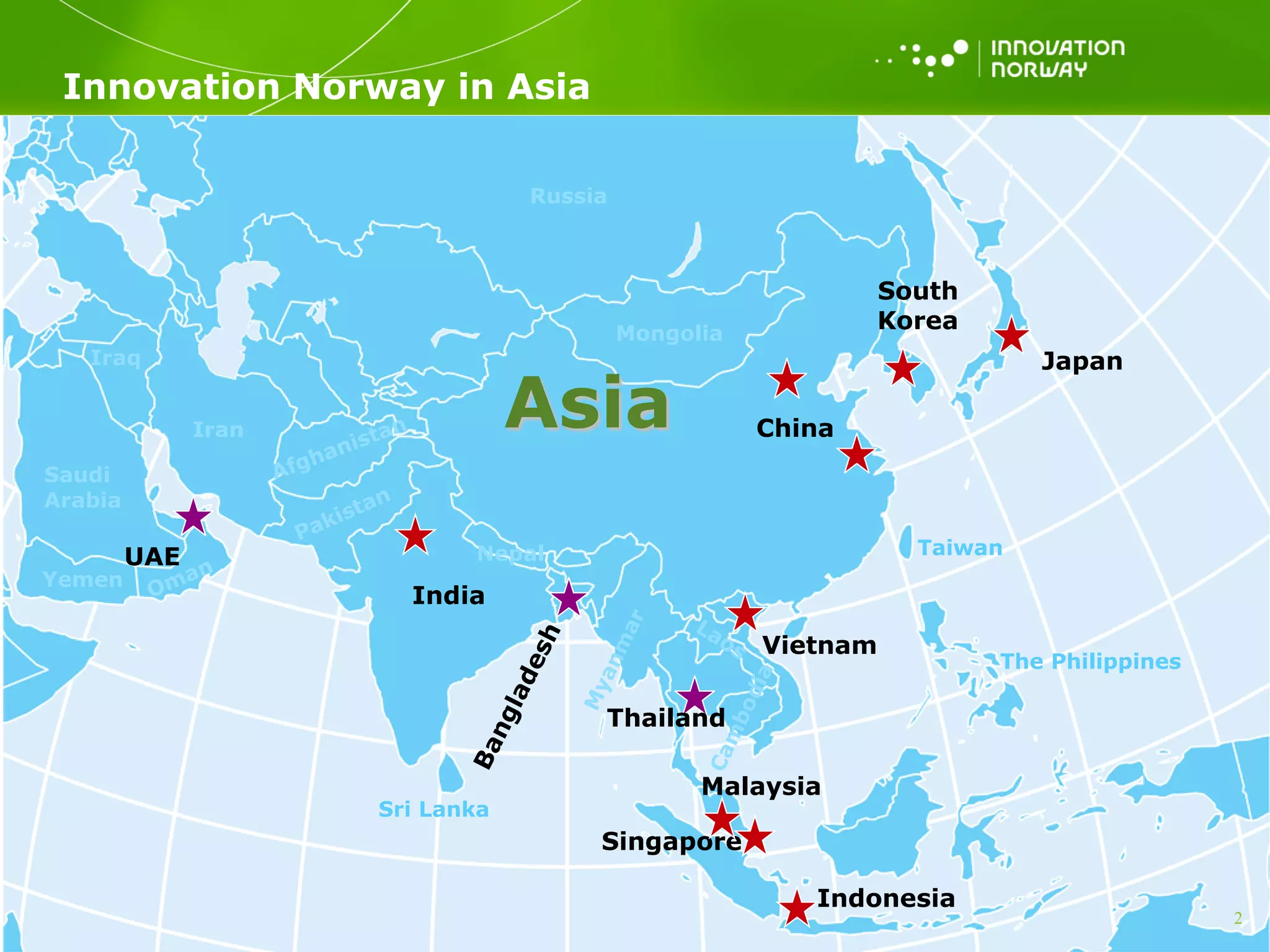
Innovation Norway in Asia
The Philippines
Taiwan
Sri Lanka
Saudi
Arabia
Iraq
Iran
Russia
Mongolia
Yemen
Nepal
>>> Back to index>>> Back to index
Innovation Norway -
The Commercial section of the
Royal Norwegian Embassy,
presence in Asia
• Tokyo
• Seoul
• Beijing
• Shanghai
• Hanoi
• Bangkok
• Kuala Lumpur
• Singapore
• Dhaka
• Delhi
• Abu Dhabi
• Jakarta
>>> Back to index
Analysis of LNG Opportunities in Asian Countries
• Singapore
• Indonesia
• China
• India
• Bangladesh
• Philippines
• Vietnam
4
© Det Norske Veritas AS. All rights reserved.
Opportunity assessment of the South East Asian market for LNG shipping and
distribution
SPONSORING PARTNERS
5
The shipping segment that first might adopt
LNG for propulsion is regional container feeders
Pasir
gudang
Yangon
Kuching
Kota
KinbaluLabuan
Taiching
Xiamen
Shek
ou
Nansha
Potianak
Pekanbaru
Kantang
Fuzhou LEGEND
LNG Marine Terminals
Liquefaction facility status
■ Existing
■ Proposed
■ Under Construction
Regasification facility status
● Existing
● Proposed
● Under construction
5 container feeder lines
4 container feeder lines
3 container feeder lines
2 container feeder lines
1 container feeder line
Routes
 About 20% of
the regional
container feeder
traffic are up for
renewal
towards 2020
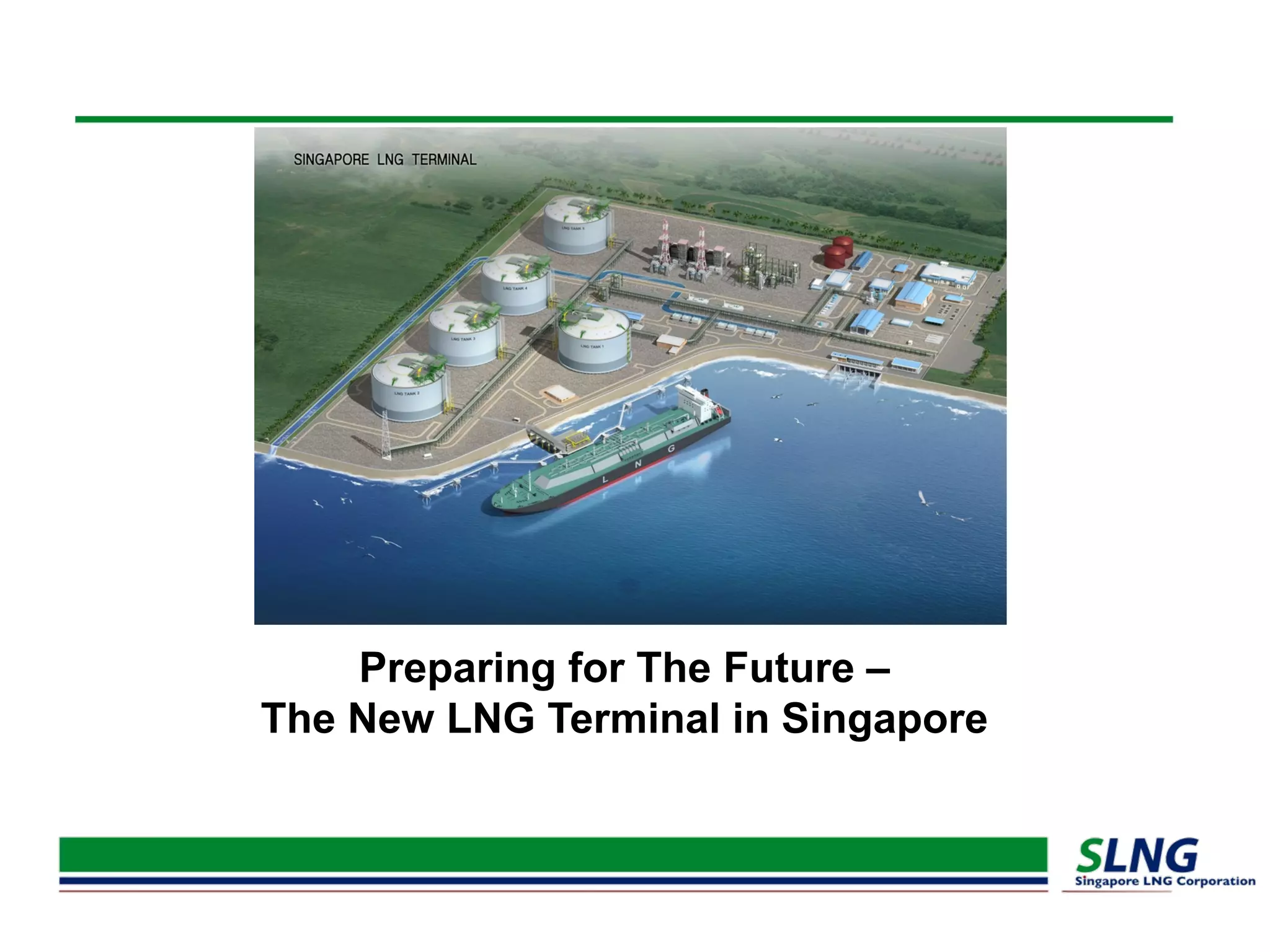
Preparing for The Future –
The New LNG Terminal in Singapore
>>> Back to index
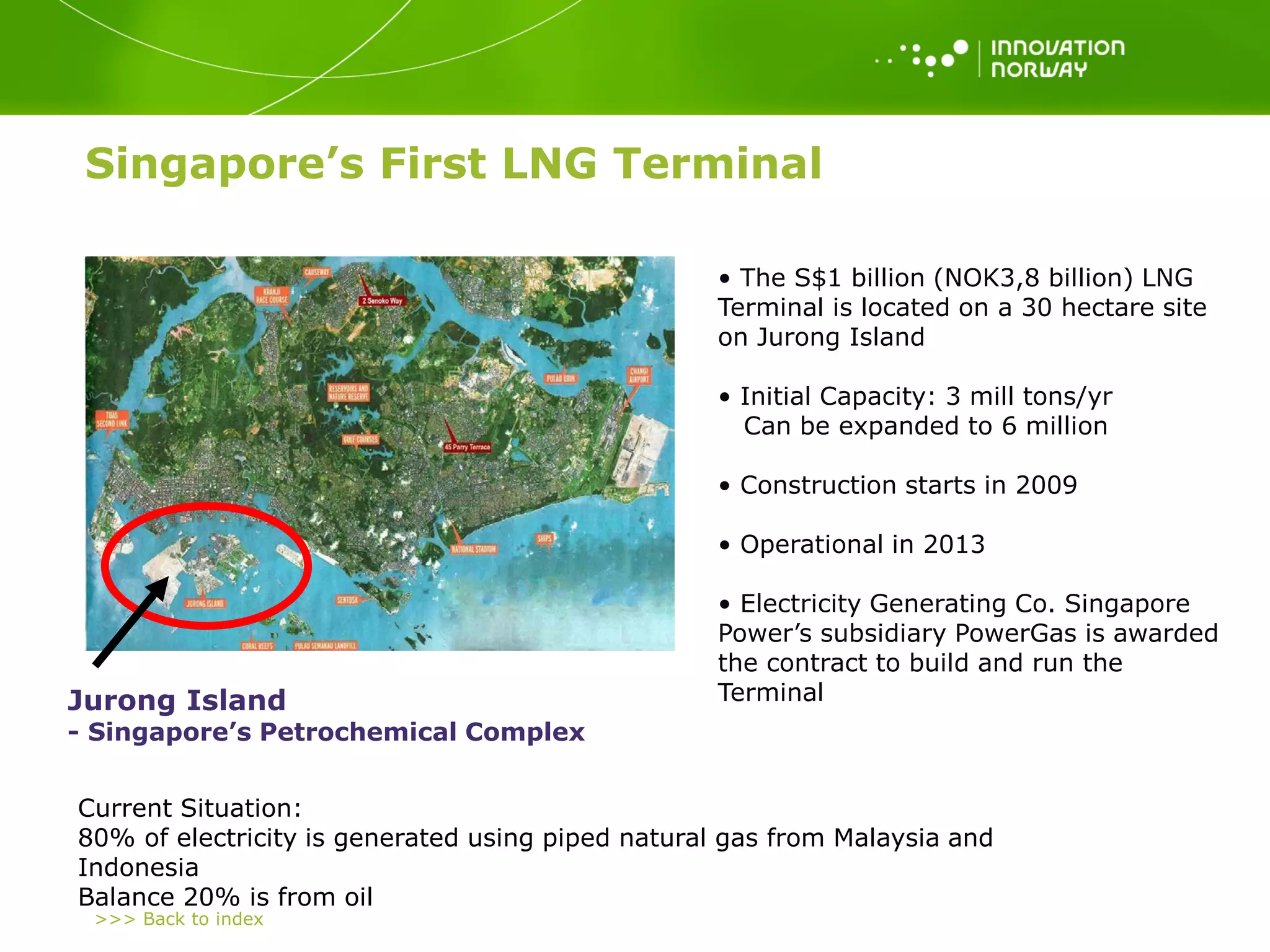
• The S$1 billion (NOK3,8 billion) LNG
Terminal is located on a 30 hectare site
on Jurong Island
• Initial Capacity: 3 mill tons/yr
Can be expanded to 6 million
• Construction starts in 2009
• Operational in 2013
• Electricity Generating Co. Singapore
Power’s subsidiary PowerGas is awarded
the contract to build and run the
TerminalJurong Island
- Singapore’s Petrochemical Complex
Current Situation:
80% of electricity is generated using piped natural gas from Malaysia and
Indonesia
Balance 20% is from oil
Singapore’s First LNG Terminal
© Det Norske Veritas AS. All rights reserved.
Indonesia LNG Opportunities - Small Scale LNG
1st & 2nd May 2013
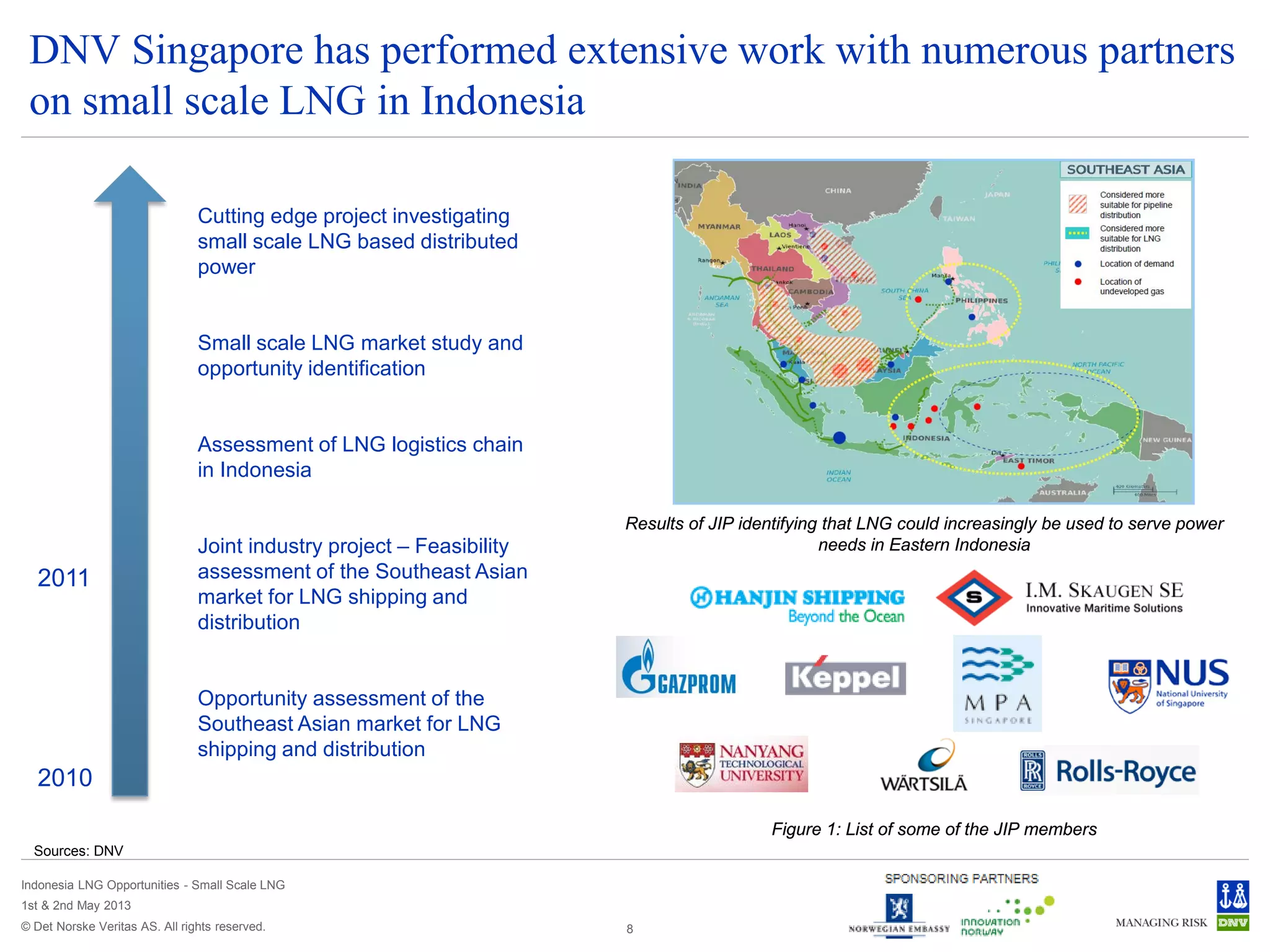
DNV Singapore has performed extensive work with numerous partners
on small scale LNG in Indonesia
8
Cutting edge project investigating
small scale LNG based distributed
power
Small scale LNG market study and
opportunity identification
Assessment of LNG logistics chain
in Indonesia
Joint industry project – Feasibility
assessment of the Southeast Asian
market for LNG shipping and
distribution
Opportunity assessment of the
Southeast Asian market for LNG
shipping and distribution
2010
2011
Results of JIP identifying that LNG could increasingly be used to serve power
needs in Eastern Indonesia
Sources: DNV
Figure 1: List of some of the JIP members
© Det Norske Veritas AS. All rights reserved.
Indonesia LNG Opportunities - Small Scale LNG
1st & 2nd May 2013
Small scale LNG is an option for supplying growing energy demand in
Eastern Indonesia
 LNG is a viable alternative to diesel
power in Eastern Indonesia
9
BONTANG
LNG Plant
TANGGUH
LNG Plant
DONGGI-SENORO
LNG Plant
MASELA/ABADI
LNG Plant
FSRU
Nusantara Regas I
FSRU
Planned
8
7
53
4
2
6
1
Small scale LNG import terminals
Phase 1 (2012)
1. Tg. Batu, Samarinda, East Kalimantan (25 mmscfd)
2. Batakan, Balikpapan, East Kalimantan (15 mmscdf)
3. Pasanggaran, Bali (25-30 mmscfd)
4. Pomala, Kendari, South Sulawesi (25 mmscfd)
Phase 2 (2013)
5. Mataram, West Nusa Tenggara (15 mmscfd)
6. Banajarmasin, South Kalimantan (6 mmscfd)
Phase 3 (2015)
7. Gorontalo, North Sulawesi (6 mmscfd)
8. Halmahera, North Maluku (60 mmscfd)
Figure 3: LNG plants and import terminals/FSRUs
Sources: DNV analysis, Petrominer, Directorate General of Oil and Gas, Pendawa (2011)
 8 small scale LNG terminals are set
to be constructed by 2015
 Currently there is 808 MW of diesel
power generation capacity in 33
locations in Eastern Indonesia
 A small scale LNG milk run carrier
could carry LNG cargoes from one
of the existing/planned LNG
plants/FSRUs
Hoegh FSRU
ARUN LNG
Plant
© Det Norske Veritas AS. All rights reserved.
Indonesia LNG Opportunities - Small Scale LNG
1st & 2nd May 2013
Cost-benefit analyses on two LNG supply chains in Eastern Indonesia
1010
Liquefaction plant
Power Plant
FLNG
Small-scale LNG ship
(10,000 – 12,000 m3)
LNG storage &
regasification (Satellite
plant)
LNG truckSmall-scale LNG terminal
(Onshore or Offshore)
Case Study 1
NG pipeline
Small-scale LNG terminal
(Onshore or Offshore)
Case Study 2
Small-scale LNG ship
(10,000 – 12,000 m3)
Supply chain options have no one size fits all – risks in each scenario varies and solutions have to
be customized to each locality
© Det Norske Veritas AS. All rights reserved.
Risks and Opportunities of Small Scale LNG Development in Indonesia
5/10/2011
Case study 1: LNG supplied along a milk-run by a combination of
small scale LNG carriers and trucks
 Milk run scenario:
 Originates from the Donggi Senoro LNG
plant
 Delivered to 8 locations with small scale
LNG carriers, and/or trucks
 These power plants are currently
diesel based and have capacities of
between 7 to 56 MW
 We assume in the future that:
 70% coal (as base load), and
 30% diesel or LNG (as peak load)
 Minimise LNG ship terminals, and use
LNG trucks within ~100km radius
11
Bitung
Lopana
Wuawua
Kendari
Kayu Merah
Poasia
Kendari
Kolaka
Luwuk
Gorontalo
Donggi Senoro
LNG plant
LNG truck transfer route Small scale LNG shipping route
Small scale LNG milk run distribution route from Donggi Senoro LNG plant
Sources: DNV analysis, Pendawa (2011), Google Earth Pro
© Det Norske Veritas AS. All rights reserved.
Risks and Opportunities of Small Scale LNG Development in Indonesia
5/10/2011
Case study 1: Unit costs of supplying LNG are driven by the volumes
being handled by the receiving terminals
 The LNG supply costs are largely driven
by the volume going through the jetty &
receiving terminal
 Current fuel costs (excl transport) are:
 Diesel: US$27.40/mmbtu
 LNG: ~US$15/mmbtu
 The trend is for the price difference to
continue to increase
 IEA price projections
 At current prices this is an annualised
savings of US$3.2 million per year for the
6 profitable locations
12
Cost of supplying small scale LNG to locations in Eastern Indonesia
0
5
10
15
20
25
0 50 100 150 200
Transportcost($/mmbtu)
Volume through jetty (m3/day)Luwuk
(no ship
needed)
Kayu
Merah
Gorontalo
Kolaka,
Poasia Kendari,
Wuawua Kendari
Lopana,
Bitung
Difference between
diesel and LNG (2011)
© Det Norske Veritas AS. All rights reserved.
Commercial and Strategic Opportunities for LNG in China
1313
LNG Sector in China:
Current Situation and Future Developments
© Det Norske Veritas AS. All rights reserved.
Commercial and Strategic Opportunities for LNG in China
1414
85 bcm of gas per year is produced from conventional
resources, 7% of which is turned into LNG
Sources: IEA, CNPC (2009), EIA, Platts, Black and Veatch (2011)
 China has more than 5950 bcm of
technically recoverable reserves
producing approximately 85 bcm of gas a
year
 About 7% of total gas produced in China,
mostly those obtained from marginal gas
fields, is turned into LNG and transported
to major cities
 These small to mid scale LNG projects
have grown in the last 5 years, with at
least 13 small to mid scale LNG plant
projects initiated
Figure 1: Conventional gas resources in China
© Det Norske Veritas AS. All rights reserved.
Commercial and Strategic Opportunities for LNG in China
1515
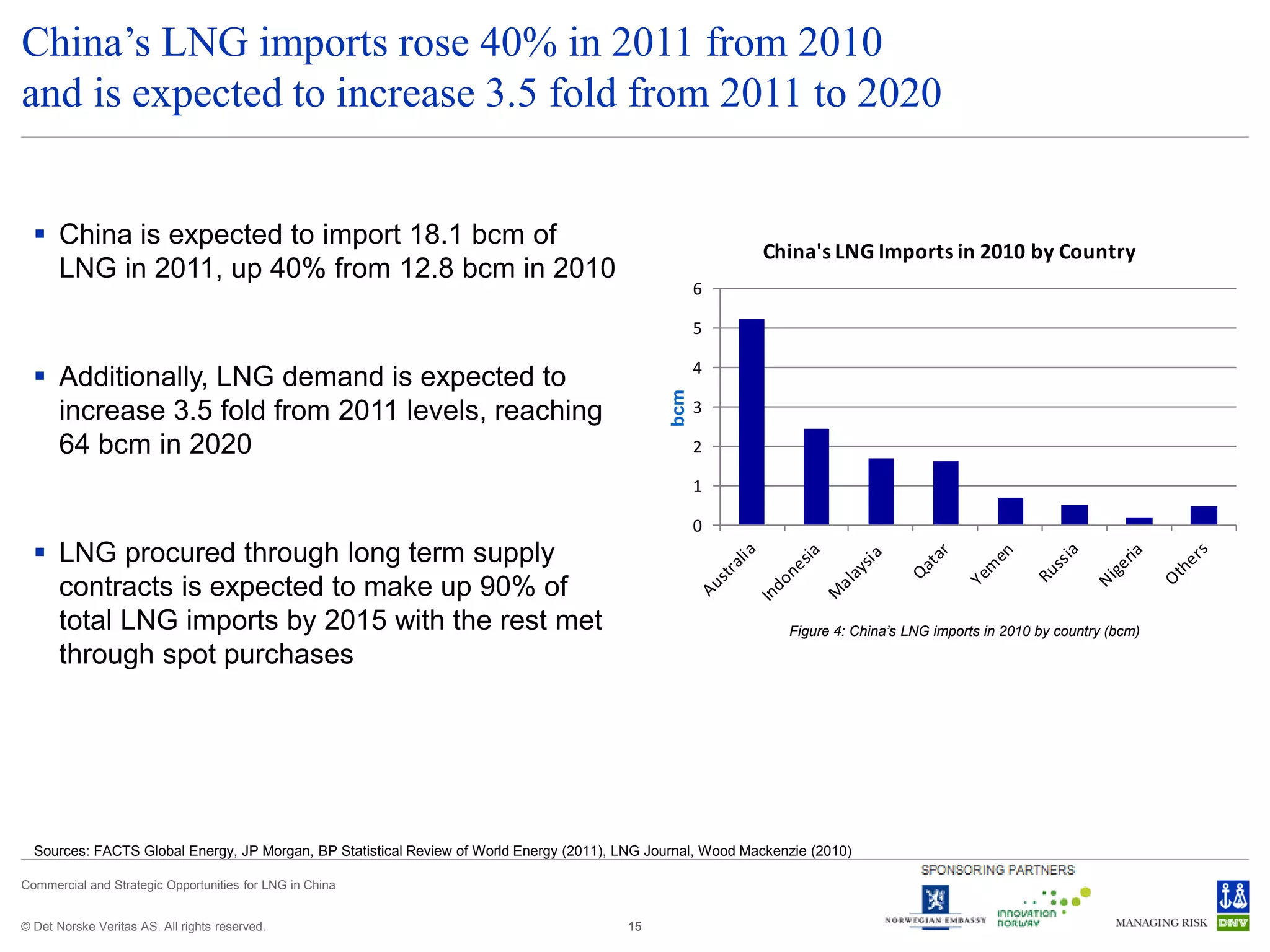
China’s LNG imports rose 40% in 2011 from 2010
and is expected to increase 3.5 fold from 2011 to 2020
 China is expected to import 18.1 bcm of
LNG in 2011, up 40% from 12.8 bcm in 2010
 Additionally, LNG demand is expected to
increase 3.5 fold from 2011 levels, reaching
64 bcm in 2020
 LNG procured through long term supply
contracts is expected to make up 90% of
total LNG imports by 2015 with the rest met
through spot purchases
Sources: FACTS Global Energy, JP Morgan, BP Statistical Review of World Energy (2011), LNG Journal, Wood Mackenzie (2010)
Figure 4: China’s LNG imports in 2010 by country (bcm)
0
1
2
3
4
5
6
bcm
China's LNG Imports in 2010 by Country
© Det Norske Veritas AS. All rights reserved.
Commercial and Strategic Opportunities for LNG in China
1616
14 LNG terminals and 65 LNG carriers will be needed in China
by 2015 to support planned import growth
 14 LNG receiving terminals are
expected to be operational by 2015 with
a combined capacity sufficient to import
>120 bcm of gas per annum
 There are more than 20 LNG receiving
terminals in various phases of
development, with >90% owned by the
major NOCs (CNOOC, CNPC, Sinopec)
or their subsidiaries
 It is estimated that >65 LNG carriers*
will be needed by 2015 to support
planned import growth
Sources: The California Energy Commission (2010), InterFax China (2008), China Shipbuilding Economic Research Centre (2011)
Figure 5: Existing and planned** LNG import terminals
* Refers to all LNG carriers importing LNG to China from overseas
sources. These carriers may not be made domestically in China.
** Note that due to the rapid development of LNG terminals in China,
not all planned import terminals may be represented
© Det Norske Veritas AS. All rights reserved.
Commercial and Strategic Opportunities for LNG in China
17
Gas-fired power generation capacity has increased
rapidly especially at key economic regions
 The share of natural gas used in power
generation over total gas consumption
more than tripled from 5% in 2005 to
18% in 2010 and is expected to grow to
21% by 2015
 Gas-fired peak load power generation is
most prevalent in the Yangtze river
delta economic zone and Southeast
region (led by Shanghai and
Guangzhou respectively)
 This coincides with areas that have the
highest number of LNG import terminals
Source: CNPC (2010)
Figure 6: Gas-fired power generation capacity by region in 2008
© Det Norske Veritas AS. All rights reserved.
Commercial and Strategic Opportunities for LNG in China
18
More than 750 000 road vehicles are already running on
CNG or LNG and the shipping sector is looking to convert
 >750,000 NGVs including CNG- and LNG-
fuelled cars, transit buses and taxis
 Shipping sector now looking to emulate
with the successful use of LNG-fuelled
road vehicles
 In 2010, a LNG-fuelled tugboat running on
70% LNG and 30% diesel was test
navigated along the Yangtze River in
Hubei province
 8 LNG-fuelled demonstration ships are
being built and will be launched
simultaneously in the Yangtze River,
Beijing-Hangzhou Grand Canal and the
Pearl River
 By 2015, 55 LNG bunkering facilities are
expected to be set up along these three
major river waterways
Source: Fortune Oil, China Natural Gas (2010), NGV Journal, Kunlun Energy, Jovo (2011)
Figure 7: Number of LNG bunkering facilities along major rivers
© Det Norske Veritas AS. All rights reserved.
Commercial and Strategic Opportunities for LNG in China
1919
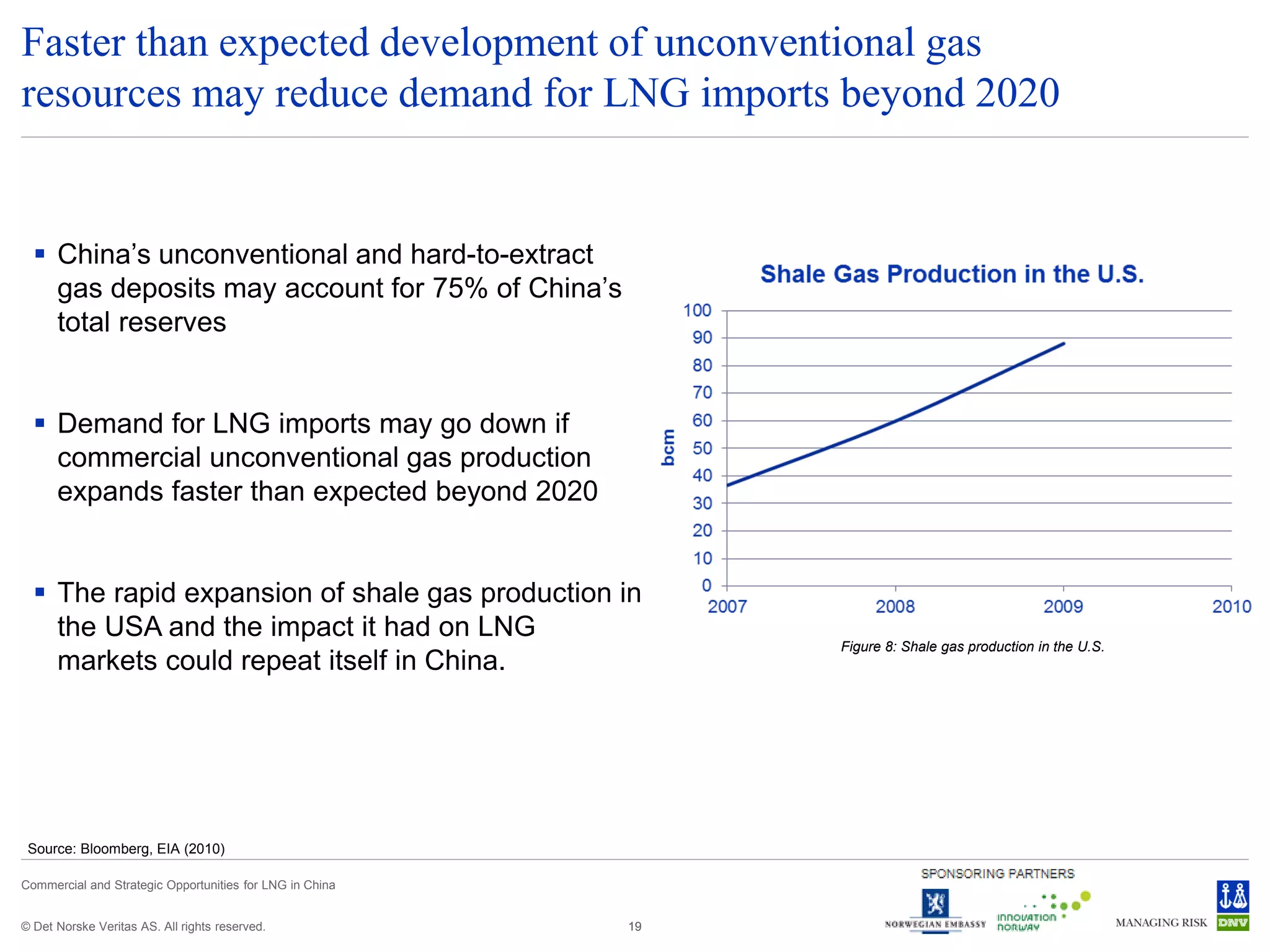
Faster than expected development of unconventional gas
resources may reduce demand for LNG imports beyond 2020
Source: Bloomberg, EIA (2010)
 China’s unconventional and hard-to-extract
gas deposits may account for 75% of China’s
total reserves
 Demand for LNG imports may go down if
commercial unconventional gas production
expands faster than expected beyond 2020
 The rapid expansion of shale gas production in
the USA and the impact it had on LNG
markets could repeat itself in China.
Figure 8: Shale gas production in the U.S.
© Det Norske Veritas AS. All rights reserved.
Commercial and Strategic Opportunities for LNG in China
20
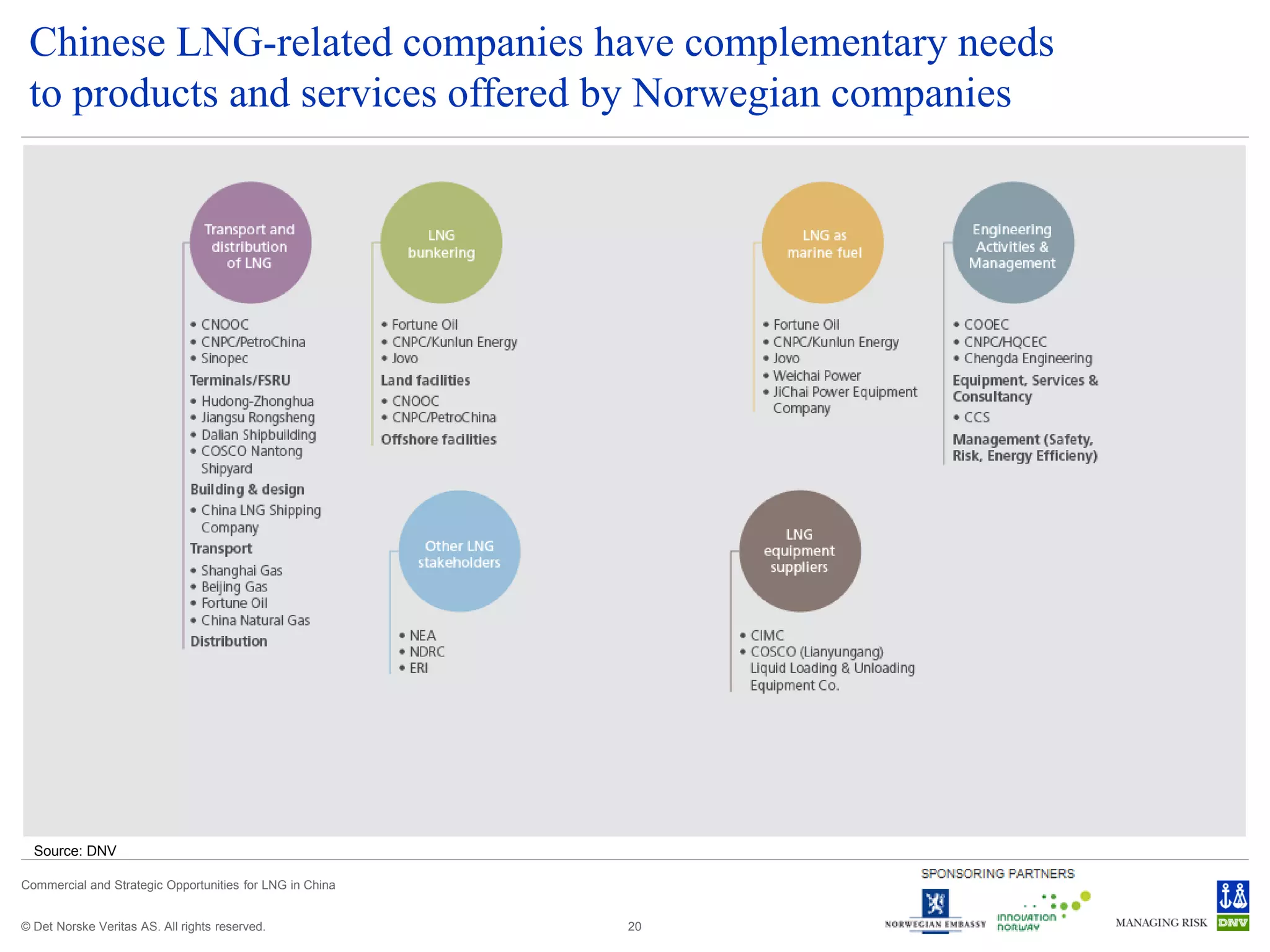
Chinese LNG-related companies have complementary needs
to products and services offered by Norwegian companies
Source: DNV
© Det Norske Veritas AS. All rights reserved.
Commercial and Strategic Opportunities for LNG in China
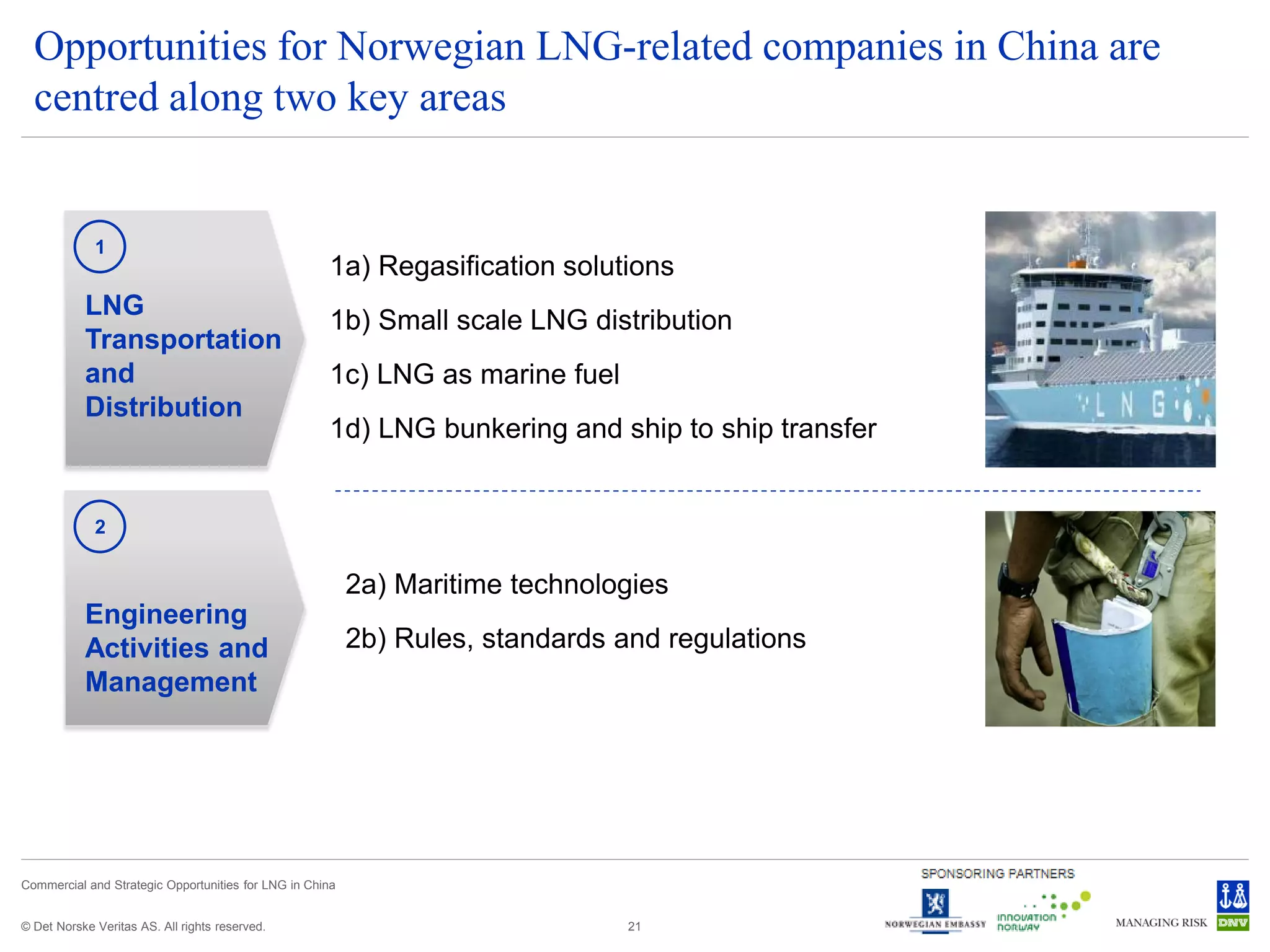
Opportunities for Norwegian LNG-related companies in China are
centred along two key areas
1a) Regasification solutions
1b) Small scale LNG distribution
1c) LNG as marine fuel
1d) LNG bunkering and ship to ship transfer
2a) Maritime technologies
2b) Rules, standards and regulations
21
2
LNG
Transportation
and
Distribution
Engineering
Activities and
Management
1
>>> Back to index
Opportunities in Vietnam
 PetroVietnam has set the target to import
the first LNG cargo by:
 2015 for Thi Vai
 2018 for Son My
 The importation of LNG will diversify primary
energy sources used for power production,
reduce the dependance on coal and ensure
national energy security.
22
Source: DNV, 2012
>>> Back to index 23
>>> Back to index
Case Study Vietnam
-Small scale LNG milk-route
24
 Once LNG developments mature in the South, a large scale
LNG receiving terminal facility could be considered for the
North post 2020, opening up a second opportunity for an
LNG FSRU
 Two LNG receiving terminals at both ends of the country
would make supplying LNG to growing demand centres along
the coast using small scale LNG vessels logistically possible
 In one example scenario, a small scale LNG vessel (20,000
m3 – 50,000 m3) originating from the Southern facility
would drop off LNG cargoes in a milk run fashion at small
scale LNG receiving facilities along the coast before calling at
the Northern facility
 After all cargoes have been dropped off, the vessel would
then call at the Northern facility, pick up fresh LNG cargoes
and double back along the same route
Source: DNV, 2012
>>> Back to index
Indian Gas Scenario
>>> Back to index
32%
10%52%
1%
5%
INDIA
Oil
Gas
Coal
Nuclear
Hydro
World vs. Indian energy scenario
34%
24%
29%
5%
7%
WORLD
Oil
Gas
Coal
Nuclear
Hydro
Source : BP Statistical Review, June 2010
>>> Back to index
LNG Prospects in India
• India is the 4th largest Energy consumer after US, China & Russia.
• Primary energy consumption of India has more than doubled between
1990 and 2011.
• The Indian gas market is projected to be one of the fastest growing in the
world over the next two decades: the IEA forecasts gas demand to
increase at 5.4% per annum over 2007-30 reaching 132 billion cubic
meters by 2030.
• The power sector is the fastest growing area for energy demand,
increasing from 23 percent to 38 percent of total energy consumption
between 1999 to 2009.
• India and China represented a combined 12% LNG market share in 2012.
• The growing appetite for LNG in India and China resulted in 7.7% &
12.2% growth in LNG import in 2012
• Natural gas currently contributes 8% of total energy consumption and is
projected to grow up to 20% by 2030 in India.
Source:- International Energy Agency
>>> Back to index
LNG in India beginning and
growth
• India began importing liquefied natural gas from Qatar in
2004 and increasingly relies on imports to meet domestic
natural gas demand gaps.
• In 2011, India was the 6th largest LNG importer with over
5.3% of the global imports.
• Gas consumption has grown at an annual rate of 10 percent
from 2001-2011
• The power sector and fertilizer sector drives the Natural Gas
Demand in the country. The government has identified
these as priority sectors, which ensures that they receive
larger shares of any new gas supply.
>>> Back to index
LNG in India reserves and
network
• According to the Oil & Gas Journal, India had 43.8 Trillion
cubic feet of proved natural gas reserves at the end of
2012. About 30 percent of these are onshore reserves, while
70 percent are offshore reserves.
• The two most important companies operating India's large
gas pipeline system are GAIL and RGTIL. GAIL is a state
owned gas transmission & marketing company having 8000
km (Source:- CRISIL) gas transportation infrastructure.
Reliance Gas Transportation Infrastructure (RGTIL) is the
largest private sector gas transmission structure.
>>> Back to index
Evolving Energy Mix- Increase
Share of GAS
Source:- GAIL
>>> Back to index
Demand Supply Outlook of LNG
• Domestic natural gas supply to grow at a CAGR of 5.6 per cent over FY13-
15 while gas demand to grow at a CAGR of 17-18 per cent thus aggravating
the deficit situation.
• LNG imports are expected to increase at a CAGR of 19 per cent over FY13-
15 but will only partially meet the shortfall, despite huge LNG re-gasification
capacity additions planned in the next 5 years.
• India’s Gas demand supply gap projection necessitating import of LNG.
Year 2015 2020 2030
Gap in
demand
and supply
MMTPA
14.175 22.05 40.95
>>> Back to index
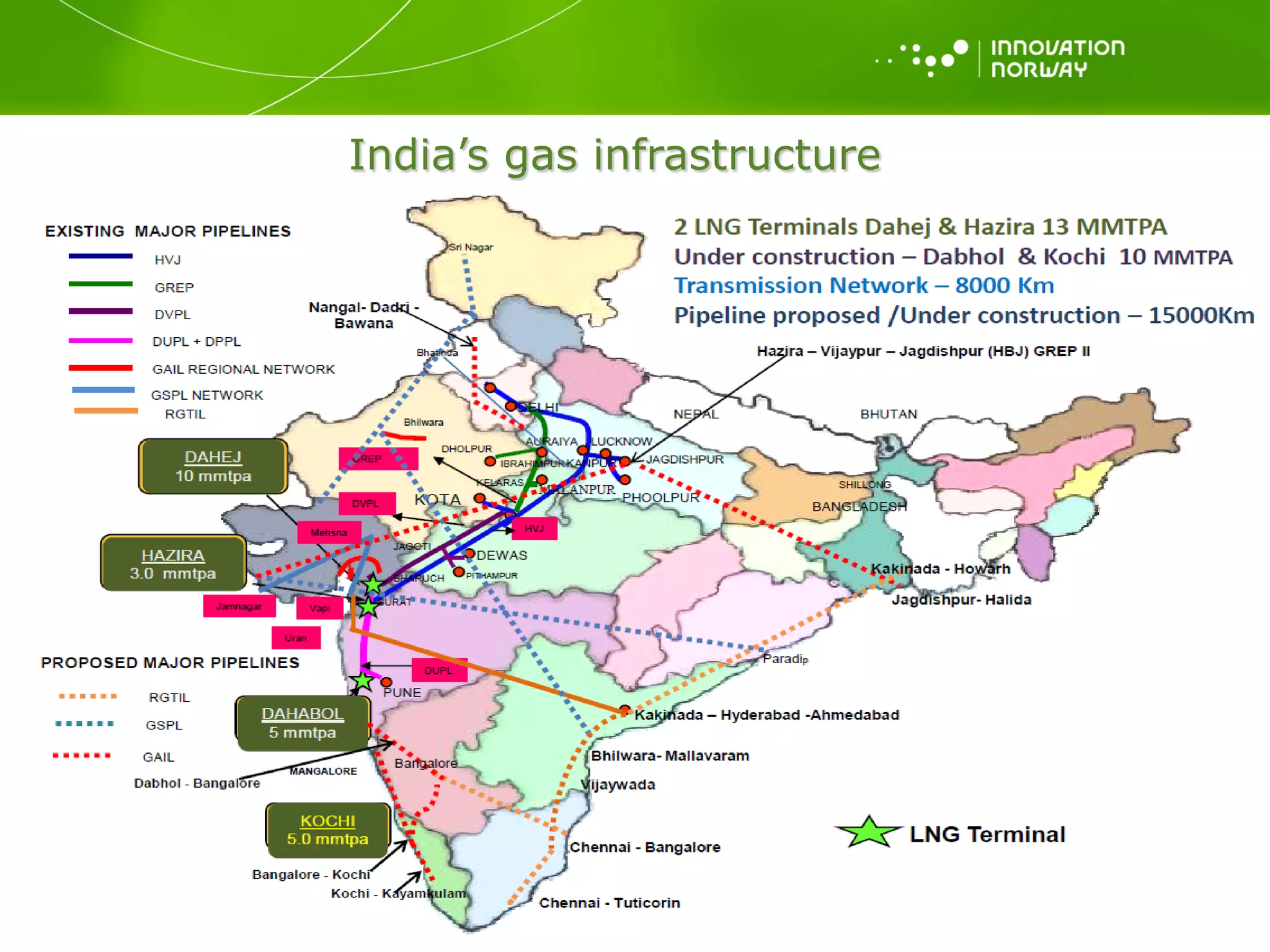
India’s gas infrastructure
>>> Back to index
Existing & Projected LNG Regas Capacity
>>> Back to index
Existing LNG Terminals in India
Terminal Partners Capacity Supply source Start up
date
Dahej Petronet LNG (GAIL,
ONGC, Indian
Oil and BPLC (each
12.5%), GDF
Suez (10%), ADB
(5.2%) and private
shareholders (34.8%))
10 mtpa Qatar – long
term (7.5
mtpa)
March
2004
Hazira Shell (operator, 74%),
Total (26%)
3.5 mtpa Merchant
model
April
2005
Dabhol NTPC, GAIL, Indian
banks15 (28.3%
each) and the
Maharashtra state
Electricity Board
(15%).
5 mtpa
(1 mtpa
initially)
Possible:
Algeria, Qatar,
Australia,
Oman and Abu
Dhabi
2010
Total 18.5 mtpa
>>> Back to index
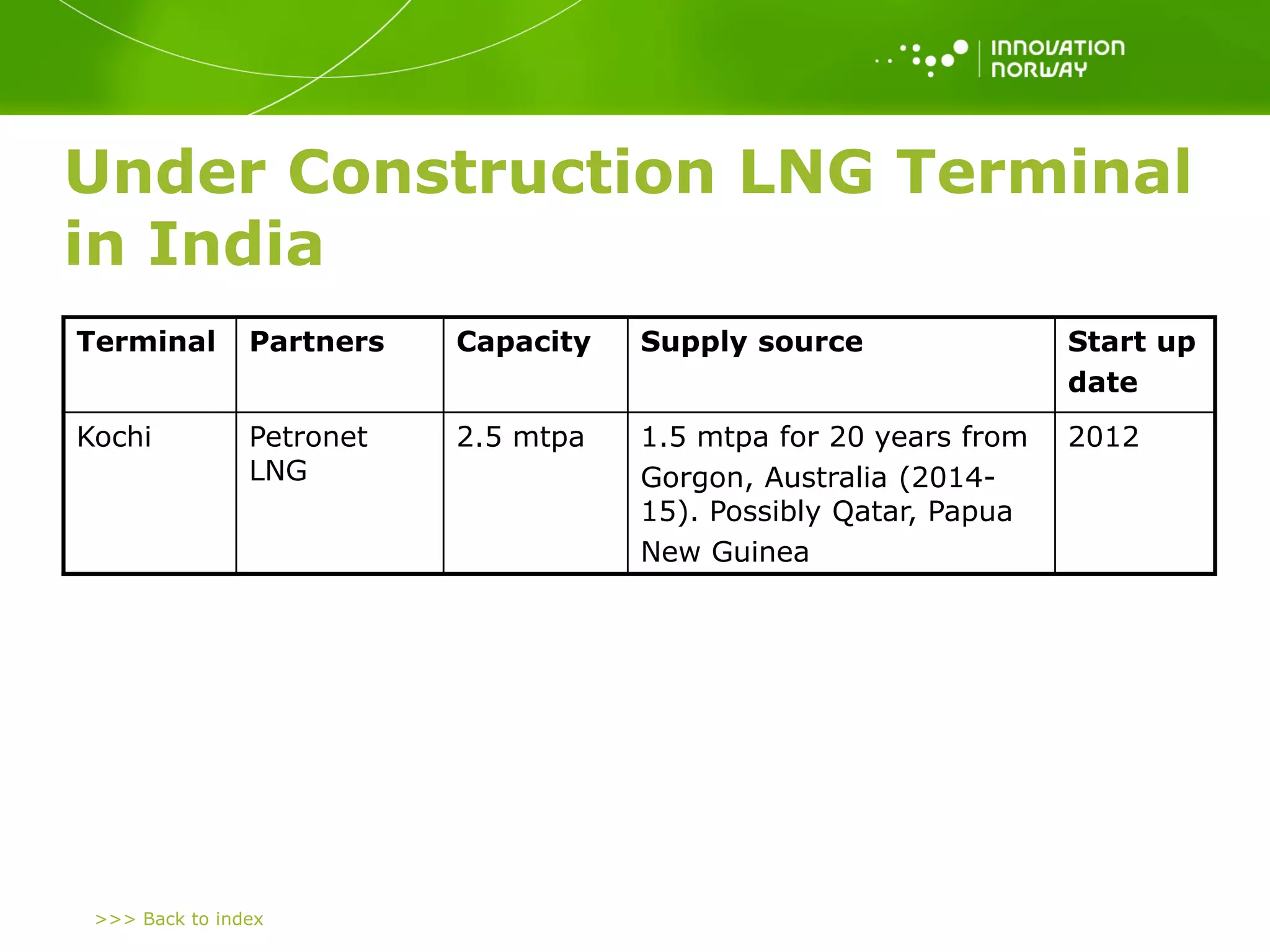
Under Construction LNG Terminal
in India
Terminal Partners Capacity Supply source Start up
date
Kochi Petronet
LNG
2.5 mtpa 1.5 mtpa for 20 years from
Gorgon, Australia (2014-
15). Possibly Qatar, Papua
New Guinea
2012
>>> Back to index
Planned LNG Terminals
Terminal Partners Capacity Start up date
Dahej exp Petronet LNG 2.5 mtpa March 2014
Hazira exp Shell, Total 6.5 mtpa TBN
Kochi exp Petronet LNG 2.5 mtpa 2014
Mundra Port GSPC (75%),
Adani Group
(25%)
6.5 mtpa 2012
Mangalore ONGC & IOC 5 mtpa 2012
Total 23 mtpa
>>> Back to index
Planned LNG Terminals
Terminal Partners Capacity Start up
date
Pipapav Port Essar Group,
Swan Energy,
possibly
GSPC Gujarat
Pipavav Port
Ltd.
Intends to
become a
partner
5 mtpa 2013
Ennore TIDCO, IOC 5 mtpa 2017
Haldia Spice Energy 2.5 mtpa 2011
Total 12.5 mtpa 37
>>> Back to index
Scope for Small LNG Tankers &
FSRUs
• Demand for natural gas across the country in
sectors such as town gas and transportation in
addition to Industrial use and imported LNG can
be an important source.
• Existing gas grid does not cover the entire
country, particularly the coastal regions.
• Delays in expansion of gas grid owing to right of
way problems & difficult terrain.
• Large coastline of about 7500 kms offers
opportunity for small LNG carriers and FSRUs.
• Construction of small LNG Terminals at Andaman
and Sri Lanka under consideration.
38
>>> Back to index
Opportunities in India
 India plans to double its use of natural gas (LNG and
CNG) over the next 10 years.
 Currently, India has two LNG terminals and another two
under construction.
 Small scale distribution will reduce the need of big
receiving terminals.
 Beneficial in regions without any pipeline grids.
39
>>> Back to index 40
Norwegian LNG-related companies are
distributed across the LNG value chain
Source: DNV
>>> Back to index
41
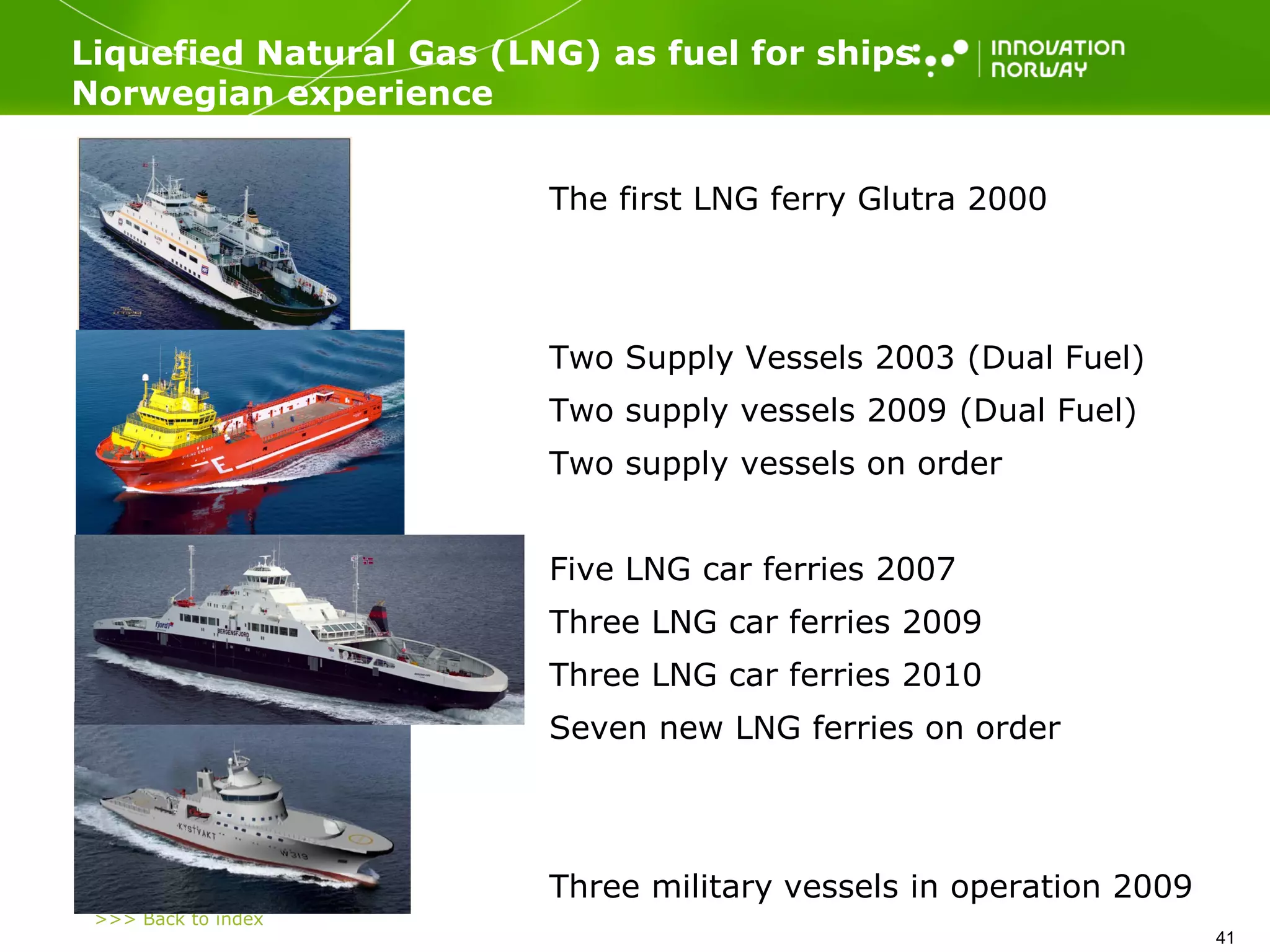
Liquefied Natural Gas (LNG) as fuel for ships
Norwegian experience
The first LNG ferry Glutra 2000
Two Supply Vessels 2003 (Dual Fuel)
Two supply vessels 2009 (Dual Fuel)
Two supply vessels on order
Five LNG car ferries 2007
Three LNG car ferries 2009
Three LNG car ferries 2010
Seven new LNG ferries on order
Three military vessels in operation 2009
MARINTEK 42
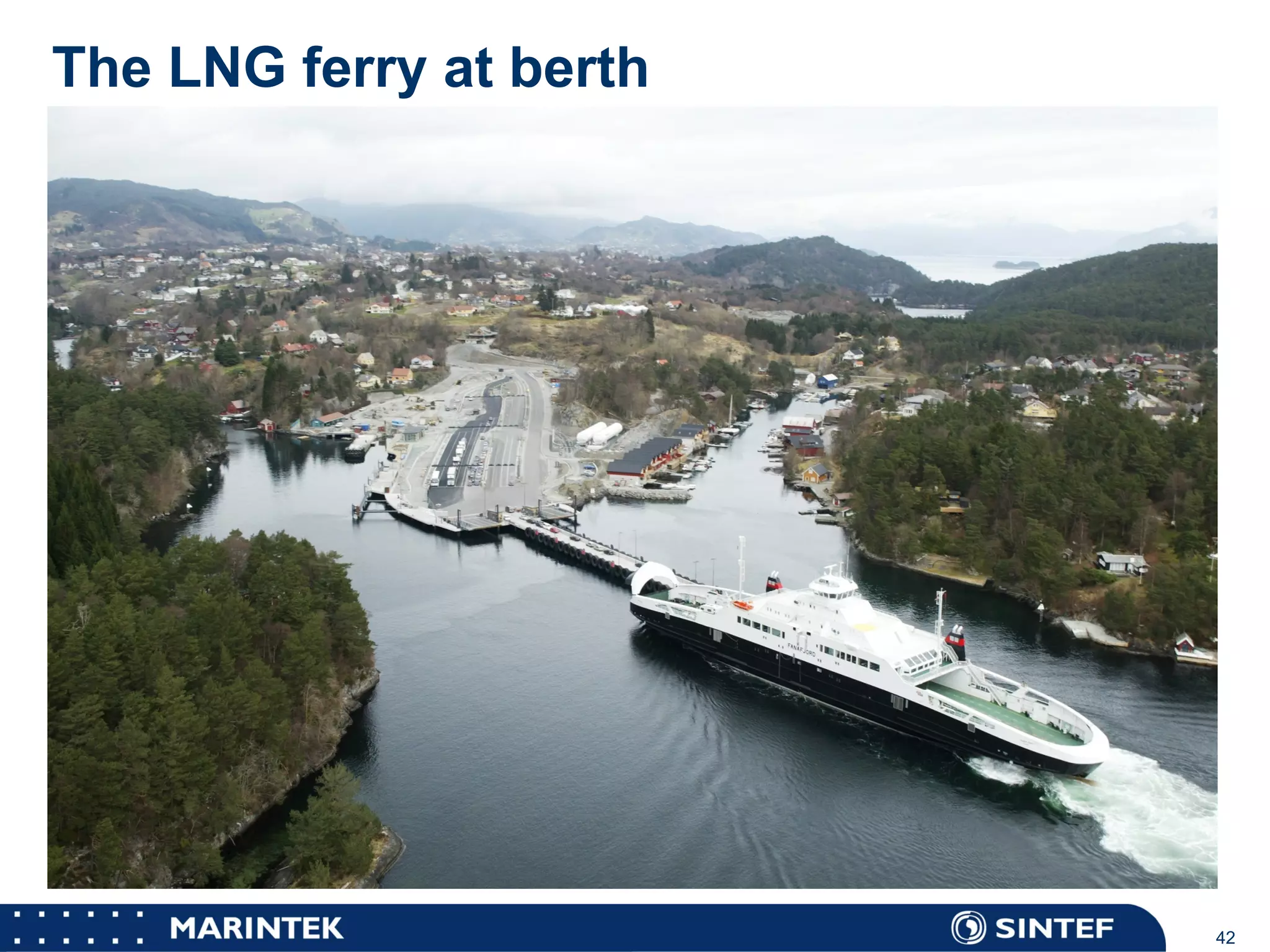
The LNG ferry at berth
Höegh LNG – a fully integrated floating LNG service provider
Production Shipping Regasification DistributionExploration
LNG carriers LNG regasification vesselsFLNG
LNG: Liquefied Natural Gas
SRV: Shuttle and Regasification Vessel
FSRU: Floating Storage and Regasification Unit
 Proprietary FLNG design
 Principle approval for a FLNG
project in Papua New Guinea
 Pre-feed agreement for an FLNG
at Tamar field in Israel
 5 standard carriers in operation
 1 carrier acquired with delivery
2Q 2012 (“LNG Libra”)
 Purchase option for 1 carrier with
delivery 2H2013
(“STX Frontier”)
 2 regasification vessels in operation
 3 regasification vessels on order, of which 2 with long-term employment
secured
 Options for additional regasification vessels
 1 conversion candidate (“LNG Libra”)
Advantages of FSRU’s
 Can be located near to key offtake loads (power
stations, heavy industry)
 Scalable – add more vessel based storage without
regas capacity
 Does not require large land tracts to be set aside
 Shallow or deep water options available, all
proven mooring solutions
 Significant savings in time and money
 Simpler permitting
 Moveable – can be used to build up market and
then move to new location
 Base for small scale LNG distribution, no
modifications necessary
Advantages of using FSRU for small scale LNG
 New FSRU projects are being specified to include
small scale capability
 Simple in operational terms
 Requires minor modification / upgrade to the
FSRU
 FSRU ideal as LNG distribution centre:
 Offshore (typically)
 Easy access for small scale vessels
 Either for point to point or milk run distribution
GasPartners
>>> Back to index
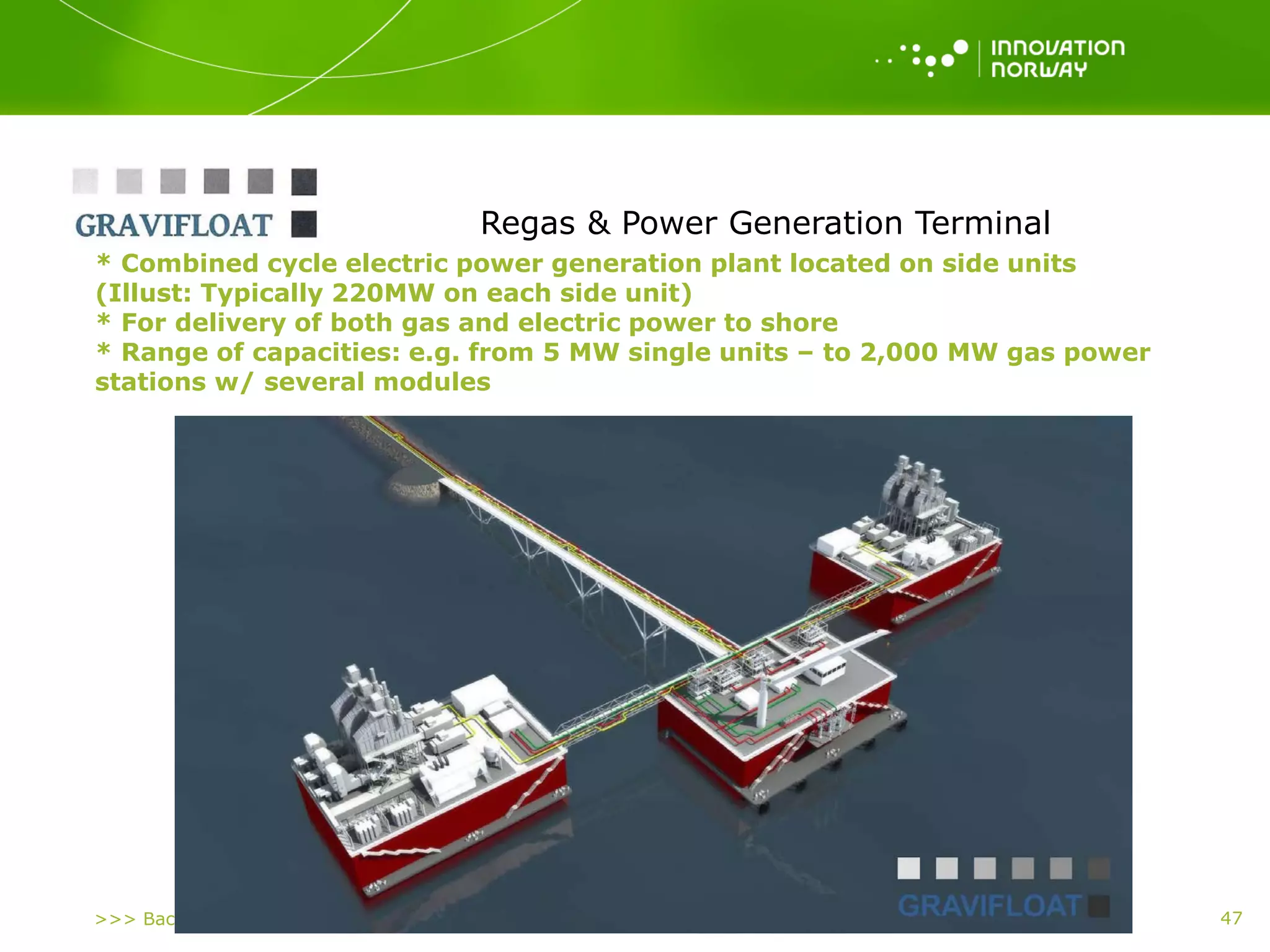
* Combined cycle electric power generation plant located on side units
(Illust: Typically 220MW on each side unit)
* For delivery of both gas and electric power to shore
* Range of capacities: e.g. from 5 MW single units – to 2,000 MW gas power
stations w/ several modules
47
Regas & Power Generation Terminal
>>> Back to index
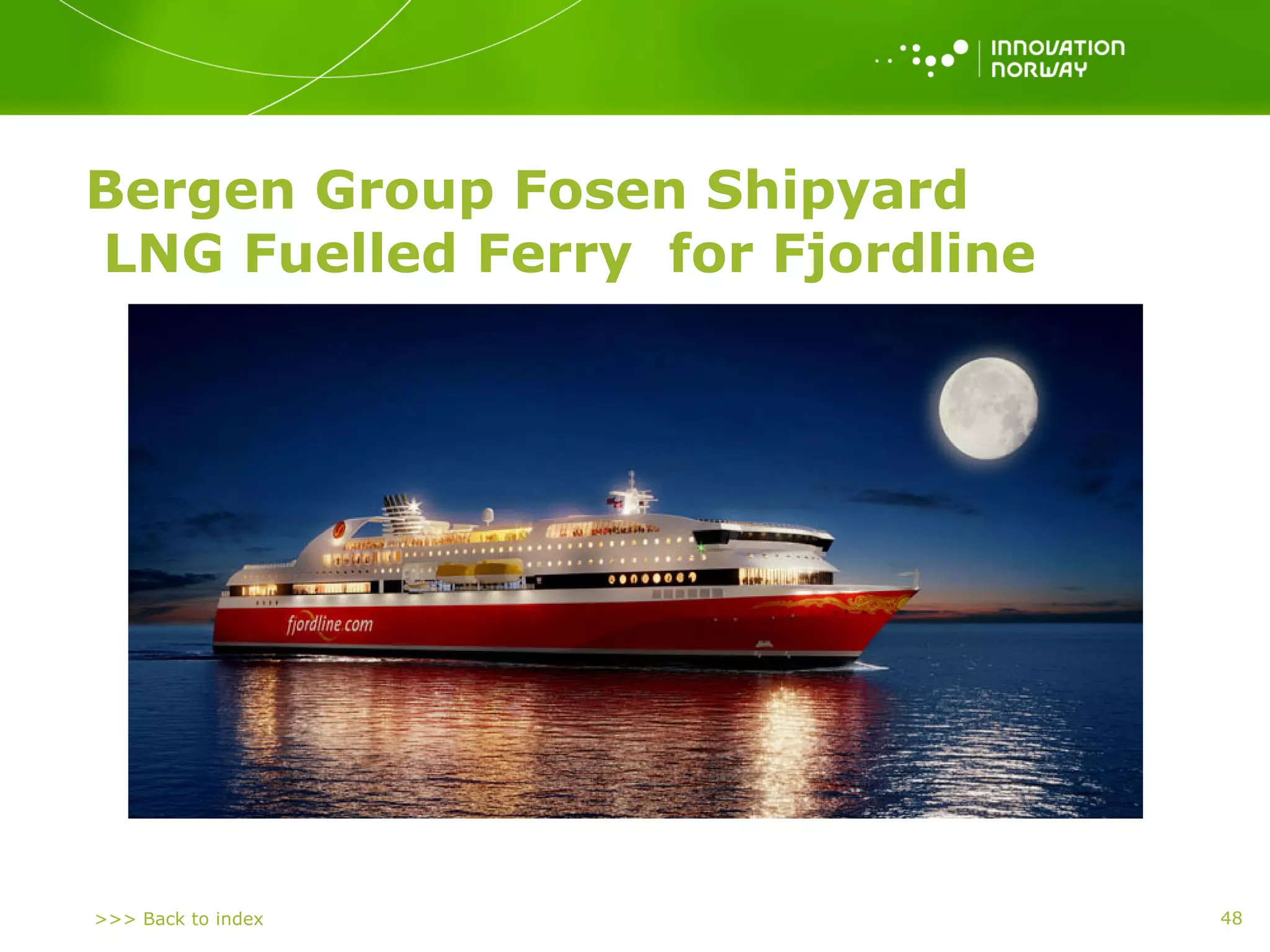
Bergen Group Fosen Shipyard
LNG Fuelled Ferry for Fjordline
48
>>> Back to index 49
Concluding remarks
• Norway has demonstrated that small scale LNG production and
distribution is competitive as fuel for ships
• LNG is available world vide and can be further distributed to a
small scale market (industry, maritime)
• LNG is considered to be the main alternative fuel to fuel oils.
• Asia will be the new large market for Small Scale distribution
and Use of LNG.
>>> Back to index
50
Thank you for your attention
Egil Rensvik@Innovationnorway.no
Singapore

Asia Days 2013 - Market opportunities for small LNG distribution

  • 1.
    >>> Back toindex Market Potential for Small Scale LNG Distribution and Use in Asia IN Information Day / Norshipping 6th June 2013 Oslo Egil Rensvik Science & Technology Counsellor Royal Norwegian Embassy Singapore Innovation Norway - South & SouthEast Asia Source: Gasnor
  • 2.
    >>> Back toindex>>> Back to index Asia 2 India Vietnam Indonesia Singapore UAE South Korea China Japan Thailand Malaysia Innovation Norway in Asia The Philippines Taiwan Sri Lanka Saudi Arabia Iraq Iran Russia Mongolia Yemen Nepal
  • 3.
    >>> Back toindex>>> Back to index Innovation Norway - The Commercial section of the Royal Norwegian Embassy, presence in Asia • Tokyo • Seoul • Beijing • Shanghai • Hanoi • Bangkok • Kuala Lumpur • Singapore • Dhaka • Delhi • Abu Dhabi • Jakarta
  • 4.
    >>> Back toindex Analysis of LNG Opportunities in Asian Countries • Singapore • Indonesia • China • India • Bangladesh • Philippines • Vietnam 4
  • 5.
    © Det NorskeVeritas AS. All rights reserved. Opportunity assessment of the South East Asian market for LNG shipping and distribution SPONSORING PARTNERS 5 The shipping segment that first might adopt LNG for propulsion is regional container feeders Pasir gudang Yangon Kuching Kota KinbaluLabuan Taiching Xiamen Shek ou Nansha Potianak Pekanbaru Kantang Fuzhou LEGEND LNG Marine Terminals Liquefaction facility status ■ Existing ■ Proposed ■ Under Construction Regasification facility status ● Existing ● Proposed ● Under construction 5 container feeder lines 4 container feeder lines 3 container feeder lines 2 container feeder lines 1 container feeder line Routes  About 20% of the regional container feeder traffic are up for renewal towards 2020
  • 6.
    Preparing for TheFuture – The New LNG Terminal in Singapore
  • 7.
    >>> Back toindex • The S$1 billion (NOK3,8 billion) LNG Terminal is located on a 30 hectare site on Jurong Island • Initial Capacity: 3 mill tons/yr Can be expanded to 6 million • Construction starts in 2009 • Operational in 2013 • Electricity Generating Co. Singapore Power’s subsidiary PowerGas is awarded the contract to build and run the TerminalJurong Island - Singapore’s Petrochemical Complex Current Situation: 80% of electricity is generated using piped natural gas from Malaysia and Indonesia Balance 20% is from oil Singapore’s First LNG Terminal
  • 8.
    © Det NorskeVeritas AS. All rights reserved. Indonesia LNG Opportunities - Small Scale LNG 1st & 2nd May 2013 DNV Singapore has performed extensive work with numerous partners on small scale LNG in Indonesia 8 Cutting edge project investigating small scale LNG based distributed power Small scale LNG market study and opportunity identification Assessment of LNG logistics chain in Indonesia Joint industry project – Feasibility assessment of the Southeast Asian market for LNG shipping and distribution Opportunity assessment of the Southeast Asian market for LNG shipping and distribution 2010 2011 Results of JIP identifying that LNG could increasingly be used to serve power needs in Eastern Indonesia Sources: DNV Figure 1: List of some of the JIP members
  • 9.
    © Det NorskeVeritas AS. All rights reserved. Indonesia LNG Opportunities - Small Scale LNG 1st & 2nd May 2013 Small scale LNG is an option for supplying growing energy demand in Eastern Indonesia  LNG is a viable alternative to diesel power in Eastern Indonesia 9 BONTANG LNG Plant TANGGUH LNG Plant DONGGI-SENORO LNG Plant MASELA/ABADI LNG Plant FSRU Nusantara Regas I FSRU Planned 8 7 53 4 2 6 1 Small scale LNG import terminals Phase 1 (2012) 1. Tg. Batu, Samarinda, East Kalimantan (25 mmscfd) 2. Batakan, Balikpapan, East Kalimantan (15 mmscdf) 3. Pasanggaran, Bali (25-30 mmscfd) 4. Pomala, Kendari, South Sulawesi (25 mmscfd) Phase 2 (2013) 5. Mataram, West Nusa Tenggara (15 mmscfd) 6. Banajarmasin, South Kalimantan (6 mmscfd) Phase 3 (2015) 7. Gorontalo, North Sulawesi (6 mmscfd) 8. Halmahera, North Maluku (60 mmscfd) Figure 3: LNG plants and import terminals/FSRUs Sources: DNV analysis, Petrominer, Directorate General of Oil and Gas, Pendawa (2011)  8 small scale LNG terminals are set to be constructed by 2015  Currently there is 808 MW of diesel power generation capacity in 33 locations in Eastern Indonesia  A small scale LNG milk run carrier could carry LNG cargoes from one of the existing/planned LNG plants/FSRUs Hoegh FSRU ARUN LNG Plant
  • 10.
    © Det NorskeVeritas AS. All rights reserved. Indonesia LNG Opportunities - Small Scale LNG 1st & 2nd May 2013 Cost-benefit analyses on two LNG supply chains in Eastern Indonesia 1010 Liquefaction plant Power Plant FLNG Small-scale LNG ship (10,000 – 12,000 m3) LNG storage & regasification (Satellite plant) LNG truckSmall-scale LNG terminal (Onshore or Offshore) Case Study 1 NG pipeline Small-scale LNG terminal (Onshore or Offshore) Case Study 2 Small-scale LNG ship (10,000 – 12,000 m3) Supply chain options have no one size fits all – risks in each scenario varies and solutions have to be customized to each locality
  • 11.
    © Det NorskeVeritas AS. All rights reserved. Risks and Opportunities of Small Scale LNG Development in Indonesia 5/10/2011 Case study 1: LNG supplied along a milk-run by a combination of small scale LNG carriers and trucks  Milk run scenario:  Originates from the Donggi Senoro LNG plant  Delivered to 8 locations with small scale LNG carriers, and/or trucks  These power plants are currently diesel based and have capacities of between 7 to 56 MW  We assume in the future that:  70% coal (as base load), and  30% diesel or LNG (as peak load)  Minimise LNG ship terminals, and use LNG trucks within ~100km radius 11 Bitung Lopana Wuawua Kendari Kayu Merah Poasia Kendari Kolaka Luwuk Gorontalo Donggi Senoro LNG plant LNG truck transfer route Small scale LNG shipping route Small scale LNG milk run distribution route from Donggi Senoro LNG plant Sources: DNV analysis, Pendawa (2011), Google Earth Pro
  • 12.
    © Det NorskeVeritas AS. All rights reserved. Risks and Opportunities of Small Scale LNG Development in Indonesia 5/10/2011 Case study 1: Unit costs of supplying LNG are driven by the volumes being handled by the receiving terminals  The LNG supply costs are largely driven by the volume going through the jetty & receiving terminal  Current fuel costs (excl transport) are:  Diesel: US$27.40/mmbtu  LNG: ~US$15/mmbtu  The trend is for the price difference to continue to increase  IEA price projections  At current prices this is an annualised savings of US$3.2 million per year for the 6 profitable locations 12 Cost of supplying small scale LNG to locations in Eastern Indonesia 0 5 10 15 20 25 0 50 100 150 200 Transportcost($/mmbtu) Volume through jetty (m3/day)Luwuk (no ship needed) Kayu Merah Gorontalo Kolaka, Poasia Kendari, Wuawua Kendari Lopana, Bitung Difference between diesel and LNG (2011)
  • 13.
    © Det NorskeVeritas AS. All rights reserved. Commercial and Strategic Opportunities for LNG in China 1313 LNG Sector in China: Current Situation and Future Developments
  • 14.
    © Det NorskeVeritas AS. All rights reserved. Commercial and Strategic Opportunities for LNG in China 1414 85 bcm of gas per year is produced from conventional resources, 7% of which is turned into LNG Sources: IEA, CNPC (2009), EIA, Platts, Black and Veatch (2011)  China has more than 5950 bcm of technically recoverable reserves producing approximately 85 bcm of gas a year  About 7% of total gas produced in China, mostly those obtained from marginal gas fields, is turned into LNG and transported to major cities  These small to mid scale LNG projects have grown in the last 5 years, with at least 13 small to mid scale LNG plant projects initiated Figure 1: Conventional gas resources in China
  • 15.
    © Det NorskeVeritas AS. All rights reserved. Commercial and Strategic Opportunities for LNG in China 1515 China’s LNG imports rose 40% in 2011 from 2010 and is expected to increase 3.5 fold from 2011 to 2020  China is expected to import 18.1 bcm of LNG in 2011, up 40% from 12.8 bcm in 2010  Additionally, LNG demand is expected to increase 3.5 fold from 2011 levels, reaching 64 bcm in 2020  LNG procured through long term supply contracts is expected to make up 90% of total LNG imports by 2015 with the rest met through spot purchases Sources: FACTS Global Energy, JP Morgan, BP Statistical Review of World Energy (2011), LNG Journal, Wood Mackenzie (2010) Figure 4: China’s LNG imports in 2010 by country (bcm) 0 1 2 3 4 5 6 bcm China's LNG Imports in 2010 by Country
  • 16.
    © Det NorskeVeritas AS. All rights reserved. Commercial and Strategic Opportunities for LNG in China 1616 14 LNG terminals and 65 LNG carriers will be needed in China by 2015 to support planned import growth  14 LNG receiving terminals are expected to be operational by 2015 with a combined capacity sufficient to import >120 bcm of gas per annum  There are more than 20 LNG receiving terminals in various phases of development, with >90% owned by the major NOCs (CNOOC, CNPC, Sinopec) or their subsidiaries  It is estimated that >65 LNG carriers* will be needed by 2015 to support planned import growth Sources: The California Energy Commission (2010), InterFax China (2008), China Shipbuilding Economic Research Centre (2011) Figure 5: Existing and planned** LNG import terminals * Refers to all LNG carriers importing LNG to China from overseas sources. These carriers may not be made domestically in China. ** Note that due to the rapid development of LNG terminals in China, not all planned import terminals may be represented
  • 17.
    © Det NorskeVeritas AS. All rights reserved. Commercial and Strategic Opportunities for LNG in China 17 Gas-fired power generation capacity has increased rapidly especially at key economic regions  The share of natural gas used in power generation over total gas consumption more than tripled from 5% in 2005 to 18% in 2010 and is expected to grow to 21% by 2015  Gas-fired peak load power generation is most prevalent in the Yangtze river delta economic zone and Southeast region (led by Shanghai and Guangzhou respectively)  This coincides with areas that have the highest number of LNG import terminals Source: CNPC (2010) Figure 6: Gas-fired power generation capacity by region in 2008
  • 18.
    © Det NorskeVeritas AS. All rights reserved. Commercial and Strategic Opportunities for LNG in China 18 More than 750 000 road vehicles are already running on CNG or LNG and the shipping sector is looking to convert  >750,000 NGVs including CNG- and LNG- fuelled cars, transit buses and taxis  Shipping sector now looking to emulate with the successful use of LNG-fuelled road vehicles  In 2010, a LNG-fuelled tugboat running on 70% LNG and 30% diesel was test navigated along the Yangtze River in Hubei province  8 LNG-fuelled demonstration ships are being built and will be launched simultaneously in the Yangtze River, Beijing-Hangzhou Grand Canal and the Pearl River  By 2015, 55 LNG bunkering facilities are expected to be set up along these three major river waterways Source: Fortune Oil, China Natural Gas (2010), NGV Journal, Kunlun Energy, Jovo (2011) Figure 7: Number of LNG bunkering facilities along major rivers
  • 19.
    © Det NorskeVeritas AS. All rights reserved. Commercial and Strategic Opportunities for LNG in China 1919 Faster than expected development of unconventional gas resources may reduce demand for LNG imports beyond 2020 Source: Bloomberg, EIA (2010)  China’s unconventional and hard-to-extract gas deposits may account for 75% of China’s total reserves  Demand for LNG imports may go down if commercial unconventional gas production expands faster than expected beyond 2020  The rapid expansion of shale gas production in the USA and the impact it had on LNG markets could repeat itself in China. Figure 8: Shale gas production in the U.S.
  • 20.
    © Det NorskeVeritas AS. All rights reserved. Commercial and Strategic Opportunities for LNG in China 20 Chinese LNG-related companies have complementary needs to products and services offered by Norwegian companies Source: DNV
  • 21.
    © Det NorskeVeritas AS. All rights reserved. Commercial and Strategic Opportunities for LNG in China Opportunities for Norwegian LNG-related companies in China are centred along two key areas 1a) Regasification solutions 1b) Small scale LNG distribution 1c) LNG as marine fuel 1d) LNG bunkering and ship to ship transfer 2a) Maritime technologies 2b) Rules, standards and regulations 21 2 LNG Transportation and Distribution Engineering Activities and Management 1
  • 22.
    >>> Back toindex Opportunities in Vietnam  PetroVietnam has set the target to import the first LNG cargo by:  2015 for Thi Vai  2018 for Son My  The importation of LNG will diversify primary energy sources used for power production, reduce the dependance on coal and ensure national energy security. 22 Source: DNV, 2012
  • 23.
    >>> Back toindex 23
  • 24.
    >>> Back toindex Case Study Vietnam -Small scale LNG milk-route 24  Once LNG developments mature in the South, a large scale LNG receiving terminal facility could be considered for the North post 2020, opening up a second opportunity for an LNG FSRU  Two LNG receiving terminals at both ends of the country would make supplying LNG to growing demand centres along the coast using small scale LNG vessels logistically possible  In one example scenario, a small scale LNG vessel (20,000 m3 – 50,000 m3) originating from the Southern facility would drop off LNG cargoes in a milk run fashion at small scale LNG receiving facilities along the coast before calling at the Northern facility  After all cargoes have been dropped off, the vessel would then call at the Northern facility, pick up fresh LNG cargoes and double back along the same route Source: DNV, 2012
  • 25.
    >>> Back toindex Indian Gas Scenario
  • 26.
    >>> Back toindex 32% 10%52% 1% 5% INDIA Oil Gas Coal Nuclear Hydro World vs. Indian energy scenario 34% 24% 29% 5% 7% WORLD Oil Gas Coal Nuclear Hydro Source : BP Statistical Review, June 2010
  • 27.
    >>> Back toindex LNG Prospects in India • India is the 4th largest Energy consumer after US, China & Russia. • Primary energy consumption of India has more than doubled between 1990 and 2011. • The Indian gas market is projected to be one of the fastest growing in the world over the next two decades: the IEA forecasts gas demand to increase at 5.4% per annum over 2007-30 reaching 132 billion cubic meters by 2030. • The power sector is the fastest growing area for energy demand, increasing from 23 percent to 38 percent of total energy consumption between 1999 to 2009. • India and China represented a combined 12% LNG market share in 2012. • The growing appetite for LNG in India and China resulted in 7.7% & 12.2% growth in LNG import in 2012 • Natural gas currently contributes 8% of total energy consumption and is projected to grow up to 20% by 2030 in India. Source:- International Energy Agency
  • 28.
    >>> Back toindex LNG in India beginning and growth • India began importing liquefied natural gas from Qatar in 2004 and increasingly relies on imports to meet domestic natural gas demand gaps. • In 2011, India was the 6th largest LNG importer with over 5.3% of the global imports. • Gas consumption has grown at an annual rate of 10 percent from 2001-2011 • The power sector and fertilizer sector drives the Natural Gas Demand in the country. The government has identified these as priority sectors, which ensures that they receive larger shares of any new gas supply.
  • 29.
    >>> Back toindex LNG in India reserves and network • According to the Oil & Gas Journal, India had 43.8 Trillion cubic feet of proved natural gas reserves at the end of 2012. About 30 percent of these are onshore reserves, while 70 percent are offshore reserves. • The two most important companies operating India's large gas pipeline system are GAIL and RGTIL. GAIL is a state owned gas transmission & marketing company having 8000 km (Source:- CRISIL) gas transportation infrastructure. Reliance Gas Transportation Infrastructure (RGTIL) is the largest private sector gas transmission structure.
  • 30.
    >>> Back toindex Evolving Energy Mix- Increase Share of GAS Source:- GAIL
  • 31.
    >>> Back toindex Demand Supply Outlook of LNG • Domestic natural gas supply to grow at a CAGR of 5.6 per cent over FY13- 15 while gas demand to grow at a CAGR of 17-18 per cent thus aggravating the deficit situation. • LNG imports are expected to increase at a CAGR of 19 per cent over FY13- 15 but will only partially meet the shortfall, despite huge LNG re-gasification capacity additions planned in the next 5 years. • India’s Gas demand supply gap projection necessitating import of LNG. Year 2015 2020 2030 Gap in demand and supply MMTPA 14.175 22.05 40.95
  • 32.
    >>> Back toindex India’s gas infrastructure
  • 33.
    >>> Back toindex Existing & Projected LNG Regas Capacity
  • 34.
    >>> Back toindex Existing LNG Terminals in India Terminal Partners Capacity Supply source Start up date Dahej Petronet LNG (GAIL, ONGC, Indian Oil and BPLC (each 12.5%), GDF Suez (10%), ADB (5.2%) and private shareholders (34.8%)) 10 mtpa Qatar – long term (7.5 mtpa) March 2004 Hazira Shell (operator, 74%), Total (26%) 3.5 mtpa Merchant model April 2005 Dabhol NTPC, GAIL, Indian banks15 (28.3% each) and the Maharashtra state Electricity Board (15%). 5 mtpa (1 mtpa initially) Possible: Algeria, Qatar, Australia, Oman and Abu Dhabi 2010 Total 18.5 mtpa
  • 35.
    >>> Back toindex Under Construction LNG Terminal in India Terminal Partners Capacity Supply source Start up date Kochi Petronet LNG 2.5 mtpa 1.5 mtpa for 20 years from Gorgon, Australia (2014- 15). Possibly Qatar, Papua New Guinea 2012
  • 36.
    >>> Back toindex Planned LNG Terminals Terminal Partners Capacity Start up date Dahej exp Petronet LNG 2.5 mtpa March 2014 Hazira exp Shell, Total 6.5 mtpa TBN Kochi exp Petronet LNG 2.5 mtpa 2014 Mundra Port GSPC (75%), Adani Group (25%) 6.5 mtpa 2012 Mangalore ONGC & IOC 5 mtpa 2012 Total 23 mtpa
  • 37.
    >>> Back toindex Planned LNG Terminals Terminal Partners Capacity Start up date Pipapav Port Essar Group, Swan Energy, possibly GSPC Gujarat Pipavav Port Ltd. Intends to become a partner 5 mtpa 2013 Ennore TIDCO, IOC 5 mtpa 2017 Haldia Spice Energy 2.5 mtpa 2011 Total 12.5 mtpa 37
  • 38.
    >>> Back toindex Scope for Small LNG Tankers & FSRUs • Demand for natural gas across the country in sectors such as town gas and transportation in addition to Industrial use and imported LNG can be an important source. • Existing gas grid does not cover the entire country, particularly the coastal regions. • Delays in expansion of gas grid owing to right of way problems & difficult terrain. • Large coastline of about 7500 kms offers opportunity for small LNG carriers and FSRUs. • Construction of small LNG Terminals at Andaman and Sri Lanka under consideration. 38
  • 39.
    >>> Back toindex Opportunities in India  India plans to double its use of natural gas (LNG and CNG) over the next 10 years.  Currently, India has two LNG terminals and another two under construction.  Small scale distribution will reduce the need of big receiving terminals.  Beneficial in regions without any pipeline grids. 39
  • 40.
    >>> Back toindex 40 Norwegian LNG-related companies are distributed across the LNG value chain Source: DNV
  • 41.
    >>> Back toindex 41 Liquefied Natural Gas (LNG) as fuel for ships Norwegian experience The first LNG ferry Glutra 2000 Two Supply Vessels 2003 (Dual Fuel) Two supply vessels 2009 (Dual Fuel) Two supply vessels on order Five LNG car ferries 2007 Three LNG car ferries 2009 Three LNG car ferries 2010 Seven new LNG ferries on order Three military vessels in operation 2009
  • 42.
    MARINTEK 42 The LNGferry at berth
  • 43.
    Höegh LNG –a fully integrated floating LNG service provider Production Shipping Regasification DistributionExploration LNG carriers LNG regasification vesselsFLNG LNG: Liquefied Natural Gas SRV: Shuttle and Regasification Vessel FSRU: Floating Storage and Regasification Unit  Proprietary FLNG design  Principle approval for a FLNG project in Papua New Guinea  Pre-feed agreement for an FLNG at Tamar field in Israel  5 standard carriers in operation  1 carrier acquired with delivery 2Q 2012 (“LNG Libra”)  Purchase option for 1 carrier with delivery 2H2013 (“STX Frontier”)  2 regasification vessels in operation  3 regasification vessels on order, of which 2 with long-term employment secured  Options for additional regasification vessels  1 conversion candidate (“LNG Libra”)
  • 44.
    Advantages of FSRU’s Can be located near to key offtake loads (power stations, heavy industry)  Scalable – add more vessel based storage without regas capacity  Does not require large land tracts to be set aside  Shallow or deep water options available, all proven mooring solutions  Significant savings in time and money  Simpler permitting  Moveable – can be used to build up market and then move to new location  Base for small scale LNG distribution, no modifications necessary
  • 45.
    Advantages of usingFSRU for small scale LNG  New FSRU projects are being specified to include small scale capability  Simple in operational terms  Requires minor modification / upgrade to the FSRU  FSRU ideal as LNG distribution centre:  Offshore (typically)  Easy access for small scale vessels  Either for point to point or milk run distribution
  • 46.
  • 47.
    >>> Back toindex * Combined cycle electric power generation plant located on side units (Illust: Typically 220MW on each side unit) * For delivery of both gas and electric power to shore * Range of capacities: e.g. from 5 MW single units – to 2,000 MW gas power stations w/ several modules 47 Regas & Power Generation Terminal
  • 48.
    >>> Back toindex Bergen Group Fosen Shipyard LNG Fuelled Ferry for Fjordline 48
  • 49.
    >>> Back toindex 49 Concluding remarks • Norway has demonstrated that small scale LNG production and distribution is competitive as fuel for ships • LNG is available world vide and can be further distributed to a small scale market (industry, maritime) • LNG is considered to be the main alternative fuel to fuel oils. • Asia will be the new large market for Small Scale distribution and Use of LNG.
  • 50.
    >>> Back toindex 50 Thank you for your attention Egil Rensvik@Innovationnorway.no Singapore