Offshore Pipeline
Operations and
Engineering
Mohammed Ibrahim Alobaid
The First GCC
International
Conference on
Industrial
Engineering and
Operations
Management
kanoo.com
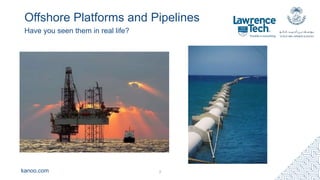
Offshore Platforms and Pipelines
Have you seen them in real life?
2
kanoo.com
Contents
• Route selection
• Submarine pipeline characteristics
• Pipeline construction
• Stabilization
• Environmental and Legal issues
3
kanoo.com
Route Selection
4
kanoo.com
Route selection
There are some standard desk studies that includes:
• A survey of geological maps.
• Bathymetry.
• Fishing charts.
• Aerial and satellite photography
• Getting information from related authorities.
5
kanoo.com
Route selection
Physical factors
6
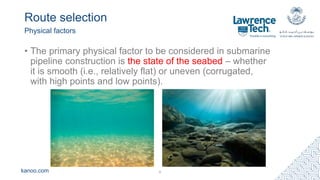
• The primary physical factor to be considered in submarine
pipeline construction is the state of the seabed – whether
it is smooth (i.e., relatively flat) or uneven (corrugated,
with high points and low points).
kanoo.com
Route selection
Physical factors
7
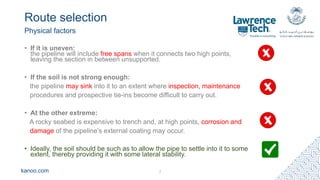
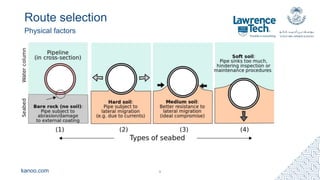
• If it is uneven:
the pipeline will include free spans when it connects two high points,
leaving the section in between unsupported.
• If the soil is not strong enough:
the pipeline may sink into it to an extent where inspection, maintenance
procedures and prospective tie-ins become difficult to carry out.
• At the other extreme:
A rocky seabed is expensive to trench and, at high points, corrosion and
damage of the pipeline's external coating may occur.
• Ideally, the soil should be such as to allow the pipe to settle into it to some
extent, thereby providing it with some lateral stability.
kanoo.com
Route selection
Physical factors
8
kanoo.com
Submarine Pipeline Characteristics
9
kanoo.com
Submarine pipeline characteristics
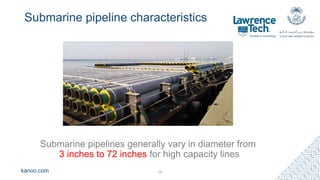
Submarine pipelines generally vary in diameter from
3 inches to 72 inches for high capacity lines
10
kanoo.com
Submarine pipeline characteristics
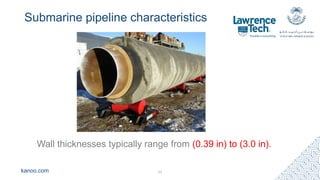
Wall thicknesses typically range from (0.39 in) to (3.0 in).
11
kanoo.com
Submarine pipeline characteristics
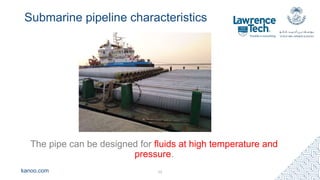
The pipe can be designed for fluids at high temperature and
pressure.
12
kanoo.com
Submarine pipeline characteristics
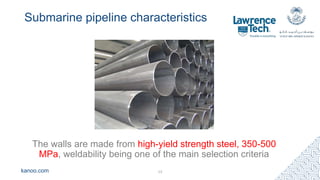
The walls are made from high-yield strength steel, 350-500
MPa, weldability being one of the main selection criteria
13
kanoo.com
Submarine pipeline characteristics
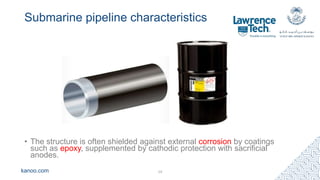
• The structure is often shielded against external corrosion by coatings
such as epoxy, supplemented by cathodic protection with sacrificial
anodes.
14
kanoo.com
Submarine pipeline characteristics
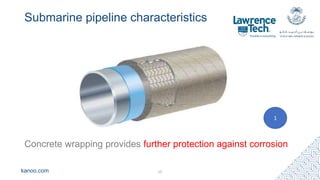
Concrete wrapping provides further protection against corrosion
15
1
kanoo.com
Submarine pipeline characteristics
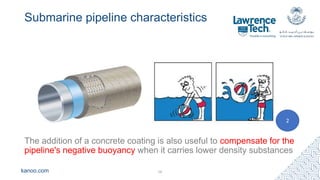
The addition of a concrete coating is also useful to compensate for the
pipeline's negative buoyancy when it carries lower density substances
16
2
kanoo.com
Pipeline Construction
17
kanoo.com
Pipeline construction
Pipeline construction involves two procedures:
1- Assembling many pipe segments into a full line.
2- Installing that line along the desired route.
18
kanoo.com
Pipeline construction
Most common systems can be used for a submarine
pipeline:
1- S-lay
2- J-lay
3- reel-lay
19
kanoo.com
Pipeline construction
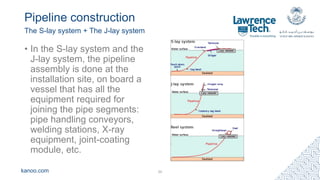
• In the S-lay system and the
J-lay system, the pipeline
assembly is done at the
installation site, on board a
vessel that has all the
equipment required for
joining the pipe segments:
pipe handling conveyors,
welding stations, X-ray
equipment, joint-coating
module, etc.
The S-lay system + The J-lay system
20
kanoo.com
Pipeline construction
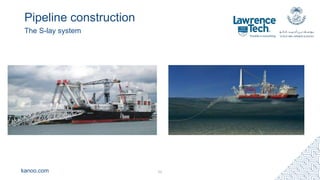
The S-lay system
21
kanoo.com
Pipeline construction
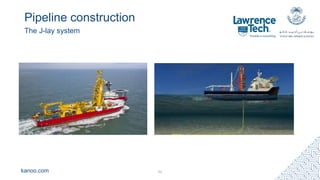
The J-lay system
22
kanoo.com
Video
The S-lay system
23
kanoo.com
Pipeline construction
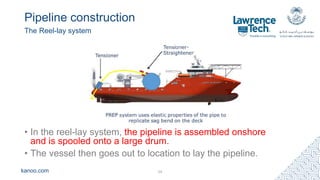
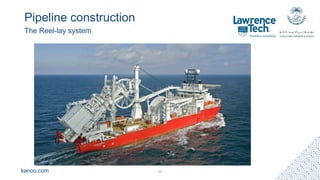
• In the reel-lay system, the pipeline is assembled onshore
and is spooled onto a large drum.
• The vessel then goes out to location to lay the pipeline.
The Reel-lay system
24
kanoo.com
Pipeline construction
The Reel-lay system
25
kanoo.com
Environmental and Legal issues
Concerns about the environmental risks of underwater pipelines
have been raised on numerous occasions:
• There have been at least two serious incidents involving oil pipelines
on the UK's continental shelf.
• There have also been several "minor spills and gas leaks" involving
other North Sea pipelines.
• In 1980 a pipeline was damaged by a ship's anchor and in 1986 a
pipeline valve failed due to pressure changed.
• Both incidents resulted in oil spills.
• Several Baltic countries expressed concerns about the Nord Stream
pipeline.
• The route of the 1,200 km underwater pipeline would travel through
fishing areas of the Baltic Sea, as well as area where chemical
weapons from World War II had been discarded.
26
kanoo.com
Resources
• Bai Y. & Bai Q. (2010) Subsea Engineering Handbook. Gulf Professional Publishing, New York, 919 p.
• Barrette, P (2011). "Offshore pipeline protection against seabed gouging by ice: An overview". Cold Regions
Science and Technology. 69: 3–20. doi:10.1016/j.coldregions.2011.06.007.
• Brown R.J. (2006) Past, present, and future towing of pipelines and risers. In: Proceedings of the 38th
Offshore Technology Conference (OTC). Houston, U.S.A.
• Croasdale K., Been K., Crocker G., Peek R. & Verlaan P. (2013) Stamukha loading cases for pipelines in the
Caspian Sea. Proceedings of the 22nd International Conference on Port and Ocean Engineering under
Arctic Conditions (POAC), Espoo, Finland.
• Dean E.T.R. (2010) Offshore Geotechnical Engineering - Principles and Practice, Thomas Telford, Reston,
VA, U.S.A., 520 p.
• Gerwick B.C. (2007) Construction of marine and offshore structures. CRC Press, New York, 795 p.
• Palmer A.C. & Been K. (2011) Pipeline geohazards for Arctic conditions. In: W.O. McCarron
(Editor), Deepwater Foundations and Pipeline Geomechanics, J. Ross Publishing, Fort Lauderdale, Florida,
pp. 171–188.
• Palmer A. C. & King R. A. (2008). Subsea Pipeline Engineering (2nd ed.). Tulsa, USA: Pennwell, 624 p.
• Ramakrishnan T.V. (2008) Offshore engineering. Gene-Tech Books, New Delhi, 347 p.
• Wilson J.F. (2003) Structures in the offshore environment. In: J.F. Wilson (Editor), Dynamics of Offshore
Structures. John Wiley & Sons, Hoboken, New Jersey, U.S.A., pp. 1–16.
27
kanoo.com
Thank You!

(BASIC) Offshore pipeline operations and engineering

  • 1.
    Offshore Pipeline Operations and Engineering MohammedIbrahim Alobaid The First GCC International Conference on Industrial Engineering and Operations Management
  • 2.
    kanoo.com Offshore Platforms andPipelines Have you seen them in real life? 2
  • 3.
    kanoo.com Contents • Route selection •Submarine pipeline characteristics • Pipeline construction • Stabilization • Environmental and Legal issues 3
  • 4.
  • 5.
    kanoo.com Route selection There aresome standard desk studies that includes: • A survey of geological maps. • Bathymetry. • Fishing charts. • Aerial and satellite photography • Getting information from related authorities. 5
  • 6.
    kanoo.com Route selection Physical factors 6 •The primary physical factor to be considered in submarine pipeline construction is the state of the seabed – whether it is smooth (i.e., relatively flat) or uneven (corrugated, with high points and low points).
  • 7.
    kanoo.com Route selection Physical factors 7 •If it is uneven: the pipeline will include free spans when it connects two high points, leaving the section in between unsupported. • If the soil is not strong enough: the pipeline may sink into it to an extent where inspection, maintenance procedures and prospective tie-ins become difficult to carry out. • At the other extreme: A rocky seabed is expensive to trench and, at high points, corrosion and damage of the pipeline's external coating may occur. • Ideally, the soil should be such as to allow the pipe to settle into it to some extent, thereby providing it with some lateral stability.
  • 8.
  • 9.
  • 10.
    kanoo.com Submarine pipeline characteristics Submarinepipelines generally vary in diameter from 3 inches to 72 inches for high capacity lines 10
  • 11.
    kanoo.com Submarine pipeline characteristics Wallthicknesses typically range from (0.39 in) to (3.0 in). 11
  • 12.
    kanoo.com Submarine pipeline characteristics Thepipe can be designed for fluids at high temperature and pressure. 12
  • 13.
    kanoo.com Submarine pipeline characteristics Thewalls are made from high-yield strength steel, 350-500 MPa, weldability being one of the main selection criteria 13
  • 14.
    kanoo.com Submarine pipeline characteristics •The structure is often shielded against external corrosion by coatings such as epoxy, supplemented by cathodic protection with sacrificial anodes. 14
  • 15.
    kanoo.com Submarine pipeline characteristics Concretewrapping provides further protection against corrosion 15 1
  • 16.
    kanoo.com Submarine pipeline characteristics Theaddition of a concrete coating is also useful to compensate for the pipeline's negative buoyancy when it carries lower density substances 16 2
  • 17.
  • 18.
    kanoo.com Pipeline construction Pipeline constructioninvolves two procedures: 1- Assembling many pipe segments into a full line. 2- Installing that line along the desired route. 18
  • 19.
    kanoo.com Pipeline construction Most commonsystems can be used for a submarine pipeline: 1- S-lay 2- J-lay 3- reel-lay 19
  • 20.
    kanoo.com Pipeline construction • Inthe S-lay system and the J-lay system, the pipeline assembly is done at the installation site, on board a vessel that has all the equipment required for joining the pipe segments: pipe handling conveyors, welding stations, X-ray equipment, joint-coating module, etc. The S-lay system + The J-lay system 20
  • 21.
  • 22.
  • 23.
  • 24.
    kanoo.com Pipeline construction • Inthe reel-lay system, the pipeline is assembled onshore and is spooled onto a large drum. • The vessel then goes out to location to lay the pipeline. The Reel-lay system 24
  • 25.
  • 26.
    kanoo.com Environmental and Legalissues Concerns about the environmental risks of underwater pipelines have been raised on numerous occasions: • There have been at least two serious incidents involving oil pipelines on the UK's continental shelf. • There have also been several "minor spills and gas leaks" involving other North Sea pipelines. • In 1980 a pipeline was damaged by a ship's anchor and in 1986 a pipeline valve failed due to pressure changed. • Both incidents resulted in oil spills. • Several Baltic countries expressed concerns about the Nord Stream pipeline. • The route of the 1,200 km underwater pipeline would travel through fishing areas of the Baltic Sea, as well as area where chemical weapons from World War II had been discarded. 26
  • 27.
    kanoo.com Resources • Bai Y.& Bai Q. (2010) Subsea Engineering Handbook. Gulf Professional Publishing, New York, 919 p. • Barrette, P (2011). "Offshore pipeline protection against seabed gouging by ice: An overview". Cold Regions Science and Technology. 69: 3–20. doi:10.1016/j.coldregions.2011.06.007. • Brown R.J. (2006) Past, present, and future towing of pipelines and risers. In: Proceedings of the 38th Offshore Technology Conference (OTC). Houston, U.S.A. • Croasdale K., Been K., Crocker G., Peek R. & Verlaan P. (2013) Stamukha loading cases for pipelines in the Caspian Sea. Proceedings of the 22nd International Conference on Port and Ocean Engineering under Arctic Conditions (POAC), Espoo, Finland. • Dean E.T.R. (2010) Offshore Geotechnical Engineering - Principles and Practice, Thomas Telford, Reston, VA, U.S.A., 520 p. • Gerwick B.C. (2007) Construction of marine and offshore structures. CRC Press, New York, 795 p. • Palmer A.C. & Been K. (2011) Pipeline geohazards for Arctic conditions. In: W.O. McCarron (Editor), Deepwater Foundations and Pipeline Geomechanics, J. Ross Publishing, Fort Lauderdale, Florida, pp. 171–188. • Palmer A. C. & King R. A. (2008). Subsea Pipeline Engineering (2nd ed.). Tulsa, USA: Pennwell, 624 p. • Ramakrishnan T.V. (2008) Offshore engineering. Gene-Tech Books, New Delhi, 347 p. • Wilson J.F. (2003) Structures in the offshore environment. In: J.F. Wilson (Editor), Dynamics of Offshore Structures. John Wiley & Sons, Hoboken, New Jersey, U.S.A., pp. 1–16. 27
  • 28.