Occlusion
Form and Function
CHAPTER 15-16
General Information
Occlusion occurs when maxillary and mandibular
teeth contact each other in any functional
relationship
Study of occlusion is concerned with all factors
involved in development, stability, and function of
masticatory system
Occlusion first occurs after the eruption of the
primary dentition
Ideal Occlusion
Ideal occlusion implies complete,
harmonious relationship of teeth, as well
as all other mouth structures
Teeth would conform to specific pattern
that includes 138 occlusal contacts on all
32 permanent teeth
This ideal relationship rarely exists
Ideal Occlusion
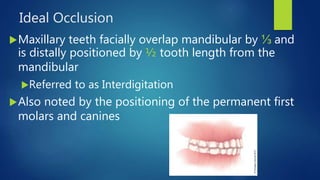
Maxillary teeth facially overlap mandibular by ⅓ and
is distally positioned by ½ tooth length from the
mandibular
Referred to as Interdigitation
Also noted by the positioning of the permanent first
molars and canines
Normal Occlusion
Normal occlusion is similar to ideal occlusion with
added common variations
Variations are considered acceptable if there is functional
comfort and stability of alignment
Necessary for each tooth to be able to withstand the biting
force
The biting force for posterior teeth is about 100-170lbs
The first permanent molars are considered key and is the
same as in an ideal occlusion
Malocclusion
Any deviation from ideal positioning of teeth
Can be minor in one tooth, severe in several teeth or
the jaws
Based on the relationship of the maxillary and
mandibular first molars and canines
Any variation in this relationship constitutes
malocclusion
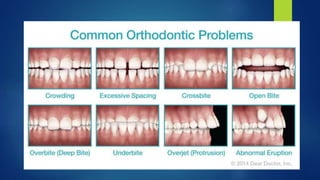
Occlusal Deviations Involving Several Teeth
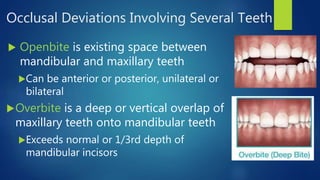
 Openbite is existing space between
mandibular and maxillary teeth
Can be anterior or posterior, unilateral or
bilateral
Overbite is a deep or vertical overlap of
maxillary teeth onto mandibular teeth
Exceeds normal or 1/3rd depth of
mandibular incisors
Occlusal Deviations Involving Several Teeth
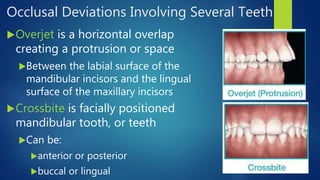
Overjet is a horizontal overlap
creating a protrusion or space
Between the labial surface of the
mandibular incisors and the lingual
surface of the maxillary incisors
Crossbite is facially positioned
mandibular tooth, or teeth
Can be:
anterior or posterior
buccal or lingual
Occlusal Deviations Involving Several Teeth
Edge-to-edge or end-to-end is
contacting incisal edges or cusp tips of
opposite arch, rather than interlinking
of cusp and fossae
Actually a crossbite or precrossbite
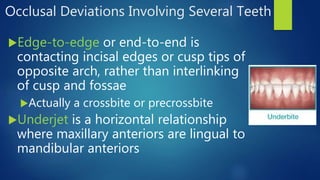
Underjet is a horizontal relationship
where maxillary anteriors are lingual to
mandibular anteriors
Occlusal Deviations Involving Individual Teeth
Labioversion/buccoversion
Tooth positioned more facially than
normal
Linguoversion
Tooth positioned more lingually than
normal
Infraversion
Tooth positioned below plane of
occlusion
Occlusal Deviations Involving Individual Teeth
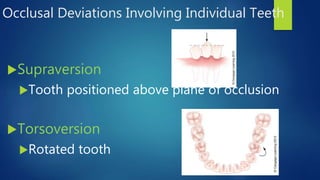
Supraversion
Tooth positioned above plane of occlusion
Torsoversion
Rotated tooth
Angle’s Classification of Occlusion
Dr. Angle was first to develop a system to classify
malocclusion
Because mandible is movable, Angle’s classification
relates to anterior–posterior or mesiodistal deviations
in relation to first molar
The first permanent molars are considered the key to
occlusion.
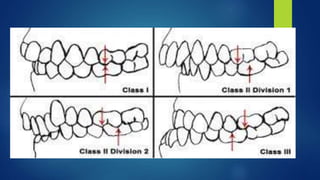
Three classifications
Class I: Neutrocclusion (Normal)
Both permanent first molar and canine relationship are
in ideal position
Mesiobuccal cusp of maxillary first molar rests in
mesiobuccal groove of mandibular first molar
Maxillary canine occludes with distal inclined plane of
mandibular canine and first premolar
Can be deviations of the anterior teeth but the molars will
have ideal positioning
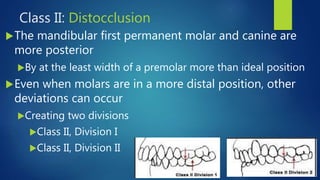
Class II: Distocclusion
The mandibular first permanent molar and canine are
more posterior
By at the least width of a premolar more than ideal position
Even when molars are in a more distal position, other
deviations can occur
Creating two divisions
Class II, Division I
Class II, Division II
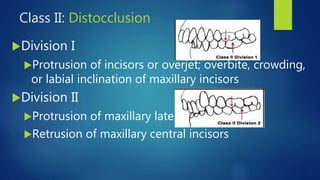
Class II: Distocclusion
Division I
Protrusion of incisors or overjet; overbite, crowding,
or labial inclination of maxillary incisors
Division II
Protrusion of maxillary lateral incisors
Retrusion of maxillary central incisors
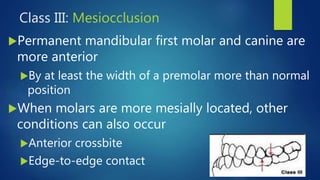
Class III: Mesiocclusion
Permanent mandibular first molar and canine are
more anterior
By at least the width of a premolar more than normal
position
When molars are more mesially located, other
conditions can also occur
Anterior crossbite
Edge-to-edge contact
Related Terms
Profiles
 Mesognathic: normal profile
 Prognathic: when mandible protrudes
 Retrognathic: when mandible retrudes
 Centric Occlusion: the most Retruded position of the condyle in the
mandibular fossa
 Functional Malocclusion: occlusal deviation created by habits or
muscular dysfunctions.
 Certain habits such as thumb sucking or revise or deviant swallowing may
cause malocclusion depending on the intensity, duration, and/or age at which
they occur
Primary Teeth Occlusion
Spacing of primary teeth plays important part of
occlusion of permanent teeth
The position of the primary second molar is
important determinant of permanent tooth
alignment
If second molars are in Class I position, permanent teeth
will usually be guided into Class I position
The positioning is then referred to as Class I mesial step
Primary Teeth Occlusion
Primary molars often show cusp to cusp
relationship called terminal plane
Also considered Class I
Extra space is provided in the area of the molars
allowing for the mesial shift of the permanent
mandibular first molar
Primary Teeth Occlusion
B: Mesial Step
• The distal surface of the
mandibular molar is mesial to
that of the maxillary molar,
thereby forming a mesial step.
Most children have this
relationship.
A: straight (flush) terminal plane.
• The distal surfaces of the second
primary molars are on the same
vertical plane. A moderate
number of children have this
relationship.
C: Distal Step
• The distal surface of the
mandibular molar is distal to that
of the maxillary molar, thereby
forming a distal step. Few
children have this relationship.
Summary
Occlusion occurs when maxillary and mandibular teeth
are in contact in any functional relationship
Ideal occlusion occurs when teeth conform to specific
pattern of contacts
Angle’s classification used to describe relationship of
first molars and canines
General Information
For teeth to masticate food, appropriate position
in arch must be maintained
Correct positioning also necessary to assist
protection of supporting structures which sustain
tooth function
Form and function are concerned with how
position and shape of teeth enable use
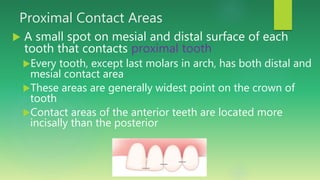
Proximal Contact Areas
 A small spot on mesial and distal surface of each
tooth that contacts proximal tooth
Every tooth, except last molars in arch, has both distal and
mesial contact area
These areas are generally widest point on the crown of
tooth
Contact areas of the anterior teeth are located more
incisally than the posterior
Function of Contact Areas
Proper contact between teeth prevents food
from packing between them
Protects gingiva from food lodged between the
teeth
Stabilize teeth in arch by providing mutual
support
Interproximal Spaces
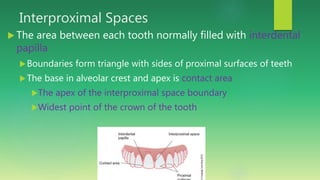
 The area between each tooth normally filled with interdental
papilla
Boundaries form triangle with sides of proximal surfaces of teeth
The base in alveolar crest and apex is contact area
The apex of the interproximal space boundary
Widest point of the crown of the tooth
Function of the Interproximal Space
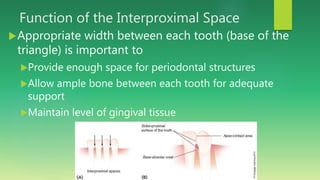
Appropriate width between each tooth (base of the
triangle) is important to
Provide enough space for periodontal structures
Allow ample bone between each tooth for adequate
support
Maintain level of gingival tissue
Embrasures
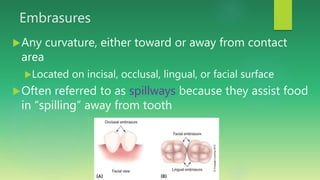
Any curvature, either toward or away from contact
area
Located on incisal, occlusal, lingual, or facial surface
Often referred to as spillways because they assist food
in “spilling” away from tooth
Function of the Embrasures
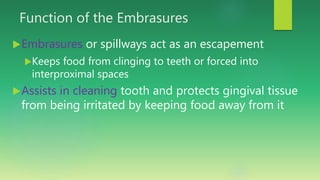
Embrasures or spillways act as an escapement
Keeps food from clinging to teeth or forced into
interproximal spaces
Assists in cleaning tooth and protects gingival tissue
from being irritated by keeping food away from it
Compensating Curvatures
Compensating curvatures of the arches account for the
strength, efficiency and stability of teeth
Have no special use other than assist in define occlusion
Main use is construction of dentures or balancing of arches
Compensating Curvatures
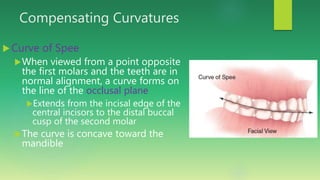
Curve of Spee
When viewed from a point opposite
the first molars and the teeth are in
normal alignment, a curve forms on
the line of the occlusal plane
Extends from the incisal edge of the
central incisors to the distal buccal
cusp of the second molar
The curve is concave toward the
mandible
Compensating Curvatures
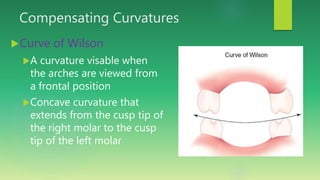
Curve of Wilson
A curvature visable when
the arches are viewed from
a frontal position
Concave curvature that
extends from the cusp tip of
the right molar to the cusp
tip of the left molar
Summary
Proper proximal contact areas prevent food
from packing between teeth
Embrasures act as spillway so that food does
not cling to teeth
Interproximal spacing allows adequate space
for periodontal structures to support teeth

Occlusion and form and function

  • 1.
  • 2.
    General Information Occlusion occurswhen maxillary and mandibular teeth contact each other in any functional relationship Study of occlusion is concerned with all factors involved in development, stability, and function of masticatory system Occlusion first occurs after the eruption of the primary dentition
  • 3.
    Ideal Occlusion Ideal occlusionimplies complete, harmonious relationship of teeth, as well as all other mouth structures Teeth would conform to specific pattern that includes 138 occlusal contacts on all 32 permanent teeth This ideal relationship rarely exists
  • 4.
    Ideal Occlusion Maxillary teethfacially overlap mandibular by ⅓ and is distally positioned by ½ tooth length from the mandibular Referred to as Interdigitation Also noted by the positioning of the permanent first molars and canines
  • 5.
    Normal Occlusion Normal occlusionis similar to ideal occlusion with added common variations Variations are considered acceptable if there is functional comfort and stability of alignment Necessary for each tooth to be able to withstand the biting force The biting force for posterior teeth is about 100-170lbs The first permanent molars are considered key and is the same as in an ideal occlusion
  • 6.
    Malocclusion Any deviation fromideal positioning of teeth Can be minor in one tooth, severe in several teeth or the jaws Based on the relationship of the maxillary and mandibular first molars and canines Any variation in this relationship constitutes malocclusion
  • 8.
    Occlusal Deviations InvolvingSeveral Teeth  Openbite is existing space between mandibular and maxillary teeth Can be anterior or posterior, unilateral or bilateral Overbite is a deep or vertical overlap of maxillary teeth onto mandibular teeth Exceeds normal or 1/3rd depth of mandibular incisors
  • 9.
    Occlusal Deviations InvolvingSeveral Teeth Overjet is a horizontal overlap creating a protrusion or space Between the labial surface of the mandibular incisors and the lingual surface of the maxillary incisors Crossbite is facially positioned mandibular tooth, or teeth Can be: anterior or posterior buccal or lingual
  • 10.
    Occlusal Deviations InvolvingSeveral Teeth Edge-to-edge or end-to-end is contacting incisal edges or cusp tips of opposite arch, rather than interlinking of cusp and fossae Actually a crossbite or precrossbite Underjet is a horizontal relationship where maxillary anteriors are lingual to mandibular anteriors
  • 11.
    Occlusal Deviations InvolvingIndividual Teeth Labioversion/buccoversion Tooth positioned more facially than normal Linguoversion Tooth positioned more lingually than normal Infraversion Tooth positioned below plane of occlusion
  • 12.
    Occlusal Deviations InvolvingIndividual Teeth Supraversion Tooth positioned above plane of occlusion Torsoversion Rotated tooth
  • 13.
    Angle’s Classification ofOcclusion Dr. Angle was first to develop a system to classify malocclusion Because mandible is movable, Angle’s classification relates to anterior–posterior or mesiodistal deviations in relation to first molar The first permanent molars are considered the key to occlusion. Three classifications
  • 14.
    Class I: Neutrocclusion(Normal) Both permanent first molar and canine relationship are in ideal position Mesiobuccal cusp of maxillary first molar rests in mesiobuccal groove of mandibular first molar Maxillary canine occludes with distal inclined plane of mandibular canine and first premolar Can be deviations of the anterior teeth but the molars will have ideal positioning
  • 15.
    Class II: Distocclusion Themandibular first permanent molar and canine are more posterior By at the least width of a premolar more than ideal position Even when molars are in a more distal position, other deviations can occur Creating two divisions Class II, Division I Class II, Division II
  • 16.
    Class II: Distocclusion DivisionI Protrusion of incisors or overjet; overbite, crowding, or labial inclination of maxillary incisors Division II Protrusion of maxillary lateral incisors Retrusion of maxillary central incisors
  • 17.
    Class III: Mesiocclusion Permanentmandibular first molar and canine are more anterior By at least the width of a premolar more than normal position When molars are more mesially located, other conditions can also occur Anterior crossbite Edge-to-edge contact
  • 19.
    Related Terms Profiles  Mesognathic:normal profile  Prognathic: when mandible protrudes  Retrognathic: when mandible retrudes  Centric Occlusion: the most Retruded position of the condyle in the mandibular fossa  Functional Malocclusion: occlusal deviation created by habits or muscular dysfunctions.  Certain habits such as thumb sucking or revise or deviant swallowing may cause malocclusion depending on the intensity, duration, and/or age at which they occur
  • 20.
    Primary Teeth Occlusion Spacingof primary teeth plays important part of occlusion of permanent teeth The position of the primary second molar is important determinant of permanent tooth alignment If second molars are in Class I position, permanent teeth will usually be guided into Class I position The positioning is then referred to as Class I mesial step
  • 21.
    Primary Teeth Occlusion Primarymolars often show cusp to cusp relationship called terminal plane Also considered Class I Extra space is provided in the area of the molars allowing for the mesial shift of the permanent mandibular first molar
  • 22.
    Primary Teeth Occlusion B:Mesial Step • The distal surface of the mandibular molar is mesial to that of the maxillary molar, thereby forming a mesial step. Most children have this relationship. A: straight (flush) terminal plane. • The distal surfaces of the second primary molars are on the same vertical plane. A moderate number of children have this relationship. C: Distal Step • The distal surface of the mandibular molar is distal to that of the maxillary molar, thereby forming a distal step. Few children have this relationship.
  • 23.
    Summary Occlusion occurs whenmaxillary and mandibular teeth are in contact in any functional relationship Ideal occlusion occurs when teeth conform to specific pattern of contacts Angle’s classification used to describe relationship of first molars and canines
  • 24.
    General Information For teethto masticate food, appropriate position in arch must be maintained Correct positioning also necessary to assist protection of supporting structures which sustain tooth function Form and function are concerned with how position and shape of teeth enable use
  • 25.
    Proximal Contact Areas A small spot on mesial and distal surface of each tooth that contacts proximal tooth Every tooth, except last molars in arch, has both distal and mesial contact area These areas are generally widest point on the crown of tooth Contact areas of the anterior teeth are located more incisally than the posterior
  • 26.
    Function of ContactAreas Proper contact between teeth prevents food from packing between them Protects gingiva from food lodged between the teeth Stabilize teeth in arch by providing mutual support
  • 27.
    Interproximal Spaces  Thearea between each tooth normally filled with interdental papilla Boundaries form triangle with sides of proximal surfaces of teeth The base in alveolar crest and apex is contact area The apex of the interproximal space boundary Widest point of the crown of the tooth
  • 28.
    Function of theInterproximal Space Appropriate width between each tooth (base of the triangle) is important to Provide enough space for periodontal structures Allow ample bone between each tooth for adequate support Maintain level of gingival tissue
  • 29.
    Embrasures Any curvature, eithertoward or away from contact area Located on incisal, occlusal, lingual, or facial surface Often referred to as spillways because they assist food in “spilling” away from tooth
  • 30.
    Function of theEmbrasures Embrasures or spillways act as an escapement Keeps food from clinging to teeth or forced into interproximal spaces Assists in cleaning tooth and protects gingival tissue from being irritated by keeping food away from it
  • 31.
    Compensating Curvatures Compensating curvaturesof the arches account for the strength, efficiency and stability of teeth Have no special use other than assist in define occlusion Main use is construction of dentures or balancing of arches
  • 32.
    Compensating Curvatures Curve ofSpee When viewed from a point opposite the first molars and the teeth are in normal alignment, a curve forms on the line of the occlusal plane Extends from the incisal edge of the central incisors to the distal buccal cusp of the second molar The curve is concave toward the mandible
  • 33.
    Compensating Curvatures Curve ofWilson A curvature visable when the arches are viewed from a frontal position Concave curvature that extends from the cusp tip of the right molar to the cusp tip of the left molar
  • 34.
    Summary Proper proximal contactareas prevent food from packing between teeth Embrasures act as spillway so that food does not cling to teeth Interproximal spacing allows adequate space for periodontal structures to support teeth